.png)
10 Examples of a Bad Marketing Campaign and What to Learn in 2025

It’s a marketer’s worst nightmare: millions spent, months of planning, and a campaign that either falls flat or explodes into a PR crisis. From tone-deaf celebrity ads to unsustainable growth models, a bad marketing campaign can erase brand equity overnight. But for savvy business owners and advertisers, these failures offer priceless lessons in what not to do.
These case studies reveal the critical gaps between strategy and execution, messaging and audience perception, and vanity metrics and true profitability. This article dissects 10 infamous marketing blunders, moving beyond the headlines to analyze exactly what went wrong and the measurable impact on key performance indicators (KPIs). More importantly, it provides a strategic playbook on how to avoid these same pitfalls.
For each example, we'll break down how a performance-focused agency would have approached the scenario. You will get actionable fixes across the four pillars of growth:
Offer: Crafting an irresistible and sustainable value proposition.
Landing Page: Engineering a conversion-focused user experience.
Omnipresent Ads: Deploying compelling creative across relevant channels.
Data: Using analytics to drive decisions and optimize for profit.
This analysis will equip you with the strategic foresight to build campaigns that deliver predictable, scalable results.
1. Pepsi's 2017 Kendall Jenner Protest Ad
Pepsi's 2017 "Live for Now" ad became a textbook example of a bad marketing campaign by completely misjudging the cultural climate. The commercial featured Kendall Jenner leaving a photoshoot to join a protest, where she defuses tension by handing a police officer a can of Pepsi.
The ad, which cost an estimated $1.4 million for production and placement, was widely condemned for trivializing and co-opting serious social justice movements like Black Lives Matter. It was pulled within 24 hours amid public outcry, becoming a cultural disaster that damaged brand perception significantly.
Strategic Breakdown: Where It Went Wrong
The core failure was a profound disconnect between the brand's message and the audience's lived experiences. The ad presented a complex, emotionally charged issue as something easily solved with a commercial product. This oversimplification felt inauthentic and exploitative, leading to accusations of "tone-deaf" marketing.
Key Failure: The creative concept was developed in a vacuum, failing to account for the real-world context of social activism and police relations. It aimed for a message of unity but delivered one of dismissive commercialism.
Actionable Takeaways & The Wojo Media Fix
To avoid a similar fate, brands must prioritize cultural sensitivity and authentic messaging. Rigorous audience testing and diverse creative reviews are non-negotiable.
Here’s how Wojo Media would have approached this:
Offer: Instead of a generic "unity" message, we would have advised Pepsi to partner with and donate to established community organizations, making the campaign about tangible support, not brand heroism.
Creative & Ads: We would have insisted on focus groups with the actual target demographic and social activists to vet the concept. The creative would have centered on real stories from community leaders, not a celebrity-driven narrative.
Landing Page: A dedicated microsite would highlight the partner organizations, showcase the real-world impact of Pepsi's contributions, and provide educational resources, shifting the focus from sales to genuine social good.
Data: We would track sentiment analysis and engagement metrics, not just views, to ensure the message was being received positively and pivot immediately if negative trends emerged.
2. MoviePass's Unsustainable Acquisition Model (2017-2019)
MoviePass’s infamous $9.95 unlimited movie plan is a legendary case study of a bad marketing campaign rooted in unsustainable economics. The offer was irresistible: see one movie a day for a monthly fee less than the cost of a single ticket. This led to explosive growth, attracting over three million subscribers in under a year.

The problem was simple: MoviePass paid theaters the full ticket price for every user. The company lost money on nearly every subscriber, burning through hundreds of millions of dollars. The entire marketing strategy was built on acquiring users at a loss without a viable path to profitability, leading to its eventual collapse.
Strategic Breakdown: Where It Went Wrong
The core failure was prioritizing hyper-growth over a sound business model. Marketing successfully acquired customers, but the underlying offer was financially toxic. The strategy relied on the flawed assumption that they could monetize user data or that most subscribers would not use the service enough to be unprofitable, which proved catastrophically wrong.
Key Failure: The company scaled a marketing offer with negative unit economics. The customer acquisition cost (CAC) was completely disconnected from a non-existent customer lifetime value (LTV), creating a cash burn that made the business insolvent.
Actionable Takeaways & The Wojo Media Fix
Brands must ensure their acquisition strategy is supported by positive unit economics before scaling. A great offer that loses money with every sale is not a strategy; it's a countdown to bankruptcy.
Here’s how Wojo Media would have approached this:
Offer: We would have modeled the economics first, proposing a tiered, sustainable offer (e.g., 3-4 movies per month for a profitable price point) instead of an unlimited, loss-leading one.
Creative & Ads: Ads would target casual moviegoers, not heavy users, and test messaging around "saving on a few nights out" rather than an "all-you-can-watch" buffet that attracts unprofitable power users.
Landing Page: The landing page would transparently display the different tiers and benefits, using a calculator to show potential savings based on realistic usage, thereby setting clear expectations.
Data: We would religiously track backend KPIs like LTV:CAC ratio and payback period from the very start. We would run small-scale tests in select markets to prove profitability before launching a national campaign.
3. Old Spice's Failed 2010-2011 Diversity Campaign Missteps
After the monumental success of its 2010 "The Man Your Man Could Smell Like" campaign, Old Spice attempted to broaden its appeal in 2011. However, this follow-up effort is a prime example of a bad marketing campaign that tried to scale a winning formula without understanding its core components. The brand introduced new characters and messaging to appeal to a more diverse audience but ended up diluting the original's charm and alienating its newly captured consumer base.
The rapid expansion across Facebook, YouTube, and TV with varied creative felt disjointed and failed to resonate. While the original campaign was a viral sensation, the subsequent efforts saw a significant drop-off in engagement and sentiment, showing that viral success doesn't guarantee a blank check for creative expansion.
Strategic Breakdown: Where It Went Wrong
Old Spice’s failure was rooted in a misinterpretation of its own success. The brand assumed the format was the magic ingredient, not the specific combination of humor, a charismatic central character, and a focused message. By introducing new faces and slightly altered messaging too quickly, they broke the formula that had worked so well, creating confusion and weakening brand identity.
Key Failure: The campaign scaled a creative concept without first testing how incremental changes would affect audience reception. It prioritized expansion over maintaining the core brand voice that had driven the initial success.
Actionable Takeaways & The Wojo Media Fix
Brands must validate new creative directions with their target audience segments before launching an omnipresent campaign. Never assume a past win will automatically translate to future variations.
Here's how Wojo Media would have approached this:
Offer: We would have advised keeping the offer and core product messaging consistent. The focus would be on reinforcing the value proposition established by the original campaign, not reinventing it.
Creative & Ads: Before a full-scale launch, we would have run A/B tests on social platforms with the new characters. By comparing engagement and conversion metrics against the original creative, we could have validated which, if any, of the new concepts resonated with the audience.
Landing Page: The landing page would have maintained the original campaign's look and feel to ensure brand consistency. New creative variations would only be featured after proving their effectiveness in smaller, controlled tests.
Data: Our focus would be on conversion rates and return on ad spend (ROAS), not just vanity metrics like views or likes. If the new ads showed lower conversion rates, we would have pulled them immediately, protecting the budget and brand equity.
4. Gap's 2010 Logo Rebrand Backlash
Gap's 2010 logo redesign is a classic cautionary tale of a bad marketing campaign that alienated its core customer base. The company abruptly replaced its iconic, 20-year-old navy blue box logo with a minimalist design featuring Helvetica font and a small blue gradient square.
The new logo was intended to signal a modern, "cool" direction for the brand. However, the change was met with immediate and widespread scorn on social media. After just six days of intense public backlash, Gap announced it was reverting to its original logo, a move that highlighted a massive failure to connect with its audience.
Strategic Breakdown: Where It Went Wrong
The fundamental error was a failure to include the brand's loyal customers in a decision central to its identity. Gap's marketing team invested heavily in a new direction without validating if that direction resonated with the people who actually buy their products. This created a jarring disconnect between the brand's self-perception and its customers' emotional connection to the classic logo.
Key Failure: The rebrand was an insular, top-down decision that ignored decades of brand equity. It treated the logo as a mere design element, not as a symbol deeply ingrained in the customer's identity and memory.
Actionable Takeaways & The Wojo Media Fix
Brands must validate major changes with their audience before a full-scale launch. Small, iterative tests and customer feedback loops are essential to prevent costly and embarrassing public reversals.
Here’s how Wojo Media would have approached this:
Offer: We would have framed the potential rebrand as a collaborative "Help us design the new Gap" campaign. This would involve customers in the process, turning a potential risk into an engagement opportunity.
Creative & Ads: We would run A/B tests on Facebook and Instagram using different logo concepts on mock-up ads, targeting segmented loyal customer audiences. This provides direct, real-world data on which design performs best.
Landing Page: A dedicated landing page would allow users to vote on their favorite logo designs and provide open-ended feedback, creating a valuable repository of customer sentiment before any final decisions are made.
Data: We would meticulously track click-through rates, conversion rates (on test ads), and social sentiment scores for each logo variation to make a data-driven decision, not an instinctive one.
5. Fyre Festival's Fraudulent Marketing Campaign (2017)
The Fyre Festival is a monumental case study of a bad marketing campaign rooted in outright deception. Promoted by Billy McFarland and the agency Jerry Media, the event was marketed as an ultra-luxurious, exclusive music festival on a private island, endorsed by top models and influencers. They spent over $250,000 on influencer marketing alone to create an illusion of unparalleled opulence.
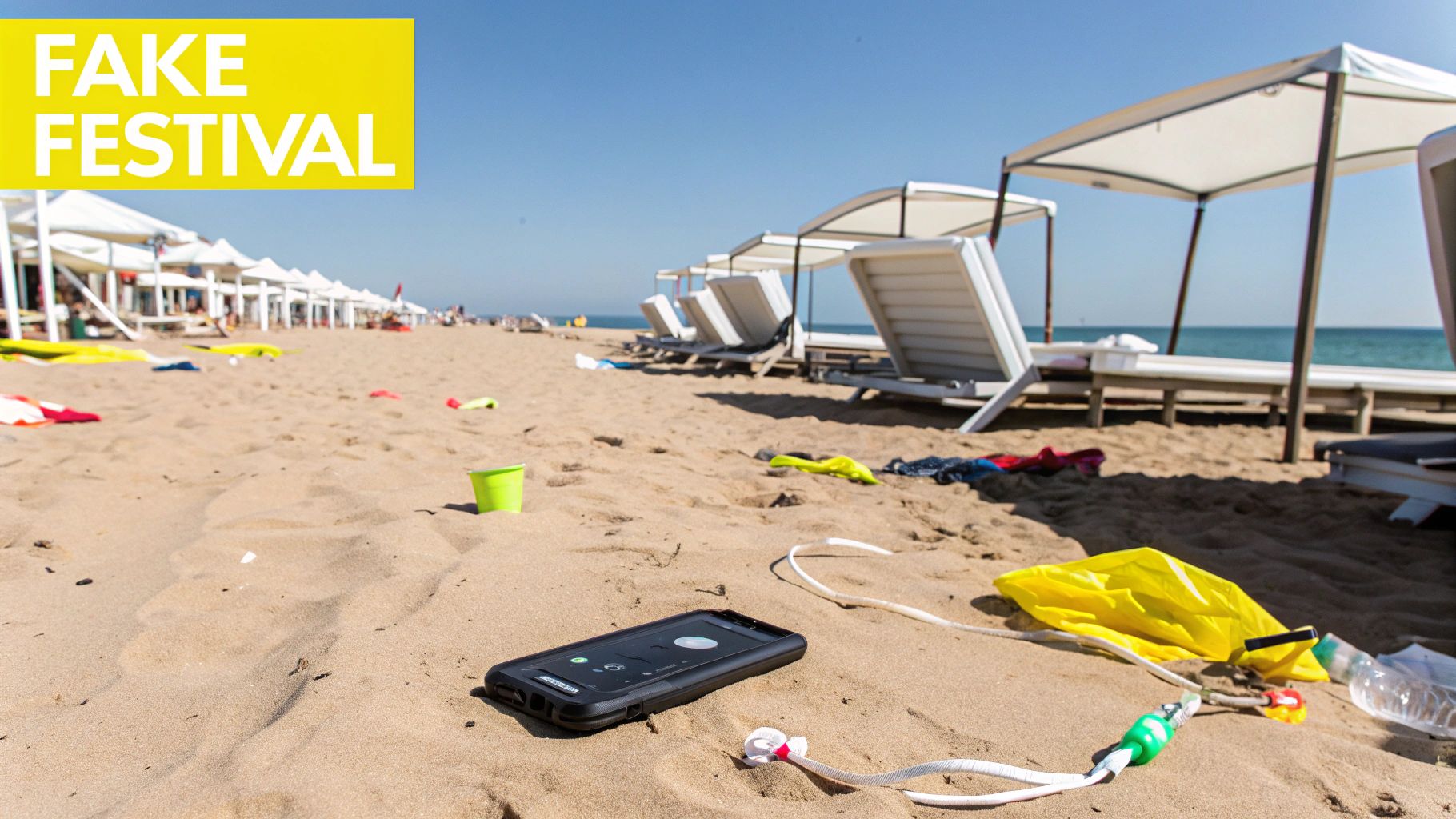
The campaign was a viral success, selling out tickets priced from $1,500 to over $12,000. However, the promised luxury was a fantasy. Attendees arrived to find disaster-relief tents, inadequate food, and no musical acts. The entire event collapsed into chaos, leading to lawsuits and jail time for its founder.
Strategic Breakdown: Where It Went Wrong
The campaign's failure was not a misstep; it was intentional fraud. The marketing team sold a product that never existed, relying entirely on hype and misleading visuals to drive sales. This "fake it 'til you make it" approach crossed the line from ambitious marketing into illegal misrepresentation, destroying all trust and credibility.
Key Failure: The core strategy was built on fabrications. The marketing campaign was completely detached from the operational reality, promising an experience that was logistically impossible to deliver.
Actionable Takeaways & The Wojo Media Fix
The primary lesson is foundational: your marketing must be based on a real, deliverable product or service. Authenticity and transparency are paramount, especially in influencer marketing.
Here’s how Wojo Media would have approached this:
Offer: We would have insisted on verifying the product before launching any campaign. The offer would have been based on confirmed assets, like "Join us for an exclusive Bahamas beach concert," rather than an unbuilt "luxury villa experience."
Creative & Ads: All ad content would have used authentic, real-time footage of venue preparations. Influencer partnerships would require transparent, honest captions like, "Excited to see this new festival come to life! #FyrePartner," rather than implying they were already attending a finished event.
Landing Page: The website would have featured realistic renderings clearly marked as "artist concepts" and provided a transparent, regularly updated timeline of event preparations. An FAQ would address logistical realities.
Data: We would have monitored social media comments for signs of public skepticism and advised the operations team to address these concerns directly and honestly to manage expectations and build genuine trust.
6. United Airlines' Bunny Video PR Disaster (2014)
In 2014, United Airlines produced a comedic YouTube rap video featuring a giant bunny, intended to be a lighthearted piece of viral marketing. This campaign became a prime example of a bad marketing campaign because it completely ignored widespread customer frustration with the airline's core service issues, like delays and poor customer service.
The expensive video landed with a thud, as customers saw it as a frivolous waste of money that could have been invested in improving the actual flight experience. The comments section was flooded with complaints, highlighting a massive disconnect between the brand's self-perception and public reality, ultimately wasting the entire production budget.
Strategic Breakdown: Where It Went Wrong
The campaign's failure was rooted in a fundamental misunderstanding of customer sentiment. While the airline aimed for entertainment, its audience craved acknowledgement and solutions for their real-world travel problems. The bunny video came across as patronizing, signaling that the company was out of touch with its most pressing operational flaws.
Key Failure: United invested in quirky, tone-deaf creative instead of addressing core customer pain points. The message was misaligned with audience priorities, making the brand appear to be ignoring what truly mattered.
Actionable Takeaways & The Wojo Media Fix
Brands must ensure their marketing messages align with the current customer experience. Before launching a creative campaign, address foundational service issues and use customer feedback to guide your messaging strategy.
Here’s how Wojo Media would have approached this:
Offer: We would have advised United to launch a "Customer First" initiative, publicly committing to specific service improvements (e.g., better baggage handling, on-time performance guarantees) and making that the centerpiece of the campaign.
Creative & Ads: The video content would have featured real United employees discussing the new service commitments and showing tangible improvements in action, building trust instead of going for cheap laughs.
Landing Page: A dedicated microsite would track progress on these service promises in real-time, feature customer testimonials about improved experiences, and offer a direct line for feedback, demonstrating transparency.
Data: We would monitor social listening tools for keywords related to customer complaints, using this data to inform the campaign's focus and measure whether sentiment improved as a direct result of our messaging.
7. Kendall Jenner's Fyre Festival Promoted Through Paid Influencer Posts (2017)
Kendall Jenner's involvement with the fraudulent Fyre Festival serves as a landmark bad marketing campaign in the influencer era. She and other high-profile influencers were paid significant sums, reportedly up to $250,000 for a single Instagram post, to promote a non-existent luxury music festival.
The posts, which presented Fyre as an exclusive, glamorous event, sold thousands of tickets to an experience that turned out to be a logistical nightmare. The fallout included lawsuits, a $27.4 million class-action settlement, and severe damage to the credibility of every influencer involved for failing to disclose the paid nature of their endorsements and promoting a fraudulent product.
Strategic Breakdown: Where It Went Wrong
The core failure was a complete lack of due diligence combined with deceptive advertising. The campaign relied solely on the borrowed credibility of influencers without verifying the festival's viability. This not only misled consumers but also violated Federal Trade Commission (FTC) guidelines requiring clear disclosure of paid partnerships. The catastrophic failure of Fyre Festival starkly highlights the need to understand ethical and effective influencer marketing best practices.
Key Failure: The campaign prioritized hype over transparency and product legitimacy. It leveraged influencer trust to sell a fraudulent concept, demonstrating the immense risk of unregulated, unvetted influencer marketing.
Actionable Takeaways & The Wojo Media Fix
Brands must treat influencer partnerships as serious business arrangements that require vetting and legal compliance. Authenticity and transparency are paramount to long-term success.
Here’s how Wojo Media would have approached this:
Offer: We would have mandated that the offer be tied to a verified and existing product. Before any promotion, we would require a thorough vetting of the festival's logistics, from accommodations to artist contracts, ensuring the offer was legitimate.
Creative & Ads: We would enforce strict FTC compliance, ensuring every influencer post included clear disclosures like #Ad or #Sponsored. The creative brief would focus on authentic experiences rather than just aspirational imagery, perhaps featuring behind-the-scenes content of the actual preparations.
Landing Page: The campaign's landing page would feature transparent FAQs, detailed logistical information, and clear terms and conditions. We would include a disclaimer clarifying that influencer participation does not constitute a guarantee of event quality.
Data: We would monitor audience comments and sentiment on influencer posts for signs of skepticism or questions about legitimacy. High levels of negative engagement would trigger an immediate review and potential pause of the campaign until concerns were addressed.
8. Wells Fargo's Fake Accounts Scandal Exposed By Marketing (2016)
Wells Fargo's aggressive marketing around account opening offers became a glaring symbol of corporate deception when its widespread fraud was uncovered. While ad campaigns promoted exceptional service and incentives for new accounts, employees were secretly creating millions of unauthorized bank and credit card accounts to meet unrealistic sales targets.

The marketing itself wasn't the initial failure, but it became inseparable from the scandal. The vast promotional spend served as a smokescreen for unethical practices, creating a catastrophic disconnect between brand promise and reality. This incident is a stark reminder that a bad marketing campaign can arise when advertising is completely detached from operational integrity, ultimately destroying consumer trust and resulting in billions in fines.
Strategic Breakdown: Where It Went Wrong
The foundational error was a toxic sales culture that directly contradicted the public-facing marketing message. The campaigns promised value to the customer, but the internal operations were designed to extract value from them without their consent. Marketing was used as a tool to project a false image of growth and customer satisfaction.
Key Failure: A complete misalignment between marketing claims and internal business practices. The promotional efforts were not just misleading; they were a component of a larger fraudulent system, making the brand itself the source of deception.
Actionable Takeaways & The Wojo Media Fix
Marketing must be an honest reflection of business operations. Any gap between the brand's promise and the customer's experience will inevitably lead to a crisis.
Here’s how Wojo Media would have approached this:
Offer: We would have immediately flagged the unsustainable conversion goals and questioned the operational ability to deliver on such aggressive promotional offers. Our focus would shift to creating realistic, ethical offers that align with genuine customer value and long-term retention.
Creative & Ads: All creative would undergo a strict compliance and ethics review. We would build campaigns around verifiable customer success stories and transparent product benefits, not just high-pressure acquisition targets.
Landing Page: The landing page would feature clear, unambiguous terms and conditions for any offer. We would integrate customer reviews and testimonials to build trust and provide social proof based on real experiences.
Data: We would monitor account data for anomalies, such as unusually high numbers of accounts per customer or rapid account closures. This data would create a feedback loop to flag potential operational issues long before they become a public scandal.
9. Yahoo's $4.48B Overpriced Acquisition Marketing (2013)
Yahoo's 2013 acquisition of Tumblr for $1.1 billion, and the subsequent years of marketing spend trying to justify it, stands as a monumental bad marketing campaign. The core problem was investing heavily in promoting an asset without first understanding its user base or its declining market fit. Yahoo sank millions into marketing initiatives to integrate and monetize Tumblr, all while the platform's core users were leaving.
The strategy was a classic case of using marketing to fix a fundamental product-market mismatch. By the time Yahoo sold the platform for less than $3 million in 2019, the acquisition and its related marketing efforts represented billions in shareholder value evaporation, driven by a failure to validate the investment with proper market research.
Strategic Breakdown: Where It Went Wrong
Yahoo's failure was rooted in a fatal assumption: that its corporate structure and monetization strategies could be forced onto Tumblr's unique, ad-averse community. The marketing campaigns aimed to blend two fundamentally incompatible cultures, alienating Tumblr's dedicated users without attracting new ones. They marketed a vision that the underlying product and community could not, and would not, support.
Key Failure: Pouring marketing dollars into a declining asset without addressing the root cause of the decline. The campaigns ignored clear user churn data and negative sentiment, essentially advertising a party that was already over.
Actionable Takeaways & The Wojo Media Fix
Before launching a major marketing push for a new product or acquisition, brands must rigorously validate its market viability. Don’t use advertising to solve a broken product issue.
Here’s how Wojo Media would have approached this:
Offer: We would have advised against a broad, integration-focused marketing push. Instead, we would have proposed small-scale, experimental offers to Tumblr's existing power users to test monetization concepts that felt native to the platform.
Creative & Ads: Ads would have been hyper-targeted and community-focused, celebrating Tumblr's unique culture rather than trying to fit it into the Yahoo ecosystem. The creative would have been developed with Tumblr creators, not in a corporate boardroom.
Landing Page: Instead of driving traffic to a generic Yahoo-branded portal, we would create dedicated landing pages for specific micro-communities within Tumblr, ensuring the messaging and user experience felt authentic and respected their culture.
Data: Our primary focus would be on user retention and engagement metrics, not just vanity traffic. We would analyze churn data to identify why users were leaving and use that insight to pause all large-scale ad spend until the core platform issues were resolved.
10. Uber's 'Greyball' Algorithmic Deception Campaign (2015-2017)
Uber’s "Greyball" program represents a catastrophic failure where operational deception directly contradicted its public marketing. The company used this sophisticated software to identify and evade government officials and law enforcement in markets where its service was restricted or illegal, while simultaneously running marketing campaigns that promoted transparency and regulatory compliance.
When The New York Times exposed the program in 2017, the fallout was immense. This wasn't just a simple PR misstep; it was a premeditated, technology-driven deception. The revelation confirmed public suspicion of Uber's aggressive tactics, leading to a U.S. Justice Department investigation, significant executive departures, and a deep erosion of consumer and regulatory trust that took years to repair.
Strategic Breakdown: Where It Went Wrong
The fundamental error was a complete misalignment between Uber's public-facing brand values and its secretive operational practices. The marketing team promoted a narrative of a compliant, cooperative partner to cities, while another part of the company was actively building tools to subvert those same authorities. This created a ticking time bomb of hypocrisy.
Key Failure: Uber’s marketing claims were not just aspirational; they were actively undermined by the company's core technology and business strategy. This duplicity made the eventual exposure a profound betrayal of public trust.
Actionable Takeaways & The Wojo Media Fix
A brand's marketing promises must be an authentic reflection of its operational reality. Trust is built when actions and advertisements align perfectly.
Here’s how Wojo Media would have approached this:
Offer: We would advise against any marketing that claims regulatory compliance until such compliance is fully and verifiably achieved. The core offer should focus on transparent benefits like convenience and rider safety, grounded in provable features.
Creative & Ads: All ad creative would be scrubbed of unsubstantiated claims. Instead of vague promises of "working with cities," we would focus campaigns on rider-centric stories and driver benefits, building an authentic, grassroots brand narrative.
Landing Page: The landing page would feature a "Trust & Safety" section with clear, auditable data on background checks, insurance policies, and rider feedback. It would build credibility through radical transparency, not unearned declarations of compliance.
Data: We would monitor brand sentiment metrics closely, specifically tracking keywords related to "trust," "safety," and "legal." A spike in negative sentiment around these terms would trigger an immediate audit of all marketing messages to ensure they align with public perception and reality.
Comparison of 10 Major Marketing Failures
Case | Implementation Complexity 🔄 | Resource Requirements ⚡ | Expected Outcomes 📊 | Ideal Use Cases 💡 | Key Advantage ⭐ |
|---|---|---|---|---|---|
Pepsi's 2017 Kendall Jenner Protest Ad | Medium — celebrity + high-production creative, coordination risk | High — ~$1.4M production + media spend | Rapid public backlash; brand credibility loss; low ROI | Avoid using social movements in ads unless authentic and tested | Teaches need for audience-aligned messaging and cultural review |
MoviePass's Unsustainable Acquisition Model (2017–2019) | Medium — subscription model scaling with heavy CAC focus | Very High — $50M+/yr ad spend; negative unit economics | Fast subscriber growth but massive cash burn and collapse | Subscription businesses testing LTV before scale | Illustrates necessity of LTV:CAC and sustainable unit economics |
Old Spice's Failed 2010–2011 Diversity Campaign Missteps | Medium — rapid creative scaling and channel fragmentation | Moderate — social + traditional spend; creative production | Engagement decline, diluted brand recall, audience fatigue | Incremental testing of creative variants after a hit | Reinforces maintaining core brand voice when scaling creative |
Gap's 2010 Logo Rebrand Backlash | Low technical complexity, high stakeholder risk | Moderate — rebrand + promotional spend | Immediate social backlash and rapid reversal; wasted budget | Rebrands and identity changes requiring customer validation | Shows the importance of pre-launch audience testing |
Fyre Festival's Fraudulent Marketing Campaign (2017) | Medium-high — influencer coordination but fraudulent execution | High — heavy influencer payouts and promo spend | Criminal exposure, lawsuits, total brand collapse | Only legitimate live events with verifiable deliverables | Underscores absolute requirement for authenticity and verification |
United Airlines' Bunny Video PR Disaster (2014) | High — large-scale video production misaligned with audience needs | High — production + YouTube/media spend | Mockery, no perceptible brand improvement, wasted budget | Campaigns meant to address real customer pain points | Demonstrates that entertainment cannot replace problem-solving messaging |
Kendall Jenner's Fyre Festival Paid Influencer Posts (2017) | Low — simple sponsored posts but high compliance risk | Very High — $250K+ per influencer in some cases | FTC scrutiny, influencer credibility loss, legal risk | Influencer promotions with full vetting and disclosure | Highlights need for transparency and contractual compliance |
Wells Fargo's Fake Accounts Scandal (2016) | Very High — systemic internal process failures + deceptive incentives | Very High — marketing spend + regulatory fines ($B) | Massive fines, criminal probes, permanent trust erosion | Any promotion tied to operational commitments and incentives | Demonstrates marketing must reflect actual business practices |
Yahoo's $4.48B Overpriced Acquisition Marketing (2013) | High — acquisition integration and platform marketing | Very High — acquisition cost + sustained marketing spend | Wasted spend, failed integration, eventual write-downs | Validate product-market fit before major acquisition marketing | Emphasizes verifying product health before heavy user acquisition |
Uber's 'Greyball' Algorithmic Deception Campaign (2015–2017) | Very High — technical evasion plus deceptive public claims | High — development and legal/regulatory exposure | Legal investigations, executive liability, long-term PR damage | Never market compliance claims without audited practices | Shows the risk of marketing claims that contradict company behavior |
Turning Lessons Into Profitable, Predictable Campaigns
The cautionary tales of Pepsi, MoviePass, and the Fyre Festival all share a common, fatal flaw: a fundamental disconnect. Whether it was a disconnect between the brand's message and the audience's reality, between the customer acquisition cost and lifetime value, or between the glamorous promise and the fraudulent reality, this gap is the breeding ground for every bad marketing campaign. These examples serve as a stark reminder that a massive budget, celebrity endorsements, or viral hype cannot salvage a strategy built on a weak foundation.
The failures we've analyzed, from Gap's logo debacle to Uber's deceptive "Greyball" program, highlight the immense risk of ignoring the customer, the data, and the core principles of authentic communication. They demonstrate that without a deep understanding of your audience and a product or service that delivers on its promises, marketing simply accelerates failure. The good news is that these catastrophic mistakes are entirely avoidable.
The Antidote to Marketing Failure
The antidote isn't a bigger budget or a flashier creative concept. It's a systematic, data-driven approach built on four unwavering pillars that work in harmony to create a predictable growth engine. By focusing on these fundamentals, you can build a campaign that is not only effective but also resilient and scalable.
A Truly Irresistible Offer: Your offer is the nucleus of your campaign. It must solve a painful problem for a specific audience and be so compelling that it makes the decision to engage feel obvious.
A High-Converting Landing Page: Your landing page has one job: to convert traffic into leads or sales. It must clearly articulate the value of your offer, build trust, and guide the user to a single, clear call to action without friction.
Data-Driven Omnipresent Ads: Your ads must reach the right people, on the right platforms, at the right time. This requires relentless testing, optimization, and a deep understanding of your customer's journey, not just a one-off viral attempt.
Rigorous KPI Tracking and Analysis: You cannot manage what you do not measure. The ultimate objective of reflecting on past marketing failures is to implement robust systems for future success. This involves understanding how to measure marketing effectiveness and maximize ROI to ensure every dollar spent is driving tangible results.
By mastering this framework, businesses across e-commerce, local services, coaching, and real estate can move beyond guesswork and avoid the pitfalls that lead to a bad marketing campaign. Instead, they can build a reliable system that consistently delivers qualified leads, profitable sales, and sustainable growth. This strategic discipline is what separates fleeting viral moments from enduring brand success.
Ready to build an advertising system that avoids these costly mistakes and delivers predictable results? Wojo Media specializes in implementing this four-pillar framework to scale businesses with data-driven paid advertising campaigns. Book a free demo call with our team today and get a custom strategy designed to grow your business without the risk.
Comments