.png)
10 Proven Real Estate Lead Generation Strategies for 2025
- Jason Wojo
- Dec 21, 2025
- 20 min read

In the competitive real estate market, a steady stream of qualified leads isn't a luxury—it's the bedrock of a thriving business. Yet, many agents, investors, and lenders find themselves stuck in a cycle of unpredictable highs and lows, often relying on a single source of new business that is prone to market shifts. The key to sustainable growth and a consistently full pipeline lies in diversifying your approach and mastering a multi-channel system.
This comprehensive guide moves beyond generic advice to provide 10 actionable real estate lead generation strategies you can implement today. We will break down each channel with practical steps, from foundational tactics like content marketing and local SEO to high-performance paid advertising and powerful relationship-based referrals. You won't just learn what to do; you'll learn how to execute, measure, and scale each method effectively. For a comprehensive overview of effective methods, explore the top real estate lead generation strategies for 2025 to further boost your business.
Whether you're looking to attract more seller leads through a hyper-local blog, capture buyer interest with compelling video tours, or nurture cold contacts into warm prospects with automated email campaigns, this list has you covered. You'll get specific implementation details, key performance indicators (KPIs) to track, and insights into building a predictable, scalable lead generation engine. Our goal is to equip you with the tools to consistently fill your pipeline and drive more closings, transforming your lead flow from a source of stress into a reliable asset.
1. Paid Advertising (PPC, Facebook Ads, Google Ads)
Paid advertising is one of the most powerful and scalable real estate lead generation strategies available. It allows you to place your brand directly in front of motivated buyers and sellers actively searching for properties or real estate services in your specific market. Unlike organic methods that take time to build momentum, paid campaigns on platforms like Google, Facebook, and Instagram can generate immediate, measurable results.
The core principle is simple: you pay to target specific demographics, interests, and search behaviors. A buyer searching "homes for sale in [Your City]" on Google can see your ad at the top of the results, while a homeowner who has shown interest in selling can see your ad in their Facebook feed. This direct line to high-intent prospects makes paid advertising a cornerstone for predictable business growth.
How to Implement Paid Advertising
Successful paid campaigns require a strategic, data-driven approach rather than just boosting a post.
Choose Your Platform & Offer: For buyer leads with high search intent, Google Ads is ideal. For seller leads or to build brand awareness, Facebook and Instagram Lead Ads are highly effective. Create a compelling offer, like a free "Ultimate [Your Neighborhood] Seller's Guide" or a list of "Off-Market Homes in [Your City]."
Develop High-Converting Landing Pages: Never send paid traffic to your generic homepage. Each ad campaign must direct users to a dedicated landing page with a single, clear call-to-action (e.g., "Download Your Free Guide Now"). This singular focus dramatically increases conversion rates.
Install Tracking Pixels: Before spending a single dollar, ensure the Facebook Pixel and Google Ads conversion tracking are installed on your website and landing pages. This is non-negotiable for measuring your return on investment (ROI) and optimizing campaigns.
Launch & Optimize: Start with a modest budget to test ad copy, visuals, and audience targeting. Monitor key metrics like Cost Per Lead (CPL) and Click-Through Rate (CTR). Double down on what works and cut what doesn't.
Pro Tip: Your speed-to-lead is critical with paid ads. Implement an automated CRM workflow that sends a text message and email to every new lead within five minutes of their submission. This simple step can increase your contact rate by over 80%.
2. Social Media Marketing & Lead Generation
Beyond just posting property photos, social media marketing has evolved into a dynamic strategy for building a personal brand, nurturing relationships, and capturing leads directly. Platforms like Facebook, Instagram, and even LinkedIn allow you to connect with your community, establish expertise, and stay top-of-mind with potential clients in a way that feels authentic and less transactional.

The goal is to move from a passive presence to an active lead-generation engine. By consistently providing value through market updates, behind-the-scenes content, and client success stories, you attract followers who are genuinely interested in your services. When it's time for them to buy or sell, you are the first person they think of, making this one of the most effective long-term real estate lead generation strategies.
How to Implement Social Media Marketing
A successful social media strategy requires a mix of organic content and targeted engagement to convert followers into clients.
Define Your Content Pillars: Don't just post listings. Create 3-5 content pillars, such as "Local Market Stats," "Home Maintenance Tips," "Client Testimonials," and "Community Spotlights." This ensures a consistent and valuable content mix that keeps your audience engaged beyond just property searches.
Leverage Platform-Specific Formats: Master the formats that each platform prioritizes. Use Instagram Reels for quick property tours and market updates, Facebook Groups to build a local community forum, and LinkedIn articles to share in-depth analysis for investor clients.
Engage Proactively and Authentically: Social media is a two-way street. Dedicate time each day to respond to every comment and direct message promptly. More importantly, engage with the content of local businesses and community members to build genuine connections.
Create Lead-Generating Content: Don't be afraid to ask for the business. Promote your lead magnets (e.g., "Download my First-Time Home Buyer Checklist") in your posts and bio. Run interactive polls in your Stories asking questions like, "Thinking of selling in the next 12 months?" and follow up with everyone who engages.
Pro Tip: Create a "Hyper-Local" content series. Film short video tours of local parks, coffee shops, and new restaurants in the neighborhoods you serve. Tag those businesses to tap into their audience and position yourself as the undisputed local market expert.
3. Local SEO & Google My Business Optimization
While paid ads deliver immediate traffic, Local Search Engine Optimization (SEO) is a powerful, long-term real estate lead generation strategy that builds a sustainable source of free, high-intent traffic. It focuses on making your business highly visible in Google Maps and the "local pack" search results for queries like "real estate agent in [Your City]" or "realtor near me." When a potential client sees you at the top of their local search, it establishes immediate authority and trust.
Dominating local search means capturing prospects at the exact moment they are looking for help, creating an invaluable asset for your business. Unlike paying for every click, a strong local SEO presence generates a continuous flow of organic leads. This approach is fundamental for any agent or brokerage aiming to become the go-to authority within a specific geographic farming area.
How to Implement Local SEO
A successful local SEO strategy hinges on optimizing your digital footprint to signal relevance and authority to Google for your specific service area.
Claim & Optimize Your Google Business Profile (GBP): This is the cornerstone of local SEO. Fill out every single section of your GBP: services, photos, hours, business description, and Q&A. Use high-quality photos of yourself, your team, and recent closings. A complete profile ranks significantly better than an incomplete one.
Generate Consistent, High-Quality Reviews: Reviews are a massive local ranking factor. Actively request reviews from every satisfied client. Create a simple link they can use and incorporate the request into your closing process. Aim for a steady stream of new 5-star reviews to build social proof and improve visibility.
Build Local Citations: A citation is any online mention of your business's name, address, and phone number (NAP). Ensure your NAP is consistent across all major directories like Yelp, Zillow, and local chamber of commerce sites. Consistency is key to building Google's confidence in your business's location and legitimacy.
Create Location-Specific Content: Develop pages on your website dedicated to the specific neighborhoods or cities you serve. Write blog posts about local market trends, community events, or the best school districts. This content signals your local expertise to both search engines and potential clients.
Pro Tip: Use the "Posts" feature on your Google Business Profile weekly. Share new listings, just-sold announcements, open house dates, or links to your latest blog posts. This keeps your profile active and shows Google that your business is current and relevant.
4. Email Marketing & Nurture Campaigns
Email marketing is the engine that drives long-term lead conversion in real estate. While other strategies generate initial interest, a systematic email nurture campaign keeps you top-of-mind with prospects who aren't ready to transact today. It allows you to build authority, deliver consistent value, and establish a relationship with your database, ensuring you’re the agent they call months or even years down the line.
This strategy moves beyond simple property alerts. It involves segmenting your audience (buyers, sellers, past clients, investors) and sending them targeted, valuable content. A potential seller might receive a monthly neighborhood market report, while a first-time buyer gets a guide to the home-buying process. This consistent, relevant communication is a cornerstone of modern real estate lead generation strategies, turning a cold database into a pipeline of warm opportunities.
How to Implement Email Marketing
A successful email strategy is built on value, not just sales pitches. It requires consistency and a deep understanding of your audience’s needs.
Segment Your Database: Before sending anything, categorize your contacts. Create lists for "Active Buyers," "Future Sellers," "Past Clients," "Investor Leads," and "Open House Visitors." This ensures every email you send is highly relevant to its recipient, boosting open rates and engagement.
Create Valuable Content Pillars: Develop a content calendar with a mix of valuable resources. This could include weekly new listing roundups, monthly market analysis reports, home maintenance tips for past clients, or guides to local schools and amenities. The goal is to be their go-to real estate resource.
Automate Nurture Sequences: Set up automated email workflows for new leads. For example, a new buyer lead from your website could trigger a 5-part email series that introduces you, shares testimonials, offers a free buyer’s guide, and asks about their search criteria.
Focus on a Clear Call-to-Action (CTA): Every email must have a purpose. Whether it's "View This Week's Listings," "Get Your Free Home Valuation," or "Schedule a 15-Minute Consultation," make it obvious what you want the reader to do next.
Pro Tip: Use a compelling and personalized subject line to dramatically increase your open rates. Instead of "Monthly Newsletter," try "[First Name], Here’s the Latest on the [Neighborhood] Market." Personalization makes your email feel like a one-to-one conversation.
5. Paid Advertising (PPC, Facebook Ads, Google Ads)
Paid advertising is one of the most powerful and scalable real estate lead generation strategies available. It allows you to place your brand directly in front of motivated buyers and sellers actively searching for properties or real estate services in your specific market. Unlike organic methods that take time to build momentum, paid campaigns on platforms like Google, Facebook, and Instagram can generate immediate, measurable results.
The core principle is simple: you pay to target specific demographics, interests, and search behaviors. A buyer searching "homes for sale in [Your City]" on Google can see your ad at the top of the results, while a homeowner who has shown interest in selling can see your ad in their Facebook feed. This direct line to high-intent prospects makes paid advertising a cornerstone for predictable business growth.
How to Implement Paid Advertising
Successful paid campaigns require a strategic, data-driven approach rather than just boosting a post.
Choose Your Platform & Offer: For buyer leads with high search intent, Google Ads is ideal. For seller leads or to build brand awareness, Facebook and Instagram Lead Ads are highly effective. Create a compelling offer, like a free "Ultimate [Your Neighborhood] Seller's Guide" or a list of "Off-Market Homes in [Your City]."
Develop High-Converting Landing Pages: Never send paid traffic to your generic homepage. Each ad campaign must direct users to a dedicated landing page with a single, clear call-to-action (e.g., "Download Your Free Guide Now"). This singular focus dramatically increases conversion rates.
Install Tracking Pixels: Before spending a single dollar, ensure the Facebook Pixel and Google Ads conversion tracking are installed on your website and landing pages. This is non-negotiable for measuring your return on investment (ROI) and optimizing campaigns.
Launch & Optimize: Start with a modest budget to test ad copy, visuals, and audience targeting. Monitor key metrics like Cost Per Lead (CPL) and Click-Through Rate (CTR). Double down on what works and cut what doesn't.
Pro Tip: Your speed-to-lead is critical with paid ads. Implement an automated CRM workflow that sends a text message and email to every new lead within five minutes of their submission. This simple step can increase your contact rate by over 80%.
6. Virtual Tours & Video Marketing
Video is no longer a "nice to have" in real estate; it's an essential tool for engaging modern buyers and sellers. Strategies like immersive virtual tours, property walk-throughs, and market update videos allow you to connect with potential clients on a deeper level, building trust and showcasing your expertise long before they ever meet you in person. This approach serves today's on-demand consumer, who expects to explore a property from the comfort of their couch.
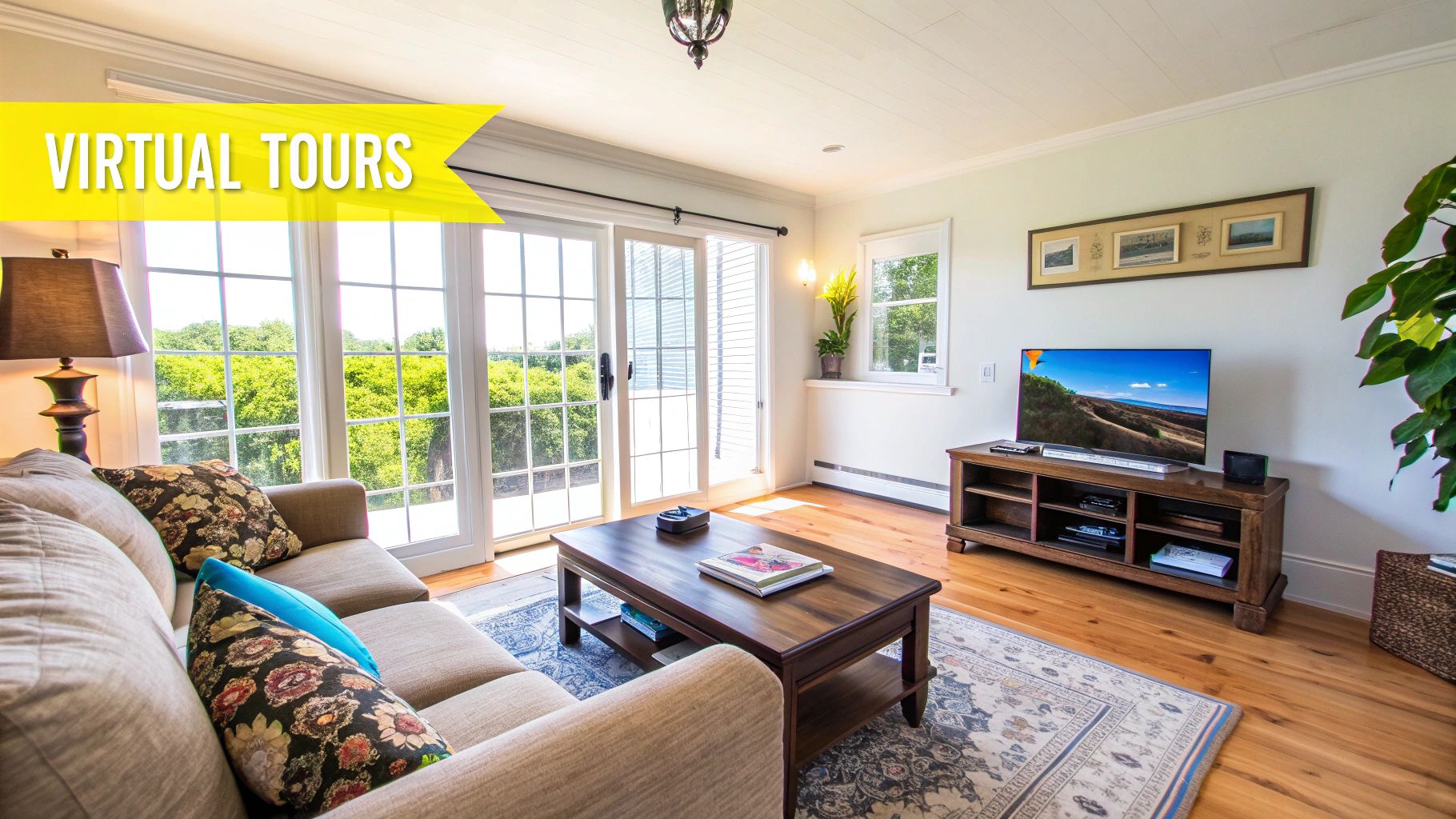
The power of video and virtual tours lies in their ability to provide transparency and convenience, attracting more qualified and serious inquiries. When a buyer has already "walked" through a home online using a Matterport 3D tour, they arrive at a showing with a much higher level of interest. This makes video a crucial component of modern real estate lead generation strategies, filtering out casual browsers and attracting committed prospects.
How to Implement Virtual Tours & Video Marketing
A successful video strategy goes beyond simply hitting "record" on your phone. It requires a thoughtful plan to capture attention and drive action.
Invest in the Right Tools: While a modern smartphone is a great start, consider investing in a high-quality gimbal for smooth video, a good microphone for clear audio, and a drone for stunning aerial shots. For immersive 3D experiences, platforms like Matterport are the industry standard.
Create a Diverse Content Mix: Don't limit yourself to property tours. Create agent introduction videos to build personal connection, short-form neighborhood tours for TikTok and Instagram Reels, and longer-form YouTube videos explaining the local market trends.
Optimize for Search & Social: Every video is a marketing asset. Use keyword-rich titles and descriptions on YouTube (e.g., "Luxury Home Tour in [Neighborhood], [City]"). On social media, keep videos short (under 90 seconds), add captions, and always include a clear call-to-action in the post.
Promote Your Videos Everywhere: Embed property tour videos directly into your MLS listings and website. Share them in your email newsletters, run them as social media ads, and send them directly to warm leads who have inquired about a specific area.
Pro Tip: Host a "Live Virtual Open House" on Facebook or Instagram. Announce the time in advance and walk viewers through the property in real-time, answering their questions as they come in. This creates urgency and generates a live list of interested buyers you can follow up with immediately.
7. Referral & Network Building Programs
Building a business on referrals is the gold standard for long-term, sustainable success in real estate. This strategy involves systemizing how you generate leads from your existing network, including past clients, your sphere of influence (SOI), and strategic partners. Instead of constantly chasing cold leads, you create a self-sustaining ecosystem where happy clients and trusted colleagues consistently send new business your way.
The core principle is to move beyond passive hope and actively cultivate relationships that produce predictable referrals. A high-producing agent whose business is over 70% referral-based didn't get there by accident; they built systems to stay top-of-mind and provide exceptional value. This makes referral programs one of the most cost-effective and powerful real estate lead generation strategies available, yielding high-trust, high-conversion prospects.
How to Implement Referral & Network Building Programs
A systematic approach transforms networking from a social activity into a core business pillar.
Formalize Your Client Program: Don't just ask for referrals; create a formal program. Offer clear, tiered incentives like a $100 gift card for a successful introduction or a high-end closing gift for a referred client who closes. Communicate this program to every client at closing.
Segment & Nurture Your Database: Your CRM is your command center. Segment your contacts into categories: "Past Clients," "A-List Sphere" (people who have referred you), and "Strategic Partners" (lenders, inspectors, contractors). Set up automated, value-driven email and text campaigns for each group to stay in touch without being salesy.
Build a Partner "Power Team": Identify the top mortgage broker, title company, home inspector, and contractor in your area. Meet with them quarterly to discuss how you can mutually refer business. Make a commitment to send them clients, and they will reciprocate.
Host Appreciation Events: Quarterly or semi-annual client appreciation events are a fantastic way to reconnect with your network in a low-pressure environment. A simple happy hour, a family park day, or a movie screening can generate immense goodwill and future business.
Pro Tip: For every referral you receive, send a handwritten thank-you note immediately, regardless of whether the lead converts. This simple, personal gesture reinforces the referrer's action and makes them significantly more likely to send you more business in the future.
8. Landing Pages & Lead Magnet Strategy
A landing page and lead magnet strategy is the engine that powers nearly all successful digital marketing efforts. Instead of directing potential clients to your generic homepage, you send them to a dedicated, single-purpose webpage designed to capture their contact information in exchange for something valuable. This targeted approach is one of the most effective real estate lead generation strategies for converting website traffic into actionable leads.
The core principle is a value-based exchange. A prospect gives you their name, email, and phone number, and in return, you provide them with a high-value piece of content or a tool, known as a "lead magnet." This could be an instant home valuation, a neighborhood market report, or a guide for first-time homebuyers. By focusing on a single offer without the distractions of a full website, you dramatically increase the likelihood of conversion.

How to Implement a Landing Page & Lead Magnet Strategy
Creating a high-converting landing page is a science that blends compelling copy, clean design, and a clear user path.
Define Your Offer & Audience: First, identify your target audience. Are you trying to attract sellers, first-time buyers, or investors? Create a specific lead magnet for them, such as a "Free [Your City] Home Valuation Report" for sellers or a "Top 10 Off-Market Deals" list for investors.
Build a Dedicated Landing Page: Use a tool like Leadpages, Unbounce, or your CRM's built-in builder to create a page for each offer. The page must have a benefit-driven headline (e.g., "Discover Your Home's True Value in 60 Seconds"), a short form (3-4 fields max), and a highly visible call-to-action (CTA) button like "Get My Free Report."
Remove All Distractions: A true landing page has no main navigation menu, no links to other parts of your site, and no competing offers. The only action a visitor can take is to fill out the form or leave the page. This singular focus is what makes them so effective.
Promote and Track: Drive traffic to your landing page from all your channels: paid ads, social media posts, your email signature, and blog articles. Track the page's conversion rate (leads / visitors) to understand its performance and make data-backed improvements.
Pro Tip: Use social proof to build instant trust. Include a testimonial from a past client directly on your landing page, right next to the form. A quote like, "Jane's home valuation was more accurate than Zillow and helped us sell for $15k over asking!" can significantly boost your conversion rate.
9. Door Knocking & Direct Outreach
In a digital-first world, door knocking and direct outreach represent a powerful, high-touch real estate lead generation strategy that cuts through online noise. This classic method involves systematically canvassing target neighborhoods to connect face-to-face with potential sellers, For Sale By Owner (FSBO) leads, and homeowners with expired listings. It builds rapport and establishes you as the go-to neighborhood expert in a way no digital ad can replicate.
The core principle is to create genuine, in-person connections within a specific geographic farm area. By providing value upfront, whether it's a market update, a neighborhood event invitation, or a simple introduction, you build top-of-mind awareness. When a homeowner in that area decides to sell, your personal interaction makes you the first agent they think to call, turning a simple conversation into a future listing.
How to Implement Door Knocking & Direct Outreach
Effective door knocking is a disciplined system, not a random walk through a subdivision. It combines personal skills with strategic planning and follow-up.
Select & Farm Your Neighborhoods: Choose 3-5 specific "farm" neighborhoods and commit to them long-term. Research recent sales, average home values, and community features. Your goal is to become the undeniable expert for that micro-market.
Prepare Your Value-Driven "Opener": Don't just ask if they're selling. Offer something of value. For example: "Hi, I'm [Your Name] with [Your Brokerage]. We just sold a home down the street and have buyers looking for a similar property. I'm just checking in to see if you've had any thoughts of selling?" or "I'm putting together a neighborhood market report and wanted to drop off a copy for you."
Target High-Intent Properties: While farming is a long-term play, you can get quicker results by targeting FSBOs and expired listings. These homeowners have already raised their hands and demonstrated a desire to sell, making them highly motivated prospects for your direct outreach efforts.
Track Everything in a CRM: Every door knocked is a data point. Use a mobile-friendly CRM to log which doors you've knocked, the outcome of the conversation, and any relevant notes (e.g., "planning to downsize in 2 years," "son is a great baseball player"). This data is gold for your follow-up campaigns. These personal interactions are also a great way to invite people to your next event; to truly maximize in-person interactions and convert visitors into leads, consider exploring these Top Open House Ideas for real estate agents.
Pro Tip: Create a "door knocking kit" with high-quality door hangers for those who don't answer, branded pens, business cards, and a printed neighborhood market snapshot. This professionalism makes a lasting impression and gives you a reason to be there.
10. Podcast & Audio Content Strategy
A podcast or audio content strategy is a sophisticated way to build authority and connect with a dedicated audience on a deeper level. Instead of chasing leads, this approach positions you as the go-to local market expert, attracting clients who already know, like, and trust you. By creating or appearing on podcasts, you can reach potential buyers, sellers, and investors during their commutes, workouts, or daily routines, establishing a highly personal connection.
This real estate lead generation strategy moves beyond direct sales pitches to focus on delivering consistent, high-value information. Whether you're discussing local market trends, interviewing community leaders, or sharing home-selling tips, you are building a brand and an audience that sees you as a trusted advisor. Listeners who tune in weekly to hear your insights are far more likely to think of you first when they are ready to transact.
How to Implement a Podcast & Audio Content Strategy
Launching a successful podcast requires consistency and a focus on value over pure self-promotion.
Choose Your Niche & Format: Don't try to be everything to everyone. Focus on a specific niche, such as "First-Time Homebuyers in [Your City]" or "[Your County] Real Estate Investing." Decide on a format: solo commentary, interviews with local experts (lenders, inspectors, business owners), or a co-hosted show.
Start as a Guest: Before launching your own show, get comfortable behind the mic by being a guest on other local business or real estate podcasts. This builds your credibility and allows you to tap into an existing audience. Prepare a compelling "one-sheet" that outlines your expertise and potential topics.
Equip and Record: You don't need a professional studio to start. A quality USB microphone (like an Audio-Technica AT2020 or Blue Yeti) and free recording software (like Audacity) are sufficient. Focus on clear audio and consistent content.
Promote and Repurpose: A podcast is a content engine. Promote each new episode to your email list and social media channels. Repurpose the audio into audiograms for Instagram, transcribe it for a blog post, and pull key quotes for social media graphics to maximize its reach.
Pro Tip: Create a specific, compelling call-to-action for your podcast listeners. Instead of a generic "call me for your real estate needs," offer a unique resource like, "Text 'MarketReport' to 555-1234 to get my exclusive monthly deep-dive analysis we discussed on today's show." This makes tracking your podcast's ROI direct and measurable.
Top 10 Real Estate Lead-Gen Strategies Comparison
Item | Implementation Complexity 🔄 | Resource Requirements ⚡ | Expected Outcomes 📊 | Ideal Use Cases 💡 | Key Advantages ⭐ |
|---|---|---|---|---|---|
Content Marketing & Blog Strategy | 🔄 Medium–High (consistent workflow) | ⚡ Time, writing/SEO skills, occasional freelancers | 📊 Long-term organic traffic & lead pipeline (3–6 months) | 💡 Local market authority, inbound lead growth | ⭐ Sustainable SEO, credibility, 24/7 lead capture |
Social Media Marketing & Lead Generation | 🔄 Medium (ongoing content cadence) | ⚡ Content creation, community management, ad budget | 📊 Fast engagement, brand reach, measurable interactions | 💡 Visual listings, audience building, short-form promotion | ⭐ Rapid visibility, relationship building, scalable ads |
Local SEO & Google My Business Optimization | 🔄 Medium (monitor & maintain) | ⚡ Local citations, review management, technical SEO | 📊 High-intent local traffic; Maps visibility | 💡 "Near me" searches, mobile discoverability, single-office agents | ⭐ Cost-effective local discoverability; trust via reviews |
Email Marketing & Nurture Campaigns | 🔄 Medium (strategy + automation) | ⚡ Email platform, list-building, content creation | 📊 High ROI and re-engagement; measurable conversions | 💡 Nurturing leads, past clients, segmented follow-ups | ⭐ Very high ROI; direct, measurable, relationship-driven |
Paid Advertising (PPC, Facebook Ads, Google Ads) | 🔄 High (continuous optimization) | ⚡ Ad budget, tracking setup, paid expertise | 📊 Immediate traffic & leads; scalable performance | 💡 Rapid lead generation, new-agent scaling, competitive markets | ⭐ Fast visibility, precise targeting, controllable spend |
Virtual Tours & Video Marketing | 🔄 High (production workflow) | ⚡ Equipment, editing, platform hosting or agency help | 📊 Increased listing engagement and inquiry rates | 💡 Luxury listings, remote buyers, high-conversion showcases | ⭐ Strong emotional impact; boosts time-on-listing & conversions |
Referral & Network Building Programs | 🔄 Medium (relationship systems) | ⚡ Time, events, CRM tracking, partner incentives | 📊 High-quality leads with elevated conversion rates | 💡 Long-term business growth, repeat/referral-heavy models | ⭐ Lowest acquisition cost; high loyalty and conversion |
Landing Pages & Lead Magnet Strategy | 🔄 Medium (design & testing) | ⚡ Landing page builders, copy/design, lead magnets | 📊 Higher conversion rates; scalable contact capture | 💡 Campaign funnels, PPC traffic, downloadable offers | ⭐ Measurable, optimizable lead capture; feeds nurture systems |
Door Knocking & Direct Outreach | 🔄 Medium (manual, repetitive process) | ⚡ Time, printed materials, CRM follow-up | 📊 Local brand awareness; sporadic but targeted leads | 💡 Neighborhood farming, FSBOs, expired listings | ⭐ Direct face-to-face contact; strong local presence |
Podcast & Audio Content Strategy | 🔄 High (production + promotion) | ⚡ Recording equipment, editing, guest coordination | 📊 Authority building; engaged, loyal audience over time | 💡 Thought leadership, investor audiences, long-form education | ⭐ Deep engagement; repurposable long-form content |
Putting It All Together: Building Your Unstoppable Lead Generation Machine
We’ve journeyed through a comprehensive arsenal of real estate lead generation strategies, from the foundational power of local SEO and content marketing to the scalable reach of paid advertising and the high-touch impact of direct outreach. It's easy to look at this list of ten distinct channels and feel overwhelmed, but the key takeaway is not to master everything at once. The secret lies in strategic integration and relentless execution.
The most successful real estate professionals don't rely on a single, fragile source of leads. They don't just run Facebook ads and hope for the best, nor do they depend solely on referrals. Instead, they build a resilient, multi-channel lead generation machine. This system is designed so that if one channel experiences a downturn, others are there to sustain and even accelerate business growth. The goal is to evolve from reactive, inconsistent prospecting to a predictable, automated flow of qualified opportunities.
From Tactics to a Cohesive System
Think of these strategies not as isolated tactics but as interconnected gears. A powerful paid advertising campaign (Strategy #5) becomes exponentially more effective when it drives traffic to a high-converting landing page with a compelling lead magnet (Strategy #8). That new lead is then seamlessly entered into a sophisticated email nurture campaign (Strategy #4), building trust and establishing your authority over time.
Simultaneously, your commitment to local SEO (Strategy #3) and consistent content creation (Strategy #1) is working in the background, capturing organic search traffic and attracting prospects who are actively seeking solutions. Your video marketing efforts (Strategy #6), shared across your social media channels (Strategy #2), put a face to your name and build the crucial "know, like, and trust" factor long before you ever speak to a potential client. This interconnected approach creates a powerful flywheel effect where each component amplifies the others.
The Power of Strategic Stacking
To get started, don't try to implement all ten strategies tomorrow. Instead, focus on a "strategic stack" of two or three complementary channels that align with your strengths and target market.
The Digital Dominator Stack: Combine Paid Advertising for immediate lead flow, Local SEO for long-term organic authority, and Email Marketing to nurture every single lead that enters your ecosystem. This stack is perfect for agents who want to build a scalable, tech-forward business.
The Community Champion Stack: Focus on building a robust Referral & Network Program, engaging in authentic Social Media Marketing, and hosting value-packed local events or webinars. This approach is ideal for agents who thrive on personal connections and community building.
The Content Authority Stack: Go all-in on Content Marketing & Blogging, develop a Podcast or Audio Strategy, and use Virtual Tours & Video Marketing to showcase your expertise and listings. This is for the agent who wants to become the go-to thought leader in their market.
The ultimate goal is not just to generate a lead, but to create an asset. Every piece of content you create, every positive review you earn, and every relationship you nurture becomes a permanent asset that works for you 24/7, building a brand that attracts clients rather than just chasing them.
Mastering these real estate lead generation strategies is the definitive path to building a sustainable business that thrives regardless of market fluctuations. It's about moving from being a salesperson to being a savvy business owner who has built a predictable system for growth. Obsessively track your key performance indicators (KPIs), from cost-per-lead and click-through rates to your final conversion rates and ROI. Data is your compass; it will tell you what's working, where to double down, and what to adjust. This commitment to measurement and optimization is what separates the top 1% from the rest.
Building and managing a high-performance, multi-channel advertising system requires deep expertise and constant optimization. If you're ready to implement a sophisticated paid media strategy without the steep learning curve, the team at Wojo Media specializes in creating and scaling profitable lead generation campaigns for real estate professionals. Book a discovery call today to see how we can build your predictable client acquisition machine.
Comments