.png)
A Guide to tiktok ads for small business that drive profit

Let's be honest, you've probably dismissed TikTok as just another app for viral dances and whatever trend Gen Z is obsessed with this week. But if you're running a small business, it's time to look again. TikTok has quietly transformed into a serious engine for growth, and it’s a place where small businesses can genuinely punch above their weight.
Why Your Small Business Needs to Be on TikTok
The platform’s core algorithm is what makes it so different. It doesn't care how many followers you have or the size of your ad budget. It cares about one thing: creating engaging content.
This creates a unique opportunity. A local bakery can post a simple, behind-the-scenes video of frosting a cake and sell out for the entire week. A small e-commerce boutique can show off a new dress and suddenly find customers from thousands of miles away. It's a space where raw authenticity and a little bit of creativity are rewarded with massive organic reach.
Beyond Entertainment to Real Economic Impact
This isn't just about hype; the shift from a fun app to a commercial powerhouse is backed by some serious numbers. Over 7 million businesses are now using TikTok to find new customers.
Specifically for small businesses, the results are compelling. Owners have reported an incredible 88% jump in sales after running ads on the platform. And the average return on ad spend (ROAS)? It’s hitting $4.13 for every $1 invested, which leaves many other social media channels in the dust. You can dig into the full TikTok Economic Impact Report for a deeper dive.
This kind of performance makes TikTok a predictable and scalable way to acquire customers. Whether you're a local service business trying to fill your appointment book or an e-commerce brand looking for sales, the platform has the tools to connect you with people who are ready to buy.
Key Takeaway: Stop thinking of TikTok as just a brand awareness play. It’s a direct-response marketing channel where a single creative video can drive leads, bookings, and product sales—sometimes overnight.
Finding Your Customers on the For You Page
The secret sauce to TikTok's success is the "For You" Page (FYP). This is the main feed where the algorithm works its magic, serving users a nonstop stream of content it thinks they'll love. When your ad shows up here, it doesn't feel like a jarring interruption. It feels like a discovery.
Just take a look at the TikTok Creative Center, which is a goldmine of top-performing ads.
What do you notice? They look just like regular, native TikToks. They often feature real people, are shot on a phone, and use trending sounds. That's the key. You have to create content that users would want to watch even if it wasn't an ad.
Of course, to really make this work, your TikTok ads need to fit into a bigger picture. If you're building your strategy from the ground up, this essential guide on marketing for small business is a great place to start.
TikTok Ads vs Other Platforms At a Glance
Still not convinced? Let's put some numbers side-by-side. It becomes pretty clear why TikTok's environment is so compelling for advertisers right now, especially those with smaller budgets.
Metric | TikTok | Industry Average | |
|---|---|---|---|
Average ROAS | $4.13 | $2.56 | $2.87 |
Avg. Engagement Rate | 5.96% | 0.98% | ~1-2% |
Average CPC | $1.00 | $3.56 | $3.00+ |
Ad Recall | 24% higher | Baseline | Varies |
The data speaks for itself. With higher returns, significantly better engagement, and lower costs, TikTok offers a unique advantage for brands willing to embrace its creative style.
Setting Up Your TikTok Ads Account for Success
Before you even think about crafting that perfect viral video, there’s a critical first step that separates the campaigns that fly from the ones that burn cash. Getting your technical foundation right isn’t just some box-ticking exercise—it’s the engine that powers your entire advertising strategy on TikTok.
This setup is what makes every dollar you spend trackable, measurable, and effective at finding you more customers. We'll start with the essentials: getting your Ads Manager account created and installing the single most important tool in your arsenal, the TikTok Pixel.
Your Command Center: The TikTok Ads Manager
Think of the TikTok Ads Manager as your mission control. It's the hub where you’ll build campaigns, dial in your targeting, set budgets, and, most importantly, see what’s actually moving the needle.
Creating an account is pretty straightforward. You just head over to the TikTok for Business website, sign up, and plug in some basic info about your company—business name, industry, contact details. It's a simple but mandatory step to unlock all the platform's advertising firepower.
Once you're in, the platform will nudge you to create your first campaign. Pump the brakes. Before we launch anything, we need to install the brains of the operation.
Why the TikTok Pixel Is Non-Negotiable
If the Ads Manager is mission control, the TikTok Pixel is your deep-space intelligence network. It's a tiny snippet of code you place on your website, and its whole job is to bridge the gap between your TikTok ads and what happens on your site.
Without it, you’re flying blind. Sure, you might see your ads are getting clicks, but you'll have no clue if those clicks are turning into actual sales, leads, or appointments.
The Pixel is what teaches the TikTok algorithm who your ideal customer is. It watches who visits your site, who adds a product to their cart, and who ultimately buys—then it uses that data to find more people just like them.
This is the feedback loop that makes TikTok ads so potent for small businesses; it gets smarter over time. The more data your Pixel gathers, the better TikTok gets at putting your ads in front of people ready to buy, which drives down your costs and boosts your return.
This infographic breaks down how that connection translates into real business growth.
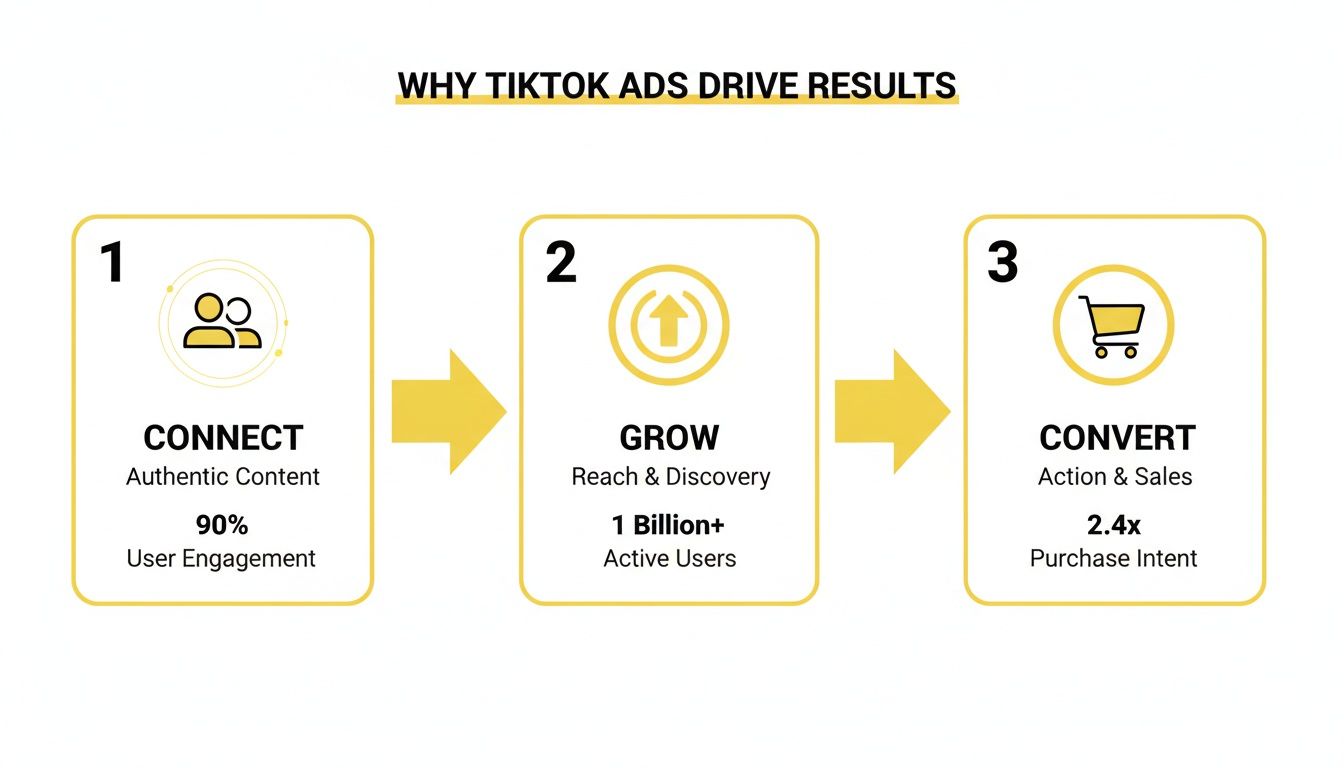
As you can see, it all starts with connecting to the right audience. That connection lets you grow your reach and, ultimately, convert interested scrollers into loyal customers.
Setting Up Key Tracking Events
Once the Pixel is installed on your site (most e-commerce platforms like Shopify have dead-simple, one-click integrations), your next move is to define your events. These are just the specific user actions you want to track.
Think about the most valuable things a customer can do on your website. For most small businesses, they boil down to a few key actions.
For an E-commerce Store:
ViewContent: Someone checks out a product page.
AddToCart: A user adds an item to their cart—a huge signal of interest.
InitiateCheckout: They take the next step and start the checkout process.
CompletePayment: The holy grail. They successfully make a purchase.
For a Local Service Business (e.g., Plumber, Med Spa):
SubmitForm: A potential client fills out your contact or "request a quote" form.
ClickButton: They tap on your phone number to call your business directly.
CompleteRegistration: They book an appointment or sign up for a consultation.
Getting these events set up correctly is absolutely vital. If you're a local plumber and your main goal is lead generation, then tracking the SubmitForm event is your North Star. Every decision you make—from creative to targeting—should be optimized to get more of that specific action at the lowest possible cost. This clarity is what turns your ad spend from a simple expense into a predictable growth investment.
How to Create TikTok Ads People Actually Watch
Let’s get one thing straight: the biggest mistake I see small businesses make on TikTok is trying to create polished, traditional commercials. The secret to winning isn't making better ads; it's to stop making "ads" altogether. Success here comes from creating content that feels like it belongs right in a user's "For You" Page.
This is all about embracing authenticity and ditching the high-production gloss. Think less Super Bowl commercial and more like a helpful or entertaining video a friend would send you. The goal is to blend in, grab attention, and provide value before you even think about asking for a sale.
Embrace Lo-Fi Content and Authentic Storytelling
The beauty of TikTok is that you don't need a professional film crew. In fact, videos shot on a smartphone often crush slick, agency-produced spots because they feel more genuine to the people actually using the app.
This is where lo-fi, native-style content becomes your superpower. It’s about showing the real people and passion behind your brand.
Behind-the-Scenes: Show your workspace or how a product gets made. A local bakery could show the satisfying process of frosting a cake, making viewers feel like they're getting an exclusive peek.
Founder Stories: Tell a quick story about why you started your business. People connect with people, and your personal journey is a powerful way to build a community.
Problem and Solution: Kick things off with a common pain point. A cleaning service could show a messy room followed by a satisfying "after" shot, proving their value in seconds.
The common thread is authenticity. It’s about creating content that feels human and doesn't scream, "I'm trying to sell you something!"
The Power of User-Generated Content and Micro-Influencers
One of the most potent ways to create authentic ads is to just let your customers do the talking. User-generated content (UGC) is any content—videos, reviews, photos—created by real people instead of the brand. It’s pure social proof.
UGC is especially powerful on TikTok; learning how to make UGC that converts is a non-negotiable skill for small businesses. It feels less like an ad and more like a genuine recommendation from a friend, which is gold on a platform built on trust.
You can also team up with micro-influencers—creators with smaller, highly engaged followings. They’ve built incredible trust with their audience, and their endorsement feels far more personal and believable than a shoutout from a mega-celebrity. A partnership with a local food blogger, for instance, could drive serious foot traffic to a new restaurant.
Expert Tip: When you're working with creators, give them a clear brief but let them run with it. The magic happens when their authentic voice and style shine through, not when they're forced to read a rigid script.
Crafting the Perfect TikTok Ad Creative
While authenticity is your north star, a little structure goes a long way. Every successful TikTok video, ad or not, follows a simple formula to grab and hold attention. Let's break down the essential pieces for your business.
The First Three Seconds are Everything
You have a tiny window to stop the scroll. Your opening, or hook, has to be a thumb-stopper. It could be a bold statement, a surprising visual, or a question that makes someone want to stick around.
A boutique selling sustainable clothing could start with, "Stop throwing away clothes you only wore once." It immediately hits a pain point and qualifies the viewer.
Storytelling Over Selling
After you’ve hooked them, your ad needs to tell a mini-story. Don't just list features; show the transformation.
For a physical product: Show it in action. A video for a portable blender shouldn't just show the blender on a counter; it should show someone making a smoothie at their desk or on a hike.
For a service-based business: Demonstrate the outcome. A financial advisor could share one simple tip that saves people money, proving their expertise and building trust.
The Call-to-Action (CTA)
Finally, tell people exactly what you want them to do next. Be direct. "Shop Now," "Book Your Free Consultation," or "Learn More" are effective because they leave no room for confusion. Combine this with on-screen text and a voiceover to make sure it lands.
Ad Formats That Work for Small Businesses
TikTok has a few ad formats, but for small businesses trying to make an impact without a huge budget, two really stand out.
In-Feed Ads: These are the standard. They pop up natively in the "For You" Page between organic videos, letting users like, comment, and share just like any other content. They're perfect for driving traffic to your site or promoting an e-commerce product.
Spark Ads: This is a game-changer. Spark Ads let you boost one of your existing organic posts or even a post made by a creator about your brand. The magic here is that all the likes, comments, and shares build up on the original post, creating massive social proof over time. If you have an organic video that's already getting some love, using Spark Ads is like pouring gasoline on a fire.
Alright, let's get into the nitty-gritty. You’ve got your account ready and ideas are starting to percolate, but even the most brilliant ad creative is dead on arrival without a solid campaign structure to back it up.
This is where the rubber meets the road. Building your first campaign on TikTok can feel a little intimidating, but it all boils down to a simple hierarchy.
Think of it like this: the Campaign is the foundation of your house—it sets your single, overarching goal. The Ad Groups are the individual rooms, each built to house a specific audience. And finally, the Ads are the furniture and decor in each room—the actual videos people will see scrolling on their For You Page.
Choosing Your Campaign Objective
First things first: you have to tell TikTok what you actually want to accomplish. This is your campaign objective, and it’s the most critical decision you'll make at this stage because it tells the algorithm exactly how to optimize your ad delivery.
For any small business that needs to see a real return, you’re going to spend most of your time in the "Conversions" and "Lead Generation" neighborhoods. Let's break down the objectives that actually move the needle.
Website Conversions: This is your bread and butter if you’re an e-commerce brand or need people to take a specific action on your site, like booking a demo. By choosing this, you're giving TikTok a direct order: "Go find me people who are most likely to complete this specific Pixel event—a purchase, an add-to-cart, a form submission."
Lead Generation: This one is a game-changer for service-based businesses. It uses TikTok’s slick Instant Form, which lets users hand over their contact info without ever leaving the app. It’s a super low-friction way to collect leads for your med spa, roofing company, or coaching program.
You might be tempted by cheaper objectives like "Traffic" or "Video Views." Don't be. These are vanity metrics. They’ll get you clicks and eyeballs, but they won't find you people who are ready to pull out their wallets. When every dollar counts, you have to focus on objectives that directly drive revenue.
Key Insight: Always, always optimize for the action closest to your wallet. If you need sales, pick "Conversions" and optimize for the Purchase event. If you need leads, pick "Lead Generation." The algorithm is incredibly smart, but it can only follow the instructions you give it.
Building Your Targeting with Ad Groups
With your campaign objective locked in, it’s time to build out your Ad Groups. This is where you define exactly who sees your ads. A classic rookie mistake is to cram all your targeting ideas into one massive ad group. Don't do it. The smart move is to create separate Ad Groups to test different audiences against each other.
You have a few powerful tools at your disposal to build these audiences.
Interest and Behavior Targeting This is your broadest targeting option. You can target users based on the videos they watch, the creators they follow, the hashtags they use, and the ads they interact with. For instance, a local coffee shop could build an audience of users interested in "coffee," "espresso," and videos tagged with "#latteart."
Lookalike Audiences This is where the TikTok Pixel really starts to work its magic for you. You can give TikTok a "source" audience and ask it to find millions of other users who share the same characteristics. Your source audience could be:
A list of everyone who has purchased from your website.
Your email list of past customers.
People who have already filled out a lead form.
The algorithm goes to work, analyzing the traits of your best customers to find more people just like them. A 1% Lookalike audience will be the most potent and similar to your source, while a 10% Lookalike will be much broader. Start with 1%.
A Targeting Playbook for Local Businesses
If you run a brick-and-mortar or local service business, your targeting needs to be laser-focused on geography. You can't afford to waste money showing your Tampa-based plumbing ads to someone in Seattle.
Here’s a simple but effective structure to get you started:
Nail Down Your Location: The very first thing you should do in your Ad Group settings is target your specific city, state, or a radius around your business address. You can get as granular as just a few miles.
Layer in Interests: Don't just stop at the location. Add interests that make sense for your business. A local med spa, for example, could layer in interests like "Skincare," "Beauty," and "Cosmetics" on top of their geographic targeting.
Create a Retargeting Ad Group: Set up a separate Ad Group just for people who have already visited your website or engaged with your TikTok profile. These people are already warm. Sometimes all they need is a simple retargeting ad to finally push them over the edge and book that appointment.
Smart Budgeting and Bidding
So, how much should you spend?
A good, safe starting point for testing is $20 to $50 per day, per Ad Group. This gives the algorithm enough data to chew on without you having to mortgage your house. Let your tests run for at least 3-5 days before making any big decisions. This gives TikTok’s algorithm enough time to exit the "learning phase" and stabilize performance.
When it comes to your bid strategy, just start with "Lowest Cost." It's exactly what it sounds like—it tells TikTok to get you the most results it can for your budget. It’s the simplest and most effective way to start.
Once you find a winning combination of an ad and an audience that’s delivering a solid return, it's time to scale. Start by increasing the budget on that specific Ad Group by 20-30% every few days. Keep a close eye on your cost per acquisition to make sure it stays profitable. This slow-and-steady approach helps you grow predictably without shocking the algorithm into a panic.
How to Analyze and Scale Your Ad Performance
You’ve launched your first campaign. That’s a huge milestone, but the real work is just getting started. Growth on TikTok isn't about setting and forgetting; it’s about digging into the data, figuring out what it's telling you, and making smart, calculated moves. This is how you stop guessing and start building a predictable growth engine for your business.

Let's cut through the noise and focus on the metrics that actually matter for a small business. You don't need to get lost in dozens of data points. You just need to master a handful of key performance indicators (KPIs) that tie directly to your bottom line.
Your Dashboard Is Your Storyteller
The TikTok Ads Manager dashboard can look like a lot at first glance, but it’s really just telling a story about your customers. Your job is to learn how to read it. The first step is to customize your columns to show only what’s essential.
For a small business laser-focused on profit, these are your non-negotiables:
Cost Per Result (CPR): This is your cost per purchase, lead, or whatever your main conversion event is. It’s the most direct measure of how efficient your ad spend is.
Return on Ad Spend (ROAS): This one’s simple: how many dollars are you generating for every dollar you put in? A 3x ROAS means you made $3 for every $1 you spent.
Click-Through Rate (CTR): What percentage of people who see your ad actually click on it? If your CTR is in the gutter, your creative probably isn't grabbing attention.
Cost Per Mille (CPM): This is the cost to show your ad to 1,000 people. It gives you a sense of how competitive your target audience is to reach.
By comparing these numbers across different ad groups and creatives, you'll quickly spot your winners. Is one video getting a much lower cost per purchase than another? That’s your hero creative. Is one audience delivering a higher ROAS? That’s where you need to point your budget.
Navigating all the different metrics can be tricky when you're just starting out. Here’s a quick-reference table to keep the most important KPIs straight.
Key TikTok Ad Metrics and What They Mean
Metric (KPI) | What It Measures | Good Benchmark for SMBs |
|---|---|---|
Return on Ad Spend (ROAS) | Total revenue generated for every dollar spent on ads. | 2.0x+ (breakeven depends on margins) |
Cost Per Result (CPR/CPA) | The cost to acquire one customer or lead. | Varies by industry; should be below your LTV. |
Click-Through Rate (CTR) | The percentage of viewers who clicked your ad's link. | 1% or higher |
Cost Per Mille (CPM) | The cost to get 1,000 ad impressions. | $5 - $15 (highly variable by audience) |
Conversion Rate (CVR) | The percentage of clicks that result in a conversion. | 2% or higher |
Video View-Through Rate (VTR) | Percentage of viewers who watched your video to completion. | 15% or higher for a 15-30 second ad |
This table isn't the final word—your own numbers will tell the real story. But it's a solid starting point for knowing if you're on the right track.
Diagnosing Your Campaign Performance
Once your ads have been running for at least 3-5 days and have exited the learning phase, it's time to play detective. I use a simple framework to figure out what's really going on with a campaign.
Scenario A: The Ideal Winner
Symptoms: High CTR, low CPR, and a strong ROAS (think 2.5x or better).
Diagnosis: You've hit the jackpot. This combination of creative and audience is resonating perfectly, and people are converting at a profitable rate.
Action: It’s go-time. This is the one you scale.
Scenario B: High Clicks, No Conversions
Symptoms: Your CTR looks great, but your CPR is through the roof and you have little to no ROAS.
Diagnosis: The ad is definitely stopping the scroll, but there’s a major disconnect after the click. The problem is almost always on your landing page—it might be slow, confusing, or the offer doesn't match what the ad promised.
Action: Go audit your website experience. Make sure your messaging is completely consistent from the ad right through to the checkout page.
Scenario C: Low Clicks and Low Impressions
Symptoms: You have a low CTR and your budget isn't even being spent.
Diagnosis: Your creative just isn't compelling enough to capture attention in the feed. The hook is failing, or the video feels way too much like a traditional, polished ad.
Action: It's back to the drawing board. Start testing entirely new hooks and angles immediately.
Your data is your roadmap. Don’t get emotionally attached to an ad you love if the numbers are telling you it isn’t working. Trust the data, kill the underperformers without mercy, and double down on what’s actually profitable.
A Repeatable System for Scaling Profitably
So you've found a winning ad group—one with a stable, profitable CPR. Now what? It's time to give it more budget, but you have to do it carefully. Suddenly doubling your budget can shock the algorithm and send your performance into a nosedive.
I always recommend sticking to the 20% Rule for steady, predictable growth.
Find that winning ad group.
Increase its daily budget by just 20-30%.
Let it run for 2-3 days while you keep a close eye on your CPR.
If the CPR holds steady and remains profitable, you're clear to repeat the process.
If that CPR starts creeping up, pause the budget increase and let things stabilize.
This methodical approach lets you ramp up your spend without spooking the algorithm, making sure your growth is both profitable and sustainable. At the same time, you should always be testing new creatives in a separate ad group. Your current winner will eventually burn out from ad fatigue, and you need the next one waiting in the wings.
The data backs this up. When managed correctly, this platform delivers. TikTok ads boast an average ROAS of $4.13 per dollar spent, outperforming Instagram's $3.21. On top of that, 56% of advertisers report getting better results on TikTok than on other platforms, making it an incredibly powerful channel for scaling tiktok ads for small business. You can find more great insights in these recent TikTok statistics.
Common Questions About TikTok Ads
Diving into TikTok ads for your small business usually kicks up a few questions. Before you start spending your hard-earned money, it's completely normal to wonder about budgets, what kind of creative actually works, and how long you'll be waiting for results.
Let's clear the air and tackle the most common questions we hear. My goal is to turn that uncertainty into a real, actionable plan so you can move forward with confidence.
How Much Should a Small Business Spend on TikTok Ads?
There's no magic number here, but a solid starting point for testing the waters is anywhere from $20 to $50 per day. Honestly, you don't need to break the bank right away.
That budget is just enough to let the algorithm do its thing—gathering meaningful data on a few different ad sets and creatives. Your initial goal isn't to go viral or get a million sales; it's simply to find a winning combination. Focus on discovering a creative and targeting setup that brings in customers or leads profitably.
Once you land on an ad that has a positive Return on Ad Spend (ROAS), then you can start thinking about scaling. A safe way to do this is to bump up the budget by 20-30% every few days. Just be sure to keep a close eye on performance to make sure it stays profitable as you grow.
What Kind of Content Works Best for TikTok Ads?
The stuff that works is the stuff that doesn't look like an ad. Authentic, native-style content is king on this platform. The ads that perform the best blend right into a user's "For You" Page. If you roll in with an overly polished, corporate-style video, people will scroll right past it—it just feels out of place.
The golden rule is to entertain or educate first and sell second. Your ad should feel like a piece of organic content that just happens to feature your product or service in a really compelling way.
This means you should be leaning into content like:
User-Generated Content (UGC): Get real customers to show off your product. It’s authentic and builds instant trust.
Simple Talking-Head Videos: You or someone on your team just explaining a key benefit. No fancy production needed.
Behind-the-Scenes Footage: Show how the sausage gets made. People love seeing how your product is created or what goes into your service.
Trend-Based Videos: Don't just copy a trend—cleverly weave your brand into a trending sound or format.
How Long Does It Take to See Results From TikTok Ads?
You'll start seeing initial data like impressions and clicks almost immediately, usually within the first 24 hours. But you have to be patient. It typically takes the TikTok algorithm about 3 to 7 days to get through its "learning phase."
During this time, it’s actively figuring out the best audience for your ads. You can't judge a campaign on day one.
To get a real sense of whether a campaign is a winner, you need to let it run for at least a full week. That gives you enough conversion data to make a smart call. It’s perfectly normal to burn through several creatives and audiences before you find a combo that's truly profitable. Consistent testing and letting the data guide your optimizations—that's the key to long-term success.
Ready to stop guessing and start scaling with a predictable advertising system? The team at Wojo Media bolts onto your business to optimize your offers, landing pages, and ad campaigns for profitable growth. Book a free strategy call today and get a custom plan to drive real results.
Comments