.png)
A Modern Playbook to Outsource Sales Development

When we talk about outsourcing sales development, we're really talking about bringing in a specialized team to run the top of your sales funnel. Think of them as a plug-and-play crew that handles all the heavy lifting—prospecting, qualifying leads, and setting solid appointments—so your closers can focus on closing.
It’s a strategic shortcut. Instead of spending months building an in-house team from scratch, you get instant access to seasoned pros and their proven systems. For anyone serious about turning ad spend into qualified meetings, it’s one of the fastest ways to ignite pipeline growth.
Why Top Companies Now Outsource Sales Development
The conversation around outsourcing sales development has changed. It’s no longer just a line item for cutting costs; it's a core growth strategy for businesses that need to scale now. The biggest reason? Speed.
Let’s be real: building an effective in-house Sales Development Representative (SDR) team is a massive project. You’re looking at six to twelve months just to recruit, hire, train, and tool up a team that can deliver consistent results.
That kind of delay is a killer, especially if you’re pouring money into high-volume ad campaigns. Every lead you generate from Google or Facebook has a ticking clock on it. Outsourcing lets you tap into a ready-made engine of pros and an optimized tech stack, turning that ad spend into appointments almost overnight.
Gain Instant Access to Expertise and Technology
A good outsourced partner doesn’t just give you more bodies; they hand you a complete, battle-tested system. Right out of the box, you get:
Specialized Talent: SDRs who live and breathe prospecting. They know how to handle objections and, most importantly, how to book meetings that don't fall apart.
An Advanced Tech Stack: They bring their own suite of tools for outreach, data enrichment, and CRM integration. That’s a huge software bill you no longer have to worry about.
Proven Processes: You’re not guessing what works. You’re adopting playbooks, scripts, and multi-channel strategies that have been sharpened over hundreds of campaigns.
The market data tells the same story. The global outsourcing services market hit a staggering US$3.80 trillion in 2024 and is still climbing. More telling is a recent survey showing that 83% of U.S. small-business leaders are either maintaining or upping their outsourcing budgets, with sales functions topping the list. You can dig into more data on this growing trend to see just how widespread this has become.
The real win here isn't just offloading tasks; it's about instantly acquiring a strategic capability. You're not just hiring SDRs. You're adopting an entire sales development operation, turning a major capital expense into a predictable operational one.
At the end of the day, outsourcing sales development is about getting an expert team to turn your ad dollars into real revenue opportunities—faster than you ever could on your own. It takes the headache of lead follow-up and transforms it into a scalable, predictable engine for growth.
Choosing The Right Outsourcing Model and Partner
Picking the right partner for your sales development is easily the most critical decision you'll make in this entire process. A great partner slots into your team like they’ve always been there. A bad one will burn through your cash and can even do some real damage to your brand’s reputation.
Before you start vetting anyone, you first need to understand the different ways you can work together. Your choice here is going to have a direct impact on your budget, how integrated they are with your team, and how quickly you can scale up or down.
Most partnerships fall into one of three buckets. A startup testing a new feature might go one way, while a company with a steady flow of ad traffic will need something totally different.
Comparing Outsourcing Models
This table breaks down the three main models to help you figure out which one aligns with your immediate goals, budget, and how deep you want the integration to be.
Model | Best For | Cost Structure | Level of Integration |
|---|---|---|---|
Project-Based | Short-term campaigns with a clear end date (e.g., webinar promotion, new product launch) | One-time project fee or fixed monthly cost | Low; they operate on a specific task and then hand off |
Dedicated Team | Businesses with a consistent lead flow needing sustained outreach | Monthly retainer per dedicated rep | High; they become an extension of your in-house team |
Hybrid Model | Companies wanting a balance of cost predictability and performance incentives | Lower monthly retainer + performance-based bonuses | Medium to High; integrated but heavily focused on hitting KPIs |
Each model has its place. The key is to match the engagement structure to your business reality, not just the sales pitch from a potential agency.
A Vetting Checklist For Potential Partners
Once you’ve got a model in mind, it’s time to start talking to agencies. You have to look past the slick sales deck and really dig into how they operate. As you start your search, checking out lists of top demand generation agencies is a great way to get a feel for the major players and what they offer.
Here are the questions you absolutely need to ask:
Industry Experience: Have you actually worked with companies in our specific niche before? Can you show me some real (but anonymized) case studies or benchmarks?
SDR Training: Walk me through your onboarding process for new SDRs. How do you get them up to speed on our brand and make sure they sound like us, not you?
Tech & CRM Integration: What’s your process for making sure every single touchpoint is logged in our CRM in real-time? Which platforms are you experts in?
Communication Cadence: What does the day-to-day communication look like? Who is my dedicated point of contact, and how often will we have formal check-ins?
Don’t just ask if they can do something; ask them to show you how they do it. A top-tier partner will have clear, documented processes for everything from script development to lead handoffs.
If you're still on the fence about whether to build in-house or outsource, a simple factor like your ad spend can make the decision a lot clearer.
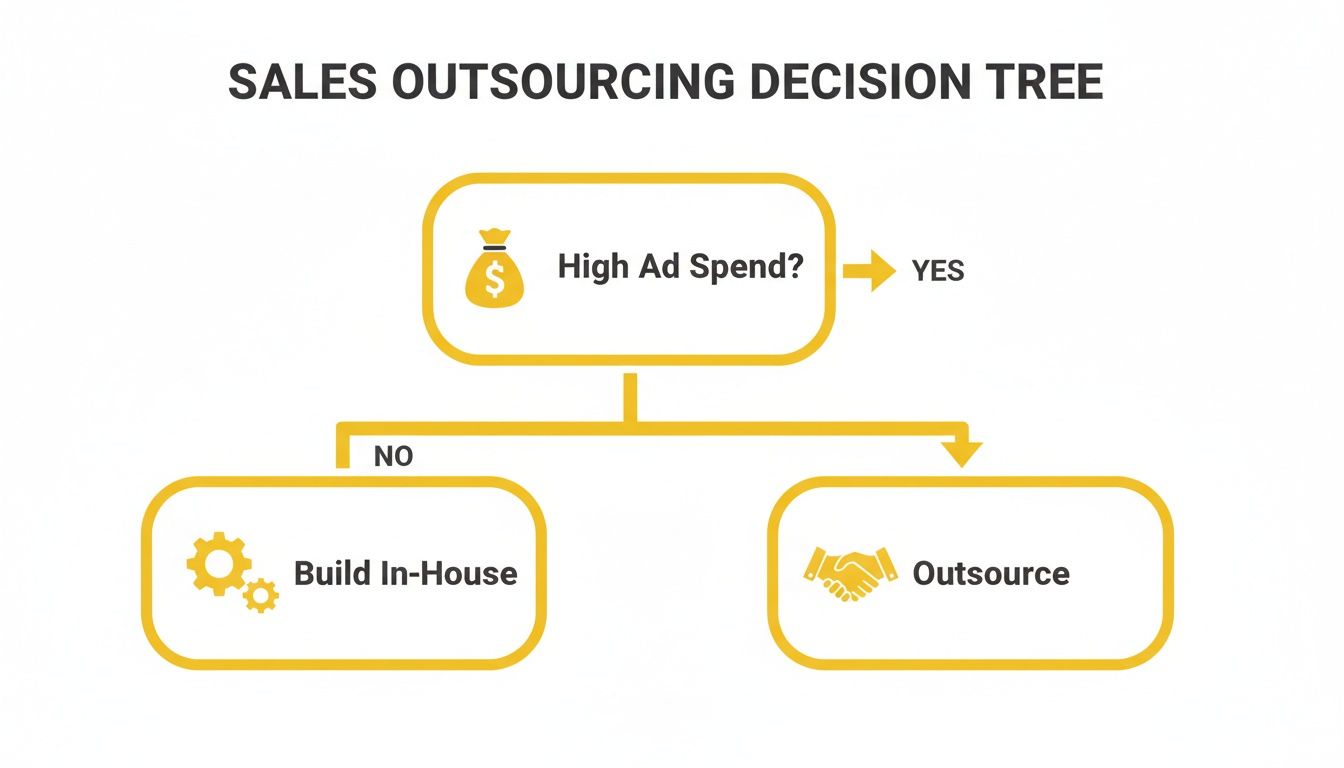
As you can see, a significant investment in advertising often creates more leads than an internal team can handle, which is the perfect scenario to bring in specialized outsourced experts. Their entire job is to maximize the ROI on that ad spend, turning those clicks into qualified meetings.
Your Blueprint for a Seamless Onboarding
So, you've picked your partner. The real work starts now. I've seen promising partnerships fizzle out because of a rushed or sloppy onboarding—it’s the fastest way to derail everything. A successful launch is all about giving your new team the tools, knowledge, and access they need to start firing on all cylinders from day one.
Think of it like handing over the keys to a high-performance car. You wouldn't just toss them over and walk away. You’d pop the hood, show them the engine, point out the blind spots, and explain what makes it so special. It's the same deal here. Your job is to download all that deep institutional knowledge you have into a practical, actionable playbook for your outsourced SDRs.
The speed you gain here is a massive competitive advantage. Building an in-house SDR team can take months of recruiting, hiring, and training. In contrast, a well-prepped outsourced team can get campaigns live in just 2–4 weeks. When you're managing significant ad spend and need to turn new leads into revenue now, that kind of speed is priceless. You can find more insights on getting outsourced sales campaigns launched quickly at leadsatscale.com.
Preparing Your Essential Onboarding Assets
Before you even jump on a kickoff call, you need to pull together a comprehensive toolkit. This isn't about just sharing a few random documents. It’s about building a single source of truth that your new team can lean on for everything.
Here’s what your asset package absolutely must include:
Ideal Customer Profile (ICP): Get specific about the companies you’re after—their industry, size, revenue, and where they’re located.
Buyer Personas: Drill down on the actual people inside those companies. What are their titles? What keeps them up at night? What are their goals, and who influences their decisions?
Proven Scripts & Messaging: Hand over the good stuff. Share your battle-tested call scripts, email templates, and LinkedIn connection requests that you already know get a response.
Objection Handling Guide: Make a list of all the common pushbacks and stalls your prospects throw out, then give clear, effective ways to handle each one.
The single biggest mistake I see companies make during onboarding is assuming their partner magically knows their business. Over-communicate everything. The more context and proven materials you provide, the faster they’ll sound like a genuine extension of your brand.
Mastering the Technical Integration
Great assets are only half the story. For an outsourced sales development program to really sing, your tech stack has to be perfectly in sync. The goal here is a seamless, real-time flow of information from your marketing efforts straight to the SDR team’s outreach.
A common—and highly effective—setup is to connect your ad platforms directly to your CRM. For instance, when a new lead fills out a form on a Google Ads or Facebook Ads campaign, an automation should instantly create a contact in your CRM and assign it to the outsourced team. This kills manual data entry and ensures every single lead gets a follow-up in minutes, not hours.
This kind of closed-loop system is also critical for tracking ROI. By connecting the lead source (the ad campaign) to the final outcome (a sale), you can actually measure the quality of leads from different channels. That's how you get smart about optimizing your ad spend on what’s truly driving revenue.
Defining the Metrics That Actually Matter
When you outsource sales development, success isn't a gut feeling; it’s a number. To make sure you’re getting the results you're paying for, you need a rock-solid performance framework—one that ditches vanity metrics for the KPIs that actually fill your pipeline. It all starts with a clear Service Level Agreement (SLA).
Think of your SLA as the official rulebook for the partnership. It needs to spell out, in no uncertain terms, what a "qualified appointment" looks like, the criteria for a lead to be accepted, and the specific numbers your partner is on the hook for. Without one, you're essentially flying blind and just hoping for the best.

From Activities to Appointments
Sure, it's useful to track daily activities like dials and emails. These can help diagnose problems down the road. But your real focus needs to be on outcome-oriented metrics. These are the numbers that tell you if the SDR team is genuinely creating sales opportunities, not just spinning their wheels to look busy.
A modern, high-performing outsourced team is built around multichannel prospecting. The best firms have this down to a science. Why? Because combining email, phone, and LinkedIn can juice response rates by a staggering 287% compared to just using a single channel. This integrated playbook is designed to squeeze every last drop of pipeline from the leads you provide. You can dig into more multichannel sales statistics at martal.ca.
As you build your reporting dashboard, here are the essential KPIs to zero in on:
Connect Rate: What percentage of calls actually reach the intended prospect? If this number is low, it’s often the first sign of poor data quality.
Conversation-to-Appointment Ratio: Of the actual conversations an SDR has, how many convert into a booked meeting? This KPI is a direct measure of an SDR’s skill and the effectiveness of their script.
Appointment "Hold" Rate: It’s one thing to book a meeting, but another for it to actually happen. A high no-show rate can point to weak qualification or sloppy scheduling.
Sales-Qualified Appointments (SQAs): This is the holy grail. The number of meetings that not only happened but that your sales team agrees met every single pre-defined qualification checkbox.
Don't get bogged down in activity metrics. An SDR can make 100 dials a day and book zero meetings. The only numbers that truly matter are the ones that directly contribute to your sales pipeline and, ultimately, your revenue.
Essential SDR KPIs and Industry Benchmarks
To ground your expectations in reality, it helps to know what "good" looks like. Here’s a quick-glance table of the KPIs you should be tracking alongside some typical industry benchmarks.
KPI | Description | Good Benchmark |
|---|---|---|
Connect Rate | % of dials where the SDR connects with the target prospect. | 8-12% |
Conversation-to-Appointment | % of live conversations that result in a booked meeting. | 20-30% |
Appointment "Hold" Rate | % of booked meetings that are successfully held. | 80-90% |
Sales-Qualified Appts (SQAs) | % of held meetings that are accepted by the sales team. | 75-85% |
These benchmarks can fluctuate based on your industry, ICP, and the quality of your lead list, but they provide a solid starting point for your SLA discussions.
Establishing a Rhythm of Communication
Data is completely useless if you don't talk about it. A truly successful partnership thrives on a consistent communication schedule where you review performance, troubleshoot issues, and align on strategy together. This isn't about micromanaging—it’s about collaborative improvement.
Your communication rhythm should look something like this:
Weekly Tactical Check-ins: A quick, 30-minute call to run through the past week’s KPIs, dig into any specific roadblocks, and make quick tweaks to messaging or targeting. This is your chance to listen to call recordings and give immediate, actionable feedback.
Monthly Strategic Reviews: This is where you zoom out for a deeper dive into performance trends. Are we on track to hit our SQA goals? Is the lead quality holding up? Use this meeting to discuss bigger strategic shifts for the month ahead.
This regular back-and-forth ensures your outsourced team feels like a genuine extension of your own. It creates a sense of shared ownership and keeps everyone laser-focused on the metrics that actually drive growth.
Avoiding Common Pitfalls and Understanding Pricing
Even the most buttoned-up partnership can fall apart if you aren’t ready for the real-world challenges. When you outsource sales development, you're handing over a piece of your brand’s voice to someone else. Knowing what can go wrong is your best defense.
Let's get real about what I see happen all the time. The first and most common issue is brand message dilution. This is when the outsourced SDR sounds… well, outsourced. They might be saying the right words, but they lack the genuine tone that builds trust. It can make your company feel generic or, even worse, robotic.
Another huge one? A terrible lead feedback loop. Your sales team gets an appointment on the calendar, but the lead is completely unqualified. Without a tight process to get that feedback to the SDR team, they just keep making the same mistakes. It's a huge waste of time and money for everyone involved.
Proactive Solutions to Common Problems
The good news is you can get ahead of these problems. You don't have to cross your fingers and hope for the best.
To keep your brand voice strong:
Jump on Weekly Call Reviews: Set aside 30 minutes a week to listen to call recordings with your SDR team. Give them specific, constructive feedback on their tone, how they handle objections, and the way they talk about your company.
Feed Them Customer Wins: Don't keep your success stories to yourself. Regularly send your outsourced team case studies, testimonials, and customer wins. This gives them the authentic stories they need to have more powerful conversations.
To tighten up that feedback loop:
Build It Into Your CRM: Create a simple dropdown field in your CRM. Your account executives can mark an appointment as "Sales-Qualified," "Nurture," or "Disqualified." Make a notes field mandatory for the "Disqualified" option. This gives SDRs instant, actionable data to improve on the next call.
The goal isn't just to hand off leads; it's to create a unified revenue team. A great partner will be hungry for this kind of feedback because it makes their job easier and their results better.
Demystifying Pricing Models
Once you’ve got a plan to sidestep the common issues, the last piece of the puzzle is figuring out the cost. Pricing for outsourced SDRs is all over the map, which can make comparing vendors a real headache. Most firms, however, stick to a few common structures.
As you look at different partners, it's absolutely critical to understand their various engagement and custom-built pricing models. This is how you make sure the budget lines up and you don't get hit with surprise costs later. It also helps you spot both the overpriced agencies and the ones that are suspiciously cheap (because you get what you pay for).
Here’s a quick rundown of what you’ll likely see:
Monthly Retainer: You pay a flat fee every month for a dedicated SDR or a small team. This is the most predictable model and works great if you need consistent, ongoing outreach. Expect retainers to land somewhere between $4,000 and $8,000 per SDR, mostly depending on their experience and where they're located.
Pay-per-Performance: Just like it sounds, you only pay for specific results—usually, a qualified appointment. This can feel low-risk, but the cost per meeting can range from $150 to over $500. If you go this route, you better have an ironclad definition of what a "qualified" appointment actually is.
Hybrid Model: This is a popular one for a reason. It mixes a lower monthly retainer with performance bonuses for hitting appointment goals. It puts skin in the game for both you and your partner, aligning everyone on getting quality results.
The right model for you really comes down to your budget, how much risk you're willing to take, and how predictable your sales process is.
Look, even after you’ve gone through all the models and looked at the onboarding plans, you're probably still going to have some questions. That's totally normal. Choosing to bring in an outside team to handle your sales development is a huge decision, and you've got to be sure about it before you sign on the dotted line.
I want to tackle the questions I hear all the time from business owners just like you. The goal here is to give you straight-up, no-fluff answers so you can feel confident moving forward.
How Much Is This Going to Cost Me?
This is always the first question, and the honest answer is: it depends. You’re going to run into a few different ways these agencies price their services, and each one has its own upside.
You might see a pay-per-appointment model, which can run anywhere from $150 to $500 for every qualified meeting they book for you. If you want something more predictable, you can get a dedicated SDR on a monthly retainer, which usually lands somewhere between $4,000 and $8,000. That price tag really depends on where they’re based and how complex your sales process is. Some agencies offer a hybrid model, which is a blend of a smaller retainer plus bonuses when they hit certain goals.
Here's the bottom line: don't just fixate on the upfront cost. You need to think about the ROI. A top-tier partner who delivers truly sales-ready appointments is worth way more than some cheap option that just sends you a bunch of unqualified leads. That just wastes your sales team's time.
How Do I Make Sure They Don't Ruin My Brand's Reputation?
This is a big one, and it's not something you can compromise on. It all boils down to a seriously in-depth onboarding process. You can't just throw a list of names at them and cross your fingers.
If you want them to sound like you, you have to give them the right tools:
Your brand guidelines, spelling out your company's voice and tone.
Deep-dive documents on your customer personas and who your ideal customer really is.
The call scripts and email templates that you know already work.
A complete guide on how to handle every objection that comes up.
You need to schedule regular training sessions, especially in those first 90 days. Get in the habit of listening to call recordings with them. A partner worth their salt will feel like a genuine part of your crew, always asking for feedback and tweaking their approach to nail your messaging. Make sure you have one person you talk to over there to keep things simple and clear.
What's the Real Difference Between an Outsourced SDR and a Call Center?
It's crucial you get this distinction. A call center is built for volume. They handle simple, transactional stuff, like taking customer service calls or reading from a rigid script over and over. They’re operators, pure and simple.
An outsourced sales development team is playing a completely different game. These are sales pros whose entire job is to do strategic prospecting. They're having real conversations with potential buyers, digging into their problems, and making sure they’re a good fit before ever booking a meeting. They aren't just dialing numbers; they are pipeline builders who tee up high-value opportunities for your closers.
How Long Until I Actually See Results?
A good outsourced team can get a campaign off the ground in just two to four weeks, but seeing a steady, predictable flow of meetings takes a little time to ramp up.
Think of the first 30 days as the setup phase—training, getting all the tech connected, and running initial tests. In months two and three (days 30-90), you should start seeing a consistent stream of qualified appointments as the team dials in the messaging. By the time that third month wraps up, the whole machine should be running smoothly. You have to be patient during that initial 90-day window; it’s what sets the foundation for a killer long-term partnership.
At Wojo Media, we specialize in bolting a world-class advertising and lead follow-up system onto your business to generate a predictable stream of qualified appointments. We handle everything from the ad creative to the final booking, turning your ad spend into measurable revenue. Book a free demo call today to get a custom paid ads strategy designed to scale your growth.
Comments