.png)
A outsource appointment setting blueprint for business growth
- Jason Wojo
- Jan 1
- 18 min read

Handing off your appointment setting is a huge strategic move. You're taking the grind of lead qualification and scheduling off your sales team's plate and giving it to a specialized external crew. This simple shift frees up your closers to do one thing: close qualified deals.
It’s all about swapping out administrative headaches for high-value conversations, which is where the real money is made.
Why Smart Businesses Outsource Appointment Setting

Most leaders I talk to know their sales team's time is gold. Yet, they still bury them in tasks that kill their momentum. Prospecting, cold calling, and chasing down leads with endless follow-ups are necessary evils, but they’re not the best use of a skilled closer’s time.
Every single hour a senior salesperson spends just trying to get a meeting is an hour they aren't using their expertise to win new business.
This is exactly why the smartest companies I've seen outsource their appointment setting. You're not just offloading work; you're re-focusing your most expensive internal resources on the only thing that matters: generating revenue.
Tap Into Specialized Expertise Immediately
Let’s be honest: building a solid in-house appointment setting team from scratch is a slow, expensive nightmare. You have to recruit, train, manage, and buy all the right tech. It’s a huge undertaking.
An outsourced partner, on the other hand, gives you instant access to a team that’s already been through the wringer. They're trained, they're equipped, and they know what they're doing.
These specialists live and breathe outreach. They’ve already got refined scripts, battle-tested ways to handle objections, and a deep understanding of how to turn a cold "no" into a warm, scheduled meeting. You get to plug into their proven system on day one and skip the costly learning curve entirely.
The core advantage is speed and focus. An outsourced team is a dedicated machine for booking meetings, allowing your internal sales team to become a dedicated machine for closing them.
Gain Scalability and Cost-Efficiency
The need for new sales meetings is rarely consistent. You might need to go all-out for a product launch or pull back during a slow quarter. Trying to manage that with an in-house team is a recipe for disaster—it means hiring freezes or, even worse, painful layoffs.
Outsourcing gives you a flexible dial you can turn up or down as your business needs change.
This agility comes with some serious financial perks. The market reflects this shift; global spending on business process outsourcing (BPO) hit a massive $212 billion in 2023. Companies are catching on, with many reporting cost reductions of up to 63% while getting more efficient. You can dig into these outsourcing statistics to see just how big this trend has become.
To make the choice clearer, here's a quick breakdown of how building your own team stacks up against hiring a partner.
In-House vs Outsourced Appointment Setting at a Glance
Factor | In-House Team | Outsourced Partner |
|---|---|---|
Cost | High upfront & ongoing (salaries, benefits, tech, training) | Predictable, often lower fixed or performance-based fees |
Speed to Launch | Slow (3-6 months for hiring, onboarding, and ramp-up) | Fast (often ready to start within a few weeks) |
Expertise | Developed over time with significant investment | Instant access to trained specialists and proven processes |
Scalability | Rigid and slow to adjust to changing demand | Highly flexible; easily scale up or down as needed |
Focus | Diverts management attention to a non-core function | Allows your core team to focus entirely on closing deals |
Ultimately, the table shows a clear trade-off: control and cultural integration with an in-house team versus speed, expertise, and flexibility with an outsourced partner. For businesses focused on rapid growth, the choice is often obvious.
Real-World Scenarios Where Outsourcing Just Works
This isn't a strategy for just one type of business. I've seen it deliver massive results across totally different industries.
SaaS Companies: A software business lives and dies by product demos. Outsourcing makes sure their account executives' calendars are always packed with qualified prospects eager to see their platform.
Local Service Businesses: Think of a med spa or a home renovation company. An outsourced team can turn website leads and call lists into confirmed consultation bookings, keeping their technicians and specialists busy and productive.
Coaching and Consulting: High-ticket coaches can’t afford to spend their days chasing discovery calls. Offloading that frees them up to deliver incredible value to current clients and show up fully prepared for those critical enrollment conversations.
By outsourcing their appointment setting, these businesses aren't just saving a bit of cash—they're buying back their most valuable asset (time) and building a sales engine that actually runs smoothly.
How to Find Your Ideal Appointment Setting Partner
Choosing a partner to represent your brand is a massive decision. This isn't just about finding a company that can dial numbers; it’s about finding a true extension of your sales team. You need someone who gets your business, your customers, and your ultimate goals.
The wrong partner can burn your budget and even damage your reputation. The right one? They become a powerful, predictable engine for growth.
The first step is to look past the glossy sales pitches and demand tangible proof. Any vendor's website will promise you the world. Your job is to dig in and see if they can actually back it up.
Define Your Non-Negotiables
Before you even glance at a vendor's website, you need to know exactly what you're looking for. A high-volume e-commerce brand has completely different needs than a B2B SaaS company selling six-figure software deals. Get crystal clear on your deal-breakers from the start.
Map out a profile of what a home-run partnership looks like for you. Start here:
Industry Expertise: Have they actually worked in your specific niche? Don't be shy—ask for case studies and references from companies that look like yours. A team that’s booked meetings for other local service businesses already knows the lingo and the common objections.
Ideal Customer Profile (ICP) Experience: Who do they know how to talk to? If you sell to enterprise-level VPs, you need a team with the business savvy and polish to engage that audience, not a crew that’s used to calling consumers at home.
Tech Stack Harmony: Will their technology play nice with yours? Make sure they can integrate directly with your CRM, whether it's Salesforce, HubSpot, or something else. The last thing you want is another manual data entry task for your team.
Getting this clarity upfront acts as an instant filter. It lets you immediately rule out vendors who are a bad fit, saving you a ton of time down the road.
Scrutinize Their Process and People
Once you have a shortlist, the real vetting begins. It’s time to dissect their operational DNA. You need to understand how they do what they do, because their process is about to become your process.
A huge piece of this puzzle is their training methodology. How do they onboard new setters? What does ongoing coaching look like? A great partner invests heavily in their people, making sure they aren't just script-reading robots but genuine conversationalists who can represent your brand with class. To ensure you find the perfect match for your needs, it helps to understand the different types of skilled appointment setters available.
A partner’s quality is a direct reflection of their agents' training and support systems. A rock-bottom price often signals underinvestment in talent, which translates to poor performance and potential brand risk for you.
And today, a world-class talent pool is more accessible than ever. The global outsourcing market blasted past $260 billion in 2023 and is on track to hit $525 billion by 2030. Hubs like the Philippines employ 1.7 million people in the BPO sector alone, giving U.S. brands access to a massive pool of affordable, highly skilled professionals.
Ask the Right Questions During the Sales Call
When you finally get on a call with potential partners, come prepared. You need targeted questions that force them off their canned talking points. This is your chance to test their real-world expertise and see if they’re a strategic partner or just another call center.
Here are a few questions I always recommend:
"Walk me through your process for a complex qualification. For instance, if a prospect hits three of our five criteria but misses the other two, what happens next?" This reveals their ability to handle nuance and think on their feet.
"Can we listen to a few sample call recordings from a campaign in our industry?" This is the ultimate sniff test. It’s raw, unedited proof of the quality of their agents' conversations.
"What's your communication and reporting cadence look like? Can you show me a sample report?" This sets expectations around transparency and accountability. You want to see clear dashboards that track meaningful KPIs, not vanity metrics like raw call volume.
By asking detailed, scenario-based questions, you get a much clearer picture of their day-to-day reality. This disciplined approach is how you find a partner that plugs in seamlessly and is genuinely equipped to drive the growth you're after.
Getting Your Outsourced Team Firing on All Cylinders
Picking your appointment setting partner is a huge step, but the real work is just getting started. The onboarding process is where you truly forge a partnership, turning an outside vendor into a seamless, high-powered extension of your own sales floor. If you rush this, you're just asking for mediocre results and a burned budget.
Think about it. You wouldn't throw a new in-house sales rep onto the phones without serious training, right? Your outsourced team deserves that same investment. The goal is simple: arm them with the knowledge, tools, and confidence to sound like they've been with you for years, right from the very first call.
Crafting the Sales Playbook
First things first, you need to build a comprehensive Sales Playbook. This isn't just a nice-to-have; it's the single source of truth for your new team. It ensures every single setter knows who you are, who you're calling, and why you're better than anyone else. Don't assume anything is common knowledge—spell it out.
Your playbook needs to nail these core elements:
Your Brand Voice and Tone: Are you a suit-and-tie corporate player or a casual, conversational startup? Show them. Pull examples from your emails, social media, and website so their outreach feels like it's coming directly from you.
Ideal Customer Profile (ICP): Don't just give them demographics. Dig deep. What are their job titles? What keeps them up at night? What are the specific, nagging problems you solve for them? A rich ICP is what allows a setter to build real rapport.
Unique Value Proposition (UVP): Get crystal clear on what makes you different. Why should a prospect take a meeting with you instead of your competitor? This is the core of their entire pitch.
And remember, this playbook isn't a static document. It’s a living guide you'll tweak and refine together as you start getting real feedback from their calls.
Before you even get to the playbook, though, a solid vetting process ensures you're starting with the right raw talent.
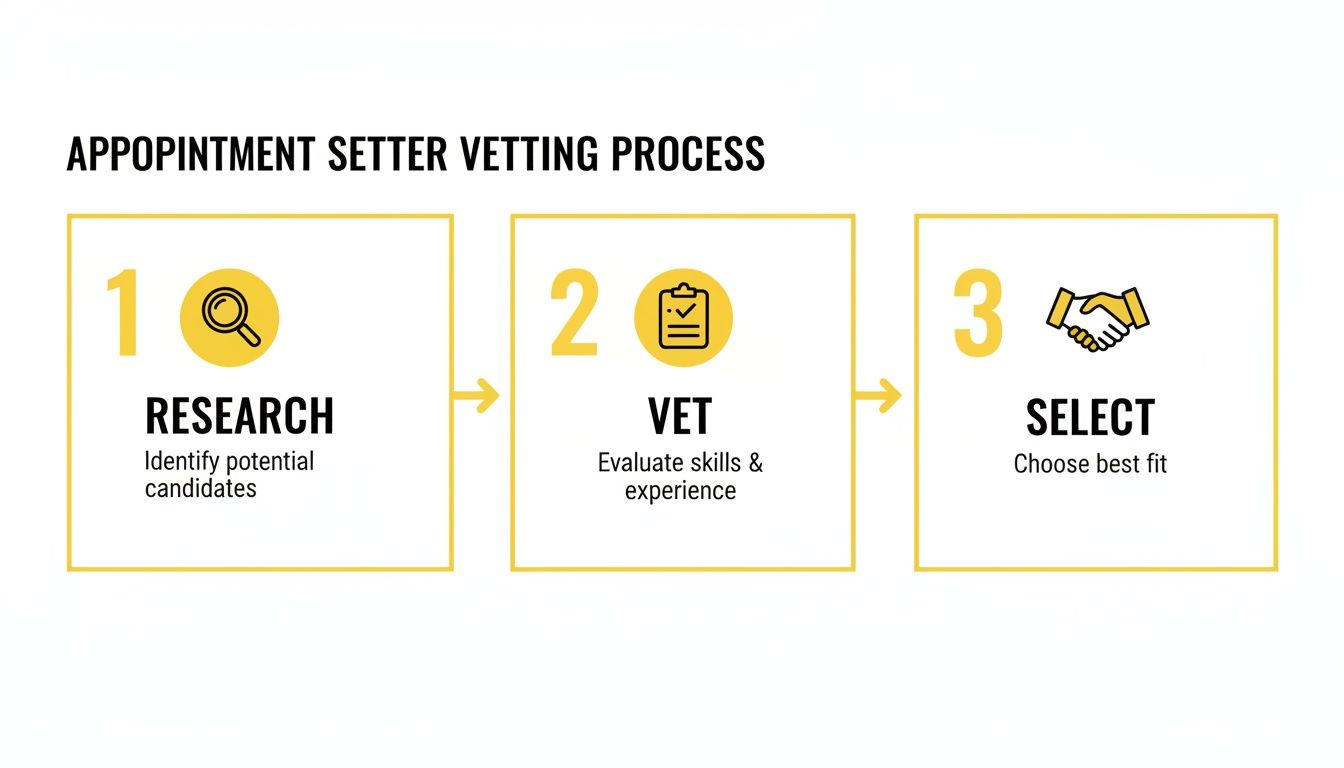
This process really highlights a key idea: great onboarding starts with great selection. You're training a team that already has the chops to succeed.
Developing Scripts and Rebuttals That Actually Work
The word "script" makes most people think of a robot reading from a screen. That’s not what we're building. A good script is a flexible framework, a roadmap that guides the conversation toward its destination—a booked meeting.
You need to co-create these frameworks with your partner. Give them the key talking points, the value props, and the must-ask qualifying questions. But then, lean on their expertise to shape it into a natural, conversational flow. They’re the ones on the front lines; they know what lands.
A great script doesn't tell a setter exactly what to say. It gives them the right things to say at the right moments, empowering them to listen and adapt.
Even more important is your objection-handling library. Your outsourced team will get hit with "no." A lot. You need to prepare them for it. Sit down and brainstorm every possible objection you can imagine, then work with your partner to craft proven, empathetic rebuttals.
"We don't have the budget right now." (The response should pivot to ROI and long-term value, not price.)
"We're already working with someone else." (This is a chance to highlight a key differentiator they won't get from their current vendor.)
"Just send me an email." (A classic brush-off that a good setter can turn into an opportunity by creating urgency or offering immediate value.)
A team that's been prepped for objections doesn't get rattled. They see them as opportunities to have a real conversation and clarify your value.
Nailing the CRM Setup and Workflows
Technology is the glue that holds this whole partnership together. Your outsourced team needs the right access and a crystal-clear workflow inside your Customer Relationship Management (CRM) system. Without it, you’re flying blind.
Here’s a quick checklist for a smooth tech setup:
Create Dedicated User Profiles: Every setter needs their own login. Critically, their permissions should be locked down to only what they absolutely need to do their job. This is non-negotiable for security and data integrity.
Define Lead Statuses: Get hyper-specific with your tags for every call outcome (e.g., "Connected - No Interest," "Booked - Qualified," "Gatekeeper - Call Back," "Wrong Number"). Vague statuses lead to messy, useless reports.
Map Out the Handoff: What happens the instant an appointment is booked? Does the setter assign the lead to a specific AE in the CRM? Does an automated email sequence kick off? Document every step so a hot lead never, ever falls through the cracks.
This technical integration is what makes it all work. It’s how you track performance, prove ROI, and ensure a seamless handoff from the setter to your sales team. A solid onboarding process makes your outsource appointment setting initiative feel less like hiring a vendor and more like you’ve just expanded your team.
Setting KPIs and Measuring Your Success

Once your outsourced appointment setting team is up and running, the real work begins. This is where you start managing the partnership for results, and it all boils down to one simple rule: if you don't measure it, you can't improve it.
Just tracking the number of calls they make is a rookie mistake. It leads to busy work, not business growth. You need to establish clear Key Performance Indicators (KPIs) that tie your partner's daily grind directly to your bottom line. This isn't about micromanagement; it's about building a transparent system for accountability. When everyone knows what success looks like, you create the foundation for a profitable, long-term relationship.
Moving Beyond Vanity Metrics
First thing's first: you have to filter out the noise. A lot of agencies will try to wow you with "vanity metrics" like total dials or emails sent. While that activity is necessary, it tells you nothing about the quality of the outreach. Your focus should be squarely on performance and outcome-based KPIs.
A simple, effective dashboard is your best friend here. It doesn't need to be some complex piece of software; a shared Google Sheet or a basic CRM report works just fine. The real key is tracking the handful of metrics that truly matter and reviewing them religiously with your partner.
Here are the essentials you absolutely must be monitoring:
Dials-to-Connect Ratio: How effective is the team at actually getting a human on the phone? A low number here could mean your contact list is junk or they’re calling at the wrong times.
Appointments Set: This is the headline number. It’s the raw count of meetings booked, giving you a quick pulse on the campaign's volume.
Appointment Show-Up Rate: This one is a critical quality check. If you book 20 appointments but only 8 show up, you don't have a volume problem—you have a qualification or follow-up problem.
Cost Per Qualified Appointment (CPQA): This is the ultimate ROI metric. This number tells you exactly what you’re paying for each legitimate sales opportunity that hits your calendar.
Tracking these numbers gives you a clear, honest picture of performance. It turns your weekly check-ins from fuzzy, subjective conversations into data-driven strategy sessions.
Using Data to Diagnose and Solve Problems
Think of your KPIs as diagnostic tools. When a metric dips, it's a signal to pop the hood and find the root cause alongside your partner. This kind of collaborative troubleshooting is what separates a decent partnership from a great one.
Let’s walk through a common scenario. Your team sets 30 appointments in a month, which looks great on the surface. But then you dig into the data and see the show-up rate is a dismal 40%. Now your sales team is wasting a huge chunk of their week prepping for no-shows.
A low show-up rate is rarely the setter's fault alone. It often points to a breakdown earlier in the process—the script might be creating false urgency, or the qualification criteria are too loose, letting unqualified and uninterested prospects slip through.
Instead of just demanding more appointments, you can use this insight to take specific action. You might work with the team to tweak the script, add a stronger qualifying question, or adjust the value proposition. This collaborative, data-informed approach is how you actively manage the partnership for maximum ROI.
Structuring Your Weekly Check-Ins
Consistency is everything. A standing weekly or bi-weekly meeting is non-negotiable. This is your dedicated time to review the dashboard, listen to a few call recordings, and strategize for the coming week.
Here’s a simple agenda that keeps these meetings productive:
KPI Review: Pull up the dashboard and go through it together. Celebrate the wins and pinpoint any metrics that are trending in the wrong direction.
Call Recording Analysis: Listen to 2-3 calls together—one good, one bad. This gives you invaluable, real-world context behind the numbers and is a fantastic coaching opportunity.
Intel from the Trenches: Ask the team what they're hearing out there. Are new objections popping up? Are prospects mentioning a specific competitor? This is priceless market intel.
Action Items: Before you hang up, clearly define what adjustments will be made before the next meeting. This could be a script change, a new contact list to target, or a different follow-up sequence.
This structured process ensures that both you and your outsource appointment setting partner are always on the same page, working from the same data to hit the same goal: filling your pipeline with high-quality sales meetings.
Making Sense of Pricing Models and Sidestepping Common Pitfalls
Figuring out the money side of outsourcing is just as critical as vetting the team you hire. The right pricing model lines up your partner's goals with your own, but the wrong one can torch your budget and leave you with nothing to show for it. It's a field with a lot of options, and choosing carefully is the first step toward a profitable partnership.
Just as important is knowing what roadblocks to expect. Even with the perfect partner, things can go sideways. Misaligned expectations on what a "good lead" actually is or simple communication breakdowns can derail everything. If you know these common traps ahead of time, you can build safeguards into your agreement from day one and ensure things run a lot smoother.
Decoding the Pricing Structures
Once you start talking to agencies, you’ll find most pricing models fall into one of three buckets. Each has its pros and cons, and the best one for you really depends on your business's predictability, how much risk you're willing to take, and what you're trying to achieve.
Pay-Per-Hour: This is the most straightforward option. You pay a set rate for every hour an appointment setter is working on your campaign. It’s easy to budget for and makes sense when the tasks are a bit more varied or require a lot of research beyond just hitting the phones.
Pay-Per-Appointment: With this model, you only open your wallet when a qualified meeting is officially on your calendar. It's a performance-based setup that a lot of people like because it ties cost directly to results and minimizes your risk. The catch? The cost for each appointment is usually much higher to make it worth the agency's time for all the leads that don't pan out.
Hybrid Model: This is a blend of the first two. It usually involves a lower hourly rate or a monthly retainer, plus a smaller bonus for each appointment they book. This gives you a nice balance of predictable costs and performance-based incentives, making it a very popular and effective compromise.
My advice? Match the model to how mature your campaign is. If you're just testing the waters in a new market or have a really complex sales process, a pay-per-hour or hybrid model gives you the flexibility to tweak your approach. But for a well-oiled, high-volume campaign, pay-per-appointment can be a seriously powerful, results-driven choice.
Choosing the right financial structure is a strategic decision that aligns your outsourcing partner's incentives with your business objectives. The table below breaks down the most common models to help you see which one fits your situation best.
Comparing Appointment Setting Pricing Models
Pricing Model | Best For | Pros | Cons |
|---|---|---|---|
Pay-Per-Hour | New campaigns, complex sales cycles, or when setters perform multiple tasks (e.g., list building). | Predictable monthly cost; easy to budget; encourages focus on quality over quantity. | You pay for effort, not just results; requires close monitoring to ensure productivity. |
Pay-Per-Appointment | Businesses with a clear ICP and a proven value proposition; high-volume needs. | Low upfront risk; you only pay for tangible results; highly motivating for the outsourced team. | Higher cost per appointment; can incentivize setters to prioritize quantity over lead quality. |
Hybrid Model | Established campaigns seeking to balance predictable costs with performance incentives. | Shared risk and reward; encourages consistent effort while still focusing on outcomes. | Can be more complex to track and manage; requires clear terms on what triggers a bonus. |
Ultimately, the best model depends on your risk tolerance and the clarity of your campaign goals. A clear understanding of these options prevents financial surprises and sets the stage for a successful partnership.
Sidestepping Common Outsourcing Pitfalls
Picking a partner and a price is only half the battle. The real long-term success of your decision to outsource appointment setting comes down to avoiding a few classic traps that can ruin the relationship and kill your ROI. Nearly every time, these problems come from a lack of clarity and communication.
One of the biggest issues I see is a major disconnect on what a "qualified" lead actually is. You might define it as a prospect with a specific budget and a clear timeline to buy. Your partner, on the other hand, might just see it as anyone who agreed to a meeting. This gap means your sales team ends up wasting time on calls with people who are a bad fit, which creates a ton of frustration.
Another problem that pops up all the time is just plain bad communication and reporting. If you're only getting a vague update once a month, you have no idea what's actually happening. Without that steady feedback loop, little issues with scripts, call lists, or handling objections can quietly snowball and tank your campaign's effectiveness.
To stop these problems before they start, you have to get out in front of them. Here are a few things that should be non-negotiable:
Get a Watertight Service Level Agreement (SLA): Before you sign a single thing, create an SLA that defines a "Sales Qualified Appointment" in excruciating detail. Spell out the exact criteria a prospect needs to meet—like industry, company size, job title, and a stated need—for that appointment to count.
Set a Rigid Communication Cadence: Make weekly check-in calls mandatory. Use that time to go over the KPIs, listen to some call recordings together, and give them feedback on the spot. This changes the dynamic from a simple vendor relationship to a true strategic partnership.
Insist on Transparent Reporting: You need access to a shared dashboard with real-time data. You should be able to see dials, connects, appointments set, and show-up rates whenever you want. Transparency is what builds trust and lets you make smart, data-driven decisions together.
By tackling these potential issues head-on, you turn your outsourcing plan from a gamble into a well-managed, predictable engine for growing your pipeline.
Frequently Asked Questions
Even with a solid game plan, dipping your toes into the world of outsourced appointment setting usually brings up a few last-minute questions. Getting clear on these final details is what lets you move forward with real confidence. We'll tackle the most common ones we hear from business owners just like you.
Think of this as your final gut check before you sign on the dotted line. We’re going to cover the practical stuff—cost, brand reputation, and the nitty-gritty operational details—so you have the full picture.
How Much Does It Cost to Outsource Appointment Setting?
This is always the first question, and the honest answer is: it’s all over the map. The cost really boils down to the pricing model, where the vendor is located, and just how complex your sales process is. You’re not just buying calls; you’re investing in a pipeline.
Hourly Rates: You could be looking at anything from $10-$15 per hour for solid offshore teams in places like the Philippines to upwards of $50 per hour for highly specialized, US-based pros.
Pay-Per-Appointment: This is a performance model, and it can run you anywhere from $50 to over $300 for a single qualified meeting. That price tag gets bigger depending on your industry and how tough it is to get your target decision-makers on the phone.
The key is to stop thinking of this as just another expense. You have to weigh the cost against the potential lifetime value of a new client. If a $150 appointment turns into a $15,000 deal, the math speaks for itself.
How Do I Ensure the Team Represents My Brand Properly?
Handing over your brand's first impression to an outside team can feel like a big leap of faith, but it’s totally manageable if you do it right. Getting this part right isn't an accident; it's the direct result of a killer onboarding process on your end.
Your best friend here is a detailed sales playbook. This isn't just a script—it needs to capture your brand’s voice, offer deep-dive insights into your ideal customer, provide serious product knowledge, and include approved frameworks for conversations.
You have to stay involved. Regular call monitoring, consistent weekly feedback sessions, and sharing customer success stories are non-negotiable. This is what keeps the outsourced team plugged in and aligned with your company’s mission.
When you commit to that ongoing collaboration, they stop feeling like a vendor and start acting like a true extension of your team.
What Is the Difference Between Lead Generation and Appointment Setting?
A lot of people throw these terms around like they're the same thing, but they’re two totally different stages of the sales funnel. Nailing down the difference is crucial for setting clear expectations with any partner you bring on.
Lead generation is the broad, top-of-funnel activity of drumming up interest. Think marketing campaigns—running social media ads, writing blog posts, or setting up a booth at a trade show. It’s all about casting a wide net to capture initial interest.
Appointment setting, on the other hand, is the surgical strike that comes next. It’s about taking those leads, directly contacting them, qualifying their actual interest and need, and then booking a formal meeting for your sales team. When you outsource appointment setting, you’re usually handing them the leads, and their specialized team takes it from there.
Can an Outsourced Team Handle Both Inbound and Outbound Leads?
Absolutely. Most top-tier appointment setting services are built to manage both inbound and outbound leads. That said, the skills and strategies for each are pretty different, so you’ve got to make sure the vendor actually has expertise in both.
Inbound Leads: With these folks, speed is everything. The team needs to be on top of demo requests, contact forms, and webinar sign-ups with rapid, persistent follow-up to catch them while they're hot.
Outbound Leads: This is a different beast entirely. It demands a proactive, resilient mindset. The team is doing cold outreach to a curated list, trying to spark interest where it didn't exist before.
Getting confirmation that a vendor can crush both ensures they can support your entire sales pipeline, no matter how a lead finds its way to you.
Ready to stop wondering where your next sales meeting will come from? Wojo Media bolts onto your business to build a predictable, omnipresent advertising system that fills your calendar with qualified, ready-to-buy prospects. We've launched over 17,000 campaigns, scaled 1,320+ businesses, and have the five-star reviews to prove it.
Book a free demo call today and get a custom-built strategy to see how we can drive predictable growth for your business.
Comments