.png)
Ad Agency for Small Business: Find, Vet, and Hire the Right Partner

As a small business owner, you're a professional juggler. You handle operations, chase down invoices, manage customer service, and somehow, you're also supposed to be a marketing expert. Trying to run your own ads can feel like the "smart" financial move, but I've seen it time and time again—it often just leads to wasted money and stalled growth.
This is exactly why partnering with the right ad agency isn't a luxury; it's a strategic move that can completely transform your marketing from a frustrating expense into a predictable engine for growth.
Why Smart Small Businesses Hire an Ad Agency
Let's be real, the thought of paying an agency can feel intimidating when you're used to doing everything yourself. Taking on marketing feels like just one more hat to wear. But that DIY mindset, while admirable, can end up costing you a fortune in bungled campaigns and missed opportunities.
The problem is, "running ads" isn't just about clicking a few buttons on Facebook or Google. That's the tiny, visible tip of a massive iceberg. A real agency isn't just a button-pusher; they're architects building a complete, data-backed system designed to bring you customers. It’s a crucial difference.
Moving Beyond DIY Marketing Efforts
Trying to master the insane complexity of platforms like Google or Meta without years of dedicated experience is like deciding to be your own mechanic. Sure, you might watch a few YouTube videos and get the car to start, but is it running efficiently? Or is it about to break down on the highway?
An agency brings that focused, expert knowledge to navigate the constant algorithm changes and new features. This partnership immediately frees you up to get back to what you're actually good at: running your business. Instead of losing your nights to ad-buying tutorials, you can focus on making your products better, leading your team, and keeping your customers happy.
A great ad agency becomes a true extension of your team. They bring the specialized skills and strategic brainpower needed to turn your ad budget into a reliable stream of revenue and qualified leads.
The True Value of Agency Expertise
The right partner brings a whole arsenal of skills to the table—skills that would be incredibly difficult and expensive to hire for in-house.
What are you really paying for?
Strategic Planning: They don't just jump in. They dig into your market, spy on your competitors, and build a profile of your ideal customer to create a game plan that has a real chance of working.
Creative Production: This is a big one. They handle the ad copy, the graphic design, and even the video. Many agencies are pros at crafting full-funnel content plans, including sophisticated small business video marketing campaigns that actually connect with people.
Data Analysis and Optimization: This is where the magic happens. They live and breathe the numbers—obsessing over metrics like Cost Per Acquisition (CPA) and Return on Ad Spend (ROAS). They are constantly tweaking and testing to squeeze every last drop of performance out of your campaigns.
Decoding the Different Types of Ad Agencies
Let's get one thing straight: not all ad agencies are the same. Picking the wrong partner is the fastest way I've seen small businesses burn through their budget and end up with nothing but frustration.
The real key is to match an agency's core strength with your most important business goal. Are you trying to make the register ring on your e-commerce site? Or do you just need the phone to start ringing with qualified leads? The answer dictates the kind of partner you need.
Before you even start looking, you have to decide if an agency is the right move at all. Continuing to DIY your ads versus bringing in a pro is a major fork in the road for any business owner.
This decision tree breaks it down pretty clearly:
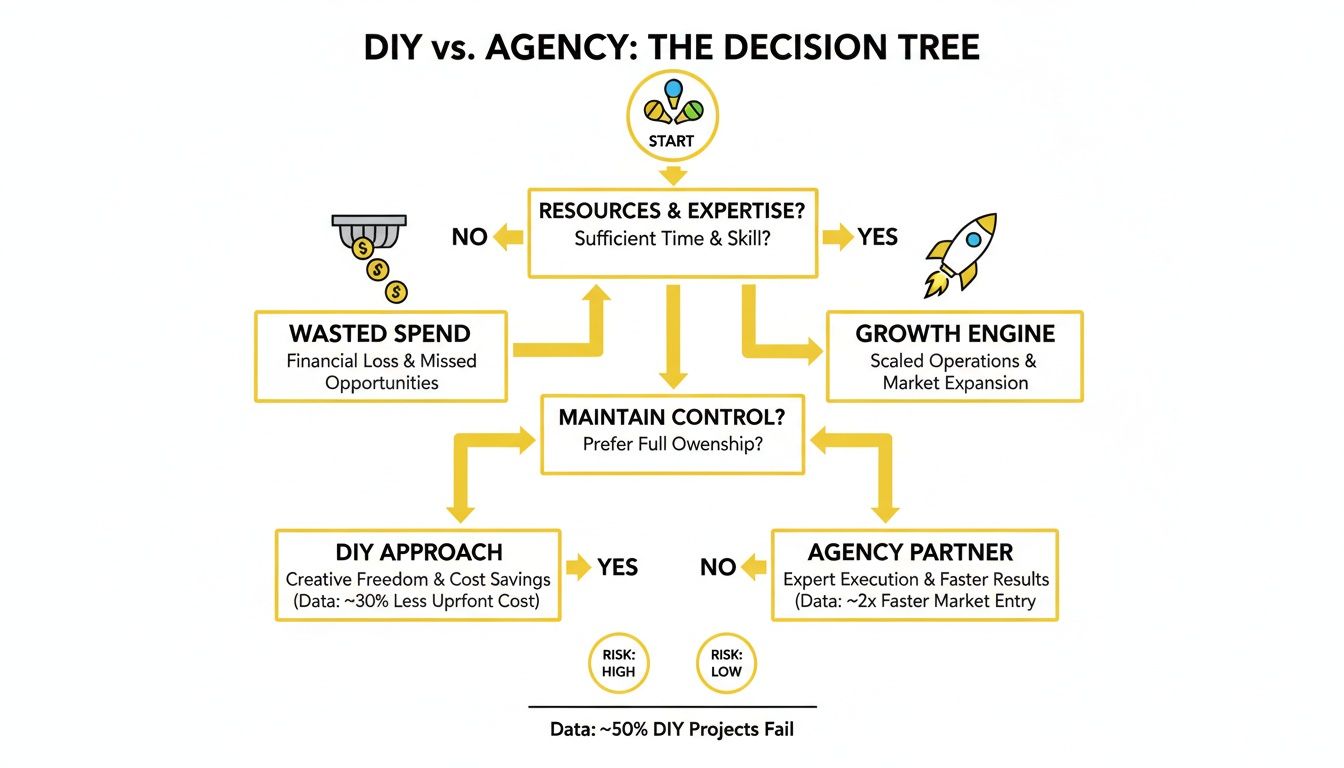
When you find the right fit, your ad spend stops being a frustrating expense and starts becoming a true growth engine for your business. So, let’s look at the different types of partners who can build that engine for you.
Full-Service vs. Specialized Agencies
You’ll run into the full-service agency pretty quickly. They aim to be a one-stop shop, handling everything from social media and SEO to PR and ad buying. It sounds convenient, but they can often be a "jack-of-all-trades, master-of-none." That's rarely a good fit for a small business that needs sharp, immediate results from every dollar spent.
Then you have the specialized or boutique agency. These guys focus intensely on one or two things and do them exceptionally well. Maybe it's running Google Ads for local roofers or scaling Shopify stores on Meta's platforms. That laser focus is exactly what most small businesses need to actually compete and win.
Performance and Direct Response Agencies
Now we're getting to the good stuff. For most small businesses, this is where you should be looking. A performance marketing agency is obsessed with one thing: measurable results.
They live and breathe data points like Cost Per Lead (CPL) and Return on Ad Spend (ROAS). They don't care about clicks for the sake of clicks; they're all about generating profitable actions for your business.
These are the go-to agencies for:
E-commerce Stores: Their entire world revolves around driving sales and hitting a target ROAS.
Local Service Businesses: Campaigns are built from the ground up to generate qualified leads and booked appointments.
Coaches & Consultants: They’re experts at filling webinar funnels and booking discovery calls.
A true performance agency doesn’t waste your time with vanity metrics like impressions or reach. They connect every single dollar you spend directly to revenue or qualified leads, giving you undeniable proof of their impact on your bottom line.
Creative Shops and Media Buying Firms
A creative agency is all about the "what"—the ad concepts, the video production, the copywriting. They are the storytellers. While their work is critical, they often don’t handle the other half of the equation: actually placing the ads.
That’s where a media buying agency comes in. They focus on the "where"—getting those ads in front of the right eyeballs on the right platforms, as efficiently as possible.
For a small business, you really want to find a performance agency that has mastered both sides of this coin. You need a team that can develop killer creative and strategically deploy it to get you the best results.
Which Agency Type Is Right for Your Small Business?
To make it even clearer, here’s a quick breakdown to help you match your goals to the right kind of agency. Finding the right fit from the start saves a ton of headaches down the road.
Agency Type | Best For | Typical Pricing Model | Primary Goal |
|---|---|---|---|
Performance Agency | E-commerce, Local Services, Lead Gen | Retainer + % of Ad Spend, or Revenue Share | Profitable growth (ROAS, CPL) |
Full-Service Agency | Larger businesses with complex needs | Large Monthly Retainer | Brand Awareness & Market Share |
Specialized/Boutique | Businesses needing deep expertise in one channel | Project-Based or Retainer | Channel-specific mastery (e.g., SEO, TikTok) |
Creative Agency | Businesses with in-house media buyers | Project-Based or Retainer | High-quality ad assets and branding |
Media Buying Agency | Businesses with a strong in-house creative team | Percentage of Ad Spend | Efficient ad placement and reach |
Ultimately, most small business owners will get the best bang for their buck from a Performance Agency. They are wired to think like a business owner, focusing relentlessly on the metrics that actually move the needle.
Setting a Realistic Small Business Advertising Budget
Let’s talk about money. It can be an awkward conversation, but it's hands-down the most important one you'll have when hiring an ad agency. Your total investment is made up of two key parts: the agency’s management fee for their time and expertise, and the actual ad spend that goes directly to platforms like Google or Meta.
A classic mistake I see business owners make is getting fixated on the management fee. A cheap agency is no bargain if they burn through your ad spend and get you zero results. A real growth partner will justify their fee many times over by generating a profitable return on your entire investment—their fee plus your ad spend.
Understanding Agency Pricing Models
Agencies usually structure their fees in a few different ways. The right model for you really depends on your business goals, your cash flow, and what you’re trying to achieve. Don't be shy about asking them which model they prefer and why they think it’s the best fit for you.
You'll almost always run into one of these three structures:
Monthly Retainer: This is a simple, fixed fee you pay each month for a specific scope of work. It’s predictable and makes budgeting a breeze, which is why it’s so popular for ongoing campaigns.
Percentage of Ad Spend: Here, the agency takes a cut of your monthly ad budget—often 10-20%—as their fee. This model scales as you spend more, so the agency's success is directly tied to your marketing efforts.
Performance-Based: This one is less common but can be a game-changer. The agency’s fee is tied directly to results, like a percentage of revenue they generate or a flat rate for every qualified lead. It gives them serious skin in the game.
Choosing the right pricing model is all about aligning incentives. A performance or percentage-of-spend model makes sure the agency is motivated to scale your budget profitably. They only make more when you make more. That's a true partnership.
So, How Much Should You Actually Spend?
This is the million-dollar question, isn't it? While a study found 41% of small businesses spend under $500 a month, that’s rarely enough to get the data a professional campaign needs to really take off. The numbers don't lie: among businesses that increased their marketing spend, a whopping 88% saw their revenue hold steady or grow. You can dive deeper into these small business marketing stats to see the full picture.
For working with a quality agency that knows what they're doing, a realistic starting point is usually a minimum of $2,500-$5,000 per month in total investment. That number covers both the agency fee and the ad spend.
Here’s how that might break down for different businesses:
Local Contractor: A $3,000 total monthly budget could look like a $1,500 retainer for the agency and $1,500 in ad spend. The goal would be to generate a predictable number of leads at a target Cost Per Lead (CPL).
E-commerce Store: With a $5,000 budget, an agency might work on a 20% of ad spend model. That’s a $1,000 fee, leaving $4,000 to drive sales, aiming for a specific Return on Ad Spend (ROAS) like 3x or 4x.
At the end of the day, this isn't about spending money—it's about investing it. Frame your budget conversation around the return you need to see, not just the cost you're willing to absorb.
How to Vet an Agency and Identify the Best Partner
Finding the right ad agency goes way beyond a flashy website or a slick sales pitch. You're not just hiring a service; you're looking for a genuine growth partner. That means you need to dig deep into their process, their past wins, and how they think strategically. It's on you to separate the real experts from those who just talk a good game.
The first thing you should do is treat their case studies like a detective. Don't just get wowed by big, impressive-sounding numbers. A solid case study will walk you through the client's initial problem, the exact strategy the agency rolled out, and the specific, measurable results they delivered. If it's full of vague fluff like "increased brand awareness," that's a red flag.
Look for proof that’s actually relevant to your business. If you run a local med spa, a case study about a huge national e-commerce brand isn’t nearly as compelling as one showing how they generated qualified leads for another local service business in a tough market.
Mastering the Discovery Call
Those initial calls with potential agencies are your golden opportunity to see what they're really made of. This isn't just their time to sell you; it's an interview, and you're the one in charge. Come prepared with a list of sharp, open-ended questions designed to peel back the curtain on how they think and operate.
Here are a few essential questions I always recommend asking:
Before you ever launch an ad, what does your strategy and research process look like? (A great agency will talk about deep dives into competitor analysis, building out customer avatars, and refining your core offer.)
How do you approach creative testing? (You want to hear a clear methodology for testing different ad copy, images, videos, and audiences to find the winners.)
Walk me through a campaign that failed. What happened, and what did you learn from it? (This is a huge one. It reveals honesty, problem-solving skills, and whether they're committed to learning from mistakes.)
Who will be my day-to-day point of contact, and what's their direct, hands-on experience with platforms like Google or Meta? (This ensures you aren't just handed off to a junior account manager after you sign the contract.)
For a business like mine, how do you define success, and what KPIs will you be obsessed with? (Their answer needs to lock in with your actual goals, like Cost Per Lead or ROAS, not fuzzy vanity metrics.)
When you're evaluating potential partners, you should also look for deep expertise in areas like small business PPC services to make sure their skills align with your specific growth needs. Their answers will tell you everything.
A top-tier agency will spend more time asking you questions than talking about themselves. They'll be intensely curious about your business model, profit margins, customer lifetime value, and sales process. This deep curiosity is the hallmark of a true strategic partner.
Spotting the Red Flags
Knowing what to look for is only half the battle; you also have to know what to avoid. Certain phrases and behaviors are immediate warning signs that an agency might not be the right fit, or worse, that they're all talk.
Be extremely cautious if you run into any of these red flags:
"Guaranteed Results": No one can guarantee results in advertising. Period. The market is always changing, and anyone making promises like that is either inexperienced or being dishonest.
A Vague Strategy: If they can't clearly explain their plan and instead hide behind buzzwords and industry jargon, it's likely because they don't have a real, repeatable process.
One-Size-Fits-All Packages: Your business is unique. Any agency pushing a cookie-cutter approach that ignores your specific industry, audience, or goals is setting you up for wasted ad spend.
Lack of Reporting Transparency: If they seem hesitant to show you all the data—the good, the bad, and the ugly—and explain what it all means, they're probably hiding something.
Choosing the right ad agency is one of the most critical growth decisions you'll make for your small business. By dissecting their past work, asking the right questions, and keeping an eye out for these warning signs, you can confidently find a partner who will help you build a predictable and profitable engine for acquiring new customers.
What a Strong Agency Onboarding Process Looks Like
You’ve signed the contract. The excitement is running high. But what happens next is what really separates the pros from the amateurs. The first 30 days aren't just about flipping a switch on your ads; they’re about laying the strategic groundwork for a profitable, long-term partnership.
A great agency doesn't just take your money and vanish for two weeks. The whole process should kick off almost immediately with a formal kickoff call. And I don't mean a quick chat—this is a deep-dive session where you meet your dedicated team, they walk you through the first month's roadmap, and you all agree on how you'll communicate.
From there, it's all about getting under the hood of your business. They'll need access to your existing ad accounts, your Google Analytics, and anything else that holds data. This isn't a power grab. It’s so they can run a full audit on your history, figuring out what worked, what bombed, and where the low-hanging fruit is.

Building the Strategic Framework
Once the initial audit is done, the real work begins. Your new agency should be scheduling deep-dive sessions to become absolute experts on what makes your business tick. This is where you, the owner, become their most valuable asset.
Get ready for them to dig into:
Your Core Offer: They’ll poke and prod at your offer, asking tough questions to make sure it's completely irresistible to the right people.
Your Ideal Customer: They should go way beyond basic demographics. A good team will build a detailed customer avatar, getting into the weeds on their biggest fears, frustrations, and desires.
Your Brand Voice and Messaging: They have to learn your language. The goal is for their ad copy to sound like it came directly from you, not some generic template.
This intensive discovery phase is completely non-negotiable. It's the only way an agency can craft messaging that actually connects, design creative that stops the scroll, and build landing pages that turn clicks into cash.
A strong onboarding process should feel more like an intense workshop than a simple hand-off. The best agencies will pull you into the strategy, using your deep knowledge of your business to build a campaign that feels like a true extension of your brand.
By the end of that first month, you shouldn't have any lingering questions. The agency should present a full strategic plan, show you the first round of ad concepts, and give you a clear set of KPIs they plan to track obsessively. This kind of transparent, collaborative start builds a partnership on trust and a shared goal: getting you real, measurable results.
Building a Profitable Long-Term Agency Partnership
So, you’ve made it through the onboarding maze and the first campaigns are officially out in the wild. This is where the real work begins—forging a partnership that’s not just durable, but truly profitable. Forget grand launches; this next phase is all about steady communication, smart, data-backed decisions, and a shared vision for long-term growth.
An agency isn't a vending machine. You don't just put money in and get instant customers out. Think of them as a growth partner. Your role shifts from vetting and interviewing to actively collaborating.
The most powerful results happen when your deep, firsthand knowledge of your customers is fused with an agency's specialized marketing skills. In fact, research shows that the 42% of small businesses that blend their internal expertise with outside agency support achieve 2.5 times more marketing success than those trying to juggle it all themselves. These advertising industry findings lay out just how powerful that synergy can be.
Nailing Down Your Communication Rhythm
Great partnerships are built on clear, consistent communication—and no, that doesn’t mean more meetings for the sake of meetings. A top-notch agency respects your time. They’ll establish a rhythm that keeps you in the loop without bogging you down.
It usually looks something like this:
Weekly Check-Ins: A quick email or a 15-minute call is perfect. You’ll cover the past week’s performance, celebrate wins, and tackle any immediate challenges.
Monthly Strategy Reviews: This is your deep-dive session. You'll crunch the numbers and have a forward-looking chat about next month’s strategy, budget adjustments, and new creative tests.
Urgent Updates: For time-sensitive stuff—like a sudden spike in ad costs or a broken landing page—there should be a dedicated channel, like a shared Slack room, for immediate action.
Focusing on the KPIs That Actually Pay the Bills
Impressions and clicks look nice on a report, but they don't pay your bills. A true performance-focused agency will steer the conversation toward the metrics that directly impact your bottom line. These are the numbers you and your agency should be obsessed with.
The health of your agency relationship can be measured by the quality of your conversations. If you're talking about lead quality and customer lifetime value, you're on the right track. If the conversation never gets past click-through rates, there’s a problem.
For most small businesses, these are the KPIs that matter most:
Customer Acquisition Cost (CAC): How much does it really cost you to land a new paying customer?
Cost Per Lead (CPL): The magic number for service-based businesses—what does it cost to get one qualified lead in the door?
Return on Ad Spend (ROAS): The lifeblood of e-commerce. For every dollar you put into ads, how many dollars in gross revenue are you getting back?
Lead-to-Close Rate: This is a team effort. What percentage of the leads the agency brings in are actually turning into paying customers?
Don't panic when performance dips. It happens. Not every ad or campaign will be a home run right out of the gate. A strong partner won’t make excuses. They’ll come to you with the data, explain what they learned from the experiment, and lay out a clear plan for what to test next. This cycle of testing, learning, and optimizing is the engine that drives sustainable, profitable growth.
Common Questions About Hiring an Ad Agency
When you're thinking about bringing on an ad agency, a few key questions always come up. Let's tackle them head-on so you know exactly what to expect.
How Long Until I See a Return on My Investment?
Look, everyone wants results yesterday. While you can definitely see some positive signals within the first 30 days—like increased traffic or lead flow—a campaign really needs about 60-90 days to hit its stride.
Think of that initial period as the data-gathering phase. It's all about testing: testing audiences, testing creative, testing the message. This is how we find the winning formula before you start scaling up your budget. Once that’s dialed in, you get the consistent, predictable returns you’re looking for.
Who Should Own the Ad Accounts and Creative Assets?
This is non-negotiable: you, the business owner, must always retain 100% ownership of your ad accounts (Google, Meta, etc.) and every piece of creative material.
A trustworthy agency will operate as a partner, working directly within your existing accounts. This is critical. It ensures that if you ever part ways, all of your valuable campaign data, audience insights, and creative assets stay with you. You paid for it, you own it.
Is an Agency Better Than a Freelance Media Buyer?
It really depends on your goals. A freelancer is one expert, which can work for simpler campaigns. But an agency brings a full team to the table—you get a strategist, a copywriter, a designer, a media buyer, and an account manager.
For a business that’s serious about building scalable, multi-channel campaigns, that depth of resources is a game-changer. You're not just hiring a button-pusher; you're bringing on a strategic growth partner with a comprehensive skillset.
Ready to build a predictable growth engine for your business? Wojo Media bolts onto your brand to drive measurable results with omnipresent advertising. Book a free demo call and get a custom paid ads strategy today.
Comments