.png)
Best real estate marketing strategies: Winning ideas for 2025

In today's hyper-competitive real estate market, generic marketing no longer cuts it. The agents, lenders, and investors who succeed are those who move beyond outdated tactics and embrace a multi-channel, data-driven approach. Stagnant lead flow, unpredictable ROI, and wasted ad spend are common frustrations, but they don't have to be your reality. This guide reveals the 10 best real estate marketing strategies that high-performing professionals are using to generate predictable, profitable growth.
We'll break down each strategy with actionable steps, real-world examples, and implementation checklists to help you build an omnipresent marketing system. To achieve market dominance, embracing potent multi-channel marketing strategies for 2025 is no longer optional; it's the foundation of scalable success. This playbook is designed to give you that exact foundation.
Forget vague advice and surface-level tips. Instead, you'll get a detailed walkthrough of systems that work, from optimizing paid ad campaigns on platforms like Facebook and Google to building high-converting lead funnels and leveraging user-generated content. We will cover comprehensive tactics including:
Omnichannel Paid Advertising: Mastering Facebook, Instagram, TikTok, and Google Ads.
Conversion-Focused Landing Pages: Building pages that turn clicks into qualified leads.
Video Marketing & Property Tours: Engaging buyers and sellers with dynamic video content.
Lead Generation Funnels: Creating automated systems with webinars and educational content.
Data-Driven Performance Tracking: Understanding the KPIs that truly matter for ROI.
Whether your goal is to attract more seller leads, close more loans, or find more investment deals, these proven strategies provide the blueprint for scaling your business in 2025 and beyond. Let's dive in.
1. Omnichannel Paid Advertising (Facebook, Instagram, TikTok, Google, YouTube)
Gone are the days of relying on a single platform to generate leads. One of the best real estate marketing strategies today is an omnichannel approach, where you deliver a cohesive and persistent message across multiple digital channels simultaneously. This ensures your brand remains top-of-mind by engaging prospects wherever they spend their time, from scrolling social feeds to searching for homes or watching videos.
This method, often called "omnipresent" marketing by agencies like Wojo Media, follows potential clients across their entire digital journey. Instead of treating each platform as a silo, it creates a unified experience that builds trust and authority. By leveraging the unique strengths of each channel, you can guide a prospect from initial awareness on TikTok to deep engagement on YouTube and final conversion through Google Ads.
How to Implement Omnichannel Paid Ads
Property Showcase: Run dynamic, visually appealing carousel ads on Facebook and Instagram featuring your latest listings, complete with high-quality photos and virtual tour links.
High-Intent Search: Capture active searchers with Google Local Services Ads and targeted search campaigns for keywords like "real estate agent in [City]" or "homes for sale [Neighborhood]."
Video Engagement: Create and promote neighborhood tours, client testimonials, or market update videos on YouTube to establish yourself as a local expert.
Short-Form Content: Use TikTok and Instagram Reels to share quick property highlights, behind-the-scenes content, or "day in the life" videos to build a personal brand connection.
Actionable Tips for Success
Key Insight: The goal is consistency in messaging, not uniformity in creative. Adapt your core message to fit the native format and user expectations of each platform for maximum impact.
To make this strategy work, maintain consistent branding across all channels but tailor your ad creative. A polished video tour for YouTube won't work as a 15-second TikTok. Next, implement conversion tracking pixels on all platforms to meticulously monitor performance and understand which channels deliver the most valuable leads. Finally, use sequential retargeting to show different ads to users based on their previous interactions, nurturing them from cold prospects to warm leads.
2. Conversion-Focused Landing Pages with Optimized Offers
Driving traffic to your generic website homepage is one of the most common and costly mistakes in real estate marketing. Instead, a superior strategy involves sending paid traffic to specialized, conversion-focused landing pages. These pages are designed with a single goal: to convert a visitor into a qualified lead by presenting a compelling, high-value offer with minimal friction.

This direct-response approach, perfected by agencies like Wojo Media for achieving sub-$10 lead costs, isolates the visitor from all other distractions (like navigation menus or blog links) and focuses their attention entirely on the action you want them to take. By combining persuasive copywriting, trust-building social proof, and a clear call-to-action, these pages can achieve conversion rates of 25% or higher, dramatically improving the ROI of your advertising spend.
How to Implement Conversion-Focused Landing Pages
For Seller Leads: Create a page offering a "Free, Instant Home Value Estimate" or a "Detailed Neighborhood Market Analysis." The form should be simple, asking only for the property address and contact information initially.
For Buyer Leads: Build a landing page that gives access to an exclusive list of "Off-Market Properties" or a "First-Time Homebuyer's Guide" in exchange for their contact details.
For Mortgage Leads: Design a page with a "5-Minute Pre-Qualification Tool" or a "Current Mortgage Rate Comparison Sheet." This offers immediate, tangible value to mortgage shoppers.
For Investor Leads: Offer a "Free Property Analysis & Market Report" for a specific investment property type, positioning yourself as an expert resource for finding profitable deals.
Actionable Tips for Success
Key Insight: Your landing page headline and offer must perfectly match the promise made in your ad. Any disconnect creates confusion and causes visitors to bounce, wasting your ad budget.
To maximize conversions, remove all navigation menus to eliminate exit points and keep the user focused on the offer. Lead with a benefit-driven headline like "Find Out Your Home's True Value in 60 Seconds" instead of a feature-focused one like "Our Home Valuation Tool." Finally, embed social proof directly on the page, such as video testimonials or client reviews with specific results (e.g., "Sold our home in 7 days for $25k over asking"), to build instant credibility and trust.
3. Video Marketing and Property Tours (YouTube, TikTok, Instagram Reels)
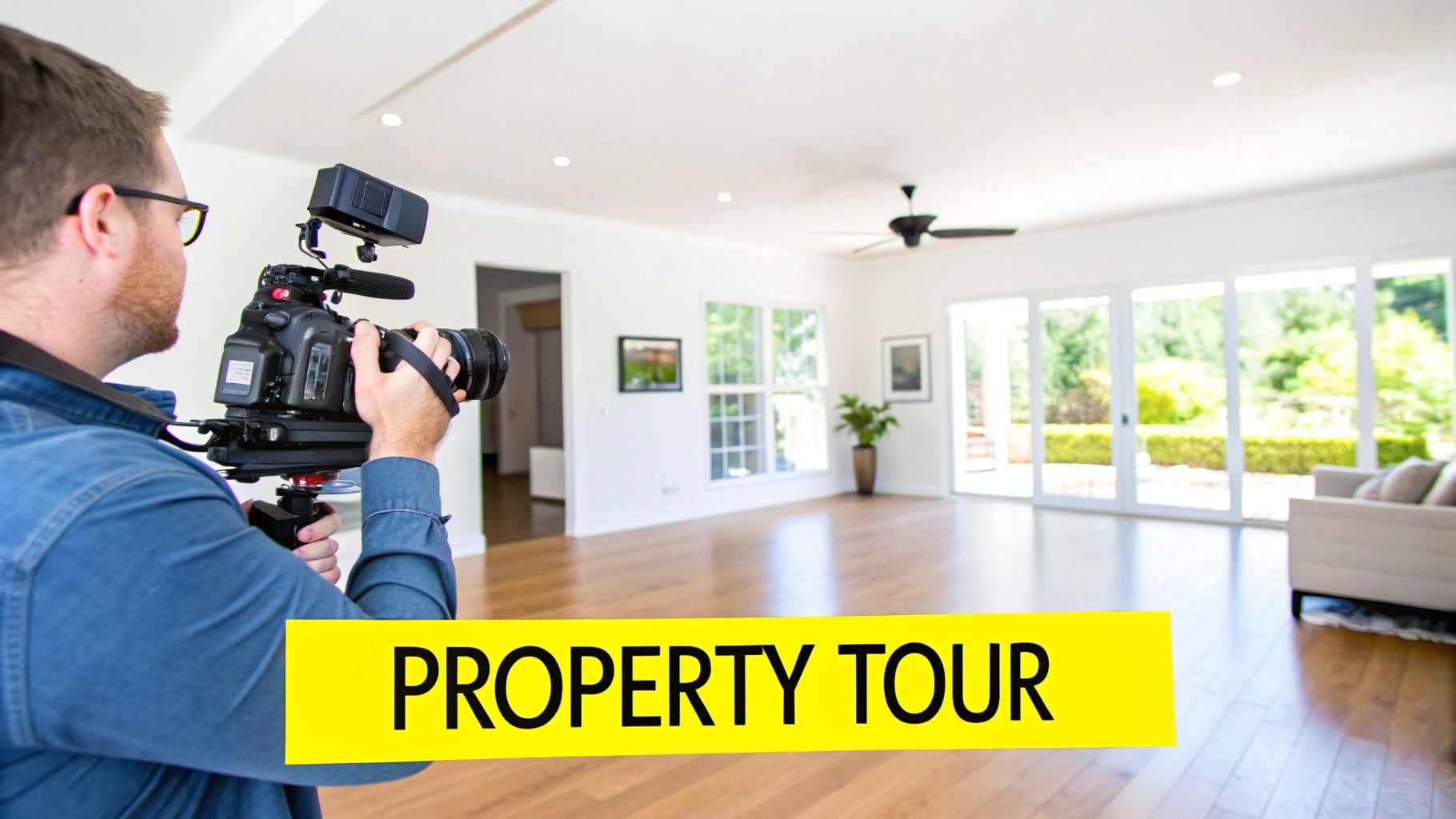
Static photos are no longer enough to capture buyer attention. A top-tier real estate marketing strategy involves immersive video content that tells a story, showcases a lifestyle, and builds a direct emotional connection. By leveraging platforms like YouTube, TikTok, and Instagram Reels, you can transport potential clients inside a property and community before they ever step foot through the door.
Video marketing drives significantly higher engagement and allows you to demonstrate your expertise in a more personal format. Whether it's a professionally shot cinematic tour or a quick, authentic clip, video helps prospects visualize their future, making it a powerful tool for generating qualified inquiries and building your brand.
How to Implement Video Marketing
Cinematic Property Tours: Create high-quality, professional video tours for YouTube that highlight a property's best features, often incorporating drone footage for a dramatic establishing shot.
Neighborhood Guides: Establish authority by producing detailed neighborhood guides for YouTube, such as "Moving to [City]: Complete Guide," which ranks well in search results for location-based keywords.
Short-Form Highlights: Use TikTok and Instagram Reels to post engaging 30-second property highlight videos, behind-the-scenes content, or before-and-after home transformations that can go viral and attract massive attention.
Live Q&A Sessions: Host live-streamed open houses or Q&A sessions on YouTube or Instagram to interact with potential buyers in real-time, answer questions, and build community trust.
Actionable Tips for Success
Key Insight: Hook viewers within the first three seconds. In the fast-paced world of social media, your intro determines whether a user stops scrolling or keeps moving. Start with the most compelling visual or a provocative question.
For TikTok and Reels, keep videos under 60 seconds and use trending audio and fast-paced transitions to maintain viewer engagement. When creating YouTube content, target long-tail, buyer-intent keywords like "How to Get Pre-Approved for a Mortgage" to attract a motivated audience. Remember to use captions and text overlays, as over 70% of social videos are watched without sound. Finally, maximize your efforts by repurposing one long-form video into five or six short clips for different platforms.
4. Lead Generation Funnels with Webinar and Educational Content Strategy
Instead of directly selling your services, one of the best real estate marketing strategies is to attract clients by offering genuine value upfront. An educational funnel does this by using high-value content like webinars, workshops, or guides to solve your audience's most pressing problems, positioning you as the go-to expert before ever asking for their business.
This approach builds trust and authority by addressing key pain points, such as a first-time homebuyer's uncertainty or an investor's desire for a proven deal-finding framework. By leading with education, you attract a more engaged and qualified audience that sees you as a trusted advisor, not just a salesperson. This method is highly effective for generating high-quality leads, from first-time buyer masterclasses that convert attendees into pre-qualified applicants to investor webinars that attract wholesale deal partners.
How to Implement an Educational Content Funnel
Investment Focus: Host a webinar on "How to Analyze Your First Rental Property" to attract aspiring investors and capture their contact information for your investor client list.
First-Time Homebuyers: Create a downloadable "Ultimate First-Time Homebuyer's Guide" that walks prospects through the entire process, from mortgage pre-approval to closing day.
Seller Leads: Run a "Home Selling Secrets" workshop (virtual or in-person) that reveals strategies for maximizing a home's sale price in the current market.
Tax & Wealth Building: Partner with a CPA to host a webinar on "Tax Planning for Real Estate Investors," attracting high-net-worth individuals who need expert guidance.
Actionable Tips for Success
Key Insight: The most successful educational content focuses entirely on the audience's pain points and goals, not on your sales pitch. The sale becomes the natural next step after you've proven your value.
First, choose topics based on common client questions, not what you want to sell. A 45-minute webinar that respects attendees' time is far more effective than a lengthy, unfocused presentation. To ensure every potential client inquiry is captured and handled efficiently, real estate professionals can significantly benefit from advanced lead management tools. For example, explore AI receptionist solutions specifically designed for real estate agents to automate appointment setting after a webinar. Finally, implement a strategic post-webinar follow-up sequence: send a thank you with resources on day one, a relevant follow-up offer on day three, and a direct pitch for a one-on-one consultation by day seven.
5. User-Generated Content (UGC) and Client Testimonial Campaigns
In an industry built on trust, nothing sells your service better than the authentic voice of a happy client. Leveraging user-generated content (UGC) and testimonial campaigns is one of the best real estate marketing strategies because it replaces polished brand messaging with powerful, relatable social proof. This approach harnesses genuine client stories, reviews, and video testimonials to build instant credibility and influence prospective buyers and sellers.

Unlike slick, professionally produced ads, UGC feels raw, honest, and far more trustworthy to modern consumers. When a prospect sees a real person, just like them, sharing a positive experience about closing on their dream home or selling their property above asking price, it resonates on a much deeper level. This authenticity can dramatically lower ad costs and increase conversion rates, as seen in campaigns run by agencies like Wojo Media that prioritize testimonial-driven creative.
How to Implement UGC and Testimonial Campaigns
Paid Social Proof: Run Facebook and Instagram ad campaigns featuring short, impactful client video testimonials. These often outperform standard property ads by over 40% in lead cost reduction.
Success Story Case Studies: Create detailed blog posts or downloadable guides titled "How [Client Name] Achieved [Specific Result]," showcasing the before-and-after journey of an investor or first-time homebuyer.
First-Time Buyer Journey: Feature new homeowners on YouTube or TikTok sharing their stories, such as "We Closed in 28 Days at a 4.2% Rate," to connect with and educate similar prospects.
Review-Based Search Ads: Incorporate your 5-star Google review rating directly into your Google Ads copy to immediately boost click-through rates and build trust at the search level.
Actionable Tips for Success
Key Insight: The power of UGC lies in its authenticity and specificity. A testimonial saying you "sold my home for $35,000 over asking in 7 days" is infinitely more compelling than one that just says you were "great to work with."
To execute this strategy effectively, request testimonials immediately after a successful closing while the client's excitement is at its peak. Guide them with specific prompts like, "Talk about the timeline" or "Mention what made the experience special." Keep videos short (30-60 seconds) and don't over-polish them; a genuine cell phone video often performs best. Finally, always get explicit permission to use their content across your ads, website, and social media channels.
6. Search Engine Marketing (SEM) and Local Services Ads
While social media is excellent for building brand awareness, Search Engine Marketing (SEM) captures prospects at the exact moment they are actively looking for a real estate solution. This paid search strategy targets high-intent keywords on platforms like Google, connecting you directly with highly qualified leads who have already decided they need an agent, loan, or investment property.
This approach is one of the best real estate marketing strategies for generating immediate, measurable results. Unlike organic methods that take time, SEM places you at the top of search results for terms like "real estate investor loans" or "property manager near me," ensuring you are the first solution a motivated prospect sees. For local agents, Google's Local Services Ads (LSAs) add a layer of trust by presenting you as a "Google Screened" or "Google Guaranteed" professional.
How to Implement SEM and Local Services Ads
Capture Buyer & Seller Intent: Launch Google Search campaigns targeting geo-specific keywords like "homes for sale in [Neighborhood]" or "how much is my house worth [City]" to attract clients at different stages of their journey.
Target Niche Investors: Create dedicated ad groups for investors searching for "rental property loans" or "off-market properties," using ad copy that speaks directly to their ROI-focused goals.
Dominate Local Search: Use Google Local Services Ads in surrounding counties to generate inbound calls and messages from verified seller and buyer leads, paying on a per-lead basis.
Provide Immediate Value: For mortgage lenders, run ads for "mortgage rates" and "refinance calculator," using ad extensions to showcase current rates directly in the search results.
Actionable Tips for Success
Key Insight: Success in SEM is about relevance. The more closely your ad copy and landing page match the user's search query, the higher your Quality Score will be, leading to lower ad costs and better positioning.
To maximize your return, start with broad match keywords and use the search term report to identify negative keywords and high-performing long-tail variations. Create separate ad groups for different client types (buyers vs. investors) with tailored ad messaging for each. Always use location-based modifiers like "Tampa real estate investor" to improve conversion rates. Finally, test Local Services Ads with a small daily budget ($15-$25) to assess lead quality in your area before scaling up your investment.
7. Email Marketing and Automated Nurture Sequences
While newer channels get the spotlight, email marketing remains one of the highest ROI real estate marketing strategies available. It is a cost-effective method for systematically nurturing relationships with past clients, new leads, and referral sources, ensuring you stay top-of-mind from initial interest all the way to closing and beyond. This is not about sending sporadic newsletters; it's about building automated systems that deliver the right message at the right time.
By segmenting your audience and using automated nurture sequences, you can guide prospects through their unique journey with tailored content. Platforms like HubSpot and Klaviyo have popularized this approach, allowing a solo agent or a large team to manage thousands of relationships efficiently. This strategy transforms your database from a simple contact list into a powerful, automated asset that consistently generates repeat and referral business.
How to Implement Email Marketing and Nurture Sequences
Segment Your Database: Divide your list into distinct groups like first-time homebuyers, potential sellers, past clients, investors, and local business partners. Each group should receive different content.
Build a Lead Magnet: Offer a free, valuable resource (e.g., a "Neighborhood Home Value Report" or "First-Time Buyer's Checklist") on your website to capture new email subscribers.
Create Automated Sequences: Develop automated email flows for different scenarios. For example, a "New Buyer Lead" sequence could deliver a series of educational emails over several weeks, while a "Post-Closing" sequence can solicit reviews and ask for referrals.
Send Consistent Updates: A high-performing agent might send a monthly neighborhood market update to their entire database, generating consistent engagement and keeping them as the go-to local expert.
Actionable Tips for Success
Key Insight: The primary goal of email is not to sell in every message but to build trust and provide value. When the time comes to transact, your name will be the first one they think of.
To maximize your results, focus on personalization beyond just the first name. Use compelling subject lines like, "Sarah, Your Home's Market Value Just Updated," which consistently outperform generic ones. Ensure every email has a clear call-to-action (CTA), such as "Schedule a Free Consultation," but limit it to one or two per message to avoid confusion. Finally, monitor your unsubscribe rate closely; if it climbs above 0.5%, it's a strong signal that your content isn't resonating with that audience segment.
8. Influencer Partnerships and Agent Brand Building
Modern real estate marketing is built on trust, and one of the most effective ways to build it at scale is by borrowing it from established voices. Influencer partnerships allow agents to connect with highly engaged, niche audiences by collaborating with local creators, thought leaders, and even other real estate professionals who have already earned their community's confidence. This strategy moves beyond traditional advertising to position you as a recommended authority in your market.
This approach is one of the best real estate marketing strategies because it leverages social proof to accelerate brand growth. Instead of you telling the market you're the expert, a trusted influencer does it for you. These partnerships, especially with micro-influencers (10k-100k followers), often yield higher engagement and a more authentic connection than collaborations with mega-celebrities, providing a direct line to motivated buyers and sellers in specific local communities.
How to Implement Influencer Partnerships
Lifestyle Collaboration: Partner with a local lifestyle or food blogger to create content showcasing the community around your listings. They can tour a neighborhood, highlight local businesses, and feature one of your properties as the ideal home to enjoy that lifestyle.
Niche Expertise: A real estate investor could sponsor a local finance or business micro-influencer to co-host a webinar on "Investing in Your First Rental Property," positioning the investor as the go-to expert for building wealth through real estate.
Agent-to-Agent Network: Mortgage lenders can partner with top-producing real estate agents (who are influencers in their own right) for co-branded content, like a "Homebuyer's Q&A" on Instagram Live, driving referrals and mutual credibility.
Luxury Property Showcase: A luxury agent can collaborate with an interior designer or high-end car vlogger to feature a stunning property, exposing the listing to an audience with a proven interest in luxury goods and aesthetics.
Actionable Tips for Success
Key Insight: The most successful influencer partnerships are built on audience alignment, not just follower count. A micro-influencer with 15,000 highly engaged local followers is far more valuable than a mega-influencer with 1 million followers scattered globally.
To execute this strategy effectively, focus on long-term relationships (3-6 months) over one-off sponsored posts to build genuine brand recall. Always use a formal partnership agreement that clearly outlines deliverables, compensation, usage rights, and FTC disclosure requirements like #ad or #sponsored. Finally, track performance meticulously by providing each influencer with a unique landing page URL or a specific call-to-action, allowing you to measure the direct impact on your lead generation and brand visibility.
9. Data-Driven Performance Tracking and Backend KPI Optimization
The most effective real estate marketing strategies move beyond surface-level metrics like clicks and impressions. A truly data-driven approach involves a comprehensive analytics framework that tracks every touchpoint, from the initial ad click to the final closing and beyond. This backend KPI optimization replaces guesswork with predictable, profitable growth by revealing which channels and campaigns deliver the highest return on investment.
This advanced methodology, a core principle for agencies like Wojo Media, focuses on measuring what truly matters: lead quality, conversion rates, and customer lifetime value (LTV). By analyzing the entire client journey, you can make informed decisions, reallocating your budget from underperforming channels to those that generate high-value, closed deals, not just cheap leads.
How to Implement Data-Driven Tracking
Lead Source Analysis: A real estate team discovers its Facebook ads, while generating a high volume of leads, only have a 30% consultation conversion rate. In contrast, Google Search leads convert at a 60% rate from consultation to close, prompting them to reallocate their ad budget accordingly.
Email Nurture Optimization: A mortgage lender tracks email sequence performance and finds that nurture sequence #3 converts at 8%, while sequence #1 only converts at 2%. They immediately pause the weaker sequence and test new copy to improve performance.
LTV-Based Budgeting: An investment firm identifies that its YouTube neighborhood tour videos attract prospects who generate multiple referral deals. They increase their YouTube content budget by 300% to scale this high-LTV channel.
Campaign-Level Tracking: By using UTM parameters on all links (e.g., ), you can pinpoint exactly which campaigns drive the most valuable clients.
Actionable Tips for Success
Key Insight: Leads are not created equal. Success isn't about getting the most leads; it's about generating the most profitable closings. Track performance beyond the initial inquiry to understand the true value of each marketing dollar.
To start, implement conversion tracking pixels before launching any significant ad spend to establish a performance baseline. Next, create a unified dashboard using a tool like Google Data Studio to view all your key performance indicators in one place. Most importantly, track beyond the lead by measuring consultation rates, closing rates, and average deal size for each source. This ensures you’re optimizing for profit, not just volume.
10. Strategic Offer and Value Proposition Development
Many agents focus entirely on the marketing channel, forgetting that the offer itself is what drives action. One of the best real estate marketing strategies involves moving beyond generic promises like "I'll sell your home fast" and developing specific, high-value offers that directly address client pain points. A powerful offer is the engine of your marketing; without it, even the most sophisticated ad campaigns will fail to convert.
This foundational strategy centers on crafting compelling, irresistible propositions that make potential clients feel they are receiving immense value with minimal risk. Instead of just advertising your services, you advertise a solution. This shifts the dynamic from you chasing clients to clients seeking out the unique solution you provide, dramatically improving lead quality and conversion rates.
How to Implement Strategic Offers
For Sellers: Create and promote a "Guaranteed Offer Program," a "Flexible Commission Plan," or a "Complimentary Pre-Listing Home Staging Consultation" to alleviate concerns about selling time and cost.
For Buyers: Offer a "Dream Home Finder Service" where you proactively search for off-market properties, or provide a "Free First-Time Homebuyer's Financial Roadmap" to guide them through the complex financial process.
For Investors: Develop a "Free Investment Property ROI Analysis" or a "Curated List of High-Cash-Flow Properties in [Your City]" to deliver immediate, tangible value.
For General Leads: Use lead magnets like a "Comprehensive [Neighborhood] Market Report" or a "Home Seller's Ultimate Checklist" to capture contact information.
Actionable Tips for Success
Key Insight: Your best offer is a direct solution to your ideal client's biggest fear or most urgent problem. Identify that pain point first, then build your value proposition around it.
To make this work, A/B test your offers relentlessly. Run different propositions on your landing pages and social media ads to see which one generates the most qualified leads. Second, clearly articulate the value and scarcity of your offer. Use phrases like "limited to the first 10 homeowners this month" to create urgency. Finally, build entire marketing funnels around your strongest offers, ensuring the promise made in the ad is fulfilled throughout the client's journey.
Top 10 Real Estate Marketing Strategies Comparison
Strategy | Implementation Complexity 🔄 | Resource Requirements ⚡ | Expected Outcomes 📊 | Ideal Use Cases 💡 | Key Advantages ⭐ |
|---|---|---|---|---|---|
Omnichannel Paid Advertising (Facebook, Instagram, TikTok, Google, YouTube) | High 🔄 — multi-platform setup, unified tracking and sequential messaging | High ⚡ — sustained ad budget, cross-channel creative, analytics tooling, experienced team | ⭐⭐⭐ 📊 Broad reach, improved brand recall, steady multi-touch lead flow; CPL reduces with optimization | Agents/investors/mortgage lenders needing consistent volume across audiences | ⭐ Cross-channel retargeting, full-funnel coverage, detailed attribution |
Conversion-Focused Landing Pages with Optimized Offers | Medium 🔄 — design, copy, CRO and A/B testing workflows | Medium ⚡ — page builder, copywriting, analytics, designer/developer | ⭐⭐⭐⭐ 📊 Much higher conversion rates and clearer attribution; lower CPL | Converting paid traffic and testing offers to maximize ROI | ⭐ High conversion lift; fast measurable wins |
Video Marketing and Property Tours (YouTube, TikTok, Reels) | Medium-High 🔄 — production, editing and platform-specific formats | Medium-High ⚡ — camera/drone equipment or production budget, editing time | ⭐⭐⭐ 📊 Increased engagement, faster sales and stronger brand authority; repurposable content | Showcasing properties, building brand, reaching younger buyers | ⭐ Emotional storytelling, SEO benefits on YouTube, wide repurpose |
Lead Generation Funnels with Webinars & Educational Content | High 🔄 — multi-stage funnel, webinar production, automation | High ⚡ — webinar platform, presenters, content creation and ad spend for signups | ⭐⭐⭐⭐ 📊 High-intent leads and authority-building; higher conversion vs. cold traffic | Investor education, lender/masterclass funnels, coach/consultant pipelines | ⭐ Qualifies prospects at scale; content repurposing for long-term use |
User-Generated Content (UGC) & Client Testimonial Campaigns | Medium 🔄 — processes for capture, editing and legal releases | Low-Medium ⚡ — incentives, coordination, light editing | ⭐⭐⭐⭐ 📊 Higher trust and ad performance; improved conversion and lower CAC | Credibility-driven campaigns, testimonial-led paid ads, local trust building | ⭐ Authentic social proof; cost-effective creative variety |
Search Engine Marketing (SEM) & Local Services Ads | Medium 🔄 — keyword strategy, bid management, landing-page alignment | Medium-High ⚡ — ongoing ad spend, SEM expertise, optimized landing pages | ⭐⭐⭐⭐ 📊 Immediate visibility to high-intent searchers; measurable ROI and CPL control | Capturing active buyers/investors and local service leads (bottom-funnel) | ⭐ Intent-driven traffic, clear attribution, Local Services pay-per-lead model |
Email Marketing & Automated Nurture Sequences | Medium 🔄 — segmentation, automation and content cadence | Low-Medium ⚡ — ESP subscription, list management, content resources | ⭐⭐⭐⭐ 📊 High long-term ROI; drives referrals, repeat business and nurture conversions | Nurturing leads, past clients, referral programs and lifecycle marketing | ⭐ Owned channel with strong ROI; scalable automation |
Influencer Partnerships & Agent Brand Building | Medium 🔄 — vetting, contracting, creative alignment and disclosure | Medium-High ⚡ — influencer fees (variable), campaign management | ⭐⭐⭐ 📊 Increased local awareness and niche reach; variable direct ROI | Personal brand growth, luxury/niche markets, community positioning | ⭐ Third-party credibility and targeted audience access |
Data-Driven Performance Tracking & Backend KPI Optimization | High 🔄 — conversion pixels, attribution models, CRM integration, dashboards | High ⚡ — analytics tools, CRM, data engineering and analyst resources | ⭐⭐⭐⭐⭐ 📊 Predictable ROI, optimized spend, clear channel profitability and funnel improvements | Scaling teams, profitability-focused marketing, mature operations | ⭐ Actionable insights, budget optimization, identifies high-LTV channels |
Strategic Offer & Value Proposition Development | Medium 🔄 — offer ideation, testing, segmentation and fulfillment alignment | Low-Medium ⚡ — copywriting, landing page/testing budget, fulfillment processes | ⭐⭐⭐⭐ 📊 Higher lead volume and better-quality traffic; improves ad relevance and conversion | Any campaign needing improved conversion relevance and self-selection | ⭐ Strong offers increase conversions and attract higher-quality leads |
Build Your Unstoppable Marketing Engine
You now have a comprehensive blueprint of the best real estate marketing strategies available today. We’ve moved far beyond simply posting listings on Zillow. We've deconstructed a modern, multi-channel system designed not just for visibility, but for predictable, scalable growth. From the omnipresent power of paid advertising across platforms like Facebook, Google, and TikTok to the conversion science behind high-performing landing pages, each strategy is a crucial cog in a larger machine.
The core takeaway is this: isolated tactics yield sporadic results, but an integrated system creates an unstoppable engine. Think of it less as a checklist and more as an interconnected ecosystem. Your compelling video tours on YouTube and Instagram Reels directly fuel your lead generation funnels. The authentic client testimonials you capture become the most powerful creative for your paid ad campaigns. Your automated email nurture sequences transform cold leads from Google Ads into warm, appointment-ready prospects. Each piece amplifies the others, creating a powerful feedback loop that drives momentum and profitability.
From Theory to Action: Your Next Steps
Reading this list is the first step, but implementation is where the transformation happens. The sheer volume of these strategies can feel overwhelming, so the key is to start with focused, intentional action rather than trying to boil the ocean. Resist the temptation to do everything at once. Instead, identify the biggest bottleneck or opportunity in your current process and attack it with precision.
Here’s a simple framework to guide your next move:
Audit Your Foundation: Before spending a dollar on ads, is your offer compelling and your landing page optimized for conversion? If not, start with Strategic Offer Development (Strategy #10) and Conversion-Focused Landing Pages (Strategy #2). A weak foundation will cripple even the most brilliant ad campaign.
Leverage Your Existing Assets: Do you have a backlog of happy clients? Immediately implement a User-Generated Content and Testimonial Campaign (Strategy #5). This social proof is marketing gold and can be used across your website, ads, and email sequences.
Master One Channel First: Instead of launching mediocre campaigns on five platforms, choose one and master it. If your audience is highly visual and you're great on camera, dive deep into Video Marketing on TikTok and Instagram (Strategy #3). If your clients are actively searching for solutions, focus your energy on Search Engine Marketing and Local Services Ads (Strategy #6).
The goal is to build momentum. One successful implementation builds the confidence and generates the cash flow needed to stack the next strategy on top. Mastering email automation this quarter provides the runway to invest in a larger paid ads budget next quarter. This methodical, layered approach is how you build a resilient, multi-channel marketing machine without burning out.
Ultimately, mastering these real estate marketing strategies is about more than just generating leads; it's about taking control of your business's future. It's the difference between waiting for referrals and creating your own demand. It’s the shift from unpredictable income swings to a reliable, scalable system that produces clients on command. By embracing a data-driven, full-funnel approach, you transition from a real estate practitioner to a strategic business owner, capable of thriving in any market condition. The path is clear, the tools are available, and the opportunity is yours to seize.
Ready to implement a proven, omnipresent system without the guesswork? Wojo Media specializes in 'bolting onto' real estate businesses to install the four core pillars of scalable growth: irresistible offers, high-converting landing pages, omnipresent ad campaigns, and data-driven tracking. Book a free demo call with our team to get a custom-built paid advertising strategy designed to generate predictable, profitable results for your business.
Comments