.png)
Google Ads for Lead Generation: Master the Basics

Using Google Ads for lead gen isn't just about getting clicks; it's about turning those clicks into actual, qualified prospects for your business. It’s a process of creating laser-focused campaigns that intercept user intent on search, display, and even video, then guiding those people to a landing page where they feel compelled to hand over their contact info.
The best campaigns I've ever seen or built were founded on a deep, almost obsessive, understanding of the target audience and an offer that was simply too good to pass up.
Laying the Groundwork for a Winning Campaign
Before you even think about touching the Google Ads interface, the real work begins. I've seen countless businesses jump straight into campaign setup without a clear strategy, and it’s always the same story: it's like trying to build a house without a blueprint. It gets expensive, messy, and almost never produces the desired result.
Success with Google Ads for lead generation is almost entirely dependent on the strategic planning you do upfront. This isn't about crossing your fingers and hoping for the best; it's about engineering a predictable system to attract your most valuable customers.
Think of this initial phase as replacing hope with a roadmap. It’s what ensures every dollar you spend is a calculated investment toward acquiring a profitable lead, not just another vanity click.
Define Your Ideal Customer Profile
So, who are you really trying to reach? A vague answer like "small business owners" is a recipe for wasted ad spend. You need a razor-sharp Ideal Customer Profile (ICP) that spells out exactly who your best customer is. This clarity is what will inform every keyword you bid on, every line of ad copy you write, and every targeting layer you apply.
For instance, a roofer in Miami isn't just targeting "homeowners." A much better ICP would be "homeowners in Miami-Dade County, living in single-family homes built before 2005, with an estimated household income over $100,000." That level of detail lets you aim your budget with surgical precision, hitting the people most likely to need and afford your service.
Craft an Irresistible Offer
Your offer is the heart and soul of your lead generation campaign. It’s the entire reason someone will trade their valuable contact information for whatever you're providing. A weak, generic offer like "Contact Us" just won't cut it in a competitive market. It’s lazy and uninspired.
Your offer has to solve a specific, nagging pain point for your ICP. Think in terms of high-value lead magnets that provide instant gratification:
For a B2B SaaS company: "Get a Free, Personalized Demo & a 30-Day Pro Trial" is worlds better than a bland "Learn More."
For a local HVAC contractor: "Claim Your Free Smart Thermostat with Any AC Installation" is far more compelling than "Request a Quote."
For a tax planner: "Download Our Free Guide: 5 Overlooked Deductions for Independent Contractors" speaks directly to a niche audience with tangible, immediate value.
A powerful offer makes the decision to convert feel like a no-brainer for your ideal prospect. It should address a pressing need and provide immediate, tangible value that outweighs the perceived cost of sharing their personal information.
Set Business-Driven KPIs
Metrics like clicks and impressions are fine for a high-level view, but they don't pay the bills. Your Key Performance Indicators (KPIs) have to be tied directly to your bottom line. The single most important metric to figure out before you spend a dime is your target Cost Per Lead (CPL).
To get this number, you have to work backward from your actual revenue.
Determine Customer Lifetime Value (LTV): First, what's a new customer really worth to your business over their entire relationship with you?
Understand Your Lead-to-Close Rate: Next, what percentage of the leads you generate actually become paying customers? Be honest here.
Calculate Your Maximum CPL: Let's do the math. If your LTV is $5,000 and you close 1 out of every 10 leads (a 10% close rate), then each lead is technically worth $500 to you. This means you can spend up to $500 per lead just to break even. Your target CPL should be comfortably below that number to ensure healthy profit margins.
This data-driven approach is what transforms your ad spend from a simple expense into a measurable investment. This is especially vital on platforms like Google Search, which continues to be a monster for capturing high-intent traffic. In fact, it's the undisputed leader in paid traffic conversions, with marketers consistently identifying it as the top channel for turning clicks into qualified leads. You can dig into more lead generation statistics on Databox.
To keep your eye on the prize, you need a clear dashboard of metrics that tell you the full story of your campaign's performance and profitability.
Essential KPIs for Lead Generation Campaigns
Here’s a breakdown of the primary metrics you should be tracking to measure the success of your Google Ads lead generation efforts. These go beyond surface-level numbers and get to the heart of what's actually driving business growth.
Metric | What It Measures | Industry Benchmark (Example) | Optimization Goal |
|---|---|---|---|
Cost Per Lead (CPL) | The average cost to acquire one new lead from your campaign. | $40 - $200+ (Varies wildly by industry) | Decrease CPL while maintaining or improving lead quality. |
Lead-to-Close Rate | The percentage of leads that convert into paying customers. | 5% - 15% (B2B/High-Ticket Services) | Increase this rate by improving lead quality and sales follow-up. |
Conversion Rate (CVR) | The percentage of ad clicks that result in a lead submission. | 2% - 5% (Across industries) | Increase CVR by optimizing ads, landing pages, and offers. |
Return on Ad Spend (ROAS) | The total revenue generated for every dollar spent on advertising. | 4:1 (A common goal, meaning $4 revenue for $1 spend) | Maximize ROAS by improving CPL and Lead-to-Close Rate. |
Customer Lifetime Value (LTV) | The total predicted revenue one customer will generate over time. | $5,000+ (SaaS, professional services) | Increase LTV through upselling, cross-selling, and retention. |
Tracking these KPIs is non-negotiable. They are your compass, telling you not just if your ads are working, but if they're making you money. Without them, you're flying blind.
Choosing the Right Campaign Type for Your Goals
Picking the right campaign type in Google Ads is like choosing the right tool for a job. You wouldn't use a hammer to saw a board, and you definitely shouldn't use a Display campaign when you need immediate, high-intent leads. I’ve seen it happen—it’s the fastest way to burn through your budget with little to show for it.
The campaign you select dictates everything: where your ads show up, who sees them, and how Google's algorithm spends your money. Your specific goal, whether it's getting phone calls right now or building a list for a future product launch, has to be the deciding factor.
Before you even think about campaign types, though, you need a solid foundation. This is where most people go wrong.
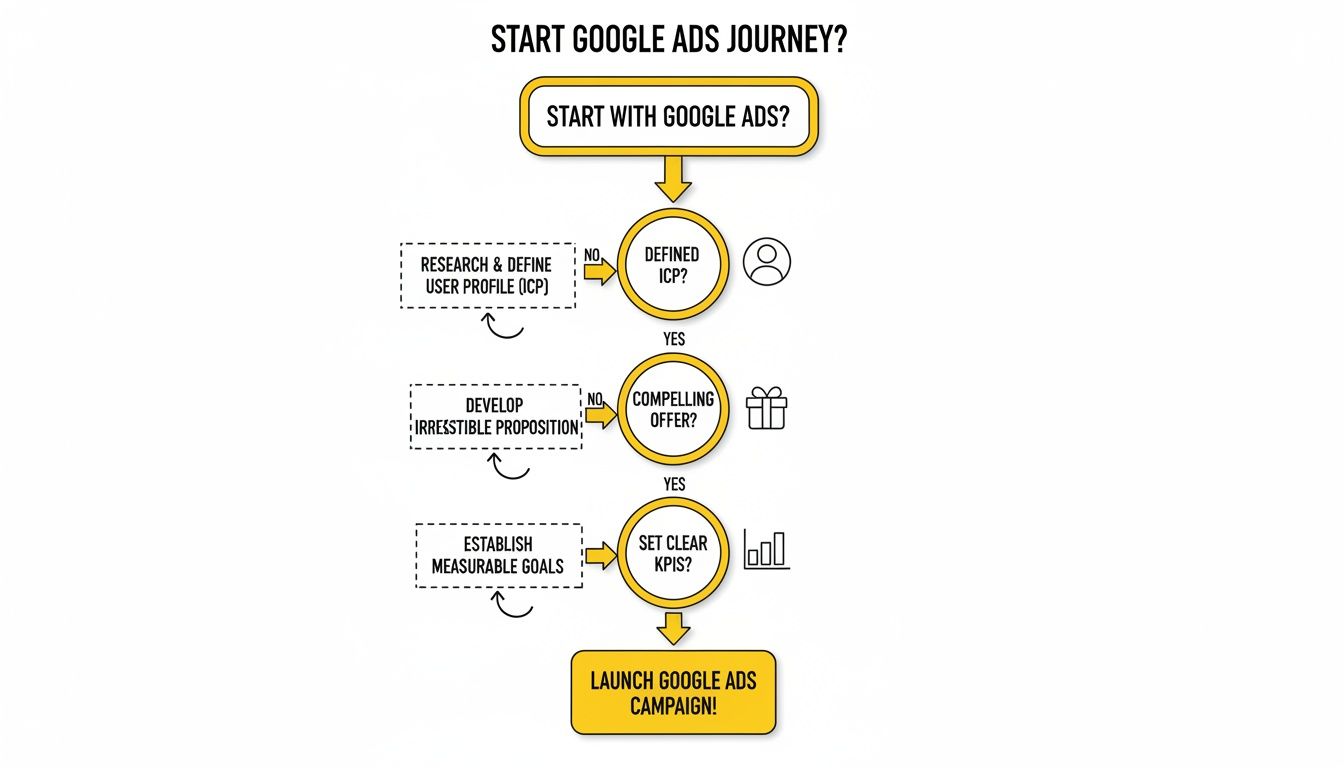
As you can see, defining your ideal customer, crafting an offer they can't refuse, and setting clear KPIs must happen before you ever spend a dime. Get this right, and everything else falls into place.
Search Campaigns: The High-Intent Workhorse
When you need leads from people actively looking for a solution, Search campaigns are your undisputed champion. This is bottom-of-the-funnel advertising at its absolute best. You’re targeting users based on the exact keywords they type into the Google search bar, capturing their intent at its peak.
For example, a local plumber bidding on "emergency pipe repair Miami" is reaching someone with an urgent, specific need. There's no guesswork. The prospect knows they have a problem and is actively looking for the solution, making them a prime candidate for a high-quality lead. For this reason, Search is the bedrock for most Google Ads for lead generation strategies—it consistently delivers prospects who are ready to act.
Performance Max: Scaling Your Reach with AI
Performance Max (PMax) is Google's answer to full-funnel, AI-driven advertising. Instead of being stuck in a single channel, PMax takes your inputs—ad copy, images, videos, and audience signals—and goes out to find converting customers across Google's entire inventory. We're talking Search, Display, YouTube, Discover, Gmail, and Maps.
Think of PMax as a force multiplier. It's the right move when you have solid conversion data from other campaigns and want to scale beyond the limits of traditional Search. A B2B SaaS company, for instance, could use PMax to find leads not just on Search but by also showing video ads on YouTube to users who perfectly fit their ideal customer profile. It’s a powerful way to uncover new pockets of your audience you might not have found otherwise.
The real magic of PMax is its ability to process thousands of signals in real-time to find the most efficient path to a conversion. It requires trusting the algorithm, but it can unlock serious scale when you feed it high-quality creative and crystal-clear conversion goals.
Lead Form Assets: Frictionless Conversions
What if you could capture a lead without ever making the user leave the search results page? That's the power of Lead Form Assets (what we used to call Lead Form Extensions). These attach a native form directly to your Search or Video ad.
When someone clicks your call-to-action, a Google-hosted form pops up, often pre-filled with their account information. This move dramatically cuts down on friction, which is a notorious killer of conversion rates. For a real estate agent running ads for a new listing, a lead form makes it incredibly simple for an interested buyer to request a showing right from the SERP. The key here is to keep the form short and sweet, and you absolutely must integrate it with your CRM for instant follow-up.
Display and YouTube Campaigns: Nurturing Future Leads
While Search and PMax are fantastic for grabbing immediate action, Display and YouTube campaigns play a crucial role in building your pipeline for tomorrow. These are visual-first channels designed to generate awareness and keep your brand top-of-mind. You aren’t capturing existing demand here; you’re creating it.
Their true strength in lead generation, however, often lies in retargeting.
Display Retargeting: You can show sharp, compelling banner ads to people who visited your landing page but didn't fill out the form. A simple ad reminding them of your "Free Consultation" offer is often all it takes to bring them back to convert.
YouTube Retargeting: Imagine showing a short video testimonial to users who watched a previous ad or visited key pages on your site. This is a brilliant way to build trust and credibility over time.
These campaign types are essential for nurturing leads through longer sales cycles, making sure your brand is the first one they think of when they're finally ready to pull the trigger. By blending the right mix of campaigns, you build a complete strategy that captures high-intent leads today while building a healthy pipeline for the future.
Building Your Campaign From the Ground Up

This is where the rubber meets the road—where your strategy gets off the whiteboard and starts working for you in the real world. Setting up a Google Ads campaign that actually generates leads is a hands-on job that demands precision from the very first click. We're not chasing vanity metrics like impressions here. Our focus is laser-sharp: build a machine that attracts high-intent prospects and makes every single dollar accountable.
A well-built campaign isn't about just tossing a bunch of keywords into the mix and hoping for the best. It's about architecting a logical, organized system where your ads, keywords, and landing pages are all perfectly aligned. This is the synergy Google rewards with a higher Quality Score, which directly lowers your ad costs and boosts your ad positions.
Uncovering Buyer-Intent Keywords
Your keyword research is the absolute bedrock of any successful Search campaign. The goal isn't to find the most keywords, but the right ones. You need to zero in on phrases that scream, "I'm ready to buy," not "I'm just browsing."
That means prioritizing what we call buyer-intent keywords, especially the longer, more specific phrases that reveal a real need. These are the queries your most qualified prospects are actually typing into Google.
Broad: "roofing" (Way too generic. You'll get researchers, DIYers, everyone but a buyer.)
Better: "roofing company" (Getting warmer, but still pretty vague.)
Best (High-Intent): "emergency roof repair quote near me" or "cost to replace shingle roof in Tampa"
These long-tail keywords have less search volume, sure, but they often carry a ridiculously high conversion rate. Why? Because they capture people who are deep in the buying cycle. They know exactly what they need and are actively looking for someone to provide it.
Your keyword list should read like a direct transcript of your ideal customer's problems. If the keywords don't reflect an immediate need or a strong desire to solve a problem, you're targeting the wrong people.
Structuring Ad Groups for Maximum Relevance
Once you've got your golden keywords, the next job is to organize them into tightly themed ad groups. This is probably the most common mistake I see advertisers make. Lumping dozens of semi-related keywords into one giant, messy ad group is a fast track to a low Quality Score and wasted budget.
The rule is simple: each ad group should focus on one, and only one, specific theme.
Let's say you're a plumber. You shouldn't have one ad group for all "plumbing services." Instead, you'd break it down like this:
Ad Group 1 Theme: Emergency Services * Keywords: "24/7 plumber," "emergency plumbing service," "burst pipe repair" * Ad Copy: "24/7 Emergency Plumber | Fast Response for Burst Pipes"
Ad Group 2 Theme: Drain Cleaning * Keywords: "clogged drain cleaning," "sewer line clearing cost," "hydro jetting services" * Ad Copy: "Expert Drain Cleaning | Unclog Sinks & Sewers Fast"
This tight structure guarantees that the ad a user sees is hyper-relevant to their specific search. That relevance is a massive factor in Google's Quality Score algorithm, leading to better performance and, you guessed it, lower costs.
Writing Ad Copy That Converts
Think of your ad copy as your digital billboard. You have a split second to grab someone's attention, show them your value, and convince them to click. Generic, boring copy gets scrolled past without a second thought.
For lead generation, effective ad copy hits on a pain point and immediately frames your offer as the perfect solution. It needs to speak directly to your ideal customer, using their language.
Here’s a simple framework I use for compelling ad copy:
Headline 1: Match the User's Search (Get your main keyword in here).
Headline 2: Hit Them With Your Value Prop (Think "Free Estimates" or "24-Hour Service").
Description: Flesh out the details, build trust, and include a crystal-clear Call-to-Action (CTA).
For example, an ad targeting "bookkeeping for small business" could look like this:Headlines: Expert Bookkeeping for Small Business | Save 10+ Hours a MonthDescription: Stop Drowning in Spreadsheets. We Handle Your Books So You Can Run Your Business. Get Your Free Consultation Today!
This ad just plain works. It mirrors the search term, quantifies the benefit ("save 10+ hours"—that's tangible), and closes with a clear, low-risk call-to-action.
Layering on Audience Targeting
Keywords are the engine, but you can sharpen your aim even more by layering on audience targeting. This tells Google not just what people are searching for, but who they are. This is a non-negotiable step in any modern google ads for lead generation campaign.
Try adding these audience layers to your Search campaigns:
In-Market Audiences: Target users Google has flagged as actively researching products or services like yours (e.g., "In-Market for Real Estate").
Custom Audiences: Build your own audiences based on keywords people search for, websites they visit, and apps they use that align with your ideal customer.
Remarketing Lists (RLSA): Go after the ones that got away. Re-engage users who visited your website but didn't fill out a form. You can, and should, bid more aggressively for this super-valuable audience.
When you combine the intent from keywords with the identity from audiences, you ensure your message isn't just relevant—it's being shown to the exact people most likely to become your next best lead.
Optimizing Your Landing Pages And Conversion Tracking
Your Google Ad makes a promise, but your landing page is where you have to deliver on it. I’ve seen countless campaigns with amazing click-through rates fall completely flat at this crucial stage. A clunky, confusing, or untrustworthy landing page is the fastest way to turn a motivated prospect into a bounce.
Think of it as the critical handoff. The journey from ad click to conversion needs to feel like one smooth, continuous thought. If there’s any disconnect in the message, the design, or the offer, you’ve already lost them.
The entire goal here is to eliminate friction and build immediate confidence. When someone lands on your page, they should instantly know they’re in the right place to solve their problem.
Anatomy of a High-Converting Landing Page
A great landing page isn’t about flashy design—it’s about pure clarity and persuasion. It has one job and one job only: to turn that visitor into a lead. For lead capture, this means designing a simple landing page that screams value and makes it easy for them to take the next step.
Every single element on the page has to serve this one purpose. Anything that distracts from that goal, like complex navigation or links to other parts of your site, needs to get the axe.
Here's what your landing page must-have to get the job done.
I've put together a quick checklist that covers the core elements your landing page needs to have. Run your pages against this list to spot weaknesses before you spend a single dollar on traffic.
Landing Page Conversion Checklist
Element | Purpose | Pro Tip |
|---|---|---|
Matching Headline | Immediately confirms to the visitor that they've landed in the right place after clicking your ad. | Use the same keywords and phrasing from your ad copy. This creates a seamless "scent trail" for the user. |
Benefit-Driven Copy | Quickly explains what's in it for them, focusing on solutions and outcomes, not just features. | Use bullet points or short, scannable paragraphs. People don't read online; they skim. Make it easy for them. |
Visible Lead Form | Makes it dead simple for a user to convert without having to search or scroll. | Keep the form "above the fold" and ask for the absolute minimum information. Every extra field kills conversions. |
Clear Call-to-Action (CTA) | Tells the user exactly what to do next with compelling, action-oriented language. | Use a button with a contrasting color. Test button copy like "Get My Free Quote" vs. "Submit." |
Social Proof | Builds instant trust and credibility by showing that other people have had success with you. | Testimonials, logos of well-known clients, star ratings, or case study snippets are all fantastic options. |
No Distractions | Keeps the user focused on the single conversion goal by removing escape routes. | Get rid of the main website navigation, footer links, and anything else that doesn't lead to a conversion. |
Getting these elements right is the foundation of a page that converts clicks into actual leads.
Your landing page has to answer three questions in under five seconds: What is this? What’s in it for me? What do I do next? If a user has to hunt for these answers, your ad spend is just evaporating.
The Technical Core of Lead Generation Success
If your landing page is the engine, then conversion tracking is your dashboard—it tells you exactly what’s working and what isn’t. Without it, you’re flying blind and making budget decisions based on gut feelings instead of cold, hard data.
Getting Google Ads conversion tracking set up properly is the single most important technical step in any lead gen campaign. It’s what teaches Google’s algorithm what a successful outcome looks like, which allows it to find more people just like your best customers.
This data is everything, especially as ad costs keep climbing. The average cost per lead (CPL) on Google Ads has hit $70.11, but businesses that pair their ads with truly optimized landing pages blow that average away. In fact, B2B companies that use personalized landing pages see 68% better conversion rates. Strategic refinement is everything.
Connecting Google Ads to Your CRM
Tracking a form submission is just the first step. The real magic happens when you connect Google Ads directly to your Customer Relationship Management (CRM) system. This is what separates amateur advertisers from professional growth marketers.
This integration lets you achieve "closed-loop reporting," and it's a game-changer. Here's how it works:
A user clicks your ad, fills out the form, and becomes a new lead in your CRM.
Your sales team works that lead and updates its status in the CRM—marking it as "Qualified," "Proposal Sent," or hopefully, "Closed-Won."
That sales data gets passed back to Google Ads, telling the platform which keywords, ads, and audiences are generating actual revenue, not just cheap form fills.
This feedback loop allows you to optimize your campaigns for lead quality, not just lead volume. You can confidently pour more budget into the campaigns that deliver profitable customers and slash spending on the ones that just send your sales team on a wild goose chase. This is how you build a truly scalable Google Ads for lead generation machine.
Mastering Advanced Bidding and Lead Quality
Getting your campaign live is a big step, but the real work—and the real money—is made in the weeks and months that follow. True success with Google Ads for lead generation isn't about how many form fills you can get. It's about bringing in high-value prospects who are ready to become profitable customers.
This means you have to get laser-focused on your bidding strategy and become absolutely obsessive about lead quality. It’s a mindset shift from chasing volume to strategically pursuing value. You'll need to move past manual bidding and let Google's powerful automated systems do the heavy lifting, but you have to know how to point them in the right direction.
Leaning Into Automated Bidding
The days of manually tweaking bids for every single keyword are long gone. Google's machine learning can now process thousands of real-time signals that no human ever could. The trick is to pick the right strategy and feed the algorithm clean, accurate conversion data.
For lead gen campaigns, two bidding strategies really shine:
Maximize Conversions: Think of this as your "data gathering" mode. You tell Google's algorithm to get you the most leads possible within your daily budget. It’s perfect for new campaigns because it helps the system quickly learn what a converting user actually looks like.
Target CPA (Cost Per Acquisition): Once you have a steady stream of leads and you know your target Cost Per Lead (CPL), this becomes your workhorse. You set your ideal cost, and Google’s AI works to hit that average, automatically bidding up or down to prioritize clicks most likely to convert at or below your target.
Just remember, these strategies are only as good as the data you feed them. If your conversion tracking is a mess, you're basically giving the algorithm a broken compass and telling it to find treasure.
The War Against Low-Quality Leads
Nothing kills morale and wastes your sales team's time faster than a pipeline clogged with junk leads. We're talking about the tire-kickers, the job-seekers, and the people who are just not a fit for what you sell. Getting this under control is absolutely critical if you want to scale profitably.
Your first line of defense here is an aggressive negative keyword strategy. You have to be proactive about blocking search terms that have nothing to do with your business.
For example, a law firm offering a "free consultation" should immediately add negative keywords like:
"pro bono"
"free legal advice"
"law school jobs"
"paralegal training"
These terms are clear signals that the searcher has zero intent of becoming a paying client. Make it a weekly habit to dig through your Search Terms Report to find and block these budget-draining queries.
A great lead generation campaign isn't just about who you attract; it's equally about who you repel. Your negative keyword list is the bouncer for your budget, making sure only qualified prospects get through the door.
Implementing Basic Lead Scoring
Ultimately, you want to optimize for sales, not just leads. This means you have to build a feedback loop between what happens in your sales process and what Google Ads is doing. By connecting your CRM to Google Ads, you can import offline conversions and tell the platform which leads actually turned into paying customers.
This is a complete game-changer.
When Google knows which leads turned into revenue, it can start optimizing for what truly matters. If you discover that leads from a particular keyword or ad group close at a 25% higher rate, you can confidently tell Google to bid more for that segment. The algorithm learns to find more people who look like your best customers, not just people who are quick to fill out a form.
Of course, once you start getting leads from Google, you also need to know what to do with them. For a deeper look into vetting your prospects, you can learn more about how to effectively qualify sales leads. This is a vital step to make sure your sales team is spending their time on opportunities that can actually close.
This closed-loop system is what turns your advertising from a simple expense into a predictable revenue driver. It's the final piece of the puzzle for building a truly scalable lead generation machine with Google Ads.
Got Questions About Google Ads for Lead Gen? We’ve Got Answers.
When you're diving into Google Ads, a few questions always seem to pop up, especially when your entire goal is to bring in high-quality leads. We hear these same concerns from founders just getting started and from seasoned marketing managers trying to dial in their campaigns.
Let's cut through the noise. This isn't about theory; it's about giving you real, actionable advice for the challenges that come with running a lead generation machine.
How Much Should I Actually Budget for a Google Ads Campaign?
There’s no magic number here. A plumber in a small town is playing a completely different game than a national SaaS company. The budget really comes down to your industry, your location, and how many competitors are bidding on the same keywords you are. The smartest way to figure this out is to work backward from what you want to achieve.
First, you need to nail down your maximum acceptable Cost Per Lead (CPL). This means getting real about your numbers:
Customer Lifetime Value (LTV): What’s a new customer actually worth to your business over the long haul?
Lead-to-Close Rate: On average, what percentage of your leads turn into paying customers?
Let’s run a quick example. Say a new customer is worth $2,000 to you, and your sales team closes one out of every ten leads (10%). That means you can pay up to $200 per lead and still break even on your ad spend. For a starting daily budget, you’ll want enough to get at least 10-15 clicks a day so you can start gathering data. For a lot of businesses, that might be around $50-$100 per day, but you have to be ready to adjust once you see what the initial data tells you.
Why Am I Getting So Many Junk Leads?
Nothing is more frustrating than a flood of low-quality leads. It wastes your time and your money. This problem almost always points back to a disconnect between your targeting, your ad's message, and what you’re offering on the other side of the click.
The first place to look is your keyword strategy. If you're leaning heavily on broad match keywords, I can almost guarantee you're pulling in irrelevant searches. You need to tighten things up. Prioritize phrase and exact match keywords, and more importantly, get absolutely relentless about building out your negative keyword list. This is how you filter out the job seekers, the DIY crowd, and the people just doing research.
Next, take a hard look at your ad copy and landing page. Are you being crystal clear about who your service is for and the specific problem you solve? Vague, fluffy language attracts a vague, unqualified audience. Being ultra-specific pre-qualifies people before they ever even click your ad.
Low-quality leads are a signal that you’re casting too wide a net. Sharpen your keyword targeting, make your ad copy painfully specific, and don’t be afraid to add a qualifying question or two on your lead form to weed out the tire-kickers.
How Long Until I Start Seeing Real Results?
You’ll see traffic and impressions almost instantly after you hit "launch," but getting consistent, profitable results is a marathon, not a sprint. Right after you launch, Google’s algorithm goes into a "learning phase" that usually takes about 7-14 days. It's critical that you don't make any big, knee-jerk changes to your bidding or targeting during this time, or you'll just reset the whole process.
You should expect your first few leads to start trickling in within a couple of weeks. But getting to a point where you have a stable CPL and a predictable flow of quality leads? That often takes anywhere from 30 to 90 days. This gives you enough time to collect real data and make smart decisions about which keywords, ads, and landing pages are your actual winners. Patience is everything in paid ads; quick, reactive changes usually do more harm than good.
At Wojo Media, we replace guesswork with a predictable system for profitable growth. If you're ready to build a lead generation machine that delivers booked-out calendars and a scalable ROI, we can help. Book a free demo call today to receive a custom paid ads strategy tailored to your business.
Comments