.png)
Grow Your Business with lead generation for local businesses: A Practical Guide

Before you even think about spending a dime on ads, you need to get two things right: a killer, problem-solving offer and a perfectly tuned Google Business Profile. Nail these, and you'll attract high-intent customers who are already looking for exactly what you do, right in your neighborhood.
Building Your Local Lead Generation Foundation
Too many local businesses jump straight into running ads, expecting the phone to ring off the hook. More often than not, it’s a recipe for burning cash because they skipped the most important work. Without a magnetic offer and a strong local search presence, you're just throwing money away. It’s like building a house on sand—bound to collapse.
To build a solid foundation, you first need to understand how to get leads with strategies that actually work today. The goal is simple: make your business the obvious choice for customers before they ever see an ad. That process begins with an offer so good it’s a no-brainer, paired with dialing in your single most critical asset for local discovery: your Google Business Profile (GBP).
Craft a Truly Irresistible Offer
Your offer isn't just a discount—it's the core promise you're making. It needs to hit a potential customer's most urgent pain point and offer a clear, valuable fix. Generic offers like "10% off" are just noise. A truly great offer is specific, has a deadline, and takes all the risk off the customer's shoulders.
The table below breaks down what goes into an offer that actually gets people to pick up the phone.
Key Elements of a High-Converting Local Offer
Component | Why It Works | Example for a Plumber |
|---|---|---|
High Perceived Value | It feels like an incredible deal, shifting focus from price to value. | Free Camera Drain Inspection with Any Service Call ($250 Value) |
Urgency/Scarcity | It gives customers a compelling reason to act now instead of later. | "This Week Only" or "Offer valid for the first 10 callers." |
Risk Reversal | It removes hesitation and builds immediate trust. | "No-Fix, No-Fee Guarantee" or "100% Satisfaction or It's Free." |
An offer that combines these elements makes the decision to call you incredibly easy for the customer.
Key Takeaway: A strong offer isn't about being the cheapest. It's about providing the most compelling value and removing any friction that might prevent a potential customer from contacting you.
Dominate Local Search with Your Google Business Profile
Think of your Google Business Profile as your digital storefront. For most local customers, it's the very first time they'll interact with your business. Letting it sit there, incomplete and unloved, is like having a messy, unwelcoming shop entrance.
The data backs this up. Nearly a third of all local searches lead to a purchase, and the top organic result gets about 24.4% of all clicks. This makes optimizing your GBP the single highest-leverage thing you can do for local leads.
Here are the non-negotiables you need to lock in right now:
Define Precise Service Areas: Don't just list your city. Get granular. List the exact neighborhoods, zip codes, and surrounding towns you cover. This tells Google exactly where to show you.
Select the Right Categories: Be as specific as possible with your primary category (e.g., "Residential Plumber" beats just "Plumber"). Then, max out all the relevant secondary categories to show up in more searches.
Upload Geotagged Photos: Constantly add high-quality photos of your team, your work, and your happy customers. Before you upload, use a free online tool to add GPS coordinates (geotags) to each image. It's a small trick that reinforces your service area to Google.
Build and Protect Your Online Reputation
Social proof is the final piece of the puzzle. Good reviews are today's word-of-mouth referrals, and they are pure gold. A steady stream of recent, positive reviews is one of the most powerful signals to both Google and new customers that you’re the real deal.
You need a simple, repeatable system for getting reviews. It could be an automated text after a job, a QR code on an invoice, or a simple follow-up email. Just make it easy for them.
Just as important is responding to every single review—good and bad. Thanking customers for great reviews shows you care. Professionally addressing the negative ones shows accountability. This active management builds a rock-solid reputation that turns curious searchers into paying customers.
Designing Landing Pages That Actually Convert
Here's one of the fastest ways to burn through your ad budget: driving paid traffic from a Google or Facebook ad straight to your website's homepage. It’s a classic mistake. Your homepage is a digital brochure, trying to be a little bit of everything for everyone. It has links to services, your blog, your "About Us" page... it's just packed with distractions.
For any serious lead generation for local businesses, every single ad campaign needs its own dedicated landing page. This isn't just a friendly suggestion; it's a non-negotiable for getting a positive return on your ad spend. A landing page has one job, and one job only: to get a visitor to take a very specific action, whether that's filling out a form or picking up the phone.
Anatomy of a High-Converting Local Landing Page
Think of your landing page as a short, focused sales pitch. It has to perfectly match the promise you made in your ad, creating a seamless, logical next step for the visitor. If your ad shouts about a "Free Roof Inspection," the landing page better greet them with that exact same offer, front and center. Any disconnect, and you’ve just confused them and lost a lead.
A winning local landing page is built from a few crucial parts working in harmony:
Benefit-Driven Headline: Don't lead with your company name. Nobody cares yet. Lead with the solution they're looking for. Instead of "Smith & Son's Plumbing," hit them with "Get Your Drains Unclogged Today—Guaranteed."
Clear Call-to-Action (CTA): Your button needs to pop, and the text has to inspire action. "Get My Free Quote" is so much more powerful than a passive "Submit." Make sure this button is visible "above the fold" so they don't have to go hunting for it.
Frictionless Contact Form: Only ask for what you absolutely need to start the conversation. Name, phone, and email are usually plenty. Every extra field you add is another reason for someone to give up and leave.
Authentic Social Proof: This is your trust-building superpower. You need real testimonials from local customers, and you should mention their town if you can ("Jane D. from Springfield"). Photos and video testimonials? Even better. They're gold.
A landing page is not a place for exploration. Its job is to eliminate distractions and guide a visitor down a single path that ends with them becoming a lead. Every element on the page should support that one goal.
Building Trust with Local Signals
For a local business, generic stock photos are the enemy. Your landing page has to feel local because your customers are local. A dental practice in Austin shouldn't be using stock images of perfect teeth; it needs to show photos of its actual office, its real staff, and smiling patients from the community.
This kind of visual proof is everything. Use pictures of your team on the job, your branded company trucks parked in front of a recognizable local landmark, or a quick video of you explaining a common issue. These things scream, "We're a real, established part of your community," not some faceless national call center.
Finally, you have to think mobile-first. The overwhelming majority of local searches happen on a smartphone in someone's hand. Your landing page absolutely must load fast and be dead simple to use on a small screen. We're talking big, tappable buttons and forms that are easy to fill out without a lot of pinching and zooming. In 2024, this isn't a nice-to-have; it's the bare minimum for capturing local leads.
Launching Your Omnipresent Local Ad Strategy
Once you've built a solid foundation and your landing page is ready to convert, it's time to open the floodgates and drive some traffic. But with a limited budget, where do you even start? The secret to dominating lead generation for local businesses isn't about outspending your competitors; it's about out-smarting them by showing up everywhere your ideal customers hang out.
This creates a powerful sense of omnipresence within your service area. The goal is to become the first name they think of, whether they’re frantically searching for a solution or just scrolling through their feed. We'll focus on the big three platforms that drive real results for local businesses: Google, Facebook, and Instagram.
Mastering High-Intent Google Ads
When someone's got an urgent problem—think a burst pipe flooding their basement or a broken AC in the middle of July—they don't waste time on social media. They head straight to Google. This is why Google Ads is hands-down the most powerful channel for capturing high-intent leads who are ready to pull out their credit card right now.
For any service-based business, the first stop should be Google's Local Service Ads (LSAs). You’ve seen them. They're the listings that sit at the very top of the search results, often above the standard ads, rocking that coveted "Google Guaranteed" badge.
That little green checkmark is a massive trust signal. But here's the best part: you only pay when a qualified lead actually calls or messages you through the ad. It’s a pay-per-lead model, which takes a ton of the risk out of your ad spend compared to just paying for clicks that go nowhere.
Creating Hyper-Local Social Campaigns
While Google is great for capturing existing demand, Facebook and Instagram are where you create it. People aren't on these platforms to hire a plumber. They're there to be entertained, to connect with friends, and to catch up on what’s happening. Your ad strategy has to reflect that. It’s less of a direct sales pitch and more about putting your irresistible offer in front of a highly specific local audience.
This is where Meta's ad platform really shines for local businesses. You can get incredibly granular with your targeting, going way beyond a simple zip code.
Radius Targeting: Draw a virtual circle around your shop or service area—5, 10, even 15 miles—and show ads only to people inside it. It's a game-changer for brick-and-mortar stores and mobile service pros.
Behavioral & Demographic Targeting: You can layer on interests, life events, and behaviors. A local real estate agent, for example, could target people in their city who are "likely to move" or have recently looked at mortgage calculators.
Custom Audiences: Got a customer list? Upload it. Facebook will find new people who look just like your best customers. This is an insanely effective way to find high-quality leads you wouldn't have reached otherwise.
Pro Tip: Don't try to boil the ocean on day one. Start small with a daily budget of just $15-$25 per day, maybe split between Google and Facebook. The initial goal isn't to get a flood of leads; it's to gather data. You want to see which platform, which audience, and which ad gives you the lowest cost per click and, more importantly, the lowest cost per qualified lead.
Allocating Your Budget for Maximum ROI
Look, most local businesses are working with tight budgets. In fact, 78% of small businesses report their monthly lead-gen spend is between $100 and $1,000. Every single dollar has to count. This means ditching expensive, old-school methods and focusing on digital channels that give you a real, trackable return. For more data on small business marketing spend, check out the insights on EmailToolTester.com.
A smart starting point for your budget might look something like this:
Channel | Budget Allocation | Rationale |
|---|---|---|
Google Local Service Ads | 40% | This is for grabbing the "hand-raisers"—people actively looking for exactly what you sell. |
Facebook/Instagram Ads | 35% | Here, you're building your brand and creating future demand with a highly targeted local audience. |
Google Search Retargeting | 25% | This is your safety net, bringing back people who visited your site but didn't convert. |
This balanced mix ensures you’re catching immediate demand while also filling your pipeline for the future. As the data starts rolling in, you can tweak these percentages. If you find Facebook is delivering ridiculously cheap, high-quality leads, shift more of your budget there. It’s all about letting the results guide your decisions.
Creating Ad Content That Builds Real Trust
Your potential customers have a finely tuned BS meter. They can spot a stock photo or a scripted, over-produced video from a mile away, and it instantly makes them skeptical. In a world crowded with ads, the only way to generate quality leads for your local business is to build genuine trust. And to do that, your ads have to feel real.
The good news? You don't need a massive budget or a professional production crew. The most powerful creative you can possibly use is the authentic story of your business, told by your team and—most importantly—your happy customers. It's time to trade polished perfection for a real connection.
The Magic of User-Generated Content
User-generated content (UGC) is just the 2024 version of a word-of-mouth referral, and it's absolute gold for building credibility. When a prospect sees someone just like them—a real person from their own community—raving about your work, it’s a thousand times more powerful than anything you could say about yourself.
Getting this content doesn't have to be some big, complicated process. After a job well done, just ask your happy customers if they’d be willing to share a photo or a quick video.
Make it dead simple for them: A quick text or email with a direct request is all it takes. You could even toss in a small discount on a future service for their time.
Give a little direction: Offer a simple prompt, like, "Hey, could you snap a quick picture of your new patio?" or "Would you mind recording a 15-second video sharing what you liked most about working with us?"
Always, always get permission: Before you splash a customer's face across your ads, get their clear, written permission. A simple email saying "Yes, you can use that!" is usually enough to cover your bases.
Using real customer photos and videos in your ads isn't just a tactic; it's a massive trust signal. It proves to prospects that you get real results for real people in their neighborhood, making you the safe, obvious choice.
Forget the Studio, Shoot Your Own Video
The thought of shooting video ads can be intimidating, but I'm telling you, you don't need a bunch of expensive gear. Your smartphone is more than capable of producing high-quality video that actually gets leads. In fact, that slightly raw, "shot on a phone" vibe often works better because it feels more authentic and less like a slick, pushy car commercial.
Start with these incredibly simple but high-impact video ideas:
The "Meet the Team" Clip: A quick, 30-second introduction to you or one of your key people. Just talk to the camera, smile, and let the personality of your business shine through.
The "Problem-Solver" Tip: Record a 60-second video explaining how to solve a common, simple problem in your industry. If you're a roofer, maybe it's how to spot the early signs of a leak. This positions you as the go-to expert, not just another salesperson.
The "Before-and-After" Showcase: Nothing shows off your value like a dramatic transformation. Use quick cuts to show the messy "before" and then reveal the incredible "after" of your work.
These simple videos forge a human connection that stock footage never could. They show you're a real, local pro who takes pride in your work and is genuinely happy to help your community.
Find What Clicks with Simple A/B Testing
Making great content is only half the job. You have to figure out what your local audience actually responds to. This is where A/B testing, or split testing, comes into play. It sounds technical, but the idea is simple: run two slightly different versions of an ad and see which one gets better results.
You don't need fancy software. Ad platforms like Facebook Ads Manager have this built right in.
Here’s a dead-simple testing plan to get you started:
Test Your Visuals: Run the exact same ad copy but with two different images. One could be a great shot of your finished work, and the other could be a picture of your friendly team on the job.
Test Your Headlines: Use the same image or video but try two different headlines. One might focus on an offer ("50% Off Your First Service"), while the other highlights a benefit ("Get Your Weekends Back, Guaranteed").
Let the ads run for a few days on a small budget. The data will tell you the story pretty quickly. Whichever version gets you more clicks, calls, or form fills for less money is your winner. Double down on what's working and kill what isn't. This simple process of testing and learning is the absolute key to turning your ad spend into a predictable flow of new customers.
Tracking and Nurturing Every Lead You Get
Getting a potential customer to click your ad or fill out a form is a victory, but it's not the end of the game. It’s the kickoff.
The hard truth is that most leads won't buy from you on the first interaction. The real profit in any lead generation for local businesses strategy is unlocked in the follow-up, and that means tracking the right numbers and nurturing folks who aren't ready to commit today.
For busy business owners, this can sound like a ton of extra work. It’s simpler than you think. It really just boils down to knowing your numbers and having an automated system to stay in front of people without you having to manually send every single text or email.
The Few Key Metrics That Actually Matter
You don't need a complicated spreadsheet with dozens of metrics. To figure out if your campaigns are actually making you money, you only need to focus on a few key performance indicators (KPIs). These are the numbers that tell the true story of your marketing health.
Here’s a quick rundown of the essential KPIs to keep on your radar.
Essential KPIs for Local Lead Generation
Metric (KPI) | What It Measures | Why It's Critical for Local Businesses |
|---|---|---|
Cost Per Lead (CPL) | Total ad spend divided by the number of leads generated. | Your most fundamental efficiency metric. It tells you exactly what you're paying to get a potential customer's attention. |
Lead-to-Customer Rate | The percentage of leads that become paying customers. | This is the ultimate measure of lead quality. A low rate means you're either attracting the wrong people or your sales process is broken. |
Customer Acquisition Cost (CAC) | The total cost (ads, sales, etc.) to acquire a single new customer. | This is your profitability benchmark. If your CAC is higher than what a customer is worth, your business model is unsustainable. |
Return on Ad Spend (ROAS) | The total revenue generated for every dollar spent on advertising. | The bottom-line metric that shows if your ads are a profitable investment. It directly answers the question: "Is this working?" |
Focusing on just these core metrics lets you diagnose problems fast. A high CPL might mean your ad creative isn't resonating, while a low Lead-to-Customer Rate could signal an issue with your sales process or your offer itself.
You can have the best ads in the world, but if you don't know your CPL and Lead-to-Customer Rate, you're flying blind. Tracking these simple numbers is the only way to know what's working and where to put your money.
Why Your Follow-Up System Is a Money Printer
Imagine a homeowner who requests a quote for a new fence but isn't ready to pull the trigger for another two months. If you don't have a system to stay in touch, they will have forgotten your name by the time they're ready to buy. This is where most local businesses leak revenue.
Research shows that a staggering 79% of marketing leads never convert without a consistent nurturing process. For a local service provider, this means most of the money you spend on ads is wasted if you don't have a plan for the leads who say, "not right now."
A structured, multi-touch follow-up system is what turns those future buyers into your customers instead of your competitor's.
This whole process starts with building trust right from the first ad they see.
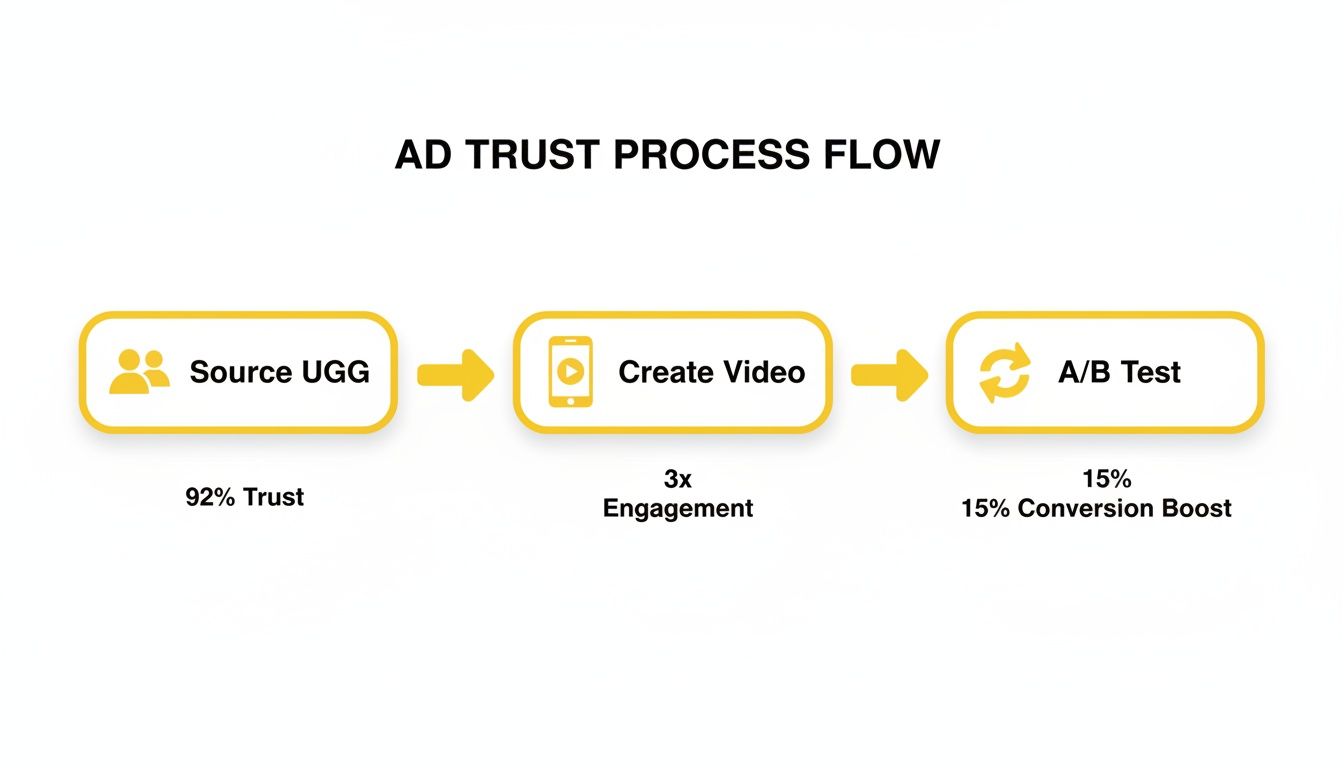
Sourcing authentic content, creating simple videos, and testing what works is how you get high-quality leads into your nurturing system in the first place.
Building Your Automated Nurturing Machine
The goal here is to stay top-of-mind by providing value, not by being pushy. Using simple automation tools, you can set up a series of emails and text messages that go out to new leads over days, weeks, or even months. To get this up and running efficiently, exploring some marketing automation software for small business is a no-brainer.
Here’s what a simple but powerful automated sequence might look like for a local contractor:
Immediate Response (Within 5 Minutes): An automated text and email fire off thanking them for their inquiry and letting them know when you’ll call. Speed is everything here.
Day 3: An email goes out with a link to a helpful blog post, like "5 Things to Ask Before Hiring a Contractor." This positions you as the expert.
Day 7: Another email showcases a recent project with great before-and-after photos and a link to a glowing customer review. This builds massive social proof.
Day 21: A simple, plain-text email from you (the owner) personally checks in to see if they have any questions. It feels personal and keeps the conversation open.
This entire sequence runs on autopilot, making sure every single lead gets a consistent, professional follow-up. It warms them up over time, building trust and familiarity. When they are finally ready to pull the trigger, your business is the only one they think of. This is how you maximize the return on every single dollar you invest in advertising.
Burning Questions About Local Lead Gen
Even with a solid game plan, it's natural to have questions when you're diving into lead generation. Business owners I talk to are constantly asking where to start, how much they really need to spend, and what a realistic timeline looks like.
Let’s clear up some of the most common hurdles I see people get stuck on. Getting these fundamentals right gives you the confidence to actually invest your time and money instead of just thinking about it.
How Much Should I Really Spend on Ads to Start?
This is always the first question, and the answer is refreshingly simple: start small. You absolutely do not need a massive budget to get the ball rolling. In fact, a starting ad spend of just $20 to $30 a day is more than enough to start pulling in some incredibly valuable data.
Look, the initial goal isn't to get a flood of new customers overnight. Your first few hundred dollars are for learning, not earning. This small, controlled investment is your ticket to finding out:
Which platform—Google or Facebook—is giving you cheaper clicks right out of the gate.
Which ad copy and images are actually stopping the scroll for your local audience.
What your baseline Cost Per Lead (CPL) is going to be.
Think of it as a low-risk research project. Once you find that winning ad that brings in leads at a cost that makes sense for your business, that's when you can confidently start turning up the dial on your budget.
Which Marketing Channel Should I Tackle First?
When your budget is tight, focus is everything. Don't try to be everywhere at once. Just pick one channel, get really good at it, and only then should you even think about adding another.
The right choice comes down to one thing: how do your customers look for you?
For "I-Need-It-Now" Services (plumbers, locksmiths, emergency roofers): Start with Google Ads, period. Specifically, look into Local Service Ads. Your customers have a problem right now and are actively searching for a solution. Being at the very top of Google is the quickest way to grab that high-intent traffic.
For "Want-Based" or Visual Services (med spas, landscapers, kitchen remodelers): Your best bet is to start with Facebook and Instagram Ads. These platforms are masters at creating demand. You can use eye-catching before-and-after photos or video testimonials to target a specific local demographic and make them realize they want what you're selling.
The biggest mistake I see is spreading a small budget too thin. Pick the one channel where your ideal customer is hanging out when they need you most, and put all your energy into winning there first.
How Long Until I Actually Start Seeing Results?
You'll see clicks and impressions almost instantly, but let's be real—that's not what you mean by "results." You want qualified leads. While initial data comes in within hours, getting a consistent, predictable flow of good leads takes a little more patience.
As a rule of thumb, give your campaigns at least two to four weeks to marinate. This gives the platform's algorithm enough time to learn who to show your ads to, and it gives you enough data to make smart decisions about what's working and what isn't.
Don't be the person who pulls the plug after three days because you're not getting calls yet. Real success in local lead gen is all about making small, consistent improvements over time, not hitting a home run on day one.
At Wojo Media, we take the guesswork out of this process. We build omnipresent campaigns that bolt right onto your local business, dialing in your offers, landing pages, and ad creative to deliver a predictable stream of qualified leads. If you're ready to scale without torching your ROI, book a free demo call with our team today.
Comments