.png)
High Ticket Closing: Master the Art of high ticket closing

When most people hear the term high ticket closing, they think of aggressive, slick-tongued salespeople using psychological tricks to corner a prospect. That couldn't be further from the truth.
Real high ticket closing is the craft of selling premium products or services—think $3,000 and up—through a structured process rooted in value. It’s less about pushing a sale and more about diagnosing a deep problem and positioning your offer as the only logical solution. Mastering this is non-negotiable for any business that wants predictable, scalable revenue.
Rethinking High Ticket Closing for Today's Market

Let's get one thing straight: the old playbook is dead. Today’s buyers are sharp. They can smell a canned script or a high-pressure tactic from a mile away, and it sends them running. True mastery isn’t found in a single closing line but in building an entire system that guides someone from being a curious stranger to a confident client.
This isn’t just about what you say on a sales call. It's a complete, end-to-end process that involves:
Attracting the Right People: You need a reliable way to get in front of leads who are not just interested, but also ready and able to invest in a real solution.
Building Trust Before the Call: A prospect should already see you as the go-to expert for their specific, high-stakes problem long before they ever book a meeting.
Executing a Flawless Sales Conversation: The call itself stops feeling like a "pitch" and becomes more of a collaborative strategy session where you unpack their pain and present the cure.
To give you a clearer picture, this entire system can be broken down into four distinct pillars. Each one builds on the last, creating a seamless journey for your future client.
The Four Pillars of a High Ticket Closing System
Pillar | Objective | Key Activities |
|---|---|---|
Lead Generation & Qualification | Attract high-intent leads who can afford your offer. | Running targeted paid ads, using pre-qualification forms, creating value-driven content. |
Nurturing & Booking | Build authority and get qualified leads on your calendar. | Automated email/SMS sequences, case studies, retargeting campaigns, calendar funnels. |
The Sales Conversation | Uncover deep pain and present your offer as the solution. | Discovery call frameworks, problem diagnosis, solution framing, handling objections. |
Follow-Up & Optimization | Convert undecided prospects and improve system performance. | Post-call follow-up sequences, KPI tracking, analyzing call recordings. |
Mastering these four pillars is what separates the pros from the amateurs. It's the difference between hoping for a sale and knowing you have a system that produces them.
Why a System Beats Sporadic Wins
If you're a coach, consultant, or real estate pro, relying on your charm or the occasional referral is a surefire way to stay on the income rollercoaster. It’s stressful and unpredictable. A structured high ticket closing system flips that script, turning your business into a revenue machine you can actually control.
The real goal is to make the sale the natural, obvious conclusion to a genuinely helpful conversation. When you’ve done the work to find the right person, diagnose their core problem, and show them the path forward, closing is just the next logical step.
There's a clear benchmark for this in the industry. The best in the business—top-tier coaches, consultants, and service providers—are hitting a 50% consultation-to-close conversion rate. Think about that. For every two qualified people you talk to, one becomes a client. That’s the standard, and it has massive implications for how you build your lead generation to hit your revenue goals. You can find more data on these benchmarks at The Business Advisory.
This guide is your playbook for building that exact system. We're going to walk through every piece of the puzzle, from pulling in high-intent leads with paid ads to mastering the sales call and using data to make it all better. By the end, you'll have the framework to stop chasing sporadic wins and start building a reliable stream of high-value clients.
Building Your High-Intent Lead Generation Machine
Let's be blunt: your high-ticket closing system is only as strong as the leads you feed it. You can have a masterful script and a perfect offer, but it all means nothing if you're talking to the wrong person. The foundation of predictable, high-value revenue isn't just about closing—it’s about attracting prospects who are already halfway to saying "yes" before they ever get on a call with you.
This is where a smart, multi-channel advertising strategy becomes your single greatest asset. Forget random acts of marketing; we're building a machine. The goal is to create an omnipresent effect, making your brand pop up everywhere your ideal client spends their time, whether that's scrolling through Meta, watching TikToks, or searching on Google.
Crafting Ads That Attract Ready Buyers
Effective high-ticket ads don't just chase clicks; they pre-qualify prospects from the very first impression. Your copy and creative have to speak directly to a specific, high-stakes problem and hint at an equally sophisticated solution. Generic ads attract generic leads, which just wastes your time and money on discovery calls that go absolutely nowhere.
Let’s see how this plays out in the real world:
For a Real Estate Agent: Instead of a lazy ad that says, "Looking to buy a home?" try targeting investors: "Tired of low-yield rentals? Discover how our off-market multifamily deals generate predictable cash flow, even in a volatile market." This instantly repels first-time homebuyers and pulls in serious investors.
For a Business Consultant: A weak ad might say, "Grow your business with our help." A high-intent ad gets surgical: "Your SaaS is stuck at $30k MRR because your churn rate is killing your growth. We implement the retention systems that cut churn by 40% in 90 days." This is a language only your ideal client understands.
The creative needs to mirror this same level of specificity. The real estate agent could use a quick video walkthrough of a successful cash-flowing property. The consultant might use a simple, punchy graphic showing a "churn kills growth" chart that immediately grabs the attention of a struggling SaaS founder.
The Profitability Mindset in Paid Advertising
Running ads isn't about being busy; it's about being profitable. You absolutely must know your numbers, inside and out. The most crucial metric isn't your ad's reach or how many likes it gets—it's your Cost Per Lead (CPL) and, even more importantly, your Cost Per Qualified Application.
If you spend $1,000 on ads and get 100 leads, your CPL is $10. That sounds great on the surface, but what if only five of those leads are actually qualified to buy your $10,000 service? Your true cost to get a real prospect on the phone is actually $200. Knowing this number is the key to scaling predictably.
Running paid ads without tracking your cost per qualified lead is like flying a plane blind. You might be moving, but you have no idea if you're headed for a five-star destination or a mountainside. Every dollar spent must be an investment toward a measurable return.
This data-driven approach is what lets you make smart decisions. If TikTok is bringing you qualified leads for $150 each while Google is costing you $300, you know exactly where to double down on your ad spend. Without that clarity, you're just gambling.
Building an Automated and Scalable System
Manual prospecting and networking can get you started, but they don’t scale. For true, predictable growth, you have to build systems that work for you 24/7. Paid advertising is the engine of this machine, consistently filling the top of your funnel with fresh, interested prospects.
To truly scale, you need to move beyond manual outreach and towards systems that consistently attract and qualify prospects; discover how to build your automated lead generation system. This is how you finally stop trading time for leads and create a business that generates opportunities even while you sleep. By combining sharp, targeted ad creative with rigorous data tracking, you build a lead-gen machine that fuels your high-ticket process with the only type of prospect that matters: the one who is ready to invest in a real solution.
Designing a Funnel That Converts Clicks to Calls
So, someone clicked your ad. They’ve raised their hand and shown they’re interested. Now what? This is where your digital storefront needs to take over, guiding them seamlessly from that first click right onto your calendar. It's not about throwing up a quick webpage; it’s about engineering a deliberate, trust-building journey from start to finish.
The whole point of this system is to turn a flicker of curiosity into a committed discovery call. You’ll need a killer landing page, a heavy dose of social proof, and some smart, automated follow-up to keep the conversation warm. Think of it as your own automated machine that qualifies leads and fills your calendar, finally putting an end to that dreaded inconsistent deal flow.
This is the basic flow—from someone seeing your ad to becoming a real, tangible lead you can talk to.
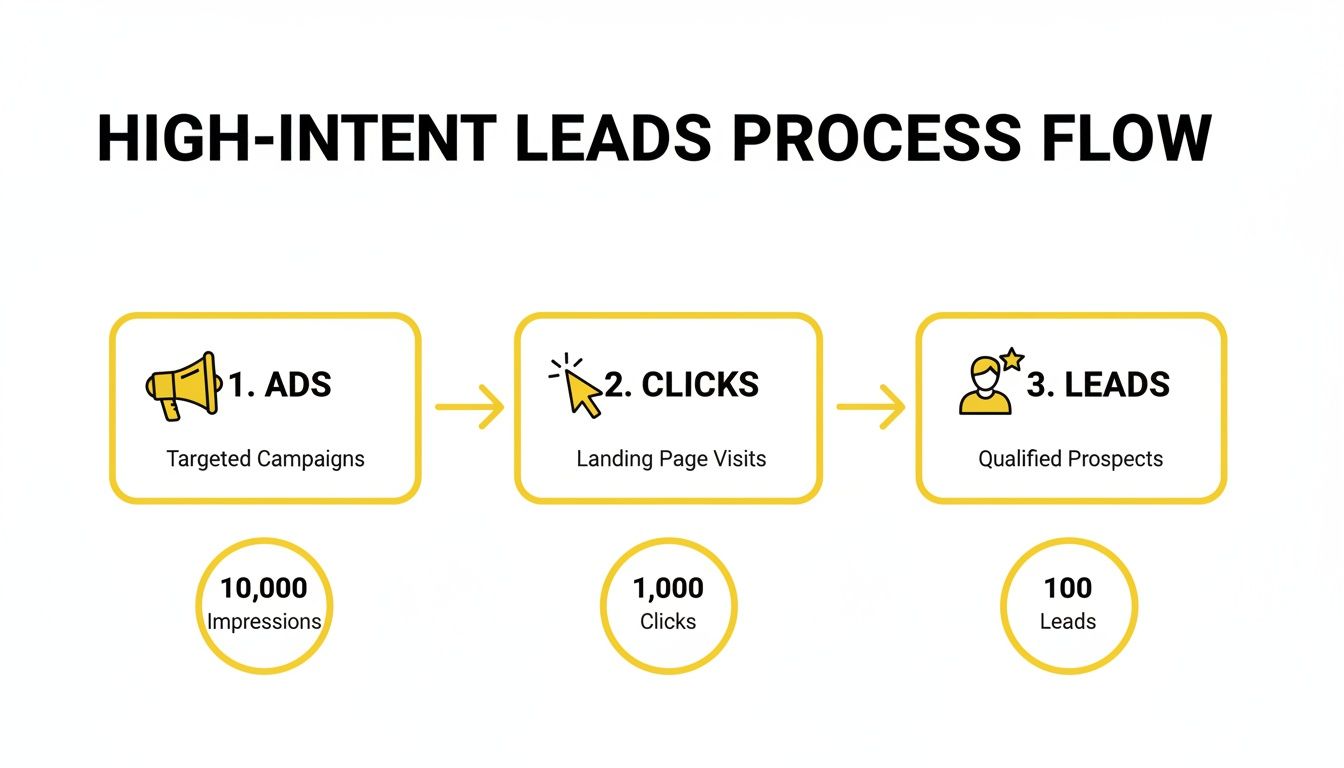
The crucial thing to see here is that every step is a potential drop-off point. That's why getting the transition from a simple click to an actual lead is a make-or-break moment you have to nail.
Anatomy of a High-Converting Landing Page
Your landing page has one job and one job only: convince a qualified prospect to take the next step. That usually means booking a call or filling out an application. Every single word, image, and button on that page must push them toward that one goal. Any distraction, confusing message, or lack of clarity will absolutely tank your conversion rates.
Here are the non-negotiables:
A Clear, Compelling Headline: It has to instantly tell the prospect they’re in the right place and echo the promise you made in your ad.
Problem-Focused Copy: Forget listing features. Talk about the real pain points your ideal client is wrestling with. Show them you get it. You’re in their world.
An Unmistakable Call to Action (CTA): Be direct. Use action-oriented buttons like “Book My Strategy Call” or “Apply For Your Consultation.” No room for vague language here.
This is where selling high-ticket services gets tricky. It’s a completely different ballgame than standard e-commerce. For high-value offers, average conversion rates hang out between a slim 0.5% and 1.5%. That’s a world away from the general e-commerce average of around 2.5%. The reason is simple: a multi-thousand-dollar decision requires a whole lot more trust and deliberation. Your funnel’s job is to build that trust, piece by piece. You can get more insights on high-ticket conversion rates at VTEX.
Building Instant Trust with Social Proof
When you’re asking for a big investment, trust isn’t just a nice-to-have—it’s everything. Prospects need to see clear evidence that you've delivered incredible results for people just like them. Your landing page is the perfect spot to lay out your proof.
Nobody wants to be your first success story, especially when there's serious money on the line. Social proof completely de-risks the decision in their mind, making it way easier for them to say "yes" to a conversation.
Here are a few of the most powerful ways to weave in social proof:
Video Testimonials: A short, authentic video of a client sharing their transformation is pure gold. It’s far more believable and hits on an emotional level that text just can’t match.
Specific Case Studies: Don't just slap up a quote. Break down the client's initial problem, the solution you provided, and the specific, measurable results they got (e.g., “Grew revenue by $150,000 in six months”).
"As Seen On" Logos: If you've been featured in industry publications or on reputable sites, show off their logos. This is a classic move that borrows credibility and builds your authority instantly.
The Automated Nurture Sequence
Okay, but what happens when someone hits your page but doesn’t book a call right away? This is where most businesses completely drop the ball. An automated email and SMS nurture sequence is your safety net. It’s designed to re-engage those warm leads and keep your offer from being forgotten.
This isn't about spamming them with aggressive sales pitches. Not at all. The goal is to keep providing value and building trust over time.
For instance, a simple three-part sequence could look like this:
Email 1 (Day 1): Send a link to a powerful case study or a short training video that solves a small piece of their problem for free. Give them a quick win.
Email 2 (Day 3): Bust a common myth or tackle a frequent objection in your industry. This positions you as the go-to expert they can trust.
Email 3 (Day 5): Send a final, more direct invitation to book a call. Frame it around the cost of not taking action versus the potential transformation.
When you combine a powerful landing page with a smart nurture sequence, you create a seriously robust system. It makes sure you not only convert the people who are ready to go right now but also cultivate the ones who need a little more time, maximizing the return on every single click you pay for.
Mastering the High-Value Sales Conversation

This is it. The moment of truth. All your hard work—the ads, the funnels, the follow-ups—it all comes down to this single conversation. If you get this right, you build a predictable revenue machine. If you fumble it, the entire system breaks down.
A high-ticket sales call isn’t a pitch. It’s a diagnostic consultation where you stop being a service provider and become a trusted advisor. Your job isn't to "sell," but to get to the heart of your prospect's world. You're digging for the real, often unspoken, pain that’s driving them to look for a solution in the first place.
When you can articulate their problem even better than they can, you build instant trust. Your offer becomes the only logical next step.
Structuring the Call for Success
The best high-value calls feel natural, but they're built on a proven framework. It’s a dance, not a march. You’re guiding the conversation from rapport to resolution without ever sounding scripted or robotic. Each phase builds on the last, creating momentum that leads straight to the close.
I like to think of the conversation in a few distinct stages:
Rapport and Framing: The first couple of minutes are make-or-break. This is where you set a collaborative tone, take control of the call, and lay out the agenda. You position yourself as the expert who is there to help, not just to sell.
Deep Discovery: This is where the magic happens. You’ll ask strategic, open-ended questions to uncover their current situation, their desired future, and every obstacle standing in their way. You’re digging for the real pain points, not just the surface-level symptoms.
Future Pacing: Once you understand their pain, you help them see what life could be like. What does their business look like after this problem is gone for good? This creates the emotional buy-in needed for a big investment.
Presenting the Solution: Only after you’ve fully diagnosed the problem do you present your offer. Don't just list features. Frame your service as the bridge that gets them from their current pain to their desired future. It's the specific cure for their specific ailment.
This structure ensures you have all the information you need before you ever mention a price, making the final ask feel like a natural conclusion instead of a jarring sales pitch.
Navigating the Inevitable Objections
No matter how perfectly you run the call, objections are going to come up. That’s just part of the game. But an objection isn't a "no"—it's a request for more information or a test of your confidence. The key is to see them coming and have a calm, prepared response that brings the conversation back to value, not cost.
To really nail this, you need to understand the underlying psychology, which is expertly covered in A Practical Guide to Mastering High Ticket Closing.
Let's break down the most common objections you'll face.
An objection is often just the prospect's fear talking. Your job is to acknowledge the fear, validate their concern, and then confidently lead them back to the value of the transformation they desire.
Common Objections and Proven Responses
When you understand the fear behind the objection, you can respond with both empathy and authority. Here’s a quick guide to what’s really being said and how to handle it.
Objection | Underlying Fear | Effective Response Framework |
|---|---|---|
"It's too expensive." | Fear of a bad investment or not getting a positive ROI. | Agree and pivot: "I understand it's a significant investment. Let's look at the other side—what's the cost of not solving this? What will another six months of [pain point] really cost you?" |
"I need to think about it." | Fear of making the wrong choice or a lack of clarity on the value. | Isolate the real issue: "Absolutely, it's a big decision. When you say you need to think about it, is it the financial side, or are you just not sure this can deliver the results we talked about?" |
"I have to talk to my partner." | Fear of making a major decision alone or a real need for spousal/business partner approval. | Empower them for that conversation: "Of course. What do you think their main questions will be? Let's make sure you have everything you need to feel confident explaining this." |
Handling objections is less about a magic script and more about maintaining control of the frame. You’re the expert guiding them to the solution they desperately need.
Anchoring Value Before the Price
The price of your offer should be one of the last things you reveal. Why? Because throughout the entire discovery process, you’ve been building a "value bank" by quantifying the cost of their problem and painting a crystal-clear picture of the ROI.
The data backs this up. B2B sales call conversion rates show just how critical lead quality and trust are. Deals under $10,000 convert at a respectable 25.73%, but massive enterprise deals over $5 million plummet to 9.09%. Where's the sweet spot? Referral leads convert at an impressive 25.56%, blowing cold calling's dismal 9.38% out of the water. For consultants, tax advisors, and real estate pros, this proves the conversation is worlds easier when it starts from a place of trust.
By the time you state your price, the prospect should already be thinking, "This is going to be expensive, but it's worth it." You’ve anchored the conversation so firmly on the value of the outcome that the investment feels reasonable, not shocking.
This makes the final step—confidently asking for the sale—the easiest part of the call. You’ve already won their trust and shown them that your solution is the best path forward.
Optimizing Your System for Predictable Growth
A high-performing client acquisition system is never really “done.” Think of it less like a project you complete and more like a high-performance engine that needs constant tuning. Getting your funnel launched is just the starting line. The real money is made when you learn how to track what’s working, spot what’s broken, and make smart, data-driven adjustments along the way.
This means you have to look past the vanity metrics. Things like ad impressions or raw page views might feel good, but they don't pay the bills. We need to zero in on the numbers that directly impact your bank account. These are the Key Performance Indicators (KPIs) that tell the true story of your system’s health.
The KPIs That Actually Matter
If you want a predictable revenue engine, you need a dashboard. It doesn't have to be fancy, but it has to track the core metrics that reveal bottlenecks and opportunities across the entire journey, from that first ad click to the final "yes."
Here are the essential KPIs you should be tracking religiously:
Cost Per Booked Call: This is your north star for the top of the funnel. It tells you exactly how much you have to spend on ads to get one qualified prospect on your calendar. It's a pure measure of your ad and landing page effectiveness.
Appointment Show-Up Rate: What percentage of those booked calls actually show up? A low number here is a huge red flag. It almost always points to a weak pre-call nurture sequence or a problem with lead quality.
Sales Close Rate: Of the people you actually talk to, how many become clients? This is the ultimate report card for your sales conversation and offer.
Once you know these three numbers, you can easily calculate your Cost Per Acquisition (CPA)—the total amount of money it costs to land one new high-ticket client. Knowing your CPA is what gives you the confidence to scale your ad spend without just guessing and hoping for the best.
Turning 'Not Right Now' into Future Revenue
Let's get real for a second: a lot of qualified, interested prospects won't close on the first call. That's just how high-ticket sales works. In fact, some research suggests that 80% of all deals require at least five follow-up interactions. If you don't have a plan for this, you are literally leaving a mountain of cash on the table.
This is where most people completely drop the ball. Their idea of "follow-up" is sending a lame, "just checking in" email that reeks of desperation and completely tanks their authority. That's a catastrophic mistake when you're selling a premium service.
An effective follow-up positions you as a trusted advisor, not a needy salesperson. Each point of contact should add value, address a concern, or reinforce the cost of inaction.
Instead of that generic check-in, send them something that actually helps. A relevant case study, an article that speaks directly to a problem they mentioned, or even a quick personalized video message referencing something specific from your call. This keeps you top of mind and continues to build the trust needed to get them over the finish line when the timing is right.
The Advisor-Focused Follow-Up Sequence
Your follow-up is an extension of the sales call, not a separate, annoying task. The goal is to stay engaged without being a pest. Don't just hammer them with emails. A good mix of email, personalized video, and maybe even a well-timed text can be incredibly powerful.
Here’s a simple but effective sequence you can steal and adapt:
The 48-Hour Recap: Within two days, send a personal message. Reiterate the main problem you talked about and briefly restate how your offer is the bridge to where they want to go.
The Value-Add (Day 5): Share something useful that has nothing to do with closing them. It could be a blog post you wrote, a short video tip, or a link to a resource you think they'd like. Be helpful, not salesy.
The Social Proof Nudge (Day 10): Send them a new client success story or a powerful testimonial. This subtly reminds them of the results they're missing out on and creates a little healthy FOMO (fear of missing out).
The Gentle Re-Engagement (Day 15): Reach out with a simple, no-pressure question. Something like, "Last we spoke, you were focused on solving [their specific challenge]. Curious if anything has shifted since our conversation?"
This disciplined approach transforms follow-up from a chore you dread into a strategic tool that generates revenue. By consistently tracking your core KPIs and running a robust follow-up system, you take all the guesswork out of growth. You start building a truly optimized machine that brings in predictable clients, month after month.
Still Have Questions About High-Ticket Closing?
Even with a proven roadmap, I get it—shifting to a high-ticket model can feel like a big leap. It's a different world from traditional sales. This isn't about brute force; it's about building real value, understanding client psychology, and creating a system that does the heavy lifting for you.
Let's clear up a few of the most common questions I hear from people building their own high-ticket client machines.
What's a Good Closing Rate for High-Ticket?
This is probably the number one question I get, but the honest answer is: it depends. There's no single magic number.
For most coaches and consultants running a tight ship with properly qualified leads, a 50% consultation-to-close rate is a great target. Think about that—for every two qualified people you talk to, one becomes a client. That’s not just possible; it’s achievable with the right system.
Now, things look a bit different in the B2B space.
Smaller deals, say under $10k, can often close above 25%.
But when you get into massive enterprise contracts over $5M, the rate can dip below 10%. That’s normal, given the sheer number of decision-makers and the layers of complexity involved.
The real takeaway here isn't to chase a percentage. It's to get obsessed with the quality of your leads. I'd take a lower close rate on high-value, perfect-fit clients any day over a high close rate on unqualified people who end up being a nightmare.
How Do I Figure Out My Pricing?
Pricing your high-ticket offer is where so many people get stuck, and it’s arguably one of the most important decisions you'll make. The biggest mistake? Pricing based on your hours or what you see a competitor charging.
Your price has to be anchored to the value of the transformation you provide. Period.
Start by mapping out the tangible ROI. If your coaching helps a real estate agent land just one more $20,000 commission, your $5,000 fee suddenly looks like the smartest investment they could make. It completely reframes the conversation.
Price is only ever an issue when value is unclear. When you can clearly show that the pain of staying where they are is far more expensive than your solution, the investment becomes a no-brainer.
And don’t forget the intangible wins—the time they get back, the stress that disappears, or the new status they achieve. Do your market research, but at the end of the day, price with confidence based on the massive results you deliver.
How Long Does My Sales Funnel Need to Be?
Your funnel’s complexity should mirror your offer’s price and complexity. It's not one-size-fits-all.
For most high-ticket offers in that $3,000 to $10,000 sweet spot, a simple, direct funnel works wonders. It usually looks something like this:
Hyper-targeted ads that point to a valuable asset (like a VSL or a webinar).
A quick application form to weed out the tire-kickers.
A direct path to booking a one-on-one discovery call.
But if you’re selling complex B2B services or anything north of $25,000, the funnel needs more runway. It has to build a much deeper level of trust. That means bringing in detailed case studies, multi-part email sequences, and sometimes several calls with different people in the company. The goal is always the same, though: build so much trust and authority that the investment feels safe and logical.
What’s the Single Most Important Metric to Watch?
Your closing rate is obviously a big deal, but the metric that gives you the most leverage is your Cost Per Qualified Appointment.
This number cuts through all the vanity metrics. It tells you, in plain dollars, how much it costs in ad spend and effort to get a real, potential buyer on the phone.
Once you know that number and your close rate, you can calculate your true Cost Per Acquisition (CPA)—the master metric. If you can drive down your Cost Per Qualified Appointment by tweaking your ad targeting, improving your landing page, or tightening your qualification process, you directly boost the profitability of your entire business. It's one of the fastest ways to scale.
Ready to stop guessing and start building a predictable, profitable client acquisition machine? The team at Wojo Media specializes in bolting onto businesses to install omnipresent ad campaigns and conversion-focused funnels that deliver a steady stream of qualified appointments. Book a free demo call today and get a custom-built paid ads strategy designed to scale your high-ticket offers.
Comments