.png)
How to Build a Sales Funnel: The Ultimate Guide to More Conversions

Forget all the complex marketing jargon for a second. Building a sales funnel is really about one thing: creating a predictable path that turns complete strangers into your best customers. It's a journey with four key stops: grabbing their Awareness, sparking their Interest, creating Desire for what you offer, and finally, prompting Action. If you can master that flow, you'll turn ad dollars into real, sustainable growth.
Your Blueprint for a High-Converting Sales Funnel
At its core, a sales funnel is just a map of your customer’s journey. It tracks the entire experience, from the very first time they hear your brand's name to the moment they pull out their credit card. Think of it less like a rigid diagram and more like a guided tour you’ve designed specifically for your ideal buyer. Its entire purpose is to systematically move people from not knowing you exist to becoming happy, paying customers.
Without a funnel, your marketing is just a bunch of random shots in the dark. A great Facebook ad or a killer blog post is fantastic, but if there's no clear next step, that initial spark of interest fizzles out almost immediately. A well-designed funnel makes sure every ad, landing page, and email has a job to do, seamlessly guiding prospects from one step to the next.
For a deeper dive into the nuts and bolts of the whole process, from defining each stage to optimizing for better results, check out this excellent guide on how to create a sales funnel that converts.
The Four Core Funnel Stages
Every great sales funnel, whether it’s for a DTC brand selling skincare or a local plumber booking service calls, is built on the same psychological foundation. Once you get these stages down, you're on your way to building a funnel that actually works.
Awareness: This is the very top of your funnel (often called TOFU). Your only goal here is to get on your ideal customer's radar. They’re aware they have a problem, but they might not know a solution exists—and they definitely don't know about you.
Interest: Now we’re in the middle of the funnel (MOFU). Once they know you exist, they start actively looking for solutions. This is where you step in with valuable content to educate them and position your brand as a trustworthy authority.
Desire: Still in the MOFU, this is where the magic happens. Your prospect is weighing their options, and your job is to create a powerful preference for your product. You need to show them exactly why your solution is the perfect one for their specific problem.
Action: We’ve reached the bottom of the funnel (BOFU). The prospect is on the verge of buying. Your goal is simple: make it as easy and compelling as possible for them to convert with a crystal-clear call-to-action (CTA) and an irresistible offer.
This classic AIDA model provides a solid framework. Here's a quick look at how these stages play out in the world of paid advertising.
Core Stages of a Modern Sales Funnel
This table breaks down each funnel stage and its primary objective within a paid ads context.
Funnel Stage | Primary Goal | Key Channels (Examples) | Core Metric |
|---|---|---|---|
Awareness (TOFU) | Grab attention & introduce the brand | Facebook/IG Video Ads, YouTube Ads, TikTok | Impressions, Reach, Video Views |
Interest (MOFU) | Educate & build trust with valuable content | Lead Magnets (eBooks), Webinars, Blog Content | CPL (Cost Per Lead), Landing Page Views |
Desire (MOFU) | Showcase product value & create preference | Case Studies, Testimonial Ads, Retargeting | Add to Carts, Free Trial Signups |
Action (BOFU) | Drive the final purchase or conversion | Dynamic Product Ads, Abandoned Cart Offers | CPA (Cost Per Acquisition), ROAS |
Understanding these goals helps you choose the right message and creative for each person, depending on where they are in their journey.
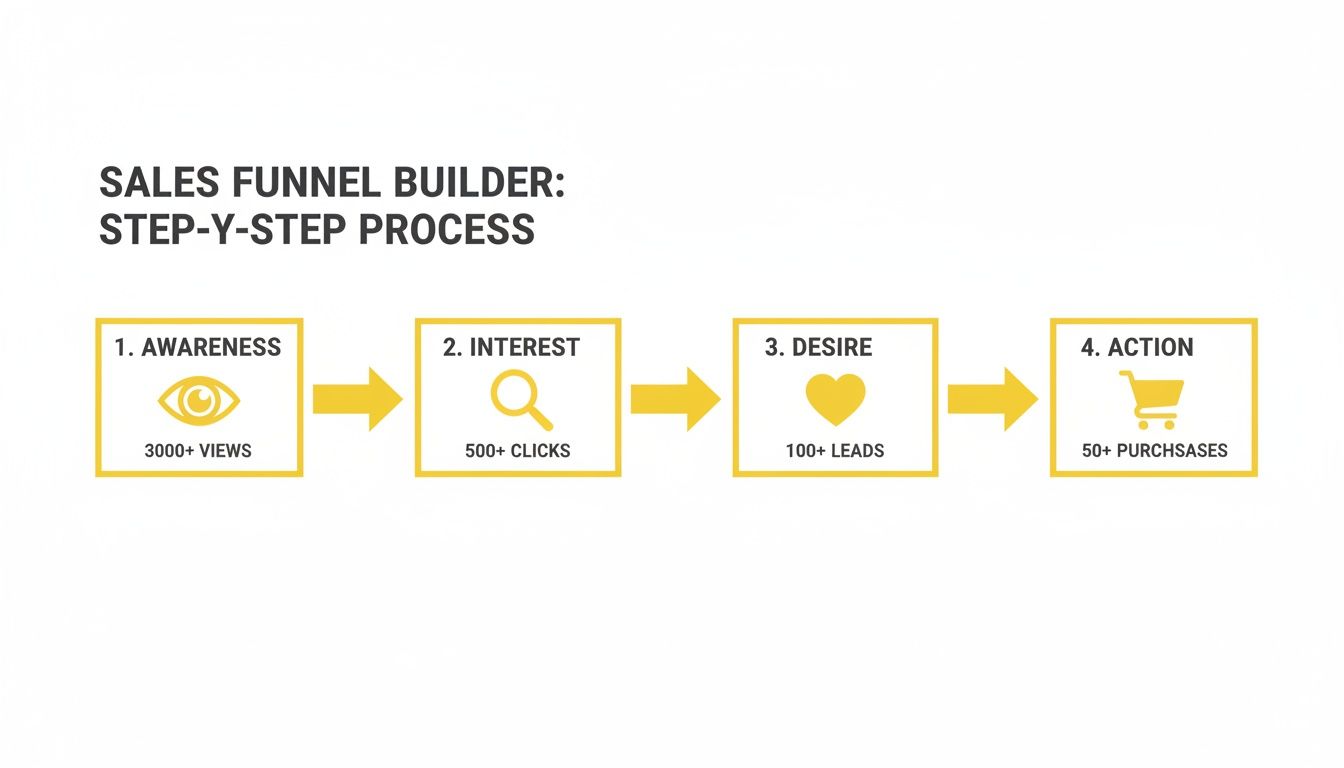
As you can see, the pool of potential customers gets smaller at each stage. That’s completely normal. The key is to optimize every step to make sure you're not losing good prospects along the way.
Crafting an Irresistible Offer Your Audience Cannot Refuse
Your entire sales funnel lives and dies by one thing: your offer.
You can nail the ad creative and laser-focus your targeting, but if the offer itself is weak, you're just lighting money on fire. The mission here isn't to just present a product. It's to build what we call a "Grand Slam Offer"—something so compelling it feels like an obvious win for your ideal customer.
A truly powerful offer is so much more than a simple discount. It’s a meticulously crafted package that solves a massive pain point so completely that the price tag becomes an afterthought. It's all about shifting the prospect's mindset from, "How much does this cost?" to "How fast can I get this result?"
The Psychology of Perceived Value
Let's get one thing straight: people don't buy products; they buy outcomes. They buy transformations. A weak offer sells a one-hour massage. A strong offer sells an escape from chronic back pain and a return to hiking on the weekends. See the difference? One is a transaction, the other is a life-changing solution.
To create an offer your audience can’t possibly refuse, you have to stack the value so high that its perceived worth completely dwarfs the actual price. You do this by bundling your core product or service with valuable bonuses that tackle related problems or help them get their desired result even faster.
Core Product: This is your main event (e.g., a 12-week coaching program).
High-Value Bonuses: These are the add-ons that sweeten the deal (e.g., "done-for-you" meal plans, a library of pre-recorded workout videos, or access to a private support community).
Each bonus needs to be so good that you could realistically sell it on its own. When you lay them out on your landing page, assign a real-world dollar value to each one. This visually hammers home that they're getting a package worth, say, $2,997 for only $497. Instantly, the purchase is reframed as a smart investment, not just another expense.
Real-World Examples in Action
Let’s see how this plays out for a couple of different businesses.
We worked with a med spa that stopped selling a simple "CoolSculpting Session" and instead created the "Summer Confidence Package." This included the core treatment, but they added three bonus skin-tightening sessions (a $900 value), a nutritional guide for maintaining results (a $150 value), and a voucher for a follow-up consultation (a $250 value). They weren’t selling a procedure anymore; they were selling a transformation.
In another case, an e-commerce client selling high-end coffee beans supercharged their average order value with a "Complete Barista Bundle." Instead of just moving a single bag of coffee, they bundled it with a premium grinder, a set of artisanal mugs, and an exclusive guide to brewing the perfect espresso. The perceived value was so much higher, making the bundle a no-brainer compared to a single bag.
A great offer makes the customer feel like they are taking advantage of you. If they pause and think, "Wow, this seems too good to be true," you've nailed it.
De-Risking the Purchase with Strong Guarantees
The final piece of your irresistible offer is to remove every ounce of perceived risk. Even with a mountain of value, people hesitate. They’re afraid of wasting money or that it just won't work for them. A bulletproof guarantee is how you neutralize that fear.
It's time to move past the generic "30-day money-back guarantee." Get creative and get specific:
Results-Based Guarantee: "If you don't generate at least 10 qualified leads in your first 60 days, we'll work with you for free until you do."
"More Than Your Money Back" Guarantee: "If you complete the course and don't feel it was worth every penny, we'll refund you in full and you can keep all the bonuses."
This level of confidence shows you stand firmly behind your product and puts the customer completely at ease. It makes saying "yes" a much, much easier decision.
Of course, you have to know your numbers. The conversion landscape changes dramatically by industry and price point. Deals under $10,000 convert at around 25.73%, while those over $5 million plummet to just 9.09%. As these industry conversion rate benchmarks show, a high-ticket coaching offer needs a very different risk-reversal strategy than a low-ticket e-commerce product.
Building Landing Pages That Convert Traffic Into Sales
You've got an irresistible offer. Now it needs a home. This is where the landing page comes in, and frankly, it’s the single most critical conversion point in your entire sales funnel. It's the digital handshake where a curious visitor from your ad decides if you’re worth their email address or their credit card.
Get this part wrong, and you're just lighting your ad budget on fire. But a great landing page? That becomes a sales machine that works for you 24/7.
This isn't about winning design awards or using flashy animations. A high-converting landing page has one job: to get a visitor to take one specific action. Every single element—every headline, image, and button—has to work together to kill distractions and build an undeniable case for your offer.
The Anatomy of a High-Converting Landing Page
Whether you're trying to get a lead for your coaching business or sell a physical product, the core principles don't change. You're aiming for a frictionless experience that builds trust and momentum, pushing the visitor straight toward the conversion. Your page must be clean, clear, and relentlessly focused on them.
Here are the non-negotiables:
A Headline That Hooks: This is your first—and maybe only—shot to grab their attention. It has to speak directly to their biggest problem or the result they desperately want.
A Compelling Sub-headline: Think of this as the one-two punch after the headline. It should expand on the big promise and give them just enough intrigue to keep scrolling.
Benefit-Driven Bullets: Stop listing features. Sell outcomes. Instead of saying “10 video modules,” you should be saying, “Master copywriting in just 10 days with our proven, step-by-step video system.” See the difference?
Engaging Visuals: People buy with their eyes first. Use high-quality images or videos that show your product being used or, even better, represent the transformation your customer is after.
Overwhelming Social Proof: Nothing builds trust faster than seeing that other people have already won with your offer. Sprinkle testimonials, case studies, reviews, and client logos all over the page. Don't be shy.
A Clear Call-to-Action (CTA): Your button needs to be unmissable. Use strong, action-oriented language. "Get My Free Guide Now" or "Start My Transformation" beats a lazy "Submit" every time.
This basic structure is the skeleton for both lead generation and e-commerce pages, but how you flesh it out will differ.
Wireframing for Lead Generation vs E-commerce
Let's get specific and break down the components for each type of funnel. The psychology is similar, but the execution is different because the end goal is different.
A lead generation landing page for a coach or service business is all about a simple, low-risk value exchange. You’re giving them something awesome (a guide, a webinar, a checklist) for their contact info. Simplicity is your absolute best friend. The entire page should be laser-focused on getting them to fill out that form.
On the other hand, an e-commerce product landing page has a much bigger job to do. It has to convince someone to pull out their wallet. That means you need more detail, more social proof, and a layout that smashes all their potential objections about shipping, returns, and product quality.
Your landing page copy should feel like you're talking directly to one person. Use words like "you" and "your" to tap into their specific pains and desires. It makes them feel like you truly get it.
Here’s a practical look at how the key elements stack up for each type of page.
Essential Landing Page Elements Checklist
To help you focus on what really matters for your funnel, this table breaks down the must-have components for both lead generation and e-commerce landing pages.
Element | Lead Generation Page | E-commerce Product Page |
|---|---|---|
Primary Goal | Capture an email address or book a call. | Drive a direct purchase. |
Headline Formula | Outcome-focused: "The 5-Step System to Double Your Leads..." | Product-focused: "The Last Coffee Mug You'll Ever Need" |
Visuals | Mockup of the lead magnet, photo of the expert. | High-quality product photos, lifestyle images, video demo. |
Social Proof | Testimonials about results, logos of past clients. | Customer reviews, star ratings, UGC photos. |
CTA | "Download Now," "Get Instant Access," "Book My Call" | "Add to Cart," "Buy Now," "Shop the Collection" |
Supporting Copy | Short, benefit-driven paragraphs, bullet points. | Detailed product description, specs, FAQ section. |
Risk Reversal | Emphasize the value of the free content. | Strong return policy, money-back guarantee, trust badges. |
See the common thread? Both pages are obsessed with building value and killing friction. When you tailor these elements to your specific offer and audience, you create a slippery slide from their first click to the final conversion, turning paid traffic into a predictable flow of leads and sales.
It's Time to Launch Ads That Actually Work
You've got a killer offer and a landing page that’s ready to convert. Now, it's time to open the floodgates with paid traffic. The goal is to make your ads feel like they’re everywhere your ideal customer looks—popping up on their Facebook feed, in their Instagram Stories, during their Google searches, and while they're scrolling through TikTok.
This isn’t about just hitting "boost post" and crossing your fingers. We're talking about a methodical system that drives qualified buyers to your offer around the clock. A well-built ad campaign is the engine of your entire sales funnel, and it all starts with how you organize your audiences.

Cold vs. Warm Traffic: Structure Is Everything
The single biggest mistake I see advertisers make is lumping all their prospects into one bucket. Think about it: someone who’s never heard of you needs a completely different message than someone who abandoned their shopping cart five minutes ago. Your campaign structure has to reflect that reality.
We always split our campaigns into two core categories:
Top of Funnel (TOFU) - Prospecting: These campaigns target cold audiences—people who have zero history with your brand. The job here is simple: grab their attention and get them interested enough to click through to your landing page. You're making a first impression.
Middle/Bottom of Funnel (MOFU/BOFU) - Retargeting: This is where you target your warm audiences. We're talking about website visitors, people who've engaged with your social posts, and especially those who added items to their cart. The goal now shifts from introduction to conversion. It’s about reminding them why they were interested and giving them a nudge to finally buy.
This separation is non-negotiable. It lets you control your budget and messaging with surgical precision, pouring money into prospecting to fill the funnel while running lean, highly effective retargeting ads to close the deal.
Stop the Scroll with Creative That Connects
In a social feed that never ends, your ad creative has less than three seconds to do its job. Generic stock photos and polished, corporate graphics are a death sentence. They get ignored.
Authenticity is the name of the game. People are exhausted by slick, overproduced ads; they crave something real. This is exactly why user-generated content (UGC) and simple, direct-to-camera videos are crushing it right now.
For example, a skincare brand we worked with saw their Cost Per Acquisition drop by 40% almost overnight. The change? We swapped their glossy studio photos for raw iPhone videos of real customers unboxing the product and sharing their genuine first impressions. It felt real, trustworthy, and relatable.
An ad that feels like a natural part of someone's feed will always beat one that screams "I'm a corporate advertisement!" The goal is to blend in so you can stand out.
Here are a few creative angles that consistently deliver results:
Authentic UGC: Get real customers on camera using your product. It’s the most powerful social proof you have, period.
Direct-Response Video: Film simple videos looking straight into the camera. Call out a specific pain point and present your offer as the undeniable solution. No fancy production needed.
Problem/Agitation/Solution (PAS): Structure your creative to first identify a common problem, then agitate it by describing why it’s so frustrating, and finally, present your product as the ultimate relief.
This approach builds an immediate emotional connection and makes your audience feel like you truly get them.
Write Ad Copy That Sells a Transformation
Once your visual hooks them, your ad copy needs to reel them in. Your headline and main text have to speak directly to your audience’s fears, frustrations, and desires. You aren't selling features; you're selling a better version of their future.
Ditch the vague, corporate jargon. Get specific. Instead of, "Our CRM software helps businesses grow," try something like, "Tired of hot leads slipping through the cracks? Our CRM gives you a crystal-clear view of your pipeline so you never miss a deal again." See the difference? The second one hits a real pain point and promises a tangible outcome.
Here’s a simple but powerful formula for your ad copy:
The Hook: Start with a sharp question or a bold statement that grabs your ideal customer's attention.
The Pain Point: Show them you understand their struggle by articulating the exact problem they're dealing with.
The Solution: Introduce your offer as the bridge that takes them from their current pain to their desired outcome.
The Call-to-Action (CTA): End with a clear, simple command. Tell them exactly what to do next, like "Tap 'Learn More' to claim your free guide."
By combining a smart campaign structure with authentic creative and emotionally charged copy, you build an advertising machine that doesn't just get clicks—it attracts qualified buyers who are ready to convert from day one.
Using Data to Optimize Your Funnel for Profitability
Getting your sales funnel live is just the starting line. The real money isn't made in the launch; it’s earned through relentless, data-driven optimization. Guesswork is the enemy of profitability. This is where you stop relying on gut feelings and start letting hard numbers guide your decisions, turning your funnel from an expensive experiment into a predictable revenue machine.
First things first: you can't optimize what you can't see. Flying blind is a surefire way to burn through your ad budget. That means getting your tracking dialed in perfectly. You’ll need to correctly install pixels from your ad platforms—like the Meta Pixel or Google Ads tag—and be meticulous about setting up your conversion events. You need a crystal-clear picture of every move a user makes, from the moment they hit your page to the second they buy.
The Metrics That Truly Matter
Vanity metrics like impressions and likes are nice for the ego, but they don’t pay the bills. When we "bolt onto" a client's business, we obsess over a handful of key performance indicators (KPIs) that tell us the real story about the funnel's health and profitability.
These are the numbers that matter:
Cost Per Lead (CPL): How much does it cost to get one person interested enough to hand over their contact info? This is your entry fee for every potential customer.
Conversion Rate (CR): Of all the people who visit your landing page, what percentage actually do the thing you want them to do? A low CR is a massive red flag—it usually points to a disconnect between your ad, your page, and your offer.
Cost Per Acquisition (CPA): This is the big one. How much are you spending in total to get one paying customer? Your CPA absolutely must be lower than what that customer is worth to you over time.
Return on Ad Spend (ROAS): For every dollar you put into ads, how many dollars do you get back? A 2x ROAS means you’re making $2 for every $1 spent. This is the ultimate bottom line for your campaigns.
Watching these numbers daily lets you catch problems before they become disasters. A sudden spike in your CPL? It could be ad fatigue. ROAS taking a nosedive? Maybe something broke in your checkout process.
Data tells you a story. It’s your job to listen to that story and rewrite the ending. A small tweak, guided by data, can be the difference between a failing campaign and a seven-figure funnel.
The game is also getting more sophisticated. Top performers are looking beyond just these front-end metrics. In B2B SaaS, for example, we often see a huge drop-off when Marketing Qualified Leads (MQLs) are handed to sales, with conversion rates to Sales Qualified Leads (SQLs) plummeting to just 15-21%. The smartest companies are now using AI to analyze user behavior and serve up dynamic content, a strategy that’s been shown to boost lead-to-opportunity conversion by as much as 37% in just a few months. It's a clear signal that tracking the entire customer journey is the key to predictable growth.
A Simple Framework for A/B Testing
Optimization isn't about throwing spaghetti at the wall to see what sticks. It's a methodical process of testing one variable at a time to find what truly moves the needle. We call this A/B testing, or split testing, and it’s the core discipline for improving your results over time.
To really nail this, you need a solid grasp of what Conversion Rate Optimization (CRO) entails. It’s both an art and a science, focused on tweaking your assets to convince more people to take action.
Your testing plan needs to be simple and focused. Don't try to change five things at once; you'll have no idea what actually worked. Instead, you isolate one variable and pit a new version (the "challenger") against your current one (the "control").
Here’s where you’ll get the biggest bang for your buck, in order of impact:
The Offer: This is the highest-leverage element you can test. Try out different bonuses, change up your guarantee, or experiment with pricing. For example, does a payment plan convert better than a pay-in-full discount?
The Landing Page Headline: It’s the first thing people see. Test a benefit-driven headline ("Get 10 New Leads in 30 Days") against a pain-point-focused one ("Tired of an Empty Sales Calendar?"). The difference can be staggering.
Ad Creative: Don't just test different colors. Test entirely different concepts. Pit a raw, UGC-style video against a polished animated graphic. Try a super long, story-based ad against one that’s short and punchy.
Let your tests run until you have a clear winner based on data, not just a few hours of results. Aim for at least 100 conversions per variation to ensure you have statistical significance. Once you have a winner, it becomes your new control. Then, you pick the next variable and start the process all over again. This constant loop of testing and iterating is how you systematically drive down costs, increase conversions, and build a genuinely profitable machine.
Common Questions About Building a Sales Funnel
Even with the best blueprint in hand, questions always pop up once you start getting your hands dirty building a funnel. It’s inevitable. The real work begins when you get into the weeds of budgeting, picking software, and figuring out what’s broken.
This is where we tackle the most common questions we hear from clients. Think of it as a practical guide to help you jump over those hurdles and turn your plan into a profitable machine. We’ll get into how much you really need to spend on ads and what to do when your perfectly planned funnel just isn't working.
How Much Should I Budget for Ads?
This is always the first question, and the honest answer is, it depends—but you don't have to guess. There’s no single magic number that works for everyone.
A solid starting point for a brand-new funnel is to set aside enough budget to get at least 1,000 clicks to your landing page. Why that number? Because it’s enough traffic to give you real data to work with, so you’re not just making decisions in the dark.
Let's say your cost per click (CPC) on Facebook ads is about $2.00. That means you’d want a starting test budget of $2,000. The goal here isn't to get rich overnight; it's to buy data. You’re paying to learn which headlines grab attention, what audiences actually care, and where your landing page is losing people.
Your initial ad spend isn't an expense; it's an investment in data. You're paying to learn exactly what your market wants and how they want it presented. Don't be afraid to spend money to find out what works.
Once you nail down a winning combo—the right ad, the right audience, and a landing page that converts—that’s when you can confidently start cranking up the ad spend. Start small, prove the concept, and then scale methodically.
What Software Do I Actually Need?
It's ridiculously easy to get lost in a sea of marketing tools. You could burn weeks just comparing features and pricing. To keep things lean and effective, you only need a few core pieces to get a high-powered funnel running.
Here’s the simple tech stack that gets the job done:
Landing Page Builder: You need a home for your offer. Tools like Leadpages or Instapage are built for one thing: conversions. They’re user-friendly and come with templates and A/B testing baked right in.
Email Marketing Platform: The moment you get a lead, the clock starts ticking. You need a system to follow up and build that relationship. Services like ActiveCampaign or ConvertKit are fantastic for setting up automated email sequences that nurture leads toward a sale.
Ad Platform Pixels: This isn't software you buy, but it’s absolutely critical. You have to install tracking pixels from your ad channels (like the Meta Pixel or Google Ads Tag) to measure what's working and build incredibly valuable retargeting audiences.
You can always add more complex tools down the road. But these three are the non-negotiable foundation for any funnel meant to turn clicks into customers.
What If My Funnel Isn’t Converting?
It’s one of the most frustrating feelings. You did everything right, traffic is hitting the page, but the conversions just aren't happening. When you hit this wall, it’s time to put on your detective hat and diagnose the problem step-by-step. Panicking and changing everything at once is the worst thing you can do.
Start at the end and work your way backward.
Check the Offer: Is it genuinely a no-brainer? A low conversion rate is often just a symptom of a weak offer. Seriously, go back to the drawing board. Can you add more value, offer a stronger guarantee, or make the promised outcome even clearer?
Analyze the Landing Page: Does the headline immediately connect with the ad they just clicked? Is the call-to-action impossible to miss? Use heatmaps or session recording tools to see exactly where people are getting stuck or bailing.
Review the Ad: Is there a disconnect between what the ad promises and what the landing page delivers? This is a massive conversion killer. Your messaging, visuals, and overall vibe need to be perfectly aligned from the first touchpoint to the final click.
By isolating each stage, you can find the real bottleneck. More often than you’d think, a simple tweak to a headline or strengthening the offer is all it takes to unlock massive performance gains. Building a sales funnel is all about this cycle of testing and refining.
Ready to stop guessing and start scaling with a predictable system for growth? At Wojo Media, we "bolt onto" your brand to build and optimize every piece of your sales funnel—from irresistible offers to omnipresent ad campaigns. Book a free demo call today and let us show you the exact blueprint to drive profitable results.
Comments