.png)
How to Choose a Marketing Agency That Delivers Real Results

Before you even think about hopping on a call with a marketing agency, you need to do some serious homework. It all starts with a simple, but surprisingly tough, question: what does success actually look like for your business? Getting this right is the difference between hiring a true strategic partner and just another vendor who cashes your checks.
Define Your Marketing Goals Before Starting Your Search

Walking into an agency pitch without clear goals is like telling a contractor to "build me something nice" without a blueprint. You’ll get something, but it probably won’t be the house you dreamed of. The best agency relationships kick off when you have a crystal-clear picture of your own objectives. This clarity helps you find the right fit and gives them the roadmap they need to deliver from day one.
Forget vague requests like "we need more traffic." What kind of traffic? Are you looking for local homeowners searching for plumbers, or e-commerce shoppers ready to add to their cart? Fuzzy goals lead to fuzzy strategies and, you guessed it, disappointing results.
Translate Business Needs into Tangible KPIs
The real magic happens when you connect those high-level business goals to specific Key Performance Indicators (KPIs). This is how you turn a broad ambition into a concrete scorecard for your future agency partner.
Here’s what this looks like in the real world for different types of businesses:
E-commerce Brands: Don't just say "more sales." Get specific. Aim for a 3.5x Return on Ad Spend (ROAS) and a 15% lift in Average Order Value (AOV). Now that’s a target.
Local Service Businesses: "More leads" is meaningless. A better goal is a target Cost Per Lead (CPL) under $50 and a steady flow of qualified appointments booked each week.
Coaches and Consultants: You’re likely after high-ticket clients. Your main KPI might be generating a set number of qualified discovery calls from a webinar funnel every single month.
Real Estate Professionals: It’s not about the sheer volume of leads; it’s about the quality. A crucial metric here is the lead-to-appointment conversion rate. You should be aiming for 10% or higher.
Having these numbers locked in before you talk to anyone completely changes the conversation. You’re no longer asking an agency what they can do for you. You’re telling them exactly what you need them to achieve. This flips the script from a sales pitch to a serious strategic discussion.
Set a Realistic and Goal-Oriented Budget
Your budget can't be a number you just pull out of thin air. It needs to be tied directly to the goals you just set.
For example, if your goal is to generate $100,000 in new revenue and you know you need a 4x ROAS to be profitable, you'll need an ad spend of $25,000, plus the agency’s fee.
Thinking this way helps you see if your financial commitment actually matches your expectations. A good agency will help you refine these numbers, but you need to walk in with a solid financial framework. It prevents sticker shock and makes sure you're only talking to partners who are actually in your price range.
Finally, do a quick audit of your own team. Got a fantastic copywriter but no one who understands the dark arts of paid ads? Or maybe a social media whiz who knows nothing about SEO? Pinpointing these gaps ensures you hire an agency to fill a real need, which means you won't be paying for redundant services. This prep work is the most powerful filter you have in your search.
How to Find and Vet Potential Agency Partners

Alright, you know what you need to achieve. Now comes the hard part: building a shortlist of agencies that can actually get you there. A quick Google search will drown you in options, but the truth is, the best partners are rarely found on the first page of results. The goal isn't to find every agency on the planet; it's to find the handful that could be a genuine fit.
The sheer volume of choices is enough to cause analysis paralysis. The U.S. alone had 7,761 marketing agency enterprises in 2022, a number that shot up 17.4% from the year before. With that kind of noise, it’s no wonder 74.1% of marketers still say referrals are their number one source for finding a new partner.
This just proves how critical it is to look beyond a simple search and tap into your trusted networks. Your first move should always be asking for recommendations from business owners or marketing VPs in your circle—especially those whose results you already admire.
Look Beyond a Standard Google Search
While search is a decent starting point, you have to dig much deeper to find top-tier talent. Don't just look for generalists. The real wins come from specialists who already get the unique headaches and opportunities of your specific market.
Here are a few other places I always recommend looking:
Industry-Specific Communities: Get active in niche Slack channels, LinkedIn groups, or private masterminds. This is where the unfiltered, real-world conversations about agency performance are happening.
Award and Recognition Lists: Check out lists like the Inc. 5000. Agencies that land on these lists have proven, verifiable growth—a massive signal that they know how to deliver results.
Review Platforms: Head over to sites like Clutch or G2. Don't just glance at the star rating. Look for agencies with a high volume of recent, detailed reviews (200+ five-star reviews is a fantastic sign) that talk about specific business outcomes, not just fluffy compliments.
A great agency won't just list services on their website—they'll showcase a clear point of view. Does their blog content and social media presence demonstrate genuine expertise, or is it just generic marketing fluff? The best partners openly share their strategic thinking.
Dissect Their Digital Footprint
Once you've got a handful of names, it’s time to put on your detective hat and see what they're really about. An agency's website is their digital storefront. It should tell you in about five seconds who they help and what problems they solve.
This is where you start looking for proof, not just promises. It’s how you separate the agencies that just talk a good game from the ones that actually deliver.
Scrutinize Case Studies and Testimonials
Don't just skim their case studies—interrogate them. A truly powerful case study goes way beyond vanity metrics like "we increased traffic." It gets right to the heart of business impact.
Look for Your Industry: Do they have a track record with businesses like yours? An e-commerce agency’s skillset probably won't translate to a local plumber. If you have specialized needs, guides on topics like how to choose the right conversion rate optimization agency can offer more specific vetting criteria.
Analyze the Metrics: Are they talking about ROAS, cost per lead (CPL), and customer lifetime value (LTV)? The more specific and business-focused their metrics are, the better.
Evaluate Testimonials: Vague praise like, "They were great to work with!" is nice but tells you nothing. You're looking for specifics: "They helped us lower our CPL from $50 to $18 in three months."
After this initial digging, your long list should be whittled down to a curated group of 3-5 top contenders. These are the agencies that have earned a spot on your calendar for a discovery call, where the real vetting begins.
You’ve whittled down your list to a handful of promising agencies. Now comes the real test: the discovery call. This is where you get to see how they think on their feet, moving past their slick sales deck to see the real strategic minds at work.
This first conversation is your chance to cut through the polished pitch and see how they really operate.
A great agency won't just present to you; they'll have a genuine conversation with you. They should be asking more questions about your business, your headaches, and your goals than they spend bragging about their own awards. If it feels like a one-way monologue about how great they are, that’s a massive red flag.
Beyond the Surface Questions
Here’s a hard truth: generic questions get generic answers. If you want to understand what an agency is truly capable of, you need to dig into the nitty-gritty of their process, their team, and how they solve actual problems.
The goal isn't to stump them. It's to see their thought process in action and figure out if their approach actually gels with what you need.
So, move past the basic stuff like, "What services do you offer?" That's on their website. Instead, frame your questions around real-world situations. This immediately shifts the dynamic from a sales pitch to what feels more like a collaborative strategy session.
Here are a few questions designed to peel back the curtain:
Process & Strategy: "Walk me through a time a campaign was underperforming. How did your team turn it around? What specific data points made you change course?"
Team & Communication: "Who would be my day-to-day point of contact? What’s their background, and what’s the chain of command if we have a critical issue on a Friday afternoon?"
Reporting & Analytics: "How do you handle attribution for a campaign that spans multiple channels? Can you show me a sample of a real reporting dashboard you send to clients?"
Digging into Performance and Data
For any business focused on performance—especially in e-commerce or lead generation—an agency's comfort with data is everything. You have to know they’re masters of their craft in areas like paid search and PPC, which represent a huge slice of the ad-spend pie.
With US paid search spending projected to rocket to $124.59 billion (an 11.1% jump year-over-year), it's obvious where the money is going. But here's the kicker: the average Google search ad click-through rate is a dismal 3.17%, and conversion rates are hovering around 2.55%. The skill of your agency is what makes or breaks those numbers. You can explore more of these marketing statistics and trends to see just how much this matters.
An agency’s comfort level with tough questions says everything about their transparency. If they get defensive about past failures or team structure, just imagine how they'll act three months into a contract when the results aren't what you expected.
This is especially critical for coaches or real estate agents where the quality of a lead is paramount. You need a partner who gets sophisticated analytics and multi-channel attribution. With 49% of marketers admitting that PPC is getting harder, you can't afford to take their word for it. Demand proof—case studies showing they've delivered sub-$10 leads for clients just like you.
Agency Vetting Interview Questions
The interview is your best chance to peek behind the curtain. These questions are designed to move beyond the sales pitch and uncover how an agency truly thinks and operates. Use them to gauge their strategic depth, communication style, and overall fit for your business.
Category | Question to Ask | What to Listen For |
|---|---|---|
Strategy & Process | Walk me through a client campaign that failed or underperformed. What went wrong, what did you learn, and how did you pivot? | Honesty and accountability. Do they blame the client or the algorithm? Or do they own it and explain their problem-solving process? |
Team & Communication | Who, specifically, will be working on my account? Can I meet them? What’s their direct experience in my industry? | A clear answer. Vague responses like "our team of experts" are a red flag. You want to know the actual people, not just the agency's brand. |
Data & Reporting | Can you show me a sample of a monthly performance report and explain your approach to data analysis and attribution? | Confidence with data. They should be able to clearly explain their KPIs, what the metrics mean for business growth, and how they track ROI. |
Client Experience | What’s your process for onboarding a new client? What can I expect in the first 30, 60, and 90 days? | A structured, well-thought-out plan. A good agency has a proven process to get you up and running smoothly and aiming for quick wins. |
Industry Fit | What are the biggest challenges you see for a business like mine in the current market, and how would you address them? | Genuine industry insight. Do they understand your customer, your competitors, and the unique hurdles you face? Generic answers won't cut it. |
Asking these kinds of targeted questions helps you separate the talkers from the doers. An agency that is truly confident in its abilities will welcome the scrutiny.
Assessing the Team You Will Actually Work With
Remember, you aren't just hiring a brand name; you're hiring the people who will be in the trenches managing your account every day. It's a classic bait-and-switch for an agency to put their A-team on the sales call, only to hand you off to a junior account manager once the ink on the contract is dry.
You need to be direct and clarify who you'll actually be working with.
Meet the Strategist: Insist on meeting the actual account manager or strategist who will be running your campaigns. This is non-negotiable.
Ask About Their Experience: Grill them on their direct experience in your industry. What kinds of budgets have they personally managed?
Understand Their Capacity: How many other accounts is your point of contact managing? You want a dedicated partner, not someone who's stretched so thin they can't give your business the attention it deserves.
A confident agency will be proud to introduce you to their team. They know their people are their greatest asset. If they hesitate, it’s a sign you should probably walk away.
Decoding Agency Proposals, Contracts, and Pricing
Once the calls and interviews are done, the real decision-making begins. The proposals that land in your inbox are more than just price tags; they’re the blueprint for your entire partnership. Reading between the lines here is a skill that will save you a world of headaches down the road.
These documents can be dense, but they give you a direct look into an agency's strategic mind, their transparency, and what they genuinely believe it will take to get you results. Your job is to dissect them piece by piece, making sure what’s on paper lines up perfectly with the goals you’ve been discussing all along.
Demystifying Common Pricing Models
The first thing you’ll probably flip to is the price. There’s no single “best” way for an agency to charge, and each model has its own pros and cons depending on what you need. Getting a handle on these is crucial for finding a partner that offers a fair exchange of value.
Here’s a quick breakdown of what you’ll likely see:
Monthly Retainer: This is your classic setup—a fixed fee paid each month for a specific set of ongoing services. It’s predictable and works great for long-game strategies like SEO or content marketing. The only catch? You pay the same whether it’s a slow month or one where they knock it out of the park.
Project-Based Fee: Got a one-off job, like a website redesign or building out a new sales funnel? This is your model. You pay a flat fee for that specific project. It’s clean and clear on cost, but obviously isn't built for continuous marketing efforts.
Performance-Based: This is where the agency puts its money where its mouth is. Their fee is tied directly to results—think a percentage of ad spend, a slice of the revenue generated, or a flat fee per lead. It aligns incentives perfectly, but it can get complicated and requires rock-solid tracking to work.
Be very skeptical of one-size-fits-all packages. The best proposals are built from the ground up around your specific goals and KPIs, not pulled from a generic menu. If it feels like a template, the work probably will be, too.
Scrutinizing the Contract Fine Print
Don’t just skim the contract—it’s your safety net. You need to read every single word. This document governs everything from what gets done to what happens when things go sideways. If an agency rushes you through this or brushes off your questions, that’s a massive red flag.
A clear contract is the foundation of a transparent partnership and prevents a ton of future arguments.
Key Clauses You Cannot Afford to Overlook
When you’re digging into the agreement, the language matters. Vague terms create loopholes, and those loopholes almost never benefit the client.
Here are the non-negotiables you need to analyze:
Scope of Work (SOW): This needs to be incredibly specific. "Social media management" is way too broad. A good SOW spells out the platforms, post frequency, reporting schedule, and specific deliverables like "four video ads per month for TikTok and Instagram Reels."
Ownership of Assets: This is critical. The contract must state, without ambiguity, that you own all creative assets, campaign data, and ad accounts when the relationship ends. You paid for them, they belong to you. I’ve seen businesses lose access to their entire Google Ads history, and it’s an absolute nightmare you want to avoid.
Performance Benchmarks: How will you know if they’re winning? The contract should tie back to the KPIs you’ve already agreed on. If your goal is a $25 Cost Per Lead, that number should be in the agreement as a target benchmark.
Termination Clause: This is your exit strategy. Look for a reasonable notice period, usually 30 days. Be wary of getting locked into long-term contracts (12+ months) that don’t have a clear "out for performance" clause. You should never be stuck in a partnership that isn’t delivering.
At the end of the day, trust your gut. If the pricing feels confusing or the terms seem stacked in the agency’s favor, it’s because they probably are. A great partner will present a clear, fair agreement that builds trust right from the start. This document is the foundation of your success together—make sure it’s a solid one.
Matching Agency Expertise to Your Industry
Choosing a marketing agency isn't like picking a software subscription; one size absolutely does not fit all. An agency that delivers incredible results for a national e-commerce brand could completely miss the mark for a local med spa. The strategies, KPIs, and even the creative language required are fundamentally different.
This is why verifying industry-specific expertise is a non-negotiable step. You're not just looking for a team that can learn your business—you're looking for one that already understands the unique challenges and opportunities within your market from day one.
E-commerce Brands Driving Profitable Scale
For an e-commerce store, success is measured in numbers. You need an agency that lives and breathes metrics like Return on Ad Spend (ROAS) and Average Order Value (AOV). Their entire focus should be on building a predictable engine for profitable growth, not just driving clicks.
When you're vetting an agency for your e-commerce business, ask them:
How do you approach scaling a winning ad campaign without destroying the ROAS? This tests their real-world understanding of audience segmentation and budget pacing.
Can you show me a case study where you successfully increased a client's AOV? This reveals if they think beyond the initial sale to maximize customer lifetime value.
Local Service Businesses Needing Qualified Leads
If you run a local business like a home service company or a barbershop, your success isn't about website traffic—it's about qualified appointments in the calendar. You need a partner who gets the nuances of local SEO, Google Business Profile optimization, and lead-nurturing systems that turn a prospect into a paying customer.
Focus your questions on lead quality, not just quantity.
A great agency for a local business will be obsessed with your lead-to-appointment conversion rate. They should be asking about your sales process and how they can deliver leads that are more likely to close, reducing wasted time for your team.
Coaches and Consultants Selling High-Ticket Offers
For coaches and consultants, the game is entirely different. You're not selling a $50 product; you're often selling a multi-thousand-dollar transformation. Your marketing partner must be an expert in building high-trust funnels, often involving webinars, VSLs (Video Sales Letters), and sophisticated email nurturing sequences.
Ask potential agencies:
Walk me through a high-ticket client acquisition funnel you've built.
What's your philosophy on balancing direct response ads with longer-term brand building for a personal brand?
This is where you determine if they understand the psychology of selling expertise and trust, not just a service. And as marketing continues to shift, you need to be sure your chosen agency has a robust strategy for how to optimize for AI search so they can drive real business growth in this evolving landscape.
Real Estate Professionals Seeking Consistent Flow
Real estate is a volume game that hinges on consistency. Agents and investors need a steady, predictable flow of motivated seller and buyer leads. An effective agency in this space is a master of platforms like Facebook and Google Ads, capable of generating high-quality leads for under a specific cost threshold, often less than $10 per lead.
The infographic below outlines a simple decision-making process for evaluating agency contracts, which is a crucial step for any industry.
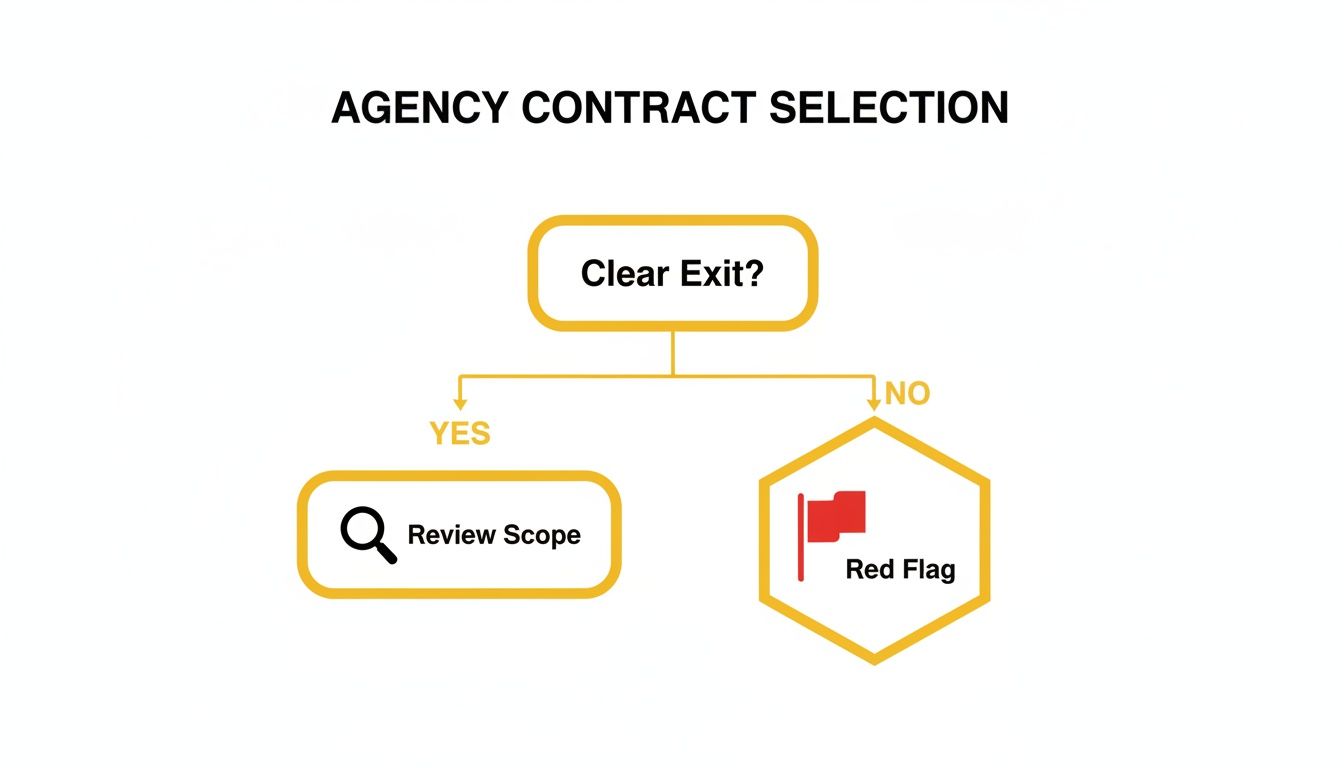
This decision tree emphasizes a critical point: a contract without a clear exit clause is an immediate red flag, regardless of the agency's promises.
Your vetting process must confirm their ability to deliver not just leads, but leads that convert into signed deals. Ask for case studies showing their track record with other real estate professionals. The right partner understands that a lead is just the starting point; the real KPI is a closed transaction.
Agency Specialization Checklist by Industry
To help you cut through the noise, here’s a quick-glance table breaking down what truly matters for different business types.
Industry | Top Priority KPI | Key Agency Skill to Verify |
|---|---|---|
E-commerce | Return on Ad Spend (ROAS) | Scaling paid ad campaigns profitably on platforms like Meta & Google |
Local Service Business | Cost Per Qualified Appointment | Local SEO and Google Business Profile optimization expertise |
Coaches & Consultants | High-Ticket Application Volume | Building and managing multi-step, high-trust sales funnels |
Real Estate | Cost Per Qualified Lead (CPL) | Generating a consistent volume of leads via social & search ads |
Ultimately, aligning an agency’s expertise with your specific industry needs is how you move from hiring a generalist vendor to securing a strategic growth partner.
Building a Successful Partnership After You Sign

Signing the contract isn't the finish line—it’s the starting pistol. The real work begins now, and how well you collaborate with your new agency will make or break your investment. A great partnership is an active process, and the first 90 days are absolutely critical for setting the right tone.
This initial period is all about building momentum. Your agency should have a structured onboarding plan, but your role is just as important. The faster you can get them the access and information they need, the faster they can start chasing those results you hired them for.
Kicking Off a Seamless Onboarding Process
Want to be an agency’s favorite client? Be proactive. Don't make them chase you down for access to your ad accounts, website backend, or analytics platforms. Get those credentials ready ahead of time so you can hand everything over on day one.
This initial phase also establishes the communication rhythm that will define your entire relationship. I’ve found that great agencies are transparent and will immediately set up shared communication channels and lock in a meeting schedule.
A strong onboarding checklist should look something like this:
Asset Handoff: Be ready to share all brand assets—logos, brand guidelines, past ad creative, and any customer personas you have.
Account Access: Grant admin-level access to Google Analytics, your ad platforms (Meta, Google, TikTok), your website’s CMS, and any relevant CRMs.
Kickoff Call: This is the big one. Key players from both teams need to be on this call to align on goals, timelines, and the immediate plan of attack.
The quality of your onboarding experience is a direct reflection of the agency's internal processes. A smooth, organized kickoff signals a well-run operation. A chaotic or disorganized start is a major red flag that problems may lie ahead.
Defining Communication and Reporting Cadence
Miscommunication is the number one killer of agency partnerships. I’ve seen it happen time and again. To avoid it, you need to establish crystal-clear expectations around communication right out of the gate. Will you use a shared Slack channel for quick questions? Who’s the main point of contact for strategic decisions versus a technical issue?
Just as important is defining what a good report looks like to you. A report should be more than just a data dump; it’s a strategic document that connects marketing activity to real business outcomes.
Work with your agency to lock in a clear reporting schedule and format. It usually involves:
Weekly Check-ins: Brief calls or emails to review campaign performance and tackle anything urgent.
Monthly Strategy Meetings: Deeper dives into the previous month's results, analyzing what worked, what didn't, and mapping out the strategy for the month ahead.
This rhythm keeps everyone aligned on progress and priorities. It turns your partnership into a predictable engine for growth instead of a constant source of anxiety.
Being the Kind of Client Agencies Love
The best results always come from true collaboration. An agency can have all the expertise in the world, but they can't succeed in a vacuum. Your insights into your customers, products, and industry are gold.
To get the most out of your partnership, you need to be a great client. That doesn’t mean being hands-off; it means being a strategic partner.
Here’s what a client who gets exceptional results looks like:
Trust the Experts You Hired: You chose this agency for a reason. Avoid the temptation to micromanage creative decisions or campaign tactics. Trust their process, but hold them accountable for results.
Provide Constructive Feedback: When something isn't working, give specific, thoughtful feedback. Instead of "I don't like this ad," try, "This ad's messaging doesn't quite capture our brand's voice. Can we try an angle that focuses more on this specific customer pain point?"
Collaborate on Strategy: Share what you're hearing from your sales team, customer service, and industry chatter. This is the stuff an agency can’t find on its own, and it helps them build much more effective campaigns.
A successful partnership is a two-way street. By being an engaged, collaborative, and trusting partner, you empower your agency to do their best work, ensuring your investment delivers the growth you set out to achieve.
Ready to partner with a performance advertising agency that bolts onto your brand and drives predictable growth? The Wojo Media team has launched over 17,000 campaigns, delivering booked-out calendars and multi-ROAS wins for businesses just like yours. Book a free demo call to receive a custom paid ads strategy and see how we can scale your results.
Comments