.png)
How to Generate Seller Leads and Dominate Your Market
- Jason Wojo
- Jan 28
- 17 min read

If you want a steady stream of seller leads, you have to stop thinking in terms of one-off tactics and start building a reliable system. Random acts of marketing just don’t cut it anymore. The real key is combining an offer sellers can't refuse—like a guaranteed home valuation—with a smart, omnipresent advertising strategy and a disciplined follow-up process.
When you get these pieces working together, you create a predictable pipeline of people who are actually motivated to sell.
The Modern Blueprint for High-Quality Seller Leads
Forget about chasing down cold leads or just sitting around waiting for referrals to trickle in. The only way to keep your calendar full is by building a systematic, repeatable machine designed to attract, capture, and convert motivated sellers.
This isn’t about finding one secret trick; it's about mastering four core pillars that work in harmony to produce consistent results. When you get these components aligned, you graduate from hoping for business to scaling it on demand.
The playbook I'm laying out here is built on a framework that has successfully scaled hundreds of businesses, both for real estate agents and local service providers who need a constant flow of high-intent prospects. And if you're looking for an even deeper dive, exploring these real estate lead generation strategies will give you a more comprehensive approach to keeping that pipeline full.
The Four Pillars of a Successful System
Your success really boils down to how well you execute across four critical areas. If you let even one of these pillars weaken, the whole structure comes crashing down, leading to nothing but wasted ad spend and a list of low-quality contacts.
Here's the thing: you need a predictable system to attract high-intent sellers consistently. Below is a breakdown of the four core components that make it all work. Nailing each one is non-negotiable if you want to move from chasing leads to having them come to you.
Four Pillars of a Successful Seller Lead Generation System
Pillar | Objective | Key Action |
|---|---|---|
1. Offer Creation | Create an irresistible value proposition that solves a seller's immediate problem. | Develop compelling offers like a "Free Home Value Analysis" or a "Guaranteed Offer Program." |
2. Landing Pages | Convert website visitors into qualified leads with a clear and persuasive call-to-action. | Design a simple, high-converting page that captures contact information with minimal friction. |
3. Omnipresent Ads | Generate a consistent flow of targeted traffic to your landing pages. | Run strategic ad campaigns across Facebook, Google, and YouTube to stay top-of-mind. |
4. Data-Driven Follow-Up | Nurture initial interest and convert leads into appointments and signed contracts. | Implement an automated and manual follow-up sequence using calls, texts, and emails. |
Each pillar builds on the last, creating a machine that not only generates leads but qualifies them in the process. When they all fire in sync, your business grows predictably.
The goal isn't just to get more leads; it's to get the right leads. A truly effective system filters out casual browsers and attracts motivated sellers who are ready to make a decision, dramatically improving your conversion rates and return on investment.
Crafting Irresistible Offers Sellers Can't Ignore

Before you even think about spending a dollar on ads, we need to talk about your offer. Get this right, and everything else flows. Get it wrong, and you’re just lighting money on fire.
Your offer is the engine of your entire lead generation machine. A weak one guarantees high costs and tire-kickers. A powerful one? It makes every other step easier and far more profitable.
The goal here is simple: create something so compelling that your ideal seller feels like they’d be a fool to pass it up. This means ditching the generic fluff and speaking directly to their biggest problems and deepest desires.
Tapping Into the Psychology of a Home Seller
Here’s the thing: you're not just offering a service; you're offering a solution. A homeowner doesn't wake up one morning desperate for a "Comparative Market Analysis." They wake up wondering, "Could I get enough for this house to finally move closer to the grandkids?"
Your offer has to bridge that gap between your service and their real-life motivation. The best ones reduce risk, deliver immediate value, or promise a clear, desirable outcome. That psychological hook is what separates an offer that gets scrolled past from one that fills your calendar.
Take the classic "Free Home Value Analysis." It’s a low-commitment offer that works because it appeals to a massive audience, from the casually curious to the seriously considering. It provides personalized, valuable information with zero strings attached. For a lot of agents, this is the bread and butter of their lead gen because it casts such a wide net.
Now, contrast that with a "Guaranteed Offer Program." This speaks to a totally different motivation. You’re attracting sellers who crave certainty and speed more than the absolute top dollar. It's a high-intent offer that instantly filters out the casual browsers and pulls in people who need to sell, often because of a job relocation, financial pressure, or another major life event.
The real key is matching your offer to the type of seller you want to attract. A broad offer will get you more volume but lower intent. A specific, high-commitment offer will bring in fewer leads, but they’ll be much more qualified.
Proven Offer Formulas for Real Estate Agents
To generate seller leads consistently, you can't just rely on one trick. You need a portfolio of offers you can deploy to hit different segments of your market.
Here are three battle-tested frameworks that just plain work:
The "What's My Home Worth?" Offer: This is the most popular lead magnet for a reason. It taps into a homeowner's natural curiosity and is an incredibly low-friction way to start a conversation. To stand out, try framing it as a "Custom Equity Assessment" or "Neighborhood Price Report" to sound more professional than just another automated valuation.
The "Guaranteed Sale" Offer: This is a high-stakes, powerful offer that grabs attention. Think "Guaranteed Offer in 48 Hours" or "I'll Buy Your Home If It Doesn't Sell." This strategy is an absolute magnet for motivated sellers who value speed and certainty above all else.
The "Seller Resource Guide" Offer: This is all about leading with value. You offer a free guide—something like "The Top 5 Costly Mistakes to Avoid When Selling Your Home"—in exchange for their contact info. This move instantly positions you as a trusted expert and builds rapport before you ever ask for an appointment.
Crafting High-Converting Offers for Local Service Businesses
The same logic applies if you run a home service business like roofing, painting, or landscaping. Your offer has to solve a specific problem for a seller trying to get their property ready for the market.
Forget generic "10% Off" discounts. Create offers that tackle seller pain points head-on.
For Roofers: Offer a "Free Pre-Listing Roof Inspection Certificate." This gives the seller a powerful document to show potential buyers, removing a huge point of friction and negotiation from the sale.
For Landscapers: Package your services as a "Curb Appeal Makeover." Frame it as a direct way to boost their home’s final sale price. Remember, over 90% of real estate agents urge sellers to improve curb appeal before listing.
For Painters: Try a "Sell Your Home Faster with a Neutral Color Consultation." This provides instant, tangible value and smartly positions your painting service as a strategic investment, not just another expense.
At the end of the day, your offer has to be a clear, compelling answer to the seller's unspoken question: "How will this help me sell my property faster, for more money, or with less stress?" Nail that, and you'll have a steady stream of high-quality leads knocking on your door.
Building Landing Pages That Convert Clicks Into Clients
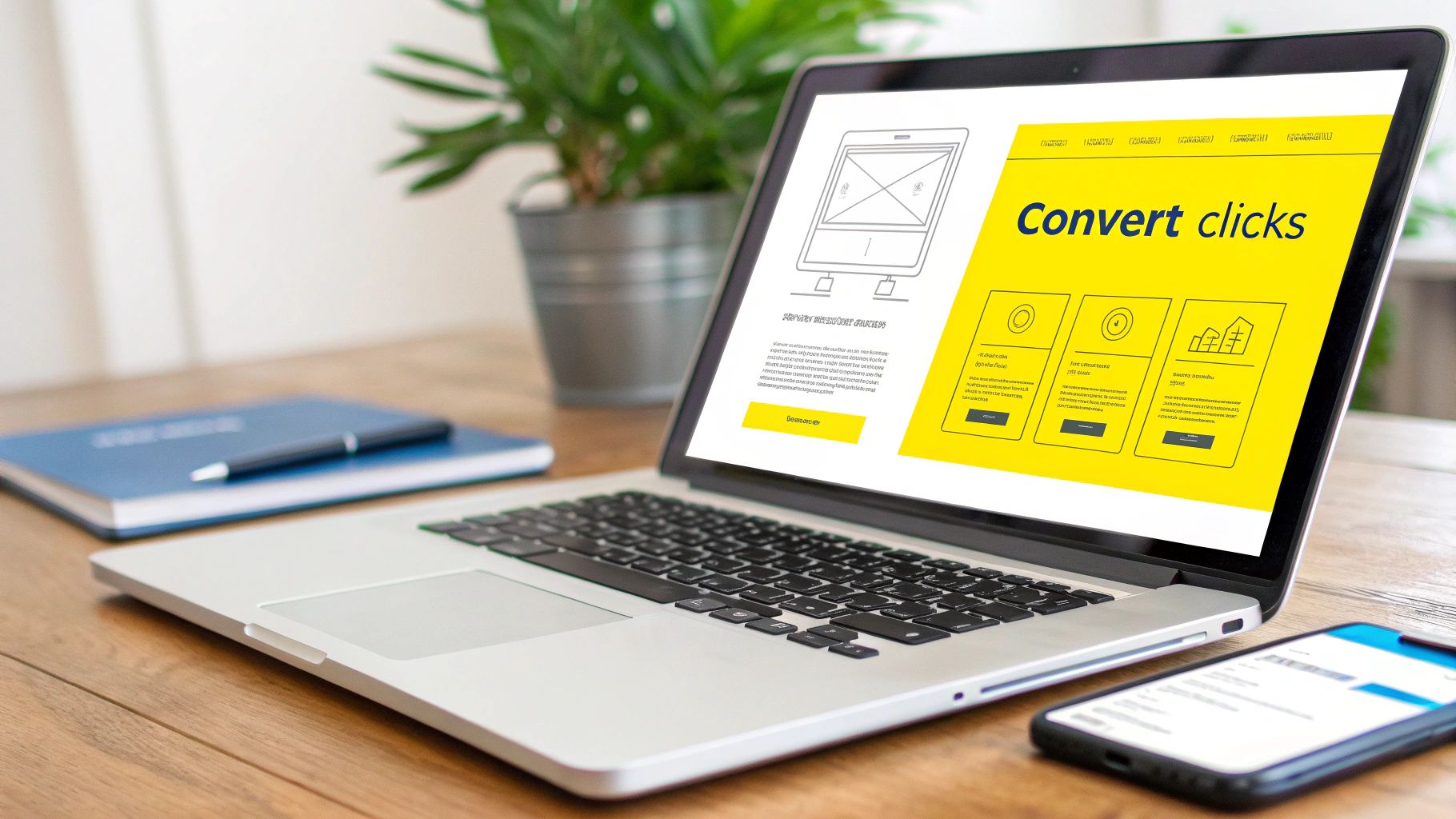
You’ve nailed the offer and your ads are finally getting clicks. Awesome. But getting the click is only half the battle. The real test—and where most marketing dollars go to die—is what happens on your landing page. This page is the single most critical conversion point in your entire funnel.
A bad landing page will absolutely kill your campaign, no matter how good your ads are. Think of it as a cluttered storefront with a broken door; potential clients will just turn around and walk away.
On the flip side, a clean, persuasive, and dead-simple page can supercharge your lead volume and slash your cost per lead. Let's get into the anatomy of a page that actually turns curious clicks into signed clients.
The Anatomy of a High-Converting Page
Your landing page has one job and one job only: get the visitor to fill out your form. That's it. Every single element on that page must push them toward that one goal. Anything that distracts from it, like navigation links to the rest of your website, has to go.
The layout needs to be intuitive, guiding the user’s eye from the headline straight down to the call-to-action without any friction. You’re building a seamless path from curiosity to conversion.
Here’s the simple framework we use to build pages that consistently pull in seller leads:
Benefit-Driven Headline: This is the first thing they see. It has to immediately answer, "What's in it for me?"
Trust-Building Subheadline: A sentence right below the headline that adds credibility or clarifies the offer.
Compelling Visuals: A high-quality image or a short, punchy video that backs up your message.
Clear Call-to-Action (CTA): Your main button needs to pop off the page and use action-oriented words.
Social Proof: Testimonials, case studies, or logos from local media mentions are pure gold for building trust.
Simple Lead Form: Only ask for what you absolutely need. The less work for them, the better.
Every element on your landing page should work together to build momentum. The headline hooks them, the social proof reassures them, and the clear CTA makes it easy for them to take the next step. If one element is weak, the entire conversion chain can break.
Headline Formulas That Hook Attention
Your headline is responsible for 80% of your page's success. No joke. If it doesn't grab a potential seller's attention and communicate value in less than three seconds, they’re gone.
Ditch generic titles like "Free Home Valuation." Instead, write a headline that speaks directly to a specific outcome they want.
Let's look at a few examples:
Generic: "Get Your Home Value"
Benefit-Driven: "Find Out Your Home's True Market Value in Under 60 Seconds"
For a Guaranteed Offer: "Receive a Competitive Cash Offer on Your Home Within 24 Hours"
See the difference? The new headlines are specific, create urgency, and focus on the result, not the process. This makes your offer feel way more tangible and valuable.
Building Unshakeable Trust and Credibility
Home sellers are skeptical, especially when they land on a website from an online ad. You're asking them for personal information, so they need to feel confident you're a legitimate, trustworthy professional. This is where trust signals become your secret weapon.
You need to sprinkle social proof throughout your page to knock down their objections before they even fully form.
Essential Trust-Building Elements:
Client Testimonials: Feature short, impactful quotes from happy sellers. A name and photo make them even more powerful.
Case Study Snippets: Briefly show off a recent win. Something like, "We helped the Smith family sell in 7 days for $15,000 over asking."
Trust Badges: Got a BBB rating? A local chamber of commerce logo? Any awards? Put them on the page.
And please, don't forget mobile. Over 60% of website traffic now comes from phones. A page that’s a pain to use on a smartphone is a campaign killer. Make sure your form fields are big, buttons are easy to tap, and the text is readable without any pinching or zooming. Your goal is to make the entire experience feel effortless from the moment they land.
Getting Your Ads Everywhere: An Omnipresent Paid Strategy

You’ve built the perfect offer and a landing page that converts. Now it’s time to stop waiting for leads to find you and start actively hunting them down. The goal here is to build an omnipresent ad machine—a system that puts your brand in front of potential sellers wherever they spend their time online.
Think about it from their perspective. They might see your video on Facebook during a lunch break, scroll past your ad on Instagram while in line for coffee, and then catch your brand again on YouTube that night. This isn't about being annoying; it's about building familiarity and trust.
When they’re finally ready to pull the trigger on selling, you’re not a stranger. You’re the obvious choice. This is how you build a predictable, scalable pipeline of motivated sellers instead of just getting a few leads here and there.
Master Your Targeting Strategy
Let's be blunt: you can have the most creative, compelling ad in the world, but if you show it to people who have no intention of selling, you’re just lighting money on fire. Getting your targeting right is what separates profitable campaigns from expensive mistakes.
Your first move, always, should be retargeting. These are the people who clicked your ad, checked out your landing page, but didn't fill out the form. They’re your warmest audience, the low-hanging fruit. You absolutely have to stay in front of them.
Once that’s running, you can start reaching out to new people using more advanced audiences.
Custom Audiences: This is a game-changer. You can upload a list of your past clients or your current database of leads. Platforms like Facebook and Google will match those emails and phone numbers to user profiles. You can then run specific campaigns just for them or—even better—exclude them from seeing introductory offers they’ve already claimed.
Lookalike Audiences: This is where the magic really happens. You take a list of your absolute best past clients—the sellers who were a dream to work with—and tell the ad platforms to go find more people just like them. They analyze thousands of data points to build a brand-new audience of people who share similar demographics, interests, and online behaviors. This is hands-down one of the most powerful ways to find high-quality seller leads at scale.
Don't just pick one audience and hope for the best. Layer your targeting. Start with your small, high-intent retargeting group, then expand to lookalikes built from your A+ clients. This ensures your budget is always working to find the people most likely to become your next client.
Battle-Tested Ad Creative That Actually Works
Okay, so you know who you're targeting. Now, what are you going to show them? In a world of endless scrolling, your ad has maybe three seconds to grab attention and convince someone to stop.
For real estate agents, simple, authentic video ads almost always win. I'm not talking about a big-budget production. A 30-second video shot on your smartphone often feels more real and builds a stronger connection than something that looks too polished.
Quick Script Idea for a Real Estate Video Ad:
(Hook - 3 seconds): "Thinking of selling your place in [City/Neighborhood]? Stop right there. Before you do anything else, you need to know what it's really worth."
(Problem - 10 seconds): "Those online estimators? They’re just algorithms, and they're often way off. We pull real, recent sales comps from right here in your neighborhood to give you the actual numbers."
(Solution/CTA - 15 seconds): "Click the link and get your free, no-strings-attached Home Equity Assessment. It takes about 60 seconds."
If you’re in home services, nothing beats a powerful "before and after" image. A painter can show a dark, dated living room transformed into a bright, modern space. A landscaper can show a scraggly yard turned into a curb appeal masterpiece.
The copy needs to be short, punchy, and focused on the seller's ultimate goal: selling faster and for more money.
Example Ad Copy for a Landscaper: "Want to add thousands to your home's sale price? Our 'Pre-Listing Makeover' boosts your curb appeal and gets buyers excited. Get a free estimate today!"
Smart Budgeting and How to Scale
"How much should I spend?" is the million-dollar question. The answer is surprisingly simple: start small. Your initial goal isn't to hit a home run; it's to gather data.
Here’s a practical way to manage your ad spend without breaking the bank:
Run a Test Budget: Set aside a small daily budget to start. Something like $20-$50 per day is plenty. Let the campaigns run for at least a full week to give the algorithms time to work and for you to collect meaningful data.
Find Your Winner: After a week or two, dive into the numbers. Don't get lost in vanity metrics. Look for one thing: the ad set with the lowest cost per lead (CPL). That's your champion.
Scale the Right Way: Turn off all the losing ad sets. Take the money you were spending on them and shift it to your winning campaign. From there, increase the budget on that winner by about 20-25% every few days. This slow, methodical scaling keeps the algorithm happy and maintains performance as you spend more.
This test-and-scale process is how you build a reliable, profitable advertising system you can count on to bring in seller leads month after month.
Sure, here is the rewritten section, crafted to sound completely human-written and natural, following the style and tone of the provided examples.
Going After High-Value Sellers With LinkedIn and Email
While blanketing Facebook and Instagram with ads is a great way to generate a high volume of leads, it's not always the right play for high-value commercial or B2B sellers. These are people who need a more direct, professional touch—a relationship, not just a retargeting ad.
This is where LinkedIn and a smart email strategy come in. We’re not talking about spamming inboxes or sending out a hundred generic connection requests. The goal here is to build a system that methodically positions you as the go-to authority in your space, so when that high-value seller is finally ready to make a move, you’re the first—and only—person they think of.
First, Turn Your LinkedIn Profile Into a Lead Magnet
Before you even think about outreach, your LinkedIn profile has to stop looking like a resume. Most people make the mistake of listing their past jobs and responsibilities. That’s a huge miss. Your profile should be a client-facing resource, speaking directly to a seller's biggest problems and positioning you as the clear solution.
Think of it as your personal landing page. Anyone who lands there should immediately understand what you do and why you're the best at it.
Your Headline: Ditch the generic job title. Instead of "Commercial Real Estate Agent," try something like, "Helping [Your City] Business Owners Maximize Their Commercial Real Estate Investments." Be specific about who you help and the result you get for them.
Your About Section: The first few lines need to hook them. Start with a question or a bold statement that hits on a major seller concern. Then, use the rest of the space to walk them through your process, using bullet points or mini case studies to show you've done this before.
The Featured Section: This is your "show, don't tell" space. Post links to successful case studies, video testimonials from happy clients, or a downloadable guide that offers real value. Prove your expertise.
Once you’ve done this, anyone who looks you up—and trust me, they will—sees a credible expert, not just another person trying to sell them something.
Pinpoint Your Ideal Sellers with Sales Navigator
With your profile dialed in, it’s time to find the right people. This is where LinkedIn Sales Navigator becomes your secret weapon. It lets you get incredibly specific, targeting key decision-makers based on company size, industry, job title, and location.
For instance, a commercial real estate agent could build a list of every business owner in a specific industrial park who has been in their role for over 10 years—a pretty strong signal they might be thinking about their next move. Or, if you run a home services company, you could target facilities managers at the top property management firms in your city.
You’re not just casting a wide net; you're building a curated list of high-potential leads.
The Big Idea: The point isn't to connect with everybody. It's to connect with the right people. A highly targeted list of 50 key decision-makers is infinitely more valuable than a list of 5,000 random contacts.
The Outreach Sequence That Actually Works
Once you have your list, it's time for outreach. The entire strategy hinges on one simple rule: lead with value, not a sales pitch. Your first message, whether it's on LinkedIn or email, has to be about them.
The numbers don't lie. Research shows that LinkedIn is 277% more effective for lead generation than Facebook or X (formerly Twitter). Their Lead Gen Forms also have an average 13% conversion rate, which completely crushes the typical 2.35% you see on most websites. When 40% of B2B marketers say LinkedIn is their number one channel for quality leads, you need to pay attention. You can dig into more of these stats on why LinkedIn works so well for lead generation.
Here's a simple, effective sequence to follow:
The Connection (LinkedIn): Send a personalized connection request. Don't just hit the button. Mention a shared connection, a post they recently made, or something from their profile. Never, ever pitch in the connection request.
The Value-Add (Email or LinkedIn): A few days after they accept, send a message with a genuinely useful piece of content. This could be a market report, a case study relevant to their industry, or an invite to an exclusive webinar. It's a resource, not a sales pitch.
The Gentle Follow-Up: If you don't hear back, wait a week and follow up with another helpful tip or piece of content. Keep it short and valuable.
The Ask: Only after you've provided value a couple of times have you earned the right to ask for a brief call. Frame it as a quick chat to see if there's a way you could specifically help them.
This patient, value-first approach builds real trust. It cuts through the noise and ensures that when they finally decide to sell, you're the one they call.
Mastering Lead Follow-Up to Maximize Conversions
All your hard work designing offers, building landing pages, and running ads means absolutely nothing if your follow-up game is weak. Think of it this way: generating a lead is a cost, but converting that lead is where you actually make money. This is the final, most crucial piece of the puzzle, and a disciplined system here can multiply your revenue.
The truth is, this is where most businesses drop the ball. They let fresh, expensive leads go stale. A fast, persistent, and value-driven follow-up process is what separates the amateurs from the pros who consistently pack their calendars with qualified appointments.
The Speed to Lead Principle
The single biggest factor in converting an online lead is speed. Period. The second a potential seller fills out your form, a stopwatch starts. Study after study confirms that contacting a new lead within the first five minutes can boost your odds of connecting with them by over 100%.
Wait just 30 minutes, and you'll see your contact rate fall off a cliff. Why? Because in that short window, their attention has already shifted. They're back to scrolling social media, answering work emails, or worse, filling out your competitor's form down the street.
When a lead comes in, you have to drop everything. It's a fire alarm. This isn't just a best practice; it's the difference between a conversation and a dead end. Treat every new lead with the urgency it deserves.
Your First 72 Hours: The Aggressive Follow-Up Blitz
The first three days are your golden window of opportunity. The lead is "hot," meaning their intent and interest are at their absolute peak. Your mission is to make meaningful contact using multiple channels without being a pest. This multi-touch approach dramatically increases your chances of getting a response.
Here’s a simple, killer sequence you can model:
Minute 1 (Phone Call): Call them immediately. If they don't answer, don't leave a voicemail yet. Just hang up and move to the next step.
Minute 2 (Text Message): Fire off a simple, non-salesy text. "Hey [Name], this is [Your Name] from [Your Company]. Just saw you requested a home value report. Is now a good time to chat for a minute?"
Minute 5 (Email): Send them the value they asked for (like the home valuation report). Make the subject line crystal clear: "Your [City] Home Value Report."
If day one is radio silence, you continue with a strategic mix of calls, texts, and emails over the next 48 hours. The key is to switch up your messaging and always lead with value, not just a lazy "checking in."
This visual breaks down the core journey for turning high-value leads from a name on a list into a long-term relationship.
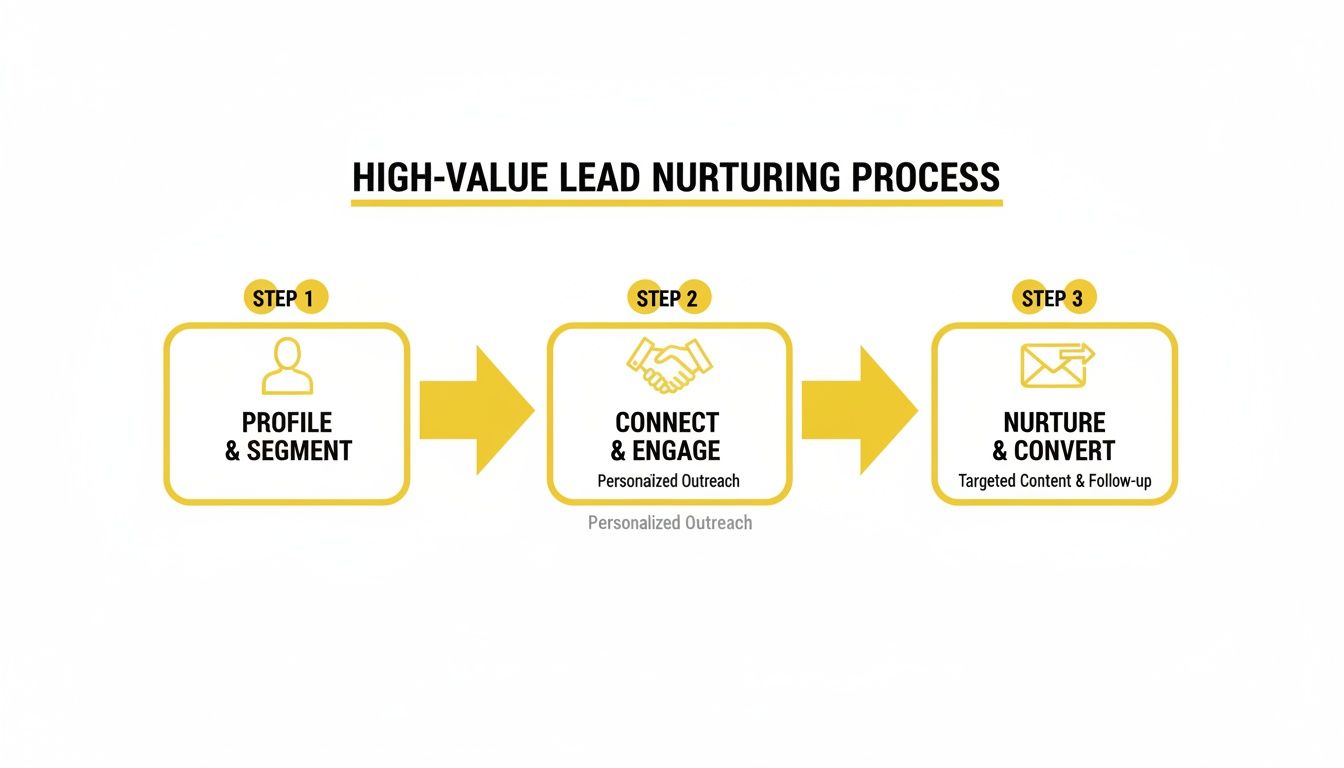
This process shows that successful lead generation isn't a one-and-done event but a sequence of profiling, connecting, and nurturing over time.
Automating Long-Term Nurture Sequences
So what happens when a lead doesn't bite in those first 72 hours? Don't just toss them in the trash. The reality is that most leads aren't ready to pull the trigger right away. Your job is to stay top-of-mind so that when they are ready, you're the only person they think of calling.
This is where automated nurture sequences are a game-changer. Using email marketing, you can build trust and deliver value over weeks and months. Email is still a powerhouse for generating seller leads, with 48% of marketers calling it their most effective channel.
And it gets better: personalized campaigns can see a 29% higher open rate and a 41% higher click-through rate. Since 63% of leads won't be ready to convert for at least three months, a solid email strategy is what keeps you in the game. You can check out more stats on how email marketing continues to deliver for lead generation.
Set up a simple email workflow that sends out genuinely useful content once a week or every two weeks:
Email 1: A case study of a recent successful sale in their neighborhood.
Email 2: A short guide on "3 Simple Fixes to Boost Your Home's Value."
Email 3: A quick local market update video.
This consistent, value-first communication positions you as a trusted advisor, not just another salesperson. When the time is right, they’ll remember the expert who was helping them all along.
Ready to stop guessing and start building a predictable pipeline of seller leads? At Wojo Media, we build and manage omnipresent ad campaigns that fill your calendar with qualified appointments. We'll help you craft the perfect offer, build a high-converting landing page, and implement a data-driven follow-up system that turns clicks into clients. Book a free demo call with our team today and get a custom strategy to scale your business.
Comments