.png)
How to Get Coaching Clients: how to get coaching clients, a proven system

Getting paid coaching clients really comes down to three things: building a magnetic foundation with an offer people can't refuse, creating an automated client attraction system that brings you leads while you sleep, and mastering the sales conversation to get them signed up.
The whole game is about positioning yourself as the only solution to a very real, very painful problem for a specific group of people.
Build a Foundation That Attracts Your Ideal Clients
Before you even think about running an ad or posting on social media, you have to get your foundation right. This is the strategic work that separates the coaches who struggle to find clients from those who seem to attract them effortlessly.
If you skip this, even the slickest marketing funnel in the world will fall flat because your message will be generic, and it won't connect with anyone. It’s all about being intentional from day one.
The coaching world is blowing up, but so is the competition. We're looking at a global market valued somewhere between $5.3 billion and $7.3 billion, with over 109,000 coaches all fighting for a piece of the pie. In this kind of environment, a rock-solid foundation isn't a "nice-to-have"—it's everything. You simply have to stand out.
Define Your Ideal Client Deeply
You have to go way beyond surface-level details like age and location. The real magic happens when you understand the person you’re meant to serve on an emotional, almost visceral level. What’s keeping them awake at 3 AM? What are the dreams they’re almost too scared to admit they have? What quick fixes have they already tried that left them disappointed?
Get granular with these questions to build out a profile of a real person:
Pains: What are the tangible, specific problems they’re stuck on? Think "I can't lose the last 15 pounds no matter what I do," not just "wants to be healthier."
Desires: What's the ultimate transformation they're secretly dreaming of? It's not "losing weight," it's "Feeling confident, sexy, and energetic on my beach vacation in three months."
Beliefs: What are the false stories they tell themselves that are keeping them stuck? Things like, "I'm just not disciplined enough," or "It's probably too late for me to make a big career change."
When you get this right, your marketing stops feeling like you're shouting into a void. Instead, it feels like you're having a real conversation with a friend who desperately needs your help.
Craft an Irresistible High-Value Offer
Let's be clear: your offer is not a list of sessions. It’s the vehicle that takes your client from where they are now to where they desperately want to be.
Those generic "12 sessions for $X" packages are a race to the bottom. They don't sell well because they focus on what you deliver, not the outcome the client gets. A true high-value offer promises a clear, desirable result that makes your price feel like a smart investment, not just another expense.
Key Takeaway: Stop selling your time. Start selling a specific outcome. A client isn't buying an hour with you; they're buying a solution to a problem that has been haunting them for months, maybe even years.
For example, a career coach doesn't sell "10 coaching calls." They sell "The 90-Day Career Accelerator: Land a Fulfilling Tech Role You Love, Without Sending Hundreds of Cold Applications." See the difference? The second one works because it names the audience, promises a specific result, and hits on a major frustration.
If you want to go deeper on setting up your entire client-getting machine, this modern digital marketing playbook for coaches is a great resource.
To help you structure your own offer, let's break down the core components. You want to build something that's so compelling, your ideal client feels like it was made just for them.
High-Value Coaching Offer Design Framework
Component | Description | Example (Health Coach) |
|---|---|---|
Specific Outcome | The #1 tangible result the client will achieve. Be clear and measurable. | Lose 20 pounds and triple your energy levels in 90 days. |
Ideal Client | Who is this offer specifically for? Don't be afraid to exclude people. | For busy female executives over 40 who struggle with yo-yo dieting. |
Unique Mechanism | Your signature process or framework. What makes your method different? | The "Metabolic Reset Method" - a 3-phase system combining nutrition, mindset, and bio-hacking. |
Core Deliverables | The tangible "stuff" included: coaching calls, modules, resources. | 12 weekly 1:1 coaching calls, on-demand video library, personalized meal plans, 24/7 Voxer support. |
Bonuses & Scarcity | Value-add items to encourage fast action. | Bonus: Lifetime access to the recipe library. Scarcity: Only 5 spots open per month. |
Guarantee/Risk Reversal | Something to remove the fear of investing. Makes saying "yes" easier. | "If you follow the plan and don't lose at least 10 pounds, I'll work with you for free until you do." |
Crafting an offer like this one is what allows you to confidently charge premium prices and attract clients who are truly committed to getting results.
Position Yourself as the Go-To Expert
Finally, you need to position yourself as the only logical choice for your ideal client. This isn't about claiming you're the "best" coach in the world. It’s about being the absolute best coach for a specific person with a specific problem.
You do this by niching down and then showing up consistently with your expertise. Instead of being a generic "business coach," you become the "profitability coach for solo creative agency owners." That sharp focus makes you instantly more credible and a whole lot more memorable.
Build Your Automated Client Attraction System
Imagine a machine that works 24/7 to bring you qualified prospects, even while you’re busy coaching or taking a well-deserved vacation. That's not a pipe dream; it's what a well-built client attraction system does. This is the engine that turns a stranger into a paying client, moving them from "Who are you?" to "How can I work with you?" without you having to manually push them along every step of the way.
Everything we've talked about so far—defining your offer, packaging your services—lays the foundation for this machine. This simple flow shows how it all fits together.
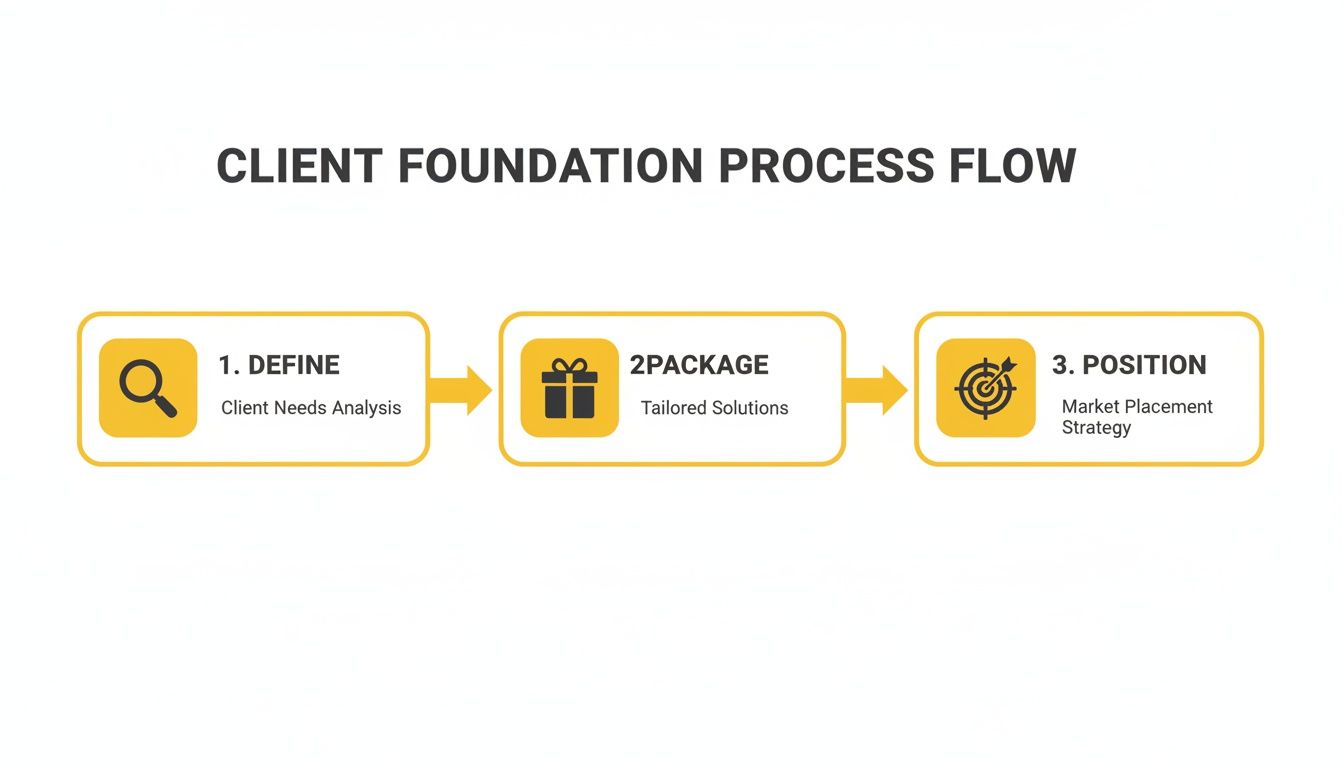
Each piece builds on the last, creating a solid, strategic base. Now, let’s get into the gears of this machine.
Design a High-Value Lead Magnet
Think of your lead magnet as the first handshake in a new relationship. It's a free, valuable piece of content you offer in exchange for an email address. The trick is to give someone a quick, tangible win that speaks directly to a burning problem they have.
Forget those generic, 50-page ebooks that just collect digital dust. You need something specific and immediately useful.
Diagnostic Quiz: An executive coach could create a "What's Your Leadership Blind Spot?" quiz that gives instant, personalized feedback.
Targeted Mini-Course: A health coach targeting busy professionals could offer a 3-day email course on "Your First Week of Meal Prepping."
Detailed Case Study: A business coach might share a case study titled, "How We Doubled a Client's Leads in 60 Days."
You're not trying to solve their entire problem for free. You're just proving you understand it and can deliver real value, which builds instant trust.
Pro Tip: Your lead magnet should be a natural bridge to your core coaching offer. It solves the first part of their problem, making your paid coaching the obvious next step to solve the rest.
Build a High-Converting Landing Page
Once your lead magnet is ready, you need a place for people to get it. That’s the job of a landing page, and it has only one mission: to turn visitors into leads.
Simplicity is your best friend here. A great landing page has one clear call to action, like "Download the Guide" or "Take the Quiz." This isn't the place to link to your social media, your blog, or other offers. Every single element must support that one goal of capturing an email.
Here's what to focus on:
A Compelling Headline: Shout the main benefit. For instance, "Discover the 5 Mistakes Sabotaging Your Career Growth."
Benefit-Driven Bullet Points: List 3-5 key outcomes they'll get from your freebie.
A Simple Opt-in Form: Only ask for what you absolutely need. Usually, a first name and email address is plenty.
This laser-focused approach cuts out the noise and maximizes your sign-ups. It’s the front door to your entire system.
Nurture Leads with an Email Sequence
Getting an email address is just the start. The real magic happens in the follow-up. An automated email nurture sequence is where you build a relationship on autopilot.
This isn't about blasting people with sales pitches. It’s about continuing to provide value, sharing your unique perspective, and building genuine trust over time. Your sequence could include client success stories, answers to common questions, or insights that help them see their problem in a new light.
Over a series of 5-7 emails, you can guide a curious lead into a qualified prospect who sees your value and is ready for more. The final email in the sequence gently invites them to book a discovery call. It's a soft sell that positions the call as a helpful conversation, not a high-pressure sales tactic. And if you're using a podcast in your marketing, exploring different strategies to monetize a podcast can be another powerful way to turn engaged listeners into paying clients.
Drive Consistent Traffic with Organic and Paid Channels
You’ve built the machine—your offer, your funnel, your lead magnet. It’s all ready to go. Now, it's time to fuel it. You need to open the floodgates and drive a consistent stream of high-quality traffic, because even the most perfect system is useless if no one ever sees it.

Without a steady flow of the right people discovering you, your funnel will stay silent. Let's break down the two primary ways to get that traffic flowing: the slow-burn trust-building of organic content and the speed and scale of paid ads.
Harness the Power of Organic Marketing
Organic marketing is the art of attracting clients without paying directly for ad space. Think of it as a long-term investment in your business. The returns might feel slow at first, but they compound over time, creating a powerful, sustainable asset that can generate leads for years to come.
The entire game here is about creating genuinely helpful content. Your future clients are already out there, right now, searching for answers to their biggest problems. Your job is simply to show up where they're looking with the solutions they need. This isn't about posting fluffy motivational quotes; it’s about proving your expertise in a way that builds unshakable trust.
For coaches, a few channels work exceptionally well:
Niche Blogging with SEO: Writing in-depth articles that directly answer the questions your ideal clients are typing into Google. I’ve seen a single, well-optimized blog post become a coach’s number one client-generator, working for them 24/7.
LinkedIn Content: If you coach professionals, LinkedIn is an absolute goldmine. Sharing your unique perspective, insights, and client case studies positions you as a go-to authority and keeps you top-of-mind.
YouTube Videos: Video is huge. For clients who prefer to watch and listen, creating how-to videos or deep dives into your topics can be a game-changer. Remember, YouTube is the world's second-largest search engine.
Key Takeaway: SEO is really just about being the most helpful person in the room. Google’s only goal is to give its users the best, most relevant answer. When you create the best resource on a topic your ideal client cares about, Google rewards you with free, highly qualified traffic.
This approach is smart because the data doesn't lie. Warm referrals and corporate introductions can convert at 20–40% or even higher. Cold leads from ads? They often convert below 5–10% without a solid nurture system. Investing in authority-building SEO content helps you generate inbound leads that feel more like warm referrals. For a deeper dive, check out these coaching industry market trends.
Client Acquisition Channel Comparison
Choosing where to spend your time and money can be daunting. Not all traffic is created equal. This table breaks down the pros, cons, and what you can realistically expect from the most common channels for coaches.
Channel | Pros | Cons | Typical Conversion Rate |
|---|---|---|---|
SEO Blogging | High-intent leads, builds long-term asset, "free" traffic over time. | Slow to start (6-12 months), requires consistent effort. | 3-8% (Lead to Client) |
Paid Social Ads (FB/IG) | Fast results, highly scalable, precise targeting. | Can be expensive, requires constant testing, ad fatigue is real. | 1-5% (Lead to Client) |
YouTube | Builds deep connection, high engagement, strong for education. | High barrier to entry (video production), takes time to build an audience. | 2-6% (Lead to Client) |
LinkedIn Organic | Great for B2B/professional clients, positions you as an expert. | Reach can be limited, requires consistent, high-value posting. | 4-10% (Lead to Client) |
Partnerships/JVs | Access to a warm, trusting audience, high conversion potential. | Finding the right partners takes time, requires revenue sharing. | 10-25%+ (Lead to Client) |
As you can see, a mix is often the best strategy. Organic builds the foundation and authority, while paid ads provide the immediate scale.
Scale Your Reach with Omnipresent Paid Ads
While organic marketing builds your foundation for the long haul, paid advertising gives you speed and predictability right now. Once you have an offer that works and you know your numbers, paid ads are like pouring gasoline on the fire. They let you get clients on demand.
The goal isn't just to run a single ad. It's to create an omnipresent campaign. This means your ideal prospects start seeing your valuable content and compelling offers everywhere they hang out online—Facebook, Instagram, YouTube, and even TikTok. This multi-platform approach builds brand recognition and trust incredibly fast.
A winning ad campaign needs a few key ingredients to work.
Crafting High-Converting Ad Copy
Your ad copy has one job: stop the scroll. It must speak directly to your prospect's biggest frustrations and deepest desires. A simple but brutally effective formula is Problem-Agitate-Solve (PAS).
Problem: Call out their specific pain. (e.g., "Struggling to land interviews for senior tech roles?")
Agitate: Twist the knife a little. Make the problem feel urgent. (e.g., "Sending out dozens of resumes a week only to hear crickets is just soul-crushing.")
Solve: Position your lead magnet as the obvious, immediate solution. (e.g., "Download my free checklist: '5 Resume Tweaks to Get Past AI Screeners and Land a FAANG Interview.'")
Designing Compelling Ad Creatives
The visual part of your ad is just as crucial as the words. It needs to grab attention instantly and feel right for your brand. For coaches, these three creative styles are killing it right now:
Simple Talking Head Videos: Just you, talking directly to the camera for 60-90 seconds, sharing a valuable tip and ending with a clear call to action. It’s authentic and builds connection fast.
User-Generated Content (UGC) Style: This looks and feels like a native post from a friend, not a slick corporate ad. It’s less polished, more real, and can dramatically boost engagement.
Text-Based Images: A powerful quote or a surprising statistic on a clean background. It’s simple, stands out in a crowded feed, and is incredibly easy to create.
By blending a patient, value-first organic strategy with a scalable, targeted paid ad plan, you build a powerful dual-engine system for client acquisition. One builds your legacy, the other fuels your immediate growth.
Master the Art of the Authentic Sales Conversation
Everything you've built—the ads, the content, the entire funnel—it all leads to this single moment. A real conversation with another human being who is deciding if you're the one who can help them get what they want out of life.
Let's be clear: this isn't about slimy scripts or high-pressure closing tactics. This is about connection. It’s about an ethical enrollment process that feels good for you and the person on the other end of the line.
The entire point of a discovery call is to find the truth. Is this person really a good fit for your program? And are you genuinely the right coach to guide them? When you shift your perspective from "closing a sale" to "collaborative discovery," all the pressure just melts away. It’s replaced by authentic connection.
The Mindset of an Enrollment Pro
Before you even dial the number, your mindset is everything. If you walk into that call feeling desperate, needy, or anxious about your bills, a prospect will sniff it out in a second. You have to make a conscious shift from, "I really hope they buy this," to, "I'm here to serve and see if we're a mutual fit."
That means detaching your self-worth from the outcome. A "no" isn't a personal rejection. It's just a signal that the timing or the fit isn't right. Your posture should be that of a confident expert—a doctor diagnosing a problem, not a salesperson begging for a deal.
A Framework for Authentic Connection
Look, you can't just wing these calls. Having a structure is what allows you to be present and listen, instead of panicking about what to say next.
Think of it less like a rigid script and more like a roadmap. It guides the conversation from introductions to a clear decision, ensuring you cover all the crucial ground without rambling.
Here’s a proven framework I’ve used to enroll hundreds of clients:
Set the Stage: You have to take control right from the first sentence. Set a clear agenda for the call. This immediately positions you as the expert and puts the prospect at ease because they know exactly what to expect.
Uncover the Pain: This is where you need to shut up and listen. Use powerful, open-ended questions to dig deep into their current situation. Don't just find out what the problem is; you need to understand how it feels. What’s the real-world impact?
Paint the Future Vision: Once you’ve sat with them in their pain, you get to shift to the pleasure. Ask them to describe their dream scenario. What does life look like when this problem is gone for good? This creates a powerful gap between their current reality and their desired future.
Connect the Dots: Now, you bridge that gap. You concisely show them how your coaching is the exact vehicle built to take them from where they are now to where they desperately want to be. You’re not just listing off features of your program; you're connecting their vision to your solution.
Make the Invitation: Finally, you state the investment with confidence and invite them to make a decision. It’s a simple, no-pressure transition into the offer itself.
This flow earns you the right to make an offer. You aren't just pitching a package; you and the prospect build the case for it together.
Navigating Common Objections
Let’s get one thing straight: objections are not rejections. They are requests for more information or a cry for reassurance.
When a prospect says, "I need to think about it," or "It's too expensive," the conversation isn't over. It's a signal that an underlying fear or a limiting belief hasn't been fully addressed.
Key Insight: Almost every objection boils down to a lack of belief in one of three things: belief in themselves, belief in your process (the coaching), or belief that the outcome is worth the price.
Here’s how to handle the two you'll hear the most:
"I need to think about it." This is usually a polite way of saying, "I'm not sold yet." Your job is to get curious. Respond with something like, "I totally get that. Usually, when someone says they need to think it over, it means there’s a specific question or concern on their mind. Is it about the investment, the timing, or something else?" This gently pries open the door to the real issue.
"I can't afford it." Sometimes, this is true. But often, it’s a value problem, not a money problem. You need to re-anchor the price against the cost of doing nothing. You can ask, "I hear you. Let me ask you this: what's the cost of staying exactly where you are for another six months? A year?" This reframes the investment against the very real pain of inaction.
Mastering the sales conversation is arguably the single most important skill you can develop as a coach. It's the moment where potential energy becomes kinetic—where a curious lead transforms into a committed client who is ready for a real change. Focus on service, connection, and a clear process, and you’ll enroll clients consistently and authentically.
Deliver a World-Class Onboarding and Client Experience
Getting a new client is a massive win, but don’t pop the champagne just yet. The moment they say "yes" and the payment clears is where the real work begins. A sale is just the starting line.
Think of your onboarding as the first—and most critical—chance you have to prove they made the right choice. A stellar experience right out of the gate crushes buyer's remorse and sets the tone for the incredible transformation you promised them.

This isn’t just about sending a few emails and a calendar link. It’s a carefully designed, professional sequence that makes your new client feel seen, supported, and genuinely excited for what's next. Get this right, and you'll see a direct impact on how long clients stay with you and how often they send referrals your way.
Crafting a Professional Welcome and Kickoff
The second their payment is processed, your system needs to kick into gear. This is no time for a generic "Thanks for your payment" receipt. You need an automated, professional welcome sequence that instantly immerses them in a premium experience.
Right away, this sequence should deliver a few key things:
A Professional Welcome Packet: This is their roadmap for working with you. It’s usually a slick PDF that clearly lays out communication rules (like your response times on Voxer), how to schedule sessions, and a recap of the program's big milestones.
An Intake Questionnaire: This is your secret weapon for a powerful first call. Ask deep, insightful questions about their biggest goals, their most frustrating challenges, and exactly what they hope to get out of your time together. It shows you’re serious and lets you walk into that first session already prepared.
Scheduling the Kickoff Call: Give them a dead-simple link to your calendar to book that first official session. It puts the ball in their court and gives them immediate forward momentum.
Setting Clear Expectations and Communication Rhythms
Your first call is all about setting the ground rules for success. This kickoff session is less about diving deep into coaching and more about co-creating the structure of your relationship. You have to be explicit.
Talk about and agree on your communication rhythm. Will you check in via email once a week? Is all your between-session support handled through an app like Voxer? Getting this clear from day one prevents future headaches and ensures your client feels supported without you feeling like your boundaries are being crossed.
Pro Tip: Before you hang up on that kickoff call, ask this exact question: "Fast forward to the end of our time together. What needs to have happened for you to feel like this was a massive, game-changing success?" Write down their answer. This becomes your North Star for the entire engagement.
This initial clarity is what separates the pros from the amateurs. It immediately positions you as a confident leader and gives your client a clear roadmap, building instant trust. When clients feel secure in the process, they’re far more likely to do the work and get the results you promised.
Delivering Transformative Results That Generate Referrals
At the end of the day, the best marketing strategy on the planet is getting such incredible results for your clients that they become your biggest advocates. A happy client who has achieved their goals is the most powerful asset you'll ever have.
Your focus should be relentless. Zero in on helping them achieve that specific outcome they defined on your first call. Check in constantly on their progress toward that goal. And celebrate every single win along the way, no matter how small.
This is how you turn a satisfied customer into a raving fan. A client who gets amazing results will do three things for you:
Give You a Powerful Testimonial: Don't be afraid to ask. As soon as they hit a major milestone, ask if they’d be willing to share their story on camera or in writing.
Become an Enthusiastic Referral Source: A client who trusts you and has seen real change will naturally bring you up when their friends or colleagues are facing the same struggles.
Re-sign for Future Work: A world-class experience makes it a no-brainer for them to stick around, whether that’s in a higher-level mastermind or another one of your advanced programs.
When you engineer a five-star experience from the very first minute, you create a powerful, self-sustaining loop. The incredible results you deliver fuel the testimonials and referrals that bring in your next wave of perfect-fit clients.
Common Questions About Getting Coaching Clients
As you start putting these pieces together to build your coaching business, you’re bound to hit a few roadblocks. It's totally normal. These are the real-world questions I get all the time from coaches who are dead serious about filling their calendars and actually making an impact.
Let's cut through the noise and get you some straight answers.
How Long Does It Really Take to Get My First Paying Coaching Client?
This is the big one, isn't it? The honest answer is, it completely depends on where you're starting from today.
If you’ve already got a solid professional network and you’ve nailed down your offer, you could realistically sign your first client in a few weeks. It might just be a matter of having a few direct conversations.
But if you're building an online audience from absolute scratch? A more realistic timeline is 2-3 months of putting in the work, day in and day out, before you see a steady stream of qualified leads. The single biggest mistake I see new coaches make is trying to be everywhere at once. The secret is to go deep on one channel—master LinkedIn content, get obsessed with SEO blogging, whatever it is—before you even think about adding a second.
Should I Focus on Organic Marketing or Paid Ads First?
Think of it like this: organic marketing is building an asset, and paid ads are buying speed. They aren't enemies; they serve two different, but equally important, purposes.
Organic—your content, your SEO, your networking—is all about building a foundation of trust and authority for the long haul. It's a slower burn, for sure. But it creates a powerful, sustainable engine that can bring you incredible, high-quality leads for years to come.
Paid ads, on the other hand, deliver immediate results. They give you scalability and, most importantly, predictability. Once you have an offer that you know converts and you understand your numbers, ads can fill your pipeline on demand.
The Ultimate Strategy: The smartest coaches I know use a hybrid model. You start with organic to build your brand and prove your offer actually works. Once you have that cash flow and validation, you pour gasoline on the fire with paid ads to amplify what's already working. That’s how you scale.
How Do I Price My Coaching Package as a New Coach?
Please, do not charge by the hour. It’s the fastest way to turn yourself into a commodity, forcing you to compete on price—a game you will never win. You have to price your packages based on the value of the outcome you deliver.
What is the transformation you provide actually worth to your client? For a solid, three-month coaching program, a starting price between $2,000 to $5,000 is completely reasonable. It all depends on your niche and just how painful the problem you're solving is.
Pricing with confidence does more than just line your pockets. It attracts clients who are more committed and resourceful, and it gives you the breathing room to deliver an incredible experience. It's always better to price high and offer payment plans than to undercharge and end up resenting the work.
Do I Need a Big Fancy Website to Start Getting Clients?
Absolutely not. In fact, getting bogged down building a complex website early on is one of the biggest distractions from the one activity that actually gets you clients: talking to people.
I know plenty of six-figure coaches who got their start with nothing more than a sharp LinkedIn profile and a simple one-page landing site with a "book a call" link. Your entire focus at the beginning should be on two things:
Clarifying your high-value offer until you can recite it in your sleep.
Talking to potential clients to see if that offer resonates.
You can go all-in on a full-blown website later, once you have consistent revenue coming in and you really understand what your audience needs to hear from you. Don't let the "perfect website" become your favorite excuse for not doing the real work.
Ready to stop the guesswork and build a predictable flow of high-quality leads? Wojo Media can bolt right onto your coaching business to build and scale omnipresent ad campaigns that put you in front of your ideal clients on Facebook, Instagram, Google, and beyond. We handle the offer, the ads, and the data so you can focus on what you do best—coaching.
Comments