.png)
How to Get Consulting Clients A Practical Guide

Before you even think about outreach, you need to build a system that brings clients to you. This is your attraction engine.
This engine is what separates the consultants who are constantly chasing leads from those who have a predictable, steady stream of ideal prospects knocking on their door.
Build Your Client Attraction Engine First
Too many consultants jump straight into the cold game—hammering out emails, firing off LinkedIn messages, and making calls. Sure, those tactics have their place, but they're a thousand times more effective when you have a solid foundation working for you in the background.
This is your client attraction engine. It’s a set of assets that warms up the market, positions you as the obvious expert, and filters for the best-fit clients before you ever have a conversation. It shifts the dynamic entirely. Instead of you chasing them, they start seeking you out.
For anyone just starting, nailing this system from the get-go is critical. A lot of the advice in guides on how to start an SEO business and get your first clients applies universally—it all begins with building a core system that attracts, rather than just pursues.
The Four Pillars of a Predictable Client System
A reliable client attraction engine isn't magic; it's a machine built on four core components. When you get these right, they create a powerful, self-sustaining loop that pulls in leads and gets them ready to buy.
The table below breaks down these four pillars. Think of them as the essential ingredients for building a system that consistently brings your ideal clients into your world.
Pillar | Objective | Key Actions |
|---|---|---|
The Offer | Create an irresistible, high-value solution to a painful problem. | Niche down, define a clear outcome, and build in risk reversal (like a guarantee). |
The Pages | Convert visitors into leads with a compelling online presence. | Develop a high-converting landing page, case study page, and a simple booking system. |
The Ads | Drive targeted traffic to your pages. | Run focused ad campaigns on platforms like LinkedIn, Facebook, or Google where your clients live. |
The Data | Optimize the entire system for maximum performance. | Track key metrics (cost per lead, conversion rates) and use the insights to refine your offer, pages, and ads. |
When these four pillars—Offer, Pages, Ads, and Data—are working together, you get a seamless client acquisition machine.
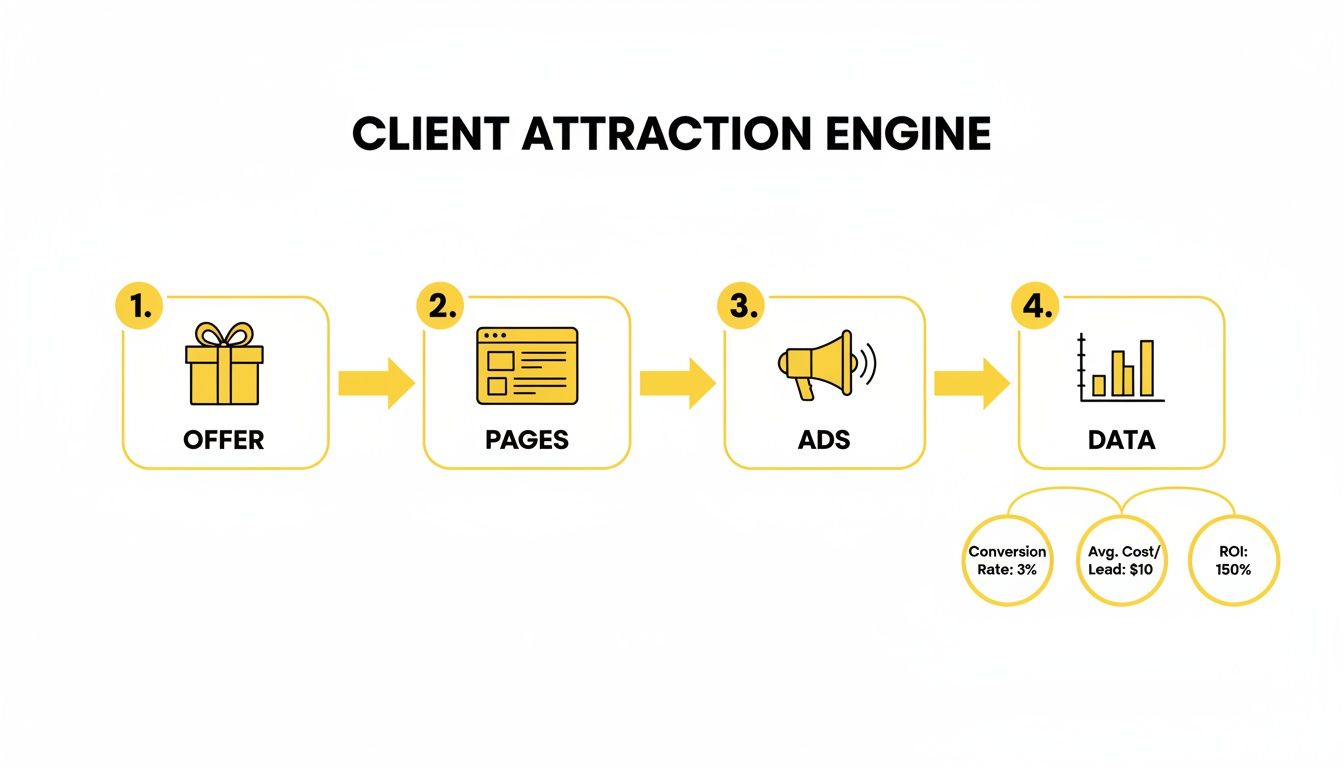
As you can see, a killer offer is the starting point. That offer fuels your pages, which are then amplified by ads, and the whole process is sharpened by data. It’s a cycle.
Niche Down for Maximum Impact
Trying to be everything to everyone is the fastest way to become a commodity, forced to compete on price. If you want to command high fees, you have to specialize.
The consulting world is exploding—it’s projected to hit a staggering $1.32 trillion by 2029. The real money is in high-growth areas like digital transformation and AI. Strategy consulting alone is on track to reach $91.38 billion by 2025 as businesses scramble to find experts who can guide them through new tech.
Niching down is how you become that expert.
Instead of being a generic "business consultant," you become the "AI automation expert for 7-figure e-commerce brands." You're not a "marketing consultant"; you're the "go-to growth strategist for B2B SaaS companies."
See the difference? Specificity cuts through the noise and makes you the only logical choice for a very specific group of people with a very specific problem.
Your value as a consultant isn’t just what you know; it’s the repeatable system you bring to solve a specific problem. Niching down lets you perfect that system and become known for delivering one particular outcome, brilliantly.
Crafting an Irresistible High-Ticket Offer
Once your niche is crystal clear, the next job is to package your expertise into a high-ticket offer that’s impossible to ignore. A weak offer makes every sale a brutal, uphill battle. A strong one makes it feel easy.
Your offer needs to be more than a list of deliverables. It’s a promise of transformation.
Here’s how to make it a no-brainer for your ideal client:
A Crystal-Clear Outcome: What tangible result will they get? Don't sell "social media management." Sell "an extra 50 qualified sales leads every single month."
A Defined Process: Give them a glimpse of your unique methodology. This isn't about giving away secrets; it's about showing them you have a real, structured plan to get them from A to B. It builds massive confidence.
Risk Reversal: A powerful guarantee completely removes their hesitation to buy. This could be performance-based ("If we don't increase your lead flow by 20% in 90 days, you don't pay") or a simple satisfaction guarantee.
When you have these foundational pieces in place—a sharp niche and a powerful offer—you’ve built the engine. Only then are you ready to add fuel with the outreach and content strategies we’ll cover next.
Master Modern Outbound Strategies For Quick Wins
While building a solid inbound engine is the long game, sometimes you just need to get conversations started now. This is where smart outbound comes in. Forget the spammy, automated nonsense of the past. Modern outbound is all about precision, genuine personalization, and starting real conversations.

It’s a proactive approach. Instead of sitting back and waiting for clients to stumble upon you, you’re handpicking the exact people who need your expertise most and reaching out. When you get this right, it can fill your calendar with qualified calls faster than anything else.
Turn LinkedIn Into a Relationship Engine
LinkedIn is easily the most powerful platform for consultants today, but almost everyone uses it wrong. They either treat it like a static resume or a pure numbers game, blasting out generic connection requests and pitches. That’s a fast track to being ignored.
The real gold is in building targeted relationships, not just racking up connections.
Your goal isn't to pitch someone in the first message. It’s to kick off a genuine conversation based on something you have in common—a recent post they made, a shared connection, or a mutual interest. This builds immediate trust and makes the eventual pivot to a business chat feel completely natural.
To really nail this, you need to incorporate proven LinkedIn lead generation strategies into your daily routine.
Here’s a simple, effective flow I've used time and again:
Pinpoint Your Prospects: Use Sales Navigator to find the decision-makers in your niche. Filter by industry, company size, role—get specific.
Engage Before You Connect: Don’t just send a blind request. Go to their profile, find a recent post, and leave a thoughtful comment. A little effort goes a long way.
Send a Personalised Request: Now, send the connection request, but reference what you just did. Something like, "Hi [Name], really enjoyed your post on [Topic]. Your point about [Specific Point] was spot on. Would love to connect."
Give, Don't Ask: Once they accept, your next move is to provide value. Share a relevant article or a helpful resource with no strings attached. You’re building a reputation as a helpful expert, not a needy salesperson.
The best outbound consultants never sell their services directly. They sell the next step in the conversation. Your only job is to spark enough curiosity and trust to earn a 15-minute call.
This simple shift changes the entire dynamic. You're no longer a random vendor; you're a valuable peer.
Crafting Cold Emails That Actually Get Replies
Yes, cold email still works. It works incredibly well, but only if you make it about them, not you. The long, self-important emails that flood most inboxes are deleted in under three seconds. Your mission is to prove you've done your homework within the first sentence.
A winning cold email is short, sharp, and built around a specific observation you’ve made about their business.
Here are the key ingredients:
A Specific Subject Line: Ditch the clickbait. Go for something clear and relevant, like "Question about [Their Company]'s recent project" or "An idea for your [Initiative]."
The Personalized Opener: Prove it's not a copy-paste job. "Saw your feature in [Publication]—was really impressed with your work on the [Project]."
A Clear Problem/Hypothesis: State a problem you solve that they’re likely facing. "I talk to a lot of [Their Role], and a common challenge is [Common Problem]."
A Low-Friction CTA: Don't ask for a 30-minute meeting right away. That's too big of a jump. Instead, ask a simple question to gauge interest: "Open to hearing a quick idea on how we helped [Similar Company] achieve [Result]?"
Using Paid Ads for Targeted Lead Generation
You don't need a huge marketing budget to make paid ads work. A small, highly targeted spend on platforms like LinkedIn, Google, or even Facebook can bring in a steady stream of high-quality leads, but only if you pair it with an irresistible offer.
Stop running ads that just say "Hire Me!" It doesn't work.
Instead, run your ads to a valuable free asset. Think about offering a webinar, a detailed case study, an industry checklist, or a free "strategy call." The ad's only job is to sell the value of that free resource. That resource, in turn, sells you.
For example, an ad for a free "Custom E-commerce Ad Strategy Session" is going to attract businesses actively looking for ways to grow, instantly pre-qualifying them for your consulting.
Scale With Content That Converts Clients
Outbound gets you in the door. Content marketing is how you own the building.
Frankly, it's the most powerful long-term play for landing consulting clients because it completely flips the script. You stop chasing leads and start attracting them. You become the go-to authority in your space.

This isn't about tossing a few articles into the void and hoping someone bites. It's about building a strategic content engine—a system that educates, builds rock-solid trust, and turns your ideal prospects into high-paying clients.
When you get this right, your content works for you 24/7. It's an asset that qualifies leads and brings them to your digital doorstep, ready to talk business.
From Expert to Authority
Being an expert means you know your stuff. That's table stakes.
Being an authority means your market knows you know your stuff. Content is what bridges that gap. Your mission is to create assets that solve your ideal client's most urgent problems, proving your value long before they ever send you a deposit.
Think of it this way: you’re not just selling a process. You're selling your ability to solve a painful, expensive problem. Content is your chance to prove you can do it, at scale.
This approach builds incredible trust and essentially pre-sells your services. By the time a prospect books a call, they’re not wondering, "Can this person actually help me?" They're already sold on your ability and are just trying to figure out the logistics of working with you.
Build Your Content Around Client Wins
The single most convincing piece of content any consultant can create is a case study. Period.
Why? Because it's cold, hard proof that you deliver results. It's not a theoretical blog post; it's a real-world story of transformation.
In a market that's getting more crowded by the day, sharing specific, quantifiable client results is how you stand out. The freelance and consulting economy is exploding—nearly 54% of U.S. adults are expected to freelance by 2025. In this $1T+ industry, the consultants who can prove their value with data will absolutely dominate. You can dig into more of these consulting industry statistics to see where things are headed.
A killer case study follows a simple, powerful story arc:
The Problem: Start by laying out the exact challenge the client was dealing with. Use their own words. Get specific with metrics to make the pain tangible.
The Solution: Walk through your unique process for crushing that problem. This isn’t about giving away the secret sauce, but it showcases your methodology and builds confidence.
The Result: This is the money shot. Quantify the outcome with concrete numbers—revenue lifted, costs slashed, leads generated. Show, don't just tell.
Your next client doesn't care about your process. They want to see the results your process created for someone just like them. Case studies are the ultimate form of social proof.
Package these stories up as blog posts, slick PDFs, or even quick video testimonials. Make them the cornerstone of your content strategy. They are undeniable proof of your value.
Creating High-Value Content Pillars
Beyond case studies, your focus should be on creating "pillar" content. These are the big, comprehensive guides and resources that tackle a major pain point for your ideal client. They're what establish you as the authority and act as magnets for high-quality leads.
Forget the short, fluffy blog posts. Go deep.
Ultimate Guides: Write the definitive resource on a core topic in your niche. Think "The Complete Guide to Funnel Optimization for SaaS Companies."
Webinar Funnels: Host a live training that solves one specific, high-value problem, then offer a consultation at the end. This is one of the most effective ways to convert warm leads into clients.
Data-Driven Reports: Run a small survey in your niche or analyze industry data to publish a unique report no one else has. This positions you as a true thought leader and gets you backlinks.
These content pillars do triple duty. They pull in organic search traffic, deliver massive value to your audience, and can be chopped up and repurposed into dozens of smaller pieces of content—social media posts, email newsletters, and short-form videos.
This approach isn't just a marketing tactic; it's how you build a robust, client-generating system that works for you around the clock. It’s the foundation of a truly scalable consulting business where clients are consistently coming to you.
Fine-Tune Your Sales Process From Discovery To Close
Getting a steady flow of leads is a fantastic start, but it's really only half the job. The true craft of building a powerhouse consulting business is turning those conversations with interested prospects into signed contracts. This is where a polished, human-centric sales process becomes your single most valuable asset.
A clunky sales process feels pushy and transactional. It leaves potential clients feeling like they’ve been "sold to," not served. A great one, on the other hand, is built on genuine curiosity and a sincere desire to understand the prospect's world. It immediately positions you as a partner in their success, not just another vendor.
Master The Discovery Call
If there's one moment you have to get right, it's the discovery call. This is the most critical stage in your entire sales cycle, period. It's your one shot to truly diagnose a prospect's pain points, grasp what they really want to achieve, and figure out if you're the right person to get them there.
This isn’t a pitch. It’s a diagnostic session.
Your main job here is to listen far more than you talk. It’s so tempting to jump in and start talking about your amazing solutions, but your real power comes from asking sharp, insightful questions. Questions that uncover the hidden costs of their problem—the frustration, the wasted time, the missed opportunities. A consultant who understands the problem better than the client does is the one who gets the check.
The best consultants don't sell their services on a discovery call. They sell a crystal-clear diagnosis of the problem. When they do that, their solution becomes the only logical next step.
Steer the conversation by digging into their current situation, the roadblocks they're hitting, and what their business would look like in a perfect world. This approach builds a massive amount of trust and gives you all the ammunition you need to put together a proposal they can't refuse.
Ditch The Pitch, Focus On Value
One of the most common blunders consultants make is treating the discovery call like a thinly veiled sales pitch. This approach instantly puts the prospect on the defensive and makes them feel like a target. Your goal is the exact opposite: create a collaborative, "us against the problem" environment.
You need to know the difference between a real discovery conversation and a pitch that’s going nowhere. Here’s a quick breakdown of what to focus on and what to avoid.
Discovery Call vs Sales Pitch: What to Focus On
This table contrasts the two approaches. Your job is to live entirely in the "Effective Discovery Call" column.
Element | Effective Discovery Call Focus | Ineffective Sales Pitch Focus |
|---|---|---|
Objective | To deeply understand the client's pain and goals. | To present your services and features. |
Main Activity | Asking strategic questions and actively listening. | Talking about your company and methodology. |
Desired Outcome | A clear "go/no-go" decision on whether you're a good fit. | Trying to get a "yes" on the spot. |
Positioning | You are a strategic advisor and problem-solver. | You are a vendor selling a commodity service. |
When you make the call about their business, you instantly shift your role. You stop being another line-item cost and start becoming a strategic investment in their future.
Presenting Proposals That Close Themselves
After a great discovery call, your proposal should never contain any surprises. Think of it as a formal confirmation of everything you’ve already talked about, directly connecting their specific challenges to your specific solutions.
A winning proposal isn't just a breakdown of services and prices; it's a compelling business case for working with you. You want to structure it in a way that constantly reminds them of the value and the potential return on their investment.
Here’s a simple framework to build proposals that get signed:
Start With Their Pain: Kick things off by summarizing the challenges they're facing and the negative impact on their business. The key here is to use their own words that you captured during the discovery call. This shows you were listening.
Connect Your Solution: Clearly map your services and deliverables to each of the problems you just outlined. Frame what you do not as a list of tasks, but as concrete steps toward reaching their ideal future state.
Define The ROI: Whenever possible, put a number on the expected return. Connect your fee directly to the potential revenue they stand to gain or the costs they'll save. Make it tangible.
By the time they get to your price, it should feel small compared to the immense value you've just laid out. The decision to move forward becomes a simple, logical choice.
Expand Your Reach Through Networking And Referrals
Your next big client might be just one introduction away. While outbound and content are fantastic, some of the warmest, highest-converting leads you'll ever get come from two timeless sources: your network and referrals from happy clients.

This isn't about sitting back and hoping someone mentions your name. It's about being intentional—building relationships and creating a repeatable process that encourages others to send business your way. When you get this right, you tap into the incredible power of trust and social proof, which almost always closes deals faster than any other method.
Think Globally, Act Digitally
The consulting world is no longer bound by geography. Digital tools have leveled the playing field, making it completely normal for an independent consultant to serve clients thousands of miles away. This is a massive growth opportunity.
Globalization is supercharging client acquisition, with the management consulting market projected to explode from $510.6 billion in 2025 to nearly $897.4 billion by 2034. As companies expand into new markets like Asia-Pacific and Europe, the need for expert guidance is off the charts. Consultants who get good at cross-border networking on platforms like LinkedIn can land 20-30% more deals. You can dig into the specifics in this management consulting market report.
Here’s how to start networking across borders:
Optimize Your LinkedIn Profile: Don't just list your skills. Clearly state your niche and the global outcomes you deliver. Use keywords that international clients would actually search for.
Join International Groups: Find and participate in industry-specific LinkedIn groups and forums where decision-makers from other countries hang out.
Attend Virtual Events: Industry conferences and webinars aren't just local anymore. These are prime opportunities to connect with a global audience without the cost and hassle of travel.
Building A Proactive Referral System
Waiting for referrals is a hope-based strategy. Building a system to generate them is an intentional one. The absolute best time to ask for a referral is when your client is at peak happiness—usually right after you've delivered a huge win or wrapped up a successful project.
Most clients are happy to help, but they’re busy. You have to make it dead simple for them. Don't just ask, "Do you know anyone who could use my services?" That puts all the work on them.
Instead, get specific.
"I’m so glad you're thrilled with the 35% increase in lead flow we achieved. I'm looking to help two more B2B SaaS companies in the fintech space do the exact same thing this quarter. Who are two people you know in that world that I should talk to?"
This script is direct, specific, and instantly paints a picture in their mind of who to introduce you to. It turns a vague, lazy request into an actionable prompt.
Activating Your Existing Network
Your existing network—former colleagues, peers from old projects, even friends in professional circles—is a goldmine. These people already know, like, and trust you. Your job is to stay top-of-mind and make it crystal clear exactly who you help and how.
Never assume they know what your ideal client looks like.
Here's a simple, non-pushy way to activate your network:
Create a "Who I Help" One-Pager: A simple document that outlines your ideal client profile, the problems you solve, and a quick mini-case study.
Reach Out Systematically: Make it a habit. Connect with 5-10 people in your network each week with a short, personalized message.
Offer Value First: Share an interesting article or resource before you ever think about asking for something in return.
Make the Ask Clear: When the time feels right, share your one-pager and ask, "Who do you know that fits this description?"
This methodical approach keeps your pipeline full of high-trust introductions, turning your network into a powerful and consistent engine for new consulting clients.
Let's face it, getting clients is the lifeblood of any consulting business. It's also where most of the questions, doubts, and headaches come from. I've been there. Below, I’m tackling the most common questions I hear from consultants, with straight-talk answers to get you moving.
How Much Should I Charge for My Consulting Services?
This is the big one, isn't it? The answer is simpler than you think: you don't charge for your time, you charge for the result. Forget hourly rates. They turn you into a commodity.
Your fee should be a direct reflection of the value you create.
If your process can genuinely add $200,000 to a client's annual revenue, what is that worth to them? Suddenly, a $20,000 project fee doesn't just sound reasonable, it sounds like a fantastic investment. Your job in the sales process is to get crystal clear on the financial cost of their problem. Once they see the ROI, your price becomes an afterthought.
As a rule of thumb, if you’re just starting out, aiming for a fee that's 10-20% of the value you deliver is a solid place to begin.
How Do I Get My First Consulting Client?
That first client feels like the toughest mountain to climb. But the good news is, you don't need a complicated marketing funnel to land them. You just need to leverage the trust you’ve already built. Your network is your launchpad.
Look to your past: Former colleagues and even old bosses have seen your work ethic up close. They know you're sharp. A quick, professional message explaining what you're doing now and the specific problems you're solving can open doors fast.
Tap into your peers: Scroll through your LinkedIn connections. Don't just blast them with a pitch. Instead, ask for their insight. Something like, "Hey, I'm launching a consultancy focused on [your niche]. From your perspective, what are the biggest headaches in that area right now?" is a great conversation starter.
Make an irresistible "beta" offer: Find a trusted contact and propose a small, high-impact pilot project. Offer it at a reduced rate, but make the terms clear: in exchange, you get a killer testimonial and a detailed case study.
The goal with client number one isn't just a payday; it's proof. A real-world success story is the most powerful marketing asset you'll ever have. It's the key that unlocks clients two, three, and ten.
What Is the Fastest Way to Get Clients?
Long-term, things like content marketing and SEO are incredible. But they're a slow burn. If you need conversations on the calendar this month, you need to get proactive. It comes down to a two-pronged attack: smart outbound and activating your warm network.
Forget mass-blasting emails. Identify 20-30 dream clients on a platform like LinkedIn. Do your homework. What did they just post? What's happening in their company? Engage with their content first, then send a connection request or message that shows you're not just another random salesperson. Make it about them, not you.
At the same time, let your existing network know exactly who you're trying to help. Be specific. This combination of hyper-targeted outreach to new prospects and leaning on warm relationships is the most reliable way to fill your pipeline, fast.
Should I Specialize in a Niche?
Yes. A thousand times, yes.
Trying to be a generalist is the quickest way to blend in, which forces you to compete on price. It's a race to the bottom. Specialization is what makes you the only choice for the right client.
Put yourself in their shoes. If your e-commerce store is doing millions and you want to grow, do you hire the generic "business consultant" or the person who specializes in "scaling ad spend for 8-figure DTC apparel brands"? It's not even a contest.
Niching down lets you build a repeatable system for solving one specific, high-value problem. You get better and faster, your results improve, and your reputation as the go-to expert starts to build itself. It clarifies your marketing, shortens your sales cycle, and is the real foundation for a seven-figure-plus consulting practice.
At Wojo Media, we've taken the guesswork out of finding new clients. We partner with businesses like yours to build omnipresent paid advertising campaigns that deliver a predictable flow of qualified leads. If you're done with the feast-or-famine cycle and ready to scale, book a free strategy call with our team and let's map out your growth.
Comments