.png)
How to Get Tax Clients A Modern Playbook for Growth

Getting tax clients on a consistent basis really boils down to three core things: defining your ideal client, creating an irresistible offer they can't say no to, and then building a predictable system to get that offer in front of them. This early legwork is what turns your marketing from a shot in the dark into a scalable growth engine.
Building Your Foundation for Client Growth
I've seen it a hundred times: a tax pro jumps straight into running ads or sending out mailers without doing the foundational work first. It’s like trying to build a house on sand. It’s expensive, it’s unstable, and it’s just not going to work.
The real key is to shift your mindset. You have to stop thinking like a generic tax preparer and start acting like a specialist who solves very specific problems for a very specific type of person.

This initial phase isn’t about flashy tactics. It’s about deep, strategic thinking. Getting this right makes every single dollar you spend on marketing later on that much more effective. Before you can attract dream clients, you have to know exactly who they are, what keeps them up at night, and what kind of solution they would happily pay to have.
Define Your Ideal Client Avatar
Most tax professionals define their market way too broadly. They'll say something like, "I help small business owners." That’s a recipe for bland marketing that doesn't connect with anyone.
You need to get granular and create an Ideal Client Avatar (ICA)—a super-detailed profile of the one person you are built to serve.
Go beyond the basic demographics and dig into the psychographics:
Their Pains: What are their biggest financial headaches? Are they terrified of an audit? Stressed because their books are a complete disaster? Confused about whether they should be an S-Corp or an LLC?
Their Aspirations: What's the end goal for them? Are they chasing financial freedom? Do they just want to buy back more time to spend with their family? Or maybe they want the confidence to finally scale their business.
Their Industry: Get specific. Are they e-commerce sellers on Shopify? Dentists with their own practice? Real estate investors flipping properties? Each one has wildly different tax challenges and speaks their own language.
When you create a specific avatar, your marketing message transforms. You stop saying "I do taxes" and start saying "I help real estate investors keep more of their profits through strategic tax planning." See the difference? The second one is infinitely more powerful to the right person.
Craft an Irresistible Offer and Guarantee
Once you know who you're talking to, you have to put an offer in front of them they can't ignore. "Tax preparation services" isn't an offer; it’s a commodity. An irresistible offer, on the other hand, solves a huge pain point and completely removes any risk for the buyer.
An offer isn’t just the service you provide. It’s the entire package—the transformation you promise, from their current painful situation to their desired future state, all backed by a guarantee that makes saying 'yes' a total no-brainer.
You have to structure your offer with a guarantee that puts all the risk on your shoulders, not theirs. Instead of them taking a chance on you, you’re betting on your own ability to get them results. A "Maximum Refund Guarantee" or a "Penalty Protection Guarantee" instantly builds trust and gets hesitant prospects over the finish line.
This solid foundation is non-negotiable for attracting and keeping great clients. For anyone thinking about branching out, understanding these fundamentals is a huge piece of the puzzle. This strategic thinking applies whether you're just starting out or learning how to start a CPA firm from the ground up.
For most tax pros, the fastest way to land new clients isn't some complex, nationwide campaign. It's right in your own backyard.
When you really tap into your local market, you build reliable, low-cost ways to get clients that work for you 24/7. This is about so much more than just claiming a few online business listings and calling it a day.
Getting Found: Why Your Google Profile is Your Local Billboard
It all starts with your Google Business Profile (GBP). Don't think of it as a static listing; treat it like a living, breathing marketing asset. Here’s a stat that should get your attention: a whopping 80% of US consumers search online for local businesses at least once a week. When they type "tax advisor near me" into that search bar, you absolutely have to be the first, most obvious choice they see.
Getting there means a real commitment to optimizing your profile down to the last detail.
Fill out every single section. And I mean every section. Use keyword-rich details that your ideal clients are actually searching for. Instead of a generic "accounting services," list out everything you do individually: "S-Corp Tax Planning," "IRS Audit Representation," "Small Business Bookkeeping."
This isn't just about keywords, though. Upload high-quality, professional photos of your office and your team. Let people see who they'll be working with. It builds an immediate human connection and a sense of trust before they've even picked up the phone.
Dominate Local Search with an Army of 5-Star Reviews
Once your profile is dialed in, your next mission is to build a fortress of social proof. Positive reviews are the single most powerful trust signal for someone checking you out online. Think about it—81% of people use Google Reviews to size up local businesses. A steady stream of five-star reviews isn't a "nice-to-have"; it's non-negotiable if you're serious about winning locally.
The trick is making it ridiculously easy for your happy clients to leave you feedback. Don't just cross your fingers and hope they'll do it. You need a simple, repeatable process.
Timing is everything. The best time to ask is right after you've delivered a big win, like confirming a huge tax saving or getting their complex return filed successfully. The good vibes are at their peak.
Give them a direct link. Use a free tool to generate a link that takes them straight to the review pop-up on your GBP. No searching, no clicking around, no excuses.
Keep the ask simple. A quick email or text is all it takes. Something like: "Hi [Client Name], it was a pleasure working with you. Would you mind taking 30 seconds to share your experience on Google? It helps other local business owners find us. Here's the direct link: [Your Link]."
A simple system like this turns your satisfied clients into your best marketing engine. It builds the credibility you need to win over new prospects before they even speak to you.
Build a Referral Engine That Never Sleeps
While local SEO is great for catching people who are actively searching, a powerful referral network brings you clients who weren't even looking. The goal here is to build genuine, strategic partnerships with other professionals who serve the same clients you do, but aren't your competitors.
So, who does your ideal client already know, like, and trust? Those are your prime referral partners.
Financial Planners
Business Attorneys
Mortgage Brokers
Payroll Service Providers
Commercial Insurance Agents
The approach isn't to walk in and ask for business. That's a rookie move. The real key is to offer value first. Pinpoint 3-5 potential partners and reach out with a genuine desire to connect and learn about their business.
The most effective referral partnerships are built on mutual benefit, not a one-way street. Your first goal should be to understand your partner's business so well that you can send them the perfect referral. This generosity always comes back to you.
Start by offering to co-host a webinar for their clients. Maybe create a joint guide on a topic you both know well, or simply introduce them to someone valuable in your own network. When you position yourself as a connector and a source of value, you create reciprocal relationships that will feed you a steady stream of high-quality, pre-vetted tax clients for years to come.
Launching Your Omnipresent Ad Campaigns
Ready to grow beyond your local network and finally build a predictable system for attracting high-quality clients? It's time to get serious about paid advertising. An omnipresent ad strategy isn't about spamming everyone, everywhere. It’s about being strategically visible wherever your ideal client spends their time online, creating a powerful sense of familiarity and trust before you ever have a conversation.
The goal here is to move from relying on inconsistent, feast-or-famine referrals to creating a dependable, on-demand flow of prospects. You'll use platforms like Facebook, Instagram, Google, and even YouTube to make sure your message is always top of mind. This is how you break through those frustrating growth plateaus and truly begin to scale your practice.
This entire process feeds into a simple, powerful growth cycle. You optimize your online presence, use ads to accelerate review generation, and in turn, fuel even more high-value referrals.
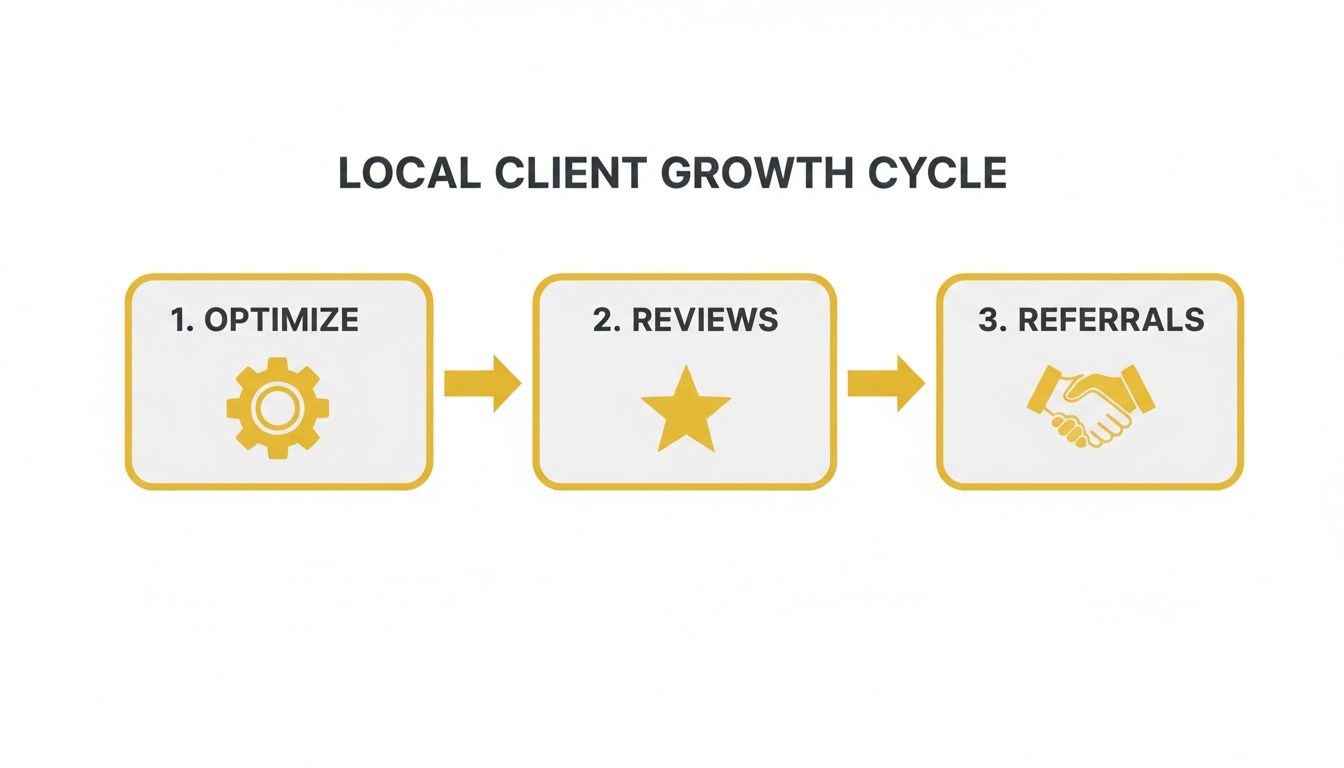
When you pour gasoline on this flywheel with paid ads, the whole system spins faster. You're not just waiting for clients anymore; you're actively creating them.
Designing Ads That Actually Convert
Let's be blunt: most ads created by tax pros are painfully boring. An ad that just says "Tax Services Available" is a complete waste of money. It will be ignored every single time. Your ads have one job—to stop the scroll and speak directly to a very specific pain point.
This means your ad creative, the images or videos you use, and the words you write have to be custom-fit to the platform and the user’s mindset. An ad on Instagram should be visual and feel like it belongs in the feed. A Google Search ad, on the other hand, needs to be direct and packed with keywords to grab someone who is actively looking for a solution.
Here are a few principles I’ve seen work time and time again:
Lead with the Problem: Don't talk about yourself first. Start your ad with a hook that hits a nerve. Think something like, "Are you a real estate investor paying more in taxes than you think you should?"
Use Compelling Visuals: Test different formats. A quick, 30-second video of you explaining a common tax mistake can build instant authority. Sometimes, a simple graphic with a bold, can't-miss headline is all it takes.
Offer a Clear Next Step: Every single ad needs a strong Call to Action (CTA). "Learn More" is weak. Be specific. "Download Our Free Tax Savings Guide" or "Book Your Complimentary Tax Strategy Session" tells them exactly what to do.
Your ad isn't meant to sell your full suite of services. Its only job is to get a single click from the right person by promising a solution to a problem they're actively experiencing.
Crafting Your Omnipresent Campaign Blueprint
A smart omnipresent strategy layers different platforms to gently guide a prospect from not knowing you exist to booking a call. You’re not just blasting the same ad everywhere. You’re tailoring the message to where they are in their journey.
For example, a full-funnel campaign targeting small business owners might look something like this:
To give you a clearer picture, here's how you might structure a campaign targeting small business owners across different platforms and funnel stages.
Sample Omnipresent Ad Campaign Structure
Funnel Stage | Platform | Ad Creative Focus | Call to Action |
|---|---|---|---|
Top of Funnel (Awareness) | Facebook & YouTube | Short, valuable video tip (e.g., "3 Tax Mistakes Costing Shopify Owners Thousands") | "Watch More" or no direct CTA |
Middle of Funnel (Consideration) | Facebook & Instagram | Retarget video viewers with a lead magnet offer (e.g., a detailed checklist) | "Download the Free Checklist" |
Bottom of Funnel (Conversion) | Google Search & Facebook | Direct offer to book a consultation, highlighting your unique value | "Book a Free Strategy Call" |
This layered approach ensures you're building a relationship and providing value before you ever ask for the sale, which dramatically increases conversion rates.
Building the High-Converting Landing Page
Sending ad traffic to your website's homepage is one of the fastest ways to burn through your ad budget. It's a rookie mistake. You need a dedicated landing page built for one thing and one thing only: converting a visitor into a lead.
A great landing page for tax clients is stripped of all distractions. No navigation menu, no links to your blog, no social media icons—nothing to click except the one button you want them to click.
Your page absolutely must include these core elements:
A Compelling Headline: It must match the promise you made in your ad.
Benefit-Driven Bullet Points: Don't list features. Quickly explain the amazing outcome they'll get.
Social Proof: Nothing sells like trust. Include client testimonials, logos of businesses you've worked with, or short case study results.
A Simple Form: Only ask for what you absolutely need. Name, email, and maybe a phone number. That's it.
A Clear Call to Action Button: Use action-oriented text. "Get My Free Tax Plan" is infinitely better than "Submit."
When you combine platform-specific ads with a laser-focused landing page, you create a seamless journey that guides your ideal client from a casual scroller into a qualified lead. This is how you turn your ad budget into a predictable engine for growth.
Turning Leads Into Clients with Automation
Getting a lead from one of your ads is a good start, but that's all it is—a start. The real money is made in the follow-up, and frankly, this is where most tax firms are leaking potential clients left and right. This is the moment you turn a mildly interested prospect into a high-value client, and if you're trying to do it all by hand, you're just not going to keep up.

This is where a solid, automated lead nurturing system becomes your unfair advantage. It works around the clock to make sure every single person who shows interest gets timely, valuable, and persuasive communication without you lifting a finger. What does that do for you? It frees you up to do what you do best: have meaningful conversations with warm, qualified prospects who are already convinced you're the expert they need.
The Anatomy of a High-Converting Nurture Sequence
A killer nurture sequence isn't just a bunch of random "just checking in" emails. It's a carefully planned series of messages, hitting them on both email and SMS, all designed to build trust, show off your value, and gently guide them toward booking that first call.
And you have to be fast. The data doesn't lie: reaching out within the first five minutes can boost lead conversion rates by a mind-blowing 391%.
Your sequence needs to be a smart blend of giving value and making a clear ask. The idea is to educate them and position yourself as the only logical solution to their tax headaches. This approach warms them up, handles their objections before they even think of them, and weeds out the tire-kickers.
Crafting Your Automated Follow-Up Messages
Every message in your sequence has a specific job to do. You're not just poking them; you're intentionally moving the relationship forward. Let’s walk through a proven sequence you can steal and adapt for your firm after someone grabs a lead magnet, like a "Tax Savings Checklist."
Message 1: The Instant Welcome (Email & SMS - Sent Immediately)
Goal: Get them what they asked for and set the stage.
Email Subject: Your Tax Savings Checklist is Here!
Email Body: "Hi [First Name], here's the checklist I promised. Over the next few days, I'll send over a few more quick tips to help you keep more of your hard-earned money. If you're ready to get a personalized tax plan now, grab a free spot on my calendar here: [Booking Link]."
SMS Body: "Hey [First Name]! Just sent your Tax Savings Checklist to your email. Check it out and let me know if you have any questions."
Message 2: The Quick Win (Email - Day 2)
Goal: Drop a piece of standalone value to build your authority.
Email Subject: The #1 Mistake Most Business Owners Make at Tax Time
Email Body: In a few short paragraphs, break down a common and expensive mistake (like botching a key deduction) and how to avoid it. This instantly frames you as the expert and reminds them of the pain of not having professional help. Finish with a soft prompt to book a call.
A great nurture sequence does more than just sell—it educates. When you give away legitimate insights for free, you build incredible trust. Prospects feel like they already know you, which turns the eventual sales call into a friendly consultation instead of a high-pressure pitch.
Message 3: The Social Proof Nudge (SMS - Day 3)
Goal: Build credibility with real-world results.
SMS Body: "Hi [First Name], just wanted to share what a client of ours, a [Client's Industry], recently said: '[Short, powerful testimonial about saving money or time]'. See if we can do the same for you: [Booking Link]."
Message 4: The Objection Crusher (Email - Day 5)
Goal: Tackle a common hang-up, like cost or complexity, head-on.
Email Subject: Is professional tax help "too expensive"?
Email Body: This is where you reframe the conversation from an expense to an investment. Show them how your services save clients far more than they cost. A mini-case study or a quick example works wonders here, followed by a clear link to book their call.
This multi-channel attack—using the professional feel of email with the can't-ignore-it immediacy of SMS—makes sure your message is seen. It systematically builds the case for hiring you, making the decision to book a consultation feel like the most natural, logical next step for any serious business owner who wants to get their finances right.
Turning New Clients into Lifelong Fans (and Boosting Your Profits)
Pouring money into ads to get new tax clients is just the first part of the equation. The real secret to building a ridiculously profitable firm isn't just getting them in the door—it's what you do the moment they step inside.
Losing a client you fought so hard to win over isn't just a bummer; it’s a direct hit to your bank account and makes your whole marketing machine less sustainable.
Getting client onboarding and retention right is the engine that makes paid ads not just work, but work incredibly well. A killer onboarding experience immediately tells a new client they made the right choice, turning that first payment into years of loyalty. This is the superpower that lets top firms confidently outspend their competition on ads and still come out way ahead.
Crafting a Flawless First Impression
Think of your onboarding process as the first real taste a client gets of your firm. It sets the entire tone for your relationship. If it’s clunky, confusing, or drags on, you’re creating instant buyer's remorse and planting a seed of doubt that's nearly impossible to pull out later.
A smooth client onboarding system is the bedrock of retention and happiness. For anyone looking to systematize this critical first step, digging into resources on mastering your client onboarding process can give you a solid framework to build from.
The mission is simple: make them feel secure, heard, and confident from day one. This isn't just about grabbing their W-2s; it’s a carefully choreographed dance of communication and action.
A top-notch onboarding system must include:
A Welcome Packet: Send a slick digital packet that lays out expectations, introduces the team they'll be working with, clarifies your communication style, and gives them a clear timeline. No guesswork.
A Secure Client Portal: Get them immediate access to a user-friendly portal for swapping documents. It screams professionalism and shows you take their data security seriously.
An Onboarding Kickoff Call: A quick, 15-minute call to personally say "welcome," tackle any immediate questions, and confirm what happens next. That human touch is everything.
This isn't rocket science, but this structured approach wipes out confusion and puts your firm's efficiency on full display from the jump.
Why Retention Is Your Secret Ad Spend Weapon
Retention is the single biggest lever you can pull to make paid acquisition profitable. The numbers here are just wild: industry reports show that bumping up client retention by just 5% can explode your profitability by 25% to 95%.
Without a real retention strategy, many firms are bleeding out 15–20% of their clients every single year. That puts them on a hamster wheel, constantly spending just to replace the business they lost. This math directly dictates how much you can afford to spend on ads. A higher client lifetime value means you can justify a higher acquisition cost.
When clients stick around, their lifetime value (LTV) goes through the roof. That healthy LTV to Customer Acquisition Cost (CAC) ratio is what gives you the firepower to bid more aggressively and confidently on Google, Facebook, and everywhere else.
Here’s the bottom line: pouring resources into your client experience and retention is a direct investment in your marketing budget. You can't scale one without the other.
Systems That Keep Clients Happy (and Paying)
Long-term loyalty isn't built on one great first week. It’s nurtured through consistent, proactive communication. Don't be that tax pro who only pops up in March.
This is where smart, automated systems become your best friend.
Automated Check-insUse your CRM to schedule simple, automated emails throughout the year. A quarterly "How's business going?" or an email sharing a relevant tax tip keeps your name at the top of their mind.
Content That Actually HelpsSend out a monthly newsletter with real insights, not fluff. You don’t need to write a novel—share a quick breakdown of a recent tax law change or a few strategies for common financial hurdles your ideal clients are facing.
Annual Strategy SessionsThis is a game-changer. Offer a mid-year or year-end tax planning session. It elevates your relationship from purely transactional to truly advisory. Suddenly, your services are indispensable, and you've created natural opportunities to upsell to higher-value work.
By putting these simple systems in place, you deliver an amazing, high-touch experience without being glued to your desk 24/7. You’re building a protective moat around your client base, making them immune to a competitor’s shiny ad. This foundation is what lets you scale your marketing with total confidence, knowing every new client you bring in is built to last.
Your Top Questions, Answered
When you're serious about growing your practice, questions are going to come up. It’s natural. Let's tackle some of the most common ones I hear from tax professionals who are ready to stop guessing and start building a predictable client-generating machine.
How Much Should I Really Budget for Marketing?
This is the big one, isn't it? Forget the generic advice. While some will tell you to earmark 5-10% of your target revenue, the real answer is a bit different.
The smartest firms don't think in terms of a fixed "budget." Instead, they think in terms of investment and return. Once you have a system that tracks your Cost Per Lead (CPL) and your total Customer Acquisition Cost (CAC), everything changes. You're no longer spending money; you're buying clients at a profit.
Think about it: if you know the average client is worth $2,500 to your firm over the next three years, would you spend $400 to acquire them? Of course, you would. You'd do it all day long. That's a fantastic return.
The most successful firms don't see marketing as an expense. They see it as a direct investment in acquiring a revenue-generating asset. Your budget shouldn't be a limitation but a dial you turn up once you've proven your acquisition model is profitable.
If you're just starting out, pick a number you're comfortable testing with—maybe $1,500 a month. The goal isn't to spend that forever; it's to prove the model. Once you see the system is generating a positive ROI, you can scale your ad spend with total confidence, because it's fueled by real data, not guesswork.
What's the Fastest Way to Get High-Value Tax Clients?
Want the shortcut? It's a powerful combination of hyper-specific paid ads and an offer that solves a real, painful problem.
Throwing money at generic ads for "tax preparation services" is a race to the bottom. You’ll just attract price shoppers and people who see your expertise as a commodity. To pull in the big fish, you have to speak their language and solve their high-stakes problems.
Get specific. Run campaigns built around major financial pain points they're feeling right now.
A webinar on "Advanced Tax Strategies for Real Estate Investors."
A specialized campaign for "S-Corp Tax Planning for 7-Figure Consultants."
An offer for a "Complimentary R&D Tax Credit Assessment" for local tech startups.
See the difference? This approach immediately frames you as a specialist, not just another tax preparer. It acts as a filter, attracting only the leads who already appreciate the value of expert advice and are ready to pay for it.
From there, it’s all about staying in front of them. Use retargeting ads on platforms like Facebook and YouTube to follow up with everyone who showed interest. These ads shouldn't just be reminders; they should drive people to book a one-on-one strategy session with you. It’s a direct line to the prospects who are already sold on your expertise.
Can I Still Get Clients Without Pouring Money into Ads?
Absolutely. Paid advertising is the king of speed and predictability, but organic methods are still incredibly powerful. They just trade money for time and sweat equity.
If you're not ready for ads, put all your energy into two areas: Local SEO and building a rock-solid referral network.
Getting your firm to the top of Google's local map pack for searches like "accountant near me" or "business tax advisor in [your city]" is a game-changer. It delivers a steady stream of free leads who are actively searching for someone like you. They're the lowest-hanging fruit.
At the same time, you need to be building relationships. You don't need hundreds of contacts. Nurturing a solid partnership with just three to five key people—think business attorneys, financial planners, or mortgage brokers—can create a referral pipeline that sends you pre-vetted, high-quality prospects month after month.
The trade-off is simple: organic growth takes more of your time and relentless consistency. A smart play is to master these organic channels first. Then, as the profit from those new clients starts rolling in, you strategically reinvest it into a paid ad system to pour gasoline on the fire and truly scale.
Ready to stop guessing and start building a predictable system for attracting high-value tax clients? At Wojo Media, we specialize in creating omnipresent ad campaigns that turn your expertise into a client-generating machine. We'll help you craft the irresistible offer, build the high-converting landing page, and launch the ads that get you in front of your ideal clients every single day. Book a free demo call with us today and get a custom-built paid ads strategy to scale your practice.
Comments