.png)
How to Reduce Customer Acquisition Cost and Boost Your ROI

If you want to lower your customer acquisition cost, it really comes down to two things: increasing the conversion rate on the traffic you already have and eliminating wasted ad spend. It’s about plugging the leaks in your funnel and making every dollar you spend work smarter, not just harder, to bring in paying customers instead of just clicks.
Auditing Your Current Customer Acquisition Cost
Before you can start slashing your customer acquisition cost (CAC), you need to get brutally honest about what you’re currently spending to land a new customer. A lot of businesses I see just look at a blended, account-wide CAC. That’s a huge mistake—it hides the real story. The genuine insights come from digging in and figuring out your CAC on a channel-by-channel basis.
This audit is your ground zero. It’s how you move from "I think this channel is working" to knowing for sure. You can't fix what you don't measure, and getting this initial benchmark is absolutely non-negotiable if you want predictable growth.
Calculating Your True CAC
The basic formula is simple enough: total sales and marketing spend divided by the number of new customers you brought in. But to make this actually useful, you have to break it down.
For instance, say you spent $5,000 on Google Ads last month and got 50 new customers. Your Google Ads CAC is $100. But what if you also spent $5,000 on Facebook Ads and only got 25 new customers? That’s a $200 CAC. Instantly, you can see exactly where the problem—and the opportunity—is.
To do this right, you need to pull together a few key expenses for each channel you’re running:
Total Ad Spend: This is the easy one. What you paid directly to Google, Meta, TikTok, etc.
Salaries: A prorated chunk of the salaries for the people managing those specific channels.
Tool Costs: Any software or subscriptions you use just for that channel, like creative tools or analytics platforms.
Content & Creative Costs: The money spent producing the videos, images, and copy for your ads.
Once you have this detailed breakdown, you can see with total confidence which channels are your workhorses and which are just draining your budget. If you want a more detailed walkthrough on getting this number right, check out this excellent guide on Calculating Cost of Customer Acquisition: A Guide.
Why This Matters More Than Ever
Getting a handle on your CAC isn't just a "best practice" anymore; it's a survival tactic. Can you imagine pouring money into ads on Facebook, Instagram, and Google, only to find out you’re losing $29 for every new customer you bring in? That’s the harsh reality for many e-commerce and local service businesses today.
That number is up a staggering 222% from just $9 back in 2013. This explosion is fueled by sky-high ad prices, insane competition, and new privacy rules. For companies that aren't optimized, acquisition has become a financial black hole.
Key Takeaway: A thorough CAC audit gives you a baseline. It turns vague feelings about ad performance into hard data, giving you a clear starting point to measure the impact of every single change you make.
CAC Audit Quick-Start Checklist
Getting started with an audit doesn't have to be some massive, complex project. You can get a quick, accurate snapshot of your performance by focusing on the most critical areas first.
Use this simple table as a guide to run your initial analysis and spot the most obvious red flags right away.
CAC Audit Quick-Start Checklist
Audit Step | What to Look For | Actionable Pro Tip |
|---|---|---|
Channel-Specific CAC | Identify high-cost channels vs. profitable ones. | Compare the CAC of Google, Facebook, and TikTok individually. Don't let a low average CAC hide an underperforming channel bleeding you dry. |
Campaign-Level Performance | Find specific campaigns with outlier CACs (either high or low). | Find the top 10% of your highest-CAC ad campaigns and pause them immediately. Reallocate that budget to your proven winners for a quick efficiency boost. |
Funnel Drop-off Points | Analyze where users are bailing between the click, lead, and purchase. | If you have a high click-to-lead cost but a low lead-to-customer cost, the problem is almost certainly your landing page, not your sales process. |
Compare to Benchmarks | See how your CAC stacks up against industry averages. | If your e-commerce CAC is over $100 (when the average is $68–$78), it’s a clear signal your offer or conversion rate needs immediate attention. |
This initial look will often reveal some low-hanging fruit you can tackle for an immediate impact on your bottom line. Once you know your numbers, you’re ready to start making meaningful improvements.
Refining Your Four Pillars for a Lower CAC
Once you have a firm grip on your numbers, the real work begins. Lowering your customer acquisition cost isn't about finding one silver bullet; it's about systematically reinforcing the core components of your marketing engine. We call these the "four pillars," and they're the foundation that all profitable campaigns are built on.
These pillars are your offer, your landing page, your ad creatives, and your data. When these four elements are firing on all cylinders, they create a powerful, efficient system that turns clicks into customers at the lowest possible cost. But if even one is weak, the whole structure can start to crumble, leading to wasted ad spend and a sky-high CAC.
This simple concept map shows how total ad spend gets filtered through different channels to acquire new customers—this is the basic formula for your audit.
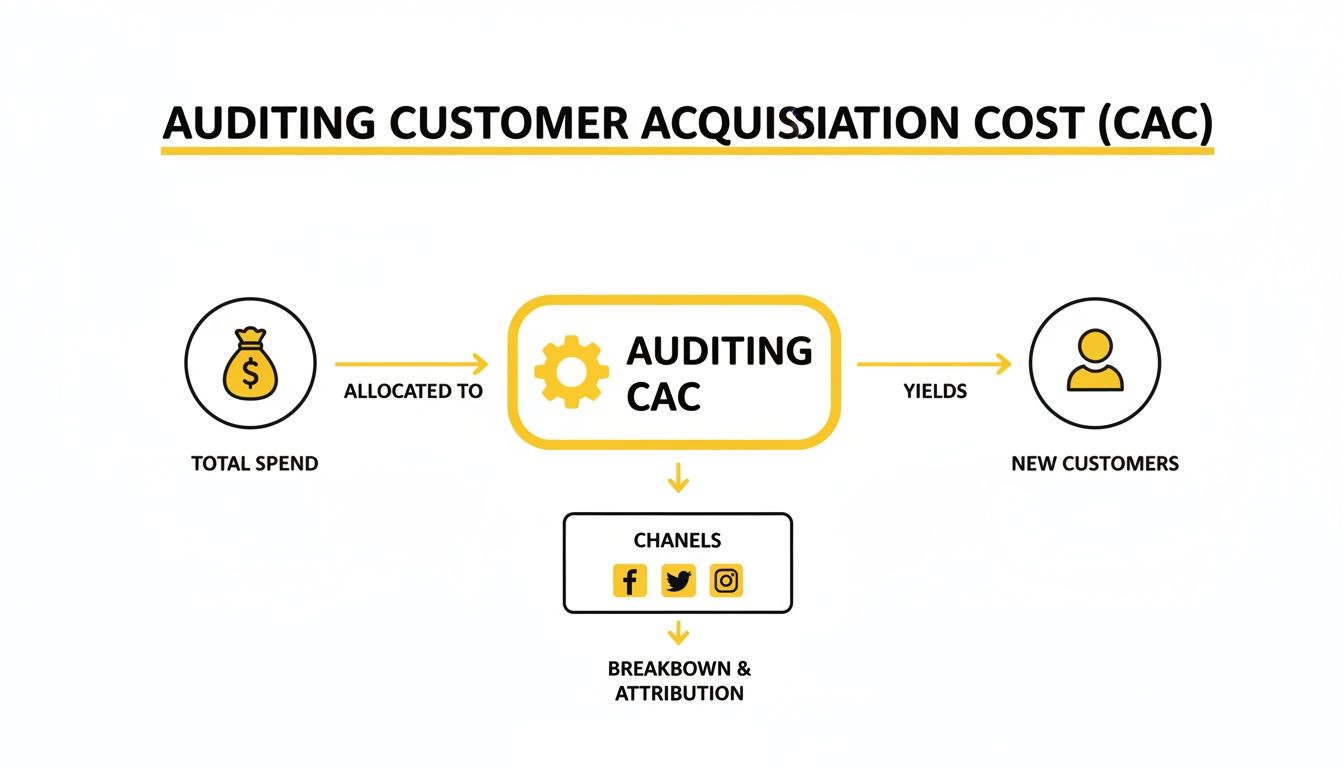
The flowchart drives home a critical point: without optimizing what happens after the spend, you’re just pouring money into a leaky bucket. Now, let’s break down how to tighten up each pillar to make sure every dollar you spend is working for you.
Crafting an Irresistible Offer
Your offer is the single most important lever you can pull. It's the core value you're presenting to your audience, and if it doesn't land, nothing else matters. A weak offer forces you to overspend just to get noticed, which directly inflates your CAC.
An irresistible offer isn't just about a discount. It's about speaking directly to a burning problem and framing your solution as the most logical, low-risk way to solve it.
Problem-Solution Fit: Does your offer solve a real, urgent pain point? A "nice-to-have" solution requires far more marketing muscle than a "must-have" one.
Clear Value: Is the benefit immediately obvious? A prospect should understand what they get in under three seconds. For an e-commerce brand, this might be a bundle deal that saves them $50. For a local service business, it could be a "first service free" package.
Risk Reversal: What are you doing to eliminate hesitation? A powerful guarantee (think "Double Your Money Back" or "Results in 30 Days or It's Free") can dramatically boost conversion rates by shifting the risk from the buyer to you.
Think of your offer as the engine of your car. You can have a sleek design and a great paint job, but if the engine is sputtering, you aren't going anywhere fast.
Building Conversion-Focused Landing Pages
Your landing page has one job and one job only: convert the traffic your ads generate. Too often, I see businesses sending expensive ad clicks to their generic homepage. That’s like trying to catch water with a fishing net. A dedicated, conversion-focused landing page plugs those leaks.
Every single element on the page—from the headline to the button color—must guide the user toward the one action you want them to take.
Your landing page is not a brochure; it’s a dedicated sales pitch. Eliminate all distractions. That means no navigation bars, no social media links, and no unrelated offers that could pull a user away from the primary conversion goal.
A high-converting landing page always includes:
A Compelling Headline: It needs to mirror the ad's message and instantly confirm the user is in the right place.
Benefit-Oriented Copy: Ditch the feature lists. Focus on what the customer gains. How does their life improve?
Strong Social Proof: Use testimonials, reviews, and case studies to build trust. According to McKinsey, a shift to digital sales can lead to 30% higher acquisition efficiency, and trust elements are a huge part of that.
A Clear Call-to-Action (CTA): The button should be impossible to miss, use action-oriented language, and appear multiple times on the page.
Developing Scroll-Stopping Creatives
In a sea of social media content, your ad creative is your opening line. You have less than a second to grab someone's attention before they keep scrolling. Generic stock photos and boring ad copy are a one-way ticket to a high CAC because they’re invisible.
Effective creatives stop the scroll by being highly relevant, deeply entertaining, or surprisingly disruptive. User-generated content (UGC) is a goldmine here, as it feels authentic and serves as built-in social proof.
E-commerce Example: A brand selling skincare products could use a raw, unedited video from a real customer showing their "before and after" results. This is infinitely more believable than a polished studio ad.
Local Service Example: A med spa could feature a quick clip of a client talking about their amazing experience right after a treatment. This builds instant trust and relatability that you just can't fake.
Your creative has to connect with the audience on an emotional level and present your offer as the perfect solution to a problem they’re feeling right now.
Tracking the Right Data
Finally, you can't reduce your customer acquisition cost if you're flying blind. Accurate data is what separates guessing from building a predictable growth machine.
Vanity metrics like impressions and clicks might look nice in a report, but they don't tell you if you're actually making money. You need to focus on the metrics that directly impact your bottom line.
Essential KPIs to Monitor
Metric | What It Tells You | Why It Matters for CAC |
|---|---|---|
Click-Through Rate (CTR) | The percentage of people who click your ad after seeing it. | Indicates if your creative and targeting are resonating. |
Cost Per Click (CPC) | The average amount you pay for each click on your ad. | A primary driver of your overall campaign cost. |
Conversion Rate (CVR) | The percentage of visitors who complete your desired action. | Shows the effectiveness of your landing page and offer. |
Cost Per Acquisition (CPA) | The cost to generate one lead or sale. | The ultimate measure of your campaign's efficiency. |
When you optimize these four pillars in tandem, you create a powerful flywheel effect. A better offer boosts your landing page conversion rate. Better creatives lower your click costs. And better data lets you make smart decisions that continuously refine the entire system, driving your CAC down over time.
Optimizing Ad Campaigns to Eliminate Wasted Spend
Alright, with a solid foundation in place, it’s time to get our hands dirty. This is where we start fine-tuning your ad campaigns to squeeze every drop of value out of your budget. We're moving past the vanity metrics and making the surgical adjustments to targeting, bidding, and campaign structure that actually cut wasted spend.
This isn't just about shuffling budgets around. It’s about building a smarter, more resilient ad strategy that scales profitably. We've used these exact tactics to help clients get everything from sub-$10 leads for local service businesses to sky-high, consistent ROAS for e-commerce brands.

Go Beyond Basic Audience Targeting
If you want to burn through your ad budget with nothing to show for it, broad demographic targeting is your fastest route. Hitting the right audience is absolutely non-negotiable for a low CAC, and that means getting way more specific than "women ages 25-54 who like fitness."
Real efficiency comes from using your own data to find people who are practically raising their hands to buy from you. Here are the audiences that consistently deliver the goods:
Lookalike Audiences: These are your secret weapon, plain and simple. You upload a list of your best customers to a platform like Facebook, and its algorithm goes out and finds new people who act just like them. A 1% Lookalike is the most potent because it's the tightest match to your source list.
Custom Lists: Don't let your existing contacts gather dust. Upload lists of past purchasers, high-value clients, or even leads who never converted. You can use these to win back old customers or, even better, create lookalikes based on your absolute most profitable segments.
Behavioral Retargeting: This is much deeper than just targeting generic "website visitors." We're talking about creating audiences of people who added to their cart but bailed, watched 75% of your video ad, or engaged with your Instagram profile. These are warm leads who just need a final nudge.
By layering these advanced targeting options, you're not just hoping the right people see your ads—you're ensuring it. This immediately lifts conversion rates and brings your acquisition cost down.
Demystify Your Bidding Strategy
Choosing the right bidding strategy can feel like you're staring at a cockpit full of buttons, but it's one of the most powerful levers you have for controlling cost. The trick is to match your bidding strategy to your campaign goals and where you are in the process.
For instance, when launching something new, you might start with a lower-risk strategy just to get some data flowing. Once the campaign proves it has legs, you can switch to a more aggressive approach focused on maximizing value.
Pro Tip: Bidding is not a "set it and forget it" task. Your strategy has to evolve. I always recommend starting with cost controls to establish a baseline. Once you have enough conversion data for the algorithm to learn, you can transition to value-based bidding and let it really work its magic.
Let's cut through the noise. Here's a simple look at the most common bidding strategies and when to actually use them.
Channel-Specific Optimization Tactics
Every platform has its own quirks and sweet spots. A quick win on Google Ads won't necessarily be the same as on TikTok. The table below breaks down some of the most effective starting points I've seen for each major channel.
Platform | Top Targeting Tactic | Best Creative Approach |
|---|---|---|
Facebook/Instagram | 1% Lookalikes from a high-value customer list. | User-Generated Content (UGC) or authentic, lo-fi video reviews. |
Google Ads | Performance Max campaigns layered with your own customer data signals. | Direct, benefit-driven headlines with clear calls-to-action. |
TikTok | Interest "stacking"—layering multiple related interests to find a niche. | Fast-paced, trending-sound-driven videos that feel native to the platform. |
This isn't an exhaustive list, but it's a battle-tested starting point. Tailoring your approach to the platform's user behavior is a fundamental step toward efficiency.
Deploy an Omnipresent Campaign Structure
Today's customer journey is a tangled mess, not a straight line. Someone might see your ad on Instagram during their lunch break, search for your brand on Google later that night, and then get hit with a retargeting video on YouTube the next day before finally buying.
If your campaigns are stuck in their own platform silos, you’re losing people at every turn.
An omnipresent campaign strategy ensures you stay top-of-mind by showing up across the platforms your prospects actually use. This coordinated dance builds familiarity and trust, which dramatically increases the odds of them converting.
Here’s how this plays out in the real world:
Top of Funnel (Awareness): Run engaging, story-driven video ads on TikTok and Facebook to a broad-but-relevant lookalike audience. Don't sell, just entertain and educate.
Middle of Funnel (Consideration): Retarget anyone who watched those videos or visited your site. Now you hit them on Google and YouTube with case studies, testimonials, or an "about us" video.
Bottom of Funnel (Conversion): Serve direct-response ads on Facebook and Instagram to people who’ve added to their cart. This is where you offer a small discount or free shipping to get them over the finish line.
This multi-touchpoint approach works because it meets customers where they are. You're respecting their journey instead of just yelling at them on one channel, leading to a much more natural—and cheaper—path to a new customer.
Boosting Conversion Rates to Cut Acquisition Costs
Driving traffic is only half the battle. If your website isn't built to turn that traffic into customers, you're just lighting money on fire. Every single visitor who clicks away represents a direct hit to your marketing ROI, which is why Conversion Rate Optimization (CRO) is a non-negotiable part of slashing your customer acquisition cost.
The math here is simple but powerful. If you manage to double your conversion rate, you effectively cut your CAC in half—without spending a single extra dollar on ads. It's all about plugging the leaks in your bucket so every click you pay for works twice as hard.
Streamline Your User Journey
Friction is the absolute enemy of conversions. Every unnecessary step, every confusing instruction, every extra form field is another reason for a potential customer to bail. Think of it as adding tiny hurdles to a race; eventually, people just give up.
For e-commerce stores, a classic friction point is the checkout process. Forcing a user to create an account before they can buy is a notorious conversion killer. One famous study found that a major retailer boosted sales by a staggering $300 million just by removing that one mandatory step.
Here are some quick wins for cutting out friction:
Simplify Lead Forms: Be ruthless. Only ask for the information you absolutely need right now. Do you really need a phone number and company size just to send an ebook? Probably not.
Enable Guest Checkout: Don't force people to create an account. Let them buy quickly, then offer them the chance to save their info after the purchase is complete.
Improve Site Speed: Slow-loading pages are a massive source of friction. A mere one-second delay in page load time can tank your conversions by 7%.
A/B Test Everything That Matters
You can't optimize what you don't measure, and gut feelings are a terrible way to make marketing decisions. A/B testing is your best friend here. It's the process of showing two different versions of a page element—a headline, a button, an image—to different segments of your audience to see which one actually performs better. It’s how you find out what really moves the needle.
Don't just test random elements, though. Focus your energy on the parts of your funnel that have the biggest impact on your bottom line.
High-Impact Elements to A/B Test:
Headlines: This is your first impression, so make it count. Test a benefit-driven headline ("Get More Leads in 30 Days") against a pain-point-focused one ("Tired of Wasting Money on Ads?").
Calls-to-Action (CTAs): The text, color, and placement of your CTA button are critical. Test "Get Your Free Quote" versus "Start My Project" to see what your audience responds to.
Page Layout: Try a long-form sales page against a more concise version. Sometimes less is more; other times, users need every last detail to feel confident enough to buy.
A/B testing removes guesswork from the equation. It allows you to make incremental improvements based on real user behavior, creating a compounding effect that consistently lowers your CAC over time.
Unpack Your Attribution Model
Finally, to truly optimize your funnel, you have to understand which touchpoints are actually driving sales. If you're stuck on a "last-click" attribution model, you're giving 100% of the credit to the final ad a customer clicked before buying. Frankly, this is a dangerously incomplete picture.
The modern customer journey is messy. A user might first discover you on a TikTok video, get retargeted with an ad on Facebook, and finally search your brand on Google before converting. A last-click model completely ignores the critical roles that the TikTok and Facebook ads played in that journey.
By moving to a more sophisticated attribution model, like a data-driven or position-based model in Google Analytics, you can see the whole story. This lets you invest intelligently in the channels that introduce new customers and assist conversions, even if they aren't getting that final click. Accurate attribution is the key to making smarter budget decisions and lowering your overall CAC.
Pivoting from Acquisition Cost to Lifetime Value
Truly scalable brands get one thing right: the first sale isn’t the finish line. It’s the starting gun. While everyone gets caught up in lowering their upfront customer acquisition cost, the real growth lever is shifting your focus from that initial cost to long-term Customer Lifetime Value (CLV). This single pivot changes everything about how you approach growth.
You stop asking, "How cheaply can I get a customer?" and start asking, "How much can I really afford to spend to get the right kind of customer?" This mindset is what separates the brands that just scrape by from the ones that completely own their market. It transforms customer acquisition from a necessary evil into a predictable, sustainable growth engine.
The Power of Retention in a High-CAC World
It's no secret that getting a new customer in the door is expensive. In fact, it’s consistently 5 to 7 times more costly than just keeping the ones you already have. When you’re only focused on that initial CAC, you’re always fighting the most expensive battle in marketing—over and over again.
Retention is the ultimate CAC-reduction hack. It's far cheaper than pure acquisition and boosts CLV, helping you absorb those rising ad costs. For e-commerce brands staring down an average $78 CAC, this isn't just a nice-to-have; it's a survival strategy. You can discover more insights about e-commerce CAC on LoyaltyLion.com.
Brands that lean hard into loyalty—using tools like fast mobile checkouts, smart incentives, and subscription models—are spreading that initial acquisition cost over countless future purchases. They're turning what looks like an upfront loss into a massive long-term win.
The 3:1 Ratio Rule: A healthy, scalable business should be aiming for a CLV-to-CAC ratio of at least 3:1. For every dollar you put in to get a customer, you should expect to get at least three dollars back over their lifetime. If your ratio is closer to 1:1, you’re just spinning your wheels.
Practical Strategies to Boost Your CLV
Increasing your Customer Lifetime Value isn't about some grand, complicated plan. It's about systematically building loyalty and encouraging repeat business with smart tactics that make your customers feel seen and valued.
Here are a few high-impact strategies you can roll out right away:
Implement a Subscription Model: This is the undisputed champion of predictable revenue and sky-high CLV. For e-commerce, think monthly restocks of a consumable product. For services, it could be a retainer or a membership with exclusive perks.
Launch a Loyalty Program: Reward your best customers for sticking with you. Simple point systems, tiered rewards, or exclusive access can make a huge difference in purchase frequency and make people feel like insiders.
Leverage Smart Email & SMS Marketing: The conversation shouldn't end at checkout. Use personalized email and SMS flows to follow up, offer relevant cross-sells, celebrate customer anniversaries, and let your best customers know about new products first.
Nurturing Your Highest-Value Assets
Your existing customer base is your single greatest asset. Full stop. These are people who have already voted for you with their wallets. By nurturing those relationships, you create a powerful flywheel effect.
Happy, loyal customers don't just buy more; they become your best marketers through word-of-mouth. Here’s a simple but effective game plan:
Segment Your Customers: Find your VIPs—the top 10-20% who drive the most revenue. Treat them like gold. Give them exclusive offers, early access, and maybe even a personal thank-you note.
Gather Feedback (and Actually Act on It): Send out regular surveys to find out what customers love and what you could do better. The key part? Show them you're listening by actually implementing their suggestions.
Create a Post-Purchase Experience: The journey doesn't end when the credit card is charged. A killer unboxing experience, a follow-up email with tips on using the product, or a simple check-in can leave a lasting impression and set the stage for the next sale.
By making CLV your north star, you break free from the stressful, expensive cycle of just chasing the next new customer. You start building a resilient business with a loyal fanbase that fuels predictable, long-term growth.
Common Questions About Cutting CAC
As we've walked through the playbook for lowering your acquisition costs, a few questions always come up. I get it. Founders and marketers want to know what "good" looks like, how fast they can actually see a difference, and what single mistake might be secretly torpedoing their budget.
Let's dive into those head-on. Answering these helps set real-world expectations and turns broad ideas into a concrete plan for your business.
What Is a Good Customer Acquisition Cost?
This is the million-dollar question, and the honest-to-God answer is: it depends entirely on your business. There’s no magic number. A $300 CAC might be a home run for a SaaS company with massive lifetime value, but it would sink an e-commerce brand selling $50 t-shirts.
The only benchmark that truly matters is your CLV:CAC ratio. This is your North Star.
As a rule of thumb, a healthy, scalable business should be aiming for a ratio of at least 3:1. For every dollar you spend to get a customer, you should be making three dollars back over their lifetime with you. If you're hovering around 1:1, you’re just buying revenue, not building a profitable business. Forget industry averages for a second and get obsessed with this internal ratio first.
How Quickly Can I See Results?
This all comes down to where the biggest leaks are in your marketing funnel. Some fixes can make an impact almost overnight, while bigger strategic shifts need more time to really pay off.
You can absolutely see some quick wins within the first 30 days by tackling the low-hanging fruit:
Kill Your Losers: Pausing your worst-performing ad campaigns and creatives is the fastest way to drop your blended CAC. Do it today.
Swap in UGC: A great piece of user-generated content can often outperform a slick, polished ad. Swapping out a weak creative for strong UGC can boost click-through rates and lower costs in a matter of days.
Fix Landing Page Friction: Simple A/B tests on a headline or call-to-action can lift conversion rates pretty quickly. Sometimes just removing a few unnecessary form fields is all it takes.
Bigger moves—like a complete overhaul of your customer journey or a new focus on maximizing long-term value—are foundational. These are the changes that will dramatically lower your CAC over 3-6 months as the positive effects start to compound.
The key is to run a two-track offense: short-term tactics and long-term strategy. The quick wins give you momentum (and free up budget) so you can invest in the deeper optimizations that build a truly efficient acquisition engine.
What Is the Biggest Mistake That Inflates CAC?
Hands down, the single biggest and most common mistake I see is sending paid traffic to a generic homepage. It’s like paying to get people in the door of your party but not giving them an address. You’re spending money on the click, then giving the user absolutely no clear path to take the action you want them to.
Think about it: your homepage is built for exploration. It has a navigation menu, multiple links, and a dozen different things a visitor could do. A dedicated landing page, on the other hand, has one job: get that specific person to convert on that specific offer. When you don't use one, your conversion rates tank, and your CAC goes through the roof.
For a deeper dive into more comprehensive strategies, you can learn more about how to reduce customer acquisition cost for good.
Ready to stop wasting ad spend and start acquiring customers profitably? At Wojo Media, we specialize in building omnipresent ad campaigns that convert. Book a free demo call with our team, and we'll give you a custom paid ads strategy to scale your business. Get your free strategy session here.
Comments