.png)
How to Write Facebook Ad Copy That Converts

When you boil it down, great Facebook ad copy comes down to three things: a hook that stops the scroll, a clear message about what you’re offering, and a call to action that actually makes people want to click. If you can nail that simple structure, you're already ahead of the game, turning passive scrollers into paying customers.
Mastering the Scroll-Stopping Hook
You have less than a second. That's it. Your first line—the hook—is the only thing standing between your ad and the endless scroll into oblivion. If that first sentence fails, the rest of your brilliant copy and eye-catching creative might as well not exist.
The real secret to a killer hook isn’t about being clever for the sake of it. It’s about understanding the psychology of interruption. Nobody opens Facebook looking for your ad; they're there to see what their friends are up to. Your ad is an interruption, so your opening line has to immediately justify the intrusion.
Beyond Textbook Frameworks
Sure, you’ve probably heard of classic copywriting formulas like PAS (Problem-Agitate-Solution) or AIDA (Attention-Interest-Desire-Action). They're a decent foundation, but a fast-paced social feed demands speed. You can't afford to gently build up to the problem—you have to hit them with it right out of the gate.
Forget the generic openers. A powerful hook needs to do one of three things instantly:
Call Out Your Audience: Speak directly to the person you want to reach.
Spark Intense Curiosity: Drop a bold or counterintuitive statement they can't ignore.
Present a Shocking Statistic: Use hard data to frame the problem in a new light.
This initial grab is your entire pitch wrapped in a single sentence. It qualifies the reader and earns you just a few more seconds of their attention. To really dial this in, it's worth learning how to create compelling video hooks that stop scrolling—the same principles apply and will make your message hit harder across any format.
Real-World Hook Examples That Work
Let's get out of the weeds of theory. Seeing these hooks in action is where it all clicks.
For a Real Estate Agent Targeting Home Sellers:
Weak Hook: "Thinking of selling your home?"Strong Hook: "Stop leaving money on the table. Most sellers in Austin don't know about the one renovation that adds 15% to their home's value."
See the difference? The strong hook creates immediate urgency and a serious case of FOMO. It promises insider information that the average seller is missing, making them desperate to learn more.
For a Coach Targeting Burnt-Out Entrepreneurs:
Weak Hook: "Are you feeling overwhelmed in your business?"Strong Hook: "That 'hustle and grind' mentality is costing you more than just sleep—it's actively shrinking your profits."
This second hook works because it challenges a sacred cow in the entrepreneurial world. It creates a pattern interrupt by suggesting the very thing they believe leads to success is actually holding them back. That kind of contrarian take forces people to stop and question everything.
Key Takeaway: Your hook should feel like it was pulled directly from a conversation your ideal customer is already having in their head. It needs to echo their specific pains and curiosities, not just spout generic business jargon.
For an E-commerce Brand Selling Skincare:
Weak Hook: "Get clear skin with our new face wash."Strong Hook: "Fact: 85% of 'sensitive skin' products still contain at least one of the top three chemical irritants."
Right away, this statistic positions the brand as a trusted expert and plants a seed of doubt about competitors. It educates the reader while creating a problem that their product is uniquely designed to solve. This hook doesn't just sell a product; it sells a new perspective, making the reader feel smarter just for having read the ad.
By focusing on a sharp, insightful hook, you set the stage perfectly for the rest of your message to land with maximum impact.
Building Compelling Ad Copy and Headlines
You’ve stopped the scroll with a killer hook. Great. Now the real work begins.
The body of your ad—what Facebook calls the primary text—and your headline need to team up and deliver a one-two punch that answers every reader's biggest question: "What's in it for me?"
This is where you have to nail your value proposition. Forget just listing what your product does. We're talking about the transformation it provides. You have to translate boring features into tangible, emotional benefits.
From Features to Feelings
I'll say it again: people don't buy a drill; they buy the hole in the wall. They don't buy a gym membership; they buy the confidence and energy that comes with it. Your ad copy needs to make this leap for them, connecting the dots between your offer and what they really want.
Here’s a simple exercise I run with all my clients. List every single feature of your product or service. Next to each one, write down the direct benefit. Then, go one step deeper: what’s the emotional outcome of that benefit?
Let's try it with an e-commerce brand selling noise-canceling headphones.
Feature: Advanced active noise cancellation technology.
Benefit: Blocks out distracting background sounds.
Emotional Outcome: Finally get the deep focus you need to finish that passion project without interruption.
That emotional outcome? That's pure gold. It’s the difference between saying "Our headphones have great tech" and "Find your sanctuary in a chaotic world." See the difference?
Structuring Your Primary Text for Readability
Nobody wants to read a novel on their phone. Your primary text has to be scannable and easy to digest. You need to use formatting to your advantage, guiding the reader’s eye right where you want it to go.
Make your copy look effortless to read.
Keep Paragraphs Short: Stick to one to three sentences max. This creates white space and makes the whole thing feel less intimidating.
Use Bullet Points: When you’re listing benefits or key takeaways, bullet points are your best friend. They break up the visual monotony and are perfect for skimmers.
Leverage Emojis: Used strategically, emojis like ✅, 👉, or 🔥 can inject personality and draw attention to key lines. Don't go crazy, but a few well-placed emojis can seriously lift engagement.
Pro Tip: Read your copy out loud. If it sounds clunky, unnatural, or you find yourself running out of breath, it’s too long and complicated. Cut it down until it flows like you're talking to a friend.
Crafting Headlines That Convert
After your image or video, the headline is the most important piece of text in your ad. While the primary text explains, the headline has to persuade. You've only got about 40 characters before it gets cut off on mobile, so every single word has to count.
Over the years, I've seen a few proven headline formulas that just work, time and time again.
Benefit-Driven HeadlinesThis is the most direct approach. Just state the number one result the user will get.
Example (Coach): "Book 5 High-Ticket Clients This Month"
Example (E-commerce): "The Last Skincare Routine You'll Ever Need"
Urgency-Based HeadlinesThese create a sense of scarcity or FOMO (fear of missing out), pushing people to act now.
Example (Local Service): "Last 3 Spots for Our Spring Cleanup"
Example (Real Estate): "Rates Are Changing—Lock Yours In Now"
Social Proof HeadlinesUse the power of the crowd to build trust and highlight popularity.
Example (E-commerce): "Join 50,000+ Five-Star Sleepers"
Example (Coach): "The System That Helped 300+ Founders Scale"
Don't just take my word for it—the data shows just how critical strong copy is. Across all industries, the average Facebook ads conversion rate hovers between 8.95% to 9.21%. For campaigns optimized for conversions, the median return on ad spend is a solid 1.79. If your copy isn't hitting at least an 8.78% conversion rate, you're leaving a massive amount of money on the table.
Understanding your goal is also vital; lead generation ads average a 2.53% click-through rate, which is way higher than traffic ads at 1.57% CTR. This should directly influence how you write your copy. For a deeper dive, check out these Facebook ad performance statistics to benchmark your campaigns.
Ultimately, the best headline for your business will come from testing. Always create a few variations—one focused on a benefit, another on urgency, and a third on social proof—and let the data tell you what your audience actually cares about. When your primary text and headline work together to tell a compelling story, that's when you've got a winning ad.
You’ve nailed the hook and your ad copy is compelling. But if the final piece—the Call to Action (CTA)—doesn’t land, all that effort goes to waste. The CTA is your ad's final, crucial instruction. It tells people exactly what you want them to do next.
A weak or confusing CTA is a dead end. People get lost, confused, or simply lose interest and keep scrolling. A strong one, however, makes the next step feel like the obvious and easy conclusion to everything they just read.
Your goal isn't just to get a click. It’s to get the right click—one that leads to a specific, valuable action. And that distinction is everything.
Clicks Versus Conversions: The Hidden Trap
So many advertisers fall into the trap of chasing the highest click-through rate (CTR). It feels good to see a high CTR, but more clicks don't always mean more sales. The words you use in your CTA directly influence the intent of the person on the other side of the screen.
Think about it. A low-commitment CTA like "Learn More" will almost always get more clicks than a high-commitment one like "Shop Now." People are naturally curious. But are those curious clickers actually ready to pull out their wallets? Most of the time, no.
It's a classic trade-off. Research digging into Facebook ad performance on Search Logistics found that switching a CTA from "Sign Up" to "Learn More" gave CTR a 22.5% boost. But here's the kicker: the "Sign Up" button, despite getting fewer clicks, delivered a 14.5% higher conversion rate. The data is clear—the click that matters is the one that converts.
The Takeaway: Your CTA's real job is to qualify the click. It needs to attract people who are genuinely ready for what's on the next page, even if it means scaring off a few casual browsers.
Choosing the Right CTA Button for Your Goal
Facebook gives you a set list of CTA buttons to choose from, and picking the right one is critical. Your choice needs to line up perfectly with your campaign goal and where your audience is in their buying journey. A mismatch here will absolutely tank your conversion rate.
Here’s how I think about it:
For Direct Sales (E-commerce): Go straight for the high-intent stuff. Shop Now or Order Now are your best friends. They set a crystal-clear expectation: clicking this button means you're going to a page where you can buy something.
For Lead Generation (Services, Coaching): For warmer audiences who are ready to take a step, buttons like Book Now, Get Quote, or Apply Now work wonders. But for colder traffic, you need to lower the barrier to entry. Think Download (for a freebie) or Subscribe.
For Content and Awareness: If your goal is just to educate or entertain, Learn More or Watch More are perfect. You're not asking for a big commitment, just a bit of their time to check out a blog post or video.
Your button doesn't work in a vacuum. The primary text and headline have to support it. If your button says "Shop Now," the copy better be building desire for that product. If it says "Download Guide," the copy needs to sell the value inside that guide. It all has to feel like one cohesive message.
To illustrate the trade-off, here's a look at how different CTAs can perform based on your primary goal.
CTA Performance Comparison: Clicks vs Conversions
This table breaks down how a simple button choice impacts who clicks and who converts. It’s not about finding one "best" CTA, but the best one for the job at hand.
CTA Button Text | Primary Goal | Impact on CTR | Impact on Conversion Rate | Best Use Case |
|---|---|---|---|---|
Learn More | Awareness/Traffic | High | Low | Driving traffic to blog posts, articles, or informational pages. Great for top-of-funnel audiences. |
Shop Now | Direct Sales | Moderate | High | E-commerce campaigns targeting audiences with clear purchase intent. Best for product-focused ads. |
Download | Lead Generation | Moderate | Moderate-High | Offering a free resource (e.g., ebook, checklist) in exchange for contact information. |
Sign Up | Lead/User Acquisition | Low-Moderate | High | Getting users to register for a webinar, newsletter, or free trial. Attracts a committed audience. |
Get Quote | Service Leads | Low | Very High | For service-based businesses where prospects need a custom price. Filters out non-serious inquiries. |
As you can see, the CTAs that generate the most clicks often produce the fewest conversions, and vice versa. Your choice sends a powerful signal to the user, so make sure it's the right one.
How to Create Urgency and Reduce Friction
The CTA isn't just the button itself; it's the copy leading into it. This is your chance to make clicking feel like a no-brainer. You do this by either cranking up the value of acting now or dialing down the perceived risk of taking that next step.
Here are a few simple ways to get it done:
To Turn Up the Urgency:
Introduce Scarcity: "Only 7 spots left at this price."
Set a Deadline: "Offer ends Friday at midnight."
Show the Consequence: "Don't miss your chance to lock in 2024 pricing."
To Lower the Friction:
Point out it's Free: "Get your free marketing plan."
State the Time Commitment: "Takes less than 60 seconds."
Remove the Risk: "No credit card required."
Think of your ad as a mini-conversation. You’ve gotten their attention and showed them what’s in it for them. The CTA is your closing line—that final, persuasive nudge that turns a passive scroller into your next customer. Make it sharp, compelling, and perfectly aligned with your goal.
Your Copy and Video Creative Need to Be a Perfect Match
Your Facebook ad copy never works alone. It's part of a team, and its most important teammate is your creative—especially video.
With video absolutely dominating formats like Reels and Stories, knowing how to write copy that clicks with what’s happening on screen isn't just a "nice-to-have" skill anymore. It’s everything.
The relationship between your words and your video is a delicate dance. Your copy shouldn’t just narrate what people can already see. Instead, it’s there to add context, deepen the emotional punch, and nudge the viewer toward that next logical step. A killer video can stop the scroll, but it's the copy that often closes the deal.
The data doesn't lie. A massive 67.55% of Facebook advertisers agree that videos pull in more clicks. And if you drill down, vertical videos with audio on Reels get a 35% higher click-through rate. Better yet, mobile-first videos (think vertical or under 15 seconds) slash the cost per conversion by 12.3%. A video-first mindset isn't just a trend; it's a direct path to better profits. You can dig into more of these numbers in Backlinko's report on Facebook ad statistics.
The First Three Seconds are Everything
On mobile, you don't have a minute to make your case. You have seconds. The first three seconds of your video are the whole ball game, and your copy has to be working in perfect harmony with that initial visual hook.
The goal is simple: reinforce, don't repeat.
If your video kicks off with a powerful visual—like a super-satisfying before-and-after shot—your primary text shouldn't just state the obvious. It should amplify the feeling that visual creates.
Let's take a home organization product as an example.
Video Opener: A chaotic, messy drawer instantly snaps into a perfectly organized space.
Weak Copy: "See how our drawer dividers can organize your messy drawers." (Yawn.)
Strong Copy: "That feeling when you finally conquer the clutter. It’s easier than you think."
See the difference? The strong copy taps right into the relief and satisfaction someone feels watching that transformation. It sells the outcome, not just the object, creating an instant connection that makes them want to see what's next.
On-Screen Text is Your Silent Co-Pilot
Here’s a hard truth: most people watch Facebook videos with the sound off. This makes your on-screen text (or "text overlays") one of your most powerful copywriting tools. Think of these captions as mini-headlines that do the heavy lifting alongside your primary text.
Keep your on-screen text:
Short and Sweet: Use punchy phrases that are easy to read in a flash.
High-Contrast: Make sure the text color pops against the video background. No one’s squinting to read it.
Value-Focused: Each snippet of text should highlight a key benefit or feature that pushes the story forward.
My Go-To Strategy: I use the primary text (the copy above the video) to tell the main story. Then, I use on-screen text to deliver the quick, scannable highlights. One provides depth, the other provides speed. They’re a perfect team.
For instance, if your primary text is about achieving financial freedom, your on-screen text could hit the key moments: "Paid Off Debt," "Saved $10k," and "Quit My 9-5."
Nail the Message Match, or Lose the Sale
The single biggest mistake I see advertisers make is a total disconnect between their video and their copy. It creates confusion and friction, and those are absolute conversion killers.
From the moment a user sees your ad, the video, the copy, the headline, and the landing page must all tell the same, cohesive story. This is what we call message match.
Imagine a real estate agent running a video ad showcasing a stunning luxury home.
The Video: Sweeping drone shots of a gorgeous mansion with a pool.
The Ad Copy: "Tired of cookie-cutter homes? Discover one-of-a-kind properties you won't find anywhere else."
The Headline: "Your Dream Home Awaits"
The Landing Page: A gallery of unique, high-end listings in that same area.
Everything lines up perfectly. The user's expectation, set by that beautiful video, is met by the copy and then fulfilled on the landing page. This seamless journey builds trust and makes the user feel like you get them, which massively increases the odds they'll take action.
Any mismatch along the way breaks that trust and sends them scrolling on to your competitor.
A Practical Guide to Testing and Optimization
Writing a great Facebook ad is just the starting line. The real wins—the kind that lead to predictable, profitable growth—come from what you do next. Relentless, structured testing is what separates the campaigns that fizzle out from the ones that scale to the moon.
Guesswork has no place in a high-performing ad account. You need a data-driven system to understand exactly what makes your audience tick. This means moving beyond just launching ads and hoping for the best, and instead, building a framework that gives you clear, actionable insights into your copy.
Building Your Testing Matrix
The key to clean data is isolating variables. If you test a new hook, a new headline, and a new call to action all at once, you'll have no idea which change actually moved the needle. A testing matrix prevents this by forcing you to be methodical.
Start by choosing just one element to test. For copy, this is usually the hook, the headline, or the CTA.
Test Hooks: Pit 2-3 different opening lines against each other while keeping the rest of the ad identical. Is a question more effective than a bold statement?
Test Headlines: Once you have a winning hook, test 2-3 different headlines against it. Does a benefit-driven headline beat one that creates urgency?
Test CTAs: Finally, with a winning hook and headline, test different CTAs. Does "Shop Now" convert better than "Learn More" for this specific offer?
This one-variable-at-a-time approach ensures your results are clean. You’ll know with certainty that the change in performance was due to the single element you adjusted, giving you a reliable insight you can use in future campaigns.
For video ads, the process is simple: make sure your hook, reinforcement (the copy), and alignment (the CTA) work in perfect harmony.
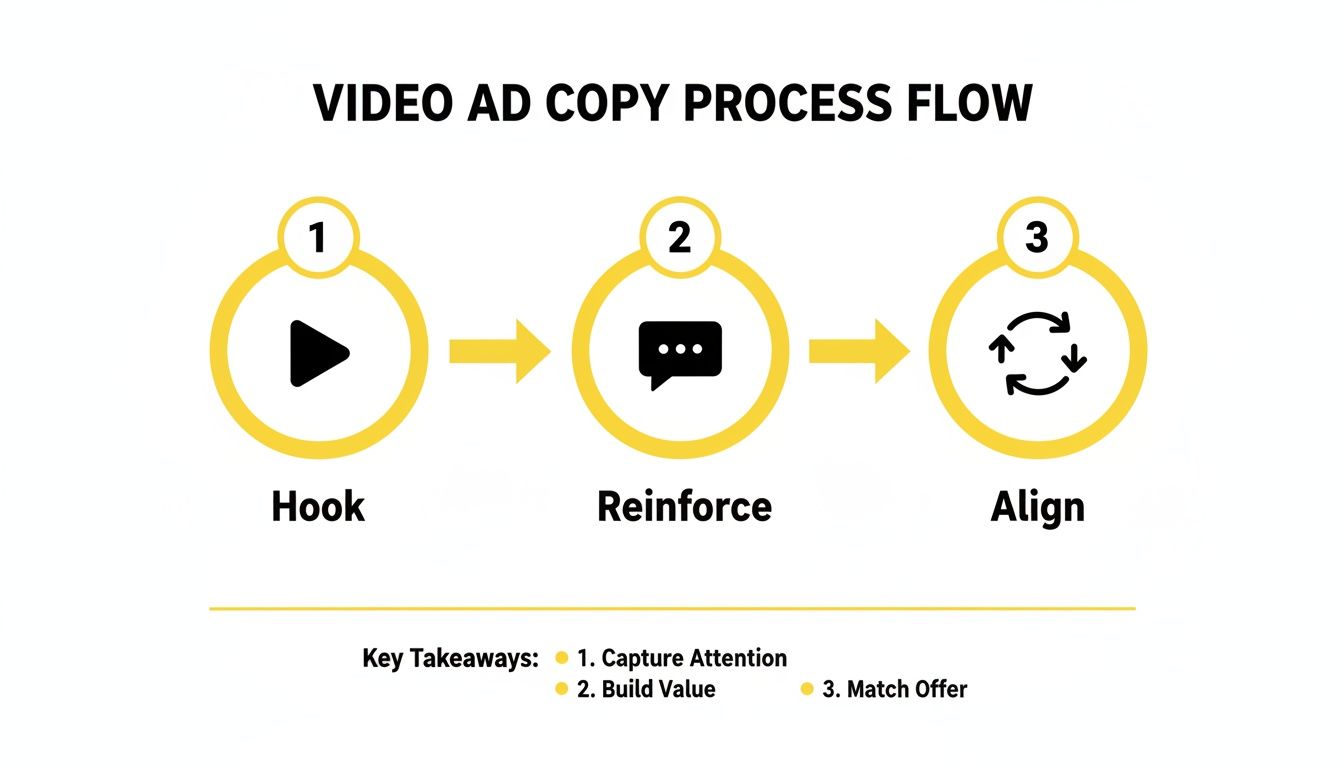
Each stage has to logically lead to the next, creating a seamless experience for the viewer that feels intuitive, not jarring.
Knowing When You Have a Winner
Don't jump to conclusions after just a day or two of data. Making decisions too early is a classic mistake. You need to wait for a statistically significant result before you can confidently declare a winner.
So what does that look like? While the exact numbers depend on your budget, here are some solid guidelines:
Let it run for at least 3-5 days. This helps you get past initial daily fluctuations in performance.
Aim for at least 1,000 impressions per ad variation. This gives the algorithm enough data to start optimizing.
Look for a clear performance gap. A winner should be outperforming the loser by at least 15-20% on your key metric, like Cost Per Result or Click-Through Rate.
If the results are too close to call, it often means both variations are equally effective (or ineffective). In that case, you can either pick one or conclude the element you tested wasn't a major driver of performance and move on to testing something else. For a deeper dive into improving campaign results, there's some great guidance on how to test a Facebook ad effectively.
Key Takeaway: Testing isn't a one-time event; it's a continuous process of refinement. Every test, whether it wins or loses, provides a valuable lesson about your audience that makes your next ad stronger.
How to Iterate on a Winning Ad
Once you’ve found a winning piece of ad copy, your job isn't done. The next step is to iterate on it to see if you can make it even better.
This is where you build on your success. Take your winning ad and use it as the new "control" or baseline. Now, start the process over by testing a different variable. If your winning ad was built on a hook that used a surprising statistic, could you make it even more powerful by testing a new headline that leverages social proof?
This iterative process of Test > Analyze > Iterate is the engine of sustainable growth. It turns advertising from a gamble into a science, allowing you to consistently refine your messaging and improve your results over time.
Common Questions About Facebook Ad Copywriting
Even with a solid framework in hand, you're going to have questions pop up when you're in the trenches writing ads. Let’s tackle some of the most common ones I hear from advertisers, day in and day out.
How Long Should My Facebook Ad Copy Be?
Honestly, there's no magic number. The "right" length comes down to your offer, who you're talking to, and how much heavy lifting your copy needs to do before they'll even consider clicking.
If you’re running a simple sale for a popular e-commerce product, short and punchy usually wins. We're talking two to three sharp sentences that cut right to the chase. But for something more complex or high-ticket—like a coaching program or a new SaaS tool—you'll likely need longer-form copy. You need that extra space to handle objections, build massive value, and tell a story that pulls people in.
My best advice? Test it. Run a short, snappy version against a longer, more detailed one and let your audience's clicks tell you what they prefer. Always prioritize getting the value across clearly, not hitting some arbitrary word count.
How Many Ad Copy Variations Should I Test at Once?
If you want clean, reliable data you can actually learn from, you have to be disciplined. A great place to start is testing two or three different hooks—that's your first line—while keeping the body, headline, and CTA exactly the same across all versions.
Once you find a clear winner, lock it in. Then you can move on to testing two or three headlines or CTAs against that proven hook. The biggest mistake I see is people testing way too many things at once, especially on a tight budget. It spreads your data so thin that it's impossible to know which specific change actually moved the needle.
Key Insight: The point of testing isn't just to find a winning ad. It's to understand why it won. Isolating your variables is the only way you’ll gain real insights into the messaging that truly connects with your customers.
Can I Use AI to Write My Facebook Ad Copy?
Absolutely. AI can be a phenomenal assistant for brainstorming and getting those first drafts down, but it's not ready to take over the strategy just yet. Use it to spit out a dozen different hooks, find new angles for your product benefits, or generate headline ideas you hadn't thought of.
But here’s the non-negotiable part: a skilled human copywriter must review, edit, and inject life into whatever the AI produces. That's how you ensure the copy actually sounds like your brand, speaks to real customer pain points, and follows proven direct-response principles. The most explosive results I've seen come from combining AI's raw speed with a human's strategic mind and emotional intelligence.
What Are the Most Common Mistakes in Facebook Ad Copy?
So many advertisers fall into the same handful of traps. Just by avoiding these, you'll immediately be ahead of 90% of your competition.
Talking features, not benefits: Nobody cares what your product does. They care what it does for them.
A weak, generic Call to Action: "Click Here" is lazy. "Get Your Free Quote" or "Claim Your 50% Off" gives a clear, compelling reason to act.
The ad-to-lander mismatch: The promise you make in your ad copy has to be the very first thing people see on your landing page. If it's not, you've broken their trust instantly.
Forgetting to call out the audience: Your first line should act like a magnet for your ideal customer. If you don't signal who the ad is for, the right people will scroll right past it.
Sidestep these common blunders, and your ad copy will instantly become clearer, more persuasive, and a whole lot more effective at driving the results you’re after.
Ready to stop guessing and start scaling with a data-driven ads strategy? Wojo Media bolts onto your business to optimize your offers, landing pages, and omnipresent ad campaigns for predictable, profitable growth. Book a free demo call to get a custom paid ads strategy built for your business. Learn more at https://www.thewojomedia.com.
Comments