.png)
Lead Generation for Real Estate Agents Your Growth Blueprint

Effective lead generation is the lifeblood of any real estate business. It's the system you build to attract and convert potential buyers and sellers into actual, signed clients. But today, that means more than just a bus bench ad. It requires a savvy, multi-platform strategy that pulls together compelling offers, sharp landing pages, and a constant advertising presence across social media and search engines. The goal? A predictable flow of business you can count on.
The Modern Blueprint For Real Estate Lead Generation
Let’s be honest, the old playbook of just relying on referrals and open houses is showing its age. While those tactics still have a pulse, today’s market demands a much more powerful and scalable system. The top agents aren't just getting lucky; they've built an engine that consistently brings in motivated buyer and seller leads, leaving behind the inconsistent, "spray and pray" methods of the past.
This modern blueprint is built on four core pillars that work in tandem to guide a potential client from stranger to closing day.
This isn’t just about being online; it’s about being everywhere your clients are. Your ideal seller is scrolling through TikTok one minute and browsing homes on Zillow the next. A killer strategy meets them in those moments, building familiarity and trust long before they’re even thinking about listing.
Core Pillars of a Scalable System
To build a pipeline that doesn't run dry, you have to stop chasing one-off leads and start engineering a complete system. It’s about mastering a few key components that feed into each other, creating a powerful flywheel that propels your business forward.
Here's what that looks like on the ground:
Compelling Offers: Ditch the generic "Free Home Valuation." Think bigger. Modern offers give real value, like exclusive access to off-market properties or a deep-dive report on neighborhood sales trends.
High-Converting Landing Pages: Your ads are worthless if they send people to a clunky, confusing website. You need a dedicated landing page with one single job: to capture their info. It has to be simple, fast, and look great on a phone.
Targeted Ad Campaigns: This is how you find your people. By running strategic ads across platforms like Facebook, Instagram, Google, and YouTube, you can catch the attention of both casual browsers and serious, high-intent searchers.
Smart Optimization and Follow-Up: The data doesn't lie. Tracking what works allows you to pour gas on the fire, while automated follow-up ensures no lead ever falls through the cracks again.
The real game-changer in modern real estate lead gen isn't some magic bullet. It’s about building an interconnected ecosystem where your Facebook ads boost your Google presence, which in turn makes your YouTube videos more effective. It all works together to create a consistent, reliable stream of new business.
Why an Omnipresent Strategy Wins
Picture this: a potential seller sees your ad on Facebook while scrolling during their lunch break. A week later, they’re on Google searching for "best real estate agents in [Your City]," and your name pops up again. That weekend, they're on YouTube and see one of your client testimonial videos.
Each touchpoint builds on the last, cementing your authority and expertise in their mind. This is how you become the obvious, go-to agent in your market.
This guide will walk you through building this exact system, step by step. We'll cover everything from crafting offers people can't refuse to launching omnipresent ad funnels and tracking the numbers that actually move the needle. The whole point is to turn your marketing from an unpredictable expense into your most reliable driver of growth, no matter what the market is doing.
Crafting Offers And Landing Pages That Convert
Your ads are only the beginning of the conversation. The real test of your lead gen system happens the moment someone clicks. Where they land—and what you offer them—is what separates a valuable new lead from just another website bounce. This is where a killer offer and a frictionless landing page become absolutely non-negotiable.
First, let's talk about the offer. The classic "Free Home Valuation" has been run into the ground. It’s lost its punch. To genuinely grab someone's attention today, you need to put something on the table with a much higher perceived value—something that solves a real problem or gives them information they can't get just anywhere. It’s a shift from a generic promise to a unique, tangible hook.
Moving Beyond The Generic Offer
Get inside the head of your ideal clients. What are they actually worried about or curious about? A first-time homebuyer isn't losing sleep over the same things as a seller looking to downsize, and your offer needs to reflect that.
Here are a few high-value offers that get clicks:
For Sellers: Instead of a simple valuation, try a "Neighborhood Equity Report." It sounds more official and delivers a detailed breakdown of recent sales, average days on market, and list-to-sale price ratios right in their specific area.
For Buyers: An offer for a "Hidden Off-Market Properties List" is pure gold. It creates a sense of exclusivity and urgency. Buyers are always looking for an edge, and getting access to properties that aren't on Zillow yet is a massive motivator.
For Niche Audiences: Get specific. Create a guide like the "First-Time Homebuyer's Down Payment Assistance Guide" for your city or a "Complete Pre-Inspection Checklist for Sellers."
The whole point is to provide genuine value right out of the gate. This builds immediate trust and positions you as the local expert before you even think about asking for their business.
Building The Perfect Real Estate Landing Page
Once you’ve got an irresistible offer, you need a dedicated place to send all that traffic. And no, it’s not your homepage. Before you start building, it's critical to nail the basics by understanding what a landing page is. Its only job is to convert a visitor into a lead by getting them to take one specific action: download your offer.
A high-converting landing page is clean, focused, and loads lightning-fast, especially on mobile, where most of your audience will see it.
Key Takeaway: Your landing page has one job: capture the lead. Kill all distractions. That means no navigation bar, no links to other pages, and no social media icons. Every single element must guide the user toward that form.
Your headline is the first thing they'll see. It has to instantly confirm they're in the right place by echoing the promise from your ad. If your Facebook ad promised a list of off-market homes, the headline should be something like, "Get Your Exclusive List of Off-Market Homes in [Your City] Now."
Below the headline, use a few concise bullet points to spell out the benefits of your offer. Don't just list features; tell them what's in it for them.
See homes before they hit the market.
Gain a serious advantage in a competitive market.
Access properties you won't find on any public sites.
Optimizing The Lead Capture Form
The final piece of the puzzle is the form itself. Keep it short. Seriously. For an initial lead magnet, a name and email are often all you need. You can always ask for a phone number on the "thank you" page or during your follow-up. Every extra field you add is another reason for them to leave.
This lean approach is crucial for agents working with tight budgets. A whopping 63.7% of real estate agents keep their monthly marketing spend under $1,000. They have to make every click count, which is why a high-converting landing page is so vital. It’s also why 63.8% of agents manage their own marketing—to control costs and keep a close eye on their funnels. You can find more insights like this in the 2025 Nationwide Real Estate Lead Generation Statistics on RealEstateBees.com.
Finally, sprinkle in some social proof. A short testimonial from a happy client or a quick mention of how many families you've helped can be incredibly powerful. This small addition reassures visitors that you’re a credible, effective agent, making them much more comfortable handing over their info. Put these pieces together, and you’ll have a landing page that works 24/7 to turn your ad clicks into qualified appointments.
Building Your Omnipresent Advertising Funnel
You've got a killer offer and a landing page that's ready to convert. Now, it's time to build the engine that actually drives your business: your advertising funnel.
An omnipresent ad funnel is your system for staying top-of-mind with ideal clients across every major platform they scroll through daily. This isn't just about boosting a post here and there. It’s a full-blown strategy to build authority and catch leads from every possible angle.
Think about it. Your target seller might see your new listing on Facebook, then search "best real estate agent in my area" on Google a few days later, and finally, watch one of your client testimonials pop up on YouTube. Each touchpoint reinforces your brand and solidifies you as the local expert they need to call.
This simple visual breaks down the powerful flow of turning a complete stranger into a qualified lead.
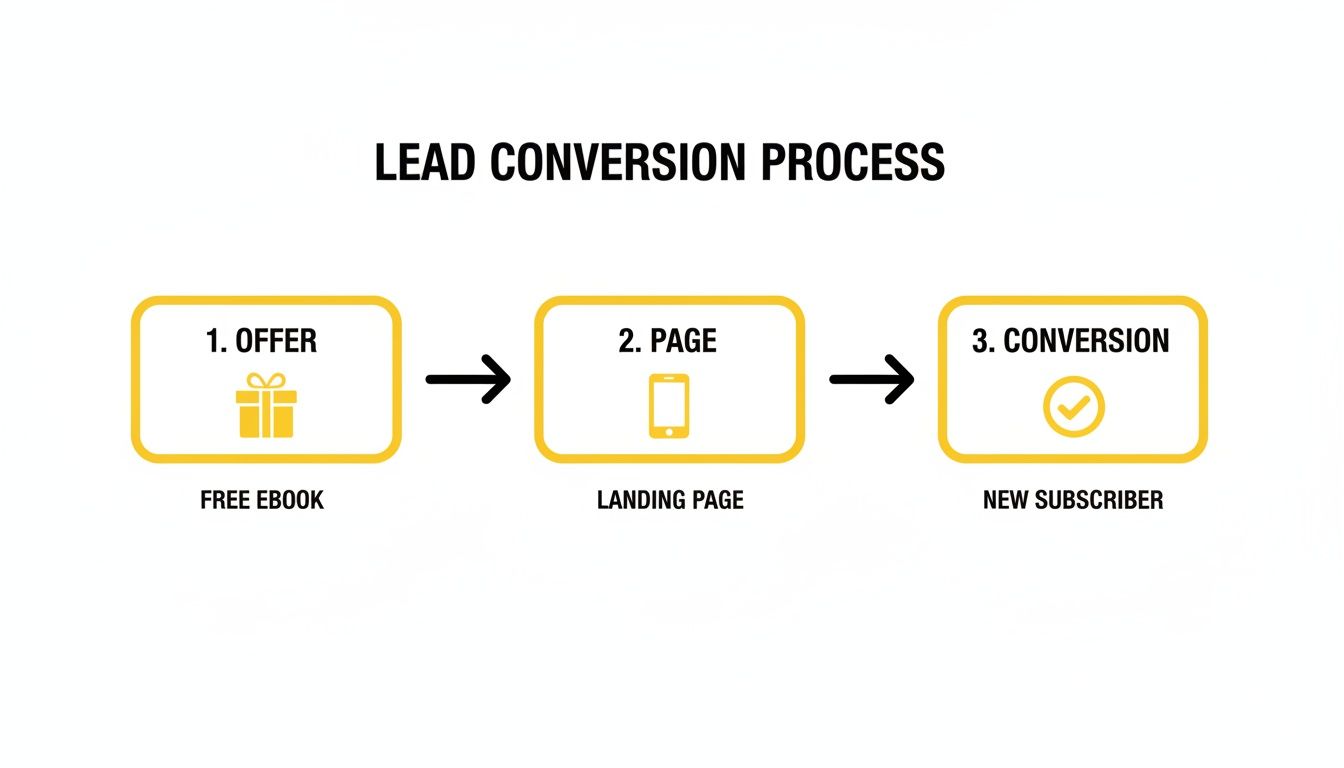
It all starts with a strong offer that pulls people to your landing page, where a smooth, no-friction experience turns them into a real, tangible lead for your business.
Choosing Your Core Advertising Platforms
While the goal is to be everywhere, you don't need to conquer every platform on day one. Start with the heavy hitters that give real estate agents the best bang for their buck.
Here’s a look at the "big four" and the unique role each plays in your funnel:
Facebook & Instagram: These are your visual powerhouses. They're perfect for showcasing stunning properties, sharing client success stories, and building a genuine community. The targeting is incredible—you can reach people based on demographics, interests (like Zillow or Realtor.com browsers), and even life events like getting married or having a kid.
Google & YouTube: This is where you capture pure, high-intent leads. When someone types "real estate agents in [Your City]" into Google, they're raising their hand for help. Search ads put you right at the top. Meanwhile, YouTube ads let you share neighborhood tours or market updates with an audience that’s already leaned in and watching.
TikTok: Don't sleep on short-form video. TikTok is a goldmine for authentic, behind-the-scenes content that builds your personal brand. Think quick property walkthroughs, market tip Q&As, or "day in the life" videos that make you a trusted, familiar face in your market.
Expert Tip: My advice? Start with Facebook and Instagram to build brand awareness and get leads flowing with your lead magnets. Once that's consistent, layer in Google Search ads to scoop up all the high-intent, "ready-to-go" prospects.
Deciding where to allocate your budget can feel overwhelming, so I've put together a quick cheat sheet to help you align your goals with the right platform.
Platform Strategy for Real Estate Ads
Platform | Primary Goal | Target Audience | Best Ad Format |
|---|---|---|---|
Facebook/Instagram | Brand Awareness & Lead Gen | Broad demographics, life events, interests (e.g., Zillow users) | Video Ads, Carousel Ads, Lead Forms |
Google Search | Capture High Intent | People actively searching for real estate services (e.g., "sell my home") | Text-based Search Ads |
YouTube | Build Authority & Nurture | Geographic targets, viewers of specific real estate channels | Skippable In-Stream Video Ads |
TikTok | Personal Branding & Engagement | Younger demographics, local community focus | Short-form vertical video (15-60 seconds) |
Each platform serves a purpose, from casting a wide net on social media to capturing ready-to-act clients on search engines. A balanced approach ensures you're not missing out on any part of the customer journey.
Hyper-Targeting Your Ideal Clients
The real magic of digital advertising is how laser-focused you can get. Forget spraying your message and praying it sticks. You can now speak directly to the exact people most likely to become your next clients. This precision is what separates the top producers from everyone else.
I always build my targeting strategy with three key layers:
Geographic Targeting: Go way beyond just your city. Zero in on specific zip codes or even drop a pin and target a one-mile radius around a new listing. This is perfect for "Just Listed" or "Just Sold" campaigns that hit the immediate neighborhood.
Custom Audiences: This is your secret weapon. Upload your database—past clients, old leads, your sphere—and run ads directly to them. It's an incredible way to generate referrals or warm up cold leads you haven't spoken to in a while.
Lookalike Audiences: Once you have a strong custom audience (like a list of your past sellers), you can ask platforms like Facebook to build a "lookalike" audience. The algorithm finds thousands of new people who share similar online behaviors and characteristics with your best clients. It's like cloning your perfect client.
Crafting Ad Creatives That Stop The Scroll
In a crowded feed, your ad has less than three seconds to grab attention. Blurry photos and generic copy just won't cut it anymore. Your creative is what earns the click.
Certain ad formats just plain work better for agents. Focus your energy here:
Carousel Ads: Perfect for showing off a new listing's best features or showcasing multiple properties at once. I always use the final card for a strong call-to-action or a picture of myself to build that personal connection.
Video Ads: Nothing beats video for property tours, client testimonials, and market updates. Keep them short and punchy (under 60 seconds) and always add captions—over 85% of social media videos are watched with the sound off.
Google Search Ads: For capturing those high-intent searches, your ad copy needs to mirror their exact query. If someone searches "sell my house fast," your headline better reflect that speed and urgency.
This multi-channel approach isn't just theory; the numbers back it up. We know that content marketing is three times more effective than old-school outbound methods, and agents who use marketing automation can see 451% more qualified leads.
In major markets where 97% of buyers start their home search online, having a targeted, omnipresent strategy across Meta, TikTok, and Google is the key to generating both volume and quality. If you want to dive deeper into the stats, you can find more on the power of multi-channel lead generation on Salesgenie.com.
Automating Follow-Up To Nurture Leads Effectively
Getting a new lead is a great feeling, but it’s just the first step. The real work—and honestly, where most agents drop the ball—is in the follow-up.
In a world of instant everything, speed isn't just an advantage; it's the whole game. Your ability to respond immediately is the single biggest factor that turns an online lead into a real, paying client.
This is where automation becomes your secret weapon. By setting up a system that engages new leads the second they come in, you can start building rapport and qualifying them before your competition even gets the notification. This system works for you 24/7, making sure no opportunity ever goes cold.
Capitalizing on The Golden Window
The first five minutes after a lead hits your system is what I call the "golden window." This is your moment of maximum impact. The prospect is actively thinking about real estate, they're online, and their interest is at its peak. Waiting even 30 minutes can slash your chances of ever connecting with them.
The data on this is staggering. Contacting a lead within five minutes makes them nine times more likely to convert. Think about that. With 96-100% of buyers now starting their search online, your response time is more critical than ever.
My Personal Tip: Ditch the email notifications. Set up an instant alert that sends every new lead directly to your phone as a text message. This bypasses any delays and puts the lead right in front of you, empowering you to call them back within that critical five-minute window.
Building Your Automated Follow-Up Machine
A powerful automated sequence doesn't need to be complicated. In fact, it's better if it isn't. It should feel personal and helpful, guiding the lead naturally toward a real conversation. The goal is to make an immediate, positive impression and pave the way for a phone call.
Here’s a simple but incredibly effective workflow you can build in your CRM:
Instant Automated SMS: The moment a lead comes in, fire off an automated text. This confirms you got their request and lets them know what’s next.
Immediate Lead Routing: At the same time, the lead's info should hit your phone with a clear notification to call them right now.
Enroll in a Nurture Campaign: If they don’t pick up that first call, the system should automatically enroll them in a long-term follow-up campaign with a mix of texts, emails, and maybe even video messages spread out over weeks or months.
To make sure no lead ever slips through the cracks, especially when you're busy, looking into AI solutions for real estate lead nurturing can be a game-changer for handling missed calls and automating those initial touchpoints.
Scripts That Build Instant Rapport
Automation gets your foot in the door, but you still need to build a human connection. Having a few proven scripts ready for that first touchpoint makes all the difference.
Example Initial SMS Script:
"Hi [First Name], it's [Your Name] with [Your Brokerage]. Just got your request for the off-market properties list. I'm putting that together for you now and will give you a quick call in about 2 minutes to make sure I send you the most relevant options. Talk soon!"
This text works perfectly because it’s not salesy. It sets a clear expectation and primes them for your call.
Example Initial Phone Call Opener:
"Hey [First Name], it's [Your Name] again. I just sent you a text. I'm finishing up that list of off-market homes for you now. Just wanted to quickly ask, are you looking for a specific neighborhood or price range so I can make sure this list is actually useful for you?"
This opener immediately shows you're there to provide value, not just to sell something.
CRM Best Practices For Long-Term Nurturing
Your CRM is the brain of this entire operation. To keep leads from getting lost in the shuffle, you need to keep it organized and put its features to work for you.
Lead Scoring: This is a total game-changer. Your CRM can automatically assign points to leads based on their actions. Opened an email? One point. Clicked a link to view a listing? Five points. This system helps you see your hottest, most engaged prospects at a glance so you can prioritize your time.
Building Smart Workflows: Create automated "if-then" workflows. For instance: IF a lead hasn't opened an email in 30 days, THEN automatically send them a "break-up" email asking if they're still in the market. This keeps your database clean and your efforts focused.
By combining the lightning speed of automation with the personal touch of a real conversation, you create a follow-up system that not only converts more leads today but also builds a pipeline of nurtured prospects ready to transact down the road.
Tracking KPIs To Scale Your Growth Predictably
Running ad campaigns without tracking the right data is like driving blind. You might be moving, but you have no idea if you're headed toward a cliff or a closing. If you want to turn your ad spend from a monthly expense into a predictable revenue machine, you have to measure what actually matters. This is where Key Performance Indicators (KPIs) come in, cutting through the noise to show you exactly what's working and what's not.
Forget vanity metrics like likes, shares, or page views. They might give you a warm fuzzy feeling, but they don't pay the bills. The whole point of this game is profitable growth, and that means focusing on the numbers that directly impact your bottom line.
By tracking a few core metrics, you can make data-driven decisions, kill losing campaigns without a second thought, and double down on your winners to scale predictably.
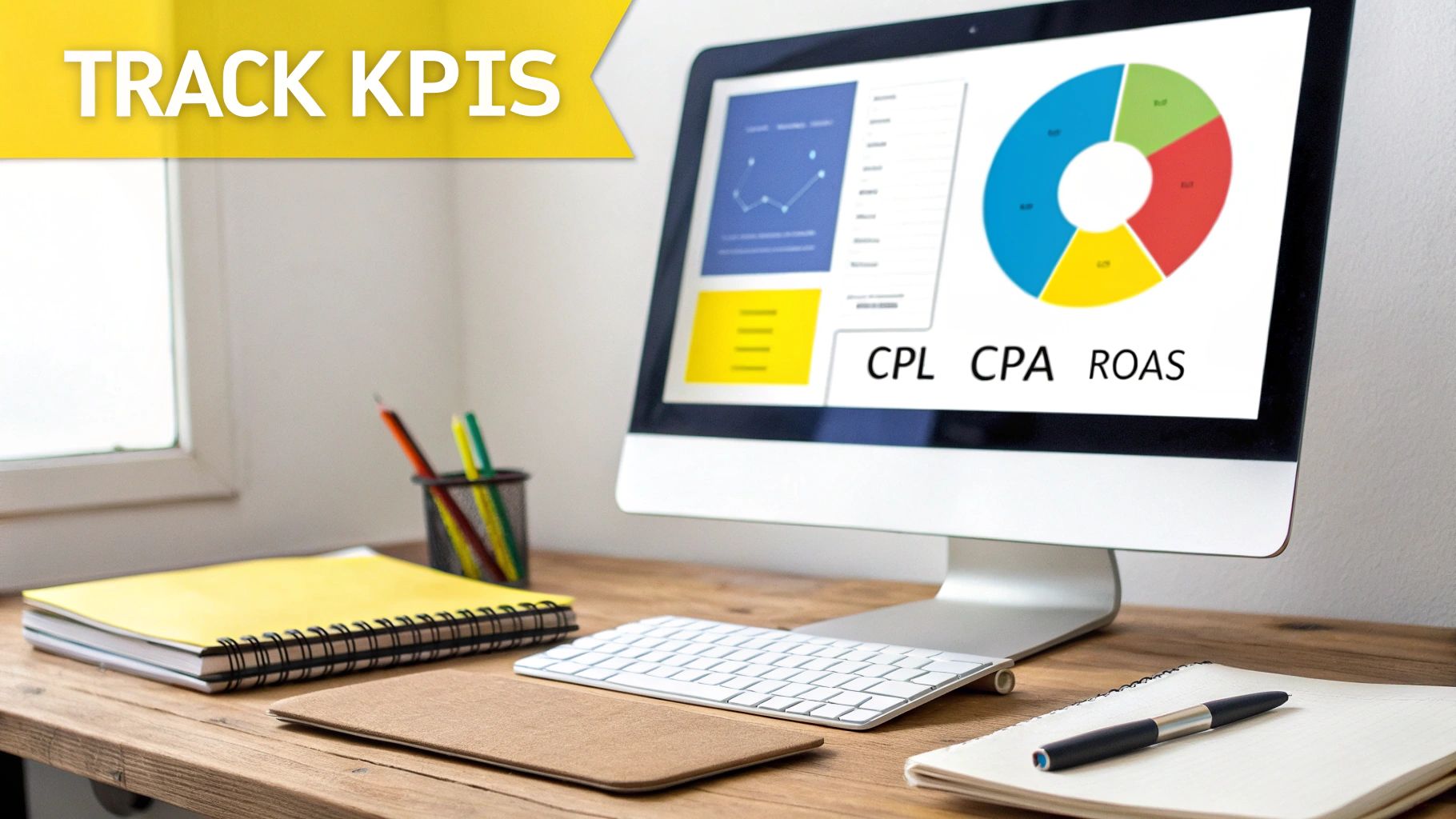
You don’t need to be a data scientist, either. It’s all about building a simple dashboard—even a basic spreadsheet works perfectly—to monitor the health of your funnel, from the very first ad click all the way to a closed deal.
Defining Your Core Funnel Metrics
To really get a grip on your campaign performance, you need to track metrics at each make-or-break stage of the client's journey. For real estate advertising, three KPIs stand head and shoulders above the rest. They give you a crystal-clear picture of your costs and your returns.
These are the numbers you should live and breathe:
Cost Per Lead (CPL): This is your most fundamental metric. You get it by dividing your total ad spend by the number of new leads you generated. Your CPL tells you exactly how efficiently you're turning ad dollars into new opportunities.
Cost Per Appointment (CPA): A lead is good, but an appointment is where the money is. This KPI measures how much it costs to get a qualified prospect to actually book a meeting with you. It’s a huge indicator of your lead quality and how effective your follow-up is.
Return on Ad Spend (ROAS): This is the ultimate scorecard. ROAS tells you how much gross commission income (GCI) you're generating for every single dollar you spend on ads. A 3x ROAS means for every $1 you spent, you made $3 back. Simple as that.
By keeping a close eye on these three KPIs, you’re officially done with guesswork. You can confidently answer the most important question in your business: "Is my marketing actually profitable?" This clarity is what gives you the confidence to pour more money into your campaigns, knowing it will come back multiplied.
Analyzing Data to Make Smart Decisions
Once you have your numbers, the real work begins. Your data tells a story about your ads, your landing pages, and your follow-up process. Learning to read that story is how you optimize your entire system for maximum profit.
Let’s look at a real-world example. Imagine you're running two different Facebook ads:
Ad A: Gets a $15 CPL. Sounds great, right? But only 1 in 20 leads ends up booking an appointment. That makes your Cost Per Appointment a whopping $300.
Ad B: Gets a $25 CPL. At first glance, it looks more expensive. But 1 in 5 of these leads books an appointment, bringing your Cost Per Appointment down to just $125.
See what happened? Ad A looked like the winner with its cheap leads, but when you dug just one level deeper, you saw that Ad B was wildly more profitable. It was generating higher-quality leads that converted to appointments way more efficiently. This is the kind of insight that separates the agents who are struggling from the ones who are scaling.
Building Your KPI Dashboard
You don’t need fancy, expensive software to get started. Honestly, a simple spreadsheet is all you need to build a powerful dashboard that gives you a daily snapshot of your business's health. This simple tool becomes your command center for all marketing decisions.
Below is a table that breaks down the most critical KPIs for any real estate agent running paid ads. Think of it as your cheat sheet for knowing what to track and why it matters.
Essential Real Estate Lead Generation KPIs
Key metrics to track at each stage of the funnel to measure campaign success and ensure a positive return on investment.
KPI | What It Measures | Industry Benchmark | How to Improve It |
|---|---|---|---|
Cost Per Lead (CPL) | The cost to acquire one new lead (name, email, phone). | $15 - $40 for buyer/seller leads on social media. | Test new ad copy/creative, refine audience targeting, improve your offer. |
Landing Page Conversion Rate | The percentage of visitors who become leads after clicking an ad. | 10% - 20%+ | A/B test headlines, simplify your form, add social proof (testimonials). |
Cost Per Appointment (CPA) | The total cost to get one qualified lead to book a meeting. | $100 - $300 | Improve your follow-up speed and scripts, use an automated ISA, send value-based emails. |
Appointment Show-Up Rate | The percentage of booked appointments that actually happen. | 70% - 85% | Send multiple reminders (email/SMS), confirm the day before, set a clear agenda. |
Return on Ad Spend (ROAS) | The gross commission generated for every dollar spent on ads. | 3x - 10x+ | Focus on high-intent leads, nurture long-term prospects, improve sales skills. |
Tracking these metrics isn't just about collecting data; it's about having the clarity to make confident decisions. It allows you to stop wasting money on underperforming ads and go all-in on the campaigns that consistently fill your calendar with qualified appointments.
Answering the Tough Questions About Real Estate Lead Gen
Jumping into a real lead generation system always brings up a few "what ifs" and "how to's." You've got the map, but now you have to actually drive the car. Let's get into the nitty-gritty questions agents always ask when they're ready to ditch the sporadic referral game for a predictable pipeline.
This isn't theory. These are the straight-up answers you need to set real expectations, spend your money wisely, and make smart moves from day one.
How Much Should I Really Budget for Ads When I'm Starting Out?
This is the big one, but the answer isn't as scary as you might think. You do not need a massive war chest to get this off the ground. In fact, starting small is the only smart way to play it.
For a solo agent, a realistic starting point is somewhere between $500 to $1,000 per month. That's enough cash to seriously test different ads, audiences, and offers on platforms like Facebook and Instagram without betting the farm. It lets you buy the data you need to figure out your Cost Per Lead (CPL) and see what actually makes people in your market click.
Think of your first couple of months as pure intel gathering. The goal isn't to sign ten new clients overnight. It's to understand your numbers. Once you find that winning combo that gives you a profitable Cost Per Appointment (CPA), then you can confidently pour more fuel on the fire.
Should I Go After Buyer or Seller Leads First?
Ah, the classic dilemma. Seller leads are the holy grail, right? They can mean a double-ended deal—the sale and their next purchase. But they’re also way more competitive and, frankly, more expensive to get.
If you’re newer to the game or just firing up your ad machine, start with buyer leads. It's the perfect entry point. They're easier to find and cost less to acquire. A simple campaign for a "First-Time Homebuyer Guide" or a "List of Homes Under $500k" will get your phone ringing, fill your pipeline, and help you build momentum and cash flow.
My Take: Get your reps in with buyer leads first. Once you've got a proven system for turning them into appointments and closings, you can take everything you learned and apply it to the tougher seller lead market. This lets you build a self-funding growth engine.
How Long Until I Actually See Consistent Results?
Patience is everything here. You can literally start generating leads within 24-48 hours of launching a campaign, but turning a list of names into a steady stream of commission checks is a different story. It's a marathon, not a sprint.
Here’s a realistic timeline to keep in mind:
Months 1-3: This is your lab. You're testing, tweaking, and optimizing everything. You'll get leads, sure, but you're mainly refining your follow-up scripts and dialing in your key numbers. You might even close a deal, but the real win here is the data.
Months 4-6: By now, things should start to click. You’ll have a much clearer idea of what works. Your CPL and CPA will stabilize, and you should be setting appointments consistently. Your follow-up machine should be humming along.
Months 6+: This is where the magic happens. With a solid foundation and months of nurturing, those leads from your first few campaigns will start converting. You'll finally have that predictable system you can scale with total confidence.
Building a lead generation machine is a serious investment in your business's future. It takes a plan, consistent effort, and a willingness to look at the numbers. But once you build it, it becomes your single most valuable asset.
Ready to stop guessing and start scaling with a predictable advertising system? The team at Wojo Media bolts onto your real estate business to build and manage omnipresent ad campaigns that deliver consistent, high-quality leads. Book a free strategy call today to see how we can fill your calendar.
Comments