.png)
Master the High Ticket Close and Seal Bigger Deals

Closing a high-ticket client can feel like the final, nail-biting scene of a movie. But the truth is, a successful high ticket close isn’t about some slick, last-minute maneuver or a dose of aggressive sales tactics. It's simply the last, most logical step in a journey you've carefully built on a foundation of trust and undeniable value.
Why Most High Ticket Sales Fall Apart
Let’s be real. The word "closing" itself brings up images of sweaty-palmed salesmen pushing for a signature, using cheesy lines from a script. Too many founders and sales pros treat the close as this one dramatic, make-or-break moment.
That’s exactly why most high-ticket sales fail.
The deal was lost long before the final ask. The foundation was shaky from the start, or maybe it was never built at all. A solid high-ticket close isn’t an event; it's the natural conclusion of a rock-solid system. When a prospect feels like you truly get them—and they believe your offer is the clearest, most direct path to solving their problem—the "close" is just a formality.
The real work happens way before you ever talk about money.
This whole journey can be mapped out. It’s a simple, predictable flow. At its core, a successful high-ticket sales process has three pillars: attract the right people, consult with them to uncover the real problem, and then close as a final agreement.
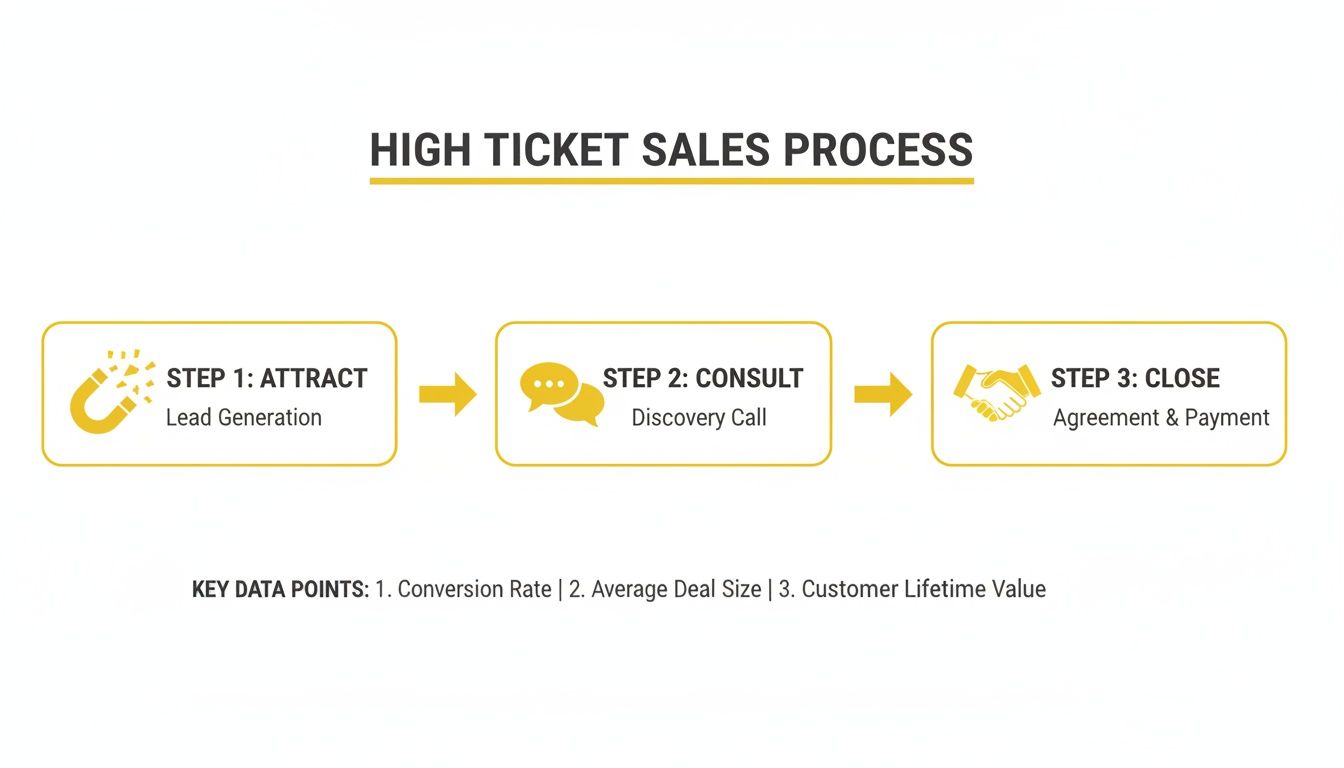
See how closing is the result? It’s what happens when you nail the attraction and consultation stages. Get those first two parts right, and this final step feels almost effortless.
Shifting from Seller to Advisor
The single biggest mindset shift you need to make is moving from a seller to a trusted advisor. A seller pushes a product. An advisor diagnoses a problem and prescribes a solution. Your prospect doesn't want to be sold; they want their pain to go away. By taking a consultative approach, you completely flip the script on the entire interaction.
What does that actually look like?
Deep Listening: You're more focused on understanding their world than on rattling off your pitch. You're listening to what they say—and what they don't.
Problem Diagnosis: You ask sharp, insightful questions to get to the root cause of their issues, not just the surface-level symptoms.
Solution Framing: You position your offer as the specific remedy for their diagnosed problem, not just a laundry list of features and benefits.
The moment you stop trying to sell and start trying to solve, everything changes. Prospects let their guard down. They start seeing you as an ally, and the final decision becomes a collaboration, not a confrontation.
This guide is your roadmap to building that system. I'll walk you through the exact tactics for each stage—from running ad campaigns that bring in qualified leads to confidently navigating the sales call itself. Predictable growth comes from a reliable system, not from charisma or luck. The goal is to make saying "yes" the easiest, most logical decision your prospect makes all day.
Qualifying Leads Before the First Call
A winning high-ticket close is decided long before you ever ask for the sale. The best closers I know aren't masters of persuasion; they're expert diagnosticians. That entire process kicks off with a rock-solid qualification system that weeds out the tire-kickers and only lets serious, motivated buyers get on your calendar.
Your time is your single most valuable asset in this game. Burning hours on calls with unqualified prospects is a fast track to burnout and a rollercoaster of revenue. The goal here is simple: make every conversation count by ensuring the person on the other end is already looking for the exact solution you provide.
Designing a Bulletproof Application Form
Your first line of defense is a strategically designed application or intake form. This is way more than just a tool to grab a name and email. It’s a filter designed to screen for real intent, budget, and—critically—decision-making power.
Think of your form as a velvet rope. It subtly communicates that your time is valuable and this isn't some casual inquiry. You need to include questions that require actual thought, forcing applicants to pause and reflect on their problems and what they’re trying to accomplish.
Here are a few questions that do the heavy lifting:
What's the single biggest challenge you're facing right now with [their specific problem area]? This cuts right to the chase and tells you how self-aware they are about their pain.
What have you already tried to solve this problem? Their answer reveals whether they're proactive and have already invested time or money, which is a huge buying signal.
On a scale of 1-10, how committed are you to solving this problem in the next 90 days? No ambiguity here. You're directly asking for their commitment level.
Are you the primary decision-maker for this investment? This simple question saves you from pitching an employee who can't actually say "yes."
This kind of pre-call filtration does more than just protect your calendar. It immediately frames you as a selective expert, which bumps up your perceived value before you even say hello.
Mastering the Diagnostic Discovery Call
Once a qualified lead books a call, your job shifts from gatekeeper to diagnostician. Let me be clear: the purpose of a discovery call is not to pitch your services. It’s to go deep into the prospect's world, truly understand their core pain points, and help them see for themselves the massive cost of doing nothing.
You need to be the one guiding the conversation with sharp, insightful questions. Your prospect should do most of the talking. A good target to aim for is an 80/20 split—they talk 80% of the time, you talk 20%.
A master closer doesn't sell; they lead the prospect to their own conclusion that your solution is the only logical next step. The discovery call is your platform for this guided journey.
The data backs this up, especially as the price tag gets bigger. Deals under $10,000 close at a rate of 25.73%, but that number plummets to just 9.09% for deals over $5 million. It's precisely why businesses from e-commerce to coaching rely on agencies like Wojo Media to get their funnels dialed in before the call. In that sweet spot of $10,000–$50,000, where many service packages live, the conversion rate is 21.81%, often driven by referrals. You can dig deeper into these average sales call conversion rates to see how you stack up.
Guiding the Conversation with a Framework
Ditch the rigid script. Instead, use a flexible framework that guides the conversation naturally. This lets you adapt to what the prospect is telling you while making sure you get all the information you need to position your offer perfectly.
A Proven Discovery Call Framework:
Build Rapport & Set the Agenda: Kick things off with a genuine connection, then clearly state the goal of the call: to see if you can actually help them and if it's a good fit for both of you.
Uncover the Problem: Ask open-ended questions about their current mess. Something like, "Can you walk me through what's happening right now with [their challenge]?" works wonders.
Quantify the Pain: This is where the magic happens. You have to help them attach a real number to their problem. Ask questions like, "What is this issue costing you each month, whether in lost revenue, wasted time, or just pure stress?"
Paint the Future State: Now, pivot to their desired outcome. "If we were talking a year from now, what would need to have happened for you to feel absolutely incredible about your progress?"
Bridge the Gap: Once they have a crystal-clear picture of their current pain (Point A) and their desired future (Point B), you can position your offer as the most direct and effective bridge to get them from one to the other.
When you use this diagnostic method, the prospect feels deeply heard and understood. It completely changes the dynamic from a pushy sales pitch into a collaborative strategy session, making the final high-ticket close feel like the most natural thing in the world.
Building an Irresistible High Ticket Offer
You've spent the call diagnosing their core problem, and now you've arrived at the moment that makes or breaks the deal: presenting your offer. This isn't the time to rattle off a list of features or deliverables. A genuine high ticket close is all about framing your solution as an undeniable transformation—a complete package that makes their desired future feel not just possible, but completely inevitable.

Your goal is to construct an offer so compelling that the price becomes an afterthought. You get there by stacking so much value that the investment seems small in comparison. The prospect should walk away feeling like they're getting an absolute steal, to the point where saying "no" would feel like a bad business decision.
From Features to a Complete Transformation
Stop selling your service; start selling the outcome. Seriously. Nobody buys coaching calls, ad campaigns, or consulting hours. They buy a future where their biggest, most frustrating business problem is gone.
Instead of just listing what they get, you need to frame it as a journey. Your offer is simply the vehicle that takes them from their current state of pain (Point A) to their desired state of success (Point B)—something you should have nailed down completely during discovery.
Let's look at a quick example:
What most people say: "You get 12 weekly coaching calls and access to my online portal."
What you should say: "We'll work together over the next 90 days to completely overhaul your client acquisition system. I’ll personally guide you each week to install the exact process that will double your qualified leads, and you’ll have my full support system to ensure you hit that goal."
See the difference? One is a list of parts. The other is a complete, tangible solution.
The Psychology of Value Stacking with Bonuses
Bonuses aren't just random, nice-to-have add-ons. They're strategic tools you use to eliminate friction and crank up the perceived value of your core offer. Every bonus should solve a potential "next problem" the client might run into, making your package feel even more comprehensive.
An irresistible offer is one where the stacked value of the bonuses alone feels like it's worth more than the total price. This psychological anchor makes the investment decision significantly easier for the prospect.
Effective bonuses aren't fluff. They're practical tools like:
Done-for-you templates that save them countless hours.
A mini-course on a complementary skill they'll need down the road.
Direct access to you via a private channel for quick, on-the-fly questions.
By giving each bonus a name and a real-world monetary value, you can visually stack the total value against your asking price. Suddenly, the investment looks a lot smaller.
Stating Your Price with Unshakeable Confidence
Alright, this is it. The moment of truth. How you state your price is just as important as the number itself. Your tone, your posture, your language—it all has to scream confidence in the value you deliver. If you hesitate for even a second, you're signaling to the prospect that you might not believe it's worth it.
State the price clearly and simply. Then, stop talking.
This is critical. Let the silence hang in the air. It gives the prospect space to process the number and respond. Don't immediately jump in to justify it or soften the blow.
Here’s a simple script that works:
"So, the total investment to completely solve this problem and get you to [desired outcome] is just one payment of ten thousand dollars. Does that sound fair?"
Calling it an "investment" instead of a "cost" and asking "Does that sound fair?" is a low-pressure way to move to the close. It feels collaborative, not confrontational. The price is anchored to the massive value you've spent the entire call building up, which makes sticker shock far less likely. To truly master the art of the high ticket close, it's crucial to ensure your offer is not only irresistible but also presented compellingly. This article provides valuable insights on how to effectively present your offer and turn prospects into clients.
Turning Objections into Closing Opportunities
Let’s get one thing straight: an objection isn’t a rejection. It’s a request for more information. It's a sign that your prospect is engaged but needs a little more convincing. I’ve seen countless salespeople freeze up when they hear an objection, but the top closers? They lean in. They see it as an opening.
When a prospect tells you, "I need to think about it," or "That's a bit more than I was expecting to spend," they're not slamming the door in your face. They're actually handing you a map to their deepest uncertainties. Your job isn't to argue, but to listen, validate their concern, and then confidently steer them back to the value you’ve already built. In these moments, poise is your greatest weapon.
The Feel, Felt, Found Framework
One of the most powerful, yet disarmingly simple, ways to handle almost any objection is what’s known as the "Feel, Felt, Found" method. It’s a three-step technique that shows you're listening and builds a bridge from their doubt to a place of confidence.
Here’s the breakdown:
Feel: First, you acknowledge and validate their concern. "I completely understand how you feel." This simple phrase immediately lowers their guard and shows you’re on their side, not against them.
Felt: Next, you connect their feeling to a relatable story. "You know, some of my most successful clients felt the exact same way before they started." This normalizes their hesitation—they’re not the only one who has had this thought.
Found: Finally, you pivot to the outcome. "But what they found was that once they implemented the system, the ROI they saw made that initial investment feel like a no-brainer." This re-frames the entire conversation around results, not cost.
This isn't about being slick. It's about genuine empathy and guiding them to a new perspective based on proven success.
Uncovering the Real Objection
Here's a hard-earned lesson: the first objection you hear is almost never the real one. "It's too expensive" is often just a smokescreen for, "I'm not convinced this will actually work for me." Your mission is to gently probe past the surface-level excuse to find the root of the problem.
A killer question I always use is: "Putting the investment aside for a moment, does this sound like the exact solution you need to finally solve [their specific problem]?"
This question is brilliant for two reasons. It temporarily takes money off the table, allowing you to confirm you've actually sold them on the value of the solution. If they say "yes," you know the only thing left to discuss is the price. If they hesitate or say "no," you've just uncovered a deeper issue with the offer itself, and now you know exactly where to refocus the conversation.
This is a classic trial close. You’re not asking for the sale, you’re just taking their temperature. Sprinkling these low-pressure check-ins throughout your call makes the final ask feel like a natural next step, not a high-stakes confrontation.
Handling the Most Common High-Ticket Objections
Frameworks are great, but you need to have a few responses locked and loaded for the objections you'll hear over and over again. Here’s a quick-reference guide for turning those common roadblocks into open doors.
Common Objections and Strategic Responses
Common Objection | Underlying Fear | Strategic Response Framework |
|---|---|---|
"It's too expensive." | Fear of not getting a return on investment (ROI). | "I hear you. When you say expensive, what are you comparing it to? If we could prove this would solve [major pain point] and generate [specific result], would it still feel that way?" |
"I need to talk to my partner/spouse." | Fear of making a major decision alone or lack of authority. | "That makes perfect sense. What specific part of this do you think they'll be most excited about, and what questions do you think they'll have that I can help you prepare for?" |
"I need to think about it." | Fear of making the wrong choice; a general feeling of uncertainty. | "Absolutely. When I hear that, it usually means there's one specific part that's still a little unclear. Is it the investment, the timing, or your confidence that this will get you the results?" |
"Now isn't the right time." | Fear of commitment or being overwhelmed. | "I understand. What would need to happen for it to be the right time? Let’s be real for a second—what's the cost of this problem still being here in another six months?" |
This strategic approach to objection handling is what separates the pros from the amateurs. In the high-stakes world of high-ticket sales, the gold standard is hitting a 50% close rate on your qualified calls. That means for every two real prospects you get on the phone with, one becomes a client.
This isn't just a fantasy number; it's the battle-tested math from closers who have mastered this process. Top-tier sales training programs have shown that using proven frameworks to address pain points can double close rates from the industry average of 20-25%. You can see more on how elite closers achieve these metrics by checking out this comprehensive high ticket closing guide.
Creating Ad Funnels That Deliver Ready-to-Buy Leads
Even the best closer in the world can't save a pipeline full of unqualified, unmotivated leads. A successful high-ticket close doesn’t kick off when you jump on a Zoom call; it starts the second a prospect lays eyes on your ad.
The real secret is building a bridge between your marketing and sales. You need an ad funnel that delivers people who are already warmed up and practically sold on your value before they ever speak to you.

This isn’t about chasing cheap clicks or packing your calendar with as many appointments as possible. It's a game of quality over quantity. The goal is to attract the right people and prime them at every single touchpoint, from the ad creative all the way to the landing page. Your marketing should do the heavy lifting long before a call is ever booked.
Scripting Ad Creative That Filters and Persuades
Your ad has two jobs, and they're equally important: pull in your ideal client and push away everyone else. For high-ticket offers, that means leading with the problem and the promise—not just a slick graphic.
Your ad copy and video scripts need to speak directly to the deep-seated pain points you’ve already uncovered in your market research.
Get specific. "Grow your business" is vague and weak. Instead, try something like, "Add an extra $30k in monthly recurring revenue without logging more hours." That kind of specificity acts like a homing beacon for your target audience and makes you invisible to those who aren't a good fit.
The ad also has to set expectations. It should hint at a premium, in-depth solution, which subtly weeds out the prospects just looking for a cheap, quick fix. Getting this pre-framing right is absolutely critical for a smooth sales conversation later.
Designing Landing Pages That Build Trust
Once someone clicks your ad, the landing page has to pick up the conversation without missing a beat. Its only job is to turn that flicker of interest into a booked call by building unshakable trust and showing off your authority.
Every high-converting landing page needs these key elements:
A Clear Headline: Immediately repeat the core promise from your ad. This tells them they’re in the right place.
Social Proof: This is non-negotiable. Plaster your page with case studies, video testimonials, and client logos. High-ticket buyers are naturally risk-averse; they need to see you’ve gotten results for people just like them.
Value-Driven Copy: Talk about the outcome, not the process. Forget the features and focus on the transformation they’ll experience.
A Simple Call to Action (CTA): Make booking a call ridiculously easy. Use clear, direct language like, "Book Your Free Strategy Call."
To keep your pipeline from running dry, you have to implement effective lead generation strategies that consistently bring in new prospects. This is how you make sure the funnel is always full of high-potential leads.
Automation gets attention. Personalization gets the sale. Your ad funnel is designed to automate the attention-grabbing part, so you can focus your personal energy on closing highly qualified, pre-sold leads.
The data tells a clear story. Standard e-commerce conversion rates for high-ticket items are pretty dismal, hovering between 0.5% and 1.5%. But funnels built around a consultation call? They perform dramatically better. Referral traffic, for instance, often converts around 5.4%, while social media traffic is much lower at 0.7%. This just hammers home the importance of building trust across multiple platforms before the call ever happens.
Aligning Price Expectations Before the Call
Sticker shock is one of the fastest ways to kill a high-ticket deal. You can get ahead of this by framing your offer's value properly from the very beginning. While you don't need to slap a price tag on your ad, your marketing absolutely must communicate that this is a premium, comprehensive solution.
Use language that implies a serious investment, like "our premier coaching program" or "a complete done-for-you service." The whole vibe of your ads and landing page—from the professional design and high-quality videos to the powerful testimonials—signals a high-value offer.
When a prospect shows up to the call already understanding they're considering a significant investment, the conversation changes. It shifts from, "Can I afford this?" to "Is this the right solution to get me where I want to go?" Getting that alignment right is the key to sidestepping price objections and creating a seamless journey from the very first click to a confidently closed deal.
Got Questions About High-Ticket Closing? We've Got Answers.
When you're dealing with high-value sales, a lot of questions come up. It's only natural. Whether you're trying to dial in your current process or just getting started, having straight answers to the most common sticking points can give you the confidence you need to close the deal.
Let's cut through the noise. Here are the direct, no-fluff answers to the questions we hear all the time.
What's the Single Biggest Mistake People Make When Closing a High-Ticket Deal?
Easy. They pitch features instead of selling a transformation.
When a prospect is about to make a significant investment, they aren't buying a list of services or deliverables. They're buying an outcome. They're paying for a solution to a problem that's causing them real pain, and they want a bridge to get them to a much better future.
The moment you start listing features—"you get 12 coaching calls and a workbook"—you turn your offer into a commodity. But when you focus on the transformation—"you get the exact system to land five new clients every month"—you're selling a result they can't put a price on.
Another huge error? Showing even a flicker of hesitation when you state the price. If you sound like you don't believe in your own value, why should they? It instantly shatters their trust.
How Long Should a High-Ticket Sales Call Actually Last?
There's no magic number, but the sweet spot for most effective calls is between 45 and 75 minutes. The real key isn't to stare at the clock, but to take whatever time is necessary to get to the root of their problem and build an undeniable case for your solution.
Rushing through the discovery phase is the fastest way to lose a sale. If you've done your job and properly qualified the lead beforehand, they’ll be more than willing to invest the time. After all, they’re looking for a real solution to a problem that's already costing them a fortune in time, money, or stress.
A rushed call feels transactional. A thorough, unhurried conversation feels like a strategic consultation, building the trust needed for a significant investment.
Your goal is depth, not speed. A short call that completely misses the mark is useless compared to a longer one that makes the prospect feel like you're the only person who truly gets it.
When Is the Right Time to Bring Up the Price?
Never, ever talk about price until you have stacked so much value that the investment feels like the next logical step. The price should only come out after you've nailed three critical things:
You've dug deep into their problems and made them feel completely heard and understood.
You've quantified the cost of doing nothing, showing them the real financial or emotional price they're already paying every day they don't solve this.
You've positioned your solution as the clearest, most certain path from where they are now to where they desperately want to be.
If you drop the price too early, it's just a number hanging in the air, waiting to be shot down. But when you reveal it after building a mountain of value, it becomes an investment weighed against a massive return. Price is just a number until you anchor it to the value of the transformation.
How Can I Practice My Closing Skills Without Blowing a Real Lead?
Role-playing. It’s the most powerful—and most overlooked—tool in the arsenal. Grab a colleague, a mentor, or even a sharp friend and run them through your entire sales process, from the first hello to the final close.
This gives you a safe space to fail and fine-tune your approach.
Record your practice calls. It might feel awkward, but listening back is the fastest way to catch weak spots in your questions, your tone, or how you handle objections.
Drill the objections. Have your partner hit you with every excuse in the book—price, timing, needing to talk to a spouse. Practice until your responses are instant, confident, and smooth.
Polish your script. Use these sessions to smooth out the rough edges in your language and transitions. The goal is a conversation that flows, not a script that’s recited.
The difference between amateurs and elite closers comes down to consistent practice. The top performers aren't just "winging it." They've rehearsed relentlessly, so when a real, high-value lead is on the line, their performance is flawless. They’ve already seen every curveball a dozen times before it ever mattered.
At Wojo Media, our specialty is building the ad funnels that get those high-value leads onto your calendar in the first place. We fuse world-class creative with omnipresent campaigns to make sure your pipeline is always full of pre-qualified prospects who are ready to buy.
Ready to stop chasing leads and start closing more deals? Book a free demo call with our team today and let's build a custom paid ads strategy designed to scale your business.
Comments