.png)
Mastering Direct Response Marketing Strategies for Immediate Growth

Direct response marketing is all about one thing: getting someone to take action right now. It could be a click, a purchase, a download, or a sign-up. Forget slowly building brand recognition over months or years—this approach demands an immediate "yes" or "no," making it an incredibly powerful tool for any business that needs to see results, fast.
What Is Direct Response Marketing
Let's think of marketing as having two completely different personalities.
On one side, you have brand marketing. This is the friendly, ongoing conversation. It wants you to get familiar with its name, like its vibe, and hopefully, remember it fondly the next time you’re in the market for something. Brand marketing is patient, focused on building a long-term relationship.
Direct response marketing is its polar opposite. It’s not interested in a long, drawn-out chat. It shows up with a very specific, compelling request that demands an immediate answer. It’s less like a casual conversation and more like a direct question: "Will you buy this now and get 50% off?" or "Will you download this free guide in exchange for your email?"
This is the engine that drives tangible growth, especially for e-commerce stores, local service businesses, coaches, and real estate agents who can't just wait around for results to trickle in. They need leads today and sales tomorrow. For them, every single dollar spent on advertising has to be accountable.
Before we dive deeper, it's helpful to see these two approaches side-by-side. While both are valuable, they operate on completely different principles and are measured in fundamentally different ways.
Direct Response vs. Brand Marketing at a Glance
Attribute | Direct Response Marketing | Brand Marketing |
|---|---|---|
Primary Goal | Generate immediate, measurable action (e.g., sales, leads) | Build long-term brand awareness, loyalty, and recognition |
Time Horizon | Short-term: seeks instant results | Long-term: focuses on future perception and preference |
Measurement | Highly data-driven: tracks clicks, conversions, CPA, ROAS | Often qualitative: measures reach, impressions, sentiment |
Call to Action | Specific and urgent: "Buy Now," "Sign Up Today" | Vague or non-existent: "Learn More," or simply brand exposure |
Communication | One-to-one (speaking directly to the individual) | One-to-many (broadcasting to a wide audience) |
Mindset | "How many sales did this ad generate?" | "How many people saw our logo?" |
Understanding this distinction is key. Direct response isn't about just getting your name out there; it’s about getting a response back and turning marketing from a cost center into a predictable revenue machine.
The Core Ingredients for Action
At its heart, every single successful direct response campaign is built on a few essential ingredients. These pieces have to work together perfectly to cut through hesitation and push someone to take a specific, desired action. Without them, you’re just making noise.
Here are the three non-negotiables:
An Irresistible Offer: This is the reason someone needs to act now. It isn't just your product or service; it's the special discount, the limited-time bonus, the free trial, or an exclusive bundle that makes the value proposition too good to pass up.
A Crystal-Clear Call-to-Action (CTA): This is the specific instruction telling the user exactly what to do next. Weak, vague suggestions like "Learn More" just don't cut it. You need direct, powerful commands like "Claim Your Free Quote" or "Buy Now & Get Free Shipping" to eliminate any confusion.
A Dedicated Conversion Point: This is the specific place where the action happens. It's almost never the homepage of a website. It’s a custom-built landing page, a simple lead form, a streamlined checkout cart, or even a direct phone number—all designed to make converting as frictionless as possible.
Direct response isn't about getting your name out there; it's about getting a response back. It transforms marketing from a cost center into a direct and predictable revenue generator.
By combining a compelling offer with a clear directive and an easy conversion point, you create a powerful and measurable system for acquiring customers and scaling a business.
The Four Pillars of High-Converting Campaigns
Every killer direct response campaign, whether it’s a Facebook ad or an old-school mailer, stands on the same four pillars. It's a lot like building a house—if one of the foundation posts is weak, the whole structure is at risk. Without getting these fundamentals right, you're just throwing money at the wall and hoping something sticks.
These four pillars are what turn a basic ad into a machine that predictably cranks out leads and sales. Once you nail these, you stop guessing and start building a real system for growth.
The whole process is simpler than you might think. It boils down to a clear path from getting their attention to making a sale.
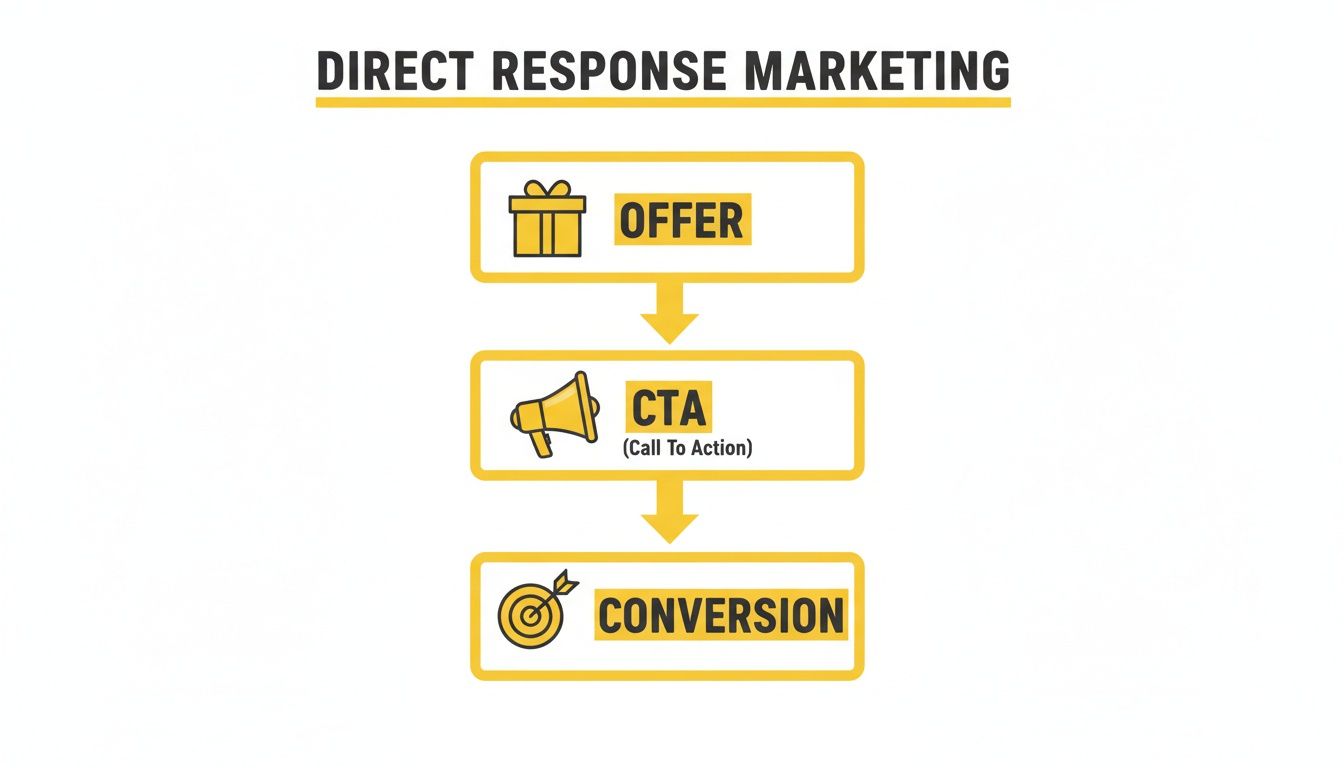
This flowchart shows you the core mission: create an offer they can't refuse, give them a clear call to action, and guide them straight to the conversion.
The Irresistible Offer
The offer is the absolute heart of your campaign. I'm not just talking about your product; I’m talking about the entire value package you present that makes someone feel like they have to act now. A weak offer means crickets, no matter how slick your ad is.
So, what goes into an offer they can't ignore?
Core Value: What’s the main thing they get out of this?
Pricing & Discounts: Are you running a limited-time sale, a bundle deal, or a special price for new customers?
Bonuses: What can you throw in for free? Think guides, checklists, exclusive access, or a bonus product.
Urgency & Scarcity: Why do they need to buy right now? Use countdown timers, limited stock warnings, or "first 50 people" deals.
Guarantee: How do you take the risk off their shoulders? A solid money-back guarantee can instantly kill hesitation.
A great offer makes the perceived value so much higher than the price that the prospect feels it would be foolish to pass up the opportunity.
The Conversion-Focused Creative
Your creative—the ad copy, the images, the videos—is what grabs attention and sells the offer. In direct response, your creative has one job: stop the scroll and earn the click. This isn't the time for artsy or clever ads. It’s about being clear, persuasive, and impossible to ignore.
Effective creative instantly answers three questions for anyone who sees it:
What is this? The ad needs to show the product or service clearly.
What’s in it for me? It must hit on a core benefit or solve a real problem for your audience.
What do I do next? A strong call to action tells them exactly what to do, like "Shop Now" or "Book a Call."
Your copy should speak directly to your audience's pains and desires, and your visuals need to be thumb-stopping while driving the message home.
The Frictionless Landing Page
Once someone clicks, they need to land on a page built for one thing and one thing only: conversion. Sending traffic to your homepage is one of the biggest and most expensive mistakes you can make. Your homepage is a library of distractions with nav bars, different sections, and competing messages.
A high-converting landing page is laser-focused. It must have:
A Headline that Matches the Ad: This confirms they’re in the right place.
Clear, Benefit-Driven Copy: The text hammers home the offer and expands on its value.
Social Proof: Testimonials, reviews, and star ratings build instant trust.
A Single, Obvious Call-to-Action: There should be zero confusion about what they need to do next.
The whole journey, from ad to thank you page, should feel completely seamless. If you want to see how this works in another channel like email, checking out some high-converting abandoned cart email examples will give you great ideas.
Data-Driven Measurement
The last pillar is what makes direct response marketing so powerful: everything is trackable. You don't have to guess what's working. By watching the right metrics, you can make smart decisions to optimize your campaigns and make them more profitable.
Forget vanity metrics like likes and shares. Direct response marketers live and die by performance data. The key numbers are:
Click-Through Rate (CTR): How good is your ad at grabbing attention?
Conversion Rate (CVR): How well does your landing page close the deal?
Cost Per Acquisition (CPA): How much are you paying for each new customer?
Return on Ad Spend (ROAS): For every dollar you put in, how many are you getting back?
By obsessively tracking these metrics, you can spot the weak links in your funnel and fix them. This data-first approach is what lets you scale your ad spend with confidence and build a predictable system for bringing in new customers.
Winning Direct Response Strategies by Channel
Knowing the theory behind a high-converting campaign is one thing. Actually putting it to work in the wild? That's a whole different ball game.
Different platforms have their own unique audiences, ad formats, and unwritten rules of engagement. A truly effective direct response strategy isn't a one-size-fits-all template. It's about meticulously tailoring your offer, your creative, and your call-to-action to the specific place where your ideal customer is scrolling, searching, or watching.
This is where we move from concepts to a tactical playbook. Let's break down how to launch powerful direct response campaigns across the platforms that matter most today. Each one demands a slightly different touch to get those immediate leads and sales.

Driving Action on Facebook and Instagram
Facebook and Instagram are still absolute powerhouses for direct response, mainly because their targeting is just so dialed in. You can get in front of incredibly specific groups based on their interests, demographics, and even past behaviors, making your offer feel like it was made just for them.
The real trick here is to stop the scroll with creative that doesn't feel like a clunky ad. It has to feel native.
For these channels, winning strategies almost always involve:
Lead Generation Ads: Meta’s built-in Instant Forms are a game-changer. They let you grab a user's info without ever forcing them to leave the app. This simple move slashes friction, making it perfect for service businesses, coaches, or real estate agents who just need to get someone booked for a call or a free quote.
Dynamic Product Ads (DPA): If you're in e-commerce, DPAs are non-negotiable. They automatically serve up products from your catalog to people who have already checked them out on your site. It’s personalized, automated retargeting that just works.
Messenger "Click-to-Chat" Campaigns: Sometimes, a quick conversation is all it takes to close a deal. These ads open up an immediate chat in Messenger, which is ideal for higher-priced products or services where a prospect might have a few questions before committing.
Your creative needs a clear, benefit-focused headline and one single, impossible-to-miss CTA button like “Shop Now” or “Get Quote.” No confusion.
Capturing High Intent on Google
When someone types a question into Google, they have a problem and they are actively looking for the solution right now. This makes Google Search one of the most potent direct response channels on the planet. You aren't interrupting their day; you're showing up as the answer they were literally just searching for.
To win on Google, you have to nail these tactics:
Keyword Targeting: Don’t just bid on broad terms. Go after long-tail keywords that signal someone is ready to buy. Instead of "plumber," you want to target "emergency plumber near me." That’s a person who needs to take action immediately.
Compelling Ad Copy: Your ad has to be a mirror of their search query and present an offer they can't refuse. Cram it with urgency ("Limited Time Offer") and a direct command ("Call Now For a Free Estimate") right in the headline.
Conversion-Optimized Landing Pages: The page you send them to must be 100% consistent with the ad they just clicked. The headline, the offer, the CTA—it should all match perfectly. This creates a seamless experience that builds instant trust.
Leveraging Short-Form Video on TikTok
TikTok’s algorithm is a discovery engine. That makes it an incredible channel for getting your brand in front of entirely new audiences with short, punchy videos. But here's the catch: the key to direct response on TikTok is authenticity. Slick, corporate-style ads almost always bomb.
Instead, the best direct response strategies on TikTok feel organic. They feel like they belong there.
The most effective TikTok ads don't look like ads at all. They look like native content, blending seamlessly into the user's "For You" page while driving them toward a clear, single action.
Try these creative approaches:
User-Generated Content (UGC): Get real customers on camera. Show them unboxing your product, giving a genuine testimonial, or demonstrating how it solved their problem. This builds a mountain of social proof and trust.
Problem-Solution Format: Kick off the video by calling out a common pain point your audience deals with. Then, in a flash, introduce your product as the obvious fix, and follow it up with a direct CTA.
Spark Ads: Take your best-performing organic videos and put some ad spend behind them. This leverages the social proof you’ve already earned (likes, comments, shares) to make the ad feel more credible and perform even better.
Using In-Stream Ads on YouTube
YouTube gives you a rare opportunity to capture someone's undivided attention, especially with those skippable in-stream ads. The first five seconds are everything. You have to hook them immediately, either by calling out their exact problem or hitting them with a bold statement that shatters their scrolling pattern.
A proven formula for YouTube ads looks like this:
The Hook: Grab their attention in the first 3-5 seconds before that "Skip Ad" button even appears.
The Problem: Twist the knife a little. Agitate the core pain point they're struggling with.
The Solution: Present your offer as the clear, simple way out of that pain.
The CTA: Tell them exactly what to do next. "Click the link below to claim your free trial."
This direct approach works because it qualifies your audience for you. Anyone who isn't interested will just skip, saving you money, while your ideal prospects will stick around and click.
The Overlooked Power of Direct Mail
While everyone is focused on digital, one old-school physical channel continues to deliver shockingly good returns. Direct mail can often produce an ROI that digital channels struggle to keep up with, making it a fantastic play for both e-commerce and local services.
In fact, according to the ANA Response Rate Report, direct mail pulls in a staggering 161% ROI. That absolutely crushes email's 44% and paid social's 21%.
For certain industries like real estate, it’s a non-negotiable staple. Diving into resources on Direct Mail Marketing for Real Estate shows just how effective it can be to put a compelling, physical offer directly into a potential client's hands.
Integrating Multichannel Campaigns for Maximum Impact
Relying on a single advertising channel is like trying to win a championship with just one star player. You might get some wins, but you'll never reach your full potential.
Today’s customer journey is messy. It jumps from a Google search on a laptop, to a scroll through Instagram on a phone, and then to a YouTube video on a tablet. To win, your direct response ads have to show up everywhere your ideal customer spends their time.
This is the core idea behind an omnichannel (or multichannel) approach. It's not about spraying your ads across every platform possible. It’s about being on the right platforms in a connected, intelligent way.
Think of it as a well-coached sports team. Your Google Ad is the point guard, identifying a need and starting the play. Your Facebook retargeting ad is the forward, moving the ball down the court. Your email follow-up is the center, positioned perfectly under the basket to score. Each channel supports the others, creating a powerful synergy that a single channel can't touch.
Creating a Synergistic Effect
The goal here is to make your brand feel like it's everywhere at once. When a prospect sees you on multiple platforms, it builds familiarity, trust, and a sense of authority. This repeated exposure dramatically increases the odds they'll take action when you finally present your offer.
The key is keeping your message and offers consistent, but tailoring the delivery to fit each platform's unique vibe. This creates a seamless experience as someone moves from one touchpoint to the next, reinforcing your core message at every step.
This isn't just theory; it's backed by some pretty powerful data. Studies show that combining digital efforts with traditional channels like direct mail can create a massive uplift. For example, businesses that use both email and catalog mail have seen 49% increases in sales and 125% spikes in inquiries. That kind of synergistic lift is one of the most compelling reasons to go multichannel. You can learn more about how direct mail and digital marketing work together from Salesgenie.
Practical Multichannel Scenarios
Let's look at how this actually works in the real world. A truly effective multichannel campaign is a choreographed sequence of touchpoints, all designed to guide a prospect toward a conversion.
Here are a few common and highly effective examples:
Google Search to Social Retargeting: A user Googles "best running shoes for flat feet" and clicks your ad. They browse your product page but don't buy. Later that day, they're scrolling Instagram and see a video ad from you—a runner giving a testimonial about how those exact shoes solved their flat feet problem.
YouTube Ad to Email Nurturing: A prospect watches your skippable YouTube ad for a free webinar and clicks through to sign up. They're immediately dropped into an email sequence that reminds them about the webinar and offers a "fast action" bonus if they buy your course before the event starts.
TikTok Lead to SMS Follow-Up: A potential customer sees your engaging TikTok video and fills out a lead form for a quote. Within minutes, an automated SMS hits their phone to schedule a call, striking while their interest is at its absolute peak.
A true omnichannel strategy doesn't just put ads on multiple platforms; it uses each platform to continue the conversation started on the last, creating a single, cohesive customer journey.
This full-funnel approach amplifies your results, builds a more resilient customer acquisition system, and ultimately drives way higher conversion rates. By connecting your channels, you make sure no lead falls through the cracks, maximizing the impact of every single dollar you spend on ads.
Measuring Success With the Right KPIs
In direct response, getting bogged down by vanity metrics like likes, shares, and impressions is a rookie mistake. They might puff up your ego, but they don’t pay the bills. The only numbers that actually matter are the ones that tell you, point-blank, if your campaigns are making money or losing it.
This is where your Key Performance Indicators (KPIs) come in. Think of your business like a race car. Your KPIs are the gauges on the dashboard—the tachometer, the oil pressure, the fuel level. Without them, you’re just flying blind, hoping you don't blow the engine.
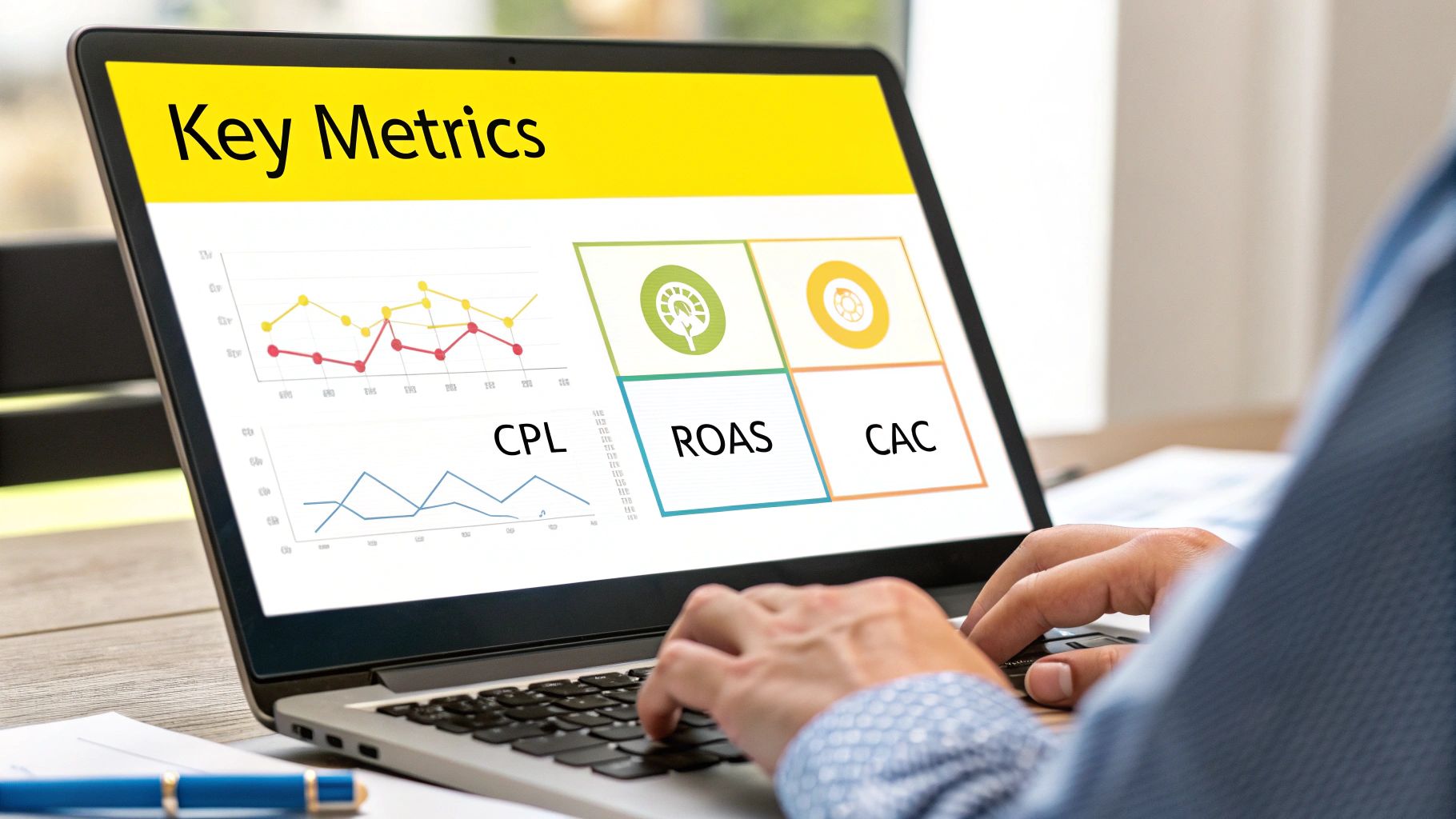
Core Metrics That Drive Decisions
If you want to move from hoping your ads work to knowing they do, you need to get obsessive about a few core metrics. These KPIs are the financial heartbeat of your campaigns, telling a crystal-clear story about what’s a winner and what’s a dud.
Here are the non-negotiables for your dashboard:
Cost Per Lead (CPL): This is simply what you pay, on average, to get one new lead in the door. A low CPL for a high-value service is a massive win and tells you your top-of-funnel messaging is hitting the mark.
Customer Acquisition Cost (CAC): Taking it a step further, this is your total cost to land a paying customer. It’s the ultimate report card for your sales efficiency.
Return on Ad Spend (ROAS): For every dollar you put into ads, how many dollars do you get back in revenue? A 3:1 ROAS means you made $3 for every $1 you spent. Simple. Powerful.
Customer Lifetime Value (LTV): This is the total profit you can expect to make from a single customer over their entire relationship with you. It’s the long-game metric.
The real magic happens when you understand how these numbers talk to each other. A high CAC might look scary at first glance, but if that customer’s LTV is ten times higher, it’s not just a good investment—it's a signal to pour more fuel on the fire. This is the math that lets businesses scale aggressively and with total confidence.
Building Your Performance Dashboard
You don’t need some overly complicated software to build a performance dashboard. A simple spreadsheet can do the trick. The goal is to see your most important numbers at a glance, allowing you to make quick, smart decisions about your budget and strategy.
A proper KPI dashboard isn’t just a report card on the past. It's a crystal ball that lets you make smarter bets on the future, turning raw data into actionable intelligence.
For instance, if you see your CPL on TikTok is half the cost of your leads from Google, you know exactly where to shift your ad spend. If the ROAS on a specific ad starts to dip, that’s your cue to refresh the creative before it burns out completely.
This data-first mindset is what separates the amateurs from the pros. It yanks emotion and guesswork out of the equation and replaces them with a predictable system for profitable growth. When you focus on these core KPIs, you’re not just marketing—you're taking complete control of your business's destiny.
Your Direct Response Implementation Checklist
Knowing the theory is one thing, but putting it into practice is where the money is made. Think of this checklist as your roadmap—a step-by-step guide to take you from a blank slate to a profitable direct response campaign. It’s designed to make sure you’ve nailed all the fundamentals before you spend a single dollar on ads.
This isn’t about throwing things at the wall and hoping they stick. It’s a proven process for building a campaign that’s measurable, repeatable, and engineered for immediate results.
Phase 1: Pre-Launch Foundation
Before you even think about writing an ad, you need to get your house in order. This first phase is all about making sure your offer and your tracking are perfectly set up to turn clicks into customers.
Define Your Irresistible Offer: First things first, what’s the deal? Is it a straight-up discount, a BOGO, a free trial, or a killer lead magnet? You need to lock this down completely, including any bonuses, guarantees, and urgency triggers you plan to use.
Build a High-Conversion Landing Page: Your offer needs a dedicated home. This means creating a simple, focused landing page with one goal. The headline has to match your ad copy, the benefits should be crystal clear, and there must be a single, obvious call-to-action button. No distractions.
Establish Your Tracking Dashboard: You can't improve what you don't measure. Get your analytics set up to watch the most important KPIs like a hawk. At a bare minimum, you need to be tracking clicks, leads or sales, Cost Per Lead (CPL) or Cost Per Acquisition (CPA), and of course, Return on Ad Spend (ROAS).
Phase 2: Campaign Go-Live
With your foundation solid, it's time to bring your campaign to life. This is where you build out the ads that will connect your amazing offer with the right audience.
Script Persuasive Ad Copy and Creative: Write ad copy that hits on your audience's biggest pain points and positions your offer as the perfect solution. Then, create visuals—images or videos—that are designed to stop the scroll and feel native to the platform you’re on.
Set Up Multi-Channel Campaigns: Don't put all your eggs in one basket. Launch your campaign on your main channels (like Facebook and Google), but also set up retargeting audiences. This creates an omnipresence effect where it feels like you're everywhere.
Integrate Physical Touchpoints: While most of this is digital, don't sleep on old-school direct response. Seriously. Direct mail still pulls in response rates between 3–5%, which absolutely crushes email's average of 0.6%. It’s worth exploring how you can leverage direct mail's tangible impact from Triadex Services to complement your online efforts.
Mini Case Study: E-commerce StoreAn online apparel brand decides on a "Buy 2 Get 1 Free" t-shirt deal, running for just 48 hours to create urgency. They whip up a landing page that screams the deal, then script some raw, UGC-style TikTok ads. To catch everyone, they also set up an Instagram retargeting campaign for anyone who hit the landing page but bailed. The second they launch, their eyes are glued to their ROAS dashboard to make sure every dollar going out is bringing more back in.
Got Questions? We've Got Answers
Even with the best game plan, a few questions always pop up when you're diving into something new. Let's tackle some of the most common ones I hear from marketers trying to get their direct response efforts off the ground.
What’s the Difference Between Direct Response and Content Marketing?
I like to think of it like fishing.
Direct response marketing is like casting a line with the perfect bait, trying to get a fish on the hook right now. The entire goal is to get an immediate, measurable bite—a sale, a lead, a sign-up. You know instantly if it's working.
Content marketing, on the other hand, is like chumming the water. You're creating a rich, valuable environment with blogs, videos, and guides that attract a whole school of fish over time. The goal is to build trust and authority. When those fish get hungry, you’re the first one they’ll come to.
Both are critical for a healthy business. One demands action now, while the other builds a loyal following for the future.
How Much Should I Actually Budget for a Direct Response Campaign?
Forget about finding a "magic number." The real secret is to start small and scale smart. You absolutely do not need a massive budget to get started. In fact, you can get incredibly valuable data with just a few hundred bucks.
Here’s the process we use:
Launch small test campaigns. Put a modest budget behind a few different offers, creatives, and audiences.
Analyze the first wave of data. Zero in on your core metrics—Cost Per Lead (CPL) and Return on Ad Spend (ROAS) are king here.
Find your winners. Pinpoint which ad variations are actually making you money.
Scale the winners. This is the fun part. You systematically pump more money into the proven, high-performing ads.
This data-first approach takes all the guesswork out of the equation. You're only pouring fuel on the fire you already know is burning hot.
How Quickly Can I Expect to See Results?
This is the best part about direct response: the feedback is almost instant.
You'll see initial data rolling in within the first 24-48 hours. Metrics like click-through rates and lead costs give you a quick pulse on what’s happening, letting you make fast decisions to stop the bleed or double down on what’s working.
But let's be clear: seeing initial data isn't the same as achieving sustainable profit. Getting leads on day one is one thing. True optimization—turning a break-even campaign into a profit-printing machine—is an ongoing process. You'll spend the next few weeks and months refining your ads, landing pages, and offers based on what the data tells you.
The first results are fast; mastery takes continuous effort.
Ready to stop guessing and start scaling with predictable, profitable direct response campaigns? The team at Wojo Media bolts onto your business to optimize your offer, landing pages, and omnipresent ads with data-driven precision. Book your free demo call today and get a custom paid advertising strategy built to deliver immediate, measurable results.
Comments