.png)
Multi Channel Marketing Strategy: Master Unified Messaging & Growth
- Jason Wojo
- Jan 17
- 17 min read

A multi-channel marketing strategy is all about showing up where your customers already are. It’s not about forcing everyone down one path. Instead, you optimize each channel—social media, email, paid ads, you name it—to connect with people on their own terms, letting them choose how they engage with you.
Building Your Multi-Channel Marketing Foundation
Before you spend a single dollar on ads, your success is already being decided. It's all in the foundation. Too many businesses get excited and jump straight to picking platforms, but that’s putting the cart way before the horse.
The real work starts with three core pillars. Get these right, and your efforts will be strategic and profitable. Get them wrong, and you're just throwing money into the wind. A great campaign built on a weak foundation is just a house of cards waiting to fall.
Nail Your Irresistible Offer
First things first: your offer. In a world where everyone is shouting, a mediocre offer is completely invisible. An irresistible offer isn't just your product or service; it's a powerful solution to a painful problem, wrapped in a guarantee that makes saying "yes" an absolute no-brainer.
It has to be so good that your ideal customer would feel stupid for passing it up.
For example, a local med spa’s offer isn't just "Botox injections." It's "Look 10 years younger in 30 minutes with our signature wrinkle-erasing treatment, backed by our 'love your look' guarantee." See the difference? One is a commodity, the other is a transformation. Nailing this simplifies every other part of your strategy, from your ad copy to your landing pages.
Your offer is the starting point for all successful marketing. It's the hook that grabs attention and the promise that drives action. If your offer doesn't stop the scroll, nothing else you do will matter.
Define Your Ideal Customer Avatar
Once your offer is dialed in, you need to know exactly who it's for. And I mean exactly. Moving beyond vague demographics like "women ages 25-45" is non-negotiable. You need to build a detailed customer avatar that brings your target audience to life.
Get into their head. You need to understand their world, which means digging into psychographics and behaviors:
Pain Points: What keeps them up at night? A real estate investor's pain isn't just finding deals; it's the gnawing fear of overpaying in a shark-infested market.
Goals and Aspirations: What's their dream outcome? A coach's client doesn't just want to "grow their business"; they want the freedom and impact that comes with a fully booked calendar.
Online Hangouts: Where do they actually spend their time online? Are they scrolling TikTok for a laugh, searching for solutions on Google, or networking in professional Facebook groups?
This deep understanding dictates where you show up. If your avatar is a 55-year-old tax professional, you're probably better off on LinkedIn and Google Ads than on TikTok. It’s all about showing up in the right places with a message that hits home.
Set Clear and Measurable Goals
The final piece of the foundation is defining what success actually looks like—in cold, hard numbers. Vague goals like "increase leads" or "get more sales" are useless. They don't give you anything to aim for. Your objectives have to be specific, measurable, and tied directly to real business outcomes.
Think of these goals as the benchmark for every decision you make. For instance:
For a Local Service: "Generate 50 qualified leads per month at a Cost Per Lead (CPL) under $25."
For an E-commerce Brand: "Achieve a minimum 4x Return On Ad Spend (ROAS) on all new customer acquisition campaigns."
For a Coach: "Book 15 strategy calls per week from our webinar funnel, maintaining a 20% landing page conversion rate."
These KPIs (Key Performance Indicators) are your north star. They tell you which campaigns are killing it, which ones need a little love, and which ones to cut loose. When you set these goals upfront, marketing stops being an expense and starts becoming a predictable engine for growth.
Selecting and Integrating Your Core Marketing Channels
Once you've locked in your foundation, it’s time to decide where you're going to play. I see so many businesses make the mistake of trying to be everywhere at once. This just spreads your resources too thin and, frankly, leads to mediocre results across the board.
A smart multi-channel strategy isn't about universal presence; it’s about a strategic presence where it actually counts.
Think of each channel—Facebook, Instagram, TikTok, Google—as a specialized tool in your toolbox. You wouldn't use a hammer to saw a board, right? The same logic applies here. You need to pick the right platform for the right job, making sure each one aligns with a specific stage of your customer's journey.
This chart shows exactly how your foundational work—your offer, audience, and goals—flows directly into your channel selection.
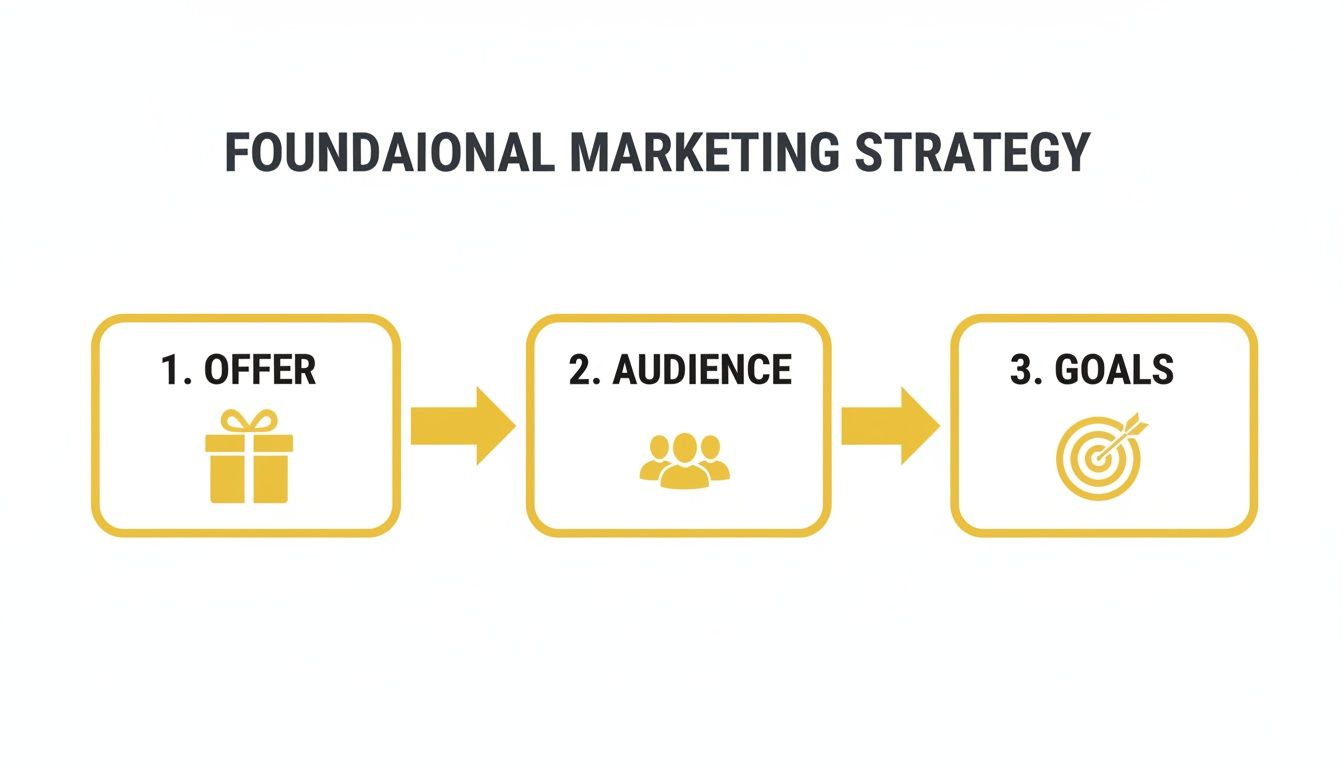
As you can see, your channel choices should never be random. They’re a direct result of knowing who you’re selling to and what you’re trying to achieve.
Building Your Full-Funnel Channel Mix
A truly powerful multi-channel approach creates a seamless experience, guiding people from that first "hello" all the way to a sale. This means assigning specific roles to each platform based on what it does best.
For example, a modern e-commerce brand might set up its funnel like this:
Top of Funnel (Awareness): They could run engaging, maybe even funny, video ads on TikTok and Instagram Reels. The goal here isn't a hard sell. It's about grabbing attention and introducing the brand’s personality to a broad, cold audience.
Middle of Funnel (Consideration): Next, they'd retarget users who watched a good chunk of those videos. This time, they’d use more product-focused carousel ads on Facebook and Instagram, showcasing benefits, social proof, and user-generated content (UGC).
Bottom of Funnel (Conversion): Finally, they’d use Google Search Ads to capture high-intent users who are actively searching for a solution. They'd also retarget anyone who abandoned their cart with compelling offers across all social platforms and Google’s Display Network.
This integration is what creates that “omnipresent” effect. The customer sees a fun video on TikTok, later gets a testimonial ad in their Instagram feed, and when they finally search for a solution, your brand is right at the top. It feels like you’re everywhere, which builds incredible trust at every step.
Aligning Channels with Business Models
The right channel mix is completely dependent on your business. What works wonders for a local med spa will fall flat for a real estate investor.
Let's look at some real-world scenarios:
For a Real Estate Wholesaler: Their main goal is to find motivated sellers. A killer combo would be Google PPC targeting keywords like "sell my house fast" paired with highly targeted Facebook Ads aimed at homeowners in specific zip codes who show behaviors that might indicate a move.
For a High-Ticket Coach: Here, the sales cycle is longer and it's all about building authority. A strong strategy would be to use YouTube for long-form educational content, promote it with YouTube Ads, and drive traffic to a webinar registration. Then, they can retarget attendees (and non-attendees) on Facebook and LinkedIn with testimonials and case studies to close the loop.
The magic isn't in just using multiple channels; it's in making them work together. A prospect should feel like they're having one continuous conversation with your brand, no matter where they interact.
Practical Integration and Execution
Integration is more than just running ads on different platforms. It's about creating a cohesive narrative. The messaging and creative from your TikTok ad have to feel connected to the landing page it sends people to. The offer you talk about in your YouTube video should be the exact same one in your email follow-up sequence.
This consistency is crucial for building trust.
When a prospect sees congruent messaging across multiple touchpoints, it reinforces your brand’s credibility and makes the decision to buy feel much safer and more natural. This is the heart of an effective multi channel marketing strategy—turning separate platforms into a unified, conversion-driving machine.
Alright, you’ve picked your channels. Now comes the hard part—making it all work together without giving your audience whiplash.
A killer multi-channel strategy falls apart the second a customer sees your fun, edgy TikTok ad and then clicks through to a stuffy, corporate-looking Instagram feed. That disconnect is an instant trust-breaker. The goal is to create a unified brand story that feels familiar and reliable, no matter where someone stumbles upon it.
This isn’t about copy-pasting the same ad everywhere. Far from it. It's about keeping your core message, tone, and brand promise locked in while tweaking the delivery for each platform’s unique vibe. Think of it like running into a friend in different places—the context changes, but they're still the same person you know and trust.

Unifying Your Brand Narrative
Your brand narrative is the story that connects what you sell to your customer’s problems. This story has to be the bedrock of every ad, post, and email you create. It’s the "why" behind your business, and it needs to echo loud and clear across the board.
For instance, a real estate investor’s brand story might be: "We give homeowners in tough spots a fast, fair cash offer, providing a compassionate and stress-free way out of a difficult situation." Every single creative should then tie back to that core idea.
To keep everyone on the same page, create a simple "Brand Messaging Guide." Seriously, don't skip this. It should outline:
Core Value Proposition: The main promise you make to customers.
Brand Voice & Tone: Are you the expert authority or the casual, relatable friend?
Key Talking Points: The top 3-5 benefits you always want to hammer home.
Visual Identity: Your non-negotiable logos, color palettes, and fonts.
This document becomes your north star. It ensures that even when you're testing a dozen different ad angles, the soul of your message stays intact.
Adapting Creatives for Platform Nuances
Your core message is set. Great. But how you deliver it has to change. People expect different things on different platforms, and if you ignore that, you're just throwing money away. A polished, cinematic ad might crush it on YouTube but will stick out like a sore thumb on TikTok.
Here's how to think about adapting your content:
TikTok & Instagram Reels: It's all about raw, authentic, and entertaining content. Think user-generated content (UGC), behind-the-scenes clips, and quick videos that jump on a trend. Our real estate investor could post a 15-second phone video of a team member giving a friendly, informal walkthrough of a recently flipped house.
Facebook & Instagram Feed: These feeds are more of a mixed bag. You can get away with higher-quality images, carousels of customer testimonials, and slightly longer video ads that tell a story. Here, the investor might run a polished video testimonial from a happy client who sold their house in a week.
YouTube Ads: This is where you can go deep. Use skippable in-stream ads to explain your process, showcase a detailed case study, or tackle a complex part of your service. That same investor could run a 2-minute ad that breaks down the three simple steps to getting a no-obligation cash offer.
The secret to ads that actually convert isn't just what you say, but how and where you say it. The best marketers speak the native language of each platform, adapting their format to fit what users expect without losing the brand's core identity.
Producing High-Impact Content at Scale
Creating unique content for a half-dozen channels sounds exhausting, right? It doesn't have to be. You just need to work smarter. The name of the game is content batching.
Instead of trying to film one ad, block off a day and shoot a ton of raw footage. A single four-hour session can give you enough material to fuel your ad campaigns for weeks.
From that one shoot, you can easily edit:
A couple of long-form YouTube ads (2-3 minutes) that tell the complete story.
Several shorter Facebook feed ads (30-60 seconds) that pull out the best highlights.
A dozen short TikTok clips (10-15 seconds each) using different hooks, soundbites, or visual cuts from the same footage.
This approach keeps your look and feel consistent while giving you a constant stream of fresh, platform-specific content. When you combine a unified story with smartly produced creatives, you build a brand presence that feels cohesive, powerful, and ready to drive sales everywhere you show up.
Driving traffic from all your different marketing channels is a huge win, but honestly, it's only half the battle. You can get all the clicks in the world, but they mean absolutely nothing if they don't turn into actual leads or sales.
I’ve seen it time and time again: one of the most common—and costly—mistakes any business makes is sending perfectly good, targeted traffic to a generic homepage. It’s a conversion killer.

Think about it. A homepage is designed to serve everyone, which means it doesn't serve any one person particularly well. It's usually cluttered with navigation links, different offers, and competing messages. Your campaigns need dedicated, single-purpose landing pages that continue the specific conversation you started with your ad or email.
This sharp focus is what turns a click into a conversion.
The Anatomy of a High-Converting Landing Page
A great landing page isn’t some mysterious art form; it’s a science. It follows a clear, proven formula designed to guide a visitor toward one single action. Every single element has to work together to build trust, create desire, and get rid of any friction that might make someone hesitate.
Here are the absolute non-negotiables:
A Compelling, Congruent Headline: Your headline must instantly connect with the ad that brought the user there. If your Facebook ad promised "5 Simple Steps to Double Your Real Estate Leads," your landing page headline better be almost identical. Any disconnect creates immediate confusion, and confused people don't convert—they bounce.
A Clear Value Proposition: Right below the headline, you have to quickly explain what the offer is and why it's valuable. This isn't the place for a long paragraph. We're talking a concise statement or a few punchy bullet points that highlight the core benefits and show you can solve their problem.
Engaging Visuals: This could be a high-quality photo of your product, a short video testimonial, or a hero shot of a happy customer. The right visual supports your message and helps the visitor imagine themselves achieving a successful outcome.
A landing page has one job and one job only: to get a visitor to take a specific action. You need to remove every single distraction—navigation menus, links to other pages, social media icons—that doesn't directly contribute to that one goal.
Building Trust and Overcoming Objections
People are naturally skeptical online. It’s just the world we live in. Your landing page has to actively work to break down those barriers and build a solid case for why they should trust you. This is where social proof and risk reversal become your most powerful allies.
Leverage Social Proof
You have to show visitors that other people just like them have already found success with your offer. It's one of the fastest ways to build credibility from scratch.
Testimonials: Feature quotes or, even better, short video clips from happy clients. Always include their name and a photo to make it feel authentic and real.
Case Studies: Briefly summarize a success story with specific, measurable results. Think: "Helped a local contractor increase their qualified leads by 350% in just 60 days." Numbers talk.
Logos & Trust Seals: If you've been featured in the media, have industry certifications, or work with well-known brands, display those logos. They act as instant credibility-boosters.
Refine Your Guarantee
A strong guarantee, what we call "risk reversal," makes it so much easier for someone to say "yes." It completely removes the fear of making a bad decision.
A standard "30-day money-back guarantee" is okay, but you can do better. A more creative, benefit-driven guarantee is far more powerful. For example, a business coach might offer a "Book 5 High-Ticket Calls in Your First Month, Or You Don't Pay" guarantee. This directly addresses the outcome they want and shows you have immense confidence in what you're selling.
Your landing page is the final handshake in your multi-channel marketing efforts, making this trust absolutely essential.
Tracking and Attributing Success Across Your Channels
Launching ads across multiple channels without a solid tracking system is like trying to navigate a ship in a storm without a compass. You’re definitely moving, but you have no idea if you’re heading toward your destination or straight into a reef.
A successful multi channel marketing strategy is built on hard data, not guesswork. Without it, you’re just throwing money at different platforms and hoping something sticks. Robust tracking and attribution are what turn that hope into a predictable, scalable revenue engine. It's the only way to know with certainty what’s working, what isn’t, and where to double down for maximum profit.
Moving Beyond Vanity Metrics
The first step in real tracking is knowing what to measure. Far too many businesses get hung up on vanity metrics—impressions, clicks, and likes. While these numbers might offer a surface-level pulse on your campaigns, they don’t tell you if you’re actually making any money.
You have to focus on the key performance indicators (KPIs) that directly impact your bottom line. These are the numbers that connect your ad spend to real business outcomes.
Cost Per Acquisition (CPA): This is your true cost to get one new customer. It’s the ultimate measure of your campaign’s efficiency.
Return On Ad Spend (ROAS): For every single dollar you put into advertising, how many dollars do you get back in revenue? A high ROAS is a clear sign of a profitable campaign.
Customer Lifetime Value (LTV): This metric looks beyond the initial sale, calculating the total revenue a single customer is expected to bring in over their entire relationship with your brand.
Zeroing in on these core KPIs forces you to make smarter, data-driven decisions. It shifts the entire conversation from, "How many people saw our ad?" to "How much profit did our ad actually generate?" This is the fundamental mindset shift required for profitable scaling.
Understanding Multi Channel Attribution Models
So, what happens when a customer sees your ad on TikTok, gets retargeted on Facebook, and then finally buys after a Google search? Which channel gets the credit? This is the core challenge of attribution in a multi-channel world. Simply giving all the credit to the last click is a massive oversimplification that leads to terrible budget decisions.
A deeper dive into how multi channel attribution improves conversion tracking is essential for getting an accurate picture of what’s really working. It helps you see the entire customer journey, not just the final step.
Several models exist, each offering a different perspective:
First-Touch Attribution: Gives 100% of the credit to the very first channel a customer interacted with. This is great for understanding which channels are best at generating initial awareness.
Last-Touch Attribution: The most common (and most flawed) model. It gives all the credit to the final touchpoint before conversion, completely ignoring every interaction that came before it.
Linear Attribution: This model spreads the credit evenly across all touchpoints in the customer's journey. It acknowledges that every single interaction played a role.
Time-Decay Attribution: Gives more credit to the touchpoints that happened closer to the conversion. It recognizes that later interactions are often more influential in closing the deal.
The goal isn't to find one "perfect" attribution model. The goal is to use multiple models to understand how different channels contribute at different stages of the funnel, from awareness all the way to conversion.
Essential KPIs for Multi Channel Campaign Tracking
To get a clear, unbiased view of your performance, you need to monitor a specific set of KPIs that tell the full story. This table breaks down the most critical metrics to watch as you scale.
KPI | What It Measures | Why It Matters | Target Example (Varies by Industry) |
|---|---|---|---|
CPA | Cost Per Acquisition: The total ad spend to acquire one customer. | Measures the efficiency and profitability of your customer acquisition efforts. | E-commerce: < $50 |
ROAS | Return On Ad Spend: Revenue generated for every dollar spent on ads. | The ultimate indicator of ad campaign profitability. | E-commerce: 4:1 or higher |
LTV | Customer Lifetime Value: Total revenue from a customer over time. | Informs how much you can afford to spend on CPA while remaining profitable. | SaaS: 3x the CPA |
Conversion Rate | Percentage of visitors who complete a desired action (e.g., purchase). | Shows how effective your landing page and messaging are at driving action. | Landing Page: > 3% |
Click-Through Rate | Percentage of people who click your ad after seeing it. | Indicates ad relevance and creative effectiveness. | Facebook Ads: > 1.5% |
By keeping a close eye on these numbers, you can move beyond simple clicks and impressions to make decisions that truly drive growth and profitability.
Implementing Robust Tracking Systems
To make any of this work, you need the right tools set up correctly from day one. Proper setup ensures you capture accurate data from every touchpoint, allowing you to connect the dots and see the customer's entire journey. This technical foundation is non-negotiable.
Your tracking stack should include:
Platform Pixels: Installing the tracking pixels for Facebook, TikTok, and Google is the bare minimum. This allows each platform to track conversions and optimize your ad delivery based on real data.
UTM Parameters: These are small snippets of code added to your URLs that tell your analytics tools exactly where a click came from. Consistent UTM tagging is crucial for differentiating traffic from various campaigns, ad sets, and individual ads.
Third-Party Analytics: Tools like Google Analytics provide a more neutral, centralized view of your data. This helps you compare performance across platforms without being biased by each ad network's native (and often self-serving) reporting.
For brands looking to scale, mastering data-driven, multi-channel marketing is the key that unlocks explosive growth. In fact, analytical tools can lead to up to 73.8% optimization in marketing spend. This stat alone shows how tracking performance across channels turns guesswork into predictable scaling. When your data is clean and organized, you can confidently make decisions that drive real, measurable growth.
Scaling Your Strategy for Predictable Growth
Once you’ve built a solid multi-channel foundation and the data is telling a clear story, the fun part begins. This is where you shift from just running campaigns to systematically scaling them for predictable, profitable growth.
But let's be clear: scaling isn't about blindly cranking up your ad spend. That’s a fast track to burning through cash and watching your ROI tank. Real scaling is a disciplined process. It’s about methodically testing every single variable—your ad creative, your audiences, your landing page—to find the winners and double down on what’s actually working. This is how you turn a trickle of leads into a reliable flood without your efficiency falling off a cliff.
Identifying the Green Lights for Scaling
Knowing when to scale is just as critical as knowing how. Hitting the accelerator too soon can kill a campaign that was just starting to find its footing. You have to wait for specific, data-backed signals that scream your campaigns are stable, profitable, and ready for a bigger budget.
Here’s what you should be looking for:
Consistent Profitability: Your campaigns are hitting or, even better, beating your target KPIs—like Cost Per Acquisition (CPA) or Return On Ad Spend (ROAS)—for at least 7-14 days straight.
Stable Performance: Your day-to-day results aren’t all over the place. You're seeing a steady, predictable flow of leads or sales, which tells you the offer is resonating and your targeting is locked in.
High Ad Relevance: Your ads are actually connecting. You’re seeing positive comments, high click-through rates (CTRs), and solid engagement. This is the market telling you your creative and messaging are on point.
When you see these green lights flashing, it’s a clear sign you’ve struck gold. Now it’s time to start pouring more fuel on the fire.
The Art of Incremental Budget Increases
When you do decide to scale, the golden rule is to take it slow. Jamming the budget up aggressively can shock the ad platform's algorithm, often throwing it right back into the learning phase and wrecking your performance in the process.
Slow and steady really does win the race here.
A safe bet is to increase your budget by no more than 20-30% every 48-72 hours. This gradual bump gives the algorithm time to adjust, find more people like your current customers, and maintain the efficiency you fought so hard to get. After every increase, keep a close eye on your KPIs. If they hold steady, you’re clear to make the next move.
Scaling is a process of earning the right to spend more. You prove profitability at one budget level, then cautiously increase it, proving it again at the next. This methodical approach is the secret to maintaining your ROI as you grow.
A Continuous Cycle of Testing and Optimization
Scaling isn’t a one-and-done deal. It’s a perpetual cycle of testing and optimizing. The creative that’s a rockstar today will eventually burn out. The audience converting like crazy right now might become saturated. For sustainable growth, you always have to be testing new variables to find your next winner.
Your testing framework needs to be structured and focused, changing just one variable at a time:
Creative Testing: Always have new ad creative in the pipeline. Test different hooks, video formats (like UGC vs. a polished edit), and various angles in your ad copy to see what your audience responds to most.
Audience Testing: Never stop exploring new lookalike audiences and interest-based targeting groups. A 1% lookalike might be your champion today, but a broader 3-5% audience could unlock a massive new wave of scalable traffic.
Landing Page Testing: Your ad is only half the battle. A/B test different headlines, calls-to-action, and offers on your landing pages to squeeze out a better conversion rate. Even a small lift here can slash your overall CPA.
To really put this on rails, many are turning to advanced tech. For instance, you can explore Lunabloom AI's solutions for predictable growth to see how technology can streamline this entire process and give you an edge.
Expanding Into New Channels Strategically
Once you’ve maxed out performance on your core channels—think Facebook and Google—it might be time to expand your territory. This is a huge lever for scaling, but you have to be smart about it. Don't just jump on TikTok because it's the hot new thing.
First, do your homework and confirm your ideal customer is actually hanging out there. Then, start small with a controlled test budget. The entire goal is to see if you can repeat your success and hit your target KPIs on the new channel before you dump significant resources into it.
Expanding your footprint is a game-changer for building a truly robust multi-channel marketing engine. In fact, research shows campaigns running on three or more channels can see a 287% higher purchase rate than single-channel efforts.
This disciplined approach—waiting for the green lights, scaling incrementally, testing constantly, and expanding strategically—is what separates a few good weeks from long-term, predictable business growth.
Comments