.png)
One Call Closer: Master the one call closer funnel
- Jason Wojo
- Jan 4
- 15 min read

Let’s get one thing straight: the one call closer isn’t some aggressive, strong-arm sales tactic. It's a high-efficiency strategy designed for well-informed, high-intent buyers who are ready to make a decision now.
The real magic doesn’t happen on the call itself. It happens in the days and weeks leading up to it. Success hinges entirely on the marketing and sales process that brings someone to that conversation in the first place, creating a scenario where a single call is the only logical next step.
What Is a One Call Closer and Why It Works

Most salespeople hear “one call close” and picture a pushy, used-car-salesman approach meant to bully someone into a quick “yes.” That’s a huge misconception.
When you do it right, a one-call close is the natural conclusion to a carefully built customer journey. You’re not forcing a decision; you’re guiding a prospect to a conclusion they were already heading toward. They’ve already identified their problem, and they’re actively looking at your solution.
This strategy is less about what you say on the call and more about the system that gets them to the call. It relies on laser-focused advertising, irresistible offers, and landing pages that do all the heavy lifting—qualifying, educating, and pre-selling for you.
The Foundation of an Effective Close
By the time a prospect books a meeting in a one-call-close funnel, they should already be 80% sold. They know their pain points inside and out, they see your solution as the answer, and they view you as the authority to provide it.
The call itself is just about dotting the i's and crossing the t's. It’s there to confirm what they already believe, answer any final lingering questions, and clear the path for them to commit.
This whole approach is built on respecting the buyer's time and intelligence. Instead of dragging them through a series of discovery calls and follow-ups, you provide a clear diagnosis and an immediate path forward. For your business, this translates into some seriously powerful outcomes.
Key business benefits include:
Dramatically Shorter Sales Cycles: You’re compressing a decision-making process that could take weeks or months into a single, focused conversation.
Increased Cash Flow and Predictability: Closing deals faster means getting paid faster. This makes your revenue more stable and your financial forecasting a whole lot easier.
Higher Sales Team Efficiency: Your closers can stop wasting time nurturing lukewarm leads and focus exclusively on what they do best: closing deals with people who are ready to buy.
A professional one call close is the final, logical step for a well-informed buyer. It is the result of a powerful marketing system that attracts, educates, and qualifies prospects before they ever speak to a salesperson.
So, how do you know if this high-octane approach is right for your business, or if a more traditional, multi-step process is a better fit? It really comes down to what you're selling and who you're selling to.
Here’s a quick breakdown to help you decide.
One Call Close vs. Multi-Call Nurture Strategy
Attribute | One Call Close Strategy | Multi-Call Nurture Strategy |
|---|---|---|
Ideal Offer | Simple, clear-value product or service (e.g., coaching, standardized services, digital products) | Complex, high-ticket, or custom solutions (e.g., enterprise software, large-scale consulting) |
Target Audience | Individuals or small business owners with direct buying power and an urgent need. | Larger companies with multiple decision-makers and longer procurement processes. |
Sales Cycle | Hours to a few days. | Weeks to several months. |
Marketing Goal | Generate high-intent, pre-sold leads who are ready to commit immediately. | Educate and build trust over time, nurturing leads until they are sales-ready. |
Rep Skillset | Expert at diagnostics, overcoming final objections, and creating urgency. | Master of relationship-building, account management, and navigating complex organizations. |
Ultimately, the one-call-close model is built for speed and efficiency, perfect for businesses with a straightforward offer and a highly motivated buyer. The multi-call approach, on the other hand, is designed for navigating complexity and building deep-seated trust over a longer period.
The Psychology of a Ready-to-Buy Prospect
To really nail the one call close, you have to get inside the head of a prospect who is perfectly primed for it. These people aren’t just window shopping. They’re on a mission to solve a problem that’s not just annoying—it’s painful and urgent.
Think about it like this: someone has spent weeks with a splitting headache, Googling their symptoms, reading WebMD articles, and watching YouTube videos. They’re now convinced they need a specialist. When they finally get an appointment, they don't want to chat about the weather or schedule a bunch of follow-ups. They want a diagnosis and a prescription, now.
That’s the exact mindset of your ideal prospect. They’re craving a clear, direct path forward. Your job isn’t to convince them they have a problem; they know that intimately. Your job is to prove you're the expert with the fastest and most effective fix.
Capitalizing on Decision Fatigue
A high-intent prospect shows up to your call already drained by decision fatigue. They've likely spent hours, maybe even days, comparing different options, weighing pros and cons, and scrolling through an overwhelming amount of information online. That mental exhaustion is actually your biggest advantage.
Instead of dragging them through a long, confusing sales process with multiple steps, the one call close is a lifeline. You’re offering a single, confident, and clear path to the result they desperately want.
By the time they get on a call with you, a serious buyer doesn't want more options. They want a definitive answer. The one call close respects their time and mental energy by giving them that final, decisive step.
This isn’t about being pushy; it’s about providing a premium service. You're helping them conserve what little mental energy they have left by guiding them to the conclusion they were already leaning toward. It makes their decision feel both easy and smart.
Building Unshakable Confidence on the Call
The prospect is already sold on needing a solution. The call is where you build their unshakable confidence in your solution. The trick is to ethically guide the conversation using a few core psychological drivers.
To make a one call close stick, you need to lean on three pillars:
Authority: You have to be the undisputed expert. You do this by diagnosing their problem with laser precision and presenting your solution with total certainty. There can't be any room for doubt.
Social Proof: You don't need to brag, but subtly mentioning case studies or results you’ve gotten for clients just like them is huge. Hearing that someone in their exact situation already won with you makes the decision feel safe.
Urgency: Real urgency isn't some cheesy, limited-time discount. It’s the cost of doing nothing. Frame the decision around what they’ll continue to lose by waiting—more time, more money, or more frustration.
When you weave these elements together, the prospect’s decision to buy doesn’t feel like a leap of faith. It feels like the only logical next step. You stop being a salesperson and become the trusted guide who can finally lead them out of the weeds and toward their goal, all in one efficient conversation.
Building Your One Call Closer Funnel
Let’s be honest: a world-class closer is completely useless without high-quality leads. The entire one call closer model lives or dies by the marketing funnel that feeds it. If your funnel isn't built to deliver prospects who are already halfway to saying "yes," the whole system collapses.
This isn’t about just casting a wide net. It’s about being incredibly strategic with your filtration and pre-selling at every single touchpoint.
The foundation here is built on solid lead generation best practices that bring in qualified people like clockwork. Your system’s only job is to attract, educate, and filter out everyone except the most motivated, problem-aware individuals. That's how you ensure your sales team spends its time actually closing deals, not trying to warm up ice-cold leads.
When you get this right, the sales call stops being a pitch. It becomes a simple confirmation, a final step where the prospect isn't looking to be convinced, but to have their decision validated by an expert.
The Irresistible High-Ticket Offer
Everything—and I mean everything—starts with your offer. It has to be so compelling and crystal clear that it does most of the selling for you before anyone ever speaks. A truly powerful high-ticket offer isn't just a laundry list of features; it's a direct, undeniable solution to a painful and urgent problem.
Your offer needs to nail these three things:
The Transformation: What’s the specific, highly desirable outcome you deliver?
The Mechanism: How does your product or service uniquely make that happen?
The Proof: Where’s the hard evidence (case studies, testimonials, results) that it actually works?
When your offer is dialed in, it becomes your first and most important qualification layer. Prospects who don't feel that promised transformation in their gut will simply click away, saving you time and a whole lot of ad spend.
Conversion-Focused Landing Pages and Ads
Think of your landing page as the digital waiting room for your sales call. Its one and only job is to reinforce the prospect's belief that they’re in the right place and that you hold the keys to their solution. A page that converts has to be direct, persuasive, and completely frictionless. No confusion, no unnecessary steps.
At the same time, your ad campaigns should be working in the background to build authority and trust. Seeing your brand pop up consistently on Google, Facebook, and YouTube creates a powerful sense of familiarity and expertise. This multi-channel exposure educates your prospects on why you’re different, making that final sales conversation feel less like a sales call and more like a strategy session.
This next image perfectly illustrates the prospect’s mental journey—from doing their initial research to hitting a point of decision fatigue. It shows exactly why a streamlined funnel is so brutally effective.
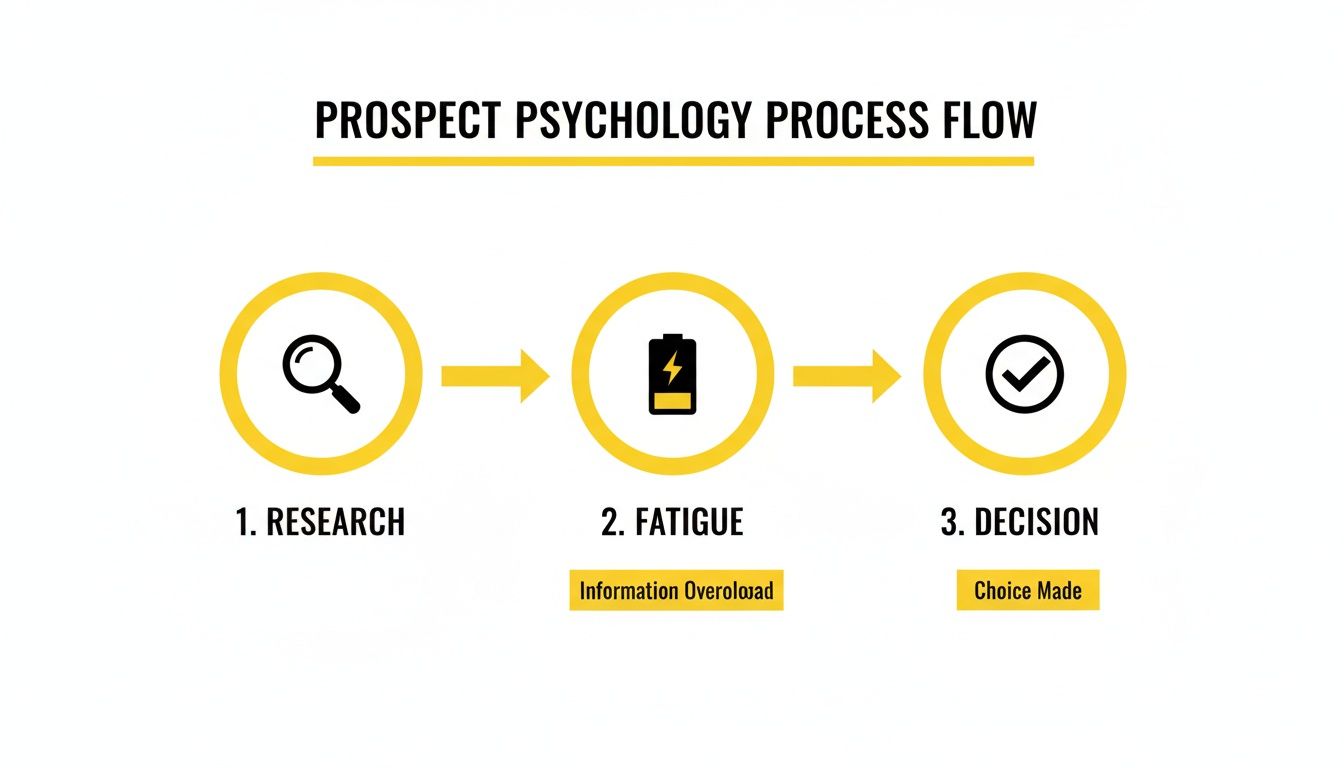
As you can see, by the time a prospect is ready to make a decision, they're often exhausted by information overload. They're just looking for a clear, confident path forward—and you're there to provide it.
In the high-stakes world of B2B, this level of preparation is what separates the winners from everyone else. A whopping 54% of B2B marketers say their biggest challenge is improving lead quality. Yet, companies that use a structured, omnichannel strategy see a 287% increase in response rates. The proof is in the numbers: a well-oiled funnel is the secret to booking high-intent calls.
A meticulously built funnel doesn't just generate leads; it manufactures certainty. By the time a prospect books a call, they should be more afraid of not working with you than they are of making the investment.
Ultimately, your funnel's job is to do all the heavy lifting. It weeds out the tire-kickers, educates the curious, and delivers only the people who are ready to pull the trigger and solve their problem now.
The Anatomy of a High-Converting Sales Call
A perfect one call close doesn't just happen. It’s a carefully choreographed conversation that unfolds in four distinct phases. When you master this playbook, you stop sounding like a salesperson and start acting like an expert consultant—the kind who guides a prospect to the only logical conclusion: your solution.
This isn’t about high-pressure tactics; it’s about precision. Each stage builds on the one before it, creating a natural momentum that makes saying “yes” feel like the smartest move they could make. When you control the flow, you control the outcome.
The Frame: Setting Clear Expectations
Those first ninety seconds? They’re everything. Your immediate job is to take control of the conversation and establish that a decision will be made on this call. Doing this upfront completely dismantles the dreaded "I need to think about it" objection before it even has a chance to surface.
You pull this off by laying out a clear agenda and getting the prospect to agree to it.
Example Script:
"Thanks for making the time today. My goal for this call is pretty simple: first, I want to really dig into what's going on in your business and what you're trying to accomplish. After that, I'll walk you through exactly how we can help. If it feels like a perfect fit, we can talk about getting you started. And if it’s not, for any reason at all, I just ask that you tell me ‘no.’ Sound fair?"
This little agreement is called an "upfront contract." It gives the prospect a sense of control, which lowers their guard and frames the entire call around a definitive outcome. It instantly positions you as a direct, no-nonsense expert who respects their time.
The Diagnosis: Uncovering Deep Pain
Once the frame is set, you pivot into a deep diagnostic. Your mission here is to get past the surface-level issues and uncover the real, emotional pain that's driving them to look for a solution in the first place. Amateurs pitch features; a one call closer unearths expensive problems.
You'll do this with sharp, open-ended questions that get them talking about their current reality and their ideal future.
Pain Questions: "What's the single biggest headache you're dealing with when it comes to [their problem]?" or "Let's be real—what happens if you do nothing and this is still a problem six months from now?"
Desire Questions: "If we were talking a year from now and everything we discussed went perfectly, what would that look like for you?"
The more clearly they can describe their pain and the transformation they want, the more valuable your solution becomes. You're connecting their problem to tangible business costs and very real, personal frustration.
The Solution Bridge: Aligning Your Offer
Okay, you have a crystal-clear diagnosis. Now it’s time to build the bridge to your solution. This isn't where you launch into a generic pitch. It's a targeted presentation that connects every single part of your offer directly back to the pain points and desires they just finished telling you about.
Example Connection:"You mentioned you're losing about 10 hours a week on manual data entry, which is pulling you away from clients. Our automation module is built to eliminate that exact problem, putting those 10 hours right back in your pocket from day one."
This creates a powerful "aha" moment. The prospect stops seeing a product and starts seeing a custom-built cure for their specific illness. You're not selling; you're prescribing.
The Close: Making a Confident Ask
If you’ve nailed the first three stages, the close is the easiest part of the call. You’ve established authority, diagnosed their core problem, and presented the perfect solution. The only thing left to do is make a confident, direct ask for the business. No hemming and hawing.
Example Script:"Based on everything you've shared, this is clearly the solution you need to [achieve their desired outcome]. So, are you ready to move forward with this?"
That directness shows your conviction in your own solution. Remember, that same persistence is crucial just to get someone on the phone in the first place. Top sales pros know that while only 10% of reps make more than three contact attempts, it often takes 6-8 touches to even begin a conversation. To dig deeper into the art of persistence, check out these insights on Factor8.com.
Handling Objections and Closing with Confidence
Even with a perfectly dialed-in funnel, you’re going to get last-minute hesitation. It’s just part of the game. A prospect’s objection isn't a hard "no"—it’s really a request for more information or a bit of reassurance. A true one call closer knows this is where the magic happens, turning that final roadblock into a bridge to a confident “yes.”
Forget about memorizing canned rebuttals. The real skill is diagnosing the issue hiding behind their words. When a prospect says, "I need to think about it," they're rarely planning to sit down and contemplate the meaning of life. They’re usually dancing around a concern about money, trust, or timing that they haven't said out loud.
Your job is to get to the root of that concern with empathy. The goal is never to argue or apply pressure. It’s about understanding their perspective and resolving the final piece of the puzzle they need to commit.
Decoding Common Objections
Most objections boil down to just three core categories. Before you can address them, you have to figure out which one you’re actually dealing with. When a prospect stalls, you need to gently probe to uncover what's really on their mind.
Money Objections ("It's too expensive"): This almost never about the sticker price. It's about value. They haven't fully connected the cost of your solution to the much higher cost of their unsolved problem.
Timing Objections ("I need to think about it"): This is the classic smokescreen. It’s usually hiding an unaddressed fear or a deeper question about whether this will actually work. They need you to lower their perceived risk.
Trust Objections ("I need to check with my partner"): Sometimes this is legitimate, but it often signals a lack of confidence in you, your company, or the solution itself. They need more proof.
An objection is simply a prospect’s way of saying, 'I’m almost there, but there’s one last thing you need to clarify for me.' Your ability to handle it with confidence is what separates amateurs from professional closers.
A Framework for Handling Any Stall
Instead of getting defensive, use a simple, repeatable framework to keep control of the conversation and guide it forward. This approach instantly lowers their guard and makes them feel safe enough to be honest.
Acknowledge and Validate: Start by agreeing with their feeling. Phrases like "I understand" or "That makes sense" immediately disarm them and prove you're on their side, not against them.
Isolate the Real Issue: Now, dig a little deeper with a clarifying question. Try something like, "When you say you need to think about it, what’s the main thing on your mind right now?" This pushes them past the generic stall.
Reframe and Resolve: Once you know the real objection, tie your answer back to the value you’ve already built. If it’s money, re-anchor the price against the cost of doing nothing.
This entire mindset is fueled by resilience. The old-school cold calling mantra—that every 'no' gets you one call closer to a booking—is a powerful way to build the thick skin needed to navigate objections. Embracing that persistence is what separates true one-call closers from the rest of the pack and stops you from putting the wrong people in your calendar. Discover more insights on how resilience fuels sales success here.
Frequently Asked Questions About One Call Closing
Even after you get the framework down, it’s natural to have questions about the one call close. Let's be honest, it’s a big shift from the slow, drawn-out sales cycles most of us are used to.
Let’s tackle some of the most common questions head-on so you can start using this strategy with total confidence. Getting these answers straight will help you see the line between being an efficient closer and just being pushy.
Is a One Call Close Too Pushy for My Industry?
This is easily the biggest hang-up people have, and it almost always comes from a misunderstanding of what a one call closer actually does. This isn't about brute force; it's about surgical efficiency. The "close" feels natural because it’s the end of a very smart marketing funnel that has already done the heavy lifting. It attracts high-intent prospects who want a solution now.
Think about it. For high-ticket services like coaching or consulting, your clients are busy executives and entrepreneurs. The last thing they want is a series of fluffy introductory chats. They've done their homework and are looking for an expert to give them a clear plan, not more meetings.
The secret is to match the buyer's existing momentum. You aren't creating urgency out of thin air; you're just getting out of the way and letting them make a decision they were already primed for.
What if the Prospect Genuinely Needs More Time?
You have to learn to tell the difference between a real logistical hurdle (like needing to move funds or talk to a spouse) and a polite "no" disguised as a delay. If it's a legitimate reason, your job isn't to apply pressure—it's to maintain control of the process.
Never leave the conversation with a vague "get back to me whenever." Lock down their commitment with a firm follow-up call.
Set a specific date and time: "Perfect, let's book a quick 15-minute call for Thursday at 10 AM to get the paperwork finalized."
Define a clear agenda: "On that call, we’ll just confirm the funds are ready and get you officially onboarded."
This shows you respect their situation while keeping things moving forward. If their reason for delaying feels fuzzy or non-committal, it’s almost always a sign there’s a deeper objection you haven’t uncovered yet.
What Key Metrics Should I Track for This Strategy?
Your closing rate is just one piece of the puzzle. To really understand if your one call close system is working, you need to be tracking a handful of critical Key Performance Indicators (KPIs). This is how you spot the weak links in your chain and optimize the whole process.
Tracking the right data turns your sales process from a guessing game into a predictable science. It shows you exactly where your funnel is crushing it and where it needs a little help, which is the key to sustainable growth.
Here’s what you should be watching:
Lead-to-Show Rate: How good is your marketing at getting motivated people to actually show up? This is a huge indicator of lead quality.
Call-to-Close Ratio: This is a pure measure of your closer’s skill and the strength of your sales script.
Average Deal Value: Are the deals you're closing actually profitable? This keeps you focused on the bottom line.
Sales Cycle Length: This is the ultimate proof that you’re hitting the main goal: maximum efficiency.
How Do Paid Ads Fuel a One Call Close Funnel?
Paid ads are the high-octane fuel for a scalable one call close machine. Well-run campaigns on platforms like Google, Facebook, and YouTube let you laser-target the exact audience with sky-high purchase intent. You educate them, build trust, and establish your authority long before they ever get on the phone.
Your ads and landing pages are a one-two punch that pre-frames and pre-qualifies every single lead. By the time someone books that call, they should already be sold on the fact they have a problem and that you are the one to solve it. This groundwork is what makes a one call close not just possible, but the most likely outcome. To get even sharper at sealing the deal, it pays to master some proven closing sales techniques.
At Wojo Media, we live and breathe this stuff. We specialize in building the high-intent funnels that make one call closes the norm, not the exception. We bolt onto your business to craft the offers, landing pages, and ad campaigns that put pre-sold, ready-to-buy prospects on your calendar, week in and week out.
Ready to fill your pipeline with buyers who are ready to commit now? Book a free demo call with our team today and we'll map out a custom advertising strategy to help you scale.
Comments