.png)
Outsourced Appointment Setting That Scales Your Pipeline
- Jason Wojo
- Jan 9
- 14 min read

So, what exactly is outsourced appointment setting?
Simply put, it’s when you hire a specialized agency to take on the all-important job of scheduling qualified sales meetings for your business. This service is the bridge between a raw lead—someone who clicked your ad—and a confirmed appointment on your sales team's calendar. It’s all about turning that initial flicker of interest into a real conversation.
Think of it as a strategic lever you can pull to get the absolute most out of your marketing spend.
The Engine and Transmission of Your Sales Funnel

Imagine your paid ad campaigns on Google or Facebook are a high-performance engine. You're pouring thousands of dollars in fuel to generate raw power, which in this case, is a flood of new leads. But what good is a revving engine without a transmission? That power goes absolutely nowhere.
Outsourced appointment setting is that transmission. It’s the critical component that takes the raw energy from your ads and converts it into forward momentum—turning those expensive clicks into tangible, revenue-generating sales calls.
It’s the solution to one of the most painful problems in marketing today: valuable leads going cold. Someone who clicks your ad is interested right now. But that interest has a short shelf life. An outsourced team jumps on that lead with the speed and persistence needed to lock in a commitment before they get distracted and move on.
What Does This Process Actually Look Like?
The core function is powerful in its simplicity. Instead of letting fresh leads pile up in your CRM, waiting for an already swamped salesperson to maybe get to them, a dedicated setter takes immediate action.
Here’s what that typically involves:
Instant Engagement: They’re on the phone, sending a text, or firing off an email within minutes of the lead coming in.
Qualification: They ask the right questions to make sure the prospect is actually a good fit for what you sell.
Scheduling: They book a confirmed meeting directly onto your sales team’s calendar, no back-and-forth required.
Nurturing and Reminders: They follow up to keep the lead warm, drastically reducing no-shows and making sure people actually attend the call.
This isn't just a generic call center service. It's a strategic operation designed to plug the leaks in your sales funnel. By making sure every single qualified lead is chased down effectively, you maximize the value of every dollar you spend on ads.
This approach is a key part of the booming BPO (Business Process Outsourcing) industry. The global market for call and contact-center outsourcing, which is where most appointment-setting programs live, was valued at a massive $97.31 billion in 2024. It’s projected to explode to $163.86 billion by 2030.
This incredible growth is being fueled by businesses in tech, healthcare, and professional services who understand they need an efficient way to convert high-value leads. To see how this fits into the bigger picture, you can also look into specialized lead generation services.
Comparing Appointment Setting Pricing Models
When you decide to bring on an outsourced appointment setting partner, you’ll find yourself looking at a few different ways they structure their fees. Getting a handle on these pricing models is the first step to finding a partner that actually fits your budget, your appetite for risk, and your real growth goals.
Think of it this way: each model splits the cost and the risk differently. The right choice isn't about which one is "best" in a vacuum, but which one is best for your business right now.
Let's unpack the three main structures you're going to run into.
Pay-Per-Appointment Model
The Pay-Per-Appointment model is as straightforward as it gets. You only open your wallet when a qualified meeting gets successfully booked on your team's calendar. That's it. This is usually the go-to for businesses dipping their toes into the outsourced world for the first time.
The biggest draw here is the near-zero upfront risk. If the agency doesn't deliver, you don't pay. This makes it a perfect fit for companies with high-ticket offers, like a B2B SaaS company, where the value of just one solid, qualified appointment easily covers the higher cost per meeting. The entire focus shifts to landing quality conversations, not just filling up the calendar.
Retainer and Hybrid Models
A retainer model is all about consistency. You pay a fixed monthly fee, and in return, you get a clearly defined scope of work. That could mean a target number of appointments, a specific volume of outreach calls and emails, or a dedicated team member working as an extension of your own. This approach gives you predictable costs and builds a much deeper, more integrated partnership over time.
This is the model for businesses that need a steady, reliable flow of meetings to keep their sales pipeline full. Picture a thriving solar installation company running aggressive ad campaigns—they need a constant stream of homeowner consultations every single week, and a retainer ensures that machine keeps running smoothly.
A hybrid model often gives you the best of both worlds. It usually involves a smaller base retainer fee plus a performance kicker for each appointment that gets booked. This setup is brilliant because it keeps both you and the agency completely aligned and gunning for the same outcome: qualified meetings that turn into real business.
Performance-Based Models
Now, this one sounds a lot like pay-per-appointment, but a true Performance-Based model can be tied to outcomes that are much further down the funnel. Instead of just paying for a booked meeting, you might pay only for appointments that actually show up, or even better, meetings that your sales team officially accepts as a "sales qualified opportunity."
This model creates the tightest possible alignment between the agency's paycheck and your business results. It’s an absolute powerhouse for high-volume campaigns where maximizing ROI is the name of the game. The agency is financially motivated to not just book meetings, but to make damn sure those meetings are with genuinely interested people who show up ready to talk business.
Comparing Outsourced Appointment Setting Models
To make the decision a little easier, we’ve put together a simple table that breaks down how each model stacks up. It’s designed to help you quickly see which approach might be the best starting point for your business based on what you need right now.
Model | Best For | Pros | Cons |
|---|---|---|---|
Pay-Per-Appointment | Testing the waters; businesses with high-ticket sales | Super low financial risk; you only pay for tangible results | Higher cost per meeting; the volume can be unpredictable |
Retainer/Hybrid | Businesses that need a consistent and predictable lead flow | Predictable monthly costs; builds a deeper partnership | You pay a fixed fee even if performance dips one month |
Performance-Based | High-volume campaigns; businesses focused on scaling fast | Incredible alignment on goals; hyper-focused on quality | Can get complex to structure the deal; requires crystal-clear definitions of success |
Ultimately, there's no single "right" answer. The best model is the one that gives you the right balance of risk, predictability, and performance to fuel your sales team and hit your revenue targets.
Calculating The True ROI Of Outsourcing
To really build a rock-solid case for outsourced appointment setting, you’ve got to look past the surface-level benefits and get into the actual financial return. Think of it less like an expense and more like a high-leverage investment—one designed to multiply the effectiveness of your entire marketing engine. A clear cost-benefit analysis shows just how powerful this move can be.
First things first: you need to compare the cost of an agency against the true, fully loaded cost of hiring someone in-house. A lot of business owners just look at the base salary, but the real number is always much, much higher.

The Hidden Costs Of An In-House Team
When you bring on an employee, the expenses pile up way beyond their paycheck. You're on the hook for a whole range of other costs that hit your bottom line directly.
These "hidden" expenses include:
Benefits and Payroll Taxes: Health insurance, retirement plans, and taxes can easily tack on an extra 25-40% to a base salary.
Recruiting and Onboarding: The time and cash you burn finding, interviewing, and training a new hire is a significant, often overlooked cost.
Software and Equipment: CRM licenses, dialing software, headsets, and computers all have to come from somewhere.
Management Overhead: A manager has to spend serious time coaching, checking performance, and giving feedback. That’s time they aren't spending on other high-value tasks.
A typical in-house setter in North America might pull a base salary of $35,000–$50,000, but their fully loaded annual cost can quickly balloon into the $43,750–$70,000 range. Compare that to outsourced programs, where you often pay per appointment, creating a direct line between what you spend and the results you get. One analysis found that outsourcing can slash the cost per B2B lead by about 33% compared to keeping it in-house. You can dive into a deeper ROI analysis to see how these numbers really stack up for your business.
Tying Outsourcing To Key Financial Metrics
The real magic happens when you connect outsourced appointment setting directly to your main financial KPIs. This isn't just about booking meetings; it's about making your ad spend work harder and smarter for you.
Outsourcing is a direct investment in lowering your Cost Per Acquisition (CPA) and jacking up your Return on Ad Spend (ROAS). By making sure more of your hard-won leads actually turn into qualified sales conversations, you squeeze every last drop of value out of every dollar you spend.
Let's run the numbers with a real estate firm. Say they drop $5,000 on ads and get 100 leads. Their in-house team is slammed and only converts 5 of them into appointments, which leads to one closed deal and a $10,000 commission. Their ROAS is 2x. Not bad, but not great.
Now, imagine they bring in an outsourced team that converts 20 of those same leads into solid, qualified appointments. If their closing rate stays the same, that translates to four deals and $40,000 in commission—all from the same $5,000 ad spend. Suddenly, their ROAS jumps to 8x. This is exactly how you turn a marketing line item into a predictable revenue generator.
Key Performance Indicators You Must Track
When you bring on an outsourced appointment setting partner, it’s easy to get lost in the weeds. Numbers like "dials made" or "emails sent" might look impressive on a report, but they're just vanity metrics. They show activity, not achievement.
True success is measured by the numbers that directly feed your pipeline and prove your investment is actually paying off. Focusing on the right Key Performance Indicators (KPIs) is the only way to hold your partner accountable, spot problems before they snowball, and make sure the service is driving real, profitable growth. It’s the difference between paying for busyness and investing in results.

Core Metrics That Define Success
So, let's cut through the noise and talk about the KPIs that actually matter. These are the numbers that paint a clear picture of your campaign’s health, from the first booking all the way to a real sales opportunity.
Show Rate: This is the ultimate gut-check for appointment quality. It’s simply the percentage of booked meetings that prospects actually show up for. A high show rate tells you your partner is setting meetings with people who are genuinely interested and ready to talk.
Appointment-to-Opportunity Rate: This metric answers the big question: are these leads actually qualified? It tracks the percentage of attended meetings that your sales team officially accepts as sales-qualified opportunities. This is your most critical checkpoint on lead quality.
Cost Per Attended Appointment: Here's where the rubber meets the road financially. You take your total spend on the service and divide it by the number of meetings that actually happened. This KPI gives you a hard, tangible cost for every real conversation your team has.
Setting Realistic Performance Benchmarks
Knowing what to track is one thing, but knowing what "good" looks like is another game entirely. Without the right benchmarks, you have no way of knowing if your partner is crushing it or just treading water.
An 80% show rate is a strong target for most businesses using outsourced appointment setting. If your rate is consistently dipping below this, it’s a massive red flag that something is wrong with either the lead quality or the follow-up process.
From a performance standpoint, a good outsourced partner completely changes the math of your B2B funnel. Specialized providers will tell you that a “good” appointment show rate hovers around 70%, with top-tier programs pushing past 85%.
Even better, a well-run campaign should see an appointment-to-opportunity conversion rate in the 40–60% range. The real value you get from outsourcing is that these firms live and breathe micro-optimizations—things like call timing, follow-up cadences, and channel mix—because they know every single percentage point translates into real revenue. To discover more insights on professional appointment setting ROI, it's worth digging into the numbers.
By tracking these outcome-focused metrics, you shift the entire conversation from "How many calls did you make?" to "How much qualified pipeline did you build?" That's how you ensure your partnership is 100% focused on driving measurable growth for your business.
How To Choose The Right Appointment Setting Partner
Let’s be real: picking an outsourced appointment setting partner is one of the most important calls you’ll make. This isn't just about hiring a service. You’re bringing someone new onto your sales team—an extension of your brand that will be the first point of contact for potential customers.
A great partner gets in the trenches with you, fully integrating into your workflow and genuinely caring about your growth. The wrong one? They’ll burn through your ad spend, frustrate your team, and could even do some serious damage to your reputation. This isn’t about finding the cheapest dialers. It's about finding a strategic ally who understands your business, gets your customers, and is obsessed with hitting your goals.
Your Vetting Checklist Non-Negotiables
Before you even think about signing a contract, any potential partner has to nail every single item on this list. Think of these as the absolute, must-have foundations for a successful relationship. Skip one, and you’re setting yourself up for a world of headaches.
Here’s what you need to look for:
Proven Industry Specialization: Ask for case studies and testimonials from businesses just like yours. An agency that crushes it for local med spas probably doesn’t speak the same language as a B2B SaaS company. You need someone who knows your world.
Seamless CRM Integration: Can they plug right into your existing CRM, whether it’s HubSpot, GoHighLevel, or Salesforce? Manual data entry is a nightmare waiting to happen, leading to lost leads and messy, unreliable reporting.
Transparent Communication: What’s the game plan for communication? How often will you meet? Who’s your go-to person? You need a crystal-clear communication rhythm established from day one.
As you’re digging in, don't forget to look at their operational backbone. Their tech stack makes a huge difference, and their results often come down to choosing the best outbound call center software.
Critical Red Flags To Watch Out For
Knowing what you want is only half the battle. You also have to know what to run away from. Some red flags are so bright they should be instant deal-breakers, often signaling an agency that cares more about their bottom line than your success.
Run, don't walk, from any agency pushing a one-size-fits-all package. Your business is unique, and your appointment setting strategy should be, too. If they won’t customize scripts or listen to your feedback, it’s a clear sign they see you as just another contract.
Keep an eye out for these other warning signs:
Vague or Unverifiable Case Studies: If they can’t show you hard numbers and specific examples of their wins, it’s because they don’t have any.
An Unwillingness to Adapt: A true partner works to fit into your sales process. They shouldn’t be forcing you to change everything to fit their model.
Overly Aggressive Sales Tactics: Pay close attention to how they sell to you. If their own process feels pushy and impersonal, just imagine how they’ll treat your hard-earned leads.
Ultimately, finding the right fit is about strategic alignment. You need a partner who has the tools, the team, and the motivation to go all-in on your success.
Integrating Appointment Setters Into Your Sales Funnel
This is where the rubber meets the road. Bringing an outsourced appointment setting team into the fold isn’t about bolting on a new department. It’s about seamlessly plugging them into your existing marketing and sales machine.
When you get this right, you create a smooth, predictable system for turning ad clicks into revenue. It’s less of an addition and more of a critical upgrade to your entire funnel.
Think of it like a relay race. Your paid ads run the first leg, grabbing a lead's attention and getting them to raise their hand. The second they fill out a form, they pass the baton to your outsourced setter. That setter’s job is to sprint—engaging immediately to qualify the lead and book a solid meeting. The final leg is handing that confirmed appointment off to your sales team to bring it home.
The Lead-to-Appointment Workflow
The whole game is about creating a clean, automated path for every single lead. The moment a prospect hits ‘submit’ on your landing page, a webhook should instantly fire off their info to both your partner’s system and your CRM. That’s the starting gun for your setter, who should be engaging within minutes, not hours.
From there, the communication has to follow a proven cadence.
For a Local Service Business: A friendly, benefit-focused text message is killer. Something like: "Hey [Name], just saw you requested info on our solar panels! My name is Sarah. Do you have a quick minute to see if we can slash your power bill?" It’s direct and gets right to the point.
For a B2B Consultant: You'll want a slightly more formal, value-driven approach. For instance: "Hi [Name], thanks for downloading our guide on scaling ad spend. I'm with Wojo Media. I have a few ideas on how this applies to [Their Company]. Are you open to a brief call next week?" This positions you as an expert from the first touch.
This flow chart breaks down the three essential stages for bringing a partner on board successfully.
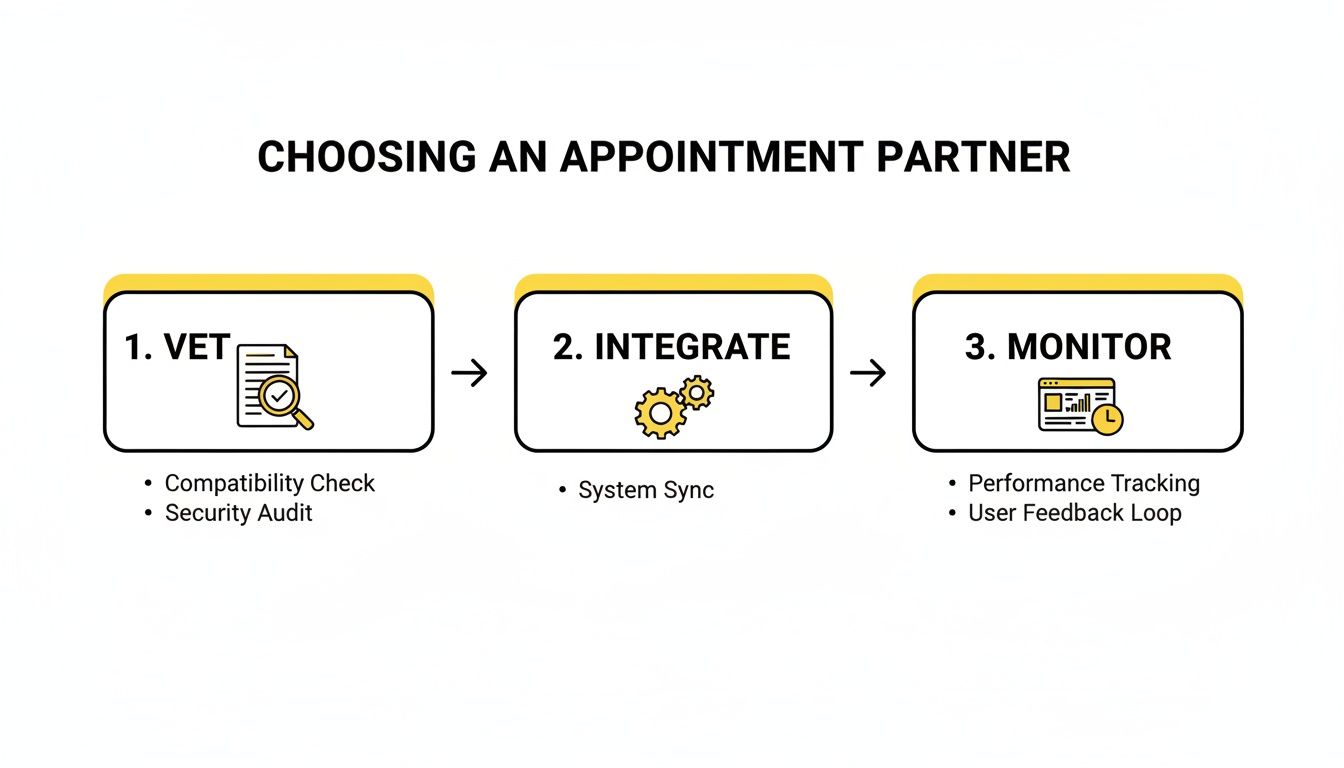
As you can see, success starts with doing your homework and vetting partners carefully. From there, it moves into the technical setup, and finally, it depends on keeping a close eye on performance. Each step is absolutely critical if you want to build a frictionless system that turns leads into qualified meetings.
Answering Your Lingering Questions About Outsourced Appointment Setting
Even when the benefits seem clear, it's smart to have a few questions before you bring on an outsourced appointment setting partner. We get it. Let’s tackle some of the most common things business owners ask, so you can move forward feeling confident this is the right play.
One of the biggest hurdles is trust. How can you be sure an outside team will represent your brand's voice and protect the reputation you've worked so hard to build? A top-tier partner won't just grab a generic script and start dialing. They dive deep. The onboarding process is an immersive experience where they learn your company culture, your unique value proposition, and exactly who your ideal customer is. The goal is to become a true extension of your team, not just a hired gun.
How Much of My Time Will This Actually Take?
This is the second most common question, and for good reason. You’re looking to outsource to save time, not add another major task to your plate. But a little bit of involvement upfront is absolutely critical to get things off the ground correctly. You should plan on setting aside a few hours for the initial strategy and onboarding sessions.
Once things are up and running, your role pivots from setup to oversight. It’s pretty straightforward and typically looks like this:
A quick weekly check-in call to go over performance and KPIs.
Giving feedback on the quality of appointments to help them sharpen their targeting.
Weighing in on script or messaging tweaks as the campaign evolves.
Don't think of it as a new daily chore, but more like a strategic checkpoint. You’re the one providing the high-level direction, and your partner is in the trenches handling the day-to-day work. This keeps the whole operation aligned with your goals without bogging you down.
This kind of strategic oversight is where the magic happens. You’re not managing dialers; you're guiding a critical piece of your sales pipeline. A great partner makes this incredibly efficient, giving you the biggest impact for the least amount of time. They should be bringing you data-backed insights and smart recommendations, not a list of problems to solve. It’s the difference between having to row the boat and just steering the ship.
At Wojo Media, we don't just run ads; we build omnipresent campaigns designed to turn clicks into qualified sales appointments. If you're tired of an empty calendar and ready for predictable, profitable growth, it's time to talk. Book a free demo call with our team and see how we can build a custom paid ads strategy for you.
Comments