.png)
Outsourced inside sales: Scale Revenue with Expert Teams
- Jason Wojo
- Jan 2
- 16 min read

Think of outsourced inside sales as hiring a specialist team to handle the heavy lifting of your sales process—specifically, engaging leads and booking appointments. This lets your star players focus on what they do best: closing deals, not chasing down prospects. It’s all about turning that initial marketing spark into a real, qualified sales opportunity.
What Exactly Is Outsourced Inside sales?
Imagine you’re throwing a 500-person gala. Would you try to cook all the food, serve the drinks, and mingle with every guest? Of course not. You'd be spread so thin that both the food and the conversations would be mediocre at best.
You’d hire a professional catering crew. That's the same logic behind outsourced inside sales. You're bringing in a specialized team to handle the complex, time-consuming work of nurturing leads so your core team can focus on building relationships and closing business.

Unlike old-school field sales that relied on handshakes and in-person meetings, inside sales is all done remotely. These teams use a modern toolkit of communication channels to connect with potential customers from anywhere.
The go-to channels for inside sales usually include:
Phone Calls: For direct conversations and critical follow-ups.
Email Sequences: To nurture leads over time with automated, yet personalized, outreach.
Social Media: Engaging prospects on platforms like LinkedIn to build real rapport.
Video Conferencing: For virtual demos and face-to-face sales presentations.
This remote-first approach makes it an incredibly efficient and scalable model, whether you're an e-commerce brand or a local service provider.
The Role of Buyer Intent
One of the most crucial jobs for an outsourced inside sales team is to jump on buyer intent. Think of buyer intent as the digital breadcrumbs a potential customer leaves behind, signaling they're actively looking for a solution just like yours.
These signals can be obvious, like filling out a contact form, or more subtle, like visiting your pricing page three times in a week.
When your marketing—like paid ad campaigns—generates these signals, the outsourced team needs to act fast. Their mission is to engage these warm leads while interest is red-hot, turning a simple click into a meaningful sales conversation.
An outsourced inside sales team is the essential bridge connecting your marketing spend to your revenue. They make sure the interest your ads generate doesn't just fizzle out but gets converted into solid appointments for your closers.
From Lead to Qualified Appointment
But it's not just about making contact. A great outsourced partner runs a tight qualification process. They know the right questions to ask to dig into a lead's needs, budget, and timeline, making sure only genuinely interested and qualified prospects get passed on.
This filtering is priceless. It stops your top salespeople from wasting their days on dead-end calls, which massively boosts their efficiency and close rates. You’re essentially handing them a calendar packed with pre-vetted meetings, empowering them to live in their zone of genius: driving revenue. This systematic approach is what turns outsourced inside sales into a powerful growth engine.
Exploring Different Outsourced Sales Models
Picking an outsourced inside sales partner isn't like grabbing a single tool from a toolbox; it's more like choosing the right blueprint for the whole project. The model you go with will directly shape your budget, how fast you can scale, and the kind of results you can realistically expect. Let's break down the three main frameworks to help you find the perfect fit.
Each of these models offers a totally different way to build your sales pipeline. Some are built for rapid growth, while others are better for targeted, short-term pushes. Getting a handle on these differences is the first real step toward a partnership that actually pays off.
The Full-Service SDR Team Model
Think of this as getting a complete, ready-to-go sales development department delivered to your doorstep. The Full-Service SDR Team is exactly what it sounds like: a comprehensive solution where the partner firm provides a dedicated team of Sales Development Reps (SDRs), along with the management, tech, and proven processes to make them effective.
This team essentially becomes an extension of your own company, handling everything from qualifying leads and outreach to getting appointments on the calendar. It’s the most hands-off option for you, since the vendor takes care of all the day-to-day operations—hiring, training, performance reviews, you name it.
This model is a fantastic fit for:
High-growth SaaS or e-commerce companies that need to pour fuel on their sales fire without getting bogged down by HR and operational headaches.
Businesses breaking into new markets that need an expert team ready to hit the ground running from day one.
Companies with a steady stream of marketing leads that need a dedicated crew to turn that interest into qualified sales meetings.
This all-in-one approach is built for pure speed and scale. It's like franchising a successful system—you plug into a model that works and get predictable results, all without having to build the entire operation from scratch.
The Managed Campaign Model
If the full-service team is a long-term strategic alliance, the Managed Campaign model is more like a targeted, tactical strike. It's project-based, designed to hit a specific, time-sensitive goal. Instead of committing to a whole team, you’re paying for a focused campaign to support a particular initiative.
This is a much more flexible and often lower-cost way to dip your toes into outsourced sales. It lets you test the waters or just give your in-house team a boost during a critical period. The focus is razor-sharp, and the deliverables are crystal clear from the get-go.
Here’s where a Managed Campaign really shines:
Product Launches: You need to drive a ton of initial interest and book demos for a new software feature.
Event Promotion: A local med spa needs to fill seats for a promotional webinar or an open house.
Seasonal Offers: An e-commerce brand wants to push a holiday sale to a very specific customer segment.
This model gives you surgical precision. You can put resources exactly where you need them, right when you need them, making it a powerful tool for any business that values agility.
The Hybrid Onshore and Offshore Model
The Hybrid Onshore/Offshore Model is a smart blend designed to give you the best of both worlds: cost-effectiveness and market-specific expertise. It strategically splits up tasks based on where they can be done most efficiently without letting quality slip.
Typically, the work that requires deep cultural understanding and language nuance—the customer-facing stuff—is handled by an onshore team. For instance, an SDR based in the United States would handle the direct calls and follow-up chats with North American prospects.
At the same time, crucial but less customer-facing tasks get managed by an offshore team, often in a different time zone. This work could include:
Lead Research and List Building: Digging up contacts and enriching data.
Data Cleansing: Making sure the info in your CRM is actually accurate and up-to-date.
Initial Email Outreach: Sending out the first wave of templated emails to get the ball rolling.
This setup allows you to tap into global talent pools, leading to major cost savings on operational work. All the while, you can rest easy knowing that your most important, revenue-driving conversations are in the hands of local experts. It’s a powerful way to optimize your sales budget without ever compromising the quality of your prospect interactions.
In-House Versus Outsourced Teams A Clear Comparison
Deciding whether to build your own sales team or bring in an outside partner is one of those critical moments for any growing business. It’s not just a budget decision; it’s a strategic choice that dictates your speed, your costs, and how quickly you can scale. The path you take determines how you turn marketing buzz into actual revenue.
On one hand, you have the slow-and-steady process of building from the ground up. On the other, you have immediate access to a pre-built growth engine. Let's dig into what each approach really looks like.
The Case For An In-House Sales Team
Building an in-house team is like planting a garden from seed. It takes a ton of upfront work, but the result is a group of people completely embedded in your company culture. They live and breathe your brand, bringing a level of passion and deep product knowledge that’s tough to get any other way.
You also get total, hands-on control. You’re in charge of every bit of training, you set the daily priorities, and you can change strategies instantly. For businesses with really complex products or those in niche markets where that deep institutional knowledge is everything, that direct oversight is gold.
But that control comes with a lot of hidden costs that go way beyond just salaries:
Recruitment: The time and money poured into finding, interviewing, and hiring good people.
Training and Onboarding: It can take months to get new hires fully productive, which means a long delay before you see any return.
Technology Stack: The licenses for CRMs, sales engagement tools, and dialers stack up fast.
Management Overhead: A manager's salary and all the time they spend coaching and supervising is a massive, ongoing expense.
When you add it all up, building an in-house team can be a slow and expensive road, especially if you need to make things happen now.
The Power Of An Outsourced Inside Sales Partner
Working with an outsourced inside sales team is like plugging into the city’s power grid. You get electricity right away without having to build the power plant yourself. This model is all about speed, efficiency, and scale, letting you launch a professional sales effort in weeks, not months.
An outsourced team hands you a turn-key system. You get trained professionals, proven processes, and an optimized tech stack, all ready to start booking qualified appointments from day one. It completely skips the ramp-up time and the huge upfront investment of hiring.
The market numbers show this isn't a niche idea. The global sales and marketing outsourcing market, which includes inside sales, hit USD 25,734.3 million in 2024 and is projected to rocket to USD 44,608.8 million by 2030. That explosive growth is happening because executives are finding that outsourcing frees them up to focus on what they do best—running their core business.
This chart helps break down the decision-making process for choosing the right outsourced model for your specific needs.
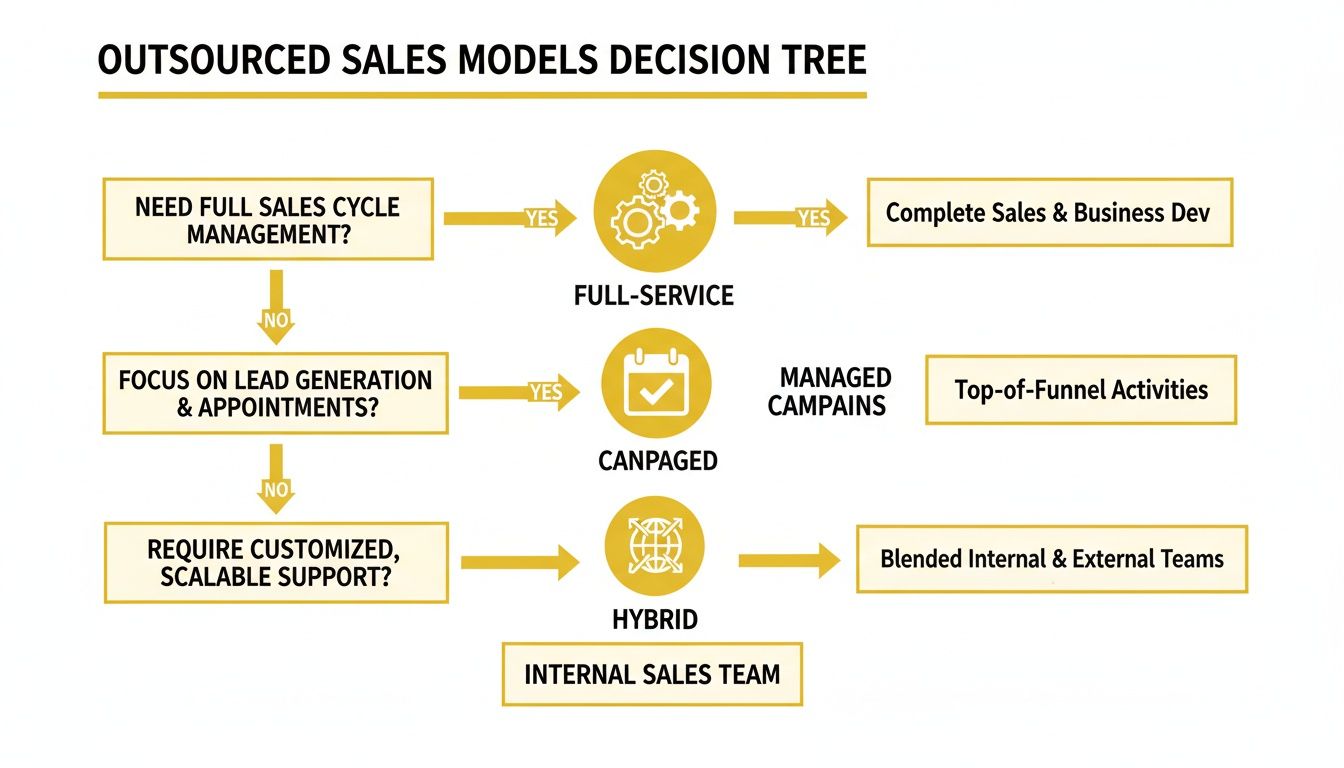
As you can see, different goals point to different solutions—like a Full-Service model for aggressive scaling, Managed Campaigns for hitting specific targets, or Hybrid models to balance cost and control.
Making The Right Choice For Your Business
Choosing to go in-house or outsource is a big decision with real consequences. To make it easier, here's a side-by-side look at the key factors.
Comparing In-House vs. Outsourced Inside Sales Teams
Factor | In-House Team | Outsourced Team |
|---|---|---|
Speed to Launch | Slow (3-6 months) | Fast (2-4 weeks) |
Upfront Costs | High (recruitment, tech, salaries) | Low (setup fees, first retainer) |
Expertise | Developed over time | Immediate access to specialists |
Scalability | Slow and costly to scale up or down | Flexible and rapid scaling |
Control | Full, direct control over daily tasks | Strategic oversight; less direct control |
Cultural Fit | Deeply integrated with company culture | Acts as an extension of your team |
Tech Stack | You purchase and manage all tools | Included in the service package |
Management | Requires a dedicated internal manager | Managed by the partner agency |
Ultimately, the best choice depends on what your business needs most right now.
The biggest hurdle with outsourcing is making sure the partner is perfectly aligned with your brand. You need someone who will invest the time to truly understand your voice, your values, and your ideal customer. Strong communication and a clear onboarding process are non-negotiable to make the outsourced team feel like a seamless part of your own company.
For a deeper look at the numbers and a cost-benefit breakdown, this comparison of a Cold Email Agency vs. In-House SDR is a great resource. In the end, it boils down to your company's stage and resources. If you have the time and capital to invest for the long haul, an in-house team offers unmatched integration. But if speed, cost-efficiency, and immediate expertise are what you need, an outsourced partner is a powerful way to accelerate your growth.
A Blueprint For Implementing Your Outsourced Team
Bringing on an outsourced inside sales team is a lot like hiring an expert architect and construction crew to build an extension on your house. You wouldn’t just hand over the keys and hope for the best; you’d give them a detailed blueprint. A successful launch demands a clear, actionable roadmap that takes the guesswork out of the equation and gets both teams on the same page from day one.
This blueprint is what ensures your new team feels like a natural part of your brand, not just some separate company making calls. The whole point is to create a seamless handoff from your marketing efforts to their sales outreach, turning warm leads into qualified appointments without missing a beat.

Stage 1: The Strategic Kickoff
This first phase is all about alignment. Before a single call gets made, you and your new partner need to agree on the goals, the targets, and what "success" actually looks like. Getting this foundation right prevents a world of headaches and costly miscommunications down the line.
Your initial kickoff meeting should nail down:
Key Performance Indicators (KPIs): Define the metrics that matter most, like appointments set per week, cost per appointment, and your lead-to-meeting conversion rate.
Ideal Customer Profile (ICP): Get really specific here. Go beyond just industry and company size to outline the exact pain points, job titles, and buying triggers of your perfect customer.
Technology Integration Plan: Map out precisely how leads will flow from your systems (like your CRM or ad platforms) straight to the outsourced team. This means setting up access, testing the connections, and making sure all the data syncs up properly.
Stage 2: Building The Sales Playbook
With your strategy locked in, it's time to build the operational playbook. This is the collection of scripts, templates, and processes the sales team will live by every single day. Your outsourced partner should take the lead, but your input is vital to make sure everything sounds and feels like your brand.
A well-defined playbook is the difference between a team that sounds like knowledgeable insiders and one that sounds like generic telemarketers. It's the core of a successful outsourced inside sales program.
This stage is a deep collaboration on:
Script and Sequence Development: Work together to craft compelling call scripts, email templates, and LinkedIn messages. These need to capture your brand’s unique voice and spell out your value proposition clearly.
Objection Handling: Think of every possible objection a prospect could throw out ("it's too expensive," "we're already using a competitor") and develop smart, effective responses for each one.
Communication Workflows: Establish a clear rhythm for how you'll talk to each other. Set up a shared Slack channel, schedule weekly check-in calls, and agree on what daily or weekly reports will look like.
Stage 3: Onboarding And Final Go-Live
The final stage is all about immersion and training. This is where your new team truly learns to think, speak, and act like they’re part of your company. A thorough onboarding process isn't just nice to have—it's non-negotiable for long-term success.
The training should cover your company history, culture, deep product knowledge, and the competitive landscape. The goal is for them to internalize your brand's story so they can tell it with confidence and authenticity.
This trend toward deeper integration is quickly becoming the industry standard. Back in 2022, a record 73% of global tech companies were already using hybrid sales models that mixed in-house and outsourced teams. This shift shows a growing recognition that external teams are essential for scaling growth, especially as talent shortages and rising costs make it tough to do it all alone. You can find more insights about this growing trend in outsourced sales.
Once the training is done and all the systems are tested, you're ready to go live. The blueprint you've built together ensures that from the very first day, your outsourced inside sales team is equipped, aligned, and ready to start filling your calendar with qualified appointments.
How To Choose The Right Outsourced Sales Partner
Picking an outsourced inside sales partner is one of the biggest growth decisions you'll ever make. Get it right, and you’ve got a powerful extension of your brand, cranking out qualified opportunities and filling your pipeline. The wrong choice, however, can burn through your budget, tarnish your reputation, and set you back for months.
Making the right call isn’t about falling for a slick sales pitch. It requires a real evaluation process where you dig into what actually drives results. A great partner isn't just a vendor; they’re a strategic ally who’s genuinely invested in seeing you win.
Vetting Your Potential Partners
First things first, you need to look at a potential partner’s track record and expertise. Proven experience in your world—whether that's e-commerce, local services, or coaching—is an absolute must. An agency that already gets the nuances of your market can craft messaging that actually connects with your ideal customers from day one.
Ask to see a portfolio of client case studies with tangible results. You're looking for proof they can deliver what you need, such as:
Hard ROI numbers: Can they show you a clear return on investment for past clients?
Relevant success stories: Do they have examples of scaling businesses just like yours?
Their tech stack: What sales engagement tools and CRM integrations do they use to stay efficient and fast?
Transparent reporting: How do they track success, and what will your dashboard actually look like?
If you’re focused on outsourcing just the top of your funnel, digging into the specifics of how to outsource lead generation, covering best vendors, pricing, and metrics can give you a solid framework for this evaluation.
A partner’s real value isn't just in the dials they make, but in the strategic system they bring to the table. This means their tech, their processes, and their ability to get fluent in your business—fast.
The market for these services is huge, especially in North America, which accounts for 42% of global outsourced sales spending and leads B2B inside sales outsourcing with a 40% market share. For us at Wojo Media, this means there's a deep pool of vendors, but it also makes rigorous vetting essential to find partners who can reliably turn ad-generated leads into booked calls—a process we've proven out over 17,000 campaigns. You can learn more about these global sales outsourcing trends to get a better feel for the landscape.
Scrutinizing The Contract And SLA
Once you have a shortlist, your focus needs to shift to the contract and the Service Level Agreement (SLA). This document is your ultimate safety net, and it needs to clearly spell out expectations, responsibilities, and performance guarantees. Don't just skim it.
Pay extra attention to these key pieces of the contract:
Performance Guarantees: The SLA needs to define what success looks like with specific, measurable metrics. This could be a guaranteed number of qualified appointments set per month or a target cost-per-lead.
Data Security Measures: How are they going to handle your customer data? Make sure they have solid security protocols in place to protect your business and your clients' private information.
A Clear Exit Clause: What happens if the partnership just isn't working out? A fair contract will always include a clear and reasonable exit clause, letting you terminate the agreement without getting hit with insane penalties.
Asking the right questions here is everything. By thoroughly vetting their expertise and combing through the contract, you can confidently pick an outsourced sales partner who’s focused on delivering a real return, not just keeping busy.
Measuring Success With KPIs And Pricing Models
You can't improve what you don't measure. When you bring on an outsourced inside sales team, success isn't about gut feelings or how busy they seem—it’s about hard data.
Laying out clear key performance indicators (KPIs) and understanding the money side of things are non-negotiable. Without that clarity, you’re just paying for activity, not actual results. Let's dig into the metrics that really move the needle and the common ways these services are priced, so you know exactly what to look for.
Core KPIs To Track
Forget vanity metrics like how many dials someone made today. Your focus needs to be on a handful of KPIs that draw a straight line from your outsourced team's effort to your bottom line. These are the numbers that tell the real story.
The most important KPIs for outsourced inside sales include:
Cost Per Lead (CPL): This is all about efficiency. It’s calculated by dividing your total campaign cost by the number of leads it brought in. Simple, but powerful.
Cost Per Appointment Set: This is the ultimate report card for an appointment-setting team. It tells you precisely how much you spent to get a qualified prospect on the calendar.
Lead-to-Appointment Rate: This percentage is a window into lead quality and the skill of the SDRs. A high rate means they’re masters at turning a flicker of interest into a real meeting.
Return on Investment (ROI): The final verdict. This is where you compare the revenue from deals that closed (thanks to your outsourced team) against what you paid for the service.
By focusing on these core metrics, you shift the conversation from "how many calls were made?" to "how much revenue did our investment produce?" This is the only framework that matters for sustainable growth.
Understanding Pricing Models
Outsourced sales partners generally operate on one of three pricing structures. Each has its place, and the right fit depends on your budget, how much risk you're willing to take, and what you’re trying to achieve.
Pay-Per-Performance: In this model, you pay a set fee for each qualified appointment they book. It's a low-risk way to directly tie your costs to tangible outcomes. No results, no fee.
Monthly Retainer: Here, you pay a fixed monthly fee for a dedicated team or a specific amount of work. This gives you predictable costs and works great for long-term, ongoing sales campaigns.
Hybrid Model: A popular blend that combines a lower monthly retainer with performance bonuses for hitting specific targets. It gives you the stability of a retainer while lighting a fire under the team to perform at their best.
Real-World ROI Examples
Let’s see what this looks like in the wild:
An E-commerce Brand: They hired a team on a hybrid model to follow up on abandoned shopping carts. The brand paid a small retainer plus a bonus for every recovered sale, hitting a 3x ROI in the first three months.
A Local Med Spa: This business used a pay-per-performance model to book consultations for a new service. They only paid for qualified appointments, which meant every single dollar spent was directly tied to a potential new client walking through the door.
A Business Coach: He brought on a team with a monthly retainer to qualify leads coming in from a webinar funnel. This freed him up to focus only on strategy sessions with high-value prospects, boosting his close rate by 40%.
Got Questions About Outsourced Inside Sales? We’ve Got Answers.
Even when you have a solid plan, jumping into a partnership with an outsourced inside sales team can feel like a big step. It’s natural to have a few nagging questions. Let's tackle them head-on, so you can move forward with confidence and set things up for a win right from the start.
Here are some of the most common things business owners ask before they pull the trigger.
How Long Until They’re Up and Running?
This is a big one. While it always depends a bit on how complex your product is, a well-oiled onboarding process usually takes about two to four weeks. Think of this as a boot camp, not just a paperwork drill. It’s an intense period of deep learning and integration.
During this critical time, your new team will be:
Diving deep into your brand voice, getting to know your offers inside and out, and profiling your ideal customers.
Working with you to build and polish the actual call scripts and email sequences they’ll be using.
Plugging directly into your CRM and other tech to make sure every lead flows smoothly without a hitch.
Any professional partner worth their salt will have a documented plan to get their team up to speed and delivering real results fast, without cutting corners on quality.
Will They Really Understand My Niche Business?
Top-tier outsourced teams are masters of rapid immersion. It’s what they do. Through a dedicated onboarding process, ongoing training, and constant communication, they are literally built to become experts in your market and product.
Frankly, their singular focus on sales execution often brings a level of discipline that’s tough to replicate with a less experienced in-house hire who's juggling multiple hats.
The trick is to pick a partner whose absolute number one priority is becoming a seamless extension of your brand. Their success is completely tied to how well they can represent you.
How Do They Plug Into Our Marketing Efforts?
This is where the magic happens. A tight, seamless integration is non-negotiable. Your outsourced partner should connect directly into your CRM and lead funnels to create a powerful, closed-loop system.
When a new lead clicks on one of your paid ads, for example, it should be instantly routed to the outsourced SDR for immediate follow-up. This is usually handled through an API or a tool like Zapier.
This also creates a powerful feedback loop. The sales team can report back to marketing on which leads are gold and which are duds. That intel allows you to constantly fine-tune your ad targeting and messaging, making your entire growth engine work together in perfect harmony.
At Wojo Media, we specialize in building omnipresent ad campaigns that deliver a steady stream of high-quality leads. But we know that leads are just the beginning—turning them into revenue requires a world-class sales process.
Book a free demo call with us, and we’ll design a custom paid ads strategy to fill your pipeline with opportunities your sales team will love.
Comments