.png)
Outsourcing Appointment Setting to Scale Your Sales Pipeline
- Jason Wojo
- Feb 15
- 18 min read

Handing off your appointment setting isn't just about delegating a task anymore. It's a strategic move where you bring in a specialized external agency to manage the whole nine yards—from finding and vetting prospects to getting qualified sales meetings on the calendar.
This lets your in-house sales team do one thing and one thing only: close deals. They're freed from the grind of prospecting and cold outreach.
Why Outsourcing Appointment Setting Is Now a Growth Lever

The conversation has totally shifted. It's no longer if a business should outsource appointment setting, but how to do it right. With budgets getting tighter and every dollar needing to prove its ROI, companies are looking for smarter, more efficient ways to get in front of qualified buyers.
That's where outsourcing stops being a simple cost-cutting tactic and becomes a powerful engine for predictable growth.
Instead of building a team from the ground up—a messy process full of high costs, long training periods, and management headaches—you can plug directly into a ready-made machine. This move liberates your most valuable players, your closers, from the burnout of prospecting. They get to do what they do best: talk to warm, qualified leads and bring in revenue.
The Strategic Shift from Cost Center to Revenue Driver
Sales development used to be seen as a necessary evil—an expensive, clunky part of the sales machine. Outsourcing flips that script entirely. It turns what was a fixed overhead cost into a flexible, performance-based investment.
You’re not just paying for someone to make calls; you’re paying for results. You're paying for qualified meetings to show up on your calendar. This model just makes sense.
Immediate Expertise: You get instant access to seasoned pros who live and breathe outreach, qualification, and scheduling.
Enhanced Scalability: Need to ramp up for a product launch? Or dial back during a slow season? You can scale your efforts up or down almost overnight, without theHR drama.
Improved Focus: Your internal team can pour 100% of their time into high-value work, like running killer demos and closing contracts.
In-House vs Outsourced Appointment Setting at a Glance
Deciding between building your own team and hiring an agency is a huge decision. To make it clearer, here’s a quick breakdown of what you're looking at with each option.
Factor | In-House Team | Outsourced Service |
|---|---|---|
Cost Structure | High fixed costs (salaries, benefits, tools) | Variable, performance-based costs |
Ramp-Up Time | Months (hiring, training, onboarding) | Days to weeks |
Expertise | Developed over time, requires training | Instant access to specialized skills |
Scalability | Slow and difficult; requires hiring/firing | Fast and flexible; adjust on demand |
Management | Significant overhead and direct supervision | Minimal; managed by vendor |
Technology Stack | Requires internal investment and management | Included in service fee |
Ultimately, while an in-house team offers more direct control, an outsourced service provides speed, expertise, and financial flexibility that’s hard to replicate internally, especially for companies focused on rapid growth.
In today's B2B sales world, this strategy has become a true game-changer. High-growth companies are increasingly leaning on specialized providers to keep their pipelines full, especially when they're being told to "do more with less."
Key Takeaway: Outsourcing appointment setting isn’t about offloading a task. It’s about strategically investing in a specialized service that delivers a consistent flow of sales-qualified meetings, creating a predictable and scalable foundation for business growth.
To really get how this drives growth, check out the deep-dive on B2B appointment setting services that scale your sales. By tapping into outside expertise, you turn marketing interest into real, tangible sales opportunities, making sure your growth is by design, not by chance.
The Financial Case for Outsourcing Appointment Setting
Deciding to bring in an outside team for appointment setting always circles back to the numbers. On the surface, the math seems easy: pit the cost of an in-house Sales Development Representative (SDR) against the price tag of an outsourced service. But if you stop there, you’re missing the real story.
The true financial picture only comes into focus when you calculate the fully loaded cost of an employee. It's a number that catches a lot of businesses by surprise and leads to some seriously skewed comparisons. We're not just talking about a salary; we're talking about the entire ecosystem needed to make that one hire successful.
These hidden costs are exactly where the in-house model starts to look a lot more expensive than you’d think. When you hire an SDR, you’re not just paying them to show up. You're also on the hook for a mountain of other expenses that pile up fast.
Deconstructing the True Cost of an In-House SDR
Let's get real about the expenses tied to a single, in-house appointment setter. This isn't just some hypothetical exercise—these are the dollars and cents that hit your P&L every single month.
Salary and Benefits: This is the obvious one. But a competitive salary is just the entry fee. You also have to cover health insurance, retirement plans, payroll taxes, and vacation time. All in, benefits can easily tack on another 25-40% to the base salary.
Recruitment and Onboarding: Finding good people is expensive. Think recruiter fees, job board ads, and the hours your team sinks into interviews. Once you hire them, you have to train them, which pulls your sales leaders away from their own work.
Technology and Tools: A modern SDR needs a serious tech stack. We're talking CRM licenses from platforms like Salesforce or HubSpot, sales engagement tools like Outreach or SalesLoft, data providers, and dialers. Those subscriptions add up to hundreds, if not thousands, of dollars per person, per year.
Management Overhead: Someone has to manage, coach, and keep your SDR motivated. A sales manager's time is incredibly valuable, and a big chunk of it will now be spent overseeing this function instead of focusing on closing deals.
Once you add it all up, the actual cost is staggering. Laying it all out like this makes it crystal clear why outsourcing has become such a smart financial move for companies that want to grow without breaking the bank.
The Hidden Financial Drain of Turnover
One of the biggest—and most frequently ignored—costs of an in-house team is turnover. The SDR role is a grind, and burnout is common. It’s a high-churn position, with the average person lasting as little as 12-18 months.
When an SDR walks out the door, you don’t just lose their output. You have to fire up the entire expensive machine of recruiting, hiring, and training all over again. And while that's happening, your lead pipeline takes a direct hit.
This constant churn creates a massive financial and operational drag on the business. Every time someone leaves, you’re looking at a productivity gap that can last for months while the new hire gets up to speed. Outsourcing sidesteps this problem entirely. You’re not just hiring a person; you’re buying a result and the continuity that comes with it.
Comparing In-House Costs to Outsourced Models
The difference really hits home when you put the fully loaded cost of an in-house SDR side-by-side with typical outsourced pricing.
Cost Component | In-House SDR (Annual Estimate) | Outsourced Service (Annual Estimate) |
|---|---|---|
Salary & Benefits | $70,000 - $95,000 | $0 (Included in service fee) |
Recruiting & Training | $10,000 - $15,000 | $0 |
Software & Tools | $5,000 - $8,000 | $0 (Included in service fee) |
Management Overhead | $15,000 - $20,000 | $0 |
Total Annual Cost | $100,000 - $138,000+ | $36,000 - $60,000 |
What this table really shows is a fundamental shift in how you spend money. An in-house team is a fixed overhead—a heavy capital expense you carry no matter how they perform. Outsourcing, on the other hand, converts appointment setting into a variable, performance-based expense.
The numbers don't lie. Outsourcing is a much smarter way to scale, especially if you’re in a high-cost labor market. A new in-house SDR can take 3-6 months to get fully productive, and by the time you factor in salary, onboarding, tools, and the inevitable cost of turnover, you're easily looking at over $88,000 a year.
An outsourced partner can be up and running in a matter of days or weeks. Their pricing models, whether it's pay-per-appointment ($50-$250 per meeting) or a monthly retainer ($2,000-$5,000), tie your spending directly to results. You get a predictable, capital-efficient way to fill your pipeline. For a deeper dive into pricing, check out these B2B appointment setting benchmarks. You’re not just cutting costs; you’re turning a hefty fixed expense into a flexible investment that grows right alongside your business.
How to Find and Vet the Right Appointment Setting Partner
Choosing an appointment setting partner is the single most critical decision you’ll make in this entire process. Let’s be blunt: the right firm becomes a seamless extension of your sales team, driving predictable growth month after month. The wrong one will burn your budget, tarnish your brand’s reputation, and clog your calendar with unqualified, time-wasting meetings.
This isn’t a decision to rush. You need a methodical approach to slice through the slick sales pitches and figure out what really matters: their process, their people, and their proof. Getting this right means knowing exactly what to look for and what questions to ask.
A great partner doesn’t just promise appointments; they promise qualified conversations that perfectly match your Ideal Customer Profile (ICP). Their whole purpose should be to make your closers' jobs easier, not just busier.
This flowchart breaks down the core financial decision when you're weighing whether to outsource or keep things in-house.
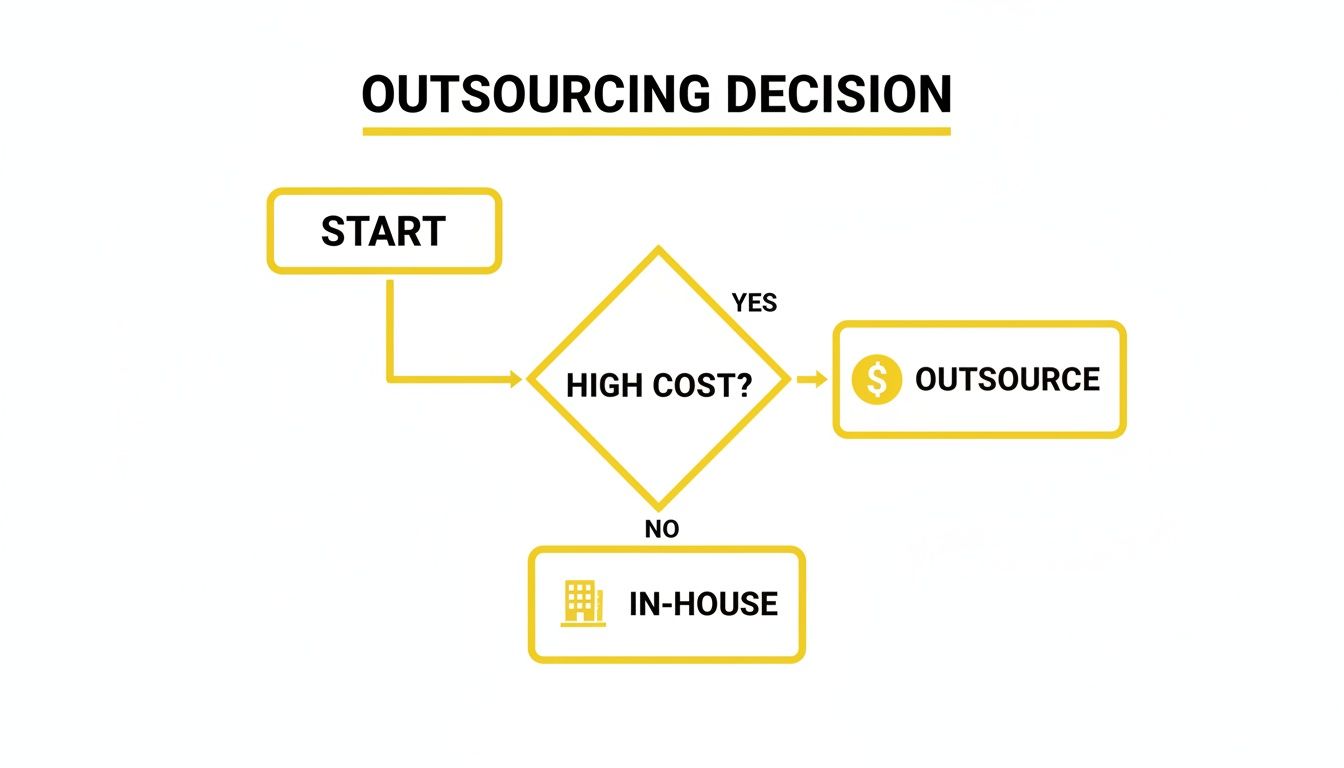
As you can see, the high overhead tied to an internal team—salaries, benefits, tech, training—often makes outsourcing the smarter financial move right from the start.
Crafting Your Vendor Shortlist
Before you even think about hopping on a Zoom call, you need to find potential partners that look good on paper. The goal here is to filter out all the noise and build a tight shortlist of agencies that seem to get what you do.
Start by hunting for firms with real, documented experience in your industry. A team that’s a rockstar in the SaaS world will likely stumble if you’re selling high-end manufacturing equipment. Look for case studies, testimonials, and client logos that look like you.
Here are the best places to start your search:
Industry-Specific Directories: Platforms like Clutch or G2 Crowd are goldmines. You can filter agencies by their specialty and, more importantly, read verified, unfiltered client reviews.
LinkedIn Searches: See which companies are actively posting valuable content and results related to B2B appointment setting. You can get a great feel for their expertise just by watching how they operate online.
Referrals: This is often the best source. Ping your professional network. A recommendation from a trusted peer who’s already been through this is worth its weight in gold.
My advice? Immediately dismiss any agency that makes huge, vague promises. Phrases like "we guarantee results" without specific, measurable claims are a massive red flag. You want transparency and a clear, unapologetic focus on process.
The Discovery Call Interrogation
Once your shortlist is ready, it’s time for discovery calls. This is where you go deep. Don't let them run the show with a canned PowerPoint. You need to show up with a list of sharp, pointed questions designed to peel back the curtain and see how they actually operate.
You’re here to understand their methodology, not just listen to a sales pitch. How they field these questions will tell you everything you need to know about their professionalism, their expertise, and whether they can actually deliver.
Pro Tip: Always record the calls (with their permission, of course). It lets you go back, compare partners objectively, and catch the little details you might have missed while you were in the moment.
To help you get started, I’ve put together a checklist of the must-ask questions for any potential partner. Don't just ask the question—listen carefully to how they answer.
Vendor Vetting Checklist: Key Questions to Ask
Category | Question to Ask | What a Good Answer Looks Like |
|---|---|---|
Qualification Process | "How do you define a Sales-Qualified Appointment (SQA)?" | They flip the question back to you. "That's a great question. What criteria—like budget, authority, need, and timeline—are non-negotiable for your team?" A generic, one-size-fits-all answer is a bad sign. |
Process & Workflow | "Walk me through your exact process for handling a no-show." | A defined, multi-step re-engagement and rescheduling workflow. They should mention things like immediate follow-up emails, a call within 24 hours, and a nurture sequence. A shrug and a "we'll just book another one" is a huge red flag. |
Tech & Integration | "What does your tech stack look like, and how would it integrate with ours?" | They should confidently name-drop specific CRMs (Salesforce, HubSpot), sales engagement tools, and data providers. Most importantly, they should immediately ask about your stack to ensure a seamless lead handoff. |
Reporting & KPIs | "Can you share a sample of your reporting dashboard?" | Look for total transparency. The report should highlight metrics that actually matter: show-up rates, qualification rates, and meetings-held-to-opportunity conversion rates. If they focus on vanity metrics like "dials made," run. |
These questions cut through the fluff and get right to the heart of a vendor’s competence. A top-tier partner will welcome this level of scrutiny; a weak one will get defensive.
Red Flags to Watch Out For
While you’re vetting, some things should set off alarm bells immediately. Spotting these early can save you from a world of hurt.
The "One-Size-Fits-All" Approach: If they don't dig deep into your ICP, value proposition, and current sales process, you can bet they're just going to plug you into a generic script. That almost never works.
Vague or Over-the-Top Guarantees: Be extremely wary of anyone promising a specific number of appointments before they even understand your market. Realistic partners talk about building a predictable, scalable pipeline over time, not overnight miracles.
Lack of Transparency: Are they hesitant to share case studies, client references, or sample reports? That’s a major warning sign. A confident partner will be an open book.
High-Pressure Sales Tactics: If their own sales process feels pushy or rushed, just imagine how they’ll represent your brand to prospects. Remember, this partner is the very first human interaction many leads will have with your company. Make sure it's a good one.
Integrating Your Outsourced Team for Maximum Success

You’ve vetted the vendors and the contract is signed. This is where the real work begins. The success of your entire outsourcing appointment setting initiative lives or dies by how you integrate this new team. Just tossing them a login and a list of names is a surefire recipe for disappointment.
Your goal isn’t to hire a vendor; it’s to build a genuine partnership. You need your outsourced setters to feel and act like a natural extension of your in-house sales department. That only happens with a structured, thoughtful onboarding process built on total clarity and deep alignment. Skip this, and your brand's voice gets lost in translation, and the quality of appointments tanks.
This is the phase where you turn an outside agency into an inside asset. It's all about giving them the knowledge, tools, and context they need to represent your brand perfectly and book the kind of meetings your closers are excited to take.
Building Your Onboarding Playbook
A rushed onboarding process is a complete waste of time and money. Those first two weeks are everything—they set the tone for the entire relationship. Your job is to deliver a comprehensive "brain dump" that leaves absolutely no room for guesswork. Think of it as the ultimate playbook they can turn to for any question that pops up.
This playbook should be a central, living resource, like a shared Google Drive folder or Notion doc. Here's what has to be in it:
Ideal Customer Profile (ICP): Go way beyond basic company size and industry. Hand them detailed buyer personas. What are their biggest headaches? What are their goals? What are the most common objections you hear? What event usually triggers them to start looking for a solution like yours?
Core Value Propositions: Don't just list product features—that's a classic mistake. You need to clearly spell out the outcomes you create for your clients. Give them tailored messaging for each persona.
Competitive Landscape: Who do you constantly go up against? More importantly, why do you win? Arming your team with this intel helps them navigate those tricky "how are you different from X?" questions with confidence.
Getting this level of detail right is non-negotiable. The more context you provide right out of the gate, the faster your outsourced team will sound like they’ve been working for you for years.
Establishing a Seamless Communication Workflow
Communication breakdowns are the silent killer of outsourced partnerships. If you're just relying on sporadic emails, you're setting yourself up for failure. You need a structured, consistent communication rhythm from day one to keep everyone aligned and ensure feedback flows both ways.
A solid communication plan mixes real-time chats with scheduled check-ins.
Shared Communication Channel: A dedicated channel in Slack or Microsoft Teams is a must. It’s the place for quick questions, real-time updates on hot leads, and immediate feedback. This simple step makes the outsourced team feel like they're actually part of the company.
Weekly Tactical Check-Ins: Get a recurring 30-minute meeting on the calendar every single week. This is for the nitty-gritty: reviewing last week's numbers, dissecting specific prospect calls, and tweaking scripts or email cadences on the fly.
Monthly Strategic Reviews: This is a higher-level meeting to zoom out. You’ll talk about big-picture trends, overall campaign performance, and long-term strategy. It's the perfect time to discuss shifts in the market or explore new industries to target.
The best partnerships I've seen treat their outsourced team like true colleagues. They get included in relevant internal updates, and their wins are celebrated company-wide. That small bit of cultural integration creates a sense of ownership that you can see directly in their performance.
This kind of proactive communication prevents small misunderstandings from becoming massive problems. It creates a tight feedback loop for constant fine-tuning—the hallmark of any successful appointment setting program.
Granting the Right Technical Access
For your team to work efficiently, they need access to your tech stack. But this has to be balanced with smart data security. The key is to provide just enough access for them to do their job, without opening the floodgates to sensitive company data.
Here’s what they’ll almost always need:
CRM Access: Limited, seat-based access to your CRM (like Salesforce or HubSpot) is critical. They have to be able to log activities, update lead statuses, and book meetings directly onto your sales reps' calendars. This makes the handoff totally seamless.
Email and Calendar Integration: Set them up with company-branded email addresses (name@yourcompany.com). This instantly builds trust with prospects and makes calendar integration a breeze, eliminating friction in the scheduling process.
The move to outsource appointment setting is part of a much bigger trend. As companies chase operational agility, the global outsourcing market is expected to hit $450 billion by late 2025, fueled by remote work and talent gaps. In the B2B world, 38% of companies already outsource roles like recruitment, cutting their time-to-hire by 27%. This same logic applies to appointment setting, where specialized firms blend automation with skilled callers to book quality meetings faster. For more on these trends, you can explore the latest outsourcing statistics. When you integrate your team the right way, you tap directly into this powerful efficiency.
Measuring Performance and Calculating Your True ROI
Alright, so you’ve signed the contract and your new outsourced team is live. Don't pop the champagne just yet. This is where the real work begins.
The difference between a successful partnership and a costly mistake comes down to rigorous, ongoing management and a sharp eye on performance. Without a clear system to track what’s working (and what isn’t), you're just paying for activity. You need to know you’re paying for results.
This is the part where we move beyond the fluffy, surface-level numbers and start measuring what actually hits your bottom line. It was never about how many meetings get booked; it’s about how many of those conversations turn into real, tangible revenue. This is how you turn this service from a cost center into a powerful growth engine.
Moving Beyond Vanity Metrics
The easiest trap to fall into is getting excited about the wrong numbers. An agency will happily boast about booking 50 appointments in a month, but that number is completely meaningless on its own. It's a classic vanity metric—it looks impressive on a report but tells you absolutely nothing about the health of your sales pipeline.
To get a real picture of what's happening, you have to focus on KPIs that measure quality and intent, not just volume. These are the metrics that draw a straight line from your outsourced team's efforts to your sales team's success.
Here are the KPIs that actually matter:
Show-Up Rate: What percentage of booked appointments actually happen? If this number is dipping below 75-80%, it's a huge red flag. It often points to weak qualification or sloppy follow-up from the setting team.
Sales Qualified Appointment (SQA) Rate: Of the meetings that do happen, how many meet the strict qualification criteria you’ve both agreed on? This is your ultimate quality check.
Meeting-to-Opportunity Conversion Rate: This one’s on your sales team. How many of those qualified meetings do they convert into a legitimate, pipeline-worthy sales opportunity?
Pipeline Value Generated: What’s the total potential deal value of the opportunities created from these appointments? This is how you translate their work into cold, hard cash.
Tracking these numbers gives you a clear, honest view of the quality you’re paying for. A high SQA rate, for example, is a powerful signal that your partner truly understands your Ideal Customer Profile.
A Simple Framework for Calculating True ROI
Calculating your return on investment doesn't require a complicated financial model. All you need is a clear view of your costs versus the revenue you’ve generated.
Let's walk through a real-world example. Imagine your company sells a service with an average customer lifetime value (LTV) of $20,000. You’re paying your outsourced appointment setting partner a $5,000 monthly retainer.
Here’s how the math breaks down for a single month:
Total Appointments Held: The agency sets 30 meetings, and 24 of them actually take place (an 80% show-up rate). Not bad.
Qualified Opportunities Created: Your sales team confirms that 12 of those 24 meetings were with genuinely qualified prospects, creating 12 new sales opportunities. That's a 50% conversion rate from meeting to opportunity.
New Customers Closed: Let's say your sales team has a historical 25% close rate on qualified ops. That means you close 3 new customers from that batch of meetings.
Total Revenue Generated: 3 new customers at an LTV of $20,000 each equals $60,000 in new revenue.
Calculate Your ROI: * Revenue: $60,000 * Investment: $5,000 * Profit: $60,000 - $5,000 = $55,000 * ROI Formula: (Profit / Investment) x 100 * Your ROI: ($55,000 / $5,000) x 100 = 1,100%
This simple calculation proves the partnership's value in a way that "appointments booked" never could.
Your ROI calculation is your ultimate source of truth. It cuts through all the noise and answers the only question that matters: "Is this investment making us money?" If the answer is a clear yes, you have a scalable system for growth.
Giving Feedback and Driving Continuous Improvement
Great results don't happen by accident—they’re the product of a tight, consistent feedback loop. Your outsourced team needs direct, constructive input from you to get better. Think of them as your eyes and ears on the front lines of the market.
Effective collaboration relies on having a structured process for sharing what you’re learning and making quick adjustments.
Share Post-Meeting Notes: After every single appointment, your sales reps should be dropping brief notes into the CRM about the lead quality. Was the prospect a perfect fit? Were they missing key information? This direct feedback is absolute gold.
Listen to Call Recordings: I can't stress this enough. Set aside time each week to review a few call recordings with your agency partner. This is the fastest way to pinpoint opportunities to tweak scripts, improve objection handling, and make sure they sound like you.
Collaborate on Scripting: Don't just hand them a script and walk away. Treat it as a living document. If your sales team keeps hearing a new objection or question, work with your partner to build a smart, effective response right into their workflow.
This collaborative spirit is what transforms a simple vendor relationship into a true strategic partnership. By constantly refining the process based on real-world data and feedback, you ensure your outsourcing efforts deliver predictable, profitable, and ever-improving results.
Got Questions About Outsourcing? You're Not Alone.
Even when you know the benefits, handing over a piece of your sales process can feel like a leap of faith. It’s smart to have questions. Getting straight answers to those nagging "what ifs" is the last step before you can move forward and really scale.
Let's tackle the most common questions we hear from founders and sales leaders right now.
"Will I Lose Control of My Brand's Message?"
This is a huge, and completely valid, concern. The fear is you'll have rogue agents saying anything to book a meeting.
But here’s the reality: with a quality partner, you don't lose control, you delegate the execution. A top-tier firm acts as a true extension of your team, not some disconnected call center. You're still the strategist. You provide the scripts, the buyer personas, the brand guidelines, and the Ideal Customer Profile (ICP) that dictates every single conversation. The secret is a tight feedback loop and regular check-ins to review calls and tweak the messaging. Before long, their voice should be indistinguishable from your own.
"Is This Really for Me? We're Not a High-Ticket B2B."
While it's a home run for high-ticket B2B sales, outsourcing appointment setting works for any business where a scheduled conversation is the key to closing a deal. The model is surprisingly flexible.
We’ve seen it pay off for all kinds of businesses:
Local service companies use it to book on-site estimates and consultations.
Coaches and consultants lean on it to pack their calendars with strategy calls.
SaaS startups use it to schedule a steady stream of product demos.
For example, a dedicated real estate appointment scheduling call center can be a game-changer for agents drowning in leads. The bottom line is, if getting a qualified person on the phone is how you make money, outsourcing helps you do that at a scale you couldn't manage alone.
"What If They Just Book a Bunch of Bad Appointments?"
This is exactly why your vetting process and the contract are so critical. Before you sign anything, you and your partner need to sit down and hammer out an iron-clad definition of a "Sales Qualified Appointment" (SQA).
Your SQA definition has to be written directly into the service agreement. Get specific. Include non-negotiable criteria like budget, authority, need, and timeline (BANT). A solid contract will state that any appointment that doesn't meet the criteria won't be billed—and will be replaced.
If you notice quality dipping, those communication channels you set up are your first move. Raise the flag immediately. A good partner will actually welcome the feedback and use it to recalibrate their team on the spot.
"How Long Until I Actually See a Return on This?"
Speed is one of the biggest reasons to outsource in the first place. You're not spending months hiring, training, and ramping up an internal team. A pro team can be on the phones and booking meetings for you in a matter of weeks.
From there, your ROI is mostly tied to your sales cycle. If you typically close deals in 30-60 days, you could easily be in the green within your first quarter. The key is obsessively tracking the right numbers: show-up rates, meeting-to-opportunity conversion, and of course, close rate. When you have that data, you'll see a clear, positive ROI way faster than if you tried to build it all from scratch.
At Wojo Media, we specialize in one thing: filling your calendar with qualified prospects who are ready to buy. We bolt onto your business, building omnipresent ad campaigns that drive a predictable flow of leads. You get to focus on what you do best—closing deals, not chasing them.
Book a free demo call with our team today and get a custom strategy to scale your business.
Comments