
Paid Social Media Ads: A Practical Guide for 2026

Your revenue has stalled, your organic posts are reaching fewer buyers each week, and someone on the team keeps asking whether ads are the answer. You're not short on opinions. You're short on a system that turns attention into profitable customers, and that is exactly where paid social media ads either work or waste money.
What Paid Social Media Ads Really Are
You're posting consistently, referrals still come in, but growth has flattened. The next customer isn't searching for you by name, and you can't wait for an algorithm to introduce you. That is the moment most founders start spending, often by boosting a post and hoping for leads.
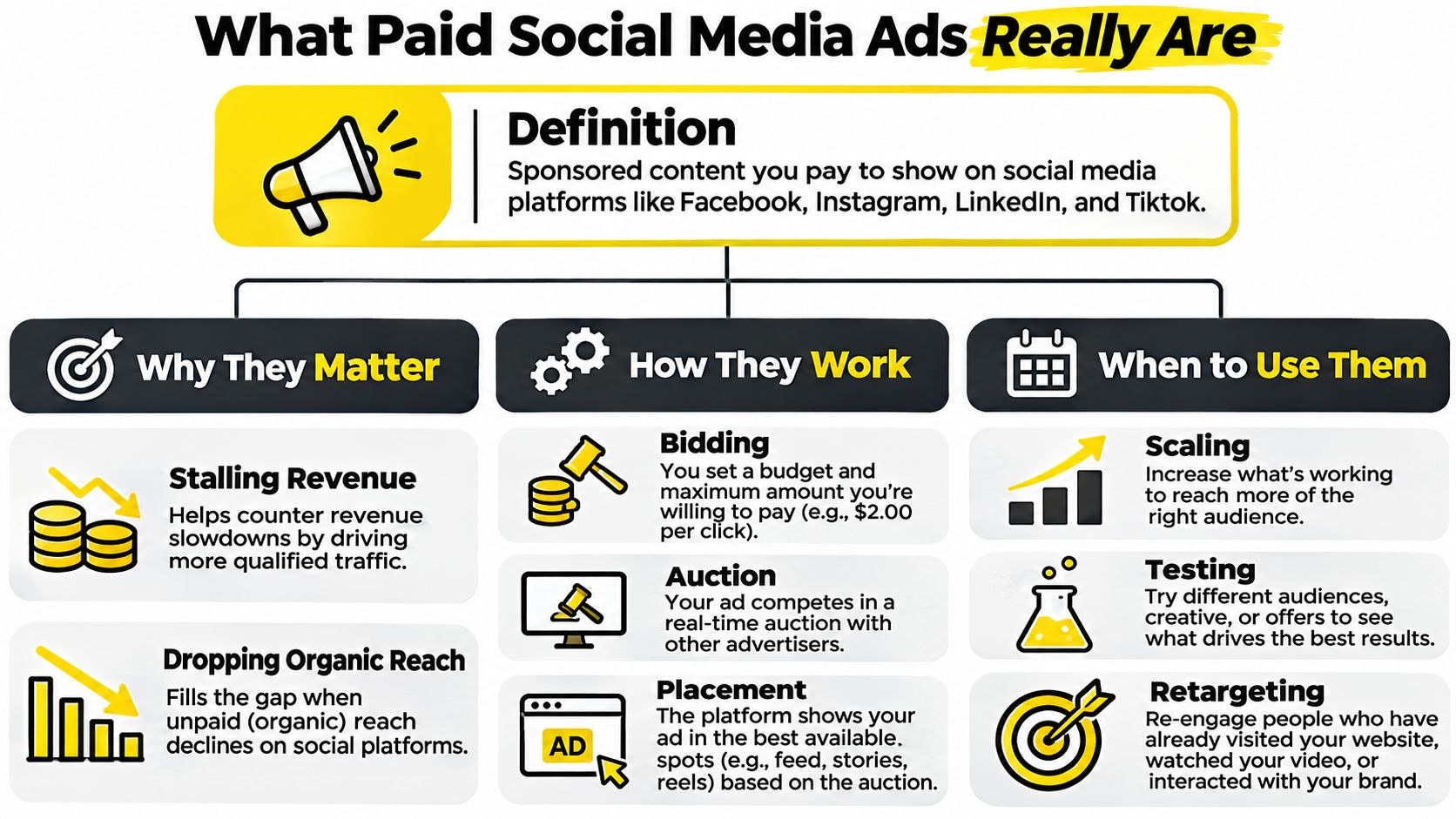
Boosting isn't a strategy. Paid social media ads are auction-based placements bought through platforms such as Facebook, Instagram, TikTok, YouTube, and LinkedIn. You pay for delivery to a defined audience instead of earning reach organically, and you choose the outcome you want the platform to optimize toward.
The scale is not experimental anymore. The IAB and PwC report on 2024 United States internet advertising revenue recorded $258.6 billion in total revenue, with social media advertising accounting for $88.8 billion, or 34.3% of the total, after growing 36.7% year over year. Paid social now competes directly with search and video for performance budgets, so treat it as core infrastructure, not a side test.
What Paid Social Is Not
Paid social won't fix a weak offer. It won't rescue a slow, confusing landing page. It amplifies what's already there, which means a clear promise, a credible guarantee, and a page that matches the ad will scale, while vague messaging will burn budget faster.
Separate brand awareness from direct response before you spend. Awareness buys familiarity and future demand. Direct response buys a measurable action now, such as a purchase, a qualified lead, or a booked call. Most growth-stage businesses need direct response first, with awareness supporting it, not replacing it.
If you can't explain in one sentence who should buy, what they'll get, and why they should trust you, don't scale the ad yet. Fix the offer first.
The Four Pillars That Make It Profitable
Offer: A specific outcome, clear value, and risk reduction that gives a cold prospect a reason to act today.
Landing page: Fast, focused, and message-matched to the ad, with proof, pricing clarity where appropriate, and one primary action.
Omnipresent ads: Consistent presence across the platforms your buyer uses, including retargeting, so one visit doesn't end the conversation.
Data: Clean conversion tracking reconciled against backend revenue, margin, and lead quality, not just platform dashboards.
You're ready to invest when those pieces exist in usable form. You don't need perfection, but you do need an offer people understand, a page that converts cold traffic at a workable rate, and tracking that tells you whether money came back. Without that foundation, better targeting only helps you lose money more precisely.
Comparing the Major Paid Social Channels
Pick channels by buyer behavior, not by what a competitor posted last week. Each platform sells a different kind of attention, at a different level of intent, in a different creative language. Your average order value, sales cycle, and customer age should decide the primary channel.
Reach data keeps this honest. Pew Research Center's survey of United States adults on social media use found 83% had used YouTube, 68% Facebook, and 47% Instagram, while TikTok reached 33%, up from 21% in 2021, in a survey of 5,733 adults. Facebook and YouTube are the only platforms used by majorities across every age group, while younger buyers are heavily multi-platform, so overlap is real and frequency management matters.
Give Each Channel a Clear Job
Facebook remains the broad direct-response workhorse. It suits local services, e-commerce, and lead generation where detailed audience signals, retargeting, and lookalike expansion help you find buyers beyond your existing list. If your customer spans age groups and your offer converts from feed creative, start here.
Instagram rewards visual proof. Before and after results, product demonstrations, creator endorsements, and polished short video fit naturally, especially for beauty, fashion, food, fitness, and home products. It's rarely separate from Facebook buying, but the creative standard is higher and social proof carries more weight.
TikTok is creative-led disruption. Native, fast, personality-driven video can create demand for products people weren't actively searching for, particularly with younger audiences. Polished brand ads often underperform there because they look like interruptions. If you can't produce authentic video consistently, TikTok will expose that weakness quickly.
YouTube handles longer consideration. Demonstrations, reviews, webinars, and educational videos suit high-ticket services, coaching, software, and considered purchases where buyers need reasons, not just reminders. You'll usually pay for deeper attention, and you'll get a viewer who's more willing to listen.
LinkedIn is for professional targeting when job title, seniority, company type, and industry determine value. Use it for B2B services, recruiting-adjacent offers, finance, and high-ticket professional services where a smaller number of qualified conversations can justify higher media costs. Don't judge it by cheap clicks.
Paid Social Channel Fit at a Glance
Channel | Best For | Dominant Format | Funnel Role |
|---|---|---|---|
Broad direct response, local leads, e-commerce | Feed video, image, carousel, lead forms | Prospecting and retargeting | |
Visual products and social proof | Reels, Stories, carousel | Discovery and conversion | |
TikTok | Younger audiences and creator-led demand | Short vertical video | Discovery and impulse action |
YouTube | Education and high-consideration offers | In-stream video and Shorts | Consideration and conversion |
B2B and professional services | Sponsored content and lead forms | Qualified lead generation |
Start with one primary channel and one retargeting layer. Add a second prospecting channel only after creative and tracking are working, because spreading a small budget across every app usually produces weak signals everywhere.
Choosing Campaign Objectives and Targeting
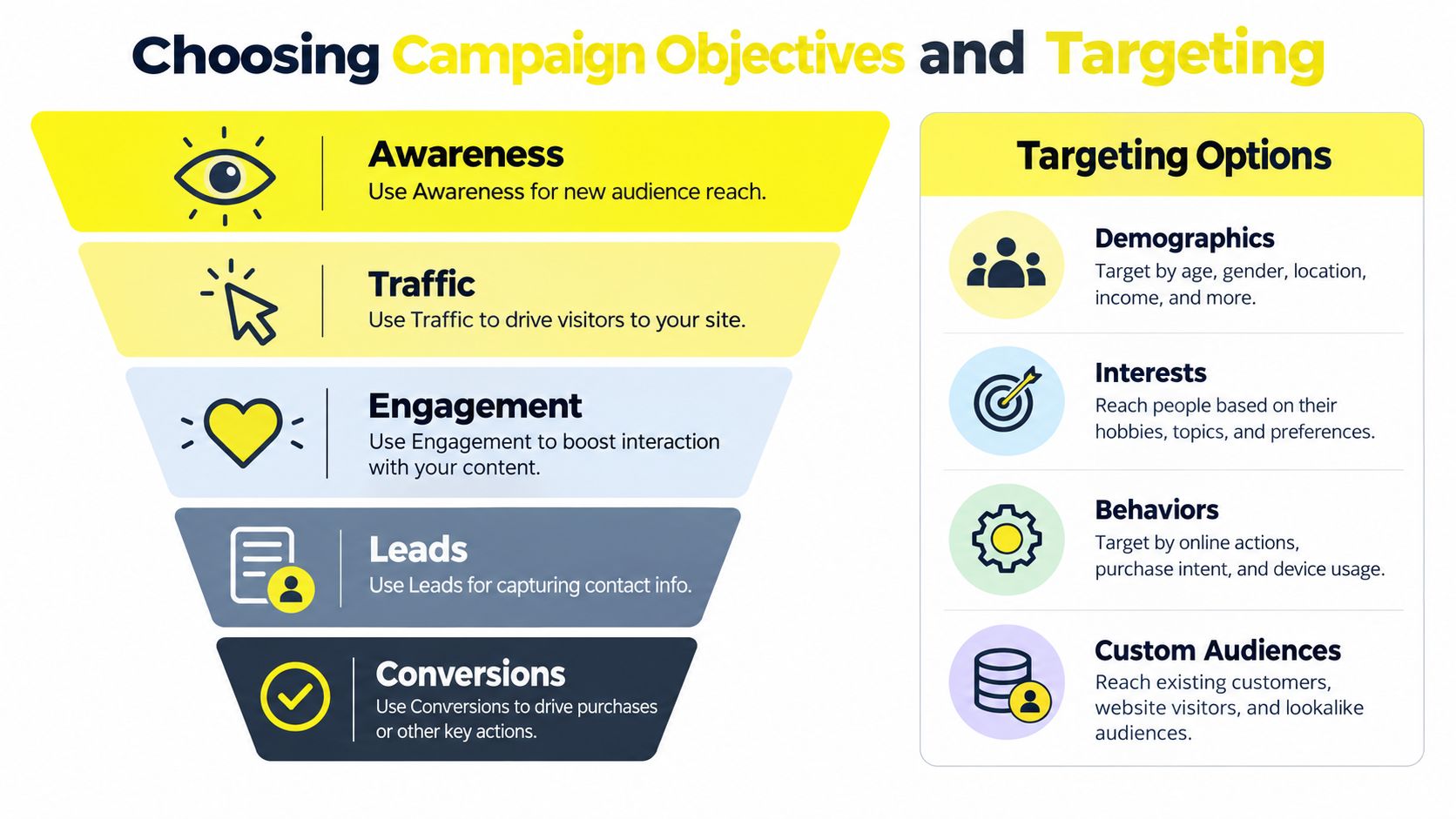
Your campaign objective isn't a label. It's an instruction that tells the platform which users to find and which actions to value. Choose traffic when you want purchases and you'll get efficient clicks from people who click often and buy rarely.
Use this sequence before launch. First, name the business outcome, such as a purchase, a qualified application, or a booked consultation. Second, confirm that event is tracked correctly. Third, select the objective closest to that event, then build audiences that give the system enough qualified volume to learn.
Match the Objective to the Funnel
Awareness: Use sparingly for new markets, launches, or retargeting pool building, and judge it by reach quality, not revenue.
Traffic and engagement: Useful for content distribution and warming audiences, but weak as a primary sales strategy.
Lead generation: Use instant forms or landing pages when speed to contact matters, then score leads by qualification, not volume.
Conversions: Use for purchases, applications, and bookings when your pixel and server events are reliable.
App installs: Optimize beyond the install wherever possible, toward activation or purchase, so you don't buy empty downloads.
Build a Targeting Stack That Expands Deliberately
Start with custom audiences because intent is highest there. Website visitors, video viewers, email subscribers, past buyers, and CRM segments give you retargeting pools and seed data for expansion. Exclude existing customers from acquisition campaigns when the offer is for new buyers, or you'll pay to re-sell people who already converted.
Layer core audiences next, using location, age, interests, behaviors, and professional attributes where relevant. Then test lookalike or expansion audiences built from buyers and qualified leads, not from all website traffic. Garbage seed data creates larger garbage audiences.
A med spa should geo-target its realistic service radius and send prospects to a consultation offer with fast follow-up. An e-commerce brand should retarget product viewers and cart abandoners separately, then expand from past purchasers. A coach selling to business owners should combine professional signals with content engagement, while a real estate investor should focus on defined ZIP codes and seller-oriented creative rather than broad homeowner interest.
For a practical companion on turning creative and audience decisions into repeatable tests, these data-driven ad optimization tips are worth reviewing before you rebuild an account structure.
The video below is useful for seeing how objective and audience choices show up inside an actual campaign setup, rather than treating them as abstract settings.
Don't fragment budgets into dozens of tiny ad sets. Consolidate where the message and outcome are the same, separate where intent or economics differ, and give each test enough spend to produce a decision.
Creative Best Practices That Move the Numbers
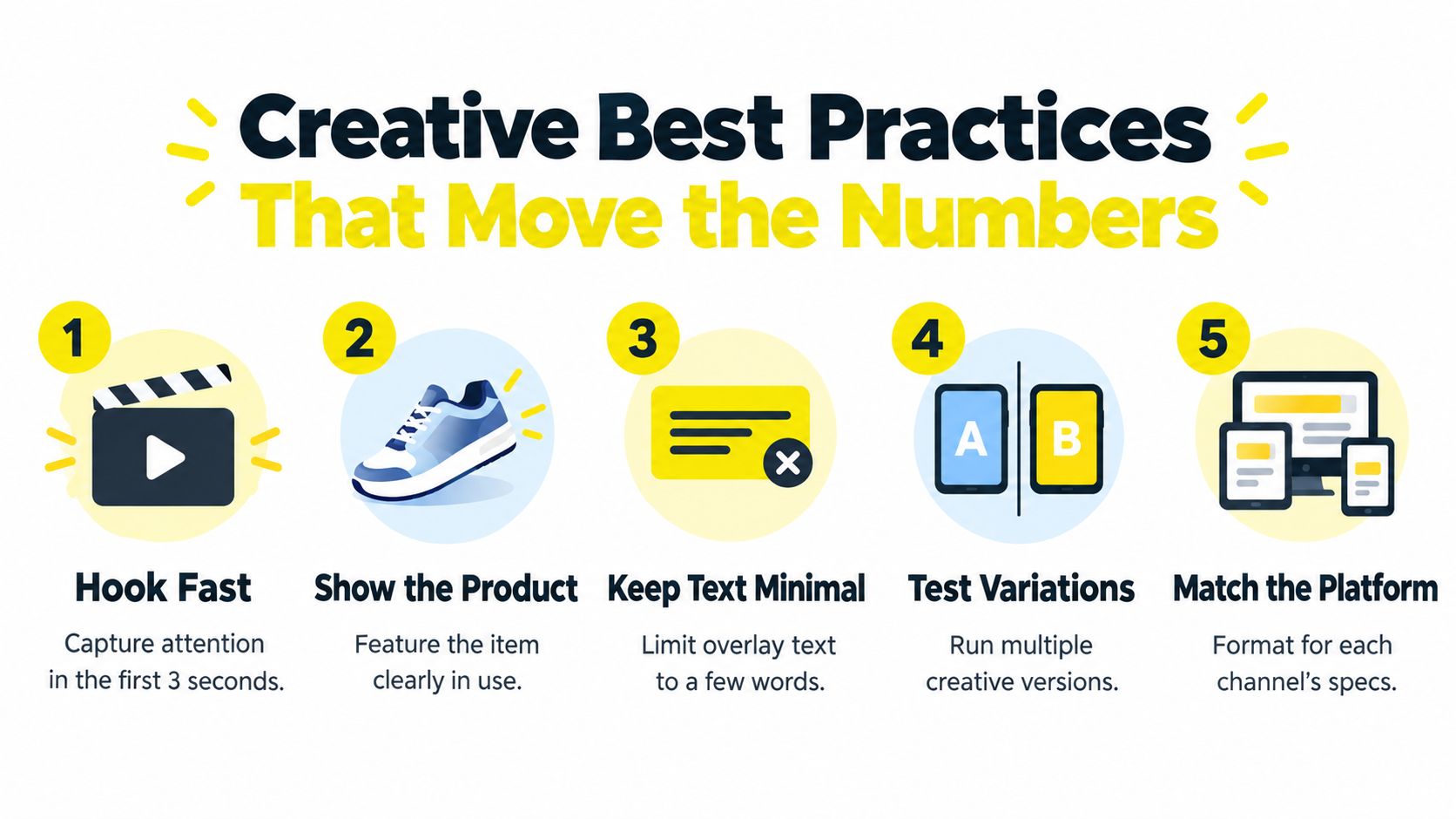
Creative is your highest-impact variable because it affects both response and delivery cost. A weak ad doesn't just convert poorly after the click. It can struggle to win impressions in the first place, even when you're willing to pay.
TikTok's guidance on bidding methods and auction delivery states that its auction evaluates bid, ad relevance or quality, and user context, and recommends at least three to five unique creatives per ad group while allowing campaigns time to pass through learning before frequent bid or targeting changes. Treat creative testing as an auction-efficiency program, not a branding exercise.
Test Materially Different Variables
Change one meaningful element at a time across a structured batch, but make the batch diverse enough to learn something. Swapping a background color rarely teaches you why buyers act. Testing a different problem, proof point, or offer frame does.
Hook: Open with the buyer's problem, a surprising result, a direct claim you can support, or a visual demonstration. Don't start with your logo.
Offer framing: Test outcome-led, price-led, guarantee-led, and comparison-led versions where they're truthful and compliant.
Proof: Use reviews, demonstrations, founder explanation, creator content, and customer stories that answer the main objection.
Format: Match short vertical video to TikTok and Reels, carousels to catalog or multi-benefit products, longer video to YouTube, and clear document or text-forward creative to professional audiences.
Call to action: Tell the viewer the exact next step and what happens after it, such as checking eligibility, booking a consultation, or viewing sizes.
Judge creative with a chain of signals. Thumb-stop rate and early video retention show attention, click-through shows curiosity, and conversion rate shows message and page alignment. Cost per acquisition and revenue or qualified-lead value decide whether attention was worth buying. A funny ad that attracts non-buyers is expensive entertainment.
Run a Cadence You Can Sustain
Build a weekly production rhythm around winning concepts, new angles, and fresh proof. Keep naming conventions consistent by concept, hook, format, audience, and date, so you can find patterns months later instead of relying on memory. Save losing ads too, because knowing which claims and visuals failed prevents expensive repeats.
Your next winning ad usually comes from a sharper angle on a proven problem, not from a prettier version of an ad nobody wanted.
Refresh before fatigue becomes obvious in revenue. Rising frequency, falling retention, weaker click-through, and increasing acquisition cost are your cues to introduce new concepts while winners still have life. If your team can't produce enough distinct creative, reduce the number of channels before you reduce creative quality.
Measurement, Attribution, and the KPIs That Matter
Platform dashboards are useful, but they're not your bank account. They attribute conversions inside defined windows, with incomplete identity data, and they optimize toward the events you send. If those events are missing, duplicated, or disconnected from revenue, the algorithm will confidently scale the wrong thing.
Build measurement before you scale spend. Use both browser pixel and server-side Events API delivery where the platform supports it, with deduplication so the same purchase or lead isn't counted twice. Use a consistent event schema, including ViewContent, AddToCart, InitiateCheckout, Lead, and Purchase, with currency, value, timestamps, and stable identifiers where legally permissible.

Attribution windows change what you see. TikTok's documentation on auction ads best practices notes that standard web attribution is limited to a one-day post-click window, while Advanced Matching can support a seven-day post-click and one-day post-view window under the documented configuration. That difference matters for considered purchases, consultations, and any offer where buyers don't act immediately.
Reconcile Platform Reports With Backend Reality
Create one weekly view that connects spend to outcomes you can verify. For e-commerce, compare platform purchases with store revenue, refunds, new versus returning customers, average order value, and contribution margin. For services and coaching, compare leads with qualified appointments, show rate, close rate, cash collected, and customer acquisition cost.
Cost per qualified outcome: Replace raw cost per lead with cost per qualified lead, booked call, or customer.
Conversion rate by step: Find whether the problem is the ad, the page, the application, the sales call, or checkout.
Payback and margin: Judge scaling by gross margin and cohort payback, not revenue alone.
Lead quality feedback: Pass qualified, booked, and closed outcomes back where possible so optimization learns from value, not form fills.
If lead costs look cheap but sales calls are poor, don't celebrate the dashboard. Work through how to lower your cost per lead alongside your qualification criteria, because lowering cost only helps when lead intent and downstream close rate hold up.
Use Value-Based Optimization Carefully
Send dynamic purchase value for commerce campaigns so the platform can distinguish a small order from a valuable one. For lead funnels, feed back qualified stages when your CRM process is consistent enough to trust. Don't optimize toward a downstream event if your team updates it sporadically, because delayed and incomplete feedback can distort delivery.
Audit tracking after every site, checkout, form, or CRM change. Test events yourself, check deduplication, compare platform totals with backend records, and document attribution settings before judging a campaign. Most scaling problems blamed on creative are signal problems hiding underneath.
Common Misconceptions That Cost Advertisers Money
The most expensive belief in paid social is that reported return on ad spend equals incremental profit. Platforms can claim credit for buyers who would have purchased through search, email, referrals, or repeat visits anyway. That's especially dangerous for local businesses, where calls, walk-ins, consultations, and delayed closes don't fit neatly into click-based reporting.
LocalImpact's research on small business marketing returns surveyed 400 United States local-business owners and managers and found 40% said paid social delivered the highest return, while the report cautioned that short-term trackability may not equal total business value. Use call tracking, unique offers, source questions, and CRM matching to separate assisted demand from demand your ads created.
Contrarian rule: A lower reported ROAS can be good news if cleaner measurement removed over-credited conversions while incremental profit stayed strong.
Native Checkout Doesn't Automatically Win
Discovery isn't the same as trust. Deloitte's 2025 global research on social commerce found 61% of consumers had discovered a new brand or product on social media in the prior year, yet only 39% of social-first brands said social commerce was delivering high ROI, and 25% of consumers were concerned about security when following purchase links from social media.
Test the checkout path by price, awareness, and risk. Low-priced, low-risk products may work in a native shop. Higher-priced or trust-sensitive offers often need a landing page with reviews, guarantees, shipping and return clarity, creator demonstration, secure payment signals, and email or SMS capture. Judge the route by refund rate, repeat purchase, and contribution margin, not conversion rate alone.
Cheap Leads and More Channels Are Not Strategies
A cheap lead that never books, shows, or buys is not efficient. It's a filtering cost you're pushing onto your sales team. Qualify inside the form, set expectations in the ad, follow up fast, and report cost per qualified appointment or customer.
More platforms can also make performance worse. Overlap raises frequency, fragmented budgets weaken learning, and shallow creative gets copied into environments where it doesn't fit. Run fewer channels with deeper creative, cleaner signals, and enough budget to learn. Expand after you've proven the offer, page, and measurement, not before.
Putting Paid Social Into a Full-Funnel Growth Plan
Paid social works best as part of a system. Social creates and captures demand in feeds and video, search catches active intent, organic content builds familiarity, and email, SMS, and CRM follow-up convert people who need more time. Retargeting connects those touches so prospects keep seeing relevant proof instead of starting from zero.
The four pillars reinforce each other. A stronger offer lifts conversion rate, better conversion improves relevance signals, stronger relevance can improve delivery efficiency, and cleaner data tells you where the next dollar belongs. That's how paid social media ads become predictable growth instead of a series of isolated campaigns.
Run this audit on your account this week:
Objective alignment: Does each campaign optimize toward the closest reliable business event?
Offer and page: Does the landing page repeat the ad promise, answer objections, load fast, and make one action obvious?
Creative supply: Do you have materially different concepts in market and replacements ready before fatigue hits?
Audience structure: Are prospecting, retargeting, and exclusions separated by intent and economics?
Tracking: Are pixel and server events deduplicated, valued correctly, and reconciled with CRM or store revenue?
Backend KPIs: Are you scaling from margin, qualification, show rate, close rate, and payback, or from dashboard claims alone?
Fix the weakest pillar first. Don't buy more traffic to solve a page problem, don't blame targeting for an offer problem, and don't scale a campaign you can't verify in the backend.
Wojo Media builds full-funnel paid social media ads systems across Meta, TikTok, Google, and YouTube, covering offer refinement, landing pages, creative production, omnipresent campaign management, and backend KPI tracking. If you want a custom plan based on profitable customers rather than dashboard claims, visit Wojo Media to book a free demo call and review what a properly measured growth system would look like for your business.
Comments