.png)
Proven Real Estate Growth: landing page for real estate that converts

A real estate landing page isn't just another page on your website. It's a highly-focused, standalone page built for one specific marketing campaign with a single, crucial goal: turning a visitor into a qualified lead.
Unlike your main homepage, which is often crowded with navigation links and different messages, a landing page strips away all the noise. It focuses a visitor's attention entirely on taking one action, whether that's downloading a free home valuation report or scheduling a consultation. This targeted approach is the real secret to separating casual browsers from high-intent clients who are ready to talk.
Why Your Website Is Quietly Sabotaging Your Lead Gen
Let’s be real for a second: your primary real estate website is probably working against your lead generation goals. It’s built to be a digital brochure—a catch-all space to showcase agent bios, neighborhood guides, blog posts, and social media links. While that’s fine for general branding, it’s a conversion killer.
Think about it. A potential seller clicks your ad for a "Free Home Value Report" and lands on your homepage. Instantly, they're bombarded with distractions. They see links for buyers, blog posts about staging, and your company's entire history. This creates decision fatigue, and a confused visitor almost always clicks away without taking action.
The Problem with a One-Size-Fits-All Approach
Your website tries to speak to everyone at once, which means it ends up speaking effectively to no one. A first-time homebuyer hunting for starter homes has completely different pain points than an investor looking for their next rental property. Your homepage simply can't address these distinct motivations with the laser focus they deserve.
This is exactly where a dedicated real estate landing page becomes your most valuable player. It's not just another page; it's a strategic asset built for a single, clear purpose.
A great landing page is your best salesperson. It works 24/7, never gets tired, and is obsessively focused on one thing: turning a curious visitor into a real, tangible lead.
By creating separate pages tailored to each campaign, you can dial in the message, the visuals, and the offer to resonate directly with a specific audience. For instance:
For Sellers: A page offering an instant, data-driven home valuation.
For Buyers: A page providing a curated list of off-market properties in a specific zip code.
For Investors: A page detailing the ROI potential of local multi-family units.
This level of specificity builds instant trust and relevance. It shows visitors you understand exactly what they need right now.
The difference between a generic homepage and a targeted landing page for capturing leads is night and day. A quick look at the core features makes it obvious why one consistently outperforms the other for paid campaigns.
Landing Page vs Website Homepage for Real Estate
Feature | Dedicated Landing Page | Website Homepage |
|---|---|---|
Primary Goal | Single action (e.g., form fill) | General exploration, branding |
Navigation | Minimal or none | Full navigation menu |
Audience Focus | Hyper-targeted to one segment | Broad, speaks to everyone |
Content | Focused on one specific offer | Covers multiple topics |
Design | Simple, clear call-to-action | Complex, multiple CTAs |
Lead Quality | High-intent, qualified | Low-intent, browsing |
Ultimately, the homepage is your digital business card, while the landing page is your expert negotiator, closing one specific deal.
The Conversion Gap
This focused strategy delivers results you can actually measure. Industry benchmarks from an analysis of over 74 million visitors show the average landing page conversion rate in real estate hovers around 4.36%. But here's the kicker: top-performing, well-optimized pages consistently hit rates between 8-12%.
That data makes it crystal clear—a specialized landing page isn't a luxury; it's a necessity for agents and brokers who are serious about growth. You can discover more insights about these industry benchmarks and see how they can shape your own strategy. That significant jump in conversions comes directly from eliminating distractions and giving visitors a clear, simple path from click to conversion.
You Need an Offer They Can't Refuse
That generic "Contact Us" button on your landing page? It’s not an offer; it's a dead end. You're asking a visitor to commit without giving them anything of real value first. To get high-intent leads, your real estate landing page has to dangle a carrot so good they can't help but bite.
Think of it this way: your offer is the bridge between the promise you made in your ad and the value you deliver on your page. If your Facebook ad promised a "list of the best fixer-uppers in Austin," your landing page better deliver that exact list—not a generic home search portal. This kind of consistency is everything for building trust and getting that conversion.
Your offer is the heart of your landing page. It needs to be so compelling that visitors feel like they’re getting an absolute steal just for sharing their contact info. Let's break down how to create these killer offers for different types of clients.
Crafting Irresistible Offers for Buyers
Buyers today are drowning in data from big players like Zillow and Realtor.com. Your job isn't to give them more of the same. It's to cut through the noise with exclusive, curated, or hard-to-find information that actually makes their search easier.
Forget the broad strokes. You need to get hyper-specific. Here are a few real-world examples that I've seen crush it for generating buyer leads:
"Get Our Curated List of Off-Market Homes in [Your Target Neighborhood]." This one is pure gold. Why? Exclusivity. Every buyer secretly believes the best deals happen before a home ever hits the MLS.
"Download Our Ultimate [City Name] Relocation Guide." This is a lifesaver for out-of-towners. Pack it with neighborhood breakdowns, school ratings, and local tax info. You're handing them a complete roadmap.
"See a List of Homes with [Sought-After Feature] Under $[Price Point]." This works like a charm for niche buyers. Think "Homes with In-Law Suites Under $700k" or "Properties with Acreage Zoned for Horses."
The goal is to stop competing with the national portals and start playing a different game. You’re the local expert with insider knowledge. That's a value proposition Zillow can't touch.
Building High-Value Lead Magnets for Sellers
When it comes to sellers, it’s all about one thing: the money. They want to know what their home is worth and how to get top dollar. Your offer needs to speak directly to that anxiety.
A simple "What's Your Home Worth?" tool is a decent start, but you can do so much better. Don't just spit out an automated number; give them a real analysis.
The best seller lead magnets go way beyond a simple estimate. They provide context—the "why" behind the valuation—and give homeowners a clear path forward. You instantly position yourself as a trusted advisor, not just another agent.
Here are a few high-converting offers I've seen work time and time again on seller-focused real estate landing pages:
The Enhanced Home Value Estimator: Instead of a single number, promise a "Custom Home Equity Report." This should include their estimate, a list of recent comps (with photos!), and a quick analysis of local market trends. It feels substantial and valuable.
The "Seller's Market-Ready Checklist": This downloadable PDF is an easy win. Fill it with actionable tips on decluttering, minor repairs with the best ROI, and simple staging hacks to help them prep their home.
"Discover Your Home's Hidden ROI: A Renovation Value Report." This is perfect for sellers thinking about making updates. You can provide data on which projects, like a kitchen remodel or bathroom update, actually pay off in your specific market.
Each of these offers gives something tangible first. You aren't just begging for their information; you're earning it by solving a problem. This simple shift in dynamics, from a sales pitch to a helpful consultation, will dramatically improve both the quality and quantity of leads your landing page generates.
The Anatomy of a High-Converting Page Layout
A killer landing page for real estate isn't just a jumble of nice photos and some text. It's a carefully crafted machine, engineered to walk a specific person toward a single, specific goal. Every single piece—from the headline down to the button color—has to work in concert to remove friction and build momentum.
Think of your page layout like you're having a conversation with a new lead. You grab their attention with a bold opening, build trust by showing them you know your stuff, and then you clearly ask for the next step. If any part of that conversation feels off or confusing, they're gone.
The structure of your page is what turns a casual click into a committed lead. It’s all about creating a smooth, intuitive experience that feels genuinely helpful, not salesy.
Nail the Hero Section to Hook Attention Instantly
You’ve got about three seconds. That's it. Three seconds to convince someone to stick around. The "hero section"—everything they see before they even think about scrolling—is where you win or lose this fight. Its only job is to answer one question for the visitor: "Am I in the right place?"
To pull this off, your hero section needs three things working together perfectly:
A Compelling Headline: This is your elevator pitch, your big promise. It has to be benefit-driven and speak directly to what your target audience actually wants. Instead of a boring "Austin Real Estate Agent," go for something like, "Unlock the Secrets to Selling Your Austin Home Above Asking Price." See the difference?
Supportive Sub-headline: This is a quick one-two punch. It adds context and throws in a secondary benefit. Something like, "Download our free guide to discover the three simple staging secrets that add thousands to your final sale."
A Crystal-Clear Call-to-Action (CTA): Your button needs to use action words that tell people exactly what they're getting. "Download My Free Guide" will crush a generic "Submit" every single time.
When these three elements click, they instantly confirm the visitor has found the solution they were searching for.
Build Unshakeable Trust with Social Proof
Okay, you've hooked them. Now you have to prove you're the real deal. In real estate, trust is the entire game. People are naturally skeptical, and they need to see cold, hard proof that you can deliver on your promises. This is where you bring in the social proof and trust signals.
Don't just tell them you're great; show them. Weave these elements right into your page, ideally just below that hero section.
Client Testimonials: Use short, punchy quotes from happy clients. Make sure to include their photo, name, and the specific result you delivered. "Sold our home in 7 days for $25k over asking!" is pure gold.
Logos and Credentials: Got featured in the local paper? Won an award? Part of a major brokerage like RE/MAX or Keller Williams? Slap those logos on the page. They’re instant credibility shortcuts.
Data and Statistics: Use local market numbers to your advantage. A simple, powerful line like, "We help our clients sell 15% faster than the local average," backed by MLS data, is incredibly persuasive.
A landing page without trust signals is like a house with no foundation. It might look fine on the surface, but it will crumble the second a prospect feels a hint of doubt.
This infographic really gets to the heart of it, breaking down the kinds of offers that work for buyers versus sellers. Your offer is the engine of the whole page.
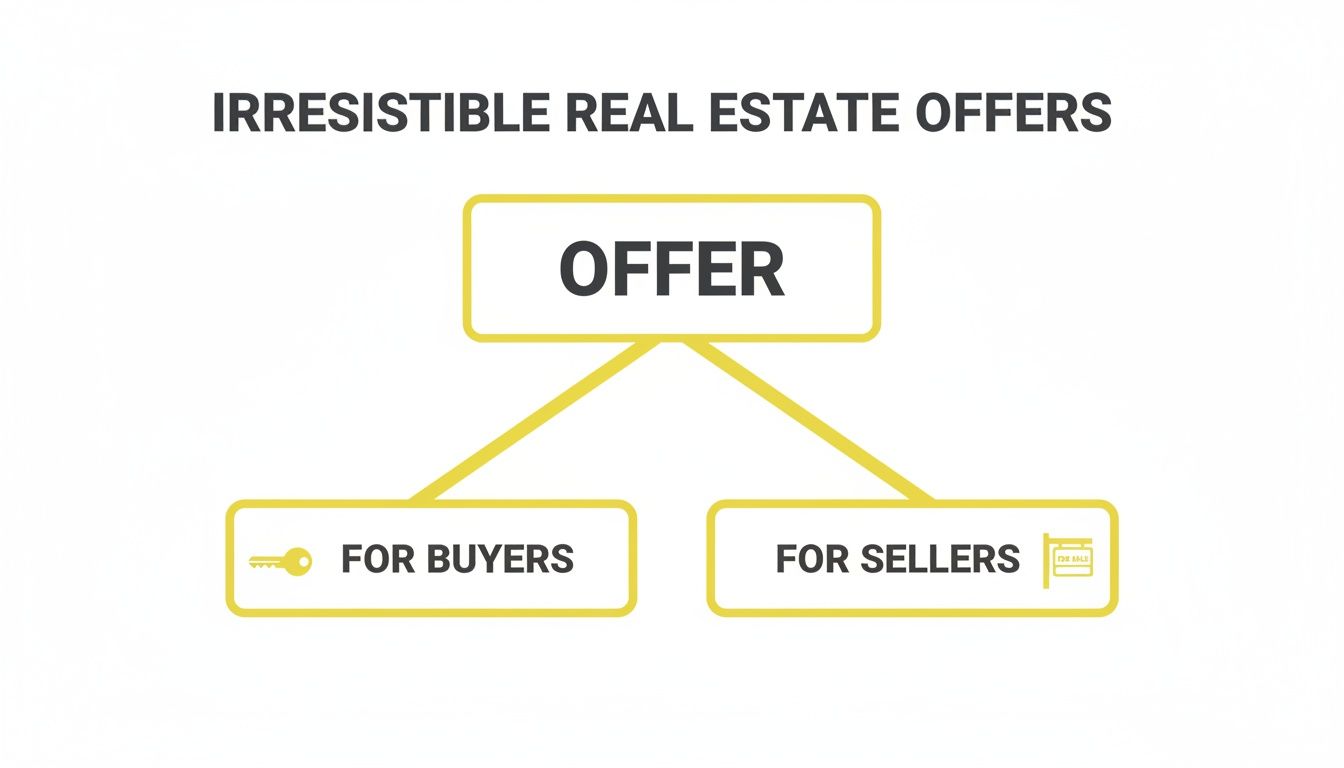
The image makes it obvious: buyers and sellers want completely different things. It's a stark reminder that your landing page absolutely must be laser-focused on one audience to have any chance of success.
Tell a Visual Story with High-Impact Imagery
People don't buy houses based on logic; they buy on emotion. And nothing sparks emotion faster than great visuals. Your images aren't just there to fill space. They need to tell a story and help visitors picture themselves living in that home.
High-quality, professional photography is the bare minimum—it’s non-negotiable. But if you really want to stand out, you have to bring in more dynamic elements.
Video Tours: A well-shot video walkthrough isn't just a nice-to-have anymore. It boosts engagement like crazy because it gives people a real feel for the flow and space that static pictures just can't match.
Virtual Staging: Empty rooms are a conversion killer. They look cold, and most buyers can't visualize the potential. To really build a page that grabs attention, a modern guide to virtual staging for real estate shows how you can use AI tools to create stunning, furnished visuals that get properties sold faster.
Drone Footage: For homes with a great yard, acreage, or unique setting, aerial shots are a game-changer. They show off the scale and context in a way that ground-level photos never could.
Finally, keep the design clean. Let your content breathe with plenty of white space. Your goal is to make the desired action—filling out that form—the easiest, most obvious thing for them to do next. Don't let anything get in the way.
Winning the Mobile and Speed Game
Let's get one thing straight: the modern property search doesn't start in an office. It starts on a smartphone during a lunch break, in line for coffee, or on the couch after dinner. A slow, clunky mobile experience is no longer just a minor annoyance—it's a massive leak in your lead generation pipeline.
Every fraction of a second a visitor waits for your landing page for real estate to load, you can literally feel their interest and patience evaporating. This isn't just a theory; it's a measurable reality that hits your bottom line, hard.
Think of page speed as the digital equivalent of curb appeal. A fast, seamless experience invites people in. A slow page is like a digital overgrown lawn—it makes potential leads turn around before they even get a glimpse of the front door.
The True Cost of a Slow Landing Page
The numbers here are completely unforgiving. Recent industry benchmarks paint a stark picture: pages loading in under one second see an incredible 31.79% conversion rate.
That number absolutely plummets to 13.93% at just two seconds and a dismal 9.68% at five seconds. And with a staggering 60% of all property searches now happening on mobile devices, this data is non-negotiable for any serious real estate professional. You can explore the full findings on conversion rates here if you really want to see how critical this is.
For an agent, this means a one or two-second delay could be costing you thousands in potential commissions. Every single month.
Actionable Steps for Lightning-Fast Performance
Getting a sub-two-second load time isn't magic. It comes down to making deliberate technical choices. Here are the most impactful things you can do right now to speed up your real estate landing page and stop losing leads.
Optimize Your High-Resolution Imagery
Those gorgeous, high-resolution property photos are the lifeblood of real estate marketing, but they are also the number one speed killer on most landing pages.
Compress, Don't Compromise: Use free tools like TinyPNG or ImageOptim to slash file sizes—often by 50-70%—without any noticeable dip in visual quality.
Use Modern File Formats: It’s time to move on from JPEGs. Switch to next-gen formats like WebP, which offers far superior compression and quality, significantly cutting down load times.
Implement Lazy Loading: This is a game-changer. It’s a technique that only loads images and videos as a visitor scrolls down the page. This dramatically speeds up that critical initial page load, getting the user engaged faster.
Leverage Browser Caching
Browser caching is like giving a return visitor's browser a key to your house. It stores static parts of your page—like your logo, fonts, and stylesheets—so they don’t have to be re-downloaded every time someone comes back.
This makes their second, third, and fourth visits almost instantaneous. It’s a simple fix that creates a much smoother experience for prospects who return to view a property or offer.
Streamline Your Code
Bloated code from page builders or too many plugins can drag your page speed down into the mud. You don't have to be a developer to get this right.
Minify CSS and JavaScript: This process strips out all the unnecessary characters from code (like spaces and comments) without changing how it works. The result is smaller files that load much faster.
Choose a Performance-Focused Host: Your web hosting provider plays a huge role. Don't cheap out. Pick a host known for speed and reliability, and seriously consider using a Content Delivery Network (CDN) to serve your page to visitors from a server that's geographically closer to them.
A mobile-first design isn't just about making things smaller; it's about rethinking the entire user journey for a smaller screen. Every element must be intentional, easy to access, and designed for a thumb, not a mouse.
Designing for the Mobile-First World
Speed is only half the battle. Your page also has to be flawless on a phone. A fast page that’s impossible to use on mobile is just as bad as a slow one.
Thumb-Friendly CTAs: Make your call-to-action buttons large, well-spaced, and easy to tap. There is nothing more frustrating than trying to hit a tiny button with your thumb.
Simplified Forms: Cut your lead forms down to the absolute essentials. Ask only for what you truly need—usually just a name, email, and phone number. You can always gather more info on the follow-up call.
Click-to-Call Functionality: This is a must. Make your phone number a tappable link. This simple feature lets mobile users call you directly from the landing page with one tap, removing a massive point of friction.
When you nail both speed and a thoughtful mobile design, you create a seamless path that makes it effortless for prospects to connect with you, no matter where they are.
Using Data to Drive Your Landing Page ROI
Building a slick landing page for real estate is a great start, but it’s just that—a start. The real magic happens when you stop guessing what works and start letting cold, hard data guide your every move. This is how you turn a pretty page into a predictable, lead-generating machine and scale your business.
Forget getting bogged down by a dozen different "vanity metrics." For a real estate business, only a handful of numbers truly matter. By focusing on these, you get a crystal-clear picture of what's working and what's just burning through your ad budget.
With this approach, you can make small, informed tweaks over time that lead to massive improvements in both your lead quality and your overall profitability.
Focusing on Metrics That Actually Matter
In real estate, a simple "conversion" doesn't even begin to tell the whole story. A lead is just an email address until it turns into a real conversation, then a showing, and finally, a closed deal. That’s why you need to track metrics that reflect the actual health of your sales pipeline.
Instead of obsessing over raw conversion rates, zero in on these key performance indicators (KPIs):
Cost Per Qualified Lead (CPQL): This is your north star. How much are you spending to get a lead who is actually ready, willing, and able to make a move? This metric cuts through the noise of tire-kickers and gives you a true sense of your ad spend’s efficiency.
Lead-to-Showing Ratio: This number is all about lead quality. If you pull in 100 leads but only one agrees to a property tour, something is off with your initial offer or targeting. A healthy ratio here is proof that your landing page is attracting people with high intent.
Cost Per Acquisition (CPA): This is the ultimate bottom line—how much it costs to actually secure a new client. It takes longer to measure, but it's the final verdict on your landing page's real-world effectiveness.
Tracking these numbers gives you a clear roadmap. If your CPQL is sky-high, you know the page or the ad needs work. If your lead-to-showing ratio is tanking, it’s time to rethink your offer.
The Power of A/B Testing Your Real Estate Landing Page
A/B testing, also called split testing, is your secret weapon for constant improvement. It’s a simple process: create two versions of your page (an 'A' version and a 'B' version), change just one single thing, and show them to different people to see which one performs better.
Stop debating whether a blue button is better than a green one in team meetings. Let the data decide. A/B testing removes ego and guesswork from the equation, replacing them with proof of what your audience actually responds to.
By testing one element at a time, you can confidently attribute any performance shift to that specific change. Over time, these small, iterative wins compound into a significantly higher-performing landing page. Ultimately, the success of your page is measured by its return on investment, and there are several proven strategies to effectively measure marketing ROI that can help you dial in your approach. This data-first mindset is what separates the amateurs from the pros.
Practical A/B Test Ideas You Can Run Today
You don't need a complicated setup to get started. Most modern landing page builders have A/B testing functionality baked right in. The key is to test elements that have the biggest potential impact on a visitor's decision to act.
Here are a few real-world tests you can run on your own landing page for real estate:
The Call-to-Action (CTA) Test: This is a classic for a reason. Pit two different offers against each other to see what truly resonates. * Version A: "Schedule a Private Tour" * Version B: "Download the Digital Brochure & Floor Plan" * Our hypothesis: The lower-commitment "Download" CTA might get more leads overall, but the "Schedule Tour" CTA will likely produce higher-quality leads ready to engage.
The Social Proof Test: See what type of trust signal builds the most confidence with your visitors. * Version A: A carousel of written testimonials from past clients with their photos. * Version B: A single, powerful video testimonial from a client sharing their story. * Our hypothesis: The video will probably create a stronger emotional connection and drive a higher conversion rate.
The Headline Test: Your headline is the first thing people read, so its power is immense. * Version A: "Find Your Dream Home in Austin, Texas" * Version B: "Get a Curated List of Off-Market Homes in Austin" * Our hypothesis: The specific and exclusive promise in Version B will attract more serious, motivated buyers.
Start with one test, let it run until you have enough data for a clear winner (usually a few hundred visitors per version is a good start), and implement the change. Then, you just pick your next test and do it all over again. This constant cycle of testing and optimizing is the engine that drives a high-ROI landing page.
A Few Lingering Questions
Even with the best game plan, a few questions always pop up when you're getting your hands dirty building a high-performance landing page. I get it. Let's tackle some of the most common ones I hear from agents so you can move forward and start generating leads.
Think of this as the final checklist before takeoff. Getting these details right ensures you're not just launching a page, but a legitimate lead-generation machine from the get-go.
How Many Landing Pages Do I Actually Need?
Great question. The answer is simpler than you think: you need one landing page for each specific campaign or offer. The classic mistake is trying to build a single, one-size-fits-all page to catch both buyer and seller leads. That just doesn't work.
The whole point of a landing page is its laser focus. A page promising a "Free Home Valuation" for sellers should look and feel completely different from one offering a "List of Off-Market Homes" for buyers. The messaging, the images, the proof—it all has to be tailored.
Running a seller campaign? You need a dedicated page just for your home valuation offer.
Targeting buyers? Build a separate page for that first-time homebuyer guide.
Chasing investors? Create another one specifically for your local ROI report.
Every single page should feel like it was custom-made for the person who just clicked your ad. That's how you get the big conversion numbers.
Can I Just Build a Landing Page on My Existing Website?
Technically, yes, but I almost always advise against it. Most real estate websites, whether they're on WordPress or Squarespace, are designed for browsing. They're loaded with navigation menus, sidebars, and footers—all packed with links that pull visitors in a million different directions.
Those extra links are absolute conversion killers. The entire purpose of a landing page for real estate is to remove every possible exit path except for your call-to-action button.
A visitor should have only two choices: fill out your form or leave. It's that simple. Ripping out the main site navigation is a non-negotiable step that can instantly boost your results by forcing them to focus on the offer.
For best results, you really need to use a dedicated landing page tool like Leadpages or Unbounce. These platforms are built from the ground up to create distraction-free pages and come with built-in A/B testing and analytics—tools you absolutely need to optimize your campaigns.
What’s a Good Conversion Rate for Real Estate?
Everyone wants to know the magic number, but the truth is, a "good" conversion rate depends heavily on where your traffic is coming from and how compelling your offer is. Generally speaking, if your real estate landing page is converting at 4-5%, you're doing okay—that's about average.
But the top agents I know aren't settling for average. They are constantly tweaking and testing their pages to hit 8-12% or even higher. They don't get there by luck; they get there by being obsessed with optimization.
Instead of getting hung up on one number, get focused on a cycle of improvement. If you're at 3%, your only goal should be to get to 5%. Once you hit 5%, you shoot for 7%. It's that relentless, data-driven mindset that turns a simple landing page into a consistent source of qualified leads.
Ready to stop guessing and start generating predictable, high-quality leads? At Wojo Media, we specialize in crafting and optimizing conversion-focused landing pages that bolt onto your business and drive real ROI. Book a free demo call with us today.
Comments