
Real Estate Marketing Funnel: Stages from Click to Lead

88% of buyers purchased through an agent or broker, even though 46% began by searching online for properties, according to the National Association of REALTORS' 2025 Profile of Home Buyers and Sellers, covering transactions from July 2024 through June 2025. That's the central challenge of a real estate marketing funnel: digital campaigns can introduce you to a prospect, but your team still has to turn that attention into a useful conversation, an appointment, and a transaction.
Buying more traffic won't repair a broken handoff. Before increasing spend, you need to know where prospects stop progressing and whether the problem is relevance, page friction, response time, or qualification.
Funnel Stages and How Prospects Move to a Lead
Stage | Prospect Question | Typical Channel | Conversion Event |
|---|---|---|---|
Awareness | What is available in my area? | Paid social, search ads, listing portals | Ad click or video view |
Consideration | Is this the right property or service? | Landing page, listing pages, retargeting | Form or valuation request submitted |
Qualification | Am I ready to buy, sell or invest? | Speed-to-lead call, SMS, email sequence | Two-way contact and qualifying answers |
Appointment | Can an agent help me now? | Calendar booking, agent call | Consultation or showing booked |
Transaction | Who do I trust to close this? | Agent-led guidance and offer support | Offer, application or closed sale |
These stages describe different levels of commitment, not interchangeable versions of a lead. Someone who watches a listing video has shown interest in the content. Someone who discusses financing and requests a showing has given your team something much more actionable.
Think of the funnel as a series of sieves. At each stage, prospects continue because the next step fits their needs, or leave because the property, service, timing, or request doesn't fit. Some drop-off is useful: you don't want agents filling their calendars with appointments they can't help.
Follow the prospect, not just the click
Say a prospective buyer sees an ad for a neighborhood guide. She clicks because she's comparing areas, not because she's ready to hire an agent. The landing page needs to deliver enough substance to justify sharing her contact information.
After submitting the form, she becomes an inquiry, not automatically a qualified buyer. Your follow-up should establish her intended area, budget, financing position, and timeline. If she's exploring a distant move, she belongs in a different workflow from someone who wants to tour an available property.
A qualified lead has both relevant intent and usable qualifying answers. Define that standard before reviewing campaign performance. Otherwise, marketing may count every submission while agents count only prospects ready to act, and both teams will argue from different denominators.
An appointment is another distinct event. Booking a consultation doesn't mean the prospect attended, signed an agreement, or made an offer. Keep those outcomes separate so a full calendar doesn't conceal weak attendance or poor fit.
Practical rule: Give every stage an entry condition, an exit event, and a named owner. A status label without those details is just an opinion.
Read a hypothetical funnel correctly
Consider this illustrative example, not an industry benchmark:
Awareness: 10,000 impressions produce 200 clicks.
Consideration: Those clicks produce 30 completed forms.
Qualification: Your team reaches 18 people and qualifies 9.
Appointment: 3 qualified prospects book consultations.
Transaction: Offers and closed sales remain separate outcomes to record as they happen.
Those numbers tell you where to investigate, but they don't identify the cause by themselves. People who don't click may have no current need. Form submitters who never answer could reflect inaccurate contact details, a misleading offer, or delayed outreach.
The hypothetical buyer might appear among the form submissions but not the qualified prospects because her purchase depends on selling another property. That's not necessarily a wasted lead. Record the dependency and set a relevant next action instead of pushing her toward an immediate showing.
For investors, the distinction continues after qualification. A motivated seller inquiry isn't the same thing as an underwritten acquisition opportunity. PropLab's guide to managing your acquisitions pipeline is useful for separating early seller conversations from deals moving through evaluation, negotiation, and closing.
Find the meaningful loss
Don't automatically fix the stage with the largest numerical loss. Broad awareness campaigns naturally reach people who won't inquire. A smaller loss among well-qualified prospects can deserve more attention because those prospects are closer to producing revenue.
Start with the sharpest avoidable drop between comparable stages. If inquiries arrive but nobody owns them, repair assignment. If qualified prospects decline appointments, examine what the consultation offers and whether the proposed next step matches their readiness.
Pull your own stage counts and ask: where do people who should reasonably continue stop moving? That's a better starting point than asking which campaign needs more budget.
Paid Ads and Landing Pages That Earn Inquiries
Paid ads determine who arrives and what they expect. The landing page determines whether that expectation survives inspection. An ad promising a neighborhood guide shouldn't send visitors to a generic homepage with a search bar and no obvious guide.
Choose a specific offer, such as a home valuation, local buyer checklist, or neighborhood comparison. Define the service geography and use audience settings appropriate to housing advertising, rather than relying on overly narrow personal assumptions about who should buy there.
Property marketing also needs a credible connection between the professional, the property details, and the next action.

Build the page in the order visitors need it
NAR's earlier buyer-profile findings, summarized in its 2025 Generational Trends report, identified photos as the most valuable website content for 41% of buyers, followed by detailed property information at 39% and floor plans at 31%. Use those preferences to prioritize useful material, not decorative page elements.
Build the page around this sequence:
Matching headline: Repeat the offer and location from the ad so visitors know they've reached the right destination.
Relevant visuals: Show the actual property, area, or professional behind the service. Don't substitute generic luxury imagery for an ordinary local offer.
Short value statement: Explain what visitors receive and what happens after they submit.
Decision-making details: Include the applicable price range, area, property characteristics, or valuation process.
Focused form: Request the contact details your team needs and a qualifying answer that changes the follow-up.
Trust signal: Add agent credentials, brokerage identity, and permissioned testimonials where available.
Check the whole experience on a phone. Look for cropped floor plans, awkward input fields, slow-loading photos, and buttons obscured by pop-ups.
Test completion and quality together
Longer forms create more effort, but removing every qualifying field can transfer that effort to your agents. I would start with name, preferred contact method, and a question about timing, then add fields only when they solve a documented screening problem.
A shorter form is useful only if the extra inquiries remain worth contacting.
Keep the offer stable while testing the headline, lead photo, form length, or value statement separately. RedirHub's guide to A/B testing landing pages with redirects explains a practical way to route visitors between versions.
Compare completions relative to visitors, then check whether the resulting leads pass screening. Don't declare a winner because a variation produces more submissions while qualified inquiries decline.
Follow-Up Speed and Nurturing That Keep Leads Alive
Contacting a web lead within five minutes, rather than waiting 30 minutes, made teams roughly 100 times more likely to establish contact and 21 times more likely to qualify the lead in the cross-company MIT/InsideSales Lead Response Management Study, as summarized by Solvea's lead-response analysis. Treat that as directional evidence for prompt response, not a promised lift for your brokerage.
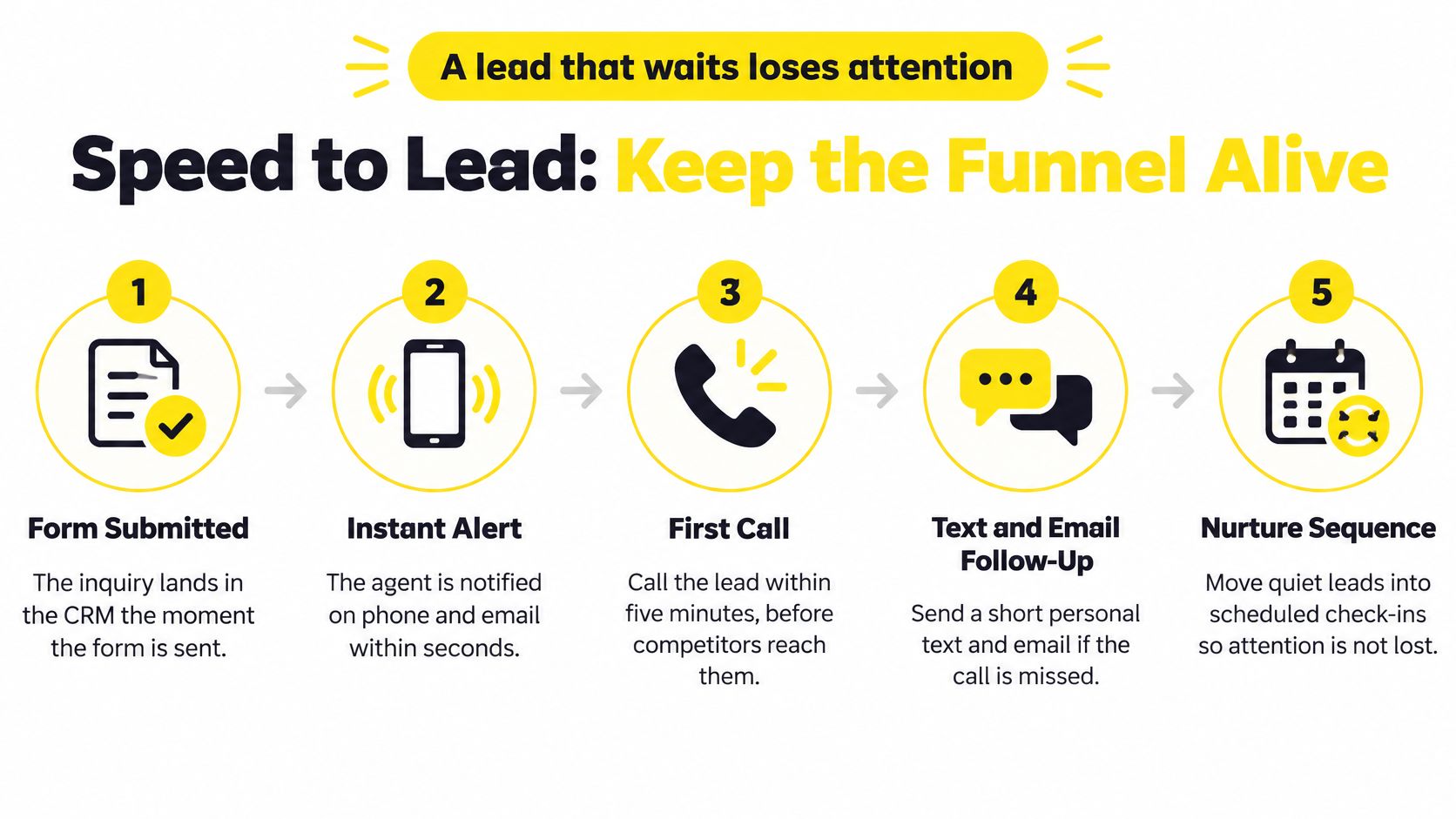
Speed-to-lead is a funnel control. If a prospect submits a request while actively comparing properties or providers, a delayed response can leave your agent calling after the prospect has moved on.
Build the handoff around a clear sequence.
Separate acknowledgement from human contact
Deliver the inquiry to the CRM immediately. Preserve its source, campaign, submitted answers, and timestamp.
Confirm receipt automatically. Send an appropriate SMS or email that identifies the business and explains the next step.
Assign a named owner. Notify a backup if the primary agent is unavailable.
Start the human call inside the target window. Measure the call attempt separately from the automated acknowledgement.
Nurture unanswered inquiries. Schedule relevant follow-up rather than leaving them in an unowned queue.
Automation isn't permission to contact people through any channel indefinitely. Match messages to the permission obtained, honor opt-outs, and avoid sending reminders after someone has declined.
A useful nurture sequence includes relevant listing alerts, neighborhood information, another call attempt, and an email that answers a likely question. MailAdept's Cold Email Sequence Structure offers a framework for sequencing messages, but an inbound property inquiry needs its own context and permission checks, not a copied cold-outreach script.
For a supplementary explanation of follow-up, the video below provides another format.
Diagnose the queue before blaming agents
Compare submission, CRM creation, assignment, and first-call timestamps. Delays before assignment suggest an integration or routing problem; delays after assignment suggest a coverage or workload problem.
Use these operational buckets without treating each boundary as a separately proven contact-rate threshold.
Response Time | Expected Effect | Required Action |
|---|---|---|
0–1 minutes | Earliest opportunity to reach an attentive prospect | Send confirmation and assign an owner instantly |
1–5 minutes | Still inside the target window | Complete the first human call attempt |
5–30 minutes | Increasing risk of losing the prospect's attention | Flag the source and review call routing |
30+ minutes | Outside the prompt-response target | Investigate the queue and reassign when needed |
Metrics That Show Which Leads Qualify
Cost per lead measures the price of an inquiry, not the price of a customer. A campaign can look inexpensive while generating unreachable contacts or appointments that never happen. Another can cost more upfront but produce better-qualified conversations.
The Real Estate Snapshot conversion-benchmark guide emphasizes measuring downstream qualification and appointments rather than platform-reported lead volume. Build your reporting around that distinction instead of adopting a generic conversion benchmark as your target.
Use a scorecard with explicit denominators
Metric | What It Tells You | Decision Rule |
|---|---|---|
Cost per lead | Price of a form fill, not of a buyer | Read alongside cost per qualified lead |
Contact rate | Share of valid leads reached in a two-way exchange | Compare across response-time buckets |
Cost per qualified lead | Price of a lead that passes screening | Scale only within your margin-based acquisition limit |
Appointment rate | Share of qualified leads who book | Review offer clarity and follow-up when it's low |
Show rate | Share of booked appointments attended | Add confirmations and reminders when it's low |
Revenue per lead | Attributable business revenue produced over time | Compare with acquisition cost and payback period |
Track events separately: landing-page view, completed form, valid lead, two-way contact, qualified opportunity, booked consultation, attended appointment, offer or application, and closed revenue. For property sales, use the revenue your business earns, not the property's sale price.
A CRM such as HubSpot or Follow Up Boss can hold the operational statuses, while your reporting connects campaign identifiers to those outcomes. Document status definitions so agents don't classify the same prospect differently.
Measurement warning: A booked appointment and an attended appointment aren't the same conversion. Combining them hides problems with commitment, scheduling, and reminders.
Return offline outcomes to the ad platforms
Offline conversion import connects CRM outcomes with the original advertising interaction. Send the appropriate qualified or closed events through consent-compliant first-party integrations, using consistent identifiers and deduplication rules.
Don't mark every stage as an equally valuable primary optimization event. Choose the deepest outcome that occurs consistently enough to support decisions, while retaining later events for evaluation. Otherwise, the platform may pursue easy form submissions that don't resemble your best opportunities.
Segment results by source, campaign, geography, lead type, and response bucket. Compare cohorts captured during the same fixed window and give them comparable time to progress. Small samples and immature sales cycles can make a campaign appear stronger or weaker than it is.
Scale only when additional spend produces worthwhile qualified appointments and expected gross profit after acquisition costs. Revenue growth alone isn't enough if servicing costs, commissions, and delayed payment leave the campaign unprofitable.
Buyer and Seller Funnels in Practice
A buyer downloading an area guide and a homeowner requesting a valuation have different questions. Sending both through the same page, call script, and nurture sequence ignores what prompted the inquiry.
These are hypothetical scenarios, not client results. They show how to choose a repair without inventing a performance promise.

The buyer campaign loses people before the form
A buyer-focused agent runs paid social ads for a neighborhood guide. People click, but the page asks for financing details and a full property wish list before explaining the area's price range.
The campaign's practical sequence is ad engagement, guide request, buyer conversation, consultation, and property search. The immediate problem is the gap between a low-commitment guide offer and a high-effort form.
The first test removes questions that aren't needed to deliver the guide and adds a clear price-range description. Keep deeper financing questions for the buyer conversation, where the agent can explain why they matter.
Judge the test by whether suitable buyers enter the conversation, not merely whether more people download the guide. If submissions increase but most respondents want properties outside the agent's market, the page still needs clearer positioning.
The seller campaign loses people after submission
A seller-focused agent runs search ads for home valuations. Homeowners submit requests overnight, but the team doesn't acknowledge them until agents review the queue the following morning.
Here, the sequence is valuation search, property-details submission, seller conversation, listing consultation, and representation decision. The first repair is an immediate acknowledgement and explicit ownership, with a prompt human-call target during staffed, appropriate calling hours.
Don't promise round-the-clock callbacks unless someone can provide them. For overnight requests, explain when the homeowner should expect contact and offer a suitable booking option.
Scenario | First Suspected Leak | Initial Fix | Evidence to Watch |
|---|---|---|---|
Buyer guide | Page visit to form completion | Shorten the form and clarify price range | More relevant buyer conversations |
Seller valuation | Submission to contact | Improve acknowledgement and coverage | More homeowners reached and consultations attended |
The seller's search can indicate a defined immediate question, while the buyer's guide download may begin a longer comparison process. Neither guarantees readiness. Fix the stage where suitable prospects stop progressing, not the stage your team finds most interesting.
Confirm Your Funnel Gaps Before Adding Ad Spend
Run a funnel audit using your ad account, landing-page analytics, and CRM export. You don't need another dashboard before you can identify missing ownership, inconsistent statuses, or a page that promises something different from the ad.
Make the audit actionable
Map your recorded events. Match existing CRM statuses to awareness, consideration, qualification, appointment, and transaction. Mark any transition your team currently guesses rather than records.
Calculate qualified acquisition cost. Group spend and screened leads by source, campaign, and geography. Exclude duplicates and invalid submissions consistently.
Inspect response timestamps. Take a recent, clearly defined batch of inquiries and sort them using the response buckets. Separate automated acknowledgement from the first human attempt.
Repair the largest avoidable loss. Choose a specific intervention, such as removing an unnecessary field, correcting owner assignment, or clarifying qualification criteria.
Hold the test through a complete cohort window. Keep the comparison period consistent and allow prospects time to progress before changing budgets.
Don't change the offer, page, routing, and call script together. You might improve the outcome, but you won't know which change deserves credit or whether another change made things worse.
Your next budget decision should follow evidence of a repaired handoff, not confidence in a new creative concept.
Choose a response-time target your staffing can support and a landing-page test to run this month, such as a shorter form with a visible price range. Name the owner, record the starting position, and set a review date. You can complete this audit without outside help.
Wojo Media connects offer refinement, landing pages, omnipresent ads, and backend KPIs so you can evaluate your real estate marketing funnel beyond form submissions. Visit Wojo Media to book a free demo call with Jason or a growth manager and start building a custom paid ad strategy around the gaps your audit identifies.
Comments