.png)
Sales Training and Coaching: Build High-Performance Teams That Win More
- Jason Wojo
- Jan 12
- 18 min read

Sales training and sales coaching are often used interchangeably, but they're two very different beasts. Think of it this way: training provides the foundational knowledge (the what), while coaching focuses on putting that knowledge into practice (the how). One builds the playbook; the other is about executing the plays to win the game.
Decoding Sales Training and Coaching

Let's break this down with an analogy. Imagine you're teaching someone to drive a high-performance race car.
Sales training is the classroom session. It's where you teach them the rules of the road, what every button and dial on the dashboard does, and the layout of the track. It’s all about the "what" and the "why."
Sales coaching, on the other hand, is putting a seasoned pro in the passenger seat during a live race. They’re giving real-time feedback—"take this corner a little tighter," "now's the time to overtake," "ease off the gas here." This is all about the "how."
What Is Sales Training
At its core, sales training is a structured event designed to give a group of people specific knowledge and skills. It’s usually a one-to-many format, like a workshop, a webinar, or a self-paced e-learning course. The goal is to get everyone on the same page and build a consistent baseline of know-how across the team.
Key topics usually covered in training include:
Product Knowledge: A deep dive into what you’re selling—features, benefits, and how you stack up against the competition.
Sales Methodology: Learning a systematic approach to selling, like The Challenger Sale or MEDDIC.
Process and Tools: Getting the team fluent in your CRM, sales engagement platforms, and internal workflows.
Core Sales Skills: Building the fundamentals, like prospecting, qualifying leads, and nailing a presentation.
It's no surprise the global sales training market is exploding, on track to double from USD 8.46 billion in 2025 to a projected USD 16.91 billion by 2032. This isn't just a trend; it's a clear signal that companies are getting serious about arming their teams for a tough market.
What Is Sales Coaching
Sales coaching is where the real magic happens. It's an ongoing, one-on-one process focused on improving a specific salesperson's performance. It’s all about helping reps apply what they learned in training to the messy reality of active deals. Unlike training, which is about knowing, coaching is about doing.
The job of a sales coach isn't to review a pipeline; it's to change behavior. A great coach can spot performance gaps and guide a rep to find their own solution, building skills and self-sufficiency that last a lifetime.
This is where true skill gets refined. For anyone in a leadership role, mastering coaching skills for managers is non-negotiable if you want to build a high-performance team. The goal isn't just to close one more deal this quarter; it’s to make your salesperson more effective at closing all their future deals.
This continuous feedback loop is what turns theoretical knowledge from a training session into consistent, revenue-generating habits. It's the critical link that ensures your investment in training actually pays off.
To make the distinction crystal clear, here’s a quick side-by-side look.
Sales Training vs Sales Coaching at a Glance
Attribute | Sales Training | Sales Coaching |
|---|---|---|
Focus | Knowledge transfer (the what) | Skill application and behavior change (the how) |
Format | One-to-many (group sessions) | One-to-one (individualized) |
Timing | Event-based (workshops, onboarding) | Ongoing and continuous |
Objective | Build a consistent knowledge baseline | Improve individual performance and habits |
Scope | Broad and general | Specific and situational |
Approach | Telling and instructing | Asking and guiding |
While they serve different purposes, training and coaching aren't an either/or proposition. They are two sides of the same coin, and the most successful sales organizations have mastered the art of blending both.
Deploying the Right Strategy at the Right Time

Knowing the difference between sales training and coaching is one thing. But the real magic happens when you know exactly which one to use and when.
Think of it like a builder’s toolkit. You wouldn't use a sledgehammer to drive a tiny finishing nail. In the same way, picking the wrong development strategy can be a massive waste of time and can kill your team’s momentum before they even get started.
Top-tier sales organizations are masters at this. They diagnose the problem on the ground and match the solution to the specific need. This ensures every effort is targeted, relevant, and actually moves the needle on performance.
When to Use Sales Training
Sales training is your go-to for building a consistent foundation of knowledge across the entire team. It’s all about getting information out efficiently so everyone is working from the same playbook.
If you’re staring down a knowledge or process gap that affects multiple people, training is almost always the right call.
Here are the classic scenarios where group training shines:
Onboarding New Hires: This is non-negotiable. You need to get new reps up to speed on your company culture, products, ideal customer profile, and sales process. Training ensures everyone gets the same solid start.
Launching a New Product or Service: When your offering changes, the whole team needs the download on new features, benefits, and how you stack up against the competition. They can't sell what they don't understand.
Rolling Out a New CRM or Sales Tool: Getting people to actually use a new tool correctly requires proper training. It's the only way to maintain clean data and get a real return on your investment.
Introducing a New Sales Process: If you're shifting to a new qualification framework or changing up your sales stages, a structured training session gets the entire team aligned and on the same page, fast.
Training creates a shared language and a unified approach. It’s the bedrock of a scalable sales engine, answering the core question: "Does my team have the information they need to succeed?"
The most effective sales organizations don't see training as a one-off event. They see it as a strategic response to specific business triggers—the essential tool for standardizing excellence and adapting to change.
When to Use Sales Coaching
While training equips the team, coaching sharpens the individual. It’s the precision tool you pull out when a rep knows the playbook but is fumbling the execution in a real-world selling situation.
Coaching isn't about dumping more information; it's about improving application and changing behavior.
Sales coaching makes the biggest impact in these specific moments:
Addressing Individual Performance Gaps: You have a rep who nails the discovery call but always gets stuck on objections. Personalized coaching can diagnose the root cause and let them practice new techniques in a safe space.
Preparing for a High-Stakes Deal: A coach can be an invaluable sounding board, helping a rep strategize for a massive negotiation, refine a pitch for a C-suite executive, or navigate tricky stakeholder politics.
Reinforcing Training Concepts: This is a big one. After a group training, one-on-one coaching is what makes the new knowledge stick. Without it, reps can forget up to 75% of what they learned.
Developing Top Performers: Coaching isn’t just for damage control. It’s how you help your A-players refine advanced skills and push them from good to truly great.
Coaching is all about answering the question, "Is this person applying their knowledge effectively to win?"
By strategically weaving together broad sales training with targeted sales coaching, you create a powerhouse development system. It's a system that doesn't just build knowledge but ensures that knowledge translates directly into measurable results.
Calculating the ROI of Your Sales Development
Let’s move past the theory and talk about what really matters: tangible business results. Great sales training and coaching aren't line-item expenses; they're high-yield investments that directly fuel growth and create predictable profit.
Viewing your team's development as a cost center is a fundamental mistake. Think of it as a powerful profit multiplier instead. A well-equipped sales team maximizes the return on every single marketing dollar you spend, turning leads into loyal, high-value customers.
Connecting Development to Dollars
The data on this is compelling. Research shows that strategic investment in sales training yields a jaw-dropping 353% ROI, with every dollar spent returning over $4 in new revenue. Other studies confirm this, highlighting a return of $4.53 per dollar, a 19% jump in win rates, and a 57% boost in overall sales effectiveness.
Yet, shockingly, only 37% of companies measure beyond simple completion rates, failing to connect their programs to hard business metrics. You can dig deeper into these powerful sales training insights and statistics to see the full picture.
This gap between investment and measurement is where most programs fall apart. Proving the value of sales training and coaching means linking it directly to the Key Performance Indicators (KPIs) that define success for your specific business.
The ultimate goal of sales development isn't just to teach skills; it's to change behavior in a way that directly increases revenue. If your training and coaching efforts don't appear on the P&L statement, they aren't working.
Industry-Specific ROI Metrics
The concept of ROI isn't abstract—it shows up in the daily wins that drive your business forward. But what that looks like depends entirely on your industry and sales cycle.
Here’s how you can translate the impact of sales development into cold, hard numbers for different business types:
For E-commerce Brands: The game is all about transactional efficiency and customer lifetime value. * Higher Average Order Value (AOV): A team trained in smart upselling and cross-selling can significantly bump the value of each transaction. * Improved Conversion Rates: Coaching on how to handle cart abandonment objections or navigate live chat inquiries can turn hesitant shoppers into happy buyers.
For Local Service Businesses: Here, success is measured by filling the appointment book with qualified leads. * Increased Appointment Booking Rate: Training on converting inbound calls into scheduled appointments is a direct line to more revenue. Simple as that. * Higher Lead-to-Customer Conversion: Coaching helps reps build trust quickly and handle common service questions, closing more deals on the spot.
For Coaches and Consultants: The goal is to shrink the sales cycle for high-ticket offers. * Shorter Sales Cycles: A well-coached consultant can master the discovery process, uncovering deep client needs faster and accelerating their decision to buy. * Higher Close Rates: Training on value-based selling and proposal presentation helps justify premium pricing and win more of the clients you actually want.
By focusing on these specific, measurable outcomes, you reframe sales development from a line-item expense into a core driver of predictable growth. The question is no longer, "Can we afford this?" but "How much revenue are we leaving on the table by not investing in our team?"
How to Build Your Sales Development Program
So, you're ready to build a system that actually improves performance day in and day out? A world-class sales development program isn't about running a few random workshops and hoping for the best. It’s about building a genuine culture of growth that turns good reps into great ones and keeps your entire team sharp.
It all starts with one simple question: "What's holding us back?" Before you can build anything meaningful, you need a blueprint grounded in reality, not just assumptions. That means getting into the trenches to figure out where the real performance gaps are.
A structured approach is the only way to ensure your investment in sales training and coaching actually moves the needle on revenue.
Start with a Thorough Needs Analysis
Your first move is to play detective. Think of a needs analysis as your diagnostic tool—it’s how you pinpoint the specific skill gaps that are costing you deals. If you skip this, you risk wasting time and money training on skills your team already has, or worse, completely ignoring a critical weakness.
You can pull together this intel in a few key ways:
Dig into Performance Data: Get into your CRM and look for patterns. Check out win/loss rates, how long deals take to close, and quota attainment. Are reps constantly getting stuck at one particular stage?
Listen to Call Recordings: This is where conversation intelligence tools are worth their weight in gold. Listening to real sales calls will show you exactly where things go wrong, whether it's weak discovery questions or fumbled objection handling.
Survey Your Team: Just ask your reps and managers. What do they think are the biggest roadblocks to closing more business? Their perspective from the front lines is priceless.
Talk to Customers: Interview people from recent wins and losses. Why did they choose you? Or why did they go with a competitor? This gives you the unfiltered truth about how your team is perceived in the market.
This analysis hands you a clear, data-backed picture of where your team needs the most help, right now.
Design Your Curriculum and Choose a Methodology
Once you know what’s broken, you can design a curriculum to fix it. A huge mistake I see all the time is creating a one-size-fits-all program. Instead, you should build your content with different modules for every experience level—from a rookie’s first day to advanced negotiation tactics for your seasoned veterans.
A core piece of your curriculum has to be a standardized sales methodology. This gives your whole team a shared language and a repeatable playbook for working through deals. Some of the most popular and proven frameworks include:
The Challenger Sale: This one is all about teaching, tailoring the message, and taking control of the conversation. It’s a great fit for complex sales cycles with a bunch of different decision-makers.
MEDDIC (Metrics, Economic Buyer, Decision Criteria, Decision Process, Identify Pain, Champion): This is a super rigorous qualification framework that forces reps to focus their energy only on the deals they can actually win.
Choosing a methodology isn’t about chasing the latest trend. It’s about picking a framework that actually aligns with your sales cycle, your ideal customer, and your business goals. Then, you need to customize it to fit your world.
To give you a better idea of how training can be structured, here's a sample onboarding plan for a new sales hire. It blends formal training with practical, hands-on coaching to make sure the learning sticks.
Sample 12-Week Sales Onboarding Curriculum
Week | Training Module Focus | Coaching Activity |
|---|---|---|
Week 1-2 | Company & Product Immersion, CRM Basics, Ideal Customer Profile | Daily check-ins, shadowing top performers, intro to manager. |
Week 3-4 | Introduction to Sales Methodology, Cold Calling & Emailing Basics | Role-playing initial outreach, live call shadowing with feedback. |
Week 5-6 | Mastering the Discovery Call, Active Listening Techniques | Call recording reviews using a scorecard, practice sessions on questioning. |
Week 7-8 | Presenting the Solution, Value Proposition & Demo Skills | Mock demo presentations to the team, feedback on storytelling. |
Week 9-10 | Objection Handling, Pricing & Negotiation Fundamentals | Live drills on common objections, deal strategy sessions in 1-on-1s. |
Week 11-12 | Closing Techniques, Pipeline Management & Forecasting | Reviewing the rep's live pipeline, setting quarterly goals. |
This kind of structure ensures new hires build a solid foundation before moving on to more advanced skills, with their manager guiding them every step of the way.
Establish a Consistent Coaching Rhythm
This is it. This is the step that separates the programs that work from the ones that are a complete waste of time. Training events might create a temporary spike in knowledge, but it's consistent coaching that turns that knowledge into real, lasting behavior change. Without it, reps forget up to 75% of what they learn in a training session.
Your coaching rhythm needs to be a non-negotiable part of your sales culture. You have to clearly define the roles and responsibilities for your sales managers—their number one job is to develop their people, not just review a pipeline.
Here’s a simple but incredibly effective structure:
Weekly 1-on-1s: Focus on specific deals and applying new skills, not just getting pipeline updates.
Monthly Call Reviews: Use a simple scorecard to give objective, structured feedback on real sales calls.
Quarterly Skill Drills: Run role-playing exercises that zero in on a specific competency, like how to handle pricing pushback.
When you combine a data-driven needs analysis with a smart curriculum and a relentless coaching rhythm, you create a powerful engine for continuous improvement. This is how you stop treating development as a one-time event and start building a true culture of high performance.
Actionable Sales Plays for Your Industry
Theory is great for building a foundation, but let's be real—revenue comes from what your team actually does in the real world. This is where we get practical. I’m going to lay out a few mini-playbooks for different types of businesses that you can adapt and put into practice right away.
The whole point of solid sales training and coaching is to build up to clear, repeatable "plays" your reps can run with confidence. These plays standardize how your team handles high-stakes situations, turning potential fumbles into consistent wins.
Think of it like this: you wouldn't send a football team onto the field without a playbook. Why would you send your sales team into a conversation without one?
This flow chart breaks down the process of building a program that actually works, from figuring out what you need to setting a rhythm for coaching.
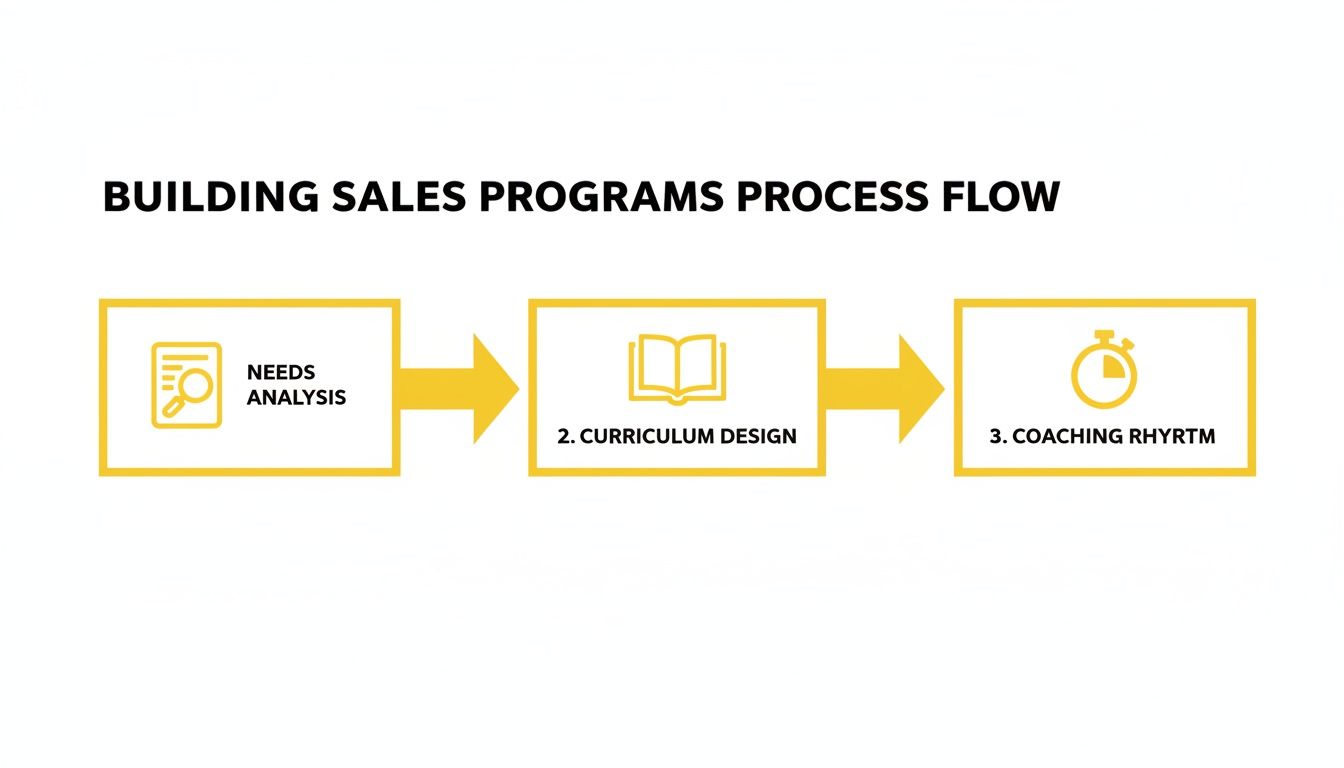
As you can see, great playbooks don't just appear out of thin air. They’re the direct result of understanding your team's gaps, designing targeted training, and then coaching them to make it stick.
Playbook for E-commerce Brands
In e-commerce, the battle is won in the margins. Every customer inquiry is a golden opportunity to increase your Average Order Value (AOV). A simple support ticket or live chat is your new sales floor.
The Play: Flip a "Where Is My Order?" (WISMO) inquiry into an upsell.
Solve First, Sell Second: Your first job is to solve their problem. Do it with empathy and clarity. "Hi [Customer Name], thanks for reaching out! I see your order shipped yesterday and is scheduled for delivery on [Date]. Here’s the tracking link so you can follow it."
Bridge to the Upsell: Now, connect their original purchase to something else you offer. "While I have you, I noticed you ordered our [Product A]. Customers who bought that absolutely love pairing it with [Product B] because it helps [achieve a specific benefit]."
Make an Irresistible Offer: Take away any friction. Give them a special, time-sensitive deal. "Since your original order is already on its way, I can add [Product B] with free shipping and a 15% discount right now. Sound good?"
If your team is on the front lines of customer communication, sharpening their live chat sales techniques can make an immediate impact on your bottom line.
Playbook for Local Service Businesses
If you run a med spa, a home service company, or even a barbershop, your money is made on the phone. That inbound call is the most critical conversion point you have. The goal is simple: turn a curious caller into a booked appointment.
The Play: Convert an inbound price inquiry into a scheduled appointment.
Caller: "Hi, I was just wondering how much you charge for [Service]?"Rep: "That's a great question, and I can definitely help you with that. The price can vary a bit depending on a few things. To give you the most accurate quote, would you mind if I ask you just two quick questions?"
Key Steps in this Framework:
Acknowledge and Control: Don't just spit out a price. Acknowledge their question, then gently pivot to take control of the conversation.
Create an Information Gap: The phrase "it depends" is your best friend here. It justifies why you need to ask a few questions before giving a number.
Ask Diagnostic Questions: Use simple questions to figure out what they really need. ("Have you had this service done before?" or "What result are you hoping to achieve?").
Book the Appointment: Frame the appointment as the obvious solution. "Based on what you've told me, the best next step is to have you come in for a free consultation. We have an opening at 2 PM today or 10 AM tomorrow. Which works better for you?"
Playbook for Coaches and Consultants
For high-ticket coaches and consultants, the discovery call is everything. This is where the sale is won or lost. Your job isn't to "pitch"—it's to diagnose their pain so deeply that your program becomes the only logical solution.
The Play: Uncover deep client needs to position a high-ticket offer.
Frame the Call: Set expectations from the start. "The goal of our chat today is to get a clear picture of your current situation and where you want to be. If it seems like I can help you close that gap, I'll explain how. Sound fair?"
Diagnose the "Current State": Use open-ended questions to dig into their challenges. * "What's the single biggest challenge you're facing with [Area of Pain] right now?" * "What have you already tried to fix this on your own?" * "What happens if you do nothing and this problem is still here six months from now?"
Define the "Future State": Get them to paint a picture of their ideal outcome. * "If we were talking a year from now, what would need to have happened for you to feel ecstatic about your progress?" * "What would achieving that goal make possible for you personally or professionally?"
Present the Bridge: Position your offer as the direct path from their pain to their desired future. "It sounds like you're here, and you want to be there. Our program is designed to bridge that exact gap by doing X, Y, and Z."
Measuring the True Impact of Your Program
If you can’t measure it, you can't improve it. That old saying has never been more true than when it comes to sales training and coaching. To justify the time and money you're pouring in, you have to look past feel-good metrics like course completion rates and focus on what actually moves the needle for the business.
A solid measurement plan gives you a clear roadmap. It shows you how to track success, prove the program's value to leadership, and make smart, data-backed decisions about where to go next. This is how you transform your program from a line-item expense into a predictable engine for revenue growth.
A Four-Level Framework for Measurement
A simple yet powerful way to track the real impact is by using a four-level model. Think of it like building a house, starting with the foundation and working your way up. This approach gives you a complete picture of your program’s effectiveness, from how the team first reacts all the way to the impact on the bottom line. It connects the dots between learning a new skill and seeing better business results.
This layered method keeps you from just guessing what’s working. For instance, if your revenue numbers aren't budging, this model helps you pinpoint the problem. Is the training content itself weak (Level 2), or are your reps just not using what they learned out in the field (Level 3)?
The real goal here is to draw a straight line from your sales development efforts to tangible business outcomes. Without that connection, training and coaching will always feel like a "nice-to-have" instead of the strategic necessity it truly is.
Level 1: Reaction and Engagement
This is the ground floor—your foundation. It’s all about capturing the team's immediate gut reaction to the training. Did they see it as relevant? Engaging? Genuinely useful for the calls they have to make tomorrow?
How to Measure: Keep it simple with post-session surveys and informal chats.
The Big Question: Does the team actually believe this program will help them win?
A happy team doesn't guarantee results, but a team that hates the training is a huge red flag. If they aren't bought in, they won’t absorb a thing.
Level 2: Learning and Knowledge Retention
Next, you need to check if the information actually stuck. Did your reps learn and, more importantly, remember the key skills, frameworks, and talking points you covered?
How to Measure: Use short quizzes, knowledge checks, or even mock-call certifications.
The Big Question: Does the team truly understand the new skills?
Level 3: Behavior and Application
This is where the rubber meets the road. Are your reps taking what they learned in the classroom and applying it to real-world sales calls? This is the most critical link in the entire chain.
How to Measure: Dive into call recording reviews, have managers shadow live calls, and analyze your CRM data for new patterns.
The Big Question: Is the team actually using the new skills with prospects?
Level 4: Business Results
Finally, we connect everything to the high-level business numbers that everyone in the C-suite cares about. This is the ultimate proof that your program is delivering a real return on investment.
How to Measure: Track your core sales KPIs like win rates, sales cycle length, average deal size, and quota attainment.
The Big Question: Are these new skills and behaviors driving more revenue?
By tracking these four levels in order, you can build a powerful story backed by data, proving once and for all the immense value of your sales training and coaching program.
Common Questions About Sales Training and Coaching
Let's be honest, diving into a formal sales development program can bring up a lot of "what ifs." Most business owners and sales leaders I talk to run into the same practical questions about budget, resources, and actually making it work. Here are some straight answers to help you get past those hurdles and launch your program with confidence.
How Much Should I Budget for Sales Training and Coaching?
You'll hear the standard benchmark of 1-3% of your total sales payroll, but that number can feel a bit abstract. I find a more practical way to start is by zeroing in on a critical skill gap that's costing you revenue right now. A small, focused investment in a specific workshop or a great coach can deliver some seriously impressive returns.
Remember the data—the right kind of training can generate a staggering 353% ROI. Don't think of it as an expense; frame it as an investment in predictable growth. My advice? Start with a pilot program. Measure its direct impact on a key metric like your win rate or average deal size, and then use that hard data to make the case for scaling the budget.
Should We Use an In-House or External Sales Coach?
Both have their strengths, and the right answer depends on your team. In-house coaching, usually done by sales managers, keeps everything tightly aligned with your company culture and day-to-day plays. The catch? This whole model relies on your managers actually being skilled coaches—which is a totally different skill set from just managing a pipeline.
External coaches, on the other hand, bring in a fresh, objective perspective. They aren't caught up in internal politics and can challenge those "we've always done it this way" habits. They come with specialized expertise and can introduce new frameworks that your team has never seen before, focusing purely on improving performance.
Often, the most powerful move is a hybrid approach. Hire an external expert to train your managers on how to be elite coaches. This gives your leaders the skills they need to develop their teams long-term, building a sustainable coaching culture from the inside out.
What Is the Biggest Mistake to Avoid in Sales Training?
The single biggest mistake I see is treating training like a one-off event. You hold a workshop, everyone gets fired up, and then... nothing. Without immediate application and consistent follow-up, that knowledge just evaporates. In fact, research shows people can forget up to 75% of what they learn if it isn't reinforced.
To sidestep this, every single training session has to be chained to a structured coaching plan. The goal isn't just to transfer knowledge; it's to change behavior.
This means managers need to be in the trenches with their reps right after the training, working to apply the new skills on live deals and real calls. That ongoing reinforcement is the bridge that turns classroom theory into the kind of consistent, high-performing sales habits that actually move the needle on revenue. Without it, you might as well have not made the training investment at all.
Ready to stop leaving money on the table? The team at Wojo Media bolts onto your business to scale revenue with precision-targeted ad campaigns. We combine expert ad strategy with irresistible offers and landing pages to deliver predictable, profitable growth. Book a free demo call today and get a custom advertising plan to fill your pipeline.
Comments