.png)
TikTok Ads vs Facebook Ads Which Is Right for You

When you get down to it, the real difference between running ads on TikTok versus Facebook boils down to two things: user intent and where they are in your sales funnel.
Think of TikTok as an entertainment-first platform. It’s your go-to for top-of-funnel brand awareness, especially if you’re trying to connect with a younger audience using authentic, trend-led creative. On the flip side, Facebook is a connection-first platform. It shines when you need to drive bottom-of-funnel conversions, leveraging its incredibly precise targeting and retargeting tools for a more mature user base.
Understanding the Core Differences
Picking between TikTok Ads and Facebook Ads isn't a simple choice; it’s a strategic one that hinges on your business goals, who you’re trying to reach, and what kind of creative you can produce. While they're both social advertising juggernauts, they exist in completely different worlds. One is built on discovery and viral energy, while the other provides a mature, data-heavy environment engineered for measurable conversions.
This goes way beyond simple demographics. It's about the user's state of mind. Someone endlessly scrolling their TikTok "For You" page is leaning back, looking to be entertained, and is wide open to discovering something new. A person on Facebook is often in a more active, community-driven mode, catching up with friends or even actively researching products and solutions.
Here’s the key insight every advertiser needs to grasp: On TikTok, your ad has to be the entertainment. On Facebook, your ad can interrupt the entertainment to solve a problem.
Key Platform Differentiators
To make a smart call, you need to see how they stack up directly. Let's break down the fundamental distinctions that every marketer should understand before they spend a single dollar. This comparison will help you see which platform truly aligns with your campaign goals, whether you're aiming for broad brand exposure or laser-focused sales.
High-Level Comparison: TikTok vs. Facebook Ads
The table below gives you a quick snapshot of the most important differences. Use it as a starting point to frame your thinking before we dive deeper into the nuts and bolts of each platform.
Attribute | TikTok Ads | Facebook Ads |
|---|---|---|
Primary Goal | Brand Awareness & Engagement | Conversions & Lead Generation |
Audience Mindset | Discovery & Entertainment | Connection & Information Seeking |
Best For | Top-of-Funnel (TOFU) | Mid/Bottom-of-Funnel (MOFU/BOFU) |
Creative Style | Authentic, Lo-fi, UGC-style | Polished, Direct-Response |
Targeting Strength | Broad, Algorithmic Reach | Granular, Interest & Behavior-Based |
Seeing them side-by-side makes the strategic choice much clearer. TikTok is your engine for reach and cultural relevance, while Facebook remains the undisputed king of performance-driven marketing.
The whole social media world is in constant motion. Projections show that by 2025, TikTok will actually overtake Facebook in daily time spent by users. Yet, Facebook's ad revenue and efficiency are still miles ahead. This tells a fascinating story: while eyeballs are moving, advertisers still put immense trust in Meta's battle-tested conversion machine. You can explore more data on social media ad spend trends to see the full picture.
Audience Demographics and User Intent
Before we even touch on ad formats or targeting options, we have to talk about mindset. It’s the single most important factor when choosing between TikTok and Facebook, and it goes way beyond simple user counts.
The psychology of the user on each platform is fundamentally different. An ad that hits all the right notes on Facebook can feel completely tone-deaf on TikTok, torching your budget and turning off potential customers before you even get started.
People open Facebook with a purpose. They’re in a community-focused or information-gathering mode, looking to connect with family, dive into their favorite groups, or even research a problem they’re actively trying to solve. This creates a prime environment for ads that offer clear value, solve a pain point, or align with interests they’ve already demonstrated.
TikTok is the polar opposite. Users are there for one reason: entertainment. They’re in a pure discovery mode, leaning back and letting the algorithm serve them an endless stream of amusing, surprising content. Their scrolling is passive and fluid, which makes them incredibly open to ads that feel like native entertainment but completely resistant to anything that screams “traditional commercial.”
The Lean-Back vs. Lean-Forward Experience
I like to think of this as the "lean-back" versus "lean-forward" dynamic.
TikTok is the ultimate lean-back experience. Content washes over the user, and the only way for an ad to succeed is to blend into that stream of entertainment. It has to feel like just another great video in their feed.
Facebook, on the other hand, is a lean-forward platform. Users are actively clicking, commenting, and digging for information. They’re much more receptive to direct-response ads that present a clear offer and a strong call-to-action.
This difference isn't just a small detail; it should dictate your entire creative strategy. A polished, direct-response video that might crush it on Facebook for a user who’s already in the market will get skipped on TikTok in less than a second.
Here's the bottom line: On TikTok, your ad must be the entertainment. On Facebook, your ad can interrupt the entertainment, but only if it solves a problem or speaks to an existing desire. Getting this wrong is the fastest way to waste your money.
Practical Application: A B2C E-commerce Scenario
Let’s make this real. Imagine you're a B2C brand selling a cool, visually striking kitchen gadget. A one-size-fits-all approach is doomed to fail. Here’s how your TikTok ads vs Facebook ads strategy would break down.
TikTok Ad Strategy (The Discovery Mindset):
Creative: Forget polished product shots. You need a fast-paced, user-generated content (UGC) style video showing the gadget making someone's life easier or more fun, all set to a trending audio clip. The focus isn't on features; it’s on the satisfying outcome.
Angle: You're not selling a product; you're sharing a "kitchen hack" or a "cool gadget I found." It has to feel like an organic discovery. The call-to-action is light, maybe just a simple text overlay saying, "Link in bio to see it."
Goal: Spark that "aha!" moment and drive top-of-funnel buzz. The user wasn't looking for your gadget, but now they're intrigued because the content was genuinely entertaining.
Facebook Ad Strategy (The Intent Mindset):
Creative: This is where you bring out the high-quality assets. Think carousel ads showing the gadget from every angle, a short video demoing its key benefits, and a graphic that clearly states your special offer.
Angle: You go straight for the pain point. The copy might read, "Tired of messy meal prep?" It's direct, benefit-driven, and features a bold call-to-action button like "Shop Now" or "Get 20% Off Today."
Goal: Drive sales. You’re targeting users who’ve already shown interest in cooking or similar products. You assume they have some intent, and your job is to give them a compelling reason to buy right now.
Comparing Ad Formats and Creative Requirements
The fundamental difference between how people use TikTok and Facebook dictates everything about the ads that succeed on each platform. An ad that kills it on Facebook will almost certainly feel clunky and out of place on TikTok, leading to thumb-stopping for all the wrong reasons—and a lot of wasted cash. To get results, you have to think and create like a native.
On TikTok, your primary job is to blend in. The goal is to make your ad feel like just another amazing video someone stumbled upon on their "For You" page. Facebook, however, is a different beast entirely. With a wider range of user activities, it offers a whole toolbox of ad formats built for direct response, guiding users from initial click to final purchase.
Here's the core principle: On TikTok, your ad is the entertainment. On Facebook, your ad can interrupt the entertainment to solve a problem or make an offer.
TikTok Ad Formats Built for Virality
TikTok's entire ad suite is designed to feel like organic content, sparking discovery and encouraging people to join in. The ads that really pop are the ones that tap into trends, feel authentic, and leverage user-generated content (UGC).
In-Feed Ads: These are your bread-and-butter, full-screen vertical videos that slide right into a user's scroll. The best ones don't look like ads at all; they use trending audio, fast edits, and have that raw, low-fi feel that screams authenticity.
Spark Ads: This is a game-changer. Spark Ads let you boost your own organic posts or—even better—amplify content from creators who've featured your products. It’s instant social proof because the ad comes from a real person, not a brand account.
Branded Hashtag Challenges: While it's a big investment, this format is unmatched for driving massive brand awareness. You create a challenge or theme, and users generate a mountain of UGC for you. It’s how you become part of the culture on TikTok.
Let's say you sell a cool blender. On TikTok, you'd use a Spark Ad to boost a creator's viral "15-second smoothie recipe" video. It feels like a genuine discovery, not a corporate plug.
Facebook Ad Formats Engineered for Conversion
Facebook's ad formats are methodical tools, each designed to move a user along a specific part of the customer journey in a more controlled environment. Mastering these means you can guide someone from casual interest to a completed purchase, sometimes without them ever leaving the app. As you dig into formats for either platform, knowing how to create AI video ads that convert is key to making your ad spend work harder.
These are a few of Facebook’s workhorses:
Carousel Ads: Perfect for showing off a range of products, different features, or a series of testimonials in one interactive unit. Each card gets its own headline, link, and call-to-action, making it a powerhouse for e-commerce brands.
Collection Ads: A mobile-first format that pairs a main video or image with a grid of products right below it. A single tap opens a full-screen storefront called an Instant Experience where users can browse and buy on the spot. It's incredibly slick.
Lead Ads: This format is all about frictionless lead gen. It pre-fills a form with the user's contact info straight from their Facebook profile, making it dead simple for them to sign up for a webinar, download an ebook, or request a quote.
Back to our blender example. On Facebook, the same brand would crush it with a Collection Ad. A polished video would show the blender in action, and just below it, users would see the different models and accessories available to buy immediately. The TikTok ads vs Facebook ads debate really boils down to this: organic, entertaining discovery versus a highly structured path to conversion.
Analyzing Targeting Capabilities and Funnel Strategy
Any ad platform is only as good as its ability to get your ad in front of the right person at the right time. When you pit TikTok Ads against Facebook Ads, you're looking at two completely different philosophies on how to do just that. One gives you the keys to a surgical suite built on a decade of data, while the other hands you a megaphone connected to a powerful, almost psychic, content discovery engine.
Facebook's targeting is legendary for its depth and granularity. It's a mature system that lets advertisers get ridiculously specific by layering interests, life events, purchase behaviors, and demographics to construct a precise customer avatar.
This level of control makes Facebook a beast for middle and bottom-of-funnel campaigns. Its secret weapon has always been the Meta Pixel, which powers some of the most effective retargeting capabilities on the planet.
Facebook: The Master of Precision and Retargeting
With Facebook, you can build hyper-specific audiences that are practically waiting to convert. The entire system is built for advertisers who already have a good idea of who their customer is and just need the tools to guide them across the finish line.
Here's where it really shines:
Lookalike Audiences: Got a list of your best customers? Upload it, and Facebook’s algorithm will go out and find millions of people who look and act just like them. It's one of the most reliable ways to scale your campaigns.
Behavioral Targeting: You can target people based on what they do, not just what they say they like. Think past purchases, the type of phone they use, or even major life events like getting engaged or moving to a new city.
Detailed Interest Layers: It’s not just about targeting "fitness." You can dial it in to people who follow specific influencers, buy certain athletic apparel brands, or are members of niche running groups.
This is why Facebook is still king when it comes to retargeting. An e-commerce brand can serve a unique discount code to someone who abandoned their cart just a few hours ago, closing the sale right then and there. That kind of precision is why it remains the go-to for driving a measurable return on ad spend (ROAS).
TikTok: The Engine of Algorithmic Discovery
At first glance, TikTok's targeting options seem simpler, but their real power is hidden in plain sight: the "For You" page algorithm. The platform operates on a different principle—it cares less about the interests users list on their profile and more about what their minute-by-minute behavior proves they want to see.
Your job is to feed the algorithm a killer piece of creative and a broad audience. From there, it works its magic, rapidly finding pockets of people who are most likely to engage. This makes TikTok an absolute powerhouse for top-of-funnel (TOFU) marketing, perfect for introducing your brand to massive new audiences who had no idea they needed you.
On Facebook, you find your customers. On TikTok, customers find you. This is a fundamental shift that demands a totally different strategy, one built on broad-appeal creative and entertainment value, not just pinpoint accuracy.
The Ultimate Omnichannel Funnel Strategy
The sharpest marketers aren't picking sides; they’re making the platforms work in tandem. The real magic happens when you use each platform's unique strengths to build one cohesive, full-funnel machine.
Here’s what that looks like in action:
Top of Funnel (TOFU) on TikTok: Kick things off with broad, entertaining video campaigns on TikTok. Your goal isn't direct sales—it's capturing massive attention and engagement at a low cost. You're getting your brand in front of millions of potential customers in a way that feels native and fun.
Middle of Funnel (MOFU) Retargeting on Facebook/Instagram: This is where the handshake happens. By placing the Meta Pixel on your website, you can capture all that traffic flooding in from your viral TikToks. You then hop into Facebook Ads Manager and create a custom audience of every single person who visited your site from TikTok.
Bottom of Funnel (BOFU) Conversion on Facebook/Instagram: Now you hit them with direct-response ads on Facebook and Instagram. Think carousel or collection ads showcasing your products. Since this audience is already warmed up and familiar with your brand from TikTok, they are exponentially more likely to convert.
This omnichannel approach truly gives you the best of both worlds. You use TikTok's unmatched reach to stuff the top of your funnel with cheap, engaged traffic, then deploy Facebook's sophisticated conversion tools to turn that attention into predictable sales.
Evaluating Cost Benchmarks and Return on Ad Spend
When you put TikTok Ads and Facebook Ads head-to-head on cost, the numbers tell two very different stories. One platform gives you incredible reach for a surprisingly low cost of entry, while the other offers a more predictable, data-backed path to a solid return. Getting a handle on these financial differences is the key to spending your ad budget wisely.
TikTok has made a name for itself with its lower Cost Per Mille (CPM), which is what you pay for a thousand views. This makes it a beast for top-of-funnel campaigns where your main goal is simply getting your brand in front of as many people as possible. The platform's discovery algorithm is brilliant at this, quickly finding audiences that will actually watch your stuff, which helps keep those costs down.
But a low upfront cost doesn't automatically mean a better return. Facebook’s ad auction is far more mature and, yes, often comes with a higher CPM. The trade-off? Its incredibly deep user data and fine-tuned optimization tools frequently lead to a more stable and predictable Return on Ad Spend (ROAS), especially when you're gunning for sales and other bottom-funnel conversions.
Diving Into the Data
Let's look at the hard numbers. Recent data shows a fascinating dynamic between cost-efficiency and conversion quality.
TikTok has been a powerhouse, delivering an average ROAS of 5.1:1 in 2025—that's a return of $5.10 for every dollar spent. It’s hard to argue with that. This impressive performance, which tops Facebook's 3.8:1 ROAS, is driven by rock-bottom costs and sky-high engagement.
Now, let's break down the metrics that drive these results.
Advertising Performance Metrics: TikTok vs Facebook
This table breaks down the average costs and performance benchmarks for each ad platform, giving advertisers a clear financial comparison for budgeting and expectation setting.
Metric | TikTok Ads | Facebook Ads |
|---|---|---|
Average ROAS | 5.1:1 | 3.8:1 |
Cost Per Click (CPC) | $1.80 | $2.85 |
Cost Per Mille (CPM) | N/A (Lower overall) | $14.40 |
Conversion Rate | 2.14% | 1.62% |
Video Completion Rate | 73% (for shorter ads) | Varies |
TikTok's lower $1.80 CPC and industry-leading 2.14% social conversion rate are fueled by an incredible 73% video completion rate on shorter ads. Compare that to Facebook, which came in with a higher $2.85 CPC and a $14.40 CPM, leading to a 1.62% conversion rate. For a deeper dive into these figures, you can check out the full research on 2025 social media advertising performance.
Contextualizing ROAS for Different Business Models
These numbers are a great starting point, but they don't tell the whole story. A "good" ROAS completely depends on your business, your profit margins, and what you’re trying to achieve. What’s a home run for a brand selling cheap t-shirts would be a total failure for a high-end B2B service.
The crucial insight here is that not all leads or conversions are created equal. A lower Cost Per Lead (CPL) from TikTok might look great on paper, but a higher-cost lead from Facebook could be far more valuable if they are closer to making a purchase.
To really get a feel for your return on TikTok, it's vital to analyze TikTok sponsored content and figure out what’s driving paid engagement versus organic buzz. This kind of analysis helps you see beyond the surface-level metrics.
Let's look at how this plays out in the real world:
Scenario 1: An E-commerce Brand Selling a $50 Product This brand would probably lean into TikTok. They can use the lower CPM and CPC to drive a ton of traffic, test if a product has viral potential, and build a massive audience for retargeting later. Even if the conversion rate is a little lower, the sheer volume of cheap clicks can still lead to a great ROAS.
Scenario 2: A High-Ticket Coaching Program This business is a perfect fit for Facebook's precision. They can easily afford a higher CPL because a single client is worth thousands. Facebook’s targeting lets them zero in on professionals with specific job titles, interests, or income levels, ensuring the leads they get are actually qualified and ready to invest.
Choosing Your Platform: A Strategic Decision Framework
Figuring out whether to put your ad dollars into TikTok Ads or Facebook Ads isn't a simple "either/or" question. The smart play is to see them as specialized tools for different jobs, not rivals fighting over your budget. This framework is designed to help you move past a basic feature comparison and start prioritizing ad spend based on your actual business model and campaign goals.
The right platform really depends on what you need to accomplish right now. Are you trying to get a new product in front of as many eyes as possible? Or are you laser-focused on converting high-intent leads who are already looking to buy? Nailing down that answer is the first step to building a profitable ad strategy that works across both platforms.
This decision tree gives you a visual of the core strategic split. It all comes down to your primary marketing objective: awareness or conversions.
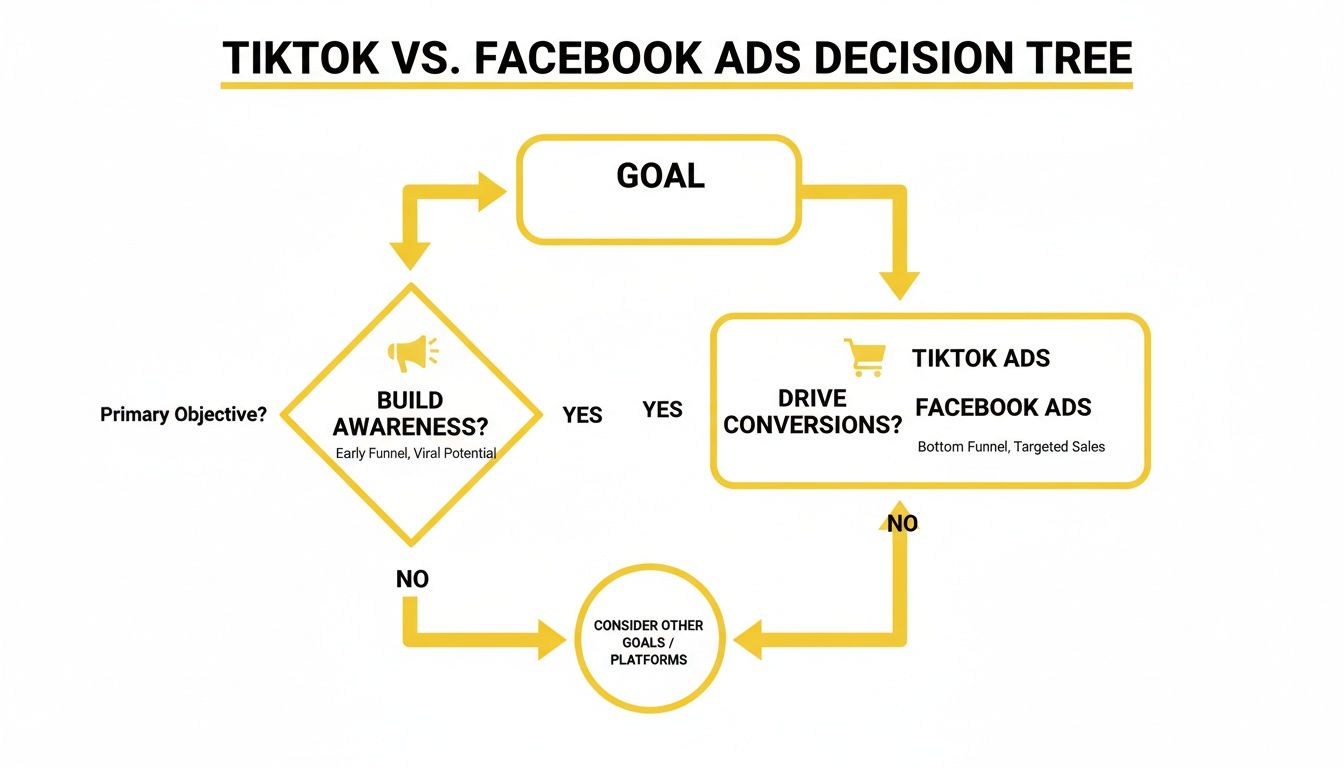
As you can see, the path is pretty clear. For top-of-funnel goals like blowing up brand awareness, TikTok is your go-to. For bottom-of-funnel, conversion-driven campaigns, Facebook is where you should start.
Recommendations for E-commerce Brands
For e-commerce, your choice often boils down to two things: your product's price and how good it looks on camera. The whole tiktok ads vs facebook ads debate hinges on whether you need to create demand from scratch or just capture the demand that's already out there.
When to Prioritize TikTok First: Got a visually interesting product, especially one under $100? Start on TikTok, no question. The platform is second to none for testing a product's viral potential. Use it to build a genuine brand following, drive massive top-of-funnel traffic, and collect a goldmine of user-generated content for social proof.
When to Prioritize Facebook First: If you’re selling a higher-ticket item or something that requires a bit more thought before purchase, lean into Facebook. Its targeting capabilities let you zero in on audiences that have already shown they’re ready to buy. Most importantly, Facebook is king for surgical retargeting to win back those abandoned carts and scale your proven winners with conversion-focused campaigns.
A killer e-commerce strategy uses both platforms in tandem. Launch on TikTok to see if a product takes off. If it catches fire, use all that traffic data to build custom and lookalike audiences on Facebook to close the deal.
Recommendations for Local Service Businesses
If you run a business tied to a specific geographic area—think med spas, home service pros, or barbershops—the game is all about immediate lead generation. This makes your decision much more straightforward.
Prioritize Facebook for High-Intent Leads
For almost any local service, Facebook is the place to start. Its advantages are just too good to pass up:
Hyper-Local Geo-Targeting: You can target users within a tight radius of your business, ensuring every single ad dollar is spent on people who can actually walk through your door.
Lead Ads for Frictionless Sign-Ups: Facebook’s native Lead Ads pre-fill a user's contact info, making it incredibly easy for them to book an appointment or request a quote right from the ad. This cuts down on friction and sends conversion rates soaring.
Demographic and Interest Targeting: You can layer location with demographics (like age and gender) and interests (like "skincare" for a med spa) to find your perfect local clients.
While Facebook is busy getting you leads right now, TikTok can play the long game. Use it to build a local buzz and show off your brand's personality with behind-the-scenes videos or client testimonials. This builds brand recall, so when someone is finally ready to buy, you’re the first name that comes to mind.
Recommendations for Coaches and Consultants
For coaches, consultants, and course creators, the main goal is usually getting new clients through lead magnets, webinars, or direct bookings. This is a high-consideration purchase, which again points to a clear platform priority.
Lead with Facebook for Qualified Leads
Facebook completely dominates for this business model. Its ability to target based on professional details like job titles, industries, and interests in specific business leaders or software makes it the perfect tool for finding qualified prospects. Use Facebook to drive sign-ups to your webinar registration pages or to fill your sales funnel with high-quality leads.
Use TikTok for Personal Branding
TikTok serves a totally different, but equally valuable, purpose here. It’s an incredible channel for building your authority and personal brand at a massive scale. By sharing valuable tips, industry insights, and client success stories in short-form video, you can grow a huge, engaged following. This audience can then be nurtured and eventually funneled into a webinar or sales process you're promoting on Facebook.
Your Questions, Answered
When you're in the trenches with TikTok and Facebook Ads, a lot of specific questions pop up. Getting straight answers is the key to building a strategy that doesn't just spend money, but actually makes it.
Can I Just Use the Same Ad Creative on Both Platforms?
I get this question all the time, and the answer is a hard no. Slapping a polished, horizontal Facebook video ad onto TikTok is probably the fastest way to burn through your ad budget and get zero results. These platforms are built on completely different creative languages.
TikTok lives and dies on authenticity and pure entertainment. Your ad has to blend in, feeling like a piece of native content someone just stumbled upon. Think trending sounds, lo-fi vibes, and that user-generated feel. Facebook, on the other hand, is much more forgiving of direct-response ads—polished creative that clearly spells out the value and pushes for a click. To win on both, you have to play by their individual rules and create bespoke ads for each.
Is TikTok Just for Reaching Teenagers?
While Gen Z absolutely fueled TikTok's insane growth, the platform has grown up. A huge, and still growing, wave of millennials and even Gen X are scrolling the "For You" page every single day. This makes it a serious channel for reaching a much wider audience than most marketers think.
That said, the demographic differences are still important. If your absolute core customer is definitively over 30, Facebook still gives you a more direct and concentrated way to reach them with its deep demographic targeting layers.
"A huge mistake I see brands make is writing off TikTok's audience as just kids. The data shows a massive diversification. Ignoring that shift is like leaving a stadium full of engaged potential customers waiting outside your door."
What's a Realistic Starting Budget for Each Platform?
Technically, you can get started with as little as $25-$50 a day on either platform just to see what happens. The problem is, a budget that small will likely get stuck in the dreaded "learning phase," where the algorithm can't get enough data to figure out who your best customers are.
If you're serious about getting real, actionable data, you need to give the platforms more to work with. A more realistic test budget is around $1,000 to $2,000, spread out over a couple of weeks. This gives the algorithms enough fuel to optimize properly and gives you enough feedback to make smart calls on what to scale and what to kill.
Which Platform Is Actually Better for B2B?
For the vast majority of B2B advertisers, Facebook is still the heavyweight champion. Its targeting is just built for reaching professionals. You can get incredibly specific, zeroing in on users based on things that actually matter for B2B:
Job Titles: Go straight to the decision-makers, like a "Director of Operations" or "Chief Financial Officer."
Industries: Target people working in specific sectors, whether that's SaaS, manufacturing, or finance.
Company Size: Focus your budget on employees at scrappy startups or massive enterprise companies.
Some B2B brands are using TikTok really well for top-of-funnel brand plays—showing off their company culture and building awareness. But when it comes to the nuts and bolts of B2B lead generation and driving measurable pipeline, Facebook is still the more reliable and direct engine.
Ready to stop the guesswork and finally build a predictable ad strategy that scales? At Wojo Media, we build omnipresent ad campaigns that turn clicks into loyal customers on every platform that matters. Book your free demo call today and let's map out a custom plan to hit your growth targets.
Comments