.png)
Top Guide: marketing agency vs in house - Choosing Growth Partners

At its core, the marketing agency vs. in-house debate boils down to one thing: resource allocation.
An agency gives you immediate access to a whole crew of specialists and high-end tools for a predictable monthly fee. The in-house route, on the other hand, offers an unrivaled level of dedicated focus and deep brand knowledge, but it comes with a hefty price tag in salaries, benefits, and overhead. Your choice really hinges on whether you need expertise and scalability right now or if you're playing the long game of brand ownership and control.
The In-House Vs Agency Dilemma: A Framework For Your Decision
Deciding whether to build your own marketing team or bring in an agency is one of those make-or-break moments for any growing business. There’s no single right answer here. The best move depends entirely on your company's stage, budget, and where you want to be in the next few years. This guide is designed to cut through the noise and give you a straightforward, data-backed framework to make the right call.
We're going to break down the five pillars you absolutely must evaluate:
Total Cost: We’ll go beyond just salary to look at the fully-loaded cost of an employee versus a simple agency retainer.
Specialized Expertise: This is about comparing the deep, focused skills of an agency specialist against a more generalist in-house hire.
Speed to Market: How long does it actually take to see results from a new hire compared to an agency team that’s ready to hit the ground running?
Scalability: We'll look at how each option holds up when you need to grow fast or pivot because the market changed overnight.
Operational Control: This covers the degree of direct oversight and day-to-day brand immersion you get with each model.
This decision tree gives you a quick visual for how a business's growth stage typically steers this choice.
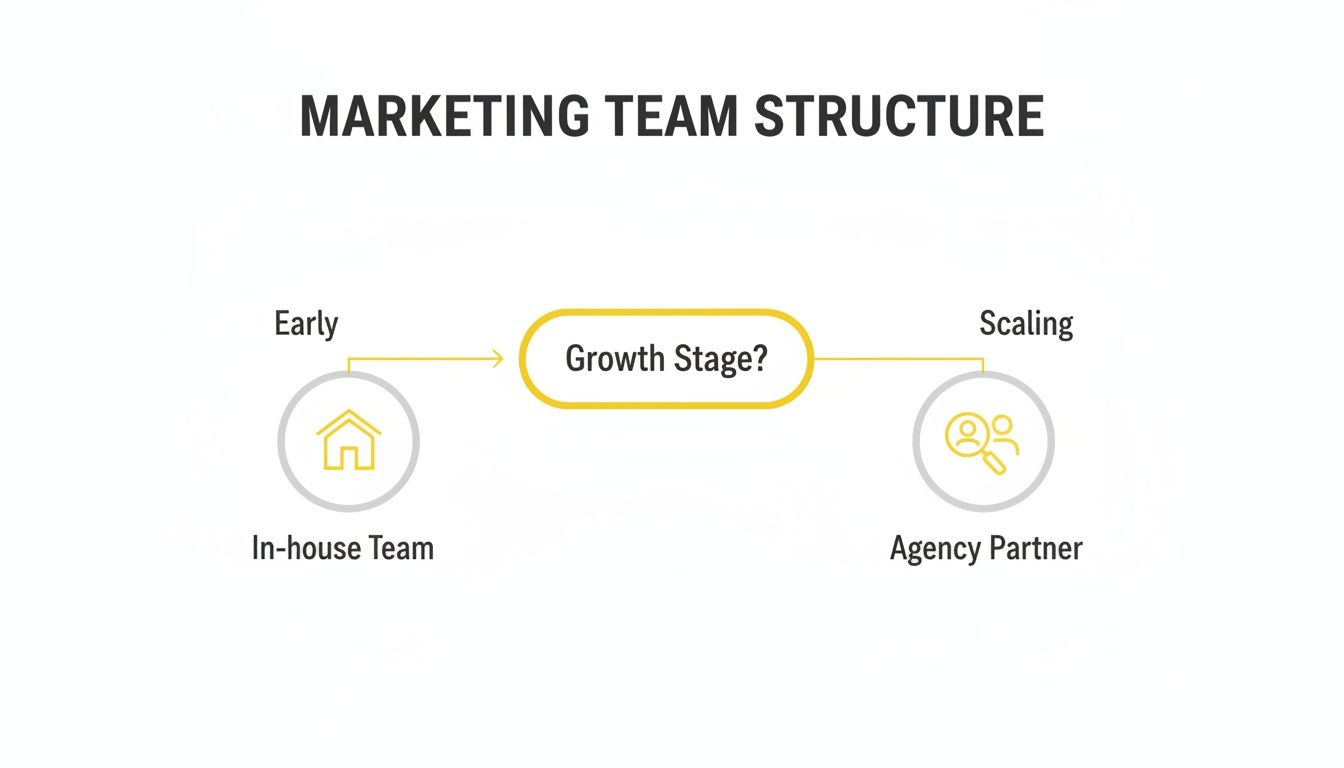
As you can see, early-stage companies often thrive with the dedicated focus of an in-house person or small team. But once you hit a certain growth trajectory, the specialized expertise an agency brings to the table becomes critical. For a deeper dive into these considerations, check out a practical guide to In-House vs Agency Marketing.
It's also worth noting that this isn't always an either/or situation. A 2023 survey found that while 66% of major brands have built up their in-house capabilities, a full 100% of them still partner with outside experts when they hit a wall. This proves that a hybrid model is often the smartest way to get the best of both worlds.
Calculating The True Cost Of Marketing
When you're weighing a marketing agency against an in-house team, the first numbers people usually throw around are salary versus retainer. But honestly, that’s a rookie mistake. That kind of surface-level math completely misses the real story of what you'll actually spend.
To make a smart financial call, you have to look at the fully loaded cost of an employee. And trust me, it’s a whole lot more than just their yearly salary. An in-house team comes with a ton of hidden expenses that pile up fast, and they aren't just minor details—they're a huge chunk of your total investment.
The Hidden Costs Of An In-House Team
So, what are these hidden costs? Beyond that base salary, you have to budget for a long list of recurring expenses just to keep an employee productive. These are non-negotiable.
Recruitment Fees: Finding great talent isn't cheap. If you use a recruiter, expect to pay 15-25% of the employee's first-year salary. Ouch.
Benefits and Payroll Taxes: This one's a biggie, typically adding another 25-30% on top of their base pay. We're talking health insurance, retirement contributions, and all those fun FICA taxes.
Software and Tools: Your team needs the right gear to even have a fighting chance. Subscriptions to platforms like Semrush for SEO, Adobe Creative Suite for design, and a solid CRM can easily run you $5,000-$10,000 a year.
Hardware and Office Space: Every new person needs a laptop, monitors, and a desk. It all adds to your overhead.
Training and Development: The digital world moves fast. To keep your team's skills sharp, you're on the hook for courses, conferences, and certifications, which can add thousands more each year.
These costs stack up with every single hire. That digital marketer you hired for an $80,000 salary? Once you factor everything in, they're actually costing your business closer to $108,000 per year. That's a huge difference.
Agency Retainers: The All-Inclusive Model
Now, let's look at the agency side. It’s a much simpler, more predictable retainer model. That monthly fee you pay is designed to be all-inclusive, bundling nearly all the overhead you’d otherwise be paying for piece by piece.
An agency retainer isn't just paying for services; it's buying access to a complete, pre-built marketing infrastructure. This includes enterprise-level software, a full team of specialists, and battle-tested processes without the associated overhead and HR liabilities.
When you bring on an agency, you get to skip the entire headache of recruiting, onboarding, and benefits administration. The agency's fee already covers the salaries, training, and tools for their entire team—from the PPC specialist and copywriter to the graphic designer and data analyst. You get a whole squad of experts from day one, for what often amounts to a fraction of the cost of hiring them yourself.
It’s a model built for financial predictability and operational efficiency. You can scale your marketing firepower without having to scale your headcount and all the complexity that comes with it.
Annual Cost Analysis: Agency Retainer Vs. Fully Loaded In-House Team
Let's put some real numbers to this so you can see the financial reality of the agency vs. in-house decision. Here’s a side-by-side comparison of what a lean in-house team might cost you in the first year versus a typical performance marketing agency retainer.
Expense Category | In-House Team (Estimated Annual Cost) | Marketing Agency (Estimated Annual Cost) |
|---|---|---|
Salaries (Fully Loaded) | $344,800 | $0 (Included in retainer) |
Digital Marketer ($80k base) | $108,000 | |
Content Creator ($70k base) | $94,500 | |
PPC Specialist ($85k base) | $114,800 | |
Recruitment Fees (15%) | $35,250 (One-time, Year 1) | $0 |
Software & Tools | $12,000 | Included |
Training & Development | $6,000 | Included |
Agency Retainer | $0 | $120,000 ($10,000/month) |
Total Year 1 Investment | $398,050 | $120,000 |
The breakdown doesn't lie. The numbers show a massive financial difference. The true annual cost of building even a small, specialized in-house team is over 3.3 times higher than partnering with a comprehensive agency that can deliver a similar—if not broader—range of expertise from the moment you sign. It’s a reality check that every business owner needs to see before making a move.
Comparing Expertise And Specialized Skills
When the conversation moves past the balance sheet, it almost always lands on one thing: expertise. This is where hiring an agency and building a team in-house stop being comparable and start becoming two entirely different strategic plays.
Building your own team often means searching for a mythical creature: the marketing “unicorn.” This is the person who’s a technical SEO wizard, a Google Ads savant, a brilliant copywriter, and a data guru, all wrapped into one. The truth? These people don't really exist. The search usually ends in a compromise, and you hire a talented generalist who is great at a couple of things but just okay at the rest. That leaves you with immediate skill gaps you have to live with.
On the flip side, bringing on a marketing agency is like getting instant access to a roster of seasoned specialists. It's essentially expertise on demand.
The Power of Collective Experience
An agency’s structure is built differently from the ground up. You’re not just hiring one person; you’re tapping into the collective, battle-tested wisdom of an entire organization. Everyone on the team, from the media buyer to the designer, has sharpened their specific craft working across dozens—sometimes hundreds—of different accounts and industries.
This kind of diverse experience is a massive advantage. The team has already weathered the algorithm updates you’re worried about, solved the tracking problems that are keeping you up at night, and seen firsthand what ad creative flops and what flies. They bring a depth of knowledge from day one that would take an in-house team years of expensive trial and error to build.
An in-house marketer knows your brand inside and out. An agency specialist knows the market inside and out. The most powerful growth happens when you can effectively combine both perspectives.
This collective knowledge is a game-changer, especially in highly technical areas of marketing. For something as complex as setting up sophisticated workflows, an agency can provide an e-commerce marketing automation ultimate guide and, more importantly, the hands-on expertise to make it work—a feat often beyond the reach of a small in-house team.
In-House Generalists Versus Agency Specialists
Let's get practical and break down what this skill difference really looks like for a few key roles.
The In-House Digital Marketer: This person is often your jack-of-all-trades, and they are incredibly valuable. They’re managing the social media calendar, writing blog posts, and setting up email campaigns. They hold the brand together. But they probably don’t have the deep, niche expertise to optimize a multi-channel ad campaign with a six-figure budget.
The Agency PPC Specialist: This professional literally lives inside platforms like Google Ads and Meta. All day, every day, they are analyzing cost-per-click, conversion rates, and return on ad spend (ROAS). Their knowledge of bidding strategies, audience targeting, and campaign structure is incredibly deep because it’s the only thing they do.
That specialization is the core difference. Your in-house marketer might spend 10 hours a week on paid ads as part of a much bigger job. An agency has a dedicated expert spending 40 hours a week on nothing but paid ads, and they’re part of a whole team of people doing the same.
Ultimately, the choice comes down to what you need right now. If you’re looking for broad, day-to-day marketing support and someone to champion your brand from the inside, an in-house generalist is a great foundation. But if your goal is rapid, scalable growth driven by elite performance in specific channels, the deep, specialized expertise of an agency team is almost impossible to replicate quickly or cost-effectively on your own.
Evaluating Speed To Market And Scalability

When you get down to the brass tacks of the marketing agency vs in house debate, most people focus on cost and skills. But the real operational difference—the one that will actually shape your growth—comes down to two things: how fast you can get impactful campaigns out the door and how quickly you can scale them.
Let's be blunt: building a great in-house team is a marathon. It’s a slow, resource-heavy process. You’re looking at months of drafting job descriptions, screening resumes, interviewing, and negotiating offers. Just getting the right person to sign on the dotted line can burn an entire quarter.
And even after you pop the champagne for a new hire, the clock is still ticking. They have to learn your brand, your products, your internal politics. Realistically, it can take six months or more before a new hire is fully up to speed and actually generating a measurable return.
The Agency Advantage in Time To Value
Working with an agency just flips that whole timeline on its head. Instead of a months-long ramp-up, you get a structured, almost immediate launch. Agencies are built for speed; their entire business model is based on getting clients results, fast.
A good agency will have you moving within weeks. The process is a well-oiled machine:
A deep-dive discovery call to get everyone aligned on strategy and goals.
Rapid asset collection where they get everything they need—brand guides, creative, account access.
Immediate campaign builds handled by specialists who have done this exact thing hundreds of times before.
This approach means you go from signing a contract to seeing leads or sales roll in, often in less time than it takes to even hire one person in-house. You’re literally compressing your time to revenue.
Scaling With Agility Versus Fixed Capacity
Past the launch, the two paths for scaling couldn't be more different. An in-house team’s capacity is, by definition, fixed. They can only handle so much. If you want to jump on a new channel or double your ad spend, you’re probably looking at another long, expensive hiring cycle.
This creates a serious bottleneck. You might see a huge opportunity, but if your team is already buried, you can’t make a move. Your growth becomes capped by your headcount.
An in-house team gives you dedicated capacity, but it's rigid. A marketing agency offers elastic capacity, letting you ramp up or pull back your efforts almost instantly based on what the market and your business needs.
This elasticity is where agencies really shine. If a campaign is crushing it, you can authorize more ad spend that day, and the agency has the people and systems to handle it. If you need to test a new platform like TikTok, they’ve already got a specialist ready to jump in.
This agility is a big reason why recent benchmarks show agencies often drive faster growth. While 56% of brands are thinking about bringing more marketing in-house, a massive 76% still depend on agency partners for their ability to pivot and scale on a dime. You can review key findings on agency performance to see more on these trends.
Ultimately, when you’re weighing a marketing agency vs in house, think about your operational DNA. If your priority is moving fast and having the flexibility to scale on demand, an agency has a structural advantage that’s almost impossible for an in-house team to match without a massive, ongoing investment.
Making The Right Choice For Your Business Model
All the theory in the world doesn't mean much until you apply it to your specific business. The whole marketing agency vs. in-house debate gets a lot simpler when you plug in the realities of your goals, your market, and how your company actually operates.
Let's walk through four common business models to see which path really leads to predictable, profitable growth.
The E-commerce Brand Scaling Ad Spend
Picture an e-commerce store that's found its groove. They have a product people love, sales are steady, and now it's time to pour fuel on the fire. Their single most important goal is to aggressively scale their Return on Ad Spend (ROAS) on major platforms like Meta and Google.
For a business like this, every second counts. They need speed, deep data expertise, and world-class ad management—yesterday.
Trying to build an in-house team of elite media buyers, copywriters, and designers from scratch is a painfully slow and expensive process. Worse, a single rookie mistake in campaign structure or audience targeting at scale can vaporize thousands of dollars in ad spend overnight.
For e-commerce brands laser-focused on scaling ROAS, an agency is almost always the answer. It’s about immediate access to a team that manages millions in ad spend, bringing battle-tested strategies that would take a new in-house hire years of costly trial and error to figure out.
Recommendation: Partner with a performance marketing agency. You’re not just hiring people; you’re hiring their collective experience managing massive campaigns, their deep understanding of platform algorithms, and their access to enterprise-level analytics tools. An agency lets you scale your ad budget up or down instantly, ensuring you never miss a market opportunity because you were stuck in the hiring process.
The Local Service Business Needing Leads
Now think about a local service business—a med spa, an HVAC company, or a dentist. Their world revolves around a steady stream of qualified, high-intent leads from a specific geographic area. Marketing isn't about massive ad budgets; it's about hyper-local targeting, stellar reputation management, and consistent follow-up.
While an agency can definitely run your local Google Ads campaigns, there’s a strong case for an in-house marketing coordinator. This person can get truly embedded in the local community. They can manage local events, respond to reviews with the owner's authentic voice, and work shoulder-to-shoulder with the sales team to track lead quality in real time.
That level of deep, on-the-ground integration is something an external agency often struggles to replicate.
Recommendation: Start with an in-house marketing coordinator or manager. This single role can handle the daily essentials, from social media posts to managing your Google Business Profile. As the business grows, you can shift to a hybrid model. Keep the in-house manager for brand and strategy, but bring in an agency for specialized, heavy-lifting tasks like advanced Local SEO or a big pay-per-click push.
The Real Estate Professional Generating Leads
A real estate agent’s business lives and dies by one thing: a consistent flow of high-intent buyer and seller leads. The competition is absolutely brutal, demanding sophisticated lead funnels, ad creative that builds immediate trust, and lightning-fast follow-up systems.
The skill set here is incredibly specialized. It’s a mix of writing ads that hit the emotional triggers of buying a home, building landing pages that convert, and wiring everything into a CRM for instant lead alerts. Finding one in-house person who's an expert in all those areas is next to impossible.
This is a classic scenario where the marketing agency vs. in-house comparison swings heavily in favor of a specialized partner.
Agency Pro: Gives you a complete, proven lead generation system—from the first ad click to the final appointment.
In-House Con: You'd need to hire multiple specialists (ads, copy, design, tech) to get the same result, creating a mountain of overhead and management headaches.
Recommendation: Hire a specialized real estate marketing agency. They bring a proven playbook that you can plug in from day one, letting you bypass the long and expensive learning curve. Their ability to produce high-quality video ads and manage complex targeting gives you the fastest path to a predictable pipeline of clients.
The Coach or Consultant With a High-Ticket Funnel
Finally, let's look at a coach or consultant selling a high-ticket program. Their entire business is built on the math of a webinar or VSL (Video Sales Letter) funnel. Everything comes down to a few key numbers: cost per lead, registration rate, show-up rate, and the all-important cost per acquisition.
This is a game of inches. Tiny percentage improvements can be the difference between a wildly profitable launch and a complete flop. It demands a team that lives and breathes direct response copywriting, persuasive video scripting, and the technical nuts and bolts of webinar platforms and email automation.
This is absolutely not a job for a marketing generalist.
Recommendation: Partner with a direct response agency. The financial risk of a poorly built high-ticket funnel is just too high to leave to an inexperienced in-house team. An agency that specializes in this model has data from hundreds of past campaigns. They know what works, and they can build and refine your funnel for maximum profitability right out of the gate.
Finding the Right Fit: The Hybrid Model and Strategic Partnerships
The debate over hiring a marketing agency versus building an in-house team isn't about picking a single winner. The smartest move, more often than not, is to combine the strengths of both into a powerful hybrid model.
This strategy sidesteps the all-or-nothing dilemma and builds a much more resilient, effective marketing operation. It’s simple: you hire an internal marketing manager or director who then partners directly with a specialized external agency.
This structure really does give you the best of both worlds. You get the deep brand knowledge and day-to-day focus of an in-house lead. At the same time, you get instant access to the specialized skills, advanced tools, and scalable firepower that only a top-tier agency can bring to the table.
The Power of a True Partnership
A hybrid model is built on the idea of a strategic partnership, not a simple vendor relationship. The goal is to find an agency that can seamlessly "bolt onto" your existing operations, becoming a true extension of your team to run the growth channels that demand deep, focused expertise.
This approach is perfect for businesses that have already found their product-market fit but just don't have the specific advertising chops to scale up profitably. An agency partner steps in to fill that exact skill gap, bringing battle-tested processes and a whole team of specialists with them.
In a real partnership, the agency doesn't just check off tasks on a list; they own outcomes. They bring an outside perspective, backed by data from hundreds of campaigns, that can challenge internal assumptions and unlock growth opportunities your in-house team might never see.
This screenshot from our homepage at Wojo Media gets to the heart of what a strategic partnership is all about—driving revenue and scaling businesses.
The focus is on tangible results, like the $145M+ in revenue we've driven for clients. That’s the mark of a growth partner, not just another service provider.
When an Agency Partnership Is the Right Call
So, how do you know if your company is ready for this model? An agency partnership becomes the obvious choice when you can check off a few key boxes. You're an ideal candidate if:
You Have a Proven Offer: Your product or service is already selling. You have hard evidence that people want what you have. An agency's job is to pour gas on the fire, not figure out if there's any wood to burn.
You Lack Specialized Scale-Up Skills: Your team is great at the day-to-day stuff, but you don't have an expert media buyer who can profitably manage a six-figure monthly ad budget.
Speed to Market is Everything: You see a window of opportunity and need to jump on it now, not in the six months it would take to hire and train a full in-house team from scratch.
Ultimately, the "agency vs. in-house" decision comes down to finding the right fit for where you are right now. For so many businesses on the verge of major growth, that fit isn't an either/or choice—it's a strategic "both." By finding a growth partner that complements your internal strengths, you can build a marketing engine that is both deeply connected to your brand and armed with the elite expertise needed to win.
Frequently Asked Questions
It’s completely normal to have a few final, nagging questions when you’re standing at this crossroads. After countless conversations with founders and business owners, we've found these are the big ones that always come up.
Will I Lose Control with an Agency?
This is a big one, and it’s a valid concern. But the truth is, you don't maintain control through physical proximity—you maintain it through structure and transparency. A great agency partnership isn’t about handing over the keys and hoping for the best. You’re delegating the execution, not the oversight.
Think of it this way: with weekly check-ins, shared performance dashboards, and a dedicated strategist, you actually gain a clearer, higher-level view of what’s working without getting tangled in the day-to-day weeds. The goal is to find a partner who feels like a genuine extension of your team, not a mysterious black box.
How Long Does It Take to See Results?
Let’s be direct. An in-house hire, even a great one, realistically needs 6-12 months to get fully up to speed, learn your business, and start producing consistently. In sharp contrast, a dialed-in agency can get your first campaigns live and pulling in data within 30-60 days.
The real advantage of an agency is how fast it closes the gap between decision and revenue. They have the systems, the team, and the experience already in place to bypass the long, costly ramp-up period of hiring, training, and building everything from scratch.
While you can see initial results like lead flow pretty quickly, real, optimized growth is a process. A solid partner will set clear 90-day goals from the jump and constantly refine the strategy based on what the real-time performance data is telling them.
Can We Start with an Agency and Build In-House Later?
Absolutely. In fact, this is one of the smartest growth strategies we see. Kicking things off with an agency gives you immediate firepower and market feedback, generating the revenue you need to eventually fund and support your own internal team.
Many of our most successful clients use us to build and prove out their profitable ad channels. Once the system is humming, they hire an in-house marketing manager to own the day-to-day relationship. This creates a powerful, seamless transition where we can focus on top-level strategy and new growth opportunities, while your internal lead handles brand alignment and execution. It's the perfect foundation for a killer hybrid model.
Ready to see how a performance advertising partner can "bolt onto" your business for predictable growth? The team at Wojo Media specializes in building custom, omnipresent ad strategies that deliver measurable results. Book a free demo call today to get your custom growth plan.
Comments