.png)
What a High Ticket Closer Is and How to Hire One for Growth
- Jason Wojo
- Jan 10
- 18 min read

So, what exactly is a high ticket closer?
Think of them as the final, critical handshake in your sales process. These aren't your typical salespeople pushing a product. They are specialized consultants who step in to guide qualified, interested prospects through the final decision on a premium offer—something that usually costs anywhere from $3,000 to $25,000, and often much more.
They build trust, articulate immense value, and turn warm leads into major revenue.
Decoding The High Ticket Closer Role

Imagine your marketing funnel is doing its job perfectly. Your ads, content, and webinars have pulled in interested people and warmed them up. They're at your digital doorstep, intrigued but hesitant. For a high-stakes purchase, a slick landing page or a checkout button just isn't enough.
This is precisely where a high ticket closer comes in. They meet that prospect at the door.
Their job isn't to apply pressure or rattle off a sales script. It’s to have a structured, empathetic conversation that gets to the heart of the prospect’s biggest challenges and deepest aspirations. They position themselves as a strategic partner, helping the potential client find clarity and feel genuinely confident in making that investment.
Where This Role Fits In Your Business
A high ticket closer is the bridge connecting your marketing spend directly to your bottom line. They solve a huge problem for many businesses: converting those expensive, highly-qualified leads who are almost there. Without a skilled closer, many companies see a massive drop-off at this final step, essentially torching their ad spend and leaving a fortune on the table.
This role really came into its own as the digital economy matured. With the explosion of online coaching, high-end courses, and premium services, a new kind of sales conversation was needed. As the U.S. online education market rockets toward a projected $100 billion by 2025, the demand for this specialty has soared.
Top-tier closers who can consistently convert 20–30% of their calls on offers in the $3,000–$15,000 range are absolute game-changers. They're often compensated with a 10–20% commission on collected revenue, making them a direct, performance-based investment. For more context, you can dig into some fascinating data on sales call conversion rates at focus-digital.co.
Key Takeaway: A high ticket closer doesn't find leads; they convert them. They are the essential human element that builds the trust and certainty someone needs to make a significant financial commitment.
High Ticket Closer vs. Traditional Salesperson
It's easy to lump closers in with traditional salespeople, but they operate on completely different playing fields. One is about volume and transactions; the other is about depth and transformation.
Here’s a quick breakdown of the key differences:
Attribute | High Ticket Closer | Traditional Salesperson |
|---|---|---|
Primary Goal | Guiding a consultative decision | Hitting a quota, closing a deal |
Approach | Diagnostic, problem-solving | Persuasive, features-focused |
Lead Quality | Pre-qualified, warm leads | Often cold or lukewarm leads |
Mindset | Consultant, trusted advisor | Pitcher, negotiator |
Conversation | Deep listening, uncovering pain | Presenting, overcoming objections |
Value Focus | Transformation, long-term ROI | Product benefits, immediate value |
Essentially, while a traditional salesperson sells a product, a high ticket closer helps a client buy a solution to a significant problem. It's a fundamental shift in dynamics.
Core Functions and Responsibilities
While closing the sale is the ultimate goal, a closer’s day-to-day work involves a lot more than just taking calls. Their entire process is built around a few key functions.
Consultative Discovery: They lead deep-dive calls to truly understand a prospect’s unique situation, their pain points, and exactly what they hope to achieve.
Value Framing: They masterfully connect the dots between the high-ticket offer and the prospect's specific problems, framing the investment as the only logical next step.
Objection Handling: They skillfully navigate and resolve concerns around price, timing, or self-doubt. The goal isn't to argue, but to turn skepticism into genuine confidence.
Building Rapport and Trust: Everything they do is grounded in authentic connection, active listening, and empathy. The prospect has to feel completely understood and supported.
At the end of the day, a high ticket closer is a master of human psychology and consultative selling. They provide that personalized, high-touch experience that justifies a premium price tag, making them an indispensable asset for any business with a high-value offer.
The Core Skills of an Elite Closer

Let's get one thing straight: becoming a killer high-ticket closer has nothing to do with memorizing scripts or using pushy, old-school sales tactics. It’s about a refined set of skills that turns a sales call into a genuine problem-solving session. This is what separates the average salesperson from a true closer who can navigate high-stakes decisions with total confidence.
The bedrock of this entire approach is consultative selling. Instead of ramming a product down someone's throat, a great closer acts more like a trusted advisor. Their first job is to get a crystal-clear picture of the prospect's world—their real pain points, what they actually want to achieve, and what's blocking them.
This immediately changes the dynamic. The typical buyer-seller tension melts away, replaced by an environment of mutual respect where both parties are working together to find the right answer.
Mastering Deep Listening and Empathy
The most powerful tool a closer has isn't what they say; it's how they listen. We're not talking about just waiting for your turn to speak. Elite closers use active listening, where they are 100% focused on what the prospect is saying—and what they aren't saying. They listen to understand, not just to cook up a reply.
This goes hand-in-hand with genuine empathy. A closer has to be able to step into the prospect's shoes and connect with their frustrations and dreams on an emotional level. This is how you build the kind of trust that's absolutely necessary before anyone makes a significant investment.
An elite closer operates from a simple principle: Automation gets attention, but personalization gets the sale. They know people don't buy from a sales funnel; they buy from another human they trust to solve their problem.
When a prospect feels like you actually get them, their defenses come down. That opens the door for an honest conversation about their real challenges, allowing the closer to accurately diagnose the root of the problem.
The Art of Framing Value and Handling Objections
Once the problem is clear, the closer’s job is to frame the offer as the clearest, most direct solution. This isn't about running through a list of features. It’s about painting a vivid picture of the "after" state, connecting the specific outcomes of the offer to the transformation the prospect is looking for.
Of course, improving verbal communication skills is crucial for any high-ticket closer trying to articulate that value. And inevitably, objections will pop up. Concerns about price, timing, or even self-doubt are part of the game. A skilled closer doesn't just tolerate objections; they welcome them as a chance to go deeper.
They don't argue. They get curious, ask clarifying questions, and reframe the concern.
For price objections: They shift the conversation from cost to investment, highlighting the long-term ROI and, more importantly, the cost of doing nothing.
For timing objections: They dig into the fear behind the hesitation, helping the prospect see why now is the perfect time to finally solve this problem.
For self-doubt objections: They step into a coaching role, building the prospect's confidence and showing them how the offer is the exact support system they need to win.
A Flexible Framework Over Rigid Scripts
Finally, a top-tier closer never, ever sounds like they're reading from a script. They work from a flexible framework that gives the conversation structure but leaves plenty of room for it to be a natural, human-to-human interaction.
This framework usually has a few key stages:
Rapport and Agenda Setting: Kicking things off by creating a comfortable vibe and a clear plan for the call.
Deep Discovery: Asking smart, open-ended questions to uncover what truly drives the prospect.
Problem Amplification: Gently highlighting the real-world consequences of leaving the problem unsolved.
Solution Presentation: Tying the offer directly to the prospect's desired outcome.
Closing and Onboarding: Asking for the sale with confidence and smoothly guiding the new client through what happens next.
By mastering this blend of empathy, strategic communication, and a structured-but-flexible process, a high-ticket closer creates an experience where the prospect feels empowered and ready to say "yes."
How Closers Turn Ad Spend into Profit
Pouring money into paid ads on platforms like Facebook, Google, or TikTok can feel like a shot in the dark. You spend thousands just to get eyeballs on your offer, but eyeballs don’t pay the bills. This is exactly where a high-ticket closer steps in, turning your marketing funnel from a costly gamble into a predictable profit machine.
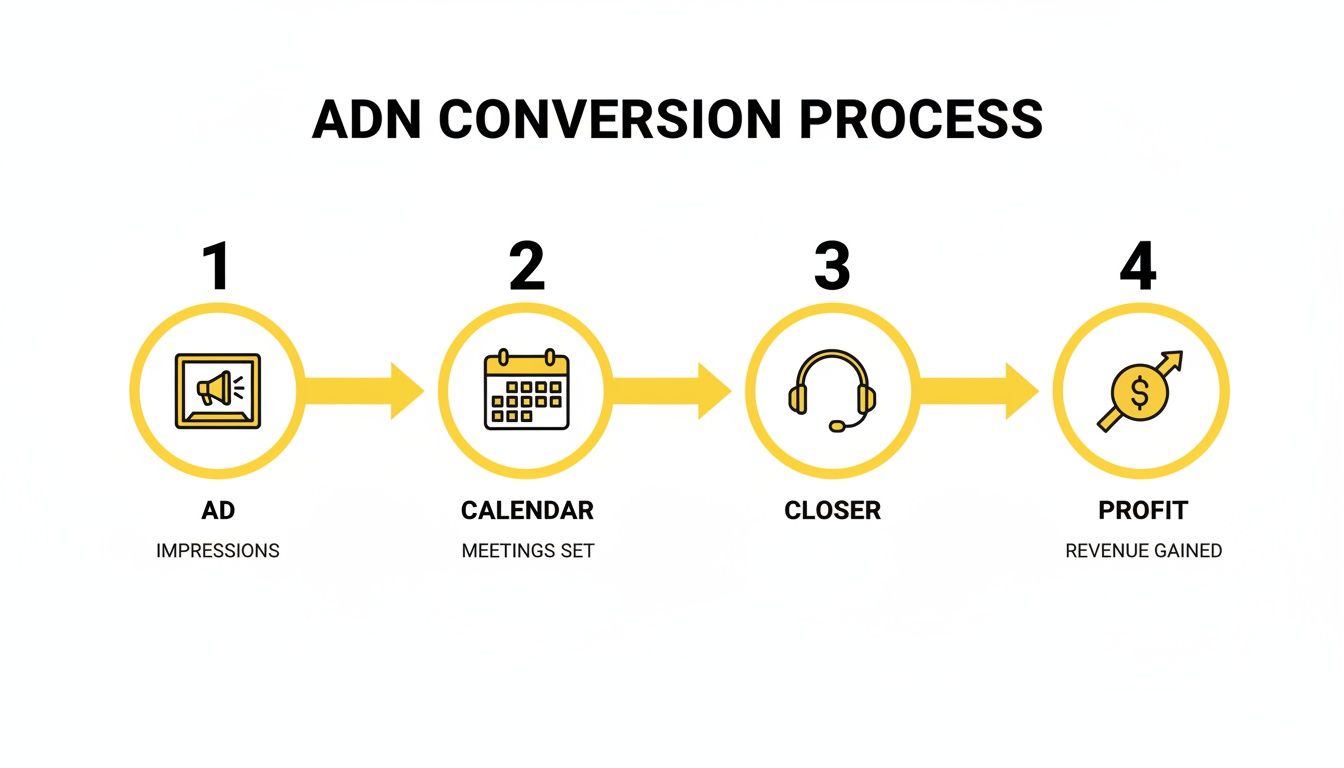
Think of your ad funnel as a relay race. Your ads are the first runner, grabbing the baton—the prospect's attention. The landing page takes the handoff, getting them to the next stage. A VSL or webinar is the third leg, building desire and weeding out the tire-kickers. But for a high-value offer, the race isn’t over yet. The closer is your anchor, the final runner who sprints across the finish line and wins the prize: the sale.
Without that final runner, all the effort and cash you burned on the first three legs goes to waste. The prospect is left hanging just feet from the finish line, and your ad spend becomes a sunk cost instead of a smart investment.
From Ad Click to Closed Deal
The journey from a random social media scroll to a closed deal is anything but random. It’s a carefully choreographed dance that starts the moment someone sees an ad that speaks directly to their pain.
The Ad: A sharp, compelling ad on Instagram or YouTube grabs their attention and earns a click.
The Funnel: They hit a landing page with a video or application designed to educate them and confirm they're a serious buyer.
The Booking: If they like what they see, they’re prompted to book a call. Using a tool like Calendly, they pick a time and fill out an intake form, giving you critical intel on their goals and challenges.
The Handoff: This is where the magic happens. That booking form data zips right over to the closer, who now has a full dossier on the prospect before even saying hello.
The Call: The closer leads a genuine conversation, not a pushy sales pitch. They use the info they already have to steer a deep-dive discussion that naturally leads the prospect to a confident "yes."
This tight integration makes sure the momentum your marketing built doesn't fizzle out. It carries them all the way to a closed deal.
The Big Picture: Your paid ad funnel’s job is to generate qualified conversations at scale. The high-ticket closer’s job is to turn those conversations into cash in the bank. One simply can't be profitable without the other.
The Power of Message Congruence
One of the most overlooked—and most critical—parts of this whole process is message congruence. The promise you make in your ad has to perfectly match the experience on your landing page and, most importantly, the conversation they have with the closer. If there's any disconnect, trust evaporates in an instant.
If your ad promises a specific outcome, the closer needs to be able to map out exactly how your offer delivers on that promise. This kind of consistency makes the prospect feel heard and understood, which removes nearly all the friction from their decision-making process. The closer isn't just a salesperson; they're the human proof of your marketing message.
This is all so important because, frankly, people don't just click "buy" on expensive things. High-ticket closing is inextricably linked to the economics of paid traffic. Across most industries, the average website conversion rate hovers around a measly 2–3%. For high-ticket e-commerce, it's often a fraction of that, somewhere between 0.5% and 1.5%. This is why the sharpest agencies pair their ad campaigns on Facebook, Instagram, and Google with dedicated closers.
When a funnel turns 10,000 paid visitors into 100 buyers on a $3,000 offer, that’s $300,000 in revenue. Pushing that close rate to just 1.5% adds another $150,000 from the exact same ad spend. You can dig into more conversion rate benchmarks at ruleranalytics.com.
Data Empowers the Closing Process
The information collected when a prospect books a call is pure gold for a closer. A well-built booking form essentially serves as a pre-call discovery session, arming them with the intel they need to walk in and dominate the conversation.
Pain Points: What's the biggest thing holding the prospect back right now?
Desired Outcomes: What does their "after" state—their dream scenario—look like?
Financial Situation: Are they actually in a position to invest in a real solution?
Urgency: Why does this problem need to be solved for them right now?
This data lets the closer customize the conversation from the first word. They can skip the boring, surface-level questions and jump right into what actually matters to the prospect, showing empathy and expertise from the get-go. It transforms a generic sales call into a personalized strategy session, which dramatically boosts the odds of closing the deal and maximizing the return on every single dollar you spent on ads.
Structuring Compensation and Measuring ROI
Figuring out how to pay a high ticket closer can feel like a puzzle, but it all comes back to one simple rule: their success needs to be directly tied to your success. The whole point is to build a structure that lights a fire under them to perform, making them a true profit center for your business, not just another fixed expense on the books.
The most common way to do this in the high ticket world is with a commission-only model. It's a pure, performance-based setup where the closer earns a slice of the revenue they bring in. This usually falls somewhere between 10% to 20% of the cash collected from the deals they close.
For a business owner, this model is a no-brainer. There's literally zero financial risk. You only pay out when you get paid, which keeps your overhead lean and means every dollar spent on commissions is backed by several more in revenue. There's a real art and science to hiring and managing commission-only sales reps, and getting it right is crucial.
High Ticket Closer Compensation Models
While going commission-only is the standard, it’s not the only game in town. Sometimes, a hybrid approach makes more sense. Let's break down the common payment structures.
The table below outlines the most frequent models, giving you a quick look at the pros and cons of each from a business perspective.
Model | Typical Structure | Pros for Business | Cons for Business |
|---|---|---|---|
Commission-Only | 10-20% of cash collected. | No upfront cost. Attracts confident, top-tier closers ("A-players"). Highly scalable. | Can be tough to attract talent without a steady, proven lead flow. Less loyalty. |
Base + Commission | Modest base salary + a lower commission rate (e.g., 5-10%). | Attracts a wider pool of talent. Fosters more loyalty and stability. Good for unpredictable lead flow. | Higher fixed overhead. Risk of paying a salary for poor performance. |
Tiered Commission | Commission percentage increases as sales volume grows (e.g., 10% on first $50k, 15% on next $50k). | Heavily incentivizes top performance and hitting higher targets. | Can become complex to manage and calculate. |
Draw Against Commission | A guaranteed "draw" (loan) paid to the closer, which is paid back from future commissions. | Provides a safety net for the closer, especially when they're new. | Business carries the risk if the closer doesn't perform and leaves. |
Ultimately, the right choice really hinges on where your business is at. If your marketing machine is humming and reliably filling the calendar with qualified prospects, a commission-only structure is almost always the most powerful and profitable way to go.
Calculating Your Closer's ROI
Paying your closer is one thing, but you absolutely have to track the right metrics to understand their real financial impact. A gut feeling about their performance won’t cut it; you need the cold, hard data.
A high ticket closer's value isn't just in the deals they close, but in the profitability they unlock from your marketing spend. They are the final conversion point that makes your entire ad funnel work.
Zero in on these key performance indicators (KPIs):
Lead-to-Show-Up Rate: What percentage of people who book a call actually show up? This tells you a lot about your lead quality and how effective your appointment reminder system is.
Close Rate (on Attended Calls): Of the prospects who actually get on a call, how many become clients? This is the single biggest measure of a closer's skill. A solid closer will consistently convert 20% to 40% of qualified calls.
Total Cash Collected: This is the bottom line. It’s not about deals closed on a handshake; it’s about the actual money hitting your bank account.
Let's walk through a quick ROI scenario. Imagine you drop $5,000 on ads, and that effort generates 50 booked calls.
Show-Up Rate: 40 of those calls attend (80% show-up rate).
Close Rate: Your closer works their magic and converts 10 of those calls (25% close rate).
Offer Price: Your program or service costs $5,000.
Total Revenue: 10 sales x $5,000 = $50,000.
Closer's Commission (at 15%): $50,000 x 0.15 = $7,500.
Total Costs: $5,000 (ads) + $7,500 (commission) = $12,500.
Net Profit: $50,000 - $12,500 = $37,500.
In this example, your $5,000 ad spend, supercharged by a skilled closer, turned into a $37,500 profit. This is the perfect illustration of how a great closer doesn't just cost you money; they multiply it.
High Ticket Closing in Different Industries

The core principles of high-ticket closing don’t change, but how they’re applied definitely does. A truly skilled high-ticket closer knows how to pivot, tailoring their approach to the specific pains, hopes, and hang-ups of each market. This flexibility is what makes them so valuable, whether they're selling a coaching program or a piece of property.
Let's move past the theory and look at how this plays out in the real world. Here are a few examples of how a closer can transform a business in four very different sectors, each with its own unique hurdles.
Coaching and Online Education
Picture this: a business coach is selling a $10,000 year-long mastermind. The leads aren't cold. They’ve just watched an hour-long webinar and booked a call because the big ideas hit home. But now, reality is setting in. They’re staring down a major investment, and the self-doubt is creeping in.
This is where the closer steps in as part strategist, part mindset coach.
The Challenge: The biggest enemy here is imposter syndrome. Prospects are paralyzed by thoughts like, "Will this really work for me?" or "Am I actually ready for this?"
The Closer's Approach: A great closer knows this isn't about listing program features. It’s about digging into the prospect’s real frustrations—the stalled revenue, the 80-hour weeks, the time stolen from their family. They help the prospect calculate the true cost of doing nothing, which suddenly makes the $10,000 price tag feel small compared to another year stuck in the same place.
The deal is closed when the prospect stops seeing the program as an expense and starts seeing it as the only logical path to get where they desperately need to go.
High-End E-Commerce
Now, think about an e-commerce brand selling specialized equipment, like a $5,000 commercial-grade coffee machine for a new café owner. The prospect knows their stuff but is getting bogged down in spec sheets and comparison shopping, hesitant to make such a big capital purchase.
In this scenario, the closer acts more like a business consultant.
The closer's job here is to get the conversation off of specs and onto profitability. They aren't selling a machine; they're selling a more successful business.
They do this by zeroing in on ROI. They’ll ask about the prospect’s business goals, their expected foot traffic, and the bottlenecks with their current setup. Suddenly, the $5,000 machine is framed as an investment that literally pays for itself.
"This model can produce 30% more drinks per hour. What does that do to your revenue during the morning rush?"
"Think about the cost of downtime. A single day of being closed for repairs on a cheaper machine could cost you hundreds."
By focusing on tangible business results, the closer turns a luxury purchase into a must-have tool for growth.
Real Estate Investment
In the real estate world, a closer might work for a firm that helps busy professionals buy turnkey rental properties. The buy-in is significant—maybe a $50,000 down payment on a $250,000 property. The leads have the money, but they’re often new to real estate and terrified of the risks.
Here, the closer's main job is to build unshakable trust.
The Challenge: The prospect is drowning in "what-ifs." What if I get a bad tenant? What if the roof starts leaking? These fears are deal-killers.
The Closer's Approach: Instead of hype, the closer brings calm. They meticulously walk the prospect through every system: the company’s tough tenant screening, the on-the-ground property management team, and the maintenance funds set aside for surprises. They use real financial projections and case studies from other properties to make the returns feel real and predictable.
The close isn't a pushy, high-pressure moment. It's just the natural next step in a conversation where every single fear has been met with a clear, logical solution, leaving the investor feeling secure and ready to move forward.
Common Mistakes When Hiring a Closer
Bringing a high-ticket closer onto your team can feel like a game-changer, but that initial excitement can sour fast if you stumble into a few common traps. Hiring the right person is only half the battle. Setting them up to actually win is what pads the bottom line.
The biggest mistake I see? Hiring based on hype instead of a proven track record. A slick personality is nice, but it doesn't collect cash. You need someone who can show you the numbers—their actual close rates on calls they took, the kinds of offers they've sold, and how much revenue they've personally brought in. Don't be shy about asking for the hard data and talking to their references.
Another massive pitfall is feeding your new closer a stream of unqualified leads. That’s like asking Gordon Ramsay to cook a five-star meal with rotten vegetables. It doesn’t matter how skilled they are; the final product is going to be a disaster.
Misaligned Expectations and Poor Onboarding
Even with a killer closer and decent leads, you’ll kill deals if there's a disconnect between what your marketing promises and what happens on the sales call. If your ads scream “get rich quick and easy” but your closer has to explain a process that takes real work, you’ve broken trust before the conversation even starts.
Message congruence is non-negotiable. The story has to stay the same from the first ad they see to the final payment.
Just as bad is having no real onboarding process. Tossing a closer a link to your calendar and saying "good luck" is a recipe for failure. A solid onboarding absolutely must include:
A Deep Dive into Your Offer: They need to understand its value from the inside out.
Your Ideal Customer Profile: They have to know who they’re talking to—their deepest pains, their biggest dreams.
Systems Training: Get them set up and comfortable with your CRM, booking system, and any communication tools.
A high-ticket closer is a precision instrument, not a blunt object. They require high-quality inputs—qualified leads, clear messaging, and robust support—to produce high-value outputs.
If you don't provide this foundation, you're forcing them to guess, which leads to sloppy performance and deals slipping through the cracks. In a competitive market, that misalignment is costly. For example, B2B benchmarks show that a closer who can bump the “opportunity to customer” conversion rate from 25% to 35% is a huge asset. This gets even more powerful when you realize personalized calls-to-action can convert over 200% better than generic ones, turning small percentage lifts into massive revenue gains. You can find more B2B sales benchmarks and insights at serpsculpt.com.
At the end of the day, your closer's success is a direct reflection of your systems. Vet them properly, get them quality leads, align your messaging, and give them a thorough onboarding. That's how you create an environment where they—and your business—can truly thrive.
Your Top Questions About High Ticket Closers, Answered
Deciding to bring a closer onto your team is a big move, and it naturally comes with some serious questions. Before you pull the trigger, you need to have a clear picture of what you're getting into. Let's break down the most common things business owners ask, so you can move forward knowing you're making the right call.
Should I Hire an Experienced Closer or Train Someone In-House?
This really comes down to three things: your budget, your lead flow, and how fast you need to see a return.
Hiring a seasoned pro gets you immediate results and a ton of expertise, but you'll pay for it with a higher commission. They're the perfect choice for a business that already has a steady stream of qualified leads and needs to turn that pipeline into cash, now.
On the flip side, training someone from your own team is easier on the wallet upfront. This path lets you mold a loyal employee into the exact closer your offer and culture demand. The trade-off? It takes a real investment of your time and a ramp-up period before they're firing on all cylinders.
Key Insight: If you've got reliable, high-quality leads and need an immediate ROI, go find an expert. If your lead volume is a bit smaller and you want someone who truly bleeds your company colors, training an existing team member can be an incredible long-term play.
What Is a Realistic Close Rate for a Good Closer?
Anyone who gives you a single number here is selling you something. A closer's performance is completely tied to the quality of the leads you hand them. It's just that simple.
For really warm, qualified prospects—people who filled out a detailed application or sat through your entire webinar—a skilled closer can realistically hit a 20% to 40% conversion rate. That's a solid benchmark for high-intent leads.
But if you're sending them colder traffic, you need to adjust your expectations. For those leads, a rate between 10% and 20% is much more typical. The most important thing is to measure this based on attended calls. No-shows are a part of the game and will always drag your numbers down if you're only looking at booked appointments.
How Soon Can I Expect to See Results?
If your lead gen is already a well-oiled machine and you bring on an experienced closer, you can see a return almost overnight. A true pro can get up to speed on your offer and ideal customer in a matter of days and often starts closing deals within their very first week.
For someone you're training from scratch, you need to be more patient. Expect a ramp-up period of 30 to 90 days. That gives them enough runway to get comfortable, really master your systems, and start hitting those target conversion rates consistently.
The big takeaway here is that your lead flow has to be sorted out before anyone comes on board. You want them to be able to hit the ground running and do what they do best: generate revenue.
At Wojo Media, we're experts at building omnipresent ad campaigns that pack your calendar with the exact kind of high-quality leads a closer dreams of. We build the predictable lead flow that turns your sales function into a profit-generating machine.
Book a free demo call with our team today and we'll map out a custom paid ads strategy designed to help you scale. Find out more at https://www.thewojomedia.com.
Comments