.png)
What Is Cost Per Acquisition A Guide to Profitable Growth
- Jason Wojo
- Feb 6
- 14 min read

Ever wonder what it really costs to get a new customer? Not just the ad click, but the whole shebang? That final, all-in price tag is your Cost Per Acquisition (CPA).
Think of it as the receipt for each new customer you win through a specific marketing campaign. Whether that customer made a purchase, booked a demo, or became a qualified lead, CPA tells you exactly what you paid for that result. It’s the most straightforward way to see if your ads are actually making you money.
Unpacking Your True Advertising Cost

Let’s make this real. Say you own a local coffee shop and spend $100 to print and distribute 1,000 flyers. If 10 people show up with a flyer and buy a latte, your cost to acquire each of those customers was $10.
Digital marketing works the exact same way. CPA cuts through the noise and connects your total ad spend directly to a specific, revenue-generating action. It’s more than just another metric; it’s the compass for your entire paid advertising strategy. While things like clicks and impressions show you that something is happening, CPA tells you if it’s profitable.
It answers the most important question of all: "Is this ad spend actually worth it?"
Why CPA Is So Important
Getting a handle on your CPA means you can stop guessing and start making data-driven decisions that grow your bottom line. It’s the secret to scaling your business because it helps you:
Pinpoint Your Winning Channels: You can clearly see which platforms—whether it’s Google Ads or TikTok—are bringing in customers at the lowest cost.
Fix Underperforming Campaigns: A high CPA is a red flag. It tells you something is off with your ad creative, your audience targeting, or your landing page experience.
Budget with Confidence: When you know your CPA, you can accurately forecast how much you need to spend to hit your customer acquisition targets.
Let's break down the essentials of Cost Per Acquisition with a quick reference table.
CPA at a Glance
Component | What It Means for Your Business |
|---|---|
Total Campaign Cost | The complete ad spend for a specific marketing effort. |
Total Conversions | The number of desired actions (e.g., sales, sign-ups) generated. |
The CPA Formula | Total Cost ÷ Total Conversions = Your cost for one new customer. |
Why It Matters | It’s a direct measure of campaign profitability and efficiency. |
This table shows how CPA strips away vanity metrics to give you a clear, actionable number.
By focusing on CPA, you shift your mindset from just buying traffic to strategically investing in profitable customer relationships. It forces you to look past surface-level engagement and measure what actually drives business growth.
Ultimately, mastering your CPA is the difference between burning cash on ads that feel busy and building a predictable system for attracting new, paying customers.
How to Calculate Your True Cost Per Acquisition
On the surface, calculating your Cost Per Acquisition looks easy. The basic formula is simple enough: divide your total campaign cost by the number of conversions you got.
CPA = Total Campaign Cost / Number of Conversions
But this is where so many marketers trip up. The biggest mistake is defining "Total Campaign Cost" way too narrowly. If you're only looking at your direct ad spend, you're not calculating a real business KPI—you're tracking a vanity metric. This gives you a dangerously low, and frankly, inaccurate CPA that can trick you into scaling campaigns that are actually losing you money.
To find your true CPA, you have to get honest about all the money you're spending.
Uncovering the Hidden Costs in Your Campaigns
Your real campaign cost is the sum of every single dollar you invested to get those conversions. You have to think beyond just the invoice from Google or Meta. A full accounting of your costs should include these often-forgotten expenses:
Agency or Freelancer Fees: If you’re not running the ads yourself, your marketing partner’s management fee is a direct cost of the campaign.
Creative Production: This is everything from paying a graphic designer and video editor to copywriting fees and the cost of any stock photos or talent you used.
Software and Tools: Don't forget to factor in the monthly subscriptions for your landing page builder, analytics platforms, or any automation software that makes the campaign run.
Team Overhead: A portion of the salaries for your in-house marketing team who work on these campaigns needs to be accounted for, too.
There’s no way around it: to truly understand and calculate your Cost Per Acquisition, you need bulletproof tracking. Tools like call tracking software, for instance, can give you the hard data required to properly attribute conversions and nail down your CPA.
Putting It All Together: A Real-World Example
Let's say you run a med spa and you've launched a Google Ads campaign to drive more appointment bookings.
Here’s a realistic breakdown of your monthly costs:
Google Ads Spend: $5,000
Agency Management Fee: $1,500
Landing Page Software: $150
Creative Assets (Video Shoot): $500
Your Total Campaign Cost isn't just the $5,000 you paid Google. It’s actually $7,150.
Now, let's say the campaign brought in 50 new appointment bookings that month. See how the math changes everything?
Incorrect CPA (Ad Spend Only): $5,000 / 50 bookings = $100 CPA True CPA (All Costs Included): $7,150 / 50 bookings = $143 CPA
That $43 difference is the gap between thinking you're profitable and knowing you are. Understanding this true number is the only way you can make smart decisions about where to put your marketing dollars for sustainable growth.
CPA vs. CAC vs. CPL: What’s the Difference, and Why Does It Matter?
In marketing, it’s easy to drown in an alphabet soup of acronyms. CPA, CAC, and CPL all get thrown around, and while they sound similar, they tell very different stories about how your business is doing. Getting them straight isn't just about semantics—it’s critical for making smart, profitable decisions.
Let's break it down with a simple analogy.
Think of Cost Per Lead (CPL) as the price of getting a phone number. It’s the cost of sparking initial interest—someone downloads your guide, signs up for your newsletter, or fills out a contact form. You’ve made a connection, but it’s far from a commitment.
Cost Per Acquisition (CPA) is the cost of the first date. This is where things get more serious. It’s tied to a specific, valuable action within a campaign, like a customer making their first purchase, a prospect booking a demo, or a user starting a free trial. It marks a real step forward.
Finally, Customer Acquisition Cost (CAC) is your total investment to get into a long-term relationship. This is the big picture. It’s the broadest of the three, accounting for all your sales and marketing costs over a given period—salaries, software, ad spend, you name it—divided by the number of new customers you brought in.
Why You Can't Afford to Confuse Them
Mixing up these metrics is a recipe for a bad strategy. If you obsess over lowering your CPL, you might end up with a flood of low-quality leads who never buy anything. That looks good on one report but ultimately sends your CPA and CAC through the roof.
You have to know your numbers at every stage of the game.
CPL tells you how well your top-of-funnel content and lead magnets are working.
CPA shows you how efficiently your campaigns are driving the actions that actually matter.
CAC gives you the 30,000-foot view of your business model's profitability and sustainability.
To get a true read on your CPA, you have to look beyond just the ad spend. It’s easy to forget the other costs that pile up. This flowchart shows how different layers of expenses contribute to your real Cost Per Acquisition.
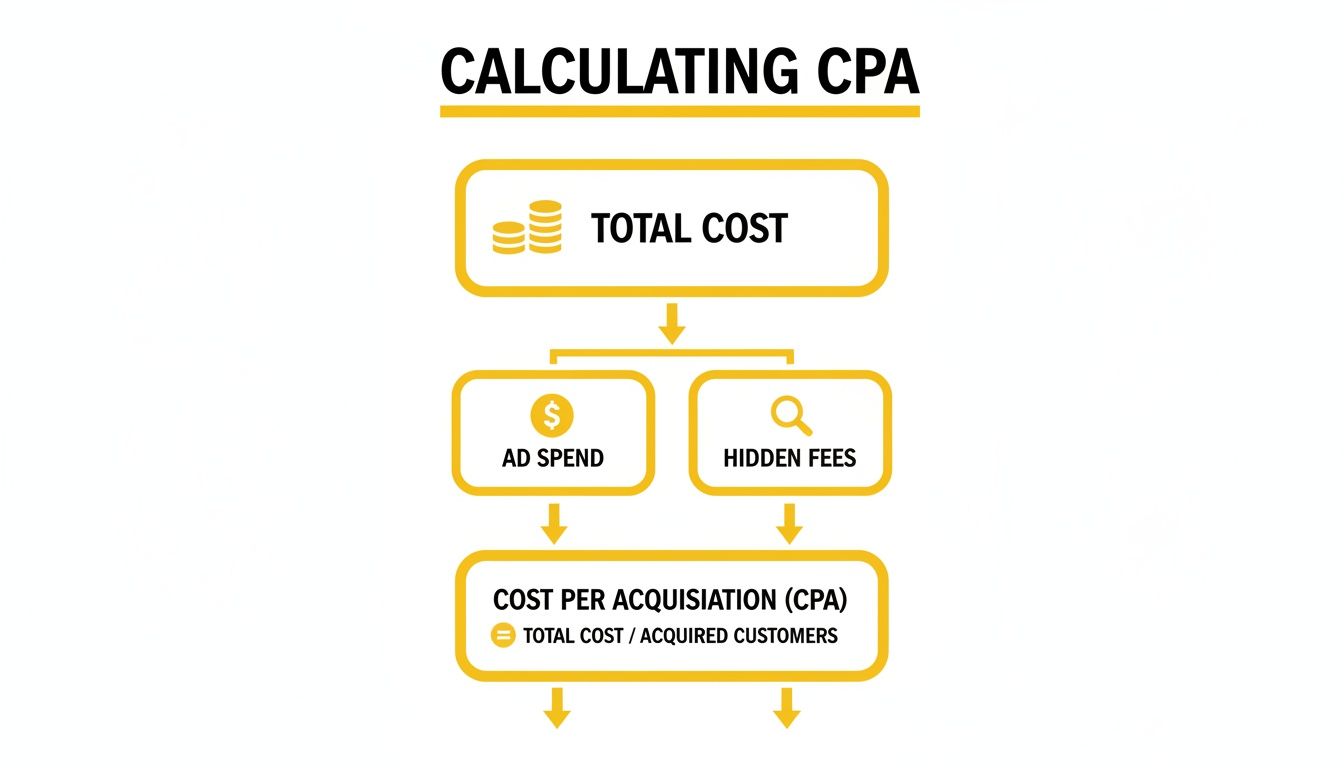
As you can see, ignoring those hidden fees gives you a dangerously optimistic CPA that doesn't reflect reality.
CPA vs CAC vs CPL A Clear Comparison
Sorting out these three critical marketing metrics helps you track performance accurately and make better decisions. Here's a quick cheat sheet.
Metric | What It Measures | When to Use It |
|---|---|---|
CPL (Cost Per Lead) | The cost to generate a new contact or prospect who has shown initial interest. | To gauge the efficiency of top-of-funnel lead generation campaigns (e.g., ebook downloads, webinar sign-ups). |
CPA (Cost Per Acquisition) | The cost to drive a specific, valuable action from a user (e.g., first purchase, free trial, demo booking). | To optimize the performance and profitability of conversion-focused campaigns, like Google Ads or social media ads. |
CAC (Customer Acquisition Cost) | The total sales and marketing cost required to acquire a new paying customer over a specific period. | To assess the overall health and long-term viability of your business model and customer acquisition strategy. |
Each metric provides a different lens to view your performance, and mastering all three gives you a complete picture from the first click to the final sale.
By drawing these sharp lines, you can diagnose problems with incredible precision. A high CPL might point to weak ad creative or a poor offer. A high CPA, on the other hand, could signal an issue with your landing page or checkout process.
Knowing which lever to pull is half the battle.
What Is a Good Cost Per Acquisition?
Sooner or later, every marketer asks the million-dollar question: "What's a good cost per acquisition?" It’s easy to get fixated on finding a single magic number, but the truth is, a “good” CPA is completely relative. It all depends on your business, your industry, and what you’re selling.
A $50 CPA could be a massive win for one company but a total disaster for another. Think about it: an e-commerce brand selling $35 t-shirts would bleed money with a $50 CPA. But for a high-ticket B2B service that closes $5,000 clients? They’d be popping champagne over that same $50 CPA.
Context is everything. That’s why blindly chasing the lowest possible CPA is a trap. The goal isn't just cheap acquisition; it’s profitable acquisition.
The LTV to CPA Ratio: The Real Measure of Success
To figure out what a good CPA is for you, you have to stop looking at it in a vacuum. Instead, you need to compare it to your Customer Lifetime Value (LTV). LTV is the total profit you expect to make from a customer over the entire time they do business with you.
This relationship, the LTV-to-CPA ratio, is your true north for sustainable growth. It shows you exactly how much value you’re getting back for every dollar you spend to bring a new customer in the door.
A healthy LTV-to-CPA ratio is the clearest sign of a scalable, profitable advertising strategy. It changes the conversation from "How low can we get our CPA?" to "How much can we actually afford to spend to get a valuable customer?"
This mindset shift is critical. It gives you the freedom to potentially spend more to acquire higher-value customers, because you know the long-term payoff more than justifies the upfront cost.
Benchmarks and the 3:1 Rule of Thumb
While every business is different, the industry has a pretty solid rule of thumb: aim for an LTV-to-CPA ratio of 3:1. For every $1 you spend on acquisition, you should be making at least $3 back over that customer's lifetime.
A 1:1 Ratio: You’re in the red. Once you factor in your cost of goods and overhead, you’re losing money on every single sale.
A 3:1 Ratio: This is the sweet spot. It signals a healthy, profitable business with plenty of room to grow.
A 4:1+ Ratio: Your acquisition machine is firing on all cylinders. You could probably stand to get more aggressive with your ad spend and scale up even faster.
While you'll see industry benchmarks floating around—with an average CPA anywhere from $50 to $150 globally—they don't tell the whole story. A much better guideline is to keep your CPA between 10-30% of your LTV. If a business coach has an average client LTV of $2,000, a CPA between $200 and $600 is perfectly healthy and profitable. You can dig deeper into how CPA and LTV shape marketing strategies in this cost per acquisition analysis.
At the end of the day, a good CPA isn't a number you pull from a report. It’s a number you calculate yourself, based on your own financials and your long-term vision for the business.
Common Reasons Your CPA Is Too High
If your cost per acquisition is creeping up, it can feel like your whole campaign is springing a leak. You're still pouring the same amount of money in, but fewer and fewer customers are coming out the other end. Finding the source of that leak is the only way to get your profitability back on track.

Sometimes, the pressure is coming from outside forces you can’t really control. Customer acquisition costs have shot up by over 60% in the last five years alone, a painful trend hitting both e-commerce and B2B businesses. That means a customer who might have cost you $50 to acquire back in 2019 now runs $80 or more, thanks to a flood of new competition on major ad platforms. You can discover more insights on these rising costs and how they’re squeezing businesses like yours.
On top of that, privacy updates from giants like Apple have made it tougher to track what users are doing, which muddies the data and makes it harder for the ad algorithms to find your ideal customer efficiently.
Internal Factors You Can Control
While you can’t change the market, you have total control over the nuts and bolts of your own campaigns. A high CPA is almost always a symptom of a breakdown in one of these key areas.
A Weak or Unclear Offer: If your offer doesn't solve a real problem or feel like an absolute steal, people just won't act. A confusing or weak value proposition is the number one conversion killer, period.
Poor Landing Page Experience: Does your page take forever to load? Is it a maze to navigate? A clunky, untrustworthy landing page creates friction and sends potential customers running for the exit.
Uninspired Ad Creative: Your ads are fighting for attention against memes, family photos, and breaking news. If your images are generic and your copy is bland, you’ll be scrolled past without a second thought, driving up your costs.
Incorrect Audience Targeting: Showing the perfect ad to the wrong person is a guaranteed way to light money on fire. Mismatched targeting means you're paying for clicks from people who were never going to convert anyway.
Think of your advertising funnel like a series of gates. A high CPA means one of those gates is stuck. Your job is to find out if it's the 'Offer' gate, the 'Landing Page' gate, or the 'Audience' gate and get it unstuck.
By systematically digging into these areas, you can stop guessing what's wrong and start actively lowering your CPA.
Actionable Strategies to Lower Your Cost Per Acquisition
Knowing your cost per acquisition is step one. Actively driving it down is where you win the game. A high CPA isn’t a dead end—think of it as a signal flare, telling you exactly where to optimize.
By zeroing in on four key pillars, you can systematically plug the leaks in your advertising funnel. This is how you turn expensive, underperforming campaigns into profitable growth engines. These strategies work because they tackle the root causes of high CPA, from a weak offer to a clunky user experience. It's about shifting your focus from just buying traffic to building an efficient machine that converts prospects into customers.
Refine Your Offer Until It's Irresistible
The single most powerful lever you can pull to lower your CPA is your offer. An average offer requires a ton of expensive advertising just to get noticed. A truly compelling one? It generates its own momentum.
The goal is to make what you're selling so valuable that your ideal customer feels like they can't afford to say no.
Start by asking the tough questions:
Is the value crystal clear? Can someone understand the core benefit of your product or service in five seconds flat?
Is there urgency? Why should someone buy now instead of putting it off? Limited-time bonuses or genuine scarcity can do wonders for conversion rates.
Is it believable? You need to remove the risk. Strong guarantees, real testimonials, and detailed case studies build the trust required to get someone to pull the trigger.
An irresistible offer cuts through the noise and does the heavy lifting for your ads.
Optimize Your Conversion Environment
You can have the best ads in the world, but if they lead to a slow, confusing, or untrustworthy landing page, you're just lighting money on fire. Your landing page is where the conversion actually happens. It has to be frictionless.
A seamless user experience is non-negotiable. Every extra second of load time, every moment of confusion—it all sends your bounce rate soaring and your CPA right along with it. Your page must be fast, clear, and trustworthy.
Here’s where to focus your energy:
Page Speed: Get this—a one-second delay in mobile load times can slash conversion rates by up to 20%. You have to be relentless about optimizing images and scripts.
Message Match: The headline on your landing page must perfectly mirror the promise you made in your ad. Any disconnect creates instant confusion and kills trust.
Clear Call-to-Action (CTA): Use a single, obvious CTA button. Don't give visitors analysis paralysis by presenting too many choices. Tell them exactly what to do next.
Elevate Your Ad Creative and Copy
In a crowded social media feed, generic ads are invisible. Your creative is your first impression, and its only job is to stop the scroll. This means you have to move beyond stock photos and bland, corporate-speak copy.
You need to test different angles, hooks, and formats to see what actually grabs your audience's attention.
User-generated content (UGC), for example, often blows polished studio ads out of the water because it feels more authentic and relatable. In the same way, ad copy that speaks directly to a customer's specific pain point will always beat vague messaging that just lists features.
A core strategy here involves a thorough understanding and minimizing expenses across all your marketing efforts, including things like promotional webinars. When you master every cost input, you gain far greater control over your final acquisition cost.
A Few Common Questions About CPA
As you get deeper into managing your own campaigns, a few key questions about Cost Per Acquisition always seem to pop up. Getting straight, practical answers is the only way to move from just tracking CPA to actually using it to drive profitable growth.
Let's tackle some of the most common things marketers ask. The answers will reinforce the core ideas behind running ads that actually work.
How Often Should I Be Checking My CPA?
The right answer really depends on your campaign volume and how long it takes to make a sale. For a high-volume e-commerce store, you should be looking at your CPA daily. It’s the only way to catch trends early and find opportunities to optimize before you waste a bunch of money.
But if you’re in a business with a longer sales cycle—like B2B services or high-ticket coaching—a weekly or bi-weekly check-in is probably smarter. That rhythm gives you enough data to work with so you aren't making knee-jerk reactions based on a day or two of weird results.
Is It Possible for My CPA to Be Too Low?
Believe it or not, yes. An unusually low CPA can sometimes be a warning sign. It sounds completely backward, but an extremely low Cost Per Acquisition might just mean you're not spending enough to reach a bigger, more scalable audience.
You could be leaving a ton of growth on the table by only hitting a tiny, super-responsive sliver of the market. The goal isn't just to get the lowest CPA possible; it's to find a profitable CPA at scale. Sometimes you have to accept a slightly higher CPA to unlock a much larger volume of customers, which drives far more overall profit in the end.
A rock-bottom CPA isn’t the trophy. The real win is finding the maximum amount you can profitably spend to get a customer, then pouring gas on that fire. That’s the mindset that builds empires.
How Does CPA Fit in with ROAS?
Think of CPA and Return On Ad Spend (ROAS) as two sides of the same profitability coin. They measure different things, but you need both to see the full picture.
CPA (Cost Per Acquisition): This is all about cost-efficiency. It answers, "How much did we have to pay to get someone to do the thing we wanted?"
ROAS (Return On Ad Spend): This is all about revenue generation. It answers, "For every dollar we put into ads, how many dollars did we get back out?"
A low CPA is great—it means you're efficient. But it doesn't automatically mean you have a high ROAS, especially if you're selling low-priced products. On the flip side, you could have a high CPA on a high-ticket item and still have a fantastic ROAS. You have to watch both to truly understand if your campaigns are working.
At Wojo Media, we don't guess. We build predictable, profitable growth by mastering metrics like these. If you're ready to scale your business with an ad strategy that actually optimizes your offer, landing pages, and data, let's talk. We'll show you exactly how we can lower your CPA while scaling your revenue. Book your free paid ads strategy call today!
Comments