.png)
What Is Direct Response Copywriting A Practical Guide to ROI

Let’s cut right to it. Direct response copywriting is writing that demands action. Right now.
It’s not about fuzzy feelings or long-term brand awareness. It’s about getting someone to click, call, subscribe, or pull out their credit card the moment they finish reading. Every word, every sentence, is engineered for one specific purpose: to trigger a measurable response.
Defining The Goal Of Direct Response
Think of a typical brand marketer like a friendly diplomat. Their job is to build goodwill and make sure you have a warm, positive association with their company. They might create a slick Super Bowl ad that makes you laugh, but it doesn't ask you to do anything. Success is murky, measured in things like "brand recall."
A direct response copywriter, on the other hand, is a closer. They are the expert salesperson whose only job is to get the deal signed today. They're not there to build a friendship; they’re there to drive revenue. Their writing is an urgent, compelling pitch designed to take a complete stranger from curious to converted in a single session.
In direct response, success isn't a matter of opinion—it’s a number on a spreadsheet. If the copy doesn't generate clicks, leads, or sales, it failed. The numbers don't lie.
This intense focus on immediate, trackable results is what sets direct response apart from nearly every other kind of marketing.
Brand Building Vs Immediate Action
At its core, the difference is all about the objective. One builds a reputation over time, while the other drives a specific, profitable action now. This single distinction changes everything, from the tone of voice to how you measure success.
To get a clearer picture, let's look at the DNA of direct response copy.
Direct Response Vs Brand Copywriting At A Glance
This table breaks down the fundamental differences between the two disciplines.
Characteristic | Direct Response Copywriting | Brand Copywriting |
|---|---|---|
Primary Goal | Generate immediate action (sale, lead, etc.) | Build long-term awareness and loyalty |
Key Metrics | Conversion rates, CPL, CPA, ROI | Brand sentiment, reach, engagement |
Tone of Voice | Urgent, persuasive, direct, benefit-driven | Relatable, aspirational, emotional |
Time Horizon | Short-term: Get the conversion now | Long-term: Build a relationship over months/years |
While both have their place, they are two completely different tools for two completely different jobs. You wouldn't use a hammer to saw a board, and you wouldn't use brand copy when you need to make sales.
So, what makes a piece of writing unmistakably direct response? It almost always boils down to these four elements:
A Clear Call-to-Action (CTA): It tells the reader exactly what to do next. "Buy Now." "Download Your Free Guide." "Book a Demo." There’s zero ambiguity.
Measurable Results: Every single campaign is tracked. You know precisely how many people clicked, converted, or bought something from a specific ad or landing page.
A Compelling Offer: It’s an irresistible deal, often supercharged with urgency ("offer ends Friday!"), scarcity ("only 12 left!"), or valuable bonuses to push someone over the edge.
Audience-Centric Focus: The copy isn't about the company; it’s about the reader. It speaks directly to their pains, fears, and dreams, positioning the product as the one and only solution.
It's also helpful to understand the distinctions between copywriting and content writing, as they serve different roles in a marketing plan. While brand copy aims for broad appeal and content writing is there to educate, direct response copy is the engine. It's built for one thing and one thing only: conversion.
The Core Principles Driving Immediate Action
Direct response copywriting isn't about winning creative awards with clever taglines. It’s a science of persuasion, built on a handful of psychological principles that have worked for decades. Getting these right is what separates a generic ad from a sales machine that brings in measurable results.
The first and most important rule is the “One Reader, One Big Idea, One Action” principle. You have to write as if you're having a one-on-one conversation, focusing on a single person's specific problem. From there, you hammer home one powerful, compelling idea that grabs their attention and refuse to dilute it with other messages. Every single word should then guide them toward one clear, simple action.
This keeps things simple, avoiding the confusion that kills conversions.
Marrying Emotion With Logic
Here's a truth all great copywriters know: People buy on emotion, but they justify with logic. Direct response copy has to master this dance. You first have to connect with the reader’s emotions—their fears, their dreams, their biggest frustrations. That’s what gets them to want to believe you have the answer.
Once you’ve set that emotional hook, you follow up with the logic to seal the deal. This is where you bring in the features, the data, the specs, and the social proof. The emotion opens the door, and the logic gives them the permission they need to walk right through it.
A powerful emotional trigger makes a prospect feel understood, while a strong logical argument makes them feel smart for choosing your product. The combination is an unstoppable force for conversion.
Think about a home security system ad. It doesn’t lead with camera specs. It starts with that gut feeling of unease when you hear a strange noise in the middle of the night. It sells you peace of mind (emotion) first, then it backs it all up with 24/7 monitoring and HD video quality (logic).
This chart really nails the difference between direct response and its cousin, brand copywriting.
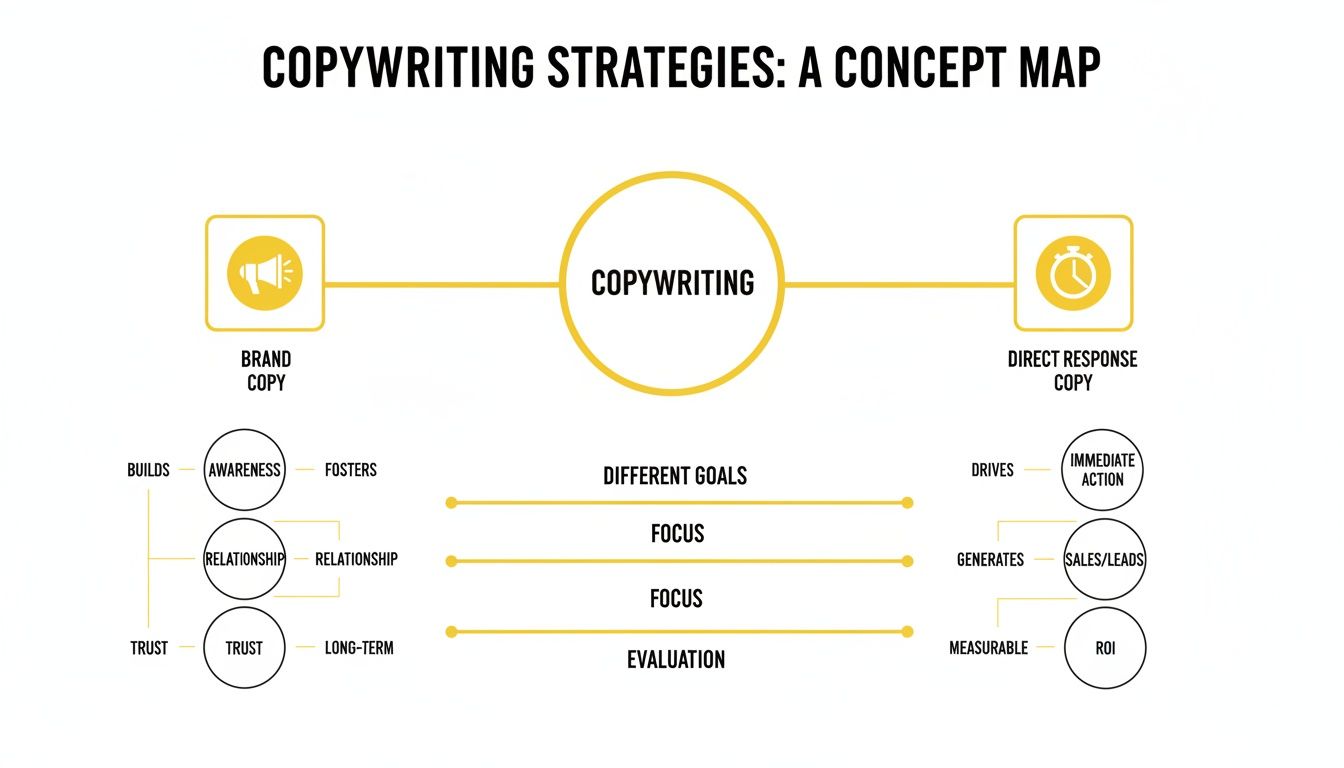
Branding is like shouting from a mountaintop, hoping to build awareness over time. Direct response is all business—it's about triggering an immediate, measurable action right now.
Crafting An Irresistible Offer
Even the most persuasive copy on the planet will fall flat without a killer offer. The offer is the entire package you’re presenting, and it needs to feel like such a lopsided, overwhelmingly good deal that saying "no" feels like a genuine mistake.
A truly irresistible offer usually has a few key ingredients:
Risk Reversal: You have to take all the fear out of the decision. Think iron-clad, no-questions-asked guarantees, like a 90-day money-back promise. This shifts the risk from their shoulders to yours.
Bonuses: What else can you throw in? Adding valuable extras that complement the main product can make the perceived value skyrocket. A course on social media ads might come with free ad templates or access to a private community.
Scarcity and Urgency: We’re all wired to act when we think we might miss out. Scarcity (“Only 50 spots left”) and urgency (“Sale ends tonight”) are powerful triggers that stop people from putting it off until "later."
For instance, a local gym could offer a discounted annual membership (the core product), toss in three free personal training sessions (bonuses), and cap the deal at the first 20 people who sign up (scarcity). That structure creates a massive incentive to act now. The tactics behind this are deeply rooted in the psychology of profit and conversion rate optimization.
These principles aren't new—they've been proven for over a century. One of the most legendary examples is the Wall Street Journal's 'Two Young Men' sales letter. It ran for 28 years straight (from 1975 to 2003) and pulled in over $2 billion in subscription revenue. Its incredible success was built on compelling storytelling, a clear value prop, and a direct call to subscribe, proving that when you master these fundamentals, you create results that last.
Proven Copywriting Formulas You Can Use Today

While the principles of persuasion are timeless, direct response copywriters rarely start with a blank page. The pros rely on battle-tested frameworks that give their message a structure built for maximum impact.
Don't think of these formulas as restrictive rules. Instead, see them as proven recipes for guiding a reader from skepticism to action.
Mastering these gives you a reliable toolkit for any scenario, whether you're writing a quick email, a social media ad, or a full-blown sales page. They provide a logical flow that lines up perfectly with the psychology of a buyer’s journey. Let's break down three of the most powerful and versatile formulas you can start using immediately.
AIDA: The Universal Blueprint For Persuasion
The AIDA formula is arguably the most famous framework in all of marketing. There's a good reason for that—it just works. It lays out the four sequential stages a prospect has to go through before they become a customer, mapping out a persuasive argument from start to finish.
Here’s the breakdown:
Attention: First, you have to grab the reader with a powerful hook. This could be a shocking statistic, a relatable question, or a bold promise in your headline.
Interest: Once you have their attention, you have to hold it. Tell a compelling story, present fascinating facts, or shine a light on a problem they didn't even realize they had.
Desire: This is where you connect the dots. You stop talking about what your product is and start showing what it will do for them. Paint a vivid picture of the transformation they'll experience.
Action: Finally, you tell them exactly what to do next. Be clear, direct, and give them a compelling reason to act now with a strong Call-to-Action (CTA).
Think about a Facebook ad for ergonomic office chairs. It might start with, "Is your back pain killing your productivity?" (Attention), then dive into the science of poor posture (Interest). Next, it would show testimonials from pain-free customers (Desire), and end with, "Click here to get 50% off and free shipping!" (Action).
PAS: The Problem-Solver’s Secret Weapon
When your audience is already feeling a specific, nagging pain, the Problem, Agitate, Solution (PAS) formula is your go-to. It's incredibly effective because it meets the reader right where they are, validates their frustration, and then presents your product as the obvious relief they’ve been looking for.
PAS works because it taps directly into the human desire to move away from pain. By intensifying the problem slightly, you create a powerful tension that only your solution can resolve.
It’s a simple three-step process:
Problem: State the customer's pain point clearly and directly. Show them you understand exactly what they're going through.
Agitate: This is the crucial step. Don't just state the problem—pour a little salt on the wound. Describe the frustrations, consequences, and emotional toll of letting it continue.
Solution: Now, you ride in on the white horse. Introduce your product or service as the ultimate solution, positioning it as the fast, easy way to make all that pain disappear.
Imagine an email from a local plumber. It could start with, "A leaky faucet isn't just annoying—it's expensive" (Problem). It would then continue, "Every drip is money down the drain, not to mention the risk of water damage" (Agitate). Finally, it offers, "Our 24/7 emergency service can fix it for good today. Call now for a free estimate" (Solution).
The 4 P’s: Painting A Compelling Future
Similar to AIDA, the 4 P's formula is another structured way to build a persuasive narrative. Its real strength lies in creating a powerful vision of success for the customer and then backing it up with undeniable proof.
This framework is excellent for products or services that promise a significant life transformation.
Picture: Open by painting a vivid picture of a desirable future or a relatable problem. Help the reader visualize a better version of their life.
Promise: Make a clear, bold promise about how your product will help them achieve that picture. This is your core value proposition.
Prove: Back it up with overwhelming proof. This is where you bring in testimonials, case studies, data, statistics, and expert endorsements to build rock-solid credibility.
Push: Nudge the reader to take action now. Use your CTA, guarantee, and any urgency or scarcity elements to close the deal.
By mastering these fundamental formulas, you can bring structure and psychological power to your copy. You’ll be turning your words into a predictable engine for driving action.
Direct Response Copywriting Across Marketing Channels
The core of direct response copywriting—a laser-focused call to action, a killer offer, and an obsession with measurable results—never changes. But how you apply those principles absolutely must change depending on where your audience is.
Think of it like this: A master musician knows music theory inside and out. That’s the foundation. But the way they play a screaming guitar solo is worlds apart from how they’d play a delicate piano melody. The theory is the same, but the technique and execution are completely different.
A great direct response copywriter is that musician, adapting their style to fit the unique environment of each platform. The goal is always to get that immediate action, but the path to getting it is different in a noisy social media feed than it is on a Google search results page or in someone’s personal inbox.
Winning Clicks On Facebook And Instagram
On platforms like Facebook and Instagram, you are an interruption. Nobody logs on to see your ad. They’re there for baby pictures, vacation photos, and funny memes. Your ad has one primary job before it can do anything else: stop the scroll.
To pull this off, your copy has to be disruptive. It needs to grab them by the collar from the very first word with a bold claim, a question that hits close to home, or a statement that makes them do a double-take.
Lead with the Hook: Don’t warm up. Start with the single most compelling piece of your message.
Be Conversational: Write like you’re talking to a friend. Corporate jargon is the kiss of death on social media.
Focus on the "Why": Nobody cares about features. They care about what those features do for them. Frame everything in terms of benefits, outcomes, and transformations.
Use a Clear CTA: Tell people exactly what you want them to do. "Shop Now," "Learn More," or "Sign Up" leaves zero guesswork.
For instance, a meal delivery ad shouldn’t say, “Our meals have 20 grams of high-quality protein.” It should scream, “Tired of wasting hours meal prepping? Get healthy, delicious dinners on your table in 2 minutes.”
Matching Intent On Google Ads
Google Ads is the complete opposite of social media. You aren't an interruption; you're the potential solution. Someone has a problem, they typed it into a search bar, and they are actively looking for an answer. Your copy’s only job is to convince them you are the best and most relevant answer on the page.
You have almost no room to work with here, so every single character is precious. The secret is to perfectly mirror the searcher’s intent in your headline and description.
When someone frantically searches for "emergency plumber near me," they don’t want a brand story. They want help, now. The ad that wins the click will have a headline like, "24/7 Emergency Plumber | We Arrive in 60 Mins."
This copy just works. It directly addresses the user's urgent pain and makes a clear, time-based promise that provides an immediate reason to click. It’s a perfect match for their intent.
Driving Conversions On Landing And Sales Pages
Once you've earned that click, the landing page is where the real work begins. This is where you have to deliver on the promise you made in the ad and guide the visitor toward one single, focused action. A great direct response landing page is a masterclass in persuasion, ruthlessly designed to eliminate distractions and build unstoppable momentum toward the conversion.
A page that actually converts will almost always have these critical elements:
A Powerful Headline: It grabs attention and instantly confirms to the visitor that they're in the right place. It should feel like a seamless continuation of the ad they just clicked.
Compelling Subheadings: These break up your copy and walk the reader through your key benefits and strongest selling points.
Benefit-Driven Bullet Points: These are for the skimmers. They quickly communicate the value and the real-world results a customer will get.
Social Proof: This is non-negotiable. Use testimonials, reviews, case studies, and trust badges to build credibility and melt away skepticism.
An Irresistible Offer: Spell out exactly what they get. Make it a no-brainer with bonuses, a strong guarantee, or a touch of scarcity.
A Single, Clear CTA: Don't confuse them with multiple options. Have one primary action you want them to take and repeat that call to action throughout the page.
Every single word and image on the page must work together to answer questions, demolish objections, and make it feel both easy and exciting for them to say "yes." This is where all the principles of direct response come together to turn a curious click into a real customer.
How To Measure The Success Of Your Copy

Unlike brand marketing, where success can feel subjective and hard to pin down, direct response copywriting is a game of numbers. Every single ad, email, and landing page has a clear job to do, and we judge its success with one simple question: did it work?
The answer isn’t found in opinions or creative awards; it’s buried in cold, hard data. This is where the real power of this discipline lies. It completely removes guesswork from your marketing and replaces it with a predictable system for growth.
By tracking the right metrics, you can see exactly what’s resonating, what’s falling flat, and make decisions that directly impact your bottom line. It’s not just about writing—it’s about engineering a profitable result.
This data-driven approach is precisely why the global demand for skilled copywriters is soaring. The copywriting services market, fueled largely by direct response, is projected to surge from $29.28 billion in 2025 to a staggering $48.89 billion by 2034. This explosive growth is driven by digital platforms that demand high-converting content, with e-commerce leading the charge. You can learn more about this market boom and its drivers.
Essential KPIs For Direct Response Copy
To prove your copy is generating a real return on investment (ROI), you need to monitor a handful of essential Key Performance Indicators (KPIs). These metrics tell the story of your campaign’s performance, from the very first click to the final sale.
Here are the core numbers you absolutely must track:
Click-Through Rate (CTR): This is the percentage of people who see your ad and actually click on it. It’s the first and most critical test of your headline and creative. A high CTR means your hook is strong enough to stop the scroll and grab their attention.
Conversion Rate: This measures the percentage of people who take the action you want after they click. Whether it’s signing up for a webinar, downloading a guide, or making a purchase, this tells you if your landing page copy is persuasive enough to close the deal.
Cost Per Lead (CPL) / Cost Per Acquisition (CPA): This is your total ad spend divided by the number of leads or customers you got. This KPI puts a clear price tag on each new prospect or sale, helping you understand how efficient your copy and campaigns really are.
Return on Ad Spend (ROAS): The ultimate measure of profitability. It calculates the total revenue you generated for every single dollar you spent on advertising. A ROAS of 3:1 means you made $3 for every $1 you invested. Simple as that.
Understanding What Good Looks Like
Knowing the KPIs is one thing, but interpreting them is where the real skill comes in. A "good" conversion rate for a $2,000 coaching program is going to look completely different from one for a free e-book download. Context is everything.
The goal isn't just to track numbers; it's to understand the story they tell. A low CTR might point to a weak headline, while a low conversion rate could signal a confusing offer on your landing page.
By constantly monitoring these KPIs, you can systematically test different headlines, offers, and calls to action. This process of A/B testing allows you to refine your messaging based on real-world feedback, turning your direct response copywriting into a fine-tuned engine for predictable, profitable growth.
Turning Words Into Revenue Is Our Thing
We’ve covered a lot of ground in this guide, walking through everything from the core principles of persuasion to the specific formulas that turn words into real-world results. By now, you should have a solid grasp of how the right message shifts your marketing from a shot in the dark to a predictable, high-return investment.
Getting this right is the key to scaling your business. It's what fuels profitable customer acquisition and turns clicks into loyal customers with almost surgical precision.
The Bridge From Knowledge to Results
But for businesses ready to play at a higher level, expert guidance is the fastest way to get there. This is where theory hits the pavement. The next logical step isn't just knowing these principles—it's seeing how they can be custom-fit to your unique business, your market, and your customer’s psychology.
That’s where Wojo Media comes in. We live and breathe this stuff, and we’ve generated over $145M+ in online revenue for our clients to prove it. We don’t just write copy; we build entire conversion systems from the ground up.
A great copywriter doesn't just sell a product; they sell a transformation. They understand the deep-seated desires of the customer and present the offer as the only logical solution to their problem.
Our process starts with a deep dive into your offer. We help you craft an irresistible value proposition that makes your competition look irrelevant. From there, we build conversion-focused landing pages and script ads designed for one purpose: to get people to act.
Let's Get It Done
You have the foundational knowledge. Now, imagine putting that knowledge into practice with a team that has successfully launched over 17,000+ campaigns across every major platform. We combine world-class copywriting with relentless data tracking, replacing guesswork with predictable, profitable growth.
The principles in this guide are powerful, but they become unstoppable when applied by specialists who have refined them through thousands of real-world tests.
If you’re ready to turn your advertising into a revenue-generating machine, it’s time to take the next step. Let’s connect and figure out exactly how a tailored direct response strategy can hit your specific business goals.
Book a free demo call with our team today. We'll map out a custom paid ads strategy and show you exactly how we can apply these principles to your business to get you booked-out calendars, low-cost leads, and scalable ROI.
Frequently Asked Questions
As you get deeper into direct response copywriting, a few questions always seem to pop up. Nailing down the answers helps clarify exactly what it is and how to use it to get real results. Let's tackle the big ones.
How Is Direct Response Different From SEO Copywriting?
This is a big one. Think of it like a sprinter versus a marathon runner—both are athletes, but they're running completely different races.
Direct response copywriting is the sprinter. Its only job is to get an immediate, measurable action right now. It's built on urgency, powerful offers, and emotional hooks that make someone click, buy, or subscribe on the spot.
SEO copywriting is the marathon runner. Its main goal is to rank high in search engines over the long haul. The focus here is on keywords, building authority, and providing value to attract a steady stream of organic traffic over months and years.
But they’re not enemies; they’re actually powerful allies. A killer strategy is using SEO copy to pull visitors to a blog post, then hitting them with direct response principles in a call-to-action to turn that traffic into leads.
Can AI Tools Write Effective Direct Response Copy?
AI platforms like ChatGPT can be amazing assistants, but they can't replace the strategic mind of a human copywriter—at least not yet. AI is fantastic at spitting out headline ideas, summarizing research, or getting a first draft on the page when you’re staring at a blank screen.
But here’s the thing: truly powerful direct response copy comes from a deep, empathetic understanding of what makes a specific audience tick. It's about their pains, their secret desires, and their unspoken fears.
AI can process data, but it can't feel. It can't replicate the genuine human emotion or the subtle psychological triggers that make a reader feel truly understood. The copy that really converts comes from blending human insight with AI’s speed.
A skilled copywriter uses AI as a launchpad. They take what the machine gives them and layer on their own strategic expertise, emotional intelligence, and brand voice to create something that actually connects with a person and gets them to act.
What Is The Most Common Mistake To Avoid?
Hands down, the single biggest mistake in direct response copywriting is a weak or confusing offer. You could write the most persuasive, emotionally charged copy in the world, but if the deal itself isn't crystal clear, appealing, or a total no-brainer, it’s going to fall flat.
Most other critical mistakes stem from this one core problem:
A Vague Call-to-Action: If people don't know exactly what you want them to do next, they’ll do nothing. Every single time.
Focusing on Features, Not Benefits: Nobody buys a drill because they want a drill; they buy it because they want a hole in the wall. You have to frame your copy around the outcome your product delivers.
No Sense of Urgency: Without a real reason to act now, most people will just say, "I'll do it later"—which is code for "never."
Getting these fundamentals right is the first step. It's how you write copy that doesn't just get read, but gets results.
At Wojo Media, we don’t just write copy. We build irresistible offers and entire conversion systems designed to turn clicks into customers. If you're ready to see what a professional direct response strategy can do to scale your business, we should talk.
Comments