.png)
What Is Direct Response Marketing and How Does It Work?

Direct response marketing is all about one thing: getting people to take a specific action right now. It's not about slowly building a brand image over time. Instead, every single campaign is a direct conversation with a potential customer that ends with a clear request—buy this, sign up for that, or call this number.
What Is Direct Response Marketing at Its Core

So, what are we really talking about here? At its heart, direct response marketing is marketing that demands a verdict.
Think of it like a sharp salesperson who can tell you exactly how many deals they closed today—not just how many people walked by their store. The entire philosophy is built on a simple, powerful idea: every dollar you spend should be tied to a result you can track and measure.
This mindset completely shifts marketing from a fuzzy cost center into a predictable profit driver. It’s a world where immediate return on investment (ROI), clear accountability, and hard data trump vague metrics like "impressions." Every piece of the campaign, from the headline to the button text, is ruthlessly optimized to get someone to act now.
To really get what makes direct response tick, it helps to see its core principles in action. This quick table breaks it down.
Direct Response Marketing at a Glance
Core Principle | Primary Goal | Key Feature |
|---|---|---|
Action-Driven | Provoke an immediate, specific behavior. | A clear, compelling call to action (CTA). |
Measurable | Attribute every result to a specific ad spend. | Unique tracking links, codes, or phone numbers. |
Audience-Centric | Speak directly to a well-defined customer. | Personalized messaging that solves a specific pain point. |
Offer-Based | Provide a powerful reason to act immediately. | An irresistible deal, often with urgency or scarcity. |
As you can see, there's no room for ambiguity. It's a disciplined approach focused entirely on performance.
Key Characteristics of Direct Response
To truly master this, you have to think of it as a mindset, not just a list of tactics. It's a disciplined focus on performance that shows up in a few distinct ways.
Every solid direct response campaign has these traits baked in:
Action-Oriented: The only goal is an immediate, specific response. A click, a call, a sign-up, a purchase—it doesn't matter, as long as it's the one thing you asked for. A clear call to action (CTA) is non-negotiable.
Highly Measurable: Success isn't a gut feeling. We're talking concrete data from tracking URLs, promo codes, and dedicated phone numbers to calculate the ROI on every single dollar spent.
Audience-Centric: This isn't spray-and-pray. It’s about speaking directly to a niche audience with a message and offer that hits on their exact needs and frustrations.
Offer-Driven: A powerful, irresistible offer is the engine of the entire campaign. You have to give people a seriously good reason to drop what they’re doing and act now, often by using a little urgency or scarcity.
This laser focus on results is what makes direct response the go-to strategy for businesses that want predictable, profitable growth.
The Power of Immediate Feedback
Unlike brand campaigns that might take months or even years to pay off, direct response gives you feedback almost instantly. You’ll know within days—sometimes just hours—if your ad, your offer, or your targeting is hitting the mark.
This rapid feedback loop is a game-changer. It lets you kill what isn't working and pour gas on what is, fast.
Direct response marketing removes the guesswork. It’s a scientific approach where every campaign is an experiment designed to find the most profitable way to acquire a customer.
This ability to test, learn, and refine is the secret sauce. You aren't just launching ads and crossing your fingers. You're building a customer acquisition machine that gets smarter and more efficient with every campaign, all based on real-world performance data.
Direct Response vs. Brand Marketing Explained
To build a winning advertising strategy, you first need to understand the fundamental difference between direct response and brand marketing. They’re two sides of the same coin, but they operate in completely different worlds.
Imagine a top-tier salesperson whose entire job is to close deals by the end of the day—that’s your direct response marketer. Now, picture an architect designing a city's most iconic skyscraper, aiming to build a legacy that lasts for decades. That’s your brand marketer. One demands immediate, measurable action. The other is all about building a long-term reputation and unshakeable loyalty.
They might seem like polar opposites, but the truly dominant marketing strategies find a way to make them work in perfect harmony.
The Core Philosophies: Two Different Worlds
Direct response marketing runs on a single, urgent principle: get the person to act now. Every ad, email, or landing page is engineered to persuade someone to do something specific—buy a product, sign up for a list, book a call—immediately. The messaging is sharp, direct, and packed with benefits, all designed to crush hesitation with a powerful, can’t-miss offer.
Brand marketing, on the other hand, is playing the long game. The goal isn’t a quick sale; it’s about building deep-seated affinity over time. It relies on storytelling, emotional connection, and consistent messaging to carve out a permanent space in the customer's mind. The aim is to become the default choice when a need eventually arises. Nike’s “Just Do It” campaign doesn’t scream at you to buy sneakers right now. It sells an identity, an attitude.
The easiest way to spot the difference is to look at the call to action. Direct response shouts, "Buy now and get 50% off!" Brand marketing whispers, "Think different." One is a command; the other is a philosophy.
This core difference in purpose ripples through every single part of the strategy, from how you measure success to the timeline you expect for results.
Goals and Timelines: Sales Today vs. Loyalty Tomorrow
The time horizons for these two approaches couldn't be more different. You’ll know if a direct response campaign is working within hours or days. Did the ad bring in leads? Did the email campaign drive sales? The feedback loop is fast, unforgiving, and laser-focused on immediate ROI.
Brand marketing initiatives are marathons, not sprints. You measure success over months, even years. The goal is to build brand equity—that intangible magic that makes a customer choose you over a competitor, even if it means paying a premium. It’s a long-term investment in your market position and the trust you’ve earned.
Metrics and Measurement: What Gets Tracked
Since the goals are worlds apart, the metrics you track are too. A direct response marketer lives and dies by a very specific set of numbers that tie directly to revenue.
Cost Per Acquisition (CPA): How much did it cost you to get that one new customer?
Return On Ad Spend (ROAS): For every single dollar you put into ads, how many dollars did you get back?
Conversion Rate: What percentage of people who saw your offer actually took you up on it?
Brand marketers, meanwhile, look at a much broader, and often less tangible, set of metrics to gauge their influence.
Brand Recall: When prompted, do people remember your brand name?
Share of Voice: In your industry's conversation, how much of it is about you versus your competitors?
Social Sentiment: Are the online conversations about your brand generally positive or negative?
Choosing the Right Tool for the Job
So, which one is better? That's the wrong question. It’s not about which one is superior; it’s about picking the right tool for the job you need to get done right now.
If you need to generate cash flow, acquire new customers at a profit, and figure out if an offer works—fast—then direct response is your go-to strategy.
But if you’re launching a new company in a crowded space or want to build a lasting competitive advantage that isn’t just about being the cheapest, brand marketing is absolutely essential. The most successful companies don't just pick one. They blend them masterfully. They use powerful brand marketing to build a name people trust, then deploy surgical direct response campaigns to turn that trust into profitable action.
Direct Response vs. Brand Marketing: A Clear Comparison
To make these differences crystal clear, I've put together a simple side-by-side comparison. This table breaks down the fundamental distinctions to help you decide which approach, or which blend, is right for your next campaign.
Attribute | Direct Response Marketing | Brand Marketing |
|---|---|---|
Primary Goal | Generate immediate action and measurable sales. | Build long-term brand awareness, loyalty, and trust. |
Key Metrics | Cost Per Acquisition (CPA), Return On Ad Spend (ROAS), Conversion Rate. | Brand recall, share of voice, impressions, social sentiment. |
Time Horizon | Short-term; success is measured in hours, days, or weeks. | Long-term; impact is measured over months and years. |
Call to Action | Specific, clear, and urgent (e.g., ‘Buy Now and Get 50% Off’). | Often indirect or completely absent (e.g., ‘Just Do It’). |
Audience Focus | A highly targeted segment with a specific, immediate need. | A broad audience to build widespread recognition. |
Ultimately, understanding both disciplines is what separates good marketers from great ones. Knowing when to push for the sale and when to build the relationship is the key to sustainable growth.
The Core Components of a Winning Campaign
A successful direct response campaign isn’t luck. It's a science, built on a handful of non-negotiable pillars that have to work in perfect harmony. When you see a campaign that’s consistently profitable, it’s because these core components are firing on all cylinders. Each part supports the others, creating a powerful argument that drives someone to act right now.
Think of it like building a race car. You need potent fuel, a flawless ignition, an aerodynamic chassis, and a skilled driver who knows the track. If even one of those fails, the whole machine sputters. A winning campaign is the same—it relies on four essential pillars to create unstoppable momentum.
This concept map breaks down how direct response, with its laser focus on immediate action, stacks up against the slower, broader approach of brand marketing.
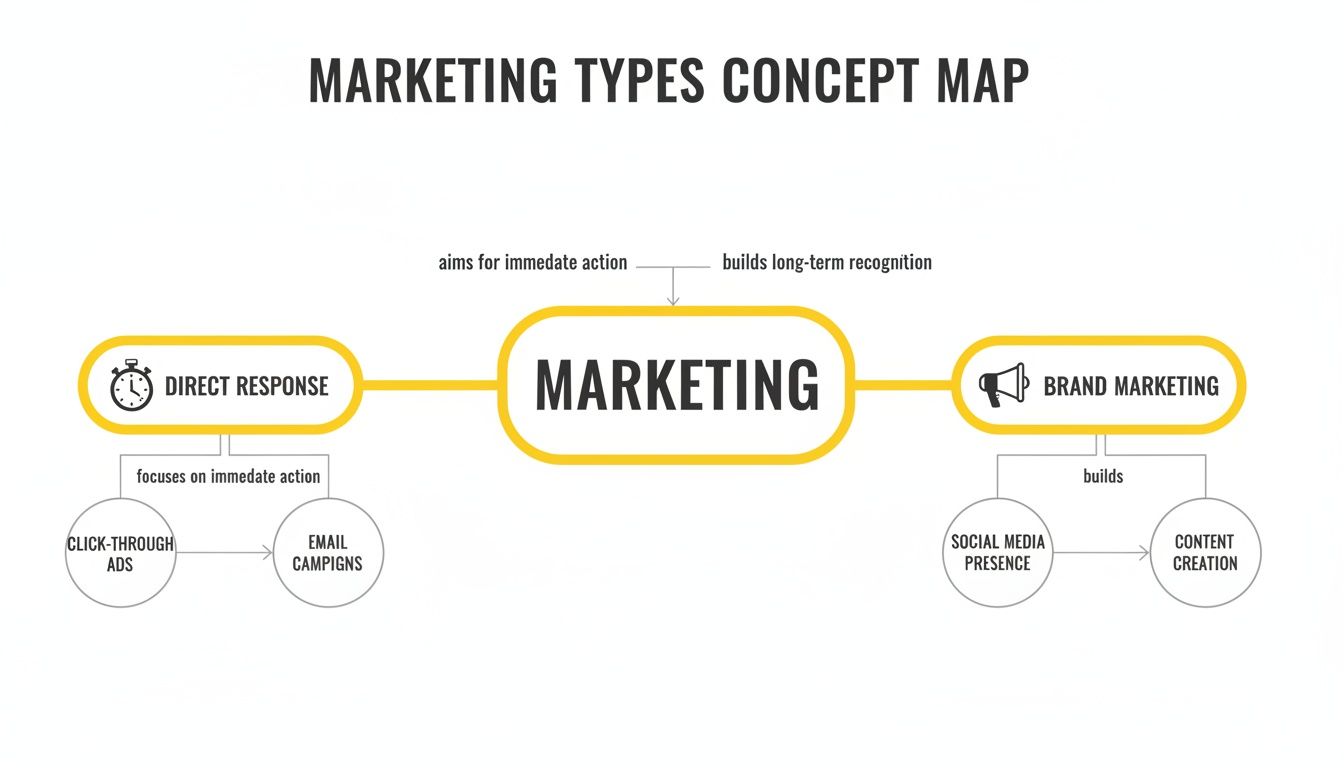
The map really hits on the core difference: direct response is measured with a stopwatch, demanding speed and results. Brand marketing uses a megaphone to build recognition over the long haul.
Pillar 1: The Irresistible Offer
The offer is the heart and soul of your campaign. It's the compelling reason someone should drop everything and click, call, or buy now. A weak, confusing, or boring offer is the #1 killer of direct response campaigns, no matter how clever the ad copy is.
An irresistible offer does more than just present your product; it frames the value so well that saying "no" feels like a genuine mistake. It’s not just "buy our stuff." It's "buy our stuff today and get a free bonus valued at $97, plus free shipping, all backed by a 90-day money-back guarantee." See the difference?
The best offers usually stack a few of these elements:
A Strong Discount: A clear, can't-miss price cut (like 50% off or Buy One, Get One Free).
Valuable Bonuses: Extra items or services that make the main product even better and crank up its perceived value.
Risk Reversal: Iron-clad guarantees ("love it or your money back") that erase any fear of making a bad decision.
Urgency or Scarcity: Time-sensitive deals ("offer ends Friday") or quantity limits ("only 50 available") that push people to act immediately.
Your offer needs to be so good that your ideal customer feels a real pang of regret if they let it pass them by.
Pillar 2: Attention-Grabbing Creative
In a world of infinite scrolling and goldfish attention spans, your creative—the ad copy, images, and videos—has one job: stop the thumb. If your ad just blends in, your amazing offer will never even be seen.
Great direct response creative isn't about being artsy or winning awards; it's about being effective. It yanks people out of their scrolling stupor by hitting a specific pain point or desire. The headline names the problem, the image shows the dream outcome, and the copy positions your offer as the clear solution.
A classic mistake is focusing creative on product features instead of customer benefits. People don't buy a drill bit; they buy the hole it makes. Your creative needs to sell the hole, not the bit.
Every single word and pixel should work together to build a slippery slide, guiding the prospect from that first flicker of interest straight to your call to action. Speaking of which, a killer CTA is non-negotiable. Learning about adding call-to-action buttons to videos can make your creative even more potent.
Pillar 3: The High-Converting Landing Page
Once your ad creative earns the click, the landing page takes the baton. This is where the sale is made or lost. A direct response landing page is a specialist, not a jack-of-all-trades. It has one singular mission: get the visitor to take the exact action promised in the ad.
That means no distracting navigation bars, no links to your blog, and no social media icons. Every element on the page—the headline, the bullet points, the testimonials, the CTA button—is there to reinforce the value of the offer and push the user toward conversion.
A battle-tested landing page always includes:
A Matching Headline: The headline instantly reassures the visitor they’re in the right place by mirroring the ad's message.
Benefit-Driven Copy: The text is all about what the customer gets, solving their problem and painting a picture of their success.
Social Proof: Testimonials, reviews, and trust badges build credibility and crush skepticism.
A Clear Call to Action: A big, obvious button with action-oriented text (think "Get My Free Quote" instead of "Submit") tells them exactly what to do next.
Your landing page is your best salesperson, working 24/7 to close deals. It has to be clear, persuasive, and ruthlessly focused on its one job.
Pillar 4: Targeted Audience and Channel
Finally, you could have the world's greatest offer, creative, and landing page, but if you show it to the wrong people, it will fail. Every time. The fourth pillar is making sure your message hits a hyper-targeted audience on the platform where they are most ready to listen.
This is about precision, not spray-and-pray. It’s far better to reach 1,000 perfect potential customers than 100,000 people who couldn't care less about what you sell. Platforms like Google, Meta (Facebook and Instagram), and TikTok have incredible targeting tools that let you zero in on people based on their demographics, interests, behaviors, and even past purchases.
The channel you pick is just as critical. Are your customers actively searching for a solution? Google Search ads are your best bet. Are they more likely to discover you while scrolling their feed? Meta or TikTok ads will work better. The trick is to meet your customers where they already are, with a message that feels native to that environment.
Where Direct Response Thrives Today
The core ideas behind direct response are timeless, but the places we put them to work have changed in a huge way. A lot of people hear "direct response" and immediately picture late-night infomercials or junk mail. The truth is, it’s more powerful than ever, just showing up in different places—from your social feed to, yes, even your mailbox.
The channel itself isn't what matters most. The magic happens when you pick the platform where your audience is ready to hear a direct offer and then shape your message to fit that space perfectly. The best channels today combine laser-focused targeting with formats built for someone to take action right now.
Paid Search Advertising
Paid search, what most of us know as pay-per-click (PPC), is probably the purest form of direct response marketing out there. When someone types "emergency plumber near me" or "buy protein powder online" into Google or Microsoft Ads, they aren't just browsing—they have a problem and they're looking for a solution this very second.
This makes paid search an incredible tool for capturing demand that already exists. Your ad shows up at the exact moment a potential customer is ready to buy. You can hit them with a clear, compelling call to action like "Call Now for a Free Quote" or "Shop Now & Get 20% Off." Since you only pay when someone clicks, every penny you spend can be tracked directly to a lead or a sale. It’s a dream scenario for any direct response marketer.
Paid Social Media Advertising
Platforms like Meta (Facebook and Instagram), TikTok, and YouTube have become absolute powerhouses for direct response. But they work a little differently. Instead of capturing existing intent like search ads, paid social is all about creating demand. Their real advantage is the ridiculously detailed audience targeting.
You can put a specific offer in front of people based on their age, what they're interested in, their online behavior, and even if they've bought from you before. This level of precision lets you create ads that don't feel like an annoying interruption but more like a genuinely helpful suggestion. The ad formats are also built to get a click, with features like:
Lead Forms: Grab someone's contact info without them ever having to leave the app.
Shoppable Posts: Let people buy your products directly from a post.
"Book Now" Buttons: Fill your calendar with appointments for your service business.
These tools make it incredibly easy for someone to see an ad and act on it immediately—the very definition of a direct response win.
Email Marketing
Email is still one of the most reliable and profitable direct response channels, period. Why? Because you’re talking to a warm audience—people who have literally given you permission to show up in their inbox. That existing relationship makes them way more likely to respond to an offer than some random person on the internet.
The real power of email is in segmentation. You can slice and dice your list into smaller groups based on what they've bought, how often they open your emails, or what they've shown interest in. This means you can send super-relevant campaigns that actually connect, like:
An exclusive discount for your most loyal customers.
A reminder for an abandoned cart, maybe with a small incentive to finish checking out.
An announcement for a new product sent only to people who bought something similar.
This kind of personal touch makes your message hit home, driving more sales and making your customers feel seen.
A well-managed email list isn't just a database. It's a direct line to your best customers, giving you a way to generate predictable revenue whenever you need it.
The Surprising Power of Direct Mail
In a world where our screens are constantly screaming for attention, getting a real, physical piece of mail can be a shocking way to cut through all that digital noise. Some might call it old-school, but modern direct mail is smarter than ever and is making a serious comeback as a direct response channel.
Something you can hold in your hand just commands attention in a way a digital ad can't. It sits on a kitchen counter or a desk, sticking around long after a social media post has vanished down the feed. And the numbers don't lie. As of 2025, direct mail campaigns are hitting response rates between 3% and 5%. Compare that to digital ads, which often struggle to get a click-through rate above 1%. You can dig deeper into why direct mail is still a powerful tool on TriadexServices.com.
Today’s direct mail campaigns aren't just "spray and pray." They use the same kind of smart targeting data as digital ads, letting you send personalized offers to specific households based on things like income, buying habits, and demographics. For local businesses, real estate agents, and even e-commerce brands, a well-designed mailer with a clear offer and an easy way to track it (like a QR code or a unique promo code) can deliver an incredible return on investment.
How to Measure Direct Response Success
If direct response marketing has a superpower, it’s this: everything is measurable. Unlike brand marketing where success can feel a bit fuzzy, every campaign kicks back hard data that tells you exactly what’s working and what isn’t. We’re not guessing here; we’re dealing with cold, hard numbers that spell out your profitability.
Tracking the right key performance indicators (KPIs) is completely non-negotiable. These metrics are the language of direct response, letting you make smart, data-driven decisions that actually fuel growth. Without them, you’re just throwing money at the wall and hoping something sticks.
The Essential Direct Response Metrics
To really get a grip on how your campaigns are performing, you have to look past the surface-level stuff like clicks and impressions. Your focus needs to be laser-sharp on the numbers that directly connect your ad spend to real business results.
Here are the core KPIs that every direct response marketer lives and dies by:
Cost Per Acquisition (CPA): This is it—the total price you pay to get one new customer. Just divide your total ad spend by the number of new customers you brought in. A low CPA is usually what you want, but it only tells half the story if you don't know what that customer is actually worth.
Return On Ad Spend (ROAS): ROAS tells you how much money you’re making for every single dollar you spend on ads. A 3:1 ROAS means you made $3 for every $1 you put in. It’s the ultimate report card for how profitable your campaign is.
Conversion Rate (CVR): This is the percentage of people who do what you want them to do after clicking your ad. If 100 people hit your landing page and 5 of them buy, your conversion rate is 5%. This metric is a dead giveaway for how well your landing page and offer are resonating with your audience.
Customer Lifetime Value (CLV): This isn't about the first sale. CLV is the total profit you expect to make from a customer over their entire relationship with your business. It's a long-term view that gives you the context you need to justify your acquisition costs.
These KPIs aren’t just a list; they’re the building blocks of a performance dashboard that gives you a clear, real-time snapshot of your campaign’s financial health.
The most successful direct response marketers aren't just looking at individual metrics. They understand how these numbers interact to paint a complete picture of profitability, turning raw data into strategic insights.
For instance, a high CPA might make you sweat at first. But what if your Customer Lifetime Value is through the roof? That "expensive" customer could turn out to be an incredibly profitable long-term investment. This is where the real strategy kicks in.
Connecting the Dots for True Insight
Metrics sitting alone are just numbers on a screen. Their real power comes to life when you start analyzing them together to understand the full story of your customer acquisition engine.
Let’s say you’re running a campaign with a CPA of $75. On the surface, that might feel a little steep. But when you dig into the data, you find that your average new customer spends $150 on their very first purchase. That's a healthy 2:1 ROAS right out of the gate.
But it gets better. Your historical data shows that the average customer comes back to make three more purchases over the next year, pushing their total CLV to $600. All of a sudden, that $75 you spent to get them in the door looks like one of the best investments you could have possibly made. This is the holistic view that separates the pros from the amateurs.
By consistently tracking CPA, ROAS, CVR, and CLV, you can stop making decisions based on gut feelings and start optimizing for what truly matters: predictable, profitable growth.
Putting Direct Response Into Practice

Theory is great, but seeing direct response marketing in the wild is where it all starts to click. The real magic is how flexible this strategy is, working its wonders across tons of different industries and channels. Whether you’re chasing a click, a call, or a form submission, the goal is always the same: get someone to take a specific, measurable action.
To really nail this down, let’s walk through four scenarios. Each one shows how the essential pieces—a killer offer, the right creative, a clear call to action, and a smart channel choice—all work together to get results now.
E-commerce Flash Sale on Instagram
Picture this: an online clothing brand needs to move last season’s inventory, fast. A direct response campaign is tailor-made for this.
The Channel: Instagram Stories and Reels. This is exactly where their target audience—fashion-lovers under 35—are already scrolling.
The Offer: A punchy "50% Off Flash Sale - 24 Hours Only!" That urgency is the secret sauce. It pushes shoppers who might otherwise wait to pull the trigger right away.
The Creative: Quick, high-energy video ads that show off the sale items. They’d use bold text overlays and a countdown timer to really dial up the scarcity.
The Call to Action (CTA): A simple, impossible-to-miss "Swipe Up to Shop the Sale." This link whisks users straight to the sale page, cutting out any extra steps.
This whole setup has one job: make sales. Its success is brutally simple to measure—just look at the Return On Ad Spend (ROAS) it generated in that 24-hour blitz. When a campaign like this hits, scaling Facebook ads for profit becomes the next logical step.
Local Service Business Lead Generation
Now, let's think about a local plumber. Their customers aren't just browsing; they have a burst pipe and are in full-blown panic mode.
The Channel: Google Search Ads. They’re targeting keywords like "emergency plumber near me" because that’s exactly what someone types when water is flooding their kitchen. It captures pure, immediate intent.
The Offer: "24/7 Emergency Service & No Call-Out Fee." This is a perfect offer because it solves the customer's immediate crisis and removes a common hesitation.
The Creative: Ad copy that gets straight to the point: "Fast, Reliable Plumber. Licensed & Insured. We'll Be There in 60 Mins or Less." It’s all about speed and trust.
The CTA: A big "Call Now" button right in the ad. One tap and the customer is talking to a dispatcher, no website needed.
In this case, website traffic is a vanity metric. What really matters is the Cost Per Call and how many of those calls turn into actual jobs.
Consultant Webinar Funnel
A business consultant selling a premium coaching program can't just ask for the sale upfront. They need to build authority and trust first. A webinar funnel is the classic direct response play here.
The Channel: LinkedIn and Facebook Ads, targeting professionals based on their job title, industry, and interests.
The Offer: A free, 60-minute training webinar on "How to Double Your Leads in 90 Days." This gives away real value in exchange for a name and email.
The Creative: The ads might feature a short video clip of the consultant dropping a knowledge bomb, inviting people to get the full story in the training.
The CTA: "Register for the Free Masterclass." This leads to a streamlined landing page designed for one thing: capturing that lead. The webinar itself then closes with an offer to book a one-on-one strategy call.
This is a multi-step process, so success is measured by the Cost Per Lead (the webinar registration) and, ultimately, the Cost Per Client Acquired.
Real Estate Direct Mail Campaign
Even today, getting a physical piece of mail can cut through the digital noise. For a real estate investor hunting for off-market properties, direct mail is a powerful way to start a one-on-one conversation. It's a serious channel, with U.S. ad spend projected to hit $20.86 billion by 2025. But that investment pays off, as direct mail can bring in an average ROI of $42 for every $1 spent.
The Channel: A highly targeted direct mail letter. It's not a blanket mailer; it's sent only to homeowners in a specific neighborhood who've lived in their houses for over 10 years.
The Offer: "Get a Free, No-Obligation Home Valuation and a Confidential Cash Offer Within 24 Hours." This is pure gold for homeowners who are curious about their equity or thinking about selling without the hassle.
The Creative: A personalized letter. It uses the homeowner’s name and mentions their street or neighborhood, making it feel personal and important—not like junk mail.
The CTA: A dedicated phone number and a simple URL to a landing page. There, they can type in their address to claim the free valuation.
The key metric is the response rate—how many calls and form fills did the mailer generate? It’s direct, trackable, and incredibly effective.
Common Questions About Direct Response Marketing
Even with a solid game plan, you're always going to have questions once you start getting your hands dirty with direct response. I get it. Nailing down the details is what separates the campaigns that flop from the ones that fly.
Let’s walk through a few of the most common questions I hear from marketers day in and day out.
Can Direct Response Also Build a Brand?
Absolutely. While the main event is always getting that immediate, measurable action, a string of successful direct response campaigns has a funny way of building your brand. It’s brand building through performance, not just promises.
Think about it. When customers have a great experience with your offer, your checkout process, and your product, they start to see your company as valuable and reliable. They associate you with solving their problems. Over time, all those individual wins stack up to create a powerful reputation—one built on actual results, not just clever taglines.
Brand marketing tells people you’re trustworthy. Direct response marketing proves it to them, one successful transaction at a time.
What Are the Most Common Mistakes to Avoid?
The biggest landmines in direct response are surprisingly common. I see them all the time. The most frequent errors are putting out a weak or confusing offer, using a wishy-washy call to action that creates zero urgency, or just flat-out targeting the wrong people. Any one of those can kill a campaign before it even gets started.
Another massive mistake is not tracking your results like a hawk. If you don't have clean data, you're just guessing. You have no clue what’s actually working. And finally, so many marketers just don't test. Relying on a "gut feeling" instead of A/B testing your headlines, images, and offers is like trying to drive across the country without a map. You'll get lost, and you’ll definitely never find the most profitable route.
How Much Should I Budget for a Campaign?
There’s no magic number here. Your budget really depends on your industry, the channels you're using, and what you’re trying to achieve. But the beauty of direct response is that you can start small and scale up intelligently.
Start with a test budget you're comfortable losing. The whole game is to obsessively track your Return On Ad Spend (ROAS) from day one. If a campaign is profitable—meaning your ROAS is positive—you can confidently reinvest those profits to scale up. This data-first approach takes the guesswork out of it and lets you grow predictably.
Ready to stop guessing and start getting predictable, profitable results from your ad spend? At Wojo Media, we specialize in building and scaling omnipresent direct response campaigns that drive real growth. Book a free demo call today to get a custom paid ads strategy for your business.
Article created using Outrank
Comments