.png)
What is multi touch attribution? A Practical Guide to Ad ROI

Here’s the deal with multi-touch attribution: it’s a way of looking at your marketing that gives credit to multiple touchpoints along a customer's path to purchase, not just the very last one. It shows you how all your channels—from that TikTok ad they saw last week to the Google search they did this morning—are actually working together as a team to land a sale.
Why Last-Click Attribution Is Killing Your True ROI
Let's say you dump your entire budget into a Google Search ad campaign. Why? Because your analytics show it's the last thing people click before they buy. Seems logical, right?
But what you don't see are the TikTok and Facebook campaigns that introduced your brand to those same customers weeks earlier. In the world of last-click attribution, those crucial first touches look like total failures. This is the classic pitfall of an outdated, flawed system.
This model gives 100% of the credit to the final click, painting a dangerously incomplete picture. It's like giving the striker on a soccer team all the glory for a goal while ignoring the defenders and midfielders who hustled the ball all the way down the field. Relying on this kind of tunnel vision is a fast track to bad decisions and wasted ad spend.
The Problem with a Partial Picture
The modern customer journey is a winding road, not a straight line. Someone might see your ad on Instagram, click a blog post from a Google search a few days later, get on your email list, and finally convert through a retargeting ad. Single-touch models just can't keep up with this reality.
Here’s what you’re missing:
Top-of-Funnel Value: Those channels building brand awareness—like social media ads or influencer posts—get zero credit, making them look completely ineffective.
Mid-Funnel Nurturing: You totally miss the impact of touchpoints that build trust, like email newsletters or helpful blog content.
Cross-Channel Synergy: You never get to see how your platforms feed each other. For example, a killer YouTube ad might be the very thing that prompts someone to search for your brand on Google later.
This is where multi-touch attribution comes in to save the day. It’s not just another tracking gimmick; it’s a total strategic shift. It’s about assigning real value to every step, from the first time someone hears about you to the moment they click "buy."
Getting this complete view is non-negotiable for making smart decisions. Sure, it’s simple to track phone calls and give all the credit to the last ad someone saw, but that approach completely hides the hard work your earlier marketing did to warm up that lead in the first place.
When you move past last-click, you finally see which channels are your best "assisters" and which are your best "closers." That's the kind of insight that lets you optimize your entire marketing machine, allocate your budget with confidence, and build predictable, profitable growth across the board.
Once you get past the obvious flaws of last-click attribution, you open the door to a much smarter way of analyzing your marketing. Understanding multi-touch attribution really comes down to getting to know its different "flavors," or models. Each model is like a different lens, spreading credit in a unique way to tell you a different story about how your customers find you.
Think of a soccer team scoring a goal. A last-click model is like giving all the credit to the striker who kicked the ball into the net. It completely ignores the rest of the play. Multi-touch attribution, on the other hand, sees the whole field—the defender who started the attack, the midfielder who made the perfect pass, and then the striker who scored. Each model just has a different opinion on how much credit each player deserves.
Let’s break down the most common frameworks marketers use, starting with the simplest.
The Linear Model: Equal Credit For All
The Linear model is the most straightforward entry point into multi-touch attribution. It just takes the total credit for a sale and splits it evenly across every single touchpoint that led to it. Simple as that.
If a customer clicked a Facebook ad, read a blog post, opened an email, and then finally bought through a Google ad, each of those four touchpoints gets exactly 25% of the credit. It’s democratic, easy to understand, and makes sure no interaction gets left behind. It’s a great place to start, especially if you have a shorter sales cycle and want to give every step of the journey some value.
By giving every touchpoint a piece of the credit, the linear model provides a balanced view. It stops you from prematurely killing the budget for channels that are quietly doing the heavy lifting at the beginning or middle of the customer journey.
This is where you can really see the difference between the old way and the new way of thinking.
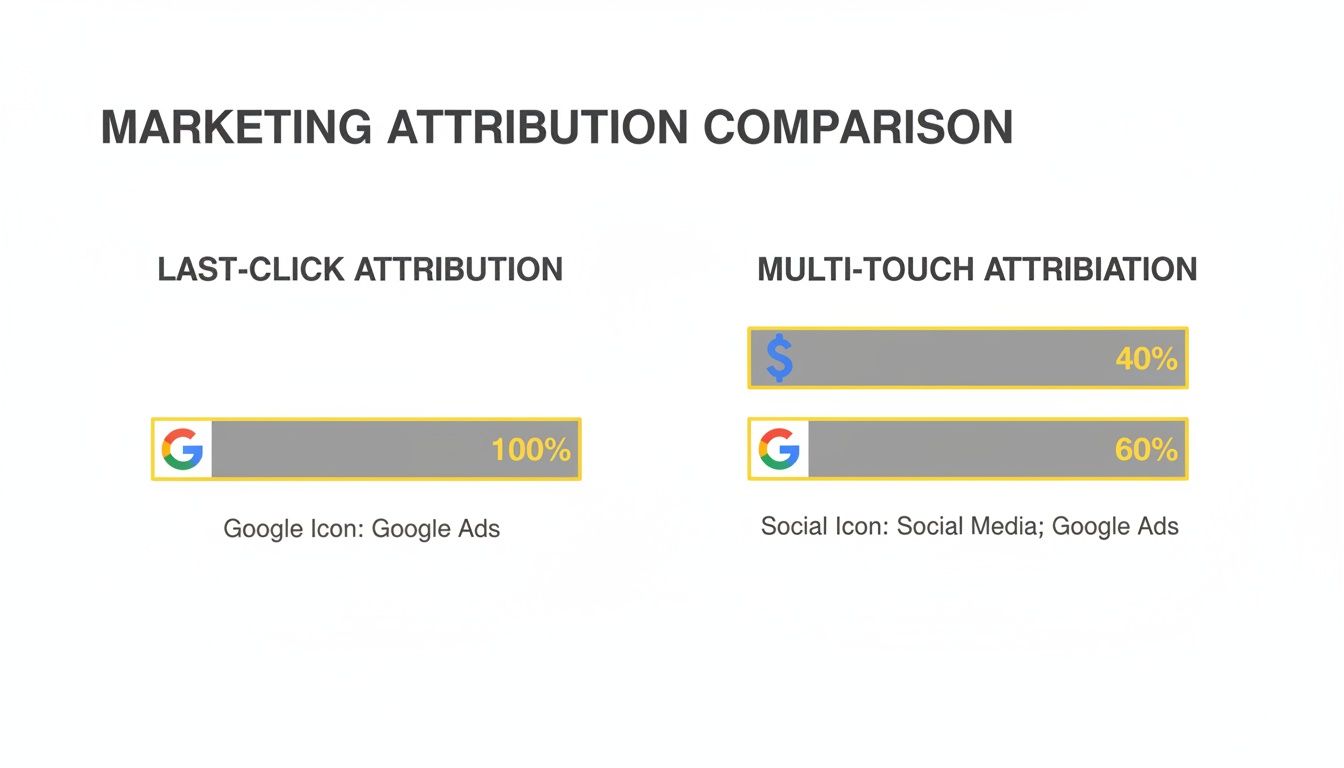
As you can see, last-click gives 100% of the win to the final Google Ad. A multi-touch model, however, recognizes that the social media ad played a huge role in even starting the conversation.
The Time Decay Model: Credit For Recent Actions
Next up is the Time Decay model. This model works on a simple, logical idea: the things a customer did right before they converted are probably more important than the things they did weeks ago.
Let's say a customer's journey takes two weeks. That Instagram ad they saw on day one gets a little bit of credit, but the email they clicked yesterday and the final search ad they clicked today? They get way more. The credit "decays" the further back in time an interaction happened.
This approach is incredibly useful for businesses with longer sales cycles, like B2B services or big-ticket e-commerce items. It still acknowledges the entire journey, but it puts more weight on those final, decisive moments that pushed the customer over the edge.
The U-Shaped Model: First And Last Touches Win
Also known as the Position-Based model, this one gives the most credit to two key moments: the very first touchpoint and the very last one. It treats these as the MVPs of the customer journey—the interaction that introduced the brand, and the one that sealed the deal.
Unlike single-touch models that dump 100% of the credit on one interaction, the U-shaped model—popularized in tools like Google Analytics—typically gives 40% to the first touch (your brand awareness play) and 40% to the last touch (your closer). The remaining 20% is then split evenly among all the interactions in the middle. It’s a powerful hybrid that values both discovery and conversion.
Here’s what that credit split looks like in the real world:
First Touch (40% credit): The initial Facebook ad that made someone aware your product even exists.
Middle Touches (20% credit, shared): The blog posts they read, emails they opened, or retargeting ads they saw along the way.
Last Touch (40% credit): The final branded Google search click that took them straight to checkout.
By highlighting the "bookends" of the customer journey, the U-Shaped model gives marketers a fantastic view of what’s working to both kick off the sales process and close it out.
To make this all a bit more concrete, let's look at how these models would assign credit for a single $100 sale. Imagine a customer's journey looked like this: they clicked a Facebook Ad, then read a Blog Post, then opened an Email, and finally converted from a Google Ad.
How Attribution Models Distribute Credit
Attribution Model | Facebook Ad (First Touch) | Blog Post (Middle Touch) | Email (Middle Touch) | Google Ad (Last Touch) | Best For |
|---|---|---|---|---|---|
Linear | $25.00 | $25.00 | $25.00 | $25.00 | Valuing all touchpoints equally, especially in short sales cycles. |
Time Decay | ~$10.00 | ~$20.00 | ~$30.00 | ~$40.00 | Long consideration periods where recent touchpoints are key. |
U-Shaped | $40.00 | $10.00 | $10.00 | $40.00 | Valuing both the first introduction and the final conversion driver. |
As you can see, the exact same $100 sale can tell three very different stories depending on which lens you look through. This is why multi-touch attribution is so powerful—it helps you see the teamwork behind every conversion, not just the final shot.
Choosing the Right Attribution Model for Your Business
Okay, we've walked through the different frameworks. So the next obvious question is: which one is actually right for my business?
The honest answer? There’s no one-size-fits-all solution. Picking the right model isn't about finding the single "best" one on the market. It’s about aligning its logic with your specific business goals, how long it takes to make a sale, and what your customer’s journey really looks like.
Think of it like choosing a camera lens. A wide-angle lens is perfect for capturing a huge, sweeping landscape, but a macro lens is built for getting those tiny, intricate details up close. Both are fantastic tools, but they do completely different jobs. Each attribution model gives you a unique perspective on your marketing, and the trick is picking the one that shows you what you need to see.
It all comes down to matching the model’s strengths to your primary goals. Are you trying to blast your brand out there and fill the top of your funnel with new leads? Or is your main focus on figuring out the final touchpoints that push people to buy right now? Your answer will point you straight to the most useful model.
Aligning Models With Marketing Goals
Let's get practical. The model you pick should directly reflect what you're trying to measure and improve.
A fast-growing e-commerce brand, for example, is going to get a ton of value from the U-Shaped model. Why? Because it spotlights the two most critical moments for them: the first ad that got someone interested and the final click that closed the deal. It gives clear credit to both customer acquisition and conversion channels, which is exactly what you need when you're trying to optimize ad spend for rapid growth.
On the other hand, a business with a long, complicated sales cycle—think B2B software or a high-ticket coaching program—needs a totally different lens. For them, a Time-Decay model often paints a much more accurate picture. It correctly gives more weight to the nurturing activities that happen right before the conversion, like a final demo call or a detailed proposal email, recognizing that those are the moments that seal a long-term decision.
The most effective multi-touch attribution strategy is not static. It’s one that mirrors your customer's reality and helps you answer your most pressing business questions. Choosing a model is choosing which part of the customer journey you want to bring into sharpest focus.
Matching Models to Business Types
Different business models create wildly different customer journeys. Your attribution should reflect that reality. Here’s a quick breakdown of which models we see working best for specific industries.
E-commerce & Direct-to-Consumer (DTC): These businesses often lean on U-Shaped or Linear models. The U-Shaped model is great for valuing that first touch and last click, while the Linear model gives you a balanced, even-handed view of all the interactions in what’s usually a pretty short sales cycle.
Lead Generation & Local Services: For businesses like med spas, home service contractors, and agencies, the journey has clear steps from first contact to lead submission. Picture a local Tampa home services company; its customer journey is way more than a single click. For years, last-click attribution forced budgets into bottom-funnel tactics, completely ignoring the 70-80% of the journey that happens during the awareness and consideration phases. You can see how modern attribution fixes this by checking out this practical B2B guide on blueprintdemand.com.
B2B, Coaching, & Real Estate: These sectors need models that understand a multi-step nurturing process. The W-Shaped model is often a perfect fit because it gives major credit to three key milestones: the first touch, the moment a lead is created, and the final conversion. It perfectly mirrors a full-funnel strategy where a social media ad creates awareness, a landing page captures the lead, and a final webinar or sales call closes the deal.
How to Implement Multi-Touch Attribution

Alright, let's get out of the theory and into the real world. Putting multi-touch attribution into practice isn't some technical nightmare reserved for data scientists. It's really just about building a solid data foundation, one step at a time. The whole system lives or dies on your ability to accurately track a customer’s journey across every single place they interact with your brand.
Think of yourself as a detective. To solve the mystery of "what actually led to this sale," you need to collect clues from every scene. If you're missing evidence or the labels are all wrong, the entire case falls apart. It’s the exact same thing with attribution—clean, consistent data is everything.
And that process starts with something you’re probably already using but maybe not to its full potential: UTM parameters.
Master Your UTM Parameters
Urchin Tracking Modules, or UTMs, are just little tags you add to the end of your URLs. They work like name tags for your traffic, telling your analytics platform exactly where each visitor came from. Getting this right is the absolute, non-negotiable first step.
For multi-touch attribution to have any chance of working, your UTM strategy needs to be obsessively consistent across every channel. Facebook, Google, TikTok, email newsletters—they all need to follow the same naming structure. No exceptions.
A simple, effective structure uses these five parameters:
: This identifies the platform where the traffic started (e.g., , , ).
: This explains the marketing channel you used (e.g., , , ).
: This names the specific campaign you're running (e.g., ).
: This tracks the specific keyword for search ads.
: This helps you tell the difference between ads or links pointing to the same URL (e.g., vs. ).
Without a standardized UTM system, your data becomes a complete mess. You’ll end up with traffic from "facebook," "Facebook," and "FB.com" all showing up as separate sources, making it impossible to see the real customer journey. Consistency is your best friend here.
Centralize Data in Your Analytics Platform
Once you’re tagging every link with consistent UTMs, you need one place to collect and make sense of it all. This is where a powerful analytics tool like Google Analytics 4 (GA4) becomes your command center.
GA4 is built to bring user interactions from your website and app into one place, giving you that unified view of the customer journey. Inside GA4's advertising workspace, you can directly compare different attribution models—last-click, first-click, linear, you name it—using the exact same data. You get to see in real-time how changing the model completely shifts the credit your marketing channels receive.
Of course, this only works if GA4 is set up correctly. You need to define your conversion events to match your actual business goals, whether that's a lead form submission, a purchase, or a booked call. These are the "wins" your attribution models will be analyzing.
Embrace Modern Tracking Solutions
Look, in today’s marketing world, you can't rely only on browser-based tracking like third-party cookies anymore. It's just not enough. Privacy shifts, like Apple's App Tracking Transparency (ATT), have made that old way of doing things less and less reliable. You have to adapt.
This is where more advanced solutions come into the picture:
Server-Side Tracking: Instead of sending data from a user's browser straight to Google Analytics, server-side tracking sends it from your website's server first. This approach is way more reliable, more secure, and less likely to be blocked by ad blockers or browser privacy settings.
First-Party Data: This is the data you collect directly from your audience with their permission—think email addresses, phone numbers, and purchase history. When you use this data, you can build a much more accurate picture of how people behave without ever needing to rely on sketchy third-party cookies.
Putting these solutions in place gives you a more durable and trustworthy data pipeline. It ensures your multi-touch attribution system is built on a foundation that can handle whatever changes come next in the ad world, giving you clear insights you can actually count on.
Our Approach to Omnipresent Attribution
The standard attribution models are a great place to start, but they only tell you what’s happening on the surface. To unlock real, predictable growth, you have to dig deeper. While platform data is useful, it often misses the full story of how marketing actually impacts the business. This is where we go beyond the basic frameworks and into a more complete, omnipresent analysis.
Our approach connects every single marketing touchpoint not just to a sale, but to the backend business metrics that truly define success. We don’t just stop when someone converts. We follow the data all the way to things like lead quality, appointment show-up rates, and even long-term customer lifetime value (LTV).
It’s about creating a full-circle view so we can see exactly how marketing efforts are impacting your bottom line.
Analyzing the Four Pillars of Growth
True optimization happens when you see how every piece of your strategy works together. We analyze performance through the lens of four core pillars, with every decision informed by this deeper level of attribution. This ensures no part of your marketing funnel is operating in a silo.
The four pillars are:
Your Offer: Is your core promise actually compelling? Attribution data can show us if certain offers bring in higher-quality leads who are more likely to show up and buy.
Your Landing Pages: Are they built to convert? We can see which pages don’t just get leads, but produce customers who spend more over time.
Your Ads: Which creative and channels are driving real action? Our data might reveal that a TikTok campaign is a killer "assist" channel, even when its last-click ROI looks weak.
Your Data: Is your feedback loop clean and actionable? Tying ad data directly to sales outcomes means we can make confident decisions based on profit, not just clicks.
By linking front-end ad performance to back-end business results, we transform attribution from a simple reporting tool into a predictive growth engine. It’s how we replace guesswork with a clear, data-driven roadmap to scale your business profitably.
From Hidden Value to Confident Scaling
This holistic approach is fantastic at revealing the hidden value in your campaigns. Let’s say a client’s TikTok campaign looks like it has a low return on ad spend (ROAS) according to Meta’s or Google’s last-click data. Most agencies would see that as a failing channel and hit pause.
But our omnipresent attribution might show something different entirely. We could see that a huge chunk of customers who eventually convert from Google Search first saw an ad on TikTok. Suddenly, that "underperforming" channel is revealed as a critical first touch that’s filling the top of your funnel with qualified prospects. Armed with that knowledge, we can confidently scale the TikTok campaign, knowing it’s feeding the entire ecosystem.
This is the method we've honed from running over 17,000 campaigns. It allows us to understand the complete story behind every single conversion. It’s the difference between just running ads and building a predictable system for acquiring high-value customers. We’re not just looking at which ad got the final click; we’re optimizing the entire journey that creates your very best customers.
Common Questions About Multi Touch Attribution
It's one thing to understand the models and another to actually put them to work. When you're making the jump from a simple last-click worldview to a full multi-touch attribution framework, a lot of practical questions pop up. It’s a big shift.
Here are some of the most common things marketers ask when they're in the trenches, making this change happen. We'll give you straight-up answers to help you navigate the real-world side of MTA.
How Long Does It Take for MTA to Become Useful?
This is the big one, and the answer comes down to one thing: data. You’ll probably spot some interesting trends within a few weeks, but for multi-touch attribution to give you truly solid insights, it needs a good amount of data to chew on.
For most businesses, you're looking at one to two full sales cycles. That's the sweet spot. It gives the system enough history to see real customer patterns instead of just reacting to random daily noise. A good rule of thumb is to plan for about 90 days of data collection before you start making major budget decisions based on your MTA models.
Patience is the name of the game here. You’re not looking for an overnight miracle. You’re building a reliable system that shows you how all your marketing works together over time.
Can I Use MTA with Only One or Two Marketing Channels?
You absolutely can. In fact, you should. There's a common myth that MTA is only for massive brands juggling a dozen different channels. That couldn't be further from the truth.
Even if you’re just running ads on Facebook and Google, multi-touch attribution is a game-changer. The real magic of MTA is seeing how your channels talk to each other, no matter how many you have.
For example, you might find out that a ton of your customers first see your brand on a Facebook ad, but then search for you on Google a week later to actually buy. Without MTA, you'd think Google did all the work and might even cut your Facebook budget, killing the very thing that started the journey.
Even with just two channels, MTA shows you the partnership between them. It lets you fund the entire customer journey, not just the last thing they clicked.
How Do Privacy Changes Like iOS 14.5 Affect MTA?
Let's be real: privacy updates changed everything. Apple's restrictions and the slow death of third-party cookies have made old-school browser tracking a lot less reliable. That hits attribution right where it hurts.
But these challenges have also forced the industry to get smarter and build more durable solutions. Modern MTA is adapting, and it’s leaning heavily on a few key things:
Server-Side Tracking: Instead of relying on a user's browser, this sends data straight from your website’s server to platforms like Google or Facebook. It’s way more accurate and much harder to block.
First-Party Data: This is gold. It’s the information you collect directly from your customers with their permission—think email lists, purchase histories, and CRM data.
Modeled Conversions: Platforms like Google and Meta aren't just guessing anymore. They use sophisticated modeling to fill in the data gaps from privacy rules, giving you a much clearer picture of what's actually working.
So while privacy changes have thrown a wrench in things, they’ve also pushed us toward a smarter, more data-savvy approach that doesn't rely on flaky, outdated tracking.
At Wojo Media, we don't just run ads; we build omnipresent campaigns around a complete, data-driven picture of your customer's journey. Ready to stop guessing and start growing? Book a free demo call with us today.
Comments