.png)
What is performance advertising? A simple guide to boosting ROI

What if you could hire a salesperson you only paid when they actually closed a deal? No salary, no retainer—just pure, unadulterated results. That’s the entire idea behind performance advertising.
It’s a straightforward approach to digital marketing where your money only leaves your bank account when something specific and measurable happens. We’re talking about a click, a new lead, or, best of all, a sale.
Defining The Pay-For-Results Model
With performance advertising, you stop treating your marketing budget like a slot machine—pulling the lever and hoping for the best. Instead, every dollar becomes a direct investment in measurable growth.
You're no longer paying for foggy metrics like "potential reach" or "brand awareness." You're paying for concrete outcomes. This model completely flips the script, shifting the financial risk from you (the advertiser) to the publisher or ad platform. If the ads don't work, you don't pay. Simple as that.
This built-in accountability is what makes it so incredibly effective. Every cent you spend is tied directly to an action, making your return on investment (ROI) impossible to ignore. It cuts through the noise and empowers you to make sharp, data-backed decisions that fatten your bottom line.
Key Principles Of Performance Advertising
At its core, performance advertising stands on a few powerful pillars that set it apart from old-school marketing.
Action-Based Payment: You only open your wallet when someone completes the action you want, whether that's a click, a form submission, a download, or a purchase.
Measurable Outcomes: Every single action is tracked, logged, and analyzed. This firehose of data is what allows you to constantly tweak and optimize your campaigns for even better results.
Risk Mitigation: Since your payment depends entirely on results, you're shielded from blowing your budget on campaigns that just don't deliver.
The numbers don't lie. The global advertising market was pegged at around $216 billion in 2024 and is on track to smash $329.7 billion by 2032. The engine driving that explosive growth? The hyper-precise targeting and crystal-clear results that define performance advertising.
To help you quickly grasp the essentials, here’s a simple breakdown of what performance advertising is all about.
Performance Advertising At A Glance
Core Principle | Payment Trigger | Primary Goal | Key Benefit |
|---|---|---|---|
Pay for Results | A specific, predefined user action (e.g., click, lead, sale) is completed. | Drive measurable conversions and achieve a positive Return on Investment (ROI). | Low financial risk and a clear, direct line between ad spend and business growth. |
This table sums it up nicely: you pay for what you get, your goal is tangible growth, and the risk is minimal. It’s a win-win.
The Ultimate Goal: Accountability And ROI
When you strip it all down, the real goal here is to supercharge your return on investment. If you want to dive deeper, there are some great guides on how to achieve ROI in advertising that break it down. By tying your costs directly to conversions, you can scale your ad efforts with a level of predictability that was once just a pipe dream.
In performance advertising, you aren't just buying ad space; you are buying results. This simple but profound shift turns marketing from a cost center into a reliable revenue driver.
This is what gives you total command over your budget and your outcomes. You stop gambling on brand awareness and start building a predictable, fine-tuned engine for acquiring new customers, ensuring your marketing dollars work as hard as you do.
To really get what performance advertising is all about, it helps to put it side-by-side with its more famous cousin, brand advertising. They both want to grow a business, sure, but they operate on totally different philosophies and define "success" in ways that couldn't be more opposite.
This isn't a "good vs. bad" situation. It's about knowing which tool to pull out of the toolbox for the job at hand.
Think of it like fishing. Brand advertising is like casting a massive net into the ocean. You’re trying to get the attention of as many fish as you can, hoping a few of them eventually decide to swim toward your boat. It’s a long game, all about building a presence and getting your name out there.
Performance advertising? That's spear fishing. You’re locked in on one specific fish, you aim with precision, and you don't count it as a win until you've made a direct catch. It’s immediate, targeted, and obsessed with a tangible result.
The Focus of Brand Advertising
Brand advertising is playing the long game. Picture a huge billboard on a packed highway or one of those unforgettable Super Bowl commercials. The point isn't to make you swerve off the road and buy a soda right that second. It’s about burning the brand’s name, logo, and vibe into your memory.
Success here is measured by metrics that feel a bit fuzzy but are crucial for long-term growth:
Impressions: How many eyeballs saw your ad.
Reach: The total number of unique people your ad was shown to.
Brand Recall: Can people remember you after the fact?
These campaigns build familiarity and trust over months or even years. They create a positive feeling that might tip the scales when a customer is finally ready to make a purchase. It’s an investment in your future.
The Focus of Performance Advertising
In total contrast, performance advertising is about one thing: now. Every single campaign is built around a specific, immediate, and trackable action. The entire strategy lives or dies by its ability to get someone to do something right away.
Performance advertising doesn't care if someone remembers your ad tomorrow; it's obsessed with whether they act on it today. This mindset completely flips the script, turning marketing from a business expense into a direct, revenue-generating machine.
This direct-response approach means success is measured with cold, hard numbers that tie directly to your bank account.
The key metrics are crystal clear:
Clicks: How many people were interested enough to click through to your website.
Conversions: The number of people who actually did the thing you wanted—like making a purchase or filling out a lead form.
Cost Per Acquisition (CPA): Exactly how much you had to spend to get one new customer.
This laser focus on actionable results is what performance advertising is all about. You know instantly if your campaigns are working because the data doesn't lie.
When To Use Each Strategy
So, which one is better? It’s a trick question—the answer is neither. The most powerful marketing strategies use both, but for totally different reasons.
Brand advertising builds the foundation. It fills the top of your funnel with people who know and trust your name. Then, performance advertising steps in to convert that awareness into actual sales and leads, capturing the demand that branding created.
For a new business, performance ads often deliver the quick wins and measurable ROI you need to get off the ground. For a big, established brand, it makes sure their market presence actually translates into consistent, profitable growth. Understanding the difference lets you make smart investments for today while still playing the long game for tomorrow.
How Performance Advertising Pricing Models Work
To really get what performance advertising is all about, you have to look under the hood at its financial engine. This isn't like old-school advertising where you just pay a flat fee for some ad space and hope for the best. Performance models tie every dollar you spend directly to a specific, measurable result.
This is where the magic happens. Your ad budget stops being a speculative expense and starts becoming a predictable investment in your growth.
The pricing model you pick is essentially the rulebook for your campaign; it decides exactly when you pay. Each one is built for a different goal, whether that’s getting traffic, building an audience, or making a direct sale. Understanding your options here is the first real step toward building an ad strategy that’s both profitable and scalable.
This decision tree gives you a quick visual of how your main goal—whether it's building awareness or driving immediate action—shapes your entire strategy from the get-go.
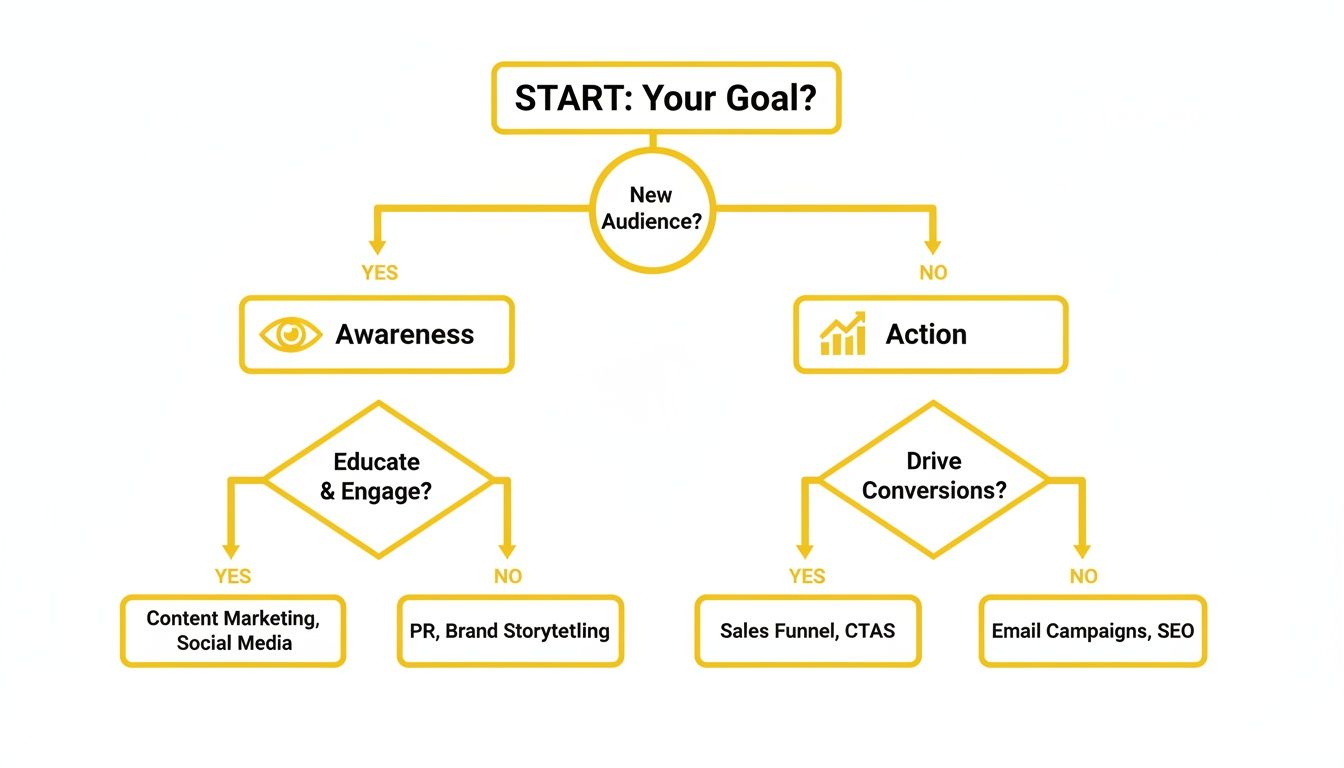
As you can see, if you're chasing a specific action, you're naturally heading toward a performance-based model. It's all about getting that tangible result. Let's break down the most common models you'll run into.
Cost Per Click (CPC): The Tollbooth Model
Cost Per Click (CPC), which you’ll often hear called Pay-Per-Click (PPC), is one of the most fundamental pricing models out there. Think of it like a tollbooth on a bridge that leads straight to your website. You only pay the toll when a car—a user—actually drives across by clicking your ad.
You aren't paying for the thousands of people who just see the sign for the bridge but drive right past.
This model is the absolute backbone of platforms like Google Ads. When someone frantically searches for "emergency plumber near me," the plumber who wins that ad auction only pays when the desperate homeowner actually clicks their ad. It's a direct payment for a crystal-clear sign of interest.
CPC is ideal for: Driving qualified traffic to a specific destination, like a landing page or a product page. It’s a powerful way to gauge if your message is resonating and get potential customers in the door.
But remember, a click is just the first step. That visitor still has to convert once they land on your site, which is why CPC is often just the beginning of the performance story.
Cost Per Mille (CPM): The Billboard Model
Cost Per Mille (CPM) means you pay a set price for every 1,000 impressions (or views) your ad gets. "Mille" is just Latin for thousand. This model is less about getting someone to do something right now and more about getting your message in front of as many relevant eyeballs as you can.
Imagine you're renting a digital billboard on a super busy highway. You pay for the ad space based on how many people are expected to drive by and see it. That's the logic behind CPM.
It's used all the time on social media platforms like Facebook and Instagram, where an initial goal might just be to build brand awareness or reach a broad, but targeted, audience. While it’s less common for pure performance campaigns, it's a solid strategy for filling the top of your marketing funnel.
Cost Per Acquisition (CPA): The Commission-Only Model
Cost Per Acquisition (CPA) is where performance advertising truly earns its name. With this model, you only open your wallet when a user completes a specific, high-value action—an "acquisition." This is the ultimate pay-for-results framework.
Think of it like hiring a salesperson who works purely on commission. You don't pay them for making calls (impressions) or setting up meetings (clicks). You only pay them when they close a deal. This aligns your advertising costs perfectly with your revenue.
The "acquisition" can be whatever matters most to your business:
A completed sale for an e-commerce store.
A qualified lead form submission for a service business.
An app install for a software company.
A booked consultation for a coach or consultant.
CPA is the go-to model for advertisers who have a clear conversion goal and want to de-risk their ad spend as much as humanly possible. You tell the ad platform your target CPA, and its algorithm goes to work trying to deliver those conversions at or below your price. It’s the clearest path to a positive return on ad spend and is a cornerstone of what performance advertising is all about.
Comparing Performance Advertising Pricing Models
Choosing the right pricing model can feel tricky, but it really just comes down to what you're trying to achieve. Each one has its place, and the best advertisers know when to use each one. This table breaks down the core differences to help you decide.
Model (Acronym) | What You Pay For | Best For | Primary Platforms |
|---|---|---|---|
Cost Per Click (CPC) | Each time a user clicks your ad. | Driving targeted traffic to a website, landing page, or product page; gauging initial interest. | Google Ads, Bing Ads, Facebook Ads |
Cost Per Mille (CPM) | Every 1,000 times your ad is shown (impressions). | Building brand awareness, reaching a large audience, top-of-funnel campaigns. | Facebook Ads, Instagram Ads, YouTube Ads, Display Networks |
Cost Per Acquisition (CPA) | A specific conversion action (e.g., sale, lead, sign-up). | Maximizing ROI, generating direct sales or leads, de-risking ad spend. | Google Ads, Facebook Ads, Affiliate Networks |
Ultimately, the best model depends entirely on your campaign goals. If you need traffic now, CPC is your friend. If you're playing the long game with brand recognition, CPM works wonders. And if every dollar has to be tied to a sale or lead, CPA is the only way to go.
Tracking The Metrics That Actually Matter
In performance advertising, your gut feeling doesn’t drive growth—data does. The pricing models are the engine, sure, but data is the compass that guides your every single move. It’s incredibly easy to get lost in a sea of numbers, but the most successful campaigns I’ve ever seen focus only on the metrics that directly connect ad spend to actual revenue.
This means you have to look past "vanity metrics" like likes or shares. They feel good, but they don't pay the bills. Instead, we zero in on the key performance indicators (KPIs) that tell the true story of your campaign's health and, more importantly, its profitability. Think of it like this: a car’s top speed is impressive, but it’s the fuel efficiency that really determines if you’ll make it to your destination.
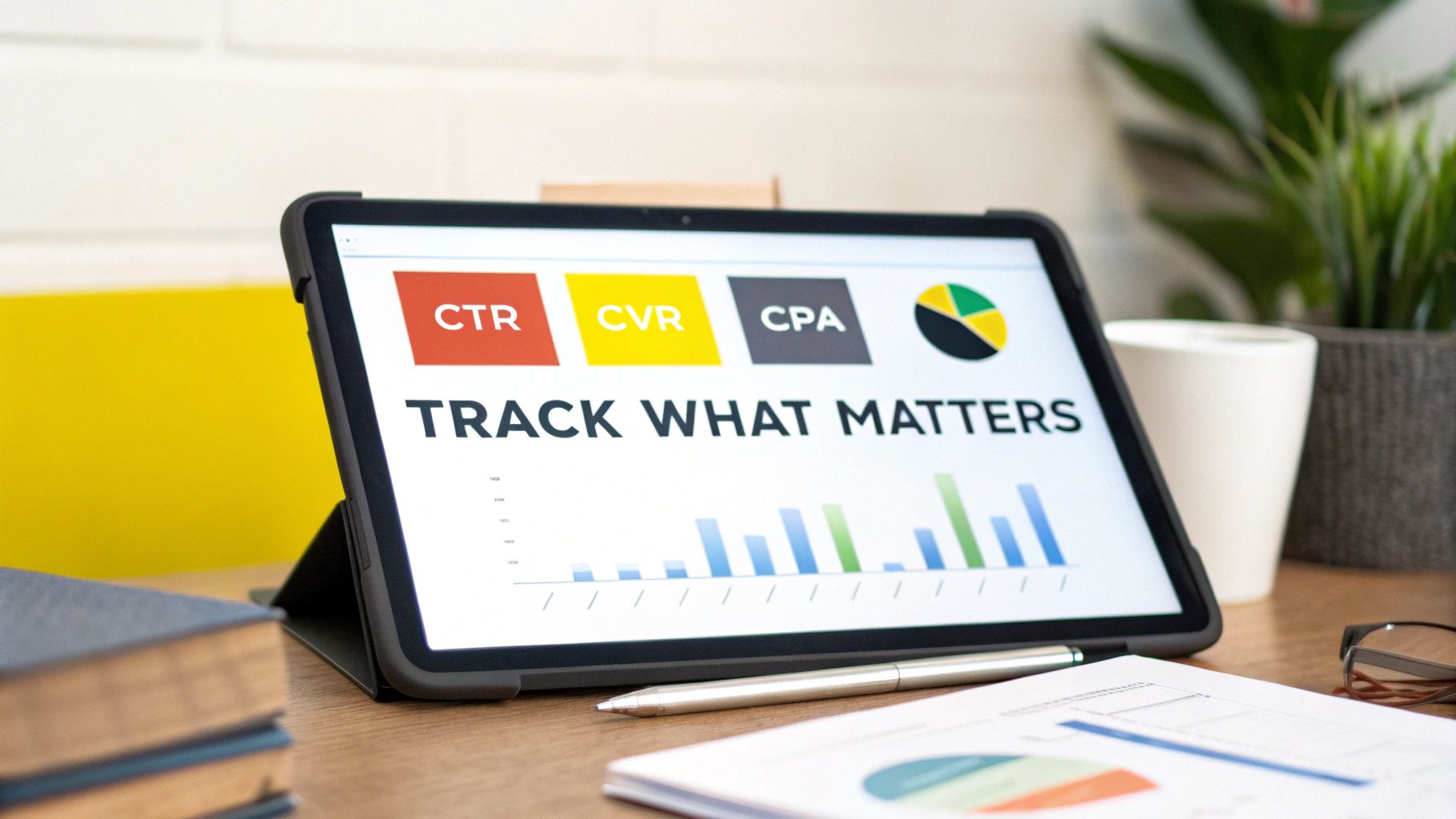
Core Performance Advertising Metrics
To really get under the hood and start optimizing your campaigns, you need to be fluent in the language of performance data. These four metrics are the pillars of any strategy that actually works.
Click-Through Rate (CTR): This is the percentage of people who saw your ad and were interested enough to click. A high CTR is a great sign—it tells you your creative and messaging are grabbing attention. But it's only the first step.
Conversion Rate (CVR): Here’s where the magic happens. CVR is the percentage of those clicks that turn into a real action—a sale, a lead, a sign-up. This metric tells you how well your landing page is doing its job after the click.
Cost Per Acquisition (CPA): Like we talked about, CPA is the bottom-line cost to get one new customer or lead. It's the ultimate measure of efficiency, telling you point-blank if you're acquiring customers at a profitable price.
Return on Ad Spend (ROAS): This is the holy grail. ROAS measures the total revenue you generate for every single dollar you spend on ads. A 5x ROAS means you made $5 for every $1 you invested. Simple as that.
The real power isn't in just looking at these numbers individually, but in understanding how they work together. For instance, a high CTR paired with a low CVR is a huge red flag. It screams that there's a disconnect between what your ad promises and what your landing page delivers, giving you a crystal-clear problem to solve.
The Technology That Makes It Possible
Honestly, none of this would be possible without the right tracking technology. Tools like the Meta Pixel and Google Ads Conversion Tracking are the unsung heroes of performance advertising. They’re just small snippets of code you install on your website, but they monitor every critical user action.
They act like a digital cashier, logging every click, form submission, and purchase that comes from your ads. This creates a closed-loop system where you can directly tie specific results to specific campaigns, ad sets, and even individual ads. That’s what makes true optimization possible.
Without precise tracking, you're just guessing. These tools transform your marketing from an art into a science, allowing you to make decisions based on cold, hard data instead of assumptions.
A crucial part of proving the value of all this is knowing how to calculate marketing ROI effectively. This is where tracking pays off in spades, giving you the hard numbers you need to show your campaigns are generating real business value.
The data-driven approach delivers, too. For instance, customers who are retargeted by display ads are up to 70% more likely to make a purchase. And with 46% of Google searches having local intent, the ability to track and drive in-person visits becomes a game-changer for local businesses. When you track the right metrics, you turn these powerful trends into profitable outcomes.
Performance Advertising In Action Across Industries
Understanding the theory is one thing, but seeing performance advertising drive real-world results is where it all clicks. This isn't just a strategy for one type of business; it’s a flexible growth engine you can tune for almost any industry. The secret is matching the right platform, pricing model, and message to a specific business goal.
By looking at how different businesses put these tools to work, you can start building a practical playbook for your own campaigns. Let's break down a few scenarios to show you exactly what this looks like in the real world.
The E-commerce Store Rescuing Abandoned Carts
Picture an online store that sells high-end coffee makers. They're facing a classic e-commerce headache: customers add a $300 machine to their cart but bail before checking out. That’s a massive amount of lost opportunity, but performance advertising offers a direct solution.
The store sets up a Meta (Facebook and Instagram) retargeting campaign. Using the Meta Pixel, they build a custom audience of everyone who ditched a cart in the last seven days. Then, they hit this super-specific group with an ad that says something like, "Still thinking it over? Your perfect morning brew is just a click away."
Platform: Meta (Facebook and Instagram)
Pricing Model: Cost Per Acquisition (CPA), optimized for purchases. The entire goal is to land a customer at a price that makes sense for the business.
Key Metrics: Return on Ad Spend (ROAS) is the north star here. They’re also glued to their Conversion Rate (CVR) and Cost Per Purchase to ensure every sale is profitable.
Outcome: The campaign consistently pulls in a 6x ROAS. For every $1 they put into ads, they get $6 back in revenue directly from those rescued carts.
This strategy flips a potential loss into a predictable revenue stream by hitting high-intent buyers with the perfect nudge right when they need it.
The Local Plumber Getting Emergency Calls
Now, think about a local plumber. Their best customer isn't someone idly browsing bathroom renovation ideas. It’s the person whose pipe just burst and is frantically Googling for help on their phone right now.
This plumber goes all-in on Google Search Ads. They target high-intent, panic-driven keywords like "emergency plumber near me" and "24-hour plumbing service." Their ad copy is short, sharp, and action-focused, screaming "fast response times" and featuring a big, fat click-to-call button.
The success of a local service campaign hinges on being visible at the exact moment of need. For a plumber, that moment is a Google search on a smartphone, and the most valuable conversion is a phone call.
The objective isn't just to get clicks—it's to make the phone ring with urgent, qualified leads.
Platform: Google Ads
Pricing Model: Cost Per Click (CPC), but with a laser focus on maximizing conversions (phone calls).
Key Metrics: The number one metric is Cost Per Lead (CPL). They need to know exactly what it costs to generate one qualified phone call. They also watch their Impression Share for top-of-page results to make sure they're the first name people see.
Outcome: By constantly tweaking their campaign, they get their CPL down to $35. This delivers a steady flow of high-value emergency jobs that keeps their team busy and the business profitable.
The Real Estate Agent Building A Homebuyer List
A real estate agent’s business lives and dies by their pipeline of potential homebuyers. Instead of just waiting for referrals, they use Facebook Lead Ads to proactively build their list.
They run an ad offering a genuinely valuable freebie: "The Ultimate First-Time Homebuyer's Guide for [City Name]." When someone clicks, a form pre-filled with their Facebook info pops up instantly. They can submit their name, email, and phone number without ever leaving the app. This low-friction process is a perfect example of what performance advertising can do for lead generation.
Platform: Facebook Ads
Pricing Model: Cost Per Lead (CPL). The agent decides what a lead is worth to them, sets a target CPL, and lets Facebook's algorithm go to work finding people at that price.
Key Metrics: It's all about CPL and Lead Quality. They also monitor the Click-Through Rate (CTR) on the ad to gauge whether the offer is hitting the mark.
Outcome: The agent is pulling in over 100 new buyer leads every month at an average cost of just $12 per lead. This gives them a predictable, scalable system for growing their client base.
These examples just scratch the surface of how versatile this approach is. The explosive growth of performance advertising is no fluke; global ad spending is on track to smash $1 trillion by 2025, with digital channels gobbling up over 75% of that pie. This massive shift is happening for one reason: the ROI is measurable and undeniable. To dig deeper into this trend, you can explore some detailed worldwide ad spending forecasts at AbbeyMecca.com.
Whether you're selling a product, a service, or a high-ticket item, there's a performance strategy out there that can help you hit your goals.
Your First Performance Advertising Campaign Checklist
This is where the theory stops and the growth starts. Launching your first performance ad campaign can feel like a massive undertaking, but breaking it down into a simple checklist makes it manageable. Think of this as your pre-flight inspection before takeoff.
Following these steps will give you a rock-solid foundation, helping you dodge the common mistakes that sink most new campaigns before they even have a chance. We're not just launching ads here; we're launching ads engineered to win from day one. Let's get you ready.
Phase 1: Nail Down Your Core Strategy
Before you even think about opening an ad manager, you need to get crystal clear on what you’re trying to do and who you’re talking to. Honestly, this groundwork is the most important part of the entire process. Get this right, and everything else gets easier.
Set One Crystal-Clear Objective: What is the single most important action you want someone to take? Is it to buy a product? Book a demo call? Download your lead magnet? Your entire campaign will be built to achieve this one goal, so it has to be specific and, most importantly, measurable.
Build a Detailed Audience Persona: Don’t just settle for "women, 25-45." Go deeper. What are their real pain points? What do they secretly desire? Where do they hang out online? When you know exactly who you're targeting, you can write copy that hits them right between the eyes and pick the perfect platforms to find them.
Establish a Realistic Budget: You need two numbers: your starting ad spend and your target Cost Per Acquisition (CPA). Knowing what you can afford to pay for a new customer is the entire game in what is performance advertising—it’s all about profitability. A firm budget keeps you from burning cash and gives you a benchmark for success.
Phase 2: Get Your Tech Setup Dialed In
With your strategy locked and loaded, it’s time to get the technical pieces in place. These aren't optional. They are the tools that let you track results and actually turn your clicks into customers. Proper setup is how you gather the data you need to make smart decisions later.
A campaign without tracking is like flying a plane without instruments. Sure, you're moving, but you have no clue if you're heading in the right direction. Good data is the bedrock of every winning performance campaign.
Install Your Tracking Pixels: Get the Meta Pixel and Google Ads conversion tracking tag on your website. This is non-negotiable. It’s how you'll measure every single conversion and calculate your true return on ad spend (ROAS).
Optimize Your Landing Page: Your ad makes the promise, but your landing page has to deliver on it. Make sure your page is fast, looks great on a phone, and has a big, obvious call-to-action that matches your ad's message perfectly.
Create Compelling Ad Creative: Now it's time to design your ads. Develop copy, images, or videos that speak directly to your audience's problems and clearly show them why your offer is the solution they've been looking for. The goal is to make them feel like they have to take that next step.
Got Questions? Let's Talk Specifics.
When you're diving into performance ads for the first time, a few questions always pop up. It's completely normal. Getting straight answers to these practical hurdles is the best way to build confidence before you launch a single campaign. Let's clear up some of the most common ones right now.
What’s the Smallest Budget I Can Realistically Start With?
Forget the myth that you need a massive war chest to get in the game. You can technically start running ads on platforms like Meta or Google for as little as $5 to $10 a day.
But let's be real. To get meaningful data—the kind that actually tells you what’s working—you'll want to aim for a starting point of $50 to $100 per day. This gives the platform's algorithm enough runway to figure out who your ideal customer is and, more importantly, how to find more of them. The initial budget isn't what matters most; it's your commitment to analyzing the early results and doubling down on the winners.
How Long Until I Actually See Results?
Performance advertising moves fast, but it’s not a magic button. The first few days, or even a couple of weeks, are what we call the "learning phase." During this time, the ad platform is like a detective, testing different audiences and ad creatives to see what gets a reaction.
You might see some encouraging signs early on, but the consistent, predictable results you’re after typically start showing up after about 2-4 weeks of disciplined optimization. The biggest mistake we see people make is panicking and turning off campaigns too early. You have to give the system enough time to learn, or you're just throwing money away.
Think of the first few weeks as an investment in data. You're not just spending money on ads; you're paying to learn exactly who your customers are and what they respond to.
Is Performance Advertising Just a Fancy Name for Affiliate Marketing?
Not quite, but they're definitely related. Think of it this way: affiliate marketing is a tactic within the larger strategy of performance advertising. It's a specific channel where you pay partners (affiliates) a commission for every sale or lead they send your way. It’s 100% performance-based.
Performance advertising, on the other hand, is the whole playbook. It includes affiliate marketing, but it also covers all the campaigns you run yourself on platforms like Google, Facebook, and TikTok. With these, you’re in the driver's seat, directly managing your ads and paying for results based on metrics like cost-per-click (CPC) or cost-per-acquisition (CPA).
So, while all affiliate marketing is a form of performance advertising, not all performance advertising involves affiliates.
Ready to stop guessing and start getting predictable results from your ad spend? At Wojo Media, we build omnipresent performance advertising campaigns that turn clicks into customers. Book a free demo call today and get a custom strategy to scale your business.
Comments