.png)
Your Guide to a Full Funnel Marketing Strategy That Works

A full-funnel marketing strategy isn't just another buzzword; it's a complete roadmap for turning total strangers into your most loyal customers. It's about creating specific, intentional touchpoints for every single stage of their journey: Awareness, Consideration, and Conversion. This approach shifts your focus from chasing quick, one-off sales to building genuine, long-term demand for your brand.
Beyond the Sale: The Power of a Full-Funnel View

Think about marketing like building any relationship. You wouldn't ask someone to marry you on the first date, right? It’s awkward, weirdly aggressive, and almost guaranteed to fail. Going straight for the sale is the marketing equivalent of that. A full-funnel marketing strategy accepts the simple truth that customers don't just magically appear ready to buy. They go on a journey, and your job is to be their trusted guide.
That journey is typically broken down into three main stages, each with its own goal and playbook. By speaking to your audience differently at each phase, you create a seamless experience that builds trust and makes the final sale feel like a natural next step.
The Three Core Funnel Stages
The funnel gives you a framework for getting inside your customer's head. It’s how you deliver the right message at exactly the right time, which is the secret to making your marketing dollars work smarter.
Top of Funnel (TOFU) - Awareness: This is your first handshake. The goal here isn't to sell anything; it's to educate, entertain, and attract a wide audience—people who might not even realize they have a problem you can solve. You're casting a wide net to get your name out there and plant the seed of your expertise.
Middle of Funnel (MOFU) - Consideration: Okay, they know who you are. Now they've entered the research phase. Your mission here is to nurture their initial interest, show them what you're all about, and position your product or service as the absolute best solution. This is where you build serious trust.
Bottom of Funnel (BOFU) - Conversion: By now, your prospect is on the verge of making a decision. Your marketing gets hyper-focused, removing any last-minute doubts and giving them a compelling reason to choose you now. This is where you finally make the ask for the sale, the demo, or the consultation.
A huge mistake we see all the time is businesses pouring 100% of their marketing spend into the bottom of the funnel. It seems logical—target people ready to buy—but it ignores the entire journey that got them there. You end up with sky-high acquisition costs and a tiny pool of potential customers.
Why a Holistic Approach Wins Every Time
Focusing only on bottom-funnel tactics, like search ads for "buy now" keywords, is a short-sighted game. You're fighting tooth and nail over a very small, very expensive slice of the market. A full-funnel strategy, on the other hand, lets you create your own demand.
When you invest in top-of-funnel content, you're filling your pipeline with the customers of tomorrow. As you guide them through the middle, you build a relationship founded on value, not just a transaction. This creates a predictable, repeatable system for growth that's far more resilient and cost-effective in the long run. As you map this out, it’s also smart to look at how an omnichannel marketing strategy can tie all these touchpoints together for a truly unified customer experience.
Building Your Top of Funnel Awareness Engine
Every great customer relationship has a beginning. The top of the funnel (TOFU) is that first introduction—your chance to get in front of a huge audience, often before they even know they have a problem you can solve. This stage isn't about pushing for a sale. It's about being genuinely helpful and making a memorable first impression.
Picture yourself as the go-to expert at a big community event. You’re not running around shoving business cards in people's faces. You're just there, offering solid advice and answering questions for anyone who asks. The aim is to become the trusted resource people think of first, so when they are ready to make a move, your name is at the top of their list.
What Top of Funnel Marketing Looks Like in Action
At this point, your content has to be one thing: valuable. Whether it's educational, entertaining, or just plain interesting, there can be no strings attached. You're casting a wide net to pull in people who fit your ideal customer profile by talking about their broad interests and pain points. The real key is creating content that solves a small, nagging problem or answers a common question in your space.
A few great examples of TOFU content include:
Educational Blog Posts: Think articles that answer "how-to," "what is," or "why" questions your audience is already asking.
Engaging Short-Form Videos: Quick, shareable clips for platforms like TikTok or Instagram Reels that teach a simple concept or are just fun to watch.
Infographics and Checklists: These are perfect for breaking down complex ideas into something visually appealing and easy to share.
For instance, a real estate agency could publish a blog post titled "5 Common Mistakes First-Time Homebuyers Make in Tampa." It’s incredibly valuable to a wide audience and doesn't feel like a sales pitch. In the same way, a med spa could create a TikTok video on "The Truth About Daily Sunscreen Use," which educates viewers and builds their authority without asking for a single dollar.
Channels and Tactics for Maximum Reach
The top of the funnel is all about getting seen. You have to show up where your audience is already hanging out and deliver content that feels like it belongs there. This usually means running broad social media campaigns designed for brand recognition, not immediate conversions. It's a strategy of generosity—you're giving away your best introductory insights for free.
The whole game at TOFU is value-first. You're making a deposit in the "trust bank" with your audience. Every time you show up with helpful, no-pitch content, you earn their attention and the right to talk to them again later on.
This focus on the upper funnel is quickly becoming a major advantage. The digital ad space is getting more crowded and expensive by the day. Businesses that only focus on bottom-funnel, "buy now" ads are finding themselves in a street fight with rising costs. It's no surprise that industry surveys show by 2025, 68% of businesses will be putting more resources into top-of-funnel activities. They're realizing it's a smarter investment to build brand awareness and scale efficiently. The smart money is shifting to a full-funnel model that creates new demand instead of just fighting over the scraps. You can discover more about how top-of-funnel marketing statistics are shaping these strategies.
Measuring Success at the Awareness Stage
Since you aren't chasing sales here, your key performance indicators (KPIs) are going to look different. You’re measuring attention and engagement, not revenue. Tracking these numbers is how you confirm you’re actually reaching the right people and that your content is hitting the mark.
Here are the key TOFU metrics to keep an eye on:
Impressions: This is the total number of times your content was shown to users. It’s your raw visibility score.
Reach: This tells you the number of unique people who saw your content. This is the true size of the audience you’ve actually touched.
Video Views (and View-Through Rate): For video, it’s not enough to know how many people started watching. You need to know how many watched a good chunk of it. A high view-through rate is a sign of seriously compelling content.
Website Traffic: A noticeable uptick in new visitors to your site coming from social media or organic search is a clear signal your awareness efforts are paying off.
By focusing on these metrics, you can confidently build a powerful awareness engine that consistently feeds your full funnel marketing strategy with qualified, engaged people ready for the next step.
Engaging Prospects in the Middle of the Funnel
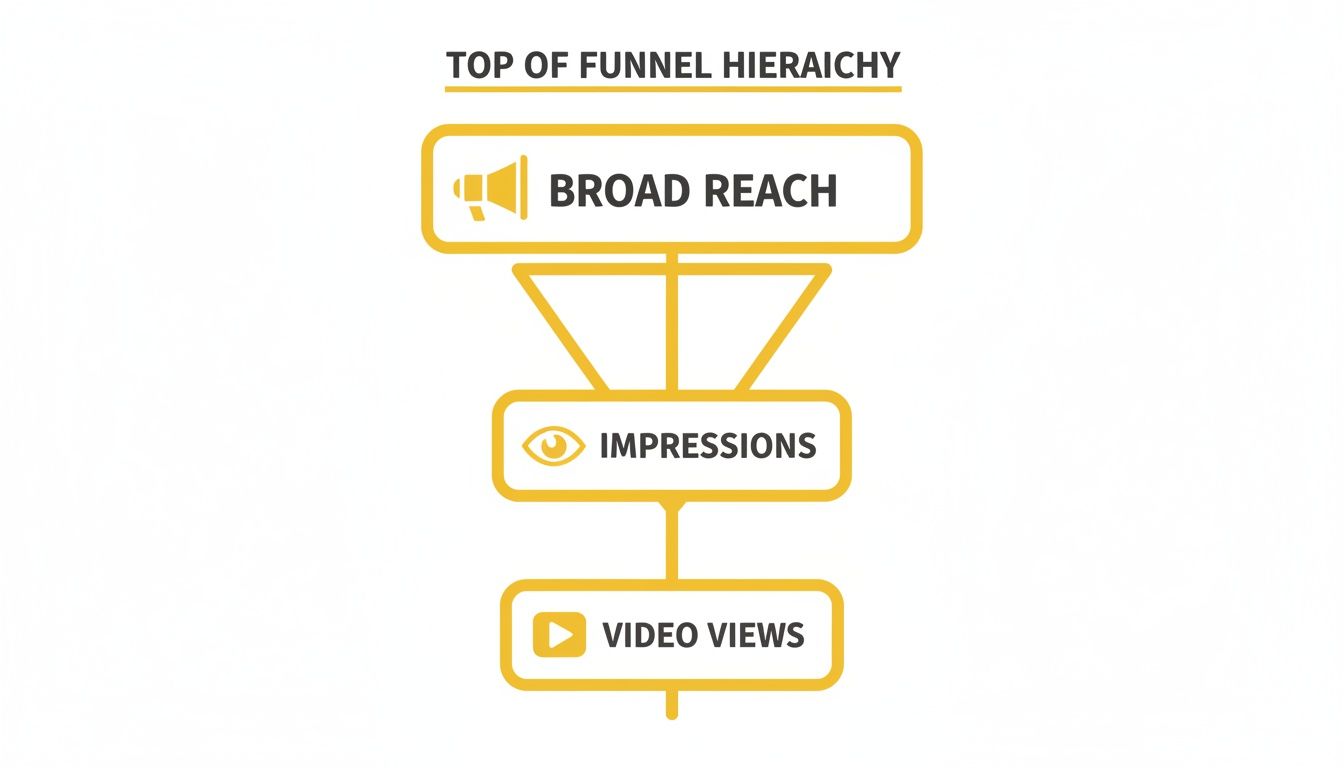
The image above really drives home how top-of-funnel campaigns work—you start with a huge audience and filter it down to a smaller group of people who are actually paying attention. Once you've captured that initial flicker of interest, you've successfully pulled them into the middle of the funnel (MOFU).
This is the “consideration” stage, and it’s where the real magic happens. Your audience has moved past casual curiosity. They now realize they have a problem and are actively hunting for the best solution. Your job is to pivot from being a helpful stranger to becoming their most trusted advisor.
Building Trust Through Deeper Value
At this point, a quick blog post won't cut it. Your audience is looking for substance. The content you serve up here needs to tackle their pain points head-on and prove your expertise in a way that truly connects. This isn’t about the hard sell; it’s about proving you have the answer they’ve been looking for.
The goal is to trade serious value for a small commitment—usually, their email address. This simple exchange opens the door to a more personal, direct conversation. By offering high-impact, problem-solving resources, you position your brand as the go-to expert and earn the right to guide them further.
Think of it like moving from a crowded party to a quiet corner table. You’re no longer shouting to be heard. Now, you’re having a focused discussion about their specific needs.
High-Impact MOFU Content and Tactics
Your MOFU content has to be so good that someone would gladly hand over their contact info to get it. This is what we call a lead magnet.
Here are some of the most effective types of lead magnets I’ve seen work time and time again:
Detailed Case Studies: Nothing builds credibility faster than proof. Showcasing how you’ve helped similar customers get real, tangible results provides powerful social proof and helps prospects see themselves achieving that same success.
In-depth Webinars: A live or on-demand webinar lets you dive deep into a complex topic, answer questions on the spot, and build a direct connection. This format is fantastic for demonstrating true expertise and handling any objections that might be holding them back.
Downloadable Guides or Ebooks: Offer a comprehensive, all-in-one resource that solves a major problem for your audience. A great example? A marketing agency might create something like, "The Ultimate Guide to Local SEO for Med Spas."
Free Tools or Calculators: Interactive tools, like an ROI calculator or a project quote generator, deliver instant, personalized value. They’re incredibly effective at capturing genuinely qualified leads.
When you offer these resources, you're also segmenting your audience. Anyone who takes the time to download a guide or sit through a webinar is signaling a much higher level of interest than someone who just scrolled past a video.
Nurturing Leads with Email Automation
Once you have that email address, the real relationship-building begins. This is where a well-crafted email automation sequence becomes one of the most powerful tools in your entire full funnel marketing strategy.
The goal of a nurture sequence isn't to blast new leads with sales pitches. It's to build a relationship over time. Every email should deliver more value, reinforce your expertise, and gently guide the prospect toward taking the next logical step.
A solid nurture sequence often looks something like this:
Instant Delivery: The first email sends the lead magnet they asked for right away. No delays.
Value-Add: A few days later, you follow up with a related tip or a link to a relevant blog post.
Case Study/Testimonial: Share a success story that hits close to home for the problem they’re trying to solve.
Soft Call-to-Action: Now you can introduce a low-commitment next step, like booking a free consultation or watching a product demo.
Key Metrics for the Consideration Stage
Measuring success in the middle of the funnel is all about tracking how well you turn anonymous visitors into known leads. Your KPIs need to reflect that critical transition.
Here’s what you should be watching closely:
Lead Magnet Downloads: The total number of people who have opted in for your content.
Cost Per Lead (CPL): How much you're spending on ads to get one new email subscriber.
Landing Page Conversion Rate: The percentage of people hitting your landing page who actually fill out the form.
Email Open and Click-Through Rates: These numbers tell you how engaged your new leads are with your nurture sequence.
By keeping a close eye on these metrics, you can fine-tune your MOFU strategy to make sure you're not just generating a bunch of leads, but attracting high-quality prospects who are genuinely ready for the final stage of their journey.
Turning Warm Leads into Paying Customers at the Bottom of the Funnel
Alright, we've made it to the final step in the journey: the bottom of the funnel (BOFU). After you’ve built awareness and helped your audience weigh their options, they’re finally ready to pull the trigger. Your one and only job now is to make choosing you the easiest, most obvious decision they’ll make all day.
This is where your marketing pivots from broad education to sharp, laser-focused persuasion. The people you're talking to here have high intent—they’re comparing you to your competitors, hunting for the best deal, and just need that final nudge to commit. A solid BOFU strategy is all about removing friction and giving them a crystal-clear reason to act now.
Mastering High-Intent Channels
At the bottom of the funnel, you have to show up at the exact moment your prospect is ready to buy. That means putting your energy into channels where people are actively signaling they’re about to make a purchase.
Hyper-Targeted Search Ads: It's time to move past general keywords. Start focusing on long-tail, commercial-intent phrases like “best med spa for coolsculpting in Tampa” or “buy [your specific product] online.” These aren't people just browsing; they have their wallets out.
Retargeting Campaigns: Use platforms like Facebook, Instagram, and Google Display to get back in front of people who visited your site, added something to their cart, or engaged with your mid-funnel content. You're there to remind them what they were looking at and sweeten the deal to bring them back. In fact, some studies show that website visitors who are retargeted are 70% more likely to convert.
Product Comparison Pages: Build pages on your own website that honestly stack your product or service against the top competitors. By transparently showing where you shine, you get to control the conversation and build that last bit of trust. It stops them from clicking away to do that research on someone else's turf.
These tactics make sure you're the first name they think of when it's time to make a decision.
Crafting Offers They Can't Refuse
The right offer can be the difference-maker, wiping out any last-minute hesitation. It needs to feel like a valuable and clear next step, not a risky jump.
Your bottom-of-funnel offer is the final handshake. It's the tangible proof that you're the best solution, designed to eliminate any remaining doubt and make saying 'yes' feel easy and logical.
Here are a few BOFU offers that consistently get the job done:
Free Demos or Consultations: For service businesses or SaaS companies, a personalized demo or a no-strings-attached consultation is a powerful way to prove your value and answer their specific questions.
Limited-Time Discounts or Bonuses: Nothing lights a fire like a little urgency. An exclusive discount, a free gift with purchase, or a bundled service that's only here for a short time can push someone to take action immediately.
Free Trials: Let your product do the talking. Offering a free trial completely removes the financial risk for the customer, letting them see the benefits for themselves before they commit. This works wonders for software and subscription models.
Customer Testimonials and Reviews: Slap your best social proof right on your sales pages. When a potential buyer sees that other people have already found success with you, it builds a massive amount of confidence. Often, it's the final piece of reassurance they need.
Measuring What Matters Most
Down here at the bottom, your key performance indicators (KPIs) are tied directly to revenue. This is where you see the cold, hard return on your marketing dollars.
Metric | What It Measures | Why It's Crucial |
|---|---|---|
Conversion Rate | The percentage of users who take the desired action (e.g., make a purchase, book a call). | This is the ultimate report card on how persuasive your BOFU efforts really are. |
Cost Per Acquisition (CPA) | The total marketing spend divided by the number of new customers acquired. | CPA tells you exactly how much it costs to land a paying customer, which defines your profitability. |
Return on Ad Spend (ROAS) | The total revenue generated from your ad campaigns divided by the amount spent on those campaigns. | This metric shows the direct financial return from your ads, helping you pour gas on what's working. |
Tracking these metrics isn't optional. They give you the clear data you need to tweak and perfect your full funnel marketing strategy for maximum profit. When you master these high-intent tactics and offers, you turn interested prospects into valuable, long-term customers.
Beyond the Funnel: Creating Customers for Life

Getting the sale isn't the finish line. Far from it. That first conversion is actually the starting pistol for your most profitable relationship. The old-school sales funnel model just stops at the purchase, but a true full funnel marketing strategy knows the real growth is just getting started. This is where you turn a one-time buyer into a loyal, repeat customer—and maybe even a raving fan.
Think about it from a purely financial standpoint. Acquiring a brand-new customer can cost a staggering five times more than keeping an existing one. By focusing on delighting the people who have already trusted you with their money, you’re not just being nice; you're building a rock-solid foundation for predictable revenue and kicking off a powerful, self-sustaining growth loop.
From Buyer to Brand Advocate
Once someone buys from you, your mission is to make them feel brilliant for their decision. They need to feel seen, valued, and confident they made the right call. This takes more than a generic "thank you" email. It's about crafting an experience that proves the value you promised and makes them feel like they're now part of an exclusive club.
Here are a few practical ways to do that:
Personalized Onboarding: Don’t just send a receipt. Create an email sequence that helps new customers master their purchase with tips, tutorials, and best practices. Show them how to get the most value out of it.
Customer-Only Content: Make them feel special. Offer exclusive content like advanced webinars, in-depth guides, or early access to new products—things only available to people who've bought from you.
Feedback and Surveys: Go out of your way to ask for their opinion. This does two things: it gives you priceless insights to improve, and it shows them you genuinely care about their experience.
These small touches are what turn a simple transaction into a long-term relationship, making it a no-brainer for them to buy from you again.
The Modern Funnel is a Flywheel
Let's be honest, the classic, top-to-bottom funnel is a bit dated. Real-world customer journeys are messy and almost never follow a straight line from Point A to B. In fact, top analysts are pushing marketers to ditch the linear model for more dynamic frameworks that reflect today's multi-touch world. You can read more about why influence maps are replacing linear funnels and see how it’s changing the game.
The smartest way to think about post-purchase marketing isn't as an "end," but as a flywheel. Happy, delighted customers generate momentum that feeds directly back into the top of your funnel through referrals, testimonials, and glowing reviews.
This flywheel effect is where your marketing becomes incredibly efficient. Your best customers become your best salespeople, generating powerful word-of-mouth that brings in new, high-trust leads for a fraction of what you’d spend on ads.
Measuring What Matters: Retention and Lifetime Value
So, how do you know if all this effort is actually working? You have to track the right numbers. Post-purchase success isn't about one-off sales; it's measured in loyalty and long-term profitability.
Key Retention KPIs to Watch:
Customer Lifetime Value (LTV): This is the big one. It’s the total revenue you can reasonably expect from a single customer over their entire relationship with you. The core goal of any retention strategy is to make this number go up.
Repeat Purchase Rate: A simple but powerful metric. What percentage of your customers have come back to buy again? This is a direct signal of customer happiness and brand loyalty.
Net Promoter Score (NPS): This metric gauges customer satisfaction by asking how likely they are to recommend your brand to a friend. It's a fantastic predictor of future growth.
When you focus on delighting customers after the sale, you close the loop on your full funnel strategy. You're not just acquiring customers anymore—you're building a sustainable, profitable, and resilient engine for growth.
Full Funnel Marketing Examples by Industry
Theory is great, but a full funnel marketing strategy doesn't really click until you see it in action. The core ideas—awareness, consideration, and conversion—are universal, but how they play out looks totally different depending on what you sell and who you're selling it to.
Let's unpack how this framework translates into real-world campaigns across a few different industries. These blueprints will show you exactly how to connect that top-funnel buzz to bottom-funnel dollars, no matter your niche.
E-commerce Brand Selling Skincare
For an e-commerce brand, the funnel is all about turning passive scrollers into paying customers. The journey needs to be seamless, visual, and compelling.
Top of Funnel (Awareness): The brand isn't just shouting "buy our stuff!" Instead, they're running educational TikTok and Instagram Reels campaigns. Think short videos like "3 Skincare Ingredients You Should Never Mix." This hooks a broad audience that’s already into skincare, building brand recognition without the hard sell.
Middle of Funnel (Consideration): Now for the smart part. Anyone who watched over 50% of the video is clearly interested, so they get retargeted with an ad for a free guide: "The Ultimate Morning Skincare Routine for Glowing Skin." To get it, they pop in their email address. Just like that, they're a lead.
Bottom of Funnel (Conversion): That lead is now in an email sequence. They get a friendly welcome, some more tips, and then a limited-time offer for 15% off their first order. If they browse the site and abandon their cart, an automated email hits their inbox 24 hours later with a gentle nudge, reminding them about their items and the discount.
SaaS Company Offering Project Management Software
With a SaaS business, the funnel has a different job. It's about educating prospects on a complex problem and carefully guiding them toward a high-value demo or free trial.
Top of Funnel (Awareness): The company goes after people actively looking for a solution. They publish a monster, SEO-optimized blog post titled, "How to Fix Common Workflow Bottlenecks in Remote Teams." It's designed to rank on Google and attract managers who are literally typing their problems into the search bar.
Middle of Funnel (Consideration): Buried inside that helpful article is a call-to-action for a free webinar on "Streamlining Your Team's Workflow in 30 Days." Attendees register with their work email, which is a massive signal of intent. They’ve just become a marketing-qualified lead (MQL).
Bottom of Funnel (Conversion): Once the webinar is over, attendees get a series of targeted emails. These messages don't just sell; they reinforce what was taught in the webinar and show how specific product features solve those exact problems. The final email is a direct, no-fluff invitation to book a one-on-one demo.
Local Med Spa
A local service business like a med spa has to turn online clicks into actual, in-person appointments. This funnel is all about building local trust and creating a smooth path to the front door.
The journey for a local business is intensely personal. Trust is the currency. The funnel must move from broad, helpful advice to a direct, personal invitation that makes booking an appointment feel like the next logical step.
First, the med spa creates short, punchy videos for Facebook and Instagram that show popular treatments. For any business trying to figure out how to make this work, this Ultimate Guide to Small Business Video Marketing is a great place to start.
Next, they retarget local people who watched the videos with an ad for a "Free Skin Type Analysis Quiz" on their website. It’s interactive and helpful.
Finally, the moment someone completes the quiz, a special offer pops up: book a free consultation now and get an introductory discount on your first treatment, but only if you book within 48 hours. This bit of urgency is the final push needed to turn a digital lead into a real-world client.
Got Questions About Full-Funnel Marketing?
Jumping into a full-funnel strategy feels like a massive commitment, so it's natural to have a few questions. The key is getting real-world answers that help you build a plan that actually works, not just one that looks good in a PowerPoint deck.
How Should I Split My Budget?
This is probably the number one question I get. While there’s no single magic formula, a solid starting point for most businesses is the 40-30-30 split.
That means 40% of your budget goes to top-of-funnel awareness, 30% to mid-funnel consideration, and the final 30% to bottom-funnel conversion. This mix ensures you’re always feeding the machine with new prospects while still capturing the low-hanging fruit—the people ready to buy right now.
How Long Until I Actually See Results?
Everyone wants to know when the money starts rolling in, especially from those top-of-funnel awareness campaigns. Unlike a direct-response Google Ad that can generate a sale today, awareness is a long game. You're building brand equity.
You’ll likely see early signs of life—like more website traffic and better social media engagement—within the first 30 to 60 days. But it often takes a good three to six months for those top-funnel ripples to turn into a noticeable wave of qualified leads and sales. You have to be patient. You're building an asset, not just running an ad for a weekend.
A full-funnel strategy is a marathon, not a sprint. The upfront investment in awareness is what makes your mid-funnel and bottom-funnel efforts cheaper and more effective down the road.
What Are the Must-Have Tools for Tracking?
You can't manage what you don't measure. To connect the dots from that first click to the final sale, you absolutely need a solid tech stack. Flying blind is not an option here.
At a minimum, you'll need a few key tools:
Analytics Platform: Something like Google Analytics is non-negotiable. It's your source of truth for website traffic, user behavior, and how people move through your funnel.
CRM Software: A Customer Relationship Management system is where you manage your leads and see the entire customer journey in one place. Think of it as your customer's diary.
Email Automation: This is the engine of your mid-funnel. Platforms that handle email marketing are crucial for building out the nurture sequences that guide prospects from "just looking" to "ready to buy."
Get your budget split right, set realistic timelines, and lock in your tracking tools. Do that, and you’ll be ready to run a full-funnel strategy with confidence.
Ready to implement an omnipresent ad strategy that drives predictable growth? The team at Wojo Media specializes in building and optimizing full-funnel campaigns that turn clicks into customers. Book a free demo call today to get a custom advertising plan for your business.
Comments