
Lead Generation Campaign: How to Build One That Pays

About 75% of respondents in a 2025 marketing-data study estimated that at least 10% of their lead data was inaccurate, outdated, or non-compliant, according to Demand Gen Report's coverage of Integrate's study. That reframes what makes a lead generation campaign successful. Collecting contact details isn't the same as creating a sales opportunity.
A useful campaign attracts people the business can serve, gives them a clear reason to respond, and connects their response to an eventual purchase. The right question isn't what each lead costs. It's what the business earns from the leads it can contact, qualify, and convert.
The Five Parts of a Lead Generation Campaign
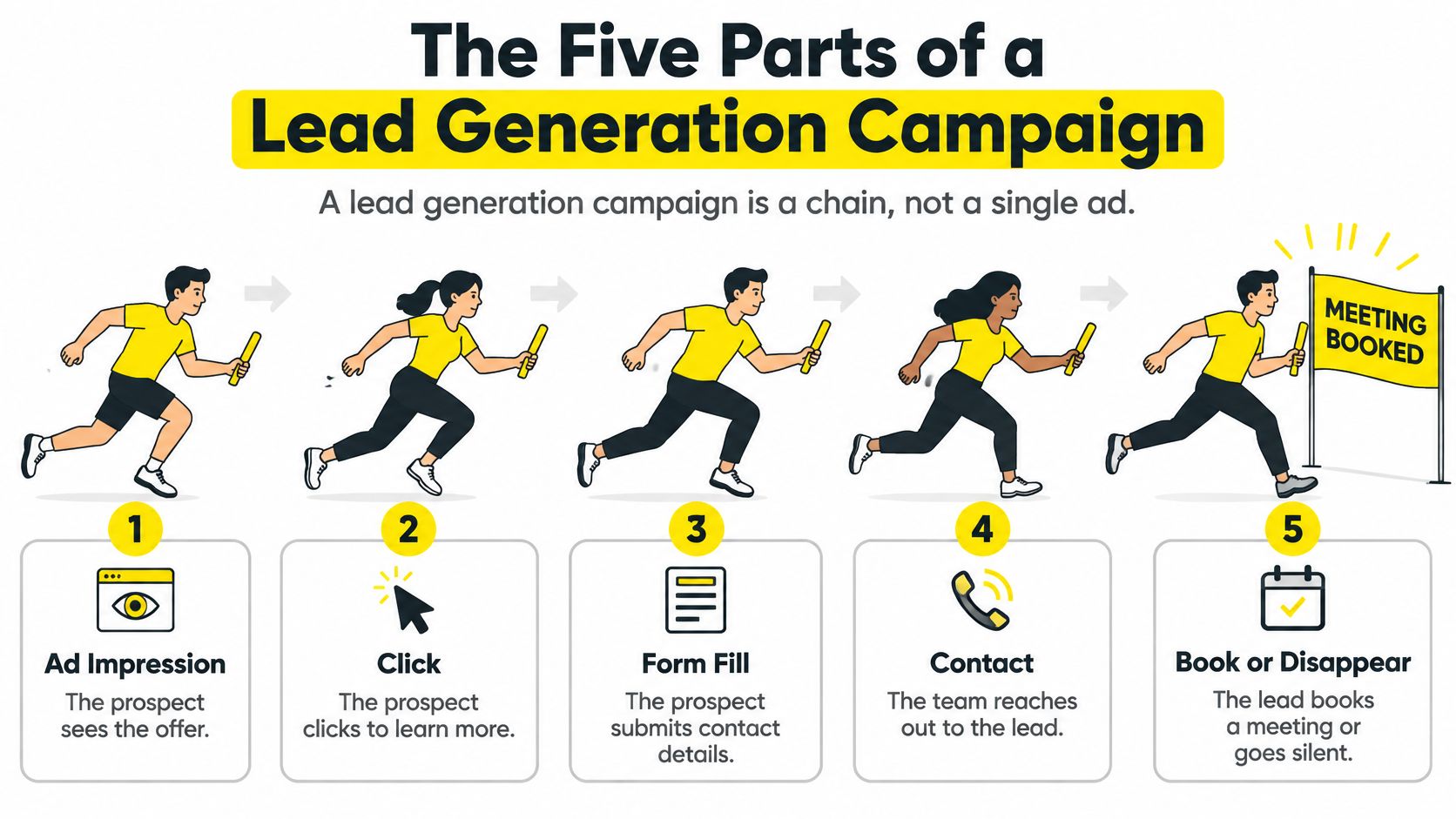
A lead generation campaign is a coordinated effort to turn a potential buyer's interest into a sales conversation. A prospect sees an ad, clicks, submits contact details, receives follow-up, and either books or disappears. The form submission is a handoff, not the finish line.
Think of a relay race. A fast opening runner can't compensate for a dropped baton later. Strong advertising won't rescue a confusing page, and a persuasive page won't rescue a sales team that never receives the inquiry.
The connected journey looks like this:
Give each component a clear job
The campaign has five working parts: audience targeting, offer, landing page, ads, and measurement. They aren't separate projects. Each part needs information from the others, especially feedback about which prospects eventually buy.
Campaign components, their jobs and the metric each owns
Component | Job in the campaign | Metric it owns |
|---|---|---|
Audience targeting | Reach people with buying intent and fit | Qualified-lead rate |
Offer | Give a specific reason to act now | Lead-to-appointment rate |
Landing page | Turn clicks into form submissions | Conversion rate by traffic source |
Ads | Create demand across channels and retarget visitors | Cost per qualified lead |
Measurement | Tie each lead to pipeline and revenue | Customer acquisition cost and contribution margin |
These metrics assign responsibility without pretending each component works alone. A landing page might convert well because its audience already knows the business. An offer might attract many inquiries while giving sales little chance of closing them.
Say a home-service company advertises a free inspection without identifying its service area. People outside that area submit the form because the offer sounds useful. The campaign records conversions, but the business can't serve those prospects.
Practical rule: A campaign component has done its job only when it passes a usable prospect to the next person or system.
Make the handoffs explicit
Assign an owner to the movement from submission to conversation. Decide who receives an inquiry, what information they need, and what happens when that person isn't available.
For businesses distributing inquiries across locations, Franchise Foundry's guide to improve franchise lead response times offers useful context for organizing those handoffs. Location-level ownership matters just as much as campaign-level reporting.
Start the campaign design with a precise buyer definition. Everything else, from the promise in the ad to the questions sales asks, depends on reaching someone who could realistically become a customer.
Target the Audience That Can Actually Buy
A barbershop in Orlando, Florida, received qualified calls at $3 each through Google Ads, with more than 500 calls generated locally as a Wojo Media client. Three dollars per call sounds like the point of the story, but it isn't. The point is the word "qualified." A campaign can produce calls at any price if nobody checks whether the caller can become a customer. Cheap leads that never buy are expensive in the only currency that matters: staff time, ad spend, and pipeline clutter.
That distinction is where audience targeting either holds up or falls apart. Targeting means intent plus fit. Someone can match the age and location of previous customers without needing the service. Someone else can urgently need the service but live outside the area your team covers. Neither one is a good lead, no matter what the form count says.
Think about the difference between two people in the same city. One types "barber near me" into a search engine because they need a haircut this week. The other watches grooming videos for entertainment. Both fit the same demographic profile, and both could eventually become customers, but they need different messages and shouldn't share a performance target. Treating them as one audience is how marketers end up celebrating lead volume while sales complains about lead quality.
Review audience behavior alongside sales outcomes, rather than stopping at demographic reports.

Separate discovery, familiarity, and fit
Build your audience definition in layers, because each layer answers a different question:
Cold audiences answer "who might want this?" Use relevant interest or lookalike audiences on Meta and TikTok where available and appropriate. On Google Search, select queries that indicate someone is actively looking for your solution, since a search phrase often reveals intent that interests cannot.
Warm audiences answer "who already knows us?" Group website visitors, video viewers, and people who engaged with your posts. Their familiarity can support a more direct invitation. Wojo Media retargets prospects on all social platforms so they keep seeing the client's ads, which is what turns this familiarity into repeated exposure rather than a single impression.
Fit filters answer "who can we serve?" Examples include service radius for local businesses, financing readiness for property buyers, and business stage for coaching prospects.
Apply the platform's advertising restrictions, particularly for regulated categories such as housing. Don't use targeting options as a substitute for clear qualification criteria.
A common confusion at this stage is treating these layers as interchangeable. A cold audience producing leads at one price and a warm audience producing leads at a lower price does not mean the cold audience is failing. They start from different positions, so judge each layer against its own history.
Compare like with like
The Pintel lead-generation benchmark snapshot reports the following reference rates, separating overall B2B conversion, SaaS visitor-to-lead conversion, high-intent pages, and lead-to-customer outcomes.
Conversion benchmarks by audience and intent
Benchmark | Rate | What it measures |
|---|---|---|
Median overall B2B conversion | 2.9% | Overall visitor conversion across the benchmark's B2B contexts |
Typical B2B SaaS visitor-to-lead | 1.5% to 2.5% | Visitors who become leads on SaaS pages |
High-intent pages run by top performers | 8% to 15% | Conversion on pages built for strong buying intent |
Lead-to-customer for many B2B companies | 2% to 5% | Leads who ultimately buy across the full journey |
Read the table as a set of ranges for comparison, not as targets. A median isn't an average, and none of these figures is a universal goal for a barbershop, tax advisor, or online store. Compare results within channel, audience, offer, and funnel stage. The useful question is never "did we beat 2.9%?" It is "did this audience, on this channel, produce buyers at a cost the business can sustain?"
Qualification must also reflect the business model. Lighthouse Legal's discussion of scoring lead quality by signed cases illustrates why a meaningful outcome is more useful than a generic engagement score. A law firm counting signed cases and a barbershop counting completed appointments are doing the same thing in different units: measuring the audience by what it produced after the form, not at the form.
Before choosing an audience, write a sentence naming the ideal buyer and the signal they show. For example: a homeowner inside our service area who is searching for roof repair after noticing a leak. That sentence forces intent and fit into one test. If a targeting choice can't be traced back to it, the choice is a guess, and guesses are what make cheap leads expensive.
Build an Offer and Landing Page That Converts
Start with a promise the buyer can understand and a next step the business can deliver. A consultation, audit, or assessment should explain what the prospect gets, who it's for, and what happens after submission.
A vague invitation to learn more leaves the visitor guessing. A clear invitation to book a consultation about a specific problem helps them decide whether the conversation is relevant.
Build the promise before the page
Use this practical sequence:
Define the outcome: Describe what the prospect will leave with, such as an assessment of their current tax-planning situation. Don't imply guaranteed savings unless the business can substantiate that promise.
Match the headline: Repeat the ad's core offer on the landing page. A visitor who clicked for an assessment shouldn't arrive at an unrelated company overview.
Choose a primary action: Make the booking or inquiry action visible without scrolling. Remove navigation that distracts from that action while keeping necessary policy and business information accessible.
Explain the commitment: State whether the next step is a call, application review, or appointment. Tell visitors what information they should have ready.
At Wojo Media, Jason Wojo personally onboards each client, writes their copy, and builds the campaign foundation. That process keeps the offer and message connected before a designer turns them into a page.
Say an agency builds a page around a service guarantee. The headline, eligibility conditions, supporting explanation, and form should all describe the same commitment. A guarantee shouldn't become broader or less qualified as the visitor moves down the page.
Choose friction deliberately
The Benchmarketing Performance Max lead-generation benchmarks report these median conversion rates across different lead-generation formats.
Median conversion by lead form format
Form format | Median conversion | Use when |
|---|---|---|
Native form-fill campaign | 4.1% | High-volume offers where lead value is modest and speed matters |
Call-driven local campaign | 5.4% | Local services where a phone call closes the sale |
Multi-step qualification flow | 2.8% | High-value offers where sales capacity is limited and fit matters most |
These aren't interchangeable experiments. Traffic quality, conversion definitions, and downstream tracking affect the comparison.
For a consultation funnel, a practical starting field set is name, phone, email, and a qualifying question about service area, budget, or urgency. Collect only information the team will use. For a call-first offer, don't force people through an unnecessary form.
More submissions aren't an improvement if sales spends more time rejecting them.
Test the headline, form length, or guarantee separately so you can interpret the result. Keep the test running until each version has enough submissions and downstream outcomes to support a decision. Choose the version that produces useful appointments economically, not merely the version with the easiest form.
Run Ads Across Platforms That Feed One Pipeline
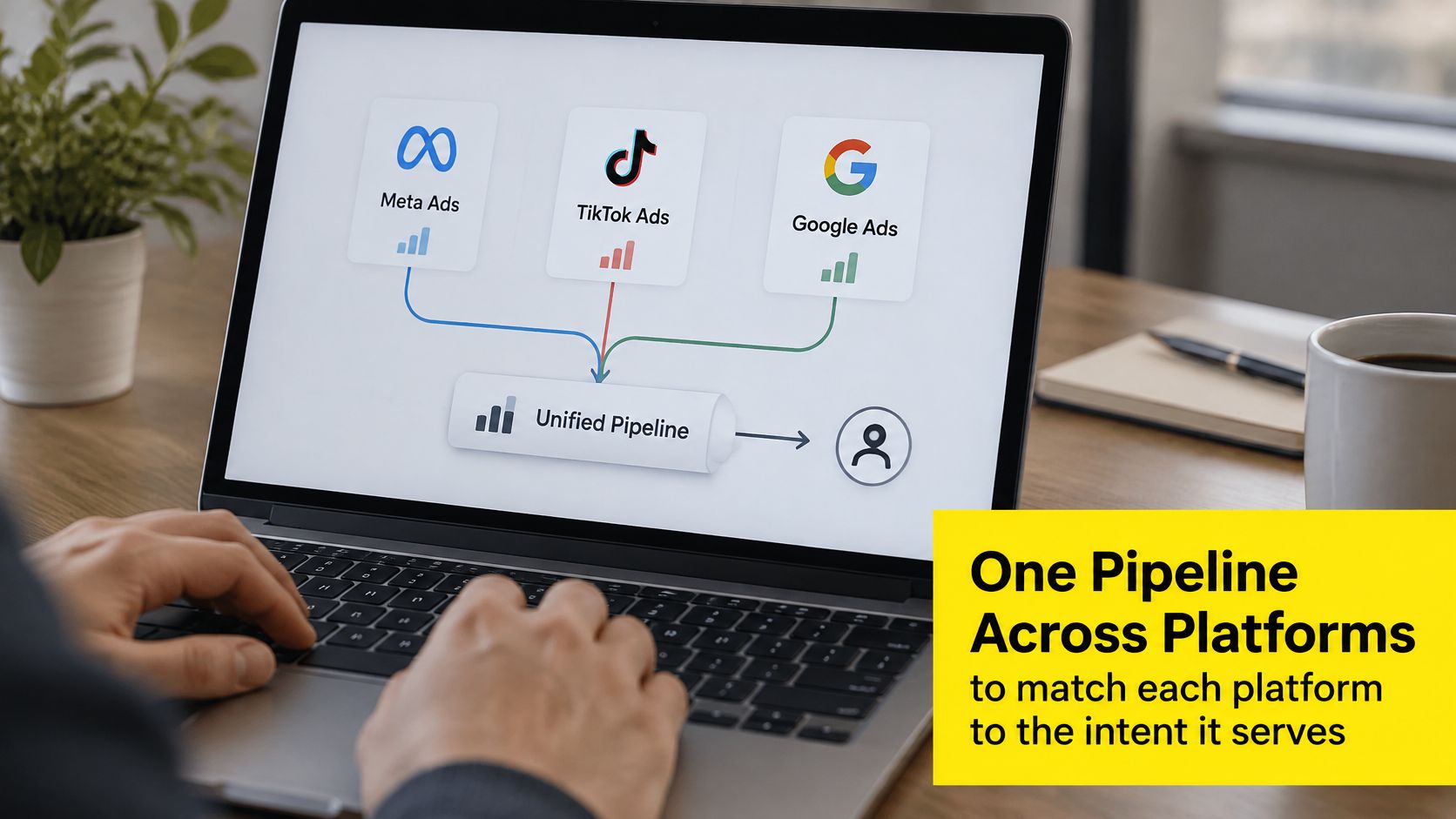
Choose platforms by the buyer's situation, not by which dashboard reports the cheapest lead. Google Search captures expressed demand. Meta and TikTok can introduce a solution before someone searches for it, while YouTube gives you room to explain an offer that requires more consideration.
The operational goal is to bring those different journeys into a shared record.
Match creative to the level of intent
On Google Search, answer the query directly. A service-specific ad should lead to the corresponding service page, not a broad homepage.
On Meta and TikTok, the opening needs to establish the problem quickly. Show the service, explain who it's for, and make the next step understandable without requiring the viewer to decode a slogan.
Our Jacksonville med spa client received TikTok leads at $19 each with a high closing rate. That's a specific client outcome, not a platform-wide expectation. It shows why inexpensive video-sourced leads shouldn't be dismissed when sales outcomes support their value.
YouTube can support demonstrations, explanations, and objections that don't fit naturally into a brief opening. Retargeting can then present the same offer through a different angle, such as proof, a frequently asked question, or a relevant case study.
For a video companion to campaign planning:
Test creative without losing attribution
Test hooks before changing the offer, then compare formats. Prepare a small set of variations per angle and establish a spend limit before launching. Don't change the audience, page, and creative simultaneously and then credit the winning hook.
Add UTM parameters to every campaign link. Configure each platform's appropriate pixel or tag subject to consent requirements, preserve available click identifiers, and store campaign details in the customer relationship management system, or CRM.
Use this weekly review:
Check the records. Confirm that submissions, calls, and booked meetings appear under the correct source.
Compare qualified outcomes. Review cost per qualified lead by platform and creative, allowing for the sales cycle.
Pause weak variations. Investigate poor-fit inquiries before assuming the problem is the visual.
Reallocate cautiously. Favor variations that generate usable prospects, not just attractive dashboard totals.
Respond to Every Lead Within Minutes
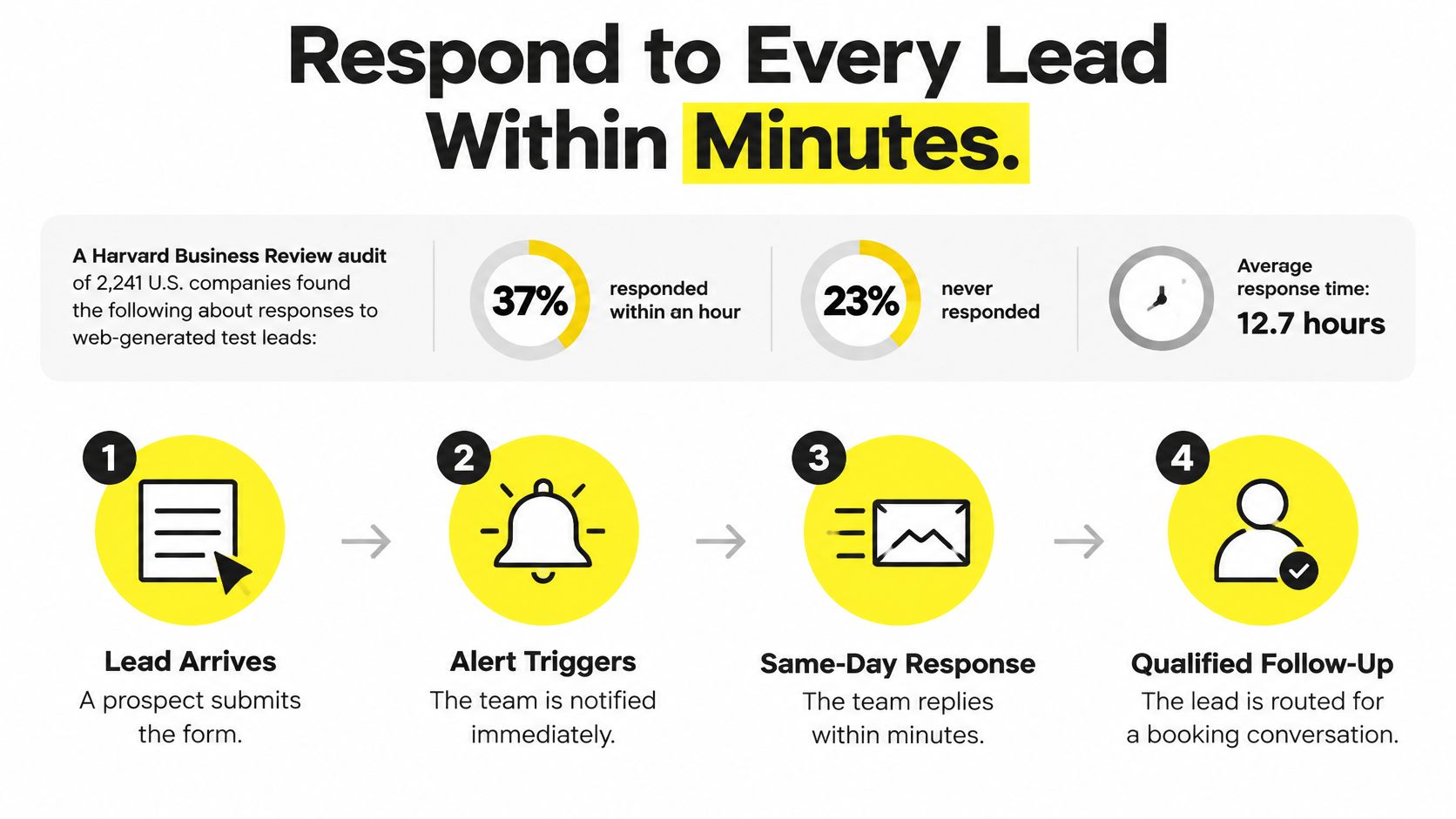
A Harvard Business Review audit of 2,241 U.S. companies found that only 37% responded to web-generated test leads within an hour, while 23% never responded; among responding firms, average response time was 42 hours. The same article describes a separate analysis of 1.25 million leads in which organizations attempting contact within an hour were nearly seven times more likely to qualify a lead than those waiting an additional hour.
The finding concerns qualification, not guaranteed sales. It also doesn't establish a universal deadline for every business. It does support treating response time as an operational priority rather than an optional courtesy.
A prospect has just described a problem and chosen to ask for help. If nobody responds, they may contact another business, become distracted, or lose urgency.
Build the response workflow before you turn on the ads.
Give every inquiry an owner
Use the following as an operating sequence, adapting contact timing to consent, business hours, and applicable rules:
Route immediately by territory or service. Assign a named owner and a backup. A notification in a shared inbox isn't the same as responsibility.
Acknowledge receipt automatically. Send a permitted SMS or email confirming the request, explaining what happens next, and offering a booking link. Don't label an automated acknowledgment as a human conversation.
Make a prompt human call attempt. Have the owner review the submitted details first so the prospect doesn't have to repeat everything.
Retry according to a documented schedule. Use a suitable later contact window and log each attempt, channel, and outcome. Avoid repeated calls that ignore the prospect's preferences.
Move unresponsive leads into a short nurture sequence. Address the original problem and provide a clear route back to booking. Stop when the prospect opts out.
Capture where the person opted in, when they did so, and what communication they agreed to receive. Our marketing emails include an unsubscribe link, and people can also opt out by contacting the business.
Measure the delay customers experience
Track median speed-to-lead and 90th-percentile speed-to-lead. The median describes the typical experience; the latter helps expose leads that wait much longer.
Operational check: Separate acknowledgment time, first human attempt, and successful contact. They measure different work.
Group contact rates by response-time bucket. That lets you distinguish a contactability problem from a staffing or routing problem, and gives managers a concrete process to fix.
Measure Qualified Revenue, Not Form Volume
The LeadSpot B2B benchmark compilation covering 2019–2024 reports qualification rates that produce the following illustrative funnel from 10,000 raw leads, with approximately 2% reaching an opportunity.
How 10,000 raw leads move through a B2B funnel
Funnel stage | Conversion step | Leads remaining |
|---|---|---|
Raw leads | Starting point | 10,000 |
Marketing-qualified leads | 31% of raw leads | 3,100 |
Sales-qualified or accepted leads | 13% of marketing-qualified leads | 403 |
Opportunities | 47% of sales-qualified leads | Approximately 189 |
These are benchmark-based calculations, not a forecast for every advertiser. The arithmetic shows why an attractive cost per submission can conceal an expensive path to a genuine sales opportunity.
Define the stages before calculating costs
A lead is a captured inquiry. A contacted lead has reached the team's defined contact milestone, ideally a successful exchange rather than just an attempted call.
A marketing-qualified lead, or MQL, meets agreed marketing fit and interest criteria. A sales-qualified lead, or SQL, has passed the sales team's assessment. ContentBuck's guide to MQL and SQL qualification frameworks can help teams put those distinctions into operational terms.
An appointment records a scheduled conversation. An opportunity represents an active potential deal, and revenue records the resulting sale. Adapt the sequence to your sales process, but don't let staff use the labels interchangeably.
Our e-commerce client moved from 0.8x ROAS to 3.52x ROAS with Wojo Media on Facebook ads. That illustrates a revenue outcome rather than a click outcome, although it doesn't establish which individual campaign change caused the improvement.
Build an economic scorecard
Track these measures together:
Cost per qualified lead: Campaign spend divided by leads meeting the agreed qualification standard.
Qualified-lead rate: Qualified leads divided by captured leads, using a consistent cohort.
Appointment show rate: Attended appointments divided by scheduled appointments.
Customer acquisition cost: Defined acquisition costs divided by new customers. State whether the calculation includes sales costs and agency fees.
Contribution margin: Revenue minus the variable costs included in your accounting definition. Be explicit about whether advertising has already been deducted.
Before interpreting the results, validate phone and email fields, deduplicate records, and retain consent metadata. Otherwise, repeated or unusable submissions can distort both the numerator and denominator.
Scale only when the records agree
UCLA Anderson's study of AppTrackingTransparency describes how reduced off-platform observability affects conversion-optimized advertising. Treat platform attribution as an estimate rather than a complete record of customer behavior.
Use platform signals for daily direction, but approve major budget increases only when CRM qualification, sales acceptance, and closed-won revenue cohorts support them. Give recent leads time to mature. Where feasible, compare a matched-spend period or use a holdout test to assess whether additional advertising produces additional business.
Audit Your Campaign Before You Spend More
Open a live campaign, its landing page, and the corresponding CRM records. Score each checkpoint pass or gap. A pass requires evidence you can inspect, not an assumption that someone configured it correctly.
Run the five-point check
Audience and fit. Find the written sentence describing the ideal buyer and their intent signal. Confirm that a relevant fit filter appears in targeting, messaging, or qualification.
Offer and next step. Read the ad beside the landing page. Both should describe the same specific outcome and explain what happens after the prospect responds.
Form and sales capacity. Check whether the questions help the team accept or reject a prospect. Remove unused questions, but retain information that prevents avoidable sales work.
Response ownership. Inspect timestamps and response-time buckets. Verify that every inquiry has an owner, including those arriving when the primary salesperson is unavailable.
Qualified cost by source. Follow an inquiry from its campaign parameters and tracking record into the CRM. Confirm that you can identify its qualification status and eventual outcome.
Cheap platform leads accompanied by few CRM opportunities aren't sufficient evidence to increase spend. Inspect rejected-lead reasons and contact attempts. The problem may involve fit, inaccurate details, an unclear promise, or a missed handoff rather than the ad's ability to attract clicks.
Fix the earliest verified failure in the customer journey before paying to send more people through it.
Turn gaps into assigned work
Record every gap in a shared sheet with an owner, metric, target, and review date. Write a specific action, such as correcting location routing or reconciling duplicate contacts, rather than a broad instruction to improve lead quality.
At the next weekly review, start with those open items. Confirm whether the fix changed the relevant outcome before changing another campaign component.
Complete the audit this week, and fix every gap before spending more.
Wojo Media builds paid advertising strategies around the offer, landing page, ads, and backend performance tracking. Visit Wojo Media to book a free demo call with Jason or a growth manager through the calendar and discuss your business, what's working, and what could improve before you scale.
Comments