
Social Media Lead Generation Services Explained

The most popular advice on social ads is also the most expensive mistake. You're told to chase the cheapest cost per lead, celebrate a low number in Ads Manager, and scale what's working. That logic breaks the moment your sales team calls those leads and finds people who don't remember the form, can't afford the service, or never show up.
A cheap lead can still lose money. A pricier lead who books, shows, and buys can be the bargain. That's why social media lead generation services should be judged after the form, not at it. The product isn't a name and a phone number. It's a qualified conversation that moves toward revenue.
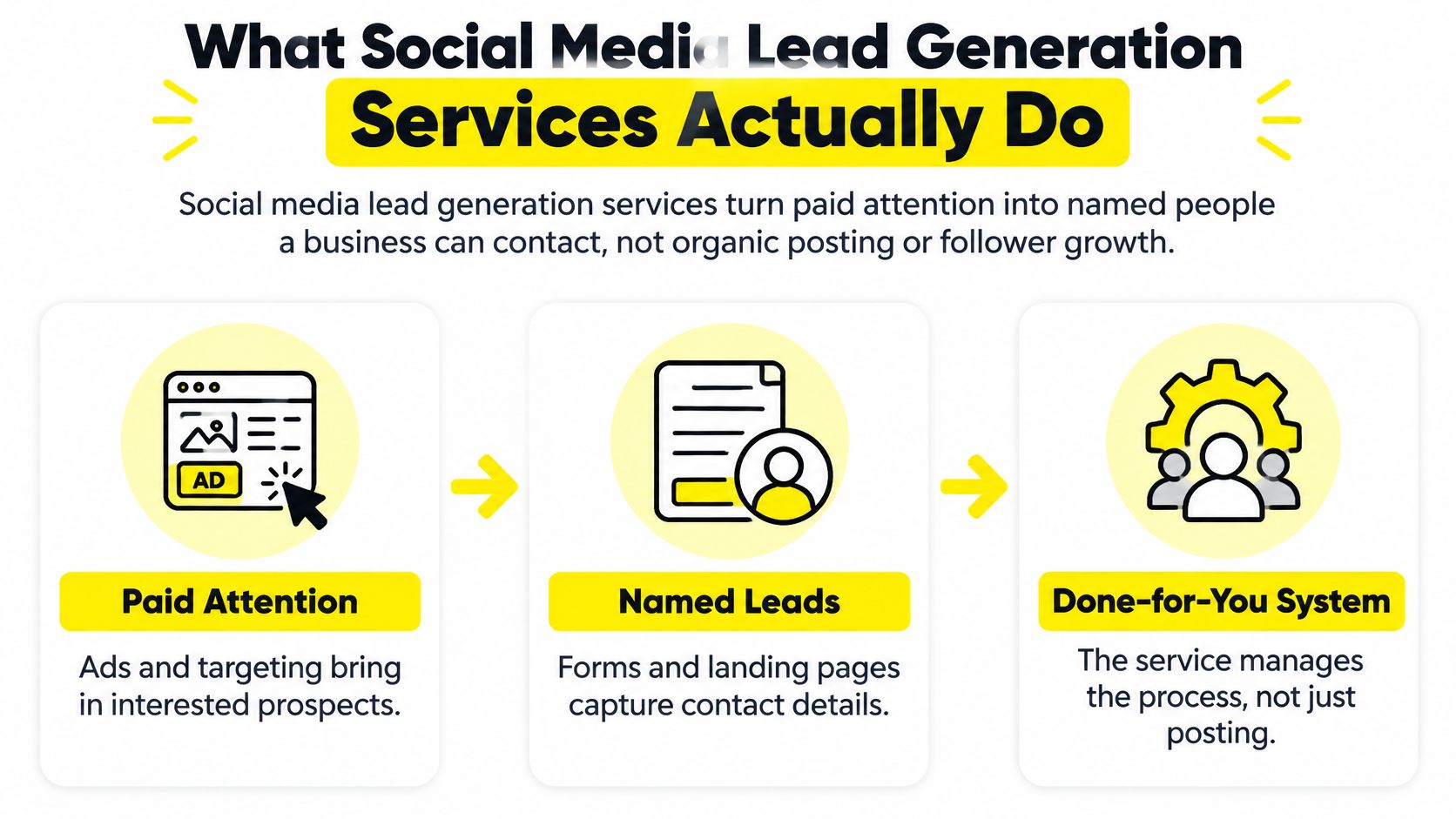
What Social Media Lead Generation Services Actually Do
Say a med spa owner posts three times a week, boosts a before and after photo, and gets likes from existing clients. That's organic posting and a boosted post. Neither is a lead generation service, because neither reliably puts a named, reachable prospect in front of someone who can book her.
What's included in the service
The usual scope covers audience and placement choices, creative testing, the offer and page that carry the promise, tracking, and the handoff into a CRM or calendar. If any piece is missing, you feel it fast. Good ads sent to a weak page waste clicks. A strong page with no follow up wastes leads who were ready an hour ago and distracted now.
Video does much of the early selling, because prospects can see the owner, the result, and the next step before they ever talk to you. If you want a practical breakdown of formats that work at that stage, ClipCreator.ai's lead generation video guide is a useful primer on matching video to the capture step.
The audience pool makes this spend rational. DataReportal's Digital 2025 Global Overview reported 5.24 billion social media user identities worldwide in February 2025, equal to 63.9% of the global population, up 4.1% in the preceding 12 months. A July 2025 update placed the total at 5.41 billion identities, or 65.7% of the world's population.
Read that carefully. Identities aren't unique people, because one person can hold several accounts. Even so, you're not buying access to a niche channel. You're buying a system that turns paid attention into people your team can contact, qualify, and close.
If a service can't tell you what happens between the click and the booked conversation, you're buying posting, not lead generation.
Service Models and What They Cost
Start with the shape of the deal, because the same monthly price can buy very different things.
Model | What is included | Fee shape | Who it fits |
|---|---|---|---|
Full-funnel retainer | Strategy, media buying, landing pages, creative tests, reporting | Commonly a few thousand to low five figures per month plus ad spend | Brands that want one team on offer, ads, and follow-up |
Percent of ad spend | Campaign management tied to the media budget | Often about 10 to 20 percent of spend, sometimes with a minimum | Accounts already spending heavily |
Creative package | Scripts, edited video, and stills for prospecting and retargeting | Starter, 5 scripted videos and 10 images. Premium, 6-hour shoot, 20 videos, 50 images | Teams that need assets more than a new media buyer |
Social posting add-on | Up to 30 posts a month from client content | One month free on Premium and Elite, then $997 a month | Clients who want organic posts beside paid ads |
In-house plus specialist | Client keeps the ad account. Specialist bolts on offer, pages, or tracking | Project or hybrid, quoted after a scoping call | Operators who won't hand over the whole account |
How to read the fees
Separate three costs in every quote. There's the management fee, the creative fee if it's broken out, and the media spend you pay directly to the platforms. A low retainer with no media budget behind it buys very little learning. A percent of spend model can align incentives at scale, but check whether there's a minimum that makes it expensive at lower budgets.
Our published creative packages show what the asset side looks like on its own. The Starter package includes 5 video creatives edited and scripted by our team plus 10 professional images. The Premium package includes full 6-hour recording days, 20 video creatives, and 50 professional images or product photos, with standard, premium, and elite video recorded vertical and horizontal for different placements.
The social posting add-on is separate from ads, and confusing the two is common. Premium and Elite include one month free of the $997 monthly social media management service, then $997 a month for up to 30 posts using the client's content. That's visibility beside the campaign, not the campaign itself.
Treat any price that promises leads with no ad spend and no sales follow up as incomplete. Someone still has to answer the lead.
What the first weeks look like
Setup, typically the first one to two weeks. Sharpen the offer and guarantee, build the landing page or native form, and verify tracking and the CRM handoff before spend rises.
Launch and learning. Prospecting and retargeting run while the platform gathers conversion data, and early cost figures are a signal to watch rather than a verdict.
Optimization. Weekly reviews of cost per qualified opportunity move budget toward the better platforms and creative.
Judgment point. Read booked jobs, show rate, and close rate once enough leads have passed through the sales cycle, which varies by vertical.
Exact durations depend on budget, offer, and sales cycle length, so confirm them on the scoping call before you sign.
Channels Creative and the Full Funnel
Platform choice is a reach decision, not a brand preference. You go where your buyers already spend time, often enough that retargeting can do its job.
The reach figures behind that mix are summarized here.
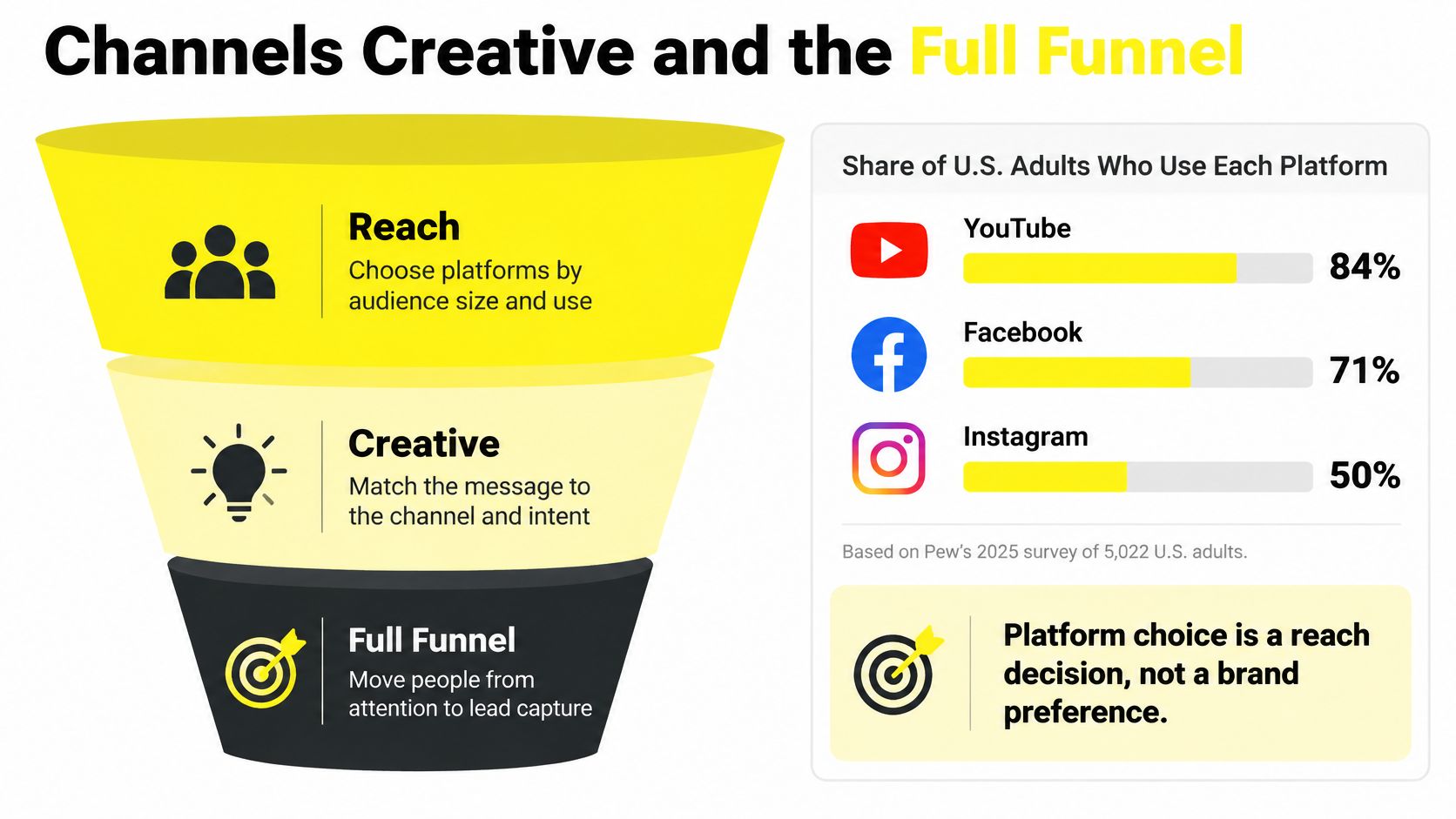
Pew Research Center's 2025 survey of 5,022 U.S. adults found 84% had ever used YouTube and 71% had used Facebook, while Instagram reached 50%, TikTok 37%, and WhatsApp 32%. Roughly half visited Facebook or YouTube at least once a day, including 37% who visited Facebook several times daily, 33% who visited YouTube several times daily, and 24% who used TikTok daily. Those figures are U.S. only, so don't treat them as a global profile.
Assign each platform a job. YouTube carries longer proof and education. Facebook gives broad reach and frequent retargeting exposure. Instagram supports visual proof and creator content. TikTok handles short form discovery, especially with younger buyers.
The funnel in order
Sharpen the offer and guarantee so the ad can promise one specific outcome.
Match a landing page or native form to that promise, word for word where it counts.
Run prospecting ads to cold audiences who fit the buyer profile.
Retarget non-converters so the offer stays visible after the first click.
Hand the lead to a person or calendar fast, while intent is still warm.
This walkthrough shows how those stages connect in a live campaign.
Creative fills each stage. Our services include promo videos, story ads, video and image ads, and UGC or influencer ads, cut vertical and horizontal. We run ads across Facebook, TikTok, and Google Ads, and we retarget prospects on all social platforms so they keep seeing the client's ads.
Reach alone doesn't create qualified leads. Targeting, the page, and follow up do. AI can speed up variations of a winning script, but it shouldn't replace human approval of claims, testimonials, or anything a prospect might read as a guarantee.
Backend KPIs That Prove Lead Quality
Cost per lead is a weak scoreboard. A form can be cheap and still waste your sales team's week. What you need is a ladder that shows where leads stall.
The quality ladder
Track every lead through these stages: raw lead, marketing-qualified lead, sales-qualified lead, booked appointment, attended appointment, closed customer, then revenue or contribution margin. Each step has its own conversion rate, and each rate points to a different fix. Low qualification points to targeting or the offer. Low show rate points to reminders and speed to contact. Low close rate points to the sales conversation.
Which rung matters most depends on how you make money.
Business type | Primary quality metrics | Do not stop at |
|---|---|---|
Local services | Cost per qualified call, booked appointment, show rate, close rate | Form-fill cost |
Coaches and consultants | Qualified applications, show rate, close rate, CAC | Webinar registration alone |
Real estate | Qualified applications, appointments, loans or transactions progressed | Raw inquiry volume |
Ecommerce | Contribution margin, repeat purchase, blended ROAS | Platform ROAS in isolation |
Tax advisors | Attended webinar to client, CAC versus client value | Click or registration cost |
Why platform numbers mislead
Many valuable outcomes happen later, on the phone or in person, where the ad platform can't see them. Google Ads documentation on offline conversion imports describes importing offline events such as qualified leads, sales, and call outcomes, storing the click identifier such as GCLID, GBRAID, or WBRAID on the CRM record, then uploading the conversion timestamp, action, value, currency, and click ID. That feedback loop lets bidding optimize toward revenue instead of inexpensive form fills.
Enhanced matching with consented, hashed first party data helps when the journey crosses devices. The operational side matters too. If new inquiries sit in an inbox, quality drops before anyone qualifies them, which is why systems for routing trial signups to sales quickly are worth building into the handoff rather than bolting on later.
Our four key parts are the offer, landing pages, omnipresent ads, and backend KPIs, and we use tracking and AI tech to shift spend toward the best areas and platforms. Demand a weekly view of cost per qualified opportunity and customer acquisition cost, plus speed to contact.
Practical rule: A higher CPL is acceptable when close rate and margin improve. A lower CPL that lowers both is a pay cut disguised as a win.
Results From Real Client Campaigns
Published results are illustrations, not guarantees. They show what the system can produce when the offer, page, and follow up line up.
Client | Channel | Reported result |
|---|---|---|
Event business | Social ads | 10% CTR, $1 cost per lead, 300 leads |
Jacksonville med spa | TikTok | Leads at $19 each with a high closing rate |
Ecommerce brand | Facebook ads | ROAS from 0.8x to 3.52x |
An event business achieved a 10% CTR, a $1 cost per lead, and 300 leads, which shows what happens when the click promise matches a high intent offer. A Jacksonville med spa received TikTok leads at $19 each with a high closing rate, and the $19 only counts as a win because those leads booked and closed. An ecommerce brand moved from 0.8x to 3.52x ROAS on Facebook ads, proof that the same channel can lose money until the offer and creative are rebuilt.

Interrogate any case study with four questions. What's the time window? Is that cost per raw lead or per qualified call? What was the close rate? Is ad spend included in the figure? Judge local services on booked jobs, and ecommerce on margin after product cost, not headline ROAS.
How to Choose a Lead Generation Agency
A low cost per lead can hide a weak sales process. Use the agency conversation to find out whether it will track what happens after someone fills out a form: qualification, booked conversations, show rate, and revenue.
The checklist below covers the checks most buyers skip.
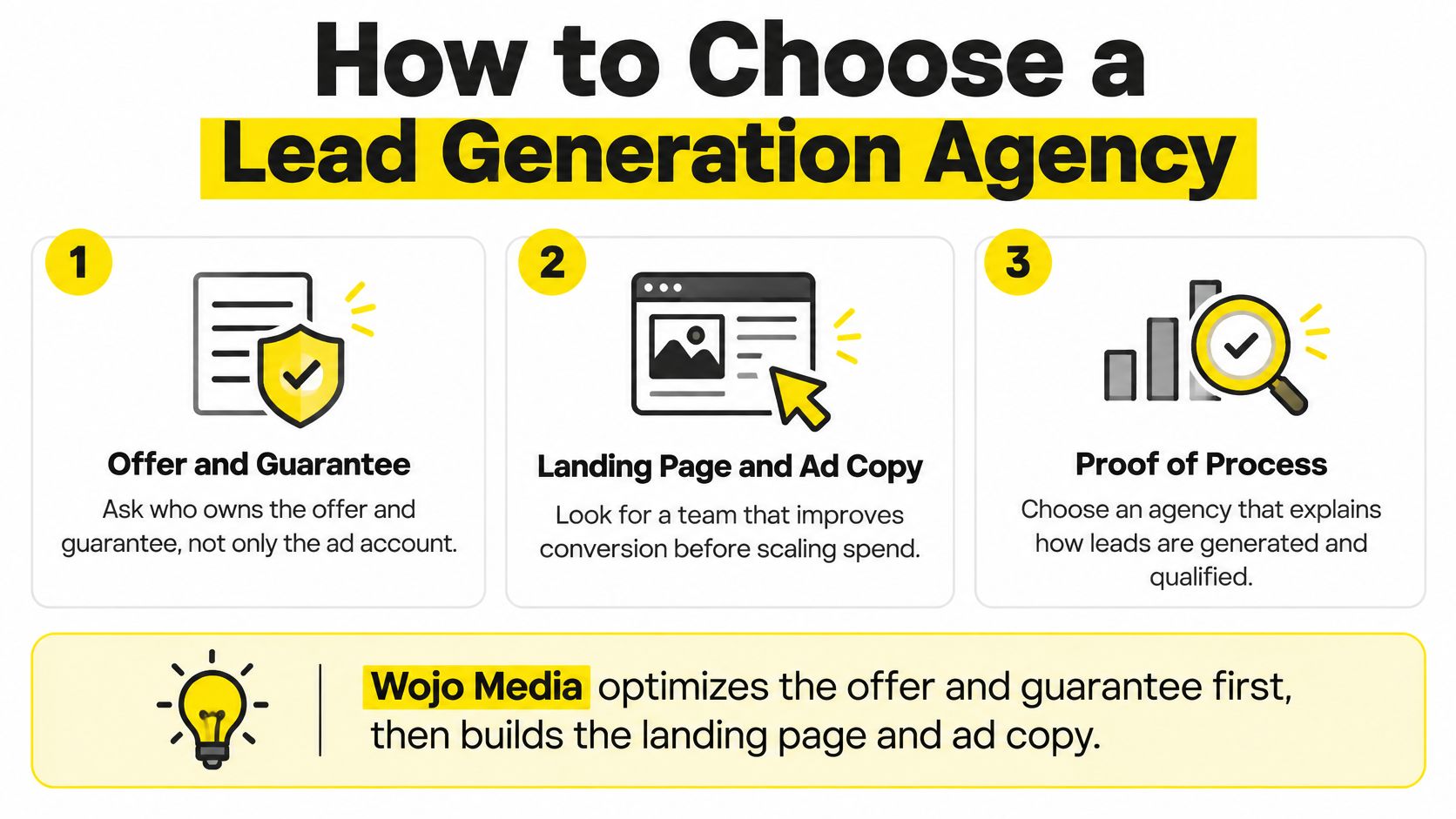
Ask who owns the offer and guarantee. The agency should help refine what you sell and make sure the landing page and ad copy support that offer. Wojo Media, for example, optimizes a client's offer and guarantee before building a matching landing page and ad copy.
Request a channel plan tied to your audience. Ask which platforms the agency proposes and why. If prospects need repeated exposure, clarify how retargeting will keep the ads in front of them.
Review the creative process. Ask what formats the agency can produce, how it tests them, and who checks that claims are accurate. A plan may include video, image, story, or creator-style ads.
Ask how lead quality gets back to the ad team. Reporting should connect spend to qualified leads, appointments, shows, and revenue. Clicks alone cannot show whether a campaign is producing sales conversations.
Separate management fees, creative fees, and media spend. Request each cost in writing. If the quote bundles them, ask what work and ad budget each amount covers.
Request a relevant case study. Look for a similar business model, a clear time period, and a definition of what counted as a qualified lead or sale.
Confirm the agency can serve your business model. Local services and online businesses may need different conversion paths, so ask how the proposed campaign fits your sales process.
Check reviews and meet the people doing the work. Ask who will manage the account after the sale and how often you will review performance together.
The AI question worth asking
AI can help with ad targeting and production, but ask how the agency uses it and where a person reviews the work. The Ipsos AI Monitor 2025 found 53% of people were comfortable with AI being used to target ads, while 62% wanted social-platform ad content created by humans rather than AI, and 79% agreed companies should disclose AI use. Ask who checks claims and how the agency keeps customer footage authentic.
For search campaigns, compare how providers define scope and accountability. NotFair's approach to Google Ads management is one reference point for examining how agencies structure their services.
Before signing, ask which downstream KPI the agency will report each week. If it can only promise more leads, you still do not know whether those leads will become qualified conversations, show up, or generate revenue.
Book a Strategy Call Before You Scale Spend
If you already have an offer and someone who can answer new leads within minutes, your next step is a scoped plan, not more random boosts. Scaling spend on top of an unproven funnel just buys the same problem in larger quantities.
Our services are done for the client, bolted onto the client's brand and business, so the work strengthens what you've built instead of replacing it. A free demo call with Jason or a growth manager is the first step to building a custom paid ad strategy.
What to bring to the call
Your current offer and guarantee, exactly as prospects see it today
The last 90 days of ad spend, if you've run ads before
Cost per lead versus cost per booked job or order, so quality is visible
Your close rate on the leads you already get
The platform accounts you own, including pixels and past campaign data
You should leave with a clear point of view on whether your constraint is the offer, the page, the creative, or the follow up. You'll also see example ranges that match your vertical, such as booked calendars, low cost leads, or multi ROAS ecommerce where those outcomes fit.
If you're not ready to hire yet, there's still one useful interim step. Track qualified outcomes, shows, and closed deals for two weeks before you increase spend. That baseline tells you what a lead is worth, and it makes every later decision cheaper. Nobody can promise you a specific cost per lead or ROAS in advance, and you should walk away from anyone who does.
Ready to stop paying for form fills and start paying for qualified conversations? Wojo Media builds the offer, landing pages, creative, and omnipresent ads as one system, then reports on the backend KPIs that prove lead quality. Book your free demo call with Wojo Media and bring your current offer, spend, and close rate, and we'll map the exact funnel your business needs before you scale.
Comments