
How to Run YouTube Ads for Real Estate

The most popular advice about YouTube ads for real estate starts with the wrong asset: a beautiful property video. A cinematic walkthrough can help someone evaluate a home, but it doesn't necessarily give an undecided buyer, seller, or investor a reason to start a conversation.
Sell help with a decision before you sell access to a listing. Then judge the campaign by what those conversations become in your CRM, not by how cheaply you bought views or collected forms. That changes the offer, the video, the landing page, and the point at which you should trust the results.
Educational Promises for Each Funnel Stage
Buyers don't always need another home to admire. They need help deciding what they can afford, which risks deserve attention, and whether a neighborhood fits the way they live. A listing ad answers what's available, often before the viewer has resolved whether buying makes sense.
The mismatch is substantial: BAM's homebuyer education analysis reports that 66% of buyers use YouTube for home-buying education, while only 2.3% of agents identify it as their primary business platform. Treat that as a reason to teach something useful, not permission to upload a generic market update and expect appointments.
Match the promise to the decision
Choose an unresolved question you can answer credibly in a named market. For buyers, that might be the ownership costs they're overlooking or the inspection issues that should change their offer. For sellers, it could be how condition and timing affect a listing strategy.
YouTube campaign map by real estate intent
Stage | Educational promise | Primary format | Landing action | Judge it by |
|---|---|---|---|---|
Cold buyer education | Affordability, inspection risk, or true cost of ownership in one metro | Short skippable in-stream | Short market guide | Qualified engagement, not view rate |
Local consideration | Neighborhood fit and price bands for that metro | Short in-stream or in-feed explainer | Metro explainer page | Cost per engaged visit |
Seller offer | What the home may be worth and the listing timeline | Agent-led in-stream explainer | Valuation form | Cost per qualified seller lead |
Investor intent | Buy-box criteria and financing trade-offs | Longer cut for warm viewers | Investor checklist | Cost per booked consult |
Proof retargeting | Results, inventory, financing, or appointment specifics | Longer cut for warm viewers | Book a consult | Appointment rate |
For cold buyer education, promise a practical comparison. Explain how taxes, insurance, maintenance, and financing affect ownership rather than announcing that now is a great time to buy. The guide should help viewers identify their next question, not hide a sales pitch behind a download button.
For local consideration, show the trade-offs within the metro. Compare property types, commuting considerations, and relevant price bands using current listing information. Give the viewer a next step that continues that comparison rather than dropping them into an unrestricted property search.
Give each intent its own destination
A seller valuation offer should explain what you need to assess the property and how the listing timeline works. Don't imply that an automated estimate is a finished pricing recommendation. Ask about condition, location, and intended timing so the follow-up conversation starts with context.
Investor creative should state the buy box: property type, market, financing approach, and operating constraints. Lender-intent creative should explain a payment trade-off with its assumptions visible, not advertise a rate teaser that the landing page can't substantiate.
Practical rule: A useful educational promise lets the wrong prospect opt out before becoming a lead.
Warm viewers need evidence that you can help them act. Use relevant inventory, a documented process, financing explanations, or appointment specifics, and suppress people who have already converted. Start the first test with buyer, seller, investor, or lender intent, not a single campaign trying to serve all of them.
How to Launch a Real Estate YouTube Campaign
Build the measurement path before buying attention. Google's direct-response video guidance recommends conversion tracking and audience tools for action-oriented campaigns, and warns that conversion and reach reporting can take time to become complete. Your launch checklist should therefore include both technical tracking and a clear definition of a useful lead.
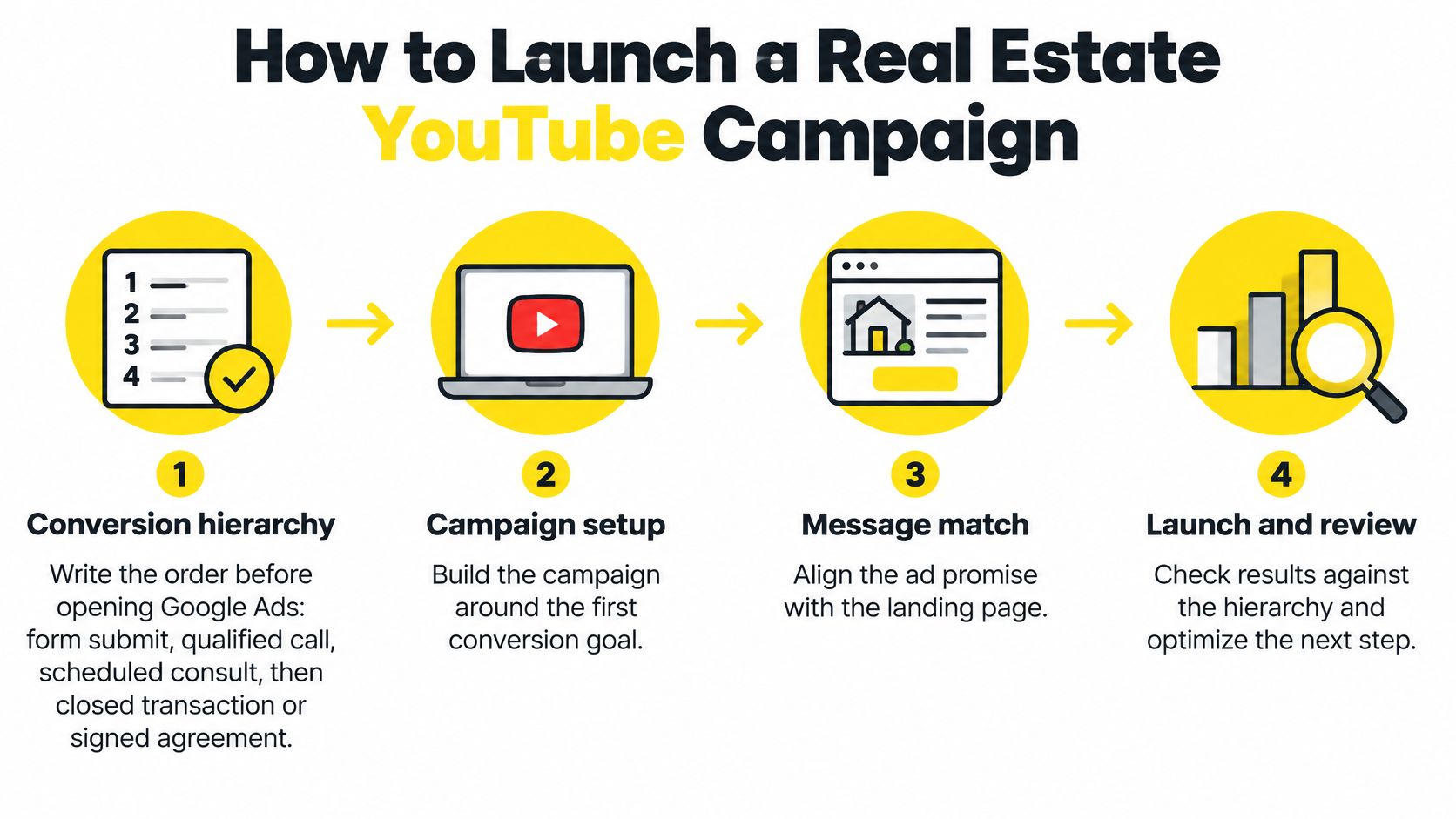
Build the path in order
Write the conversion hierarchy before opening Google Ads, because every optimization choice needs a business outcome. Define form submission, qualified phone call, scheduled consultation, and closed transaction or signed listing. Give sales a written qualification rule, such as serviceable geography, relevant intent, and a realistic next step.
Install conversion tracking on the thank-you page and call workflow, because button clicks don't prove an inquiry was completed. Submit a test form, place a test call, and confirm that each event appears where expected. Check that refreshing a confirmation page doesn't create another lead.
Pass campaign identifiers and a persistent lead ID into the CRM, because attribution must survive the handoff to sales. Preserve UTMs in hidden form fields and store the original acquisition source separately from the latest visit. Don't let a later direct visit overwrite the paid-video origin.
Separate market, intent, and audience temperature, because each represents a different sales task. A local seller valuation offer shouldn't share reporting with investor acquisition or an appointment reminder for an engaged viewer. Use campaign names that make those distinctions readable without opening every ad group.
Finish the landing page before activating the ad, because message mismatch wastes interested traffic. Repeat the educational promise in the headline, make the page work cleanly on mobile, and offer the action named in the video. Keep the form focused on information sales will use.
Connect verified CRM outcomes to offline conversion imports, because the platform needs more than submission counts. Decide who confirms appointments and who updates lead dispositions. Resolve missing fields before those records become bidding signals.
Make the page continue the conversation
If the ad offers inspection-risk education, the page should deliver that explanation before asking the visitor to browse listings. If it offers a valuation, explain the valuation process and what happens after submission. A calendar request shouldn't arrive as an unexpected escalation.
For property-specific consideration pages, Virtual Tour Easy's guide to use 360° tours in real estate ads is a useful resource for giving interested viewers a closer look. Keep the tour connected to the decision the ad promised to help with.
Launch through the account's available conversion-focused video campaign workflow, with matching headlines and calls to action. Don't assume an older campaign label or tutorial reflects the options currently available in your account. Start with a tightly scoped market and intent so troubleshooting remains manageable.
Audiences Bids and Budgets That Hold Up
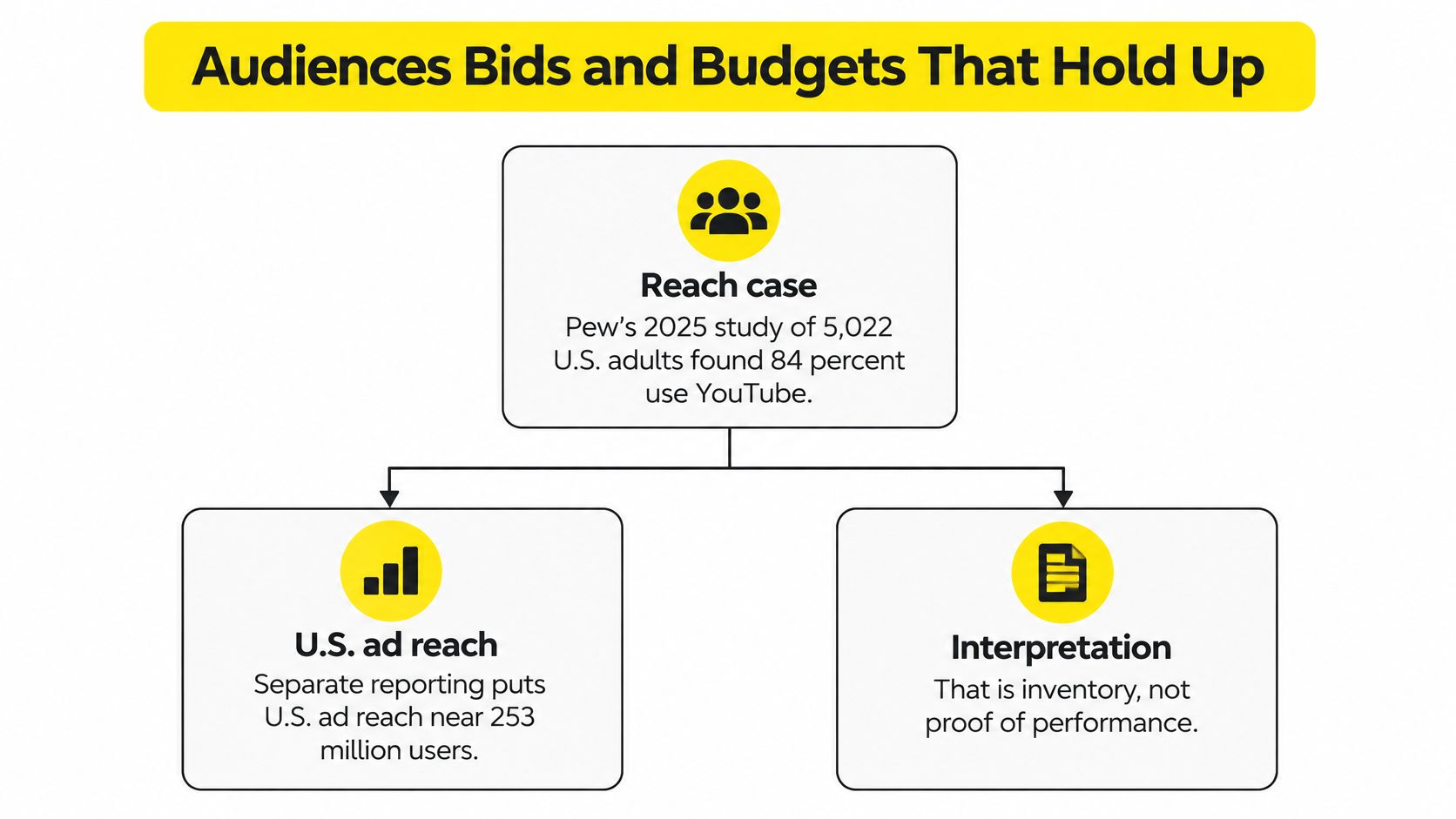
YouTube offers enough reach to support a local strategy without pretending every viewer is a prospect. Pew Research Center's 2025 study of 5,022 U.S. adults found that 84% used YouTube, while separate reporting based on Google advertising resources estimated approximately 253 million U.S. advertising users in early 2025, according to XtendedView's real-estate social-media statistics. That's available inventory, not evidence of qualified demand.
Buy the market you can actually serve
Start with geography and the offer's relevance. Check the targeting restrictions that apply to housing and credit advertising before using demographic filters, custom segments, or customer lists. Don't build a campaign around audience controls your account isn't permitted to use.
Where eligible, use home-search or mortgage-related intent signals and custom segments based on the questions your offer answers. A campaign about ownership costs should reach people exploring that decision, not anyone who has watched home-improvement content.
Use Customer Match conservatively for eligible suppression or relevant warm follow-up, with appropriate permission and policy checks. Keep older owners in mind when developing seller and financing creative rather than assuming the useful audience is young.
Local relevance: Name the service area in the script and show market-specific evidence.
Audience expansion: Compare expanded delivery with your more controlled audience approach before treating additional conversions as better prospects.
Warm follow-up: Keep engaged viewers and site visitors distinct from new audiences.
Exclusions: Remove converted leads from acquisition messaging and review whether repeated exposure still serves a purpose.
For an investor offer, inspect the inventory destination before writing the audience brief. Dream Destin Realty's Emerald Coast investment properties for sale provides a concrete reference for aligning a location-specific investor offer with a relevant property destination. The ad should explain the investment criteria the viewer needs to evaluate, not promise returns from attractive photography.
Let the sales capacity set the budget
Choose a conversion-maximizing bidding approach around an outcome you can verify reliably. A qualified call may be more useful than a booked appointment if appointment reporting is inconsistent. A deeper event isn't automatically a better optimization target when your team rarely records it.
Consider a target cost per action only when recent conversion volume and qualification standards are steady enough to make the target meaningful. An aggressive target won't repair a weak offer or a broken import.
Put the larger share of the test into the selected cold audience and reserve a smaller, separate budget for proof retargeting. Size both against your ability to answer inquiries and conduct consultations. Buying leads faster than sales can handle them makes the acquisition report harder to interpret.
Cheap warm conversions don't prove you can acquire new customers at the same cost.
Keep warm and cold bidding separate. That lets you decide whether additional prospecting spend is earning new qualified conversations rather than borrowing credit from people who already knew you.
Scripts and Cuts Worth Testing First
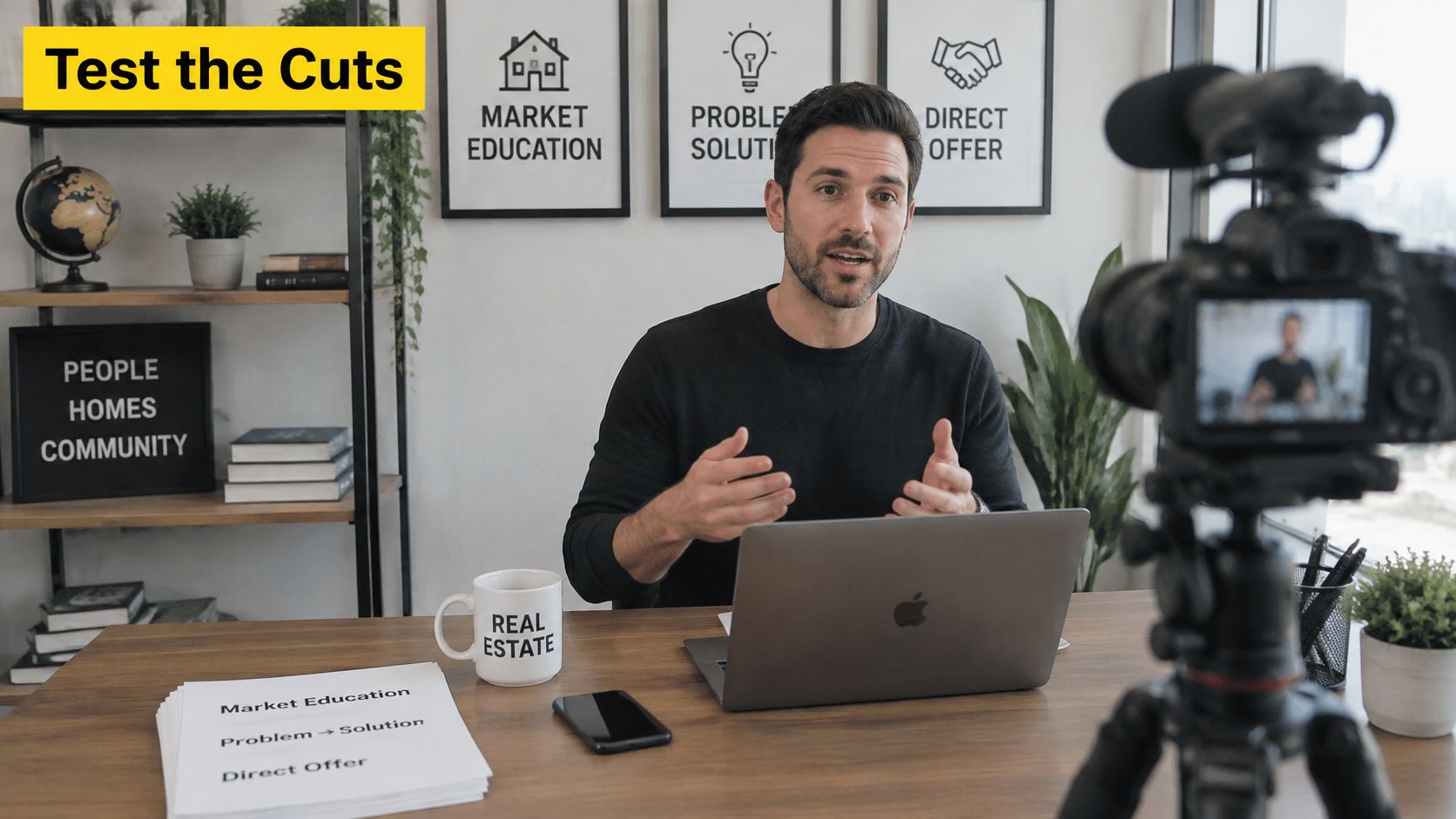
A polished property tour can earn views and still produce no useful conversations. Test concepts that help viewers make a decision: a market-education cut, a problem-solution cut, or a credibility cut showing how an agent, investor, or lender evaluates a situation. Keep the offer and landing page consistent so the creative concept is the main variable.
Write the problem before the introduction
A buyer hook can expose the gap between a mortgage payment and total ownership cost. A seller hook can show how an ambitious asking price may conflict with a moving timeline. An investor hook can point to a property feature that fails the advertised buy box.
Give viewers a useful part of the answer: show the cost categories, a pricing comparison, or a screening checklist. Introduce the professional through the explanation, not a logo animation. A script tool can help generate alternate hooks and tighter drafts; SleekPost explains how to write better YouTube scripts using AI. Check local claims and financing assumptions yourself, and remove invented testimonials or unsupported promises before recording.
Test length without rewarding empty attention
Google's video optimization guidance recommends 20 seconds instead of 30 when the message still fits, noting that shorter ads generally achieve higher TrueView view rates. Use that as a reason to tighten a script, not as evidence that shorter ads produce better appointments.
Set benchmarks from your own account history, then compare each cut with the same measurement window and campaign conditions. These account-level measures help identify changes in performance; they are not industry targets.
Creative measures to compare against your own account
Measure | Your account baseline | Use it to | Do not use it to |
|---|---|---|---|
Median CTR | Your median for the comparison period | Spot a hook that may be failing to earn attention | Declare a lead-quality winner |
Top-quartile CTR | Your top-quartile result for the same period | Set a stretch reference for creative testing | Promise the result in every market |
Median conversion rate | Your median for the same page and traffic type | Compare cuts on a consistent landing page | Mix cold and retargeting traffic |
Top-quartile conversion rate | Your top-quartile result for the same page and traffic type | Frame a stronger conversion outcome | Scale before CRM outcomes are recorded |
Preferred cold length | About 20 seconds versus 30 | Shorten when the decision-stage promise still fits | Cut proof ads that need more explanation |
Hold targeting and budget conditions steady. Give each cut its own UTM and CRM creative field, then compare outcomes after enough delivery to make the results useful. Judge the winner by qualified conversion rate and cost per qualified lead, not view rate alone.
Watch for common failure patterns:
Branding before the problem: Viewers do not know why the ad matters to them.
National copy in a local market: The message sounds interchangeable with competing agents.
A slow or mismatched page: The page fails to deliver what the video promised.
An easy form with no qualification: Sales receives inquiries that cannot become useful conversations.
A high-click creative can still attract the wrong intent. If its CRM pipeline events lag behind its form fills, revise the promise rather than congratulating the hook.
How to Judge Leads Beyond the Form Fill
A prospect can watch a YouTube ad, search your name later, return through Google, and submit an inquiry after discussing the decision with a partner. A last-click report may credit the final visit while leaving the earlier video exposure invisible. Treat that as an attribution question, not automatic proof that either channel deserves all the credit.
The NAR generational figures summarized in Reel-E's real-estate marketing statistics indicate that 37% of buyers used online video sites during their home search, while 12% of sellers' agents marketed homes with video. Online video sites aren't synonymous with your YouTube campaign, but the distinction reinforces why exposure and subsequent sales activity need separate measurement.
Use cohorts rather than a daily verdict
The following windows are an operating review schedule, not promises about when a real-estate transaction will close. Assign leads to their acquisition cohort and keep updating that cohort as sales verifies outcomes.
Pipeline events and when to trust them
Event | Recorded in | Wait | Scale decision |
|---|---|---|---|
Form submit | Google Ads thank-you page and CRM | 7 days | Only after spam and duplicates are removed |
Qualified call | Call tracking plus CRM disposition | 30 days | Use cost per qualified lead |
Appointment set | CRM | 30 days | Primary event for budget increases |
Appointment shown | CRM | 30 to 90 days | Gate scaling on show rate |
Loan app, showing, or listing signed | CRM offline import | 90 days | Confirm the intent segment is real |
Closed deal or gross commission | CRM | 90 days or longer | Judge profit, don't optimize daily |
Record buyer, seller, investor, and lender intent separately. A loan application and a signed listing can both be valuable, but combining them into a generic conversion total hides which offer produced the opportunity.
Sales dispositions should distinguish unreachable, outside service area, unsuitable intent, qualified but delayed, appointment booked, and appointment attended. Without that detail, marketing can't tell whether the problem is acquisition quality, follow-up, or timing.
Compare credit with verified progress
Review click-through and view-through conversions separately. Don't delete view-through activity merely because there was no click, but don't treat an attributed view as proof that the ad caused the transaction. Compare those records with contactability, appointment attendance, and downstream progression.
Use offline imports where available to return verified outcomes to Google Ads. Keep the CRM record as the business source of truth, and prevent the same appointment from being imported repeatedly as a new result.
Cost per qualified appointment equals campaign spend divided by verified qualified appointments. Pair that with contact rate and show rate. A low appointment cost is less useful when few prospects attend, while a higher acquisition cost may be acceptable when the appointments progress.
Report assisted demand honestly. YouTube may introduce the prospect while Search or direct traffic captures the eventual inquiry.
Hold major bid or budget changes when reporting is marked incomplete. Otherwise, you risk reacting to missing information rather than a genuine change in performance.
Raise spend when qualification, contactability, appointments, and attendance hold together across a mature cohort. CTR and raw cost per lead remain diagnostic measures, not permission to scale.
Scale Only After the Pipeline Math Works
Stay in house for another test cycle when the campaign is structurally sound and the missing ingredient is delivery. You have a defined market, a specific intent, distinct creative concepts, functioning tracking, and sales dispositions that identify what happened. In that situation, rebuilding the funnel can introduce more uncertainty than letting the current test mature.
More impressions won't fix an undefined offer. If sales can't explain why someone should request the guide or book the consultation, a larger media budget will only expose that weakness to more people.
Choose between more delivery and a rebuild
Use the business bottleneck to decide what happens next:
Keep testing when delivery is the constraint. The page matches the promise, tracking reconciles, and sales understands the incoming intent. Give the creative enough opportunity to produce a readable comparison.
Repair the sales handoff when qualified leads stall. Check response ownership, call attempts, appointment confirmation, and disposition hygiene before blaming the audience.
Rebuild when the offer and destination disagree. If the video promises education but the page demands an immediate sales call, changing bids won't resolve the mismatch.
Stop scaling when the only winning metric is attention. Views and clicks can help diagnose creative, but they don't cover the cost of producing and handling leads.
Set your acceptable acquisition cost based on the economics of the business, not a borrowed industry benchmark. Work backward from what a closed transaction contributes after relevant costs, then account for the proportion of qualified appointments that become business. Use your own verified outcomes rather than assuming every appointment has equal value.
Make budget increases conditional
Require the campaign owner and sales owner to agree on the evidence before increasing spend. Marketing should show which offer and creative produced the appointments. Sales should confirm whether those people attended and whether their needs matched the service.
If the offer, landing page, creative, and reporting all need rebuilding, consider a performance partner rather than assigning the entire problem to a media buyer. An internal team, a specialist freelancer, or a full-funnel agency can each fit, provided someone owns the connection between the ad promise and the eventual sales outcome.
Keep ownership of the Google Ads account, YouTube channel, landing pages, and CRM records clear. Ask any prospective partner to explain how they'll measure qualified appointments and how they'll distinguish acquisition problems from follow-up problems.
Scale the acquisition process you can verify, not the platform number you most want to believe.
Wojo Media offers offer refinement, conversion-focused landing pages, YouTube, Meta, and Google advertising, plus backend KPI tracking for a full-funnel approach to real-estate lead generation. Visit Wojo Media to book a free demo call for a custom paid-ads plan, and bring your recent spend, qualified-lead records, and appointment outcomes so the discussion starts with pipeline economics.
Comments