
TikTok Ads Objectives: Every Option and When to Use It

The most popular advice on TikTok Ads objectives is also the most misleading. Pick Sales if you want sales, pick Traffic if you want traffic, pick Reach if you want reach, and the labels will do the work. That's backwards. An objective doesn't guarantee an outcome. It tells TikTok which behavior to hunt for in the auction, and if the event signal behind that objective is thin, late, or badly tracked, you'll optimize confidently toward the wrong people. Cheap clicks and cheap leads look like progress in Ads Manager. They often mean you've taught the system to find clickers and form fillers instead of buyers. The actual decision isn't which name you like. It's which deepest event your account can reliably generate, in enough volume, to train delivery toward profit.
TikTok Ads Objectives by Funnel Stage and Business Goal
An objective is an instruction, not a category for your report. When you select one, you're telling TikTok which user behavior to prioritize when it distributes your ads, so the choice changes who sees them. Two campaigns with identical creative, audiences, and budgets will find different people if one optimizes for Reach and the other for Sales.
TikTok Ads Manager organizes campaign objectives into three foundational funnel categories, Awareness, Consideration, and Conversion, according to TikTok's guide to choosing the right objective. Awareness is designed to maximize reach and help people remember a business or product. Consideration encourages users to learn more through Traffic, Video Views, and Community Interaction. Conversion seeks measurable actions such as app installs, lead submissions, or purchases, including Sales across TikTok Shop, websites, and apps.
The full menu in one lookup
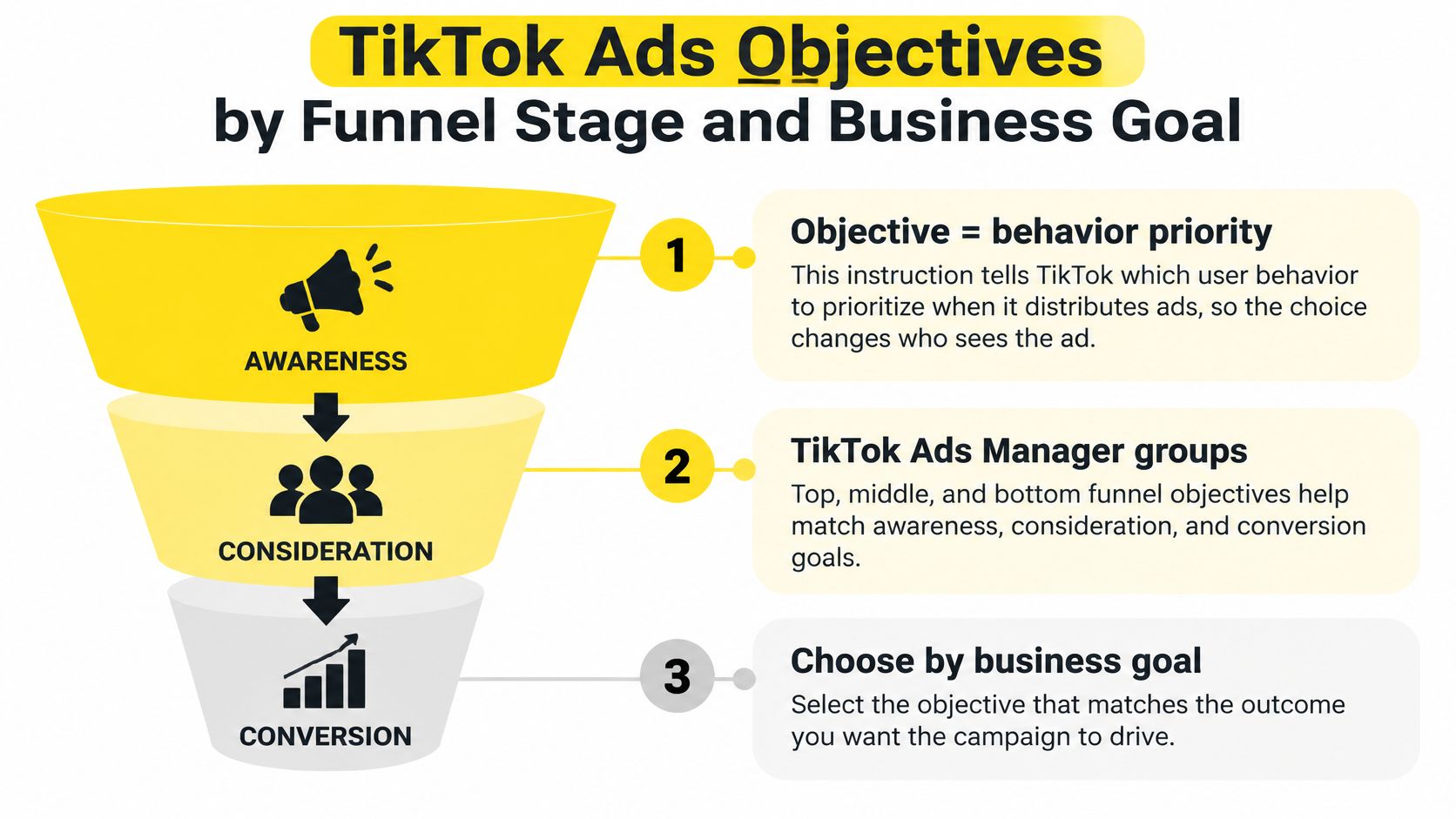
Start from the business goal you already have, then work backward. Launching a new product to people who've never heard of you points to Reach. Driving visits to a product page points to Traffic. Testing which hook holds attention points to Video Views, and growing a following you can retarget later points to Community Interaction. Selling online points to Sales, growing installs or in-app actions points to App Promotion, and collecting consultations points to Lead Generation.
Objective | Funnel category | Designed to do | Typical use case | Primary KPI |
|---|---|---|---|---|
Reach | Awareness | Show ads to as many people as possible and build recall | Launching a new product line to a cold audience | CPM and reach |
Traffic | Consideration | Send users to a website or app | Driving visitors to a product page | CPC |
Video Views | Consideration | Find people likely to watch and engage with video | Testing hooks for a short brand video | CPV and 6-second view rate |
Community Interaction | Consideration | Earn likes, comments, shares and follows | Building a following for a creator-led series | Engagement rate |
Sales | Conversion | Drive purchases on TikTok Shop, a website or an app | Selling a catalog product to likely buyers | CPA and ROAS |
App Promotion | Conversion | Drive in-app actions such as installs and purchases | Growing downloads for a fitness app | CPA per install or event |
Lead Generation | Conversion | Collect business leads through forms, messages or a website | Booking consultations for a tax practice | Cost per lead |
Notice what the table separates. The designed to do column describes what TikTok will chase. The typical use case describes what your business needs. Those two only align if you choose deliberately. A Traffic campaign that delivers cheap product page visits has succeeded on its own terms, even if none of those visitors buy. TikTok did what you asked. You asked for the wrong thing.
Objective names and availability can change in Ads Manager, and some options appear based on account setup or market. Confirm the current list inside your account before you build around a name you saw in a tutorial. The funnel logic stays stable even when labels shift, which is why you should anchor on the stage you're trying to move people through.
Practical rule: Match the objective to the stage of the customer journey you need to move people through, not to the impression count or click count you want to screenshot.
That rule sounds obvious until budget pressure hits. Reach and Traffic produce big, fast numbers at low unit costs, so they feel safer than a Conversion campaign that spends more per result. But a low CPM or CPC isn't a discount on customers. It's a price for a different, shallower behavior. If revenue is the goal this quarter, paying less for attention you can't convert is the expensive option.
How Each Objective Sets Optimization and Billing
An objective isn't a label you attach after building the campaign. It sets three things at once, and you should check all three before launch. First, it sets the optimization location, the environment where TikTok seeks action. Second, it sets the optimization event, the specific behavior delivery learns from. Third, it sets the metric you'll use to judge efficiency, which shapes what your team will defend or cut.
TikTok's official documentation on optimization location lists Traffic campaigns as suitable for sending users to a website or app, Lead Generation as capable of collecting prospects through a website, Instant Form, TikTok Direct Messages, or messaging apps, and Website Conversions as suitable for optimizing toward purchases or sign-ups. Product Sales can drive purchases from a product catalog through a website or app. The same documentation maps web goals to measurement models, with CPC or CPV for traffic growth, CPA for diversified conversion goals, and ROAS for ROI-focused campaigns.
How the three parts combine
Objective | Optimization location | Optimization event | Billing or efficiency metric |
|---|---|---|---|
Reach | Ad delivery | Maximize people reached | CPM |
Traffic | Website or app | Website or app visits | CPC or CPV |
Video Views | Video | 2-second or 6-second views | CPV |
Community Interaction | Feed engagement | Engagement actions | Cost per engagement |
Lead Generation | Website, Instant Form, TikTok Direct Messages or messaging apps | Lead submission | CPA (cost per lead) |
Website Conversions | Website or app | Purchase or sign-up | CPA |
Product Sales | Product catalog via website or app | Purchase | ROAS |
App Promotion | App | Install, registration, subscription, purchase or retention | CPA or ROAS |
Read the Video Views row carefully. TikTok distinguishes video-view optimization with 2-second and 6-second viewing thresholds, so a cheap CPV at two seconds isn't comparable to a CPV at six seconds. One measures a pause in scrolling. The other measures something closer to actual attention. Comparing them as if they're the same view inflates weak creative.
App campaigns show the same spread. Listed goals include reach, mobile-app installs, retention, account registration or subscription, ad interactions, and purchase. An install is cheap because it's early. A subscription costs more because it's worth more. The metric you report will push you toward whichever one you picked, whether or not it predicts revenue.
The practical test is simple. If the optimization event doesn't match the business outcome, the headline metric will look healthy while revenue doesn't move. A campaign judged on CPC will keep finding cheaper clickers. A campaign judged on cost per lead will keep finding cheaper form fillers. Neither system is broken. Both are obedient.
Awareness and Consideration Objectives in Detail
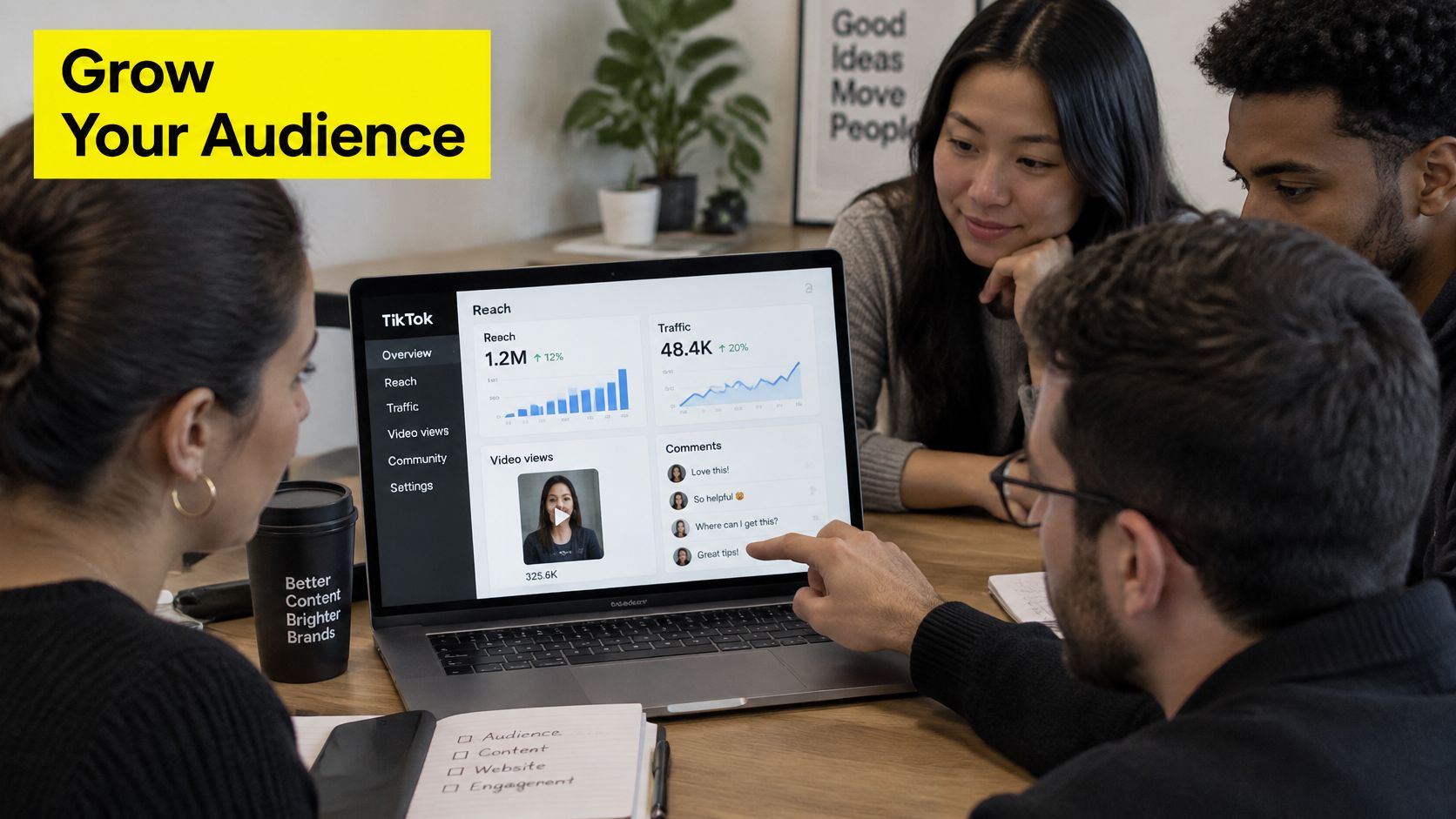
The image below captures how teams review these objectives together around early performance signals.
Reach
Use Reach for new launches, category entry, and reminding a past audience that you exist. Test a short, memorable brand clip built around one message, not three claims competing for attention. No landing page is needed because success here is recall and breadth, measured by CPM and reach. A cheap CPM says nothing about sales, and judging Reach on purchases will make a working awareness campaign look like a failure.
Traffic
Use Traffic when you need users on a specific product or landing page, for example to warm a new collection page before a conversion push. Test a hook plus a single product benefit, such as a comparison hook that shows your option against the familiar alternative in the first seconds. The page message must match the ad almost immediately, because visitors decide fast whether they landed in the right place. Read CTR and CPC, and remember that TikTok will find people who click readily, which isn't the same as people who buy readily.
Video Views
Use Video Views to test which hook holds attention before you spend heavily behind one angle. Open with a strong hook in the first two seconds in native vertical format, since the opening drives whether the view threshold is ever reached. The gap between your 2-second and 6-second rates tells you whether curiosity survives contact with the actual message. Read 6-second view rate and CPV together, not CPV alone.
The walkthrough below shows these settings in context before you apply them to your own creative tests.
Community Interaction
Use Community Interaction to build a following you can reach again without paying for every impression. Test creator-led or UGC content that explicitly invites comments or shares, since polished brand spots rarely prompt conversation. Send people to a profile or follow prompt rather than a sales page, because you're asking for a relationship step, not a transaction. Measure engagement rate, cost per engagement, and follower growth.
Don't borrow a benchmark from another vertical. Set a baseline from your own account history first, then judge whether a new test beats your baseline.
Benchmark ranges for all four objectives are indicative only and vary by vertical and region. A skincare brand, a tax advisor, and a local med spa will see different costs for the same objective, with different value attached to each result. Your own first campaigns establish the baseline that later tests should beat. Until you've run them, treat outside benchmarks as context, not as a pass or fail line.
Conversion Objectives in Detail
Conversion objectives fail for unglamorous reasons. The event doesn't fire, the catalog is stale, the form sends leads nowhere. Each objective below starts with the prerequisite it can't run without, because creative can't compensate for a missing signal.
Sales
Sales covers TikTok Shop, website, and app purchases, and it requires three things first. You need a current product catalog, a working purchase event that fires accurately, and product pages that load fast on mobile. Skip any one of them and TikTok optimizes on incomplete information, usually by finding people who trigger whatever partial signal exists.
Creative should show the product in use, state the offer plainly, and include proof such as reviews or a visible result. Say a skincare brand runs a before and after routine video with the price and a review quote on screen. That gives a likely buyer everything needed to act without leaving to research. Track CPA and ROAS, and set your baseline from account history since no outside benchmark knows your margins.
App Promotion
App Promotion requires the app properly installed in your ad account, in-app events defined, and event tracking verified before spend starts. You can optimize beyond the install toward a registration or subscription event, which usually matters more because installs include plenty of people who never open the app twice. A custom event may not appear as an optimization goal until it reaches the required conversion threshold, so plan a standard event as your starting point.
Creative works best as a gameplay or feature demo with a clear free-trial hook, showing the core loop rather than describing it. A fitness app should show a real workout timer running, not a montage of happy users. Track cost per install or cost per registration, and follow the cohort past install day, because cheap installs that churn immediately aren't cheap.
Lead Generation
Lead Generation gives you three collection points, and they trade friction against quality in different ways.
Instant Form: Friction stays low because users remain on TikTok, but you need a qualifying question and a working CRM connection or leads will sit unworked.
Website form: You control the experience, but you need a short field list and a thank-you page that fires the lead event so optimization gets a clean signal.
Direct Messages: Quick conversations suit simple offers and fast booking, and they require someone answering promptly.
For high-ticket services such as coaching, tax, and real estate, the form should pre-qualify before your sales team spends time. Ask about revenue range, timeline, or property situation, whichever separates a real prospect from a curious one. Use a problem-first hook and a clear consultation offer, then track cost per lead alongside lead quality, meaning show rate and close rate from your CRM. Where no verified benchmark exists, mark the target as set-your-own-baseline and derive it from what a closed client is worth.
Choosing the Deepest Optimization Event
Here's the assumption worth challenging directly. Selecting a Sales or Conversion objective does not automatically make your campaign purchase-optimized. TikTok optimizes toward the event you feed it, at the volume you feed it. A Sales campaign learning from a handful of erratic purchases may perform worse than one learning from a steady stream of a slightly earlier event.
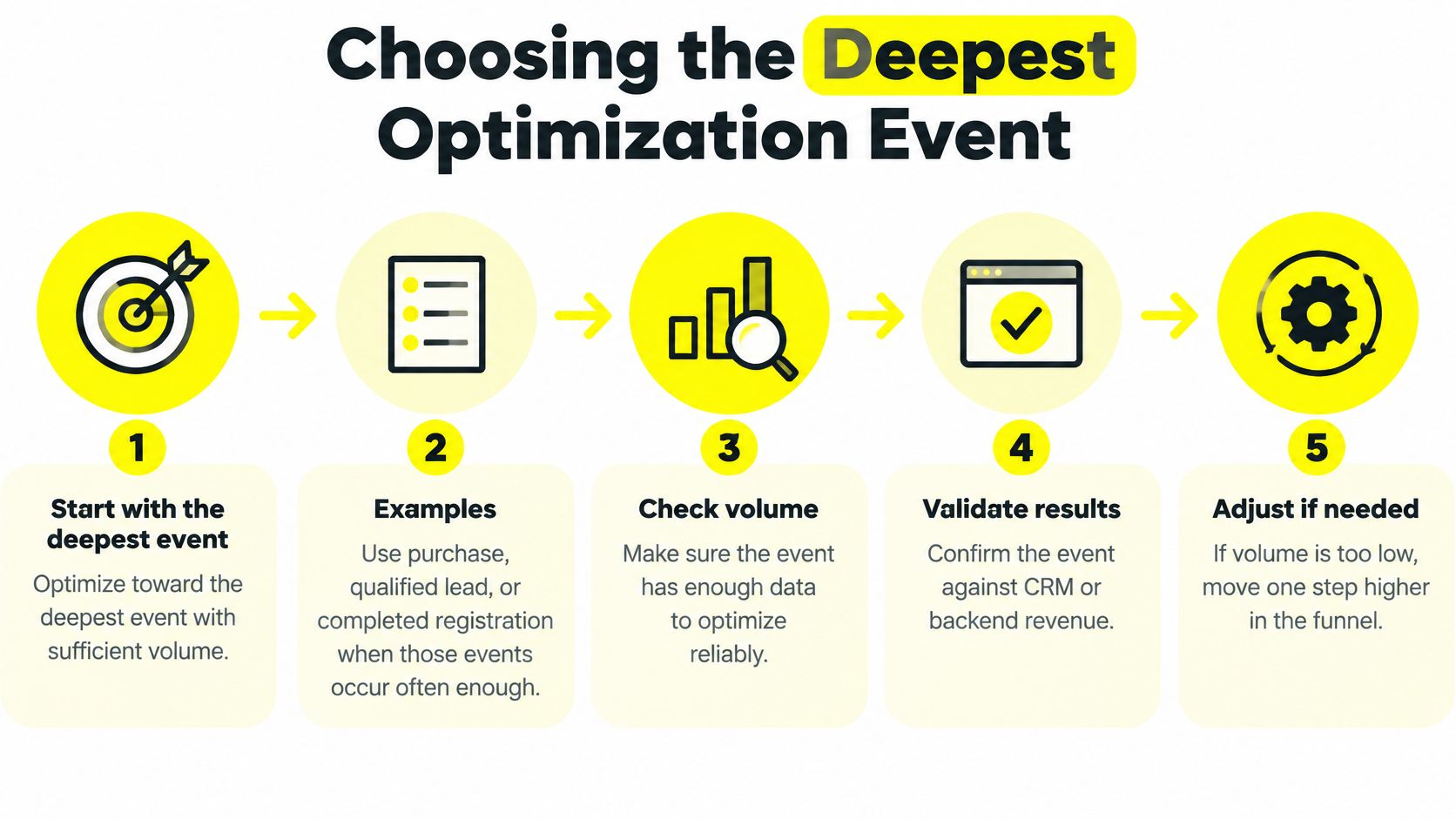
The rule of thumb is to optimize toward the deepest event with sufficient volume, such as purchase, qualified lead, or completed registration, and validate it against CRM and backend revenue, as described in TikTok's guidance on setting up custom events for apps. TikTok supports click-through and view-through attribution with windows including 1, 7, 14, and 28 days. For TikTok Shop Ads, the documented windows are a 7-day click window and 1-day view window, with clicks taking precedence when both qualify.
The staged path for low-volume accounts
Start with Add to Cart or Initiate Checkout when purchases are too sparse to learn from, then move to Purchase once volume steadies, then to value-based optimization once purchase volume supports pursuing higher-value users. Each step trades signal depth for signal reliability. Moving too early starves learning. Staying too long trains the system on browsers who never intended to buy.
Account situation | Optimization event | Reason | Switch trigger |
|---|---|---|---|
New pixel or app, low purchase volume | Add to Cart or Initiate Checkout (staged) | Builds learning before purchases are reliable | Purchases reach a steady weekly volume |
Steady purchases, order values vary | Purchase, then value-based optimization | Pursues higher-value users once volume allows | Enough purchase events for a value signal |
Long sales cycle (coaching, tax, real estate) | Qualified lead or booked appointment | Purchases too rare to learn from | Backend close rate proven against leads |
Local service with a booking calendar | Completed booking via lead form | Calendar fill is the business outcome | Booking volume stable for several weeks |
Subscription app | Registration or subscription | Revenue events occur after install | Retention data available for the cohort |
Attribution deserves equal discipline. View-through conversions can add useful signal for optimization, but reporting should separate click-through and view-through contributions so view-through doesn't overstate direct-response efficiency. If your platform reports strong returns that your bank account doesn't confirm, the gap usually lives in that blended number.
Use Split Testing for targeting, bidding and optimization, and creative, changing one variable at a time. If you want those tests to teach you something real, it's worth learning to avoid common testing hypothesis pitfalls before you design them, because a vague hypothesis produces a result you can't act on. A custom event also may not appear until it reaches TikTok's conversion threshold, so don't build your launch plan around an event the system can't select yet.
Set the Objective and Event in Ads Manager
Set up in the order the choices depend on each other. Later settings only make sense once earlier ones are fixed, and rebuilding wastes the learning you've already paid for.
Choose the campaign objective. Pick from the funnel category that matches the business outcome, such as Reach for awareness, Traffic for visits, or Sales for purchases.
Configure app campaigns next if relevant. Select App Promotion, choose the app under Optimization and Bidding, then select the in-app event as the optimization goal. A custom event appears only after it reaches the conversion threshold, so use a standard event until then.
Set location, event, and billing for web and lead campaigns. Select the optimization location, whether website, Instant Form, TikTok Direct Messages, or messaging apps. Then select the event, such as purchase, sign-up, or lead submission, and the matching measure, such as CPC or CPV for traffic, CPA for conversion goals, or ROAS for ROI-focused campaigns.
Configure attribution. Choose click-through and view-through settings with windows that fit your sales cycle, and plan reporting that keeps the two types separate. For TikTok Shop Ads, expect the documented 7-day click and 1-day view structure.
Verify before saving. Confirm the event fires correctly on the page or in the app and matches backend revenue on a test conversion. Then set up Split Testing so only one variable changes at a time once you launch.
Most setup mistakes happen at step five, because it feels like admin after the interesting decisions are done. It isn't. An unverified event means every optimization choice above it runs on guesswork, and you'll spend your first budget discovering a tracking problem you could've caught in ten minutes. Test the full path yourself, from ad click to recorded event to CRM entry, before real spend touches it.
Common Objective Problems and How to Fix Them
Most objective problems announce themselves clearly if you know which symptom pairs with which cause. Work through this table in order of how often each failure appears, and note the fix timeline, because some repairs take a day and others need a full learning cycle.
Symptom | Likely cause | Fix |
|---|---|---|
Cheap clicks or impressions, no sales | Objective does not match the business outcome | Switch to Sales or Website Conversions and re-test creative |
Campaign stuck in learning | Too few optimization events per week | Use a shallower staged event until volume builds; avoid frequent edits |
Custom event not in the optimization list | Event has not reached the conversion threshold | Use a standard event until the custom event qualifies |
CPA rises after an objective change | Learning reset after the change | Allow a full learning window before judging; change one variable at a time |
Platform conversions exceed CRM sales | View-through attribution inflating results | Report click-through and view-through separately; reconcile with backend revenue |
Lead volume high, sales team reports poor quality | Lead form does not pre-qualify | Add a qualifying question or switch optimization to qualified leads |
Which fixes are fast and which need patience
The attribution fix and the lead form fix are same-day work. You can split click-through and view-through reporting today, and you can add a qualifying question to a form today. The results will look worse before they look honest, because you'll stop counting conversions that were never really yours and stop collecting leads your team couldn't close. That drop is information, not damage.
Objective switches, staged event changes, and post-change CPA spikes need a full learning cycle. Every significant edit disturbs delivery, and judging performance during that window leads teams to revert changes that were working. Change one variable, let it learn, then decide. If you change the objective, the creative, and the audience in the same week, you'll never know which one moved the number, and you'll repeat the expensive parts next quarter.
A rising CPA right after a change usually means learning restarted, not that the change failed. Give it the window before you verdict it.
Confirm the Objective Before You Launch
Selecting Sales does not make a campaign purchase-optimized, because the objective is only as good as the event signal behind it. TikTok states that conversion data trains its bidding, targeting, and optimization systems over time, and Value-Based Optimization requires sufficient purchase-event volume to pursue higher-value users, according to TikTok's attribution overview. TikTok also reports that campaigns using Conversion objectives with full-funnel events and Advanced Matching achieved 40–50% lower CPAs than Traffic-only campaigns. Treat that as a platform-published, directional claim rather than a guaranteed result for your account.
A new or low-volume account may need a deliberately staged signal before it can graduate to Purchase or value-based optimization. The cheapest lead, booked appointment, or first purchase may not be your most valuable customer, especially in e-commerce, coaching, tax, and local services where order value and close quality vary widely. If you're producing the video creative to feed these campaigns, a tool like the ShortGenius TikTok ad generator can help you generate variations faster, though the event strategy still decides whether those variations learn anything useful.
Your pre-launch checklist
Confirm the business outcome. Sale, lead, booking, or install, named in one sentence.
Confirm the deepest repeatable event. The deepest action your account can generate every week, not on your best week.
Confirm tracking. The event fires accurately and matches CRM or backend revenue.
Choose the attribution window. Match it to your actual sales cycle, not the default.
Stage the event if volume is low. Start earlier in the funnel with a defined switch trigger.
Launch with one variable under test. One change, one learning window, one decision.
Run those six checks before spend, and TikTok Ads objectives stop being a menu you guess from. They become instructions you give a system that will follow them to the letter. Give it a shallow instruction and it'll deliver shallow results efficiently. Give it the deepest honest signal you have, and the same budget starts hunting for customers instead of metrics.
If you want your TikTok campaigns built around backend revenue and qualified leads rather than cheap clicks, Wojo Media plans and manages full-funnel paid campaigns across TikTok, Meta, Google, and YouTube, starting with your offer, landing pages, and tracking. Visit Wojo Media to book a free demo call and get a custom paid ads strategy for your business.
Comments