.png)
Facebook and Instagram Ads: Plan, Launch, and Scale

You're probably staring at an Ads Manager dashboard that looks healthy on paper and ugly in the bank account. Leads are coming in, purchases are being attributed, and spend keeps climbing, yet the calls are worse, the refund rate is louder, or the calendar is still half empty. That's the trap with Facebook and Instagram ads when the account is measured by clicks and platform-reported conversions instead of contribution-margin-positive revenue.
The fix is simple to say and hard to execute. Stop treating Meta like a dashboard game and start treating it like a distribution system that only works when the tracking, the audience structure, the creative, and the optimization event all point to the same business outcome. Cheap CPMs don't pay payroll. CTR doesn't close deals. Attributed leads don't guarantee profit.
Why Most Facebook and Instagram Ads Fail Before the Pixel Loads
The account usually looks fine right until the operator asks one real question, "Which of these conversions made money?" That's where the story changes fast. The lead form is full, the purchase count is up, and the platform says things are improving, but the sales team is wasting time on bad-fit prospects or the order mix is too thin to carry margin.
That failure starts before the ad is even live. If the campaign is built around the wrong event, the wrong audience split, or the wrong success metric, Meta will optimize the machine exactly as instructed and still miss the business target. More attributed activity is not the same as better economics.
The metric that matters
Meta's dashboards reward you for motion. Business owners need revenue quality, not motion. A lead is only useful if it turns into a qualified appointment, a funded loan, a retained client, or a purchase that leaves margin after fulfillment and overhead.
Practical rule: If your reporting can't tell you whether a customer was worth acquiring, your ad account is not really optimized, it's only busy.
That's why this topic has to be approached from the backend forward. Tracking informs optimization. Optimization shapes audience behavior. Creative changes who raises a hand. The entire system should be built to identify profitable demand, not just generate activity that looks impressive in Ads Manager.
For e-commerce, local service, and lead-gen accounts alike, the question is the same. What event do you want Meta to find more of, and what proof will tell you the event was valuable? Once that's clear, everything else becomes easier to judge, including bidding, budget allocation, and whether automation deserves more room or tighter guardrails.
How the Meta Ads Auction Works
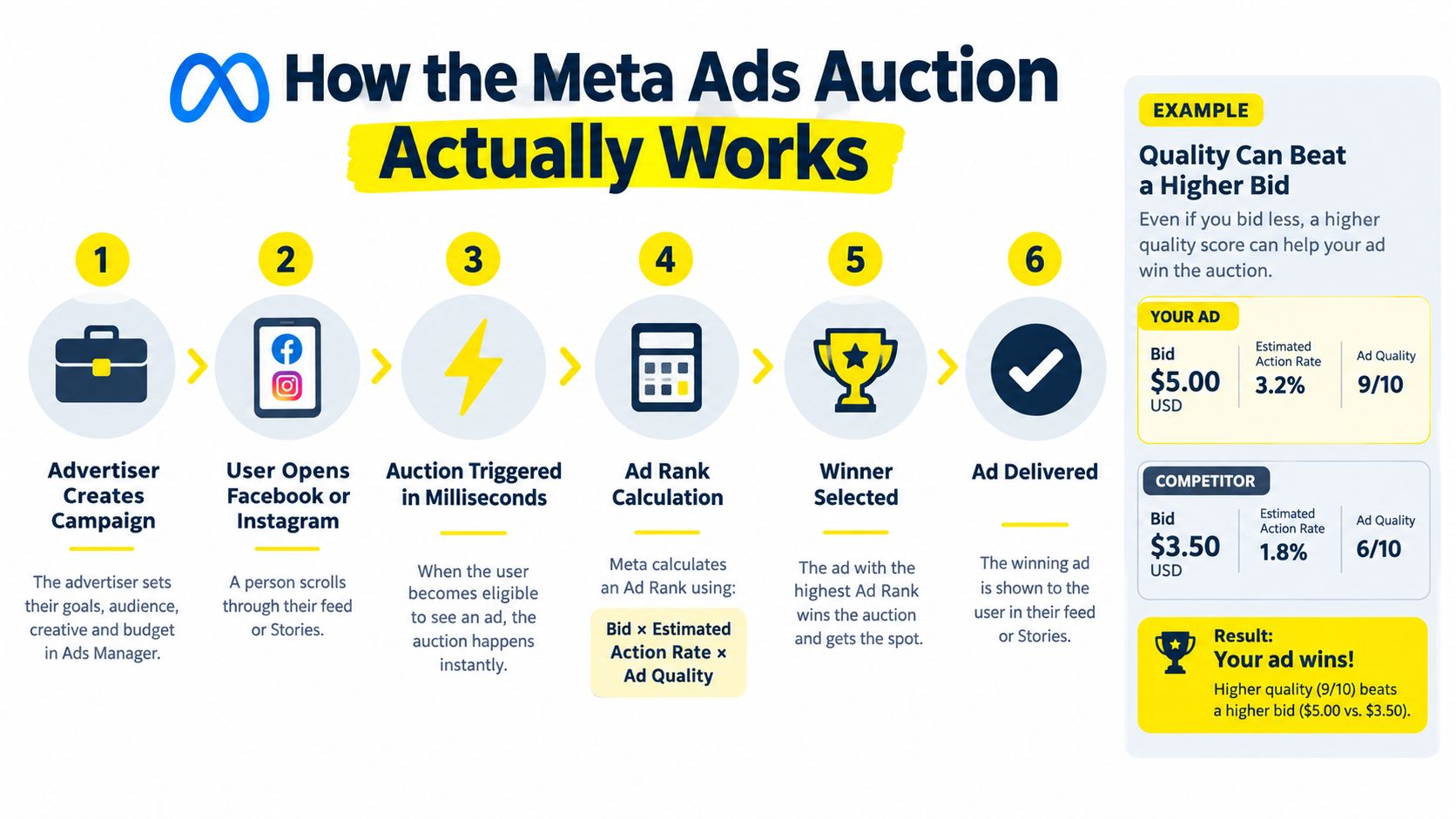
The auction is not won by the highest bid alone. Meta evaluates bid, estimated action rate, and ad quality in real time, then delivers the ad most likely to achieve the selected objective while maintaining user experience. That means an advertiser with a lower bid can win the auction if their creative drives a stronger estimated action rate and ad quality score.
What the learning phase is really doing
The learning phase gives Meta time to collect optimization events and predict who should see the ad next. Industry guidance places the practical stabilization benchmark at roughly 50 optimization events within a seven-day window. Before that point, delivery can shift as the system tests audiences, placements, and creative combinations. Statistical confidence, not a preset switch, stabilizes performance.
That benchmark should shape account structure. If an ad set is likely to produce only a handful of conversions, splitting it into five small ad sets weakens the signal. Consolidation usually works better because the system receives enough data to learn and compare results with less noise.
Meta's machine is not broken when it fluctuates. It's underfed.
Build the measurement stack before scaling
Set up the pixel with Conversions API, then deduplicate browser and server events so one action is counted once. Event priority also affects optimization. The deepest event you can send consistently usually provides the clearest signal. If purchase volume is limited, qualified lead or booked appointment may be the better optimization event, provided those outcomes connect to contribution-margin-positive revenue.
Budget math exposes weak structures quickly. A campaign targeting a $40 cost per lead would need roughly $2,000 in weekly spend to generate 50 leads, or about $286 per day, assuming the target CPA is achieved. Spread that budget across too many ad sets and none receives enough events to stabilize. The account then produces volatile delivery, thin comparisons, and platform-attributed results that are harder to connect to profitable customer outcomes.
Audience Strategy Across Both Networks
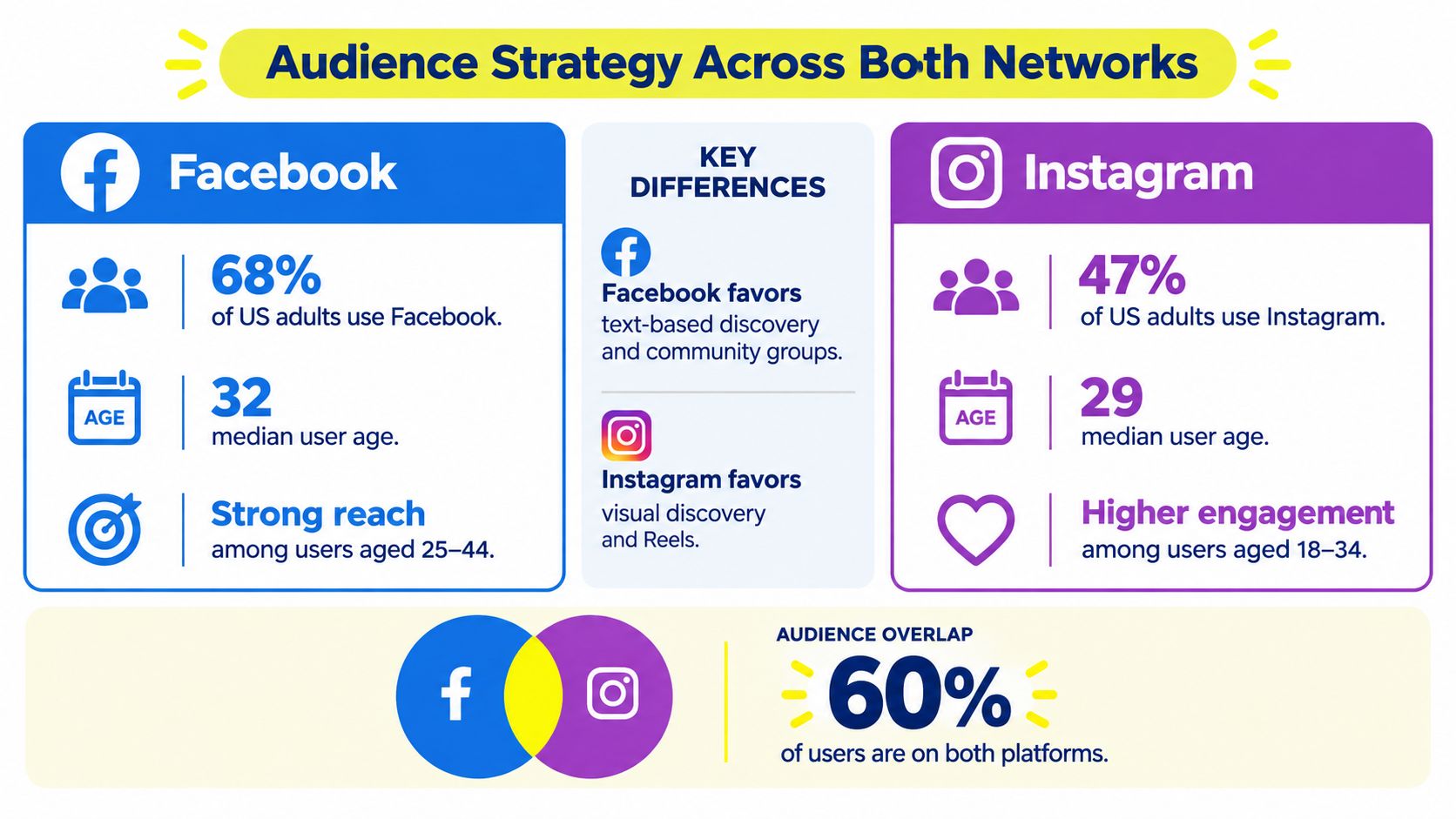
Facebook and Instagram are one ecosystem, but they're not the same audience pool wearing different colors. Pew Research Center reported that 68% of U.S. adults used Facebook and 47% used Instagram in 2023, and Instagram usage was much higher among adults ages 18 to 29, at 78%, than among adults 65 and older, at 15%. Facebook also remained a major information channel, with 30% of U.S. adults saying they regularly get news there, compared with 16% for Instagram. Those are not trivia points, they're creative and channel decisions disguised as survey data. Pew Research Center's Facebook and Instagram usage breakdown
Match the platform to the buying pattern
Use Facebook when you need broad reach, durable demand, and an audience that still responds to direct, explanatory messaging. Use Instagram when the offer benefits from visual proof, quick attention, and stronger concentration among younger adults. If the offer is both broad and visual, run both, but don't assume the same creative will win on both surfaces.
DataReportal's planning estimates show the scale is massive on both sides. Instagram ads could reach about 1.74 billion users worldwide in January 2025, while Facebook's global ad reach was about 2.28 billion at the start of 2025, making Facebook the larger audience by reported reach. Instagram's ad reach also grew faster year over year in that period, which is useful context, but it's still only a planning estimate, not a promise of performance. DataReportal's January 2025 Instagram and Facebook reach estimates
Use guardrails, not audience micromanagement
For most scaling accounts, the default should be broad or Advantage+ with business constraints, not a web of tiny interest stacks. Narrow targeting can still work, but every extra split steals signal from the learning phase. That's how advertisers end up paying for precision they can't use.
A cleaner operating model is this:
Facebook first when the buyer needs context, trust, or explanation.
Instagram first when the creative can carry the pitch visually.
Both together when the offer is familiar enough that the platform should optimize, not the marketer.
Retargeting separately only when the audience is large enough to support it without starving prospecting.
If you want a shortcut, think of Facebook as the broader utility channel and Instagram as the more visual demand-capture channel. They overlap heavily, but the creative and the message still need to respect where the user is likely to pay attention.
Building Campaign Structure That Holds Up at Scale
The account structure should reflect the business model, not the media buyer's preference for neat folders. E-commerce needs one logic. Local lead gen needs another. High-ticket services need a third. When advertisers force the same structure across all three, they usually break delivery or create fake clarity that disappears once spend rises.
Campaign Structure by Business Model | Campaign Shape | Optimization Event | Suggested Budget Split |
|---|---|---|---|
E-commerce | Single CBO or Advantage+ Shopping for scale, separate testing layer for new offers | Purchase, or deepest frequent event | Prospecting-heavy, with a smaller retargeting layer |
Local service | One campaign per offer, tightly grouped by service line and geography | Qualified lead or booked appointment | Majority to prospecting, controlled retargeting |
High-ticket service | Consolidated campaigns with fewer ad sets and clearer qualification filters | Booked call or qualified appointment | Prospecting first, retargeting only where volume supports it |
Pick the event the account can actually feed
The deepest event is the one closest to revenue that still happens often enough for Meta to learn from it. If purchases are frequent, optimize for purchase. If they're not, qualified lead or booked appointment is better than pretending a raw lead is business value. The goal is to train the algorithm on the outcome you want, not the easiest event to collect.
Retargeting should support prospecting, not cannibalize it
Retargeting works best as a cleanup layer, not the main growth engine. If most of your budget is trapped chasing warm traffic, the account will look efficient until the audience runs dry. That's especially true in local service markets where the reachable pool is smaller and frequency rises fast.
Keep the structure boring enough to scale
The best scaling accounts are usually the least theatrical. They have fewer moving parts, cleaner naming, and a narrow set of meaningful decisions. If every week requires rebuilding the account architecture, the structure is the problem.
Practical rule: If an account can't be explained in one minute, it's probably too fragmented to scale cleanly.
Bidding and Budgeting Inside the Learning Phase
Bidding is where advertisers either pay Meta to learn or starve the machine and call it “control.” Lowest cost is the default for a reason, because it gives the system room to find conversions without constant constraints. Cost cap, bid cap, and ROAS goal can all work, but only when the account already has enough signal and the business can tolerate reduced delivery.
Lowest cost versus capped strategies
Lowest cost is the best starting point when the account is still finding its rhythm. It tends to spend more freely and can produce less predictable CPA, but that's often a better trade than throttling delivery too early. Cost cap makes sense when you have a clear efficiency target and can accept fewer impressions to stay near it.
Bid cap is the tightest constraint. It's useful when every acquisition has a hard ceiling, but it can choke delivery if the bid is too low. ROAS goal belongs in accounts with strong purchase volume and clean value data, where the system can optimize for revenue quality instead of only conversion count.
Don't change the cap just because you're impatient
A bad habit in scaling accounts is raising caps too aggressively after a slow day. That can destabilize learning and make the next comparison meaningless. If a cap needs to move, move it because the business can support a different acquisition cost, not because the dashboard looked moody this morning.
Use CBO with intent
Advantage+ Campaign Budget is powerful when the ad sets are already built around a coherent objective and the system has enough volume to allocate spend intelligently. It's less helpful when you're trying to force too many business cases into one campaign. A $200 per day account needs far more restraint than a $20,000 per day account, because the smaller account can't afford wasted splits.
The right question is not “Should I use automation?” It's “Does this budget have enough signal to let automation do useful work?” If the answer is no, simplify the structure before you ask the bid strategy to solve a math problem it can't win.
Creative Systems for Reels, Feed, and Stories
Instagram inventory is moving toward Reels. In Q1 2026, Instagram impressions rose 31% year over year, spend increased 28%, CPM fell 3%, and Reels reached 33% of Instagram ad impressions, compared with 19% a year earlier. The shift changes how you produce assets, but it does not require every business to imitate an influencer brand. Tinuiti's Q1 2026 digital ads benchmark report
Stop worshipping the single hero ad
One winning video is a temporary event. Treat it that way and keep producing around the same offer. Scalable accounts use a repeatable system that generates multiple hooks, demonstrations, proof points, and objection handlers. That variety gives Meta more combinations to test across placements, while your reporting can judge success by contribution-margin-positive revenue rather than platform-attributed conversions alone.
Build production around the buyer's decision process. If you want a practical primer on production style, shooting shareable short-form video is a useful resource for developing stronger hooks, pacing, and native-format execution. Casual presentation can work, but every opening still needs a clear reason to keep watching.
Adapt the message to the placement
Reels need a fast opening and a visual value proposition. Feed supports more explanation and direct-response framing. Stories perform best when the offer is simple and the CTA is obvious. Carry the same core idea across placements, then edit each version for how people consume it.
Regulated categories, including tax and mortgage advertising, need credibility more than borrowed trends. Use credible presenters, concrete demonstrations, and plainspoken objection handling. A flashy opening that confuses the buyer wastes spend and weakens conversion quality.
Refresh before fatigue reaches revenue
Refresh creative before declining response becomes obvious in the revenue line. Rotate angles, rewrite the opening, or replace the proof point while the offer still has room to scale. Production capacity determines how quickly you can respond, so set a testing cadence before fatigue appears.
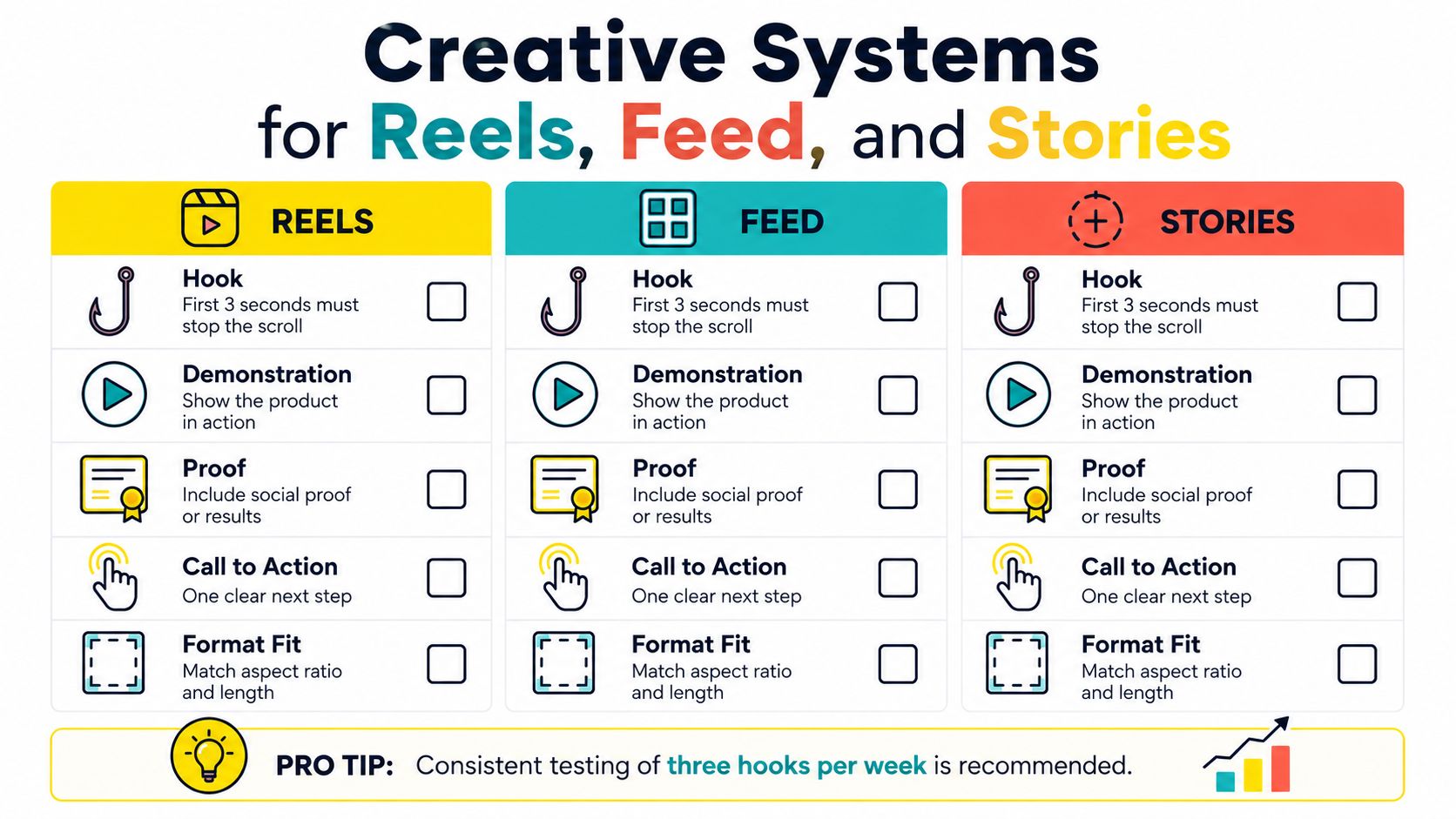
Use this review standard:
Hook: Stop the scroll immediately.
Demonstration: Show the product, service, or outcome in action.
Proof: Add social proof, results, or a believable credential.
CTA: Give one next step.
Format fit: Match aspect ratio and length to the placement.
This framework keeps creative decisions tied to qualified demand, efficient acquisition, and business revenue instead of personal taste.
Tracking, Attribution, and True ROAS
Platform ROAS can look strong while contribution margin gets worse. That gap shows up because privacy-preserving measurement weakens observed lift through match-rate loss, reduced linkability, shorter attribution windows, aggregation thresholds, and reporting noise. Use Ads Manager as a read on delivery and trend, then judge revenue impact with more skepticism. Research on privacy-preserving measurement and lift validation
Build the proof outside the platform
A usable measurement stack connects browser events, server-side events through Conversions API, CRM or commerce outcomes, and deduplication so one purchase does not get counted twice. Then compare Meta's reported conversions with what posted in the business system. If the two views disagree, the backend gets the final vote.
Holdout testing gives you the cleanest read on incrementality. Keep a comparable control group out of the campaign, expose the treatment group, and measure the lift in conversion rate between them. Calculate incremental CAC from spend divided by the additional conversions the holdout test identified.
That is the number that tells you whether scaling creates profit or just prettier attribution.
If the business can't survive a little measurement humility, it's probably overconfident in noisy data.
Don't confuse attribution with incrementality
A customer can search, click, leave, come back later, and buy. Meta may have influenced the sale without being the whole reason it happened. Treat click-through conversions, view-through conversions, and platform reporting as inputs into a broader measurement system, not as the final answer for budget decisions.
For teams that want a better model for shared credit across channels, Quikly on multi touch attribution is a useful reference. The practical rule is simple. As decisions get closer to budget allocation, backend evidence and incrementality testing should carry more weight than platform-attributed ROAS.
The 30-60-90 Scaling Playbook
Days 1 through 30 are about making the account legible. Verify pixel and Conversions API setup, confirm event mapping, launch one campaign per offer, and queue enough creative to avoid starving learning. Don't edit the structure every time a result wiggles.
Days 31 through 60 are about validation. Let the account reach the stabilization benchmark of roughly 50 optimization events within seven days where possible, tune bidding around the actual acquisition cost, and design a holdout test before you call any result “proven.” This is the window where most advertisers either get disciplined or get loud.
Days 61 through 90 are about controlled scale. Raise budgets in measured steps, add new audiences only when the current structure is stable, and enforce a creative refresh cadence before fatigue starts leaking margin. The account should grow only after the backend says the growth is profitable.
The one habit that separates compounding accounts from churn accounts is a weekly review of contribution-margin-positive revenue. Not clicks. Not impressions. Not even raw platform ROAS. If the business metric isn't improving, the campaign is not winning, even if Ads Manager says it is.
Wojo Media builds and manages paid advertising across Facebook and Instagram as part of broader omnichannel campaigns, with creative testing, retargeting, and backend KPI tracking tied to revenue outcomes. If you want a team that treats Meta like a profit system instead of a vanity dashboard, visit Wojo Media and see how they approach offer, landing page, creative, and data alignment.
Comments