.png)
Lead Generation for Coaches: A Proven Strategy

You're posting regularly, maybe running the occasional webinar, and still checking the calendar to see whether next month's consultations will arrive. One campaign brings a rush of inquiries; the next produces cheap form fills who don't answer, don't show, or aren't ready to buy. The problem usually isn't a shortage of tactics. It's that attention, follow-up, and revenue aren't connected.
Lead generation for coaches works when every step reports back to the same operating system. Build a clear offer, attract the right prospects, respond quickly, qualify carefully, and track which leads become clients. Then use that feedback to improve the offer and acquisition, instead of celebrating a low cost per lead that never turns into revenue.
The Real Problem With Coaching Lead Flow
Coaches often build lead flow from disconnected activities. They post when they have time, promote a webinar when the calendar feels light, change the offer after a slow week, and leave inquiries sitting in an inbox while they finish client work. That combination makes results feel unpredictable because no one can tell which action produced a qualified conversation or why a prospect decided to buy.
The market is substantial, but that doesn't make attention automatic. The International Coaching Federation, using research conducted with PwC across more than 14,500 participants in 157 countries, estimated 109,200 coach practitioners worldwide in 2022, a 54% increase from its 2019 estimate. The study also found that 91% had active clients, and estimated $4.564 billion in annual coaching income for active coaches, 60% higher than the 2019 estimate. Those figures establish a growing, populated professional market, where a coach needs more than visibility: a focused position and a dependable path from first contact to client. (ICF Global Coaching Study executive summary)
Replace disconnected tactics with one operating system
Start with one offer, one primary funnel, and one measurement layer. That doesn't mean you can only post on one platform or test one ad. It means every channel should move a particular prospect toward the same relevant next step, and every lead should enter the same CRM and revenue reporting process.
For example, an executive coach might use a diagnostic assessment to attract managers struggling to delegate. A prospect who completes it receives a concise result, a relevant invitation to book a call, and follow-up that reflects their stated challenge. The same offer should appear in the ad, on the landing page, in the confirmation, and in the conversation. If every touchpoint promises something different, buyers have to do the work of figuring out what's being sold.
Operating rule: Don't add another channel to fix a funnel you can't measure. Find where the current path breaks first.
Treat creative, qualification, and follow-up as repeatable components. Record which message attracts qualified prospects, whether they book, whether they show, and whether they become clients. When deciding how to connect the stages, MakeAutomation's funnel optimization insights can help frame the journey as a system rather than a collection of isolated tactics.
Designing the Offer and Lead Magnet
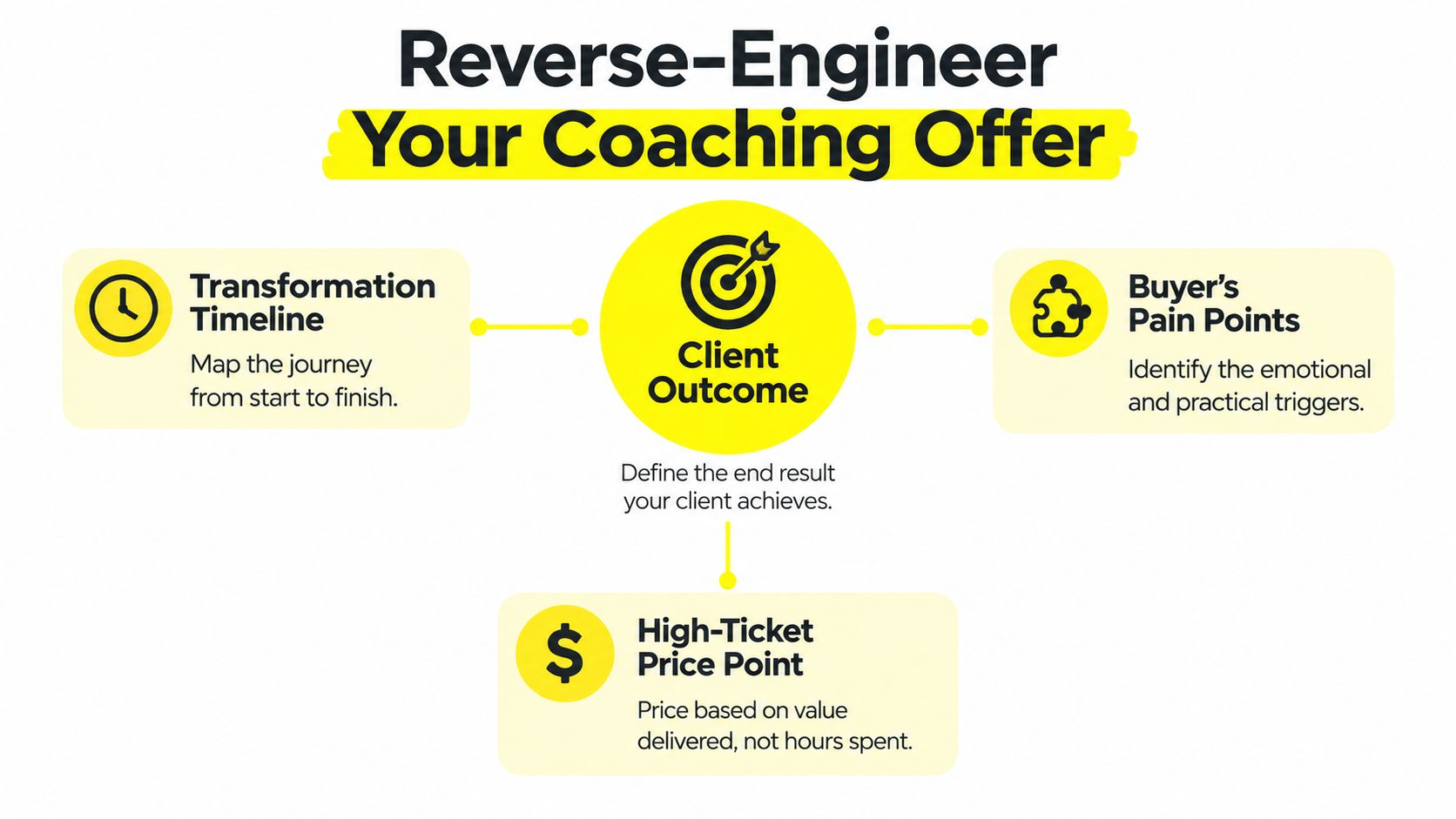
A lead magnet can't rescue a vague coaching offer. Start by defining the buyer's outcome, then work backward: what's happening in their life or work before they seek help, what changes through coaching, and what kind of support makes that change credible? “Become more confident” is difficult to evaluate. “Lead difficult performance conversations without avoiding the issue” gives an executive a concrete reason to pay attention.
Your offer needs a clear audience and an honest account of the transformation. Map the client's starting point, the work you'll do together, and the evidence that progress is happening. Price the engagement around the value and scope of the service, not a tally of coaching hours. A guarantee should reduce a real source of hesitation without promising an outcome you can't control. For instance, you might guarantee a defined onboarding deliverable or additional support if agreed participation conditions are met, rather than promising a promotion, a healed relationship, or a fixed revenue result.
Match the entry point to the service
A one-to-one offer can support a more personal, higher-context buying decision. Pair it with a diagnostic quiz or a short case-study PDF that helps prospects identify a specific challenge and understand your method.
A group program needs to demonstrate both a clear shared problem and a credible learning path. A focused workshop replay or a short email course can show how you teach before asking someone to join a cohort.
A self-paced course with a VIP path should let a prospect experience the approach while making personal support visible as the next step. A practical template or short lesson can lead into an application for the VIP option.
A useful lead magnet speaks to a person with a particular problem, not a broad topic. "Career clarity for senior product leaders weighing an internal move" is more specific than "career advice." Name the audience, the challenge, and the useful next step. If you're choosing a format, Coachful's lead magnet ideas for coaches can help you compare options, but make the final choice based on the offer you sell.
Build the first version this week. Write one sentence describing the client outcome, choose one offer archetype, and create a lead magnet that helps the right prospect recognize the problem your coaching solves.
Building Paid Social and Search Funnels
Paid acquisition should route people into a system you can evaluate, not scatter budget across platform experiments with no shared goal. Choose the channel based on how prospects discover and assess coaching. Facebook and Instagram can put useful creative in front of defined audiences and retarget people who have engaged. TikTok can introduce a coach's ideas through short, native-feeling videos. YouTube gives a coach room to explain a method and build familiarity. Google Search can capture people already looking for a coach or a specific solution.

Give every campaign a job
Use a practical account structure with distinct roles: a prospecting ad set for new audiences, a warm-audience ad set for people who've engaged or visited, a bottom-of-funnel retargeting ad set for prospects who viewed the offer or began an application, and a creative-testing bucket for founder-led and user-generated-style video.
Don't assume interest targeting is always more precise. Test it against broader prospecting and compare the quality of the leads each produces in your CRM. Once you have consented first-party information, use it to define customer and qualified-lead audiences where platform controls allow. Search campaigns are a different job: organize them around the problems and services a buyer actively searches for, then make sure the landing page answers that exact intent.
Budget should support learning as well as retargeting. If you put everything into warm audiences, you'll keep showing ads to the same people without replenishing the pool. If you spend only on cold prospecting, you may lose people who need more context before booking. Let downstream outcomes determine where to invest, not a platform dashboard's cheapest form fill.
Here's the operational risk to avoid: paid leads need an owner as soon as they arrive. A Harvard Business Review audit of 2,241 U.S. companies found that only 37% responded to web leads within an hour, while 24% took more than a day. Firms contacting leads within an hour were nearly seven times more likely to qualify them than firms waiting an additional hour, and more than 60 times more likely than firms waiting at least a day. Those are historical, directional findings from broad web inquiries, not guaranteed coaching conversion rates. (HBR-cited speed-to-lead audit summary)
Organic content should feed the same path: a useful post introduces a problem, a video explains your approach, and the landing page offers a relevant next step. For local and niche search visibility, Bornbir's SEO guide for doulas provides a related example of tailoring search content to a defined professional audience.
A video can help illustrate how paid acquisition fits into a wider coaching funnel:
Landing Pages That Actually Convert Coaches
A landing page should make the offer easy to understand and the next step easy to take. If a visitor can't tell who the offer is for, what it helps them do, and what happens after they click, the page is making the prospect work too hard.
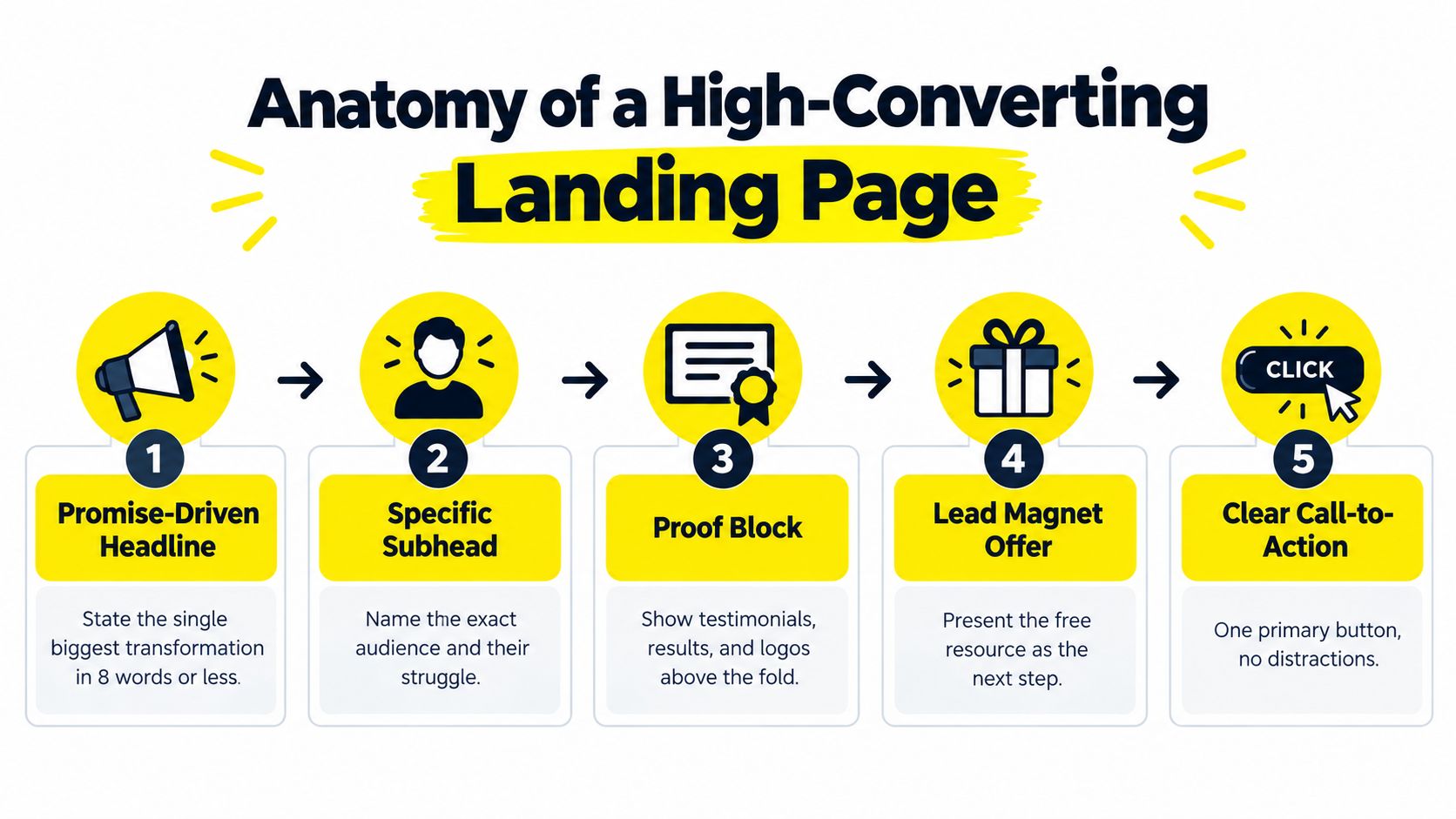
Put a clear promise in the headline, then name the audience and their struggle in the subhead. An executive coach might write, “Lead difficult conversations without losing your team's trust,” followed by, “For new managers who avoid performance issues until they become bigger problems.” A business coach could say, “Build a sales process that doesn't depend on referrals,” then clarify which kind of service business they help. A relationship coach might promise support for rebuilding communication, without implying that coaching can guarantee a particular relationship outcome.
Make the proof and mechanism specific
Place relevant proof high on the page. Use testimonials with context, explain what the coach did, and avoid editing a client's words into a promise of universal results. Then explain the method: how the coaching works, what the prospect will do, and how they'll know whether it's a fit.
A short FAQ should answer genuine objections, such as how sessions work, what preparation is expected, who shouldn't apply, or whether the program is a fit for a particular situation. Give the page one primary CTA path. If the page invites a prospect to book, download, subscribe, and browse unrelated services all at once, it dilutes the decision.
A webinar registration page has a narrower job: explain the topic, the intended audience, and what the attendee will learn, then collect the registration. A long-form sales page is for a prospect evaluating a paid program, so it needs to establish the offer, method, fit, proof, and terms. Don't send cold traffic to a short registration page when it needs more trust-building, and don't bury a simple webinar signup beneath a full sales pitch.
Page Block | Primary Job | Example Element |
|---|---|---|
Headline and subhead | State the transformation and audience | “For founders whose sales depend on referrals” |
Proof | Build relevant confidence | A client testimonial with context |
Mechanism | Explain how the coach works | A clear description of the coaching process |
FAQ | Resolve practical uncertainty | Fit, format, expectations, and terms |
CTA | Make the next step obvious | “Book a fit call” |
Audit the page in this order: headline and hero visual first, then offer and proof, then form length, then CTA wording. Check each block against the visitor's likely question. If the page has one vague promise, proof without context, or several competing calls to action, fix that before changing the ad.
Follow-Up, CRM Sequencing, and Speed to Lead
A lead in an inbox isn't a follow-up system. For consultation leads, capture the prospect's name, email, phone, coaching objective, urgency, and relevant qualification signals. Route the submission to a CRM immediately, send a confirmation by SMS or email, provide a timezone-aware calendar link, and assign a human call attempt within five minutes. The Harvard Business Review audit cited above gives a reason to treat response time as an operating standard, not an afterthought.
Be clear about data collection at the point of entry. Tell prospects why you ask for an email address or phone number, what they'll receive, and how those details will be used. Ask only for information that helps deliver the resource or assess fit, and make the opt-in clear rather than treating a lead magnet download as blanket permission for every kind of contact.
Build branches around what the lead does
For booked calls, use a 14-day sequence that supports the appointment rather than pestering the prospect. Send an immediate confirmation and calendar details, then reminders as the call approaches. Include a short questionnaire about the prospect's challenge and desired outcome so the call can start with context. If they don't show, send a respectful message with a simple rescheduling option, followed by a human check-in if appropriate.
If the prospect attends but isn't ready, move them into a reactivation branch based on their stated timeline or obstacle. Don't keep sending the same urgency message to someone who said they need to speak with a business partner or wait for a budget decision. Use notes from the call to make subsequent messages relevant.
For webinar viewers who haven't booked, build a 30-day nurture across email, retargeting, and a founder-led video. Share one useful insight, explain your method, answer a common concern, and invite a conversation when the offer is relevant. If a prospect clicks through or replies, route that signal to a human rather than leaving them in a generic newsletter sequence.
Practical rule: Every sequence needs a next action, an owner, and a stop condition. Suppress people who have booked, opted out, or become clients.
Keep the CRM stages simple enough that the team uses them consistently: new lead, contacted, booked, attended, qualified, opportunity, won, and closed or not a fit. That shared record lets you judge acquisition by the eventual outcome instead of counting every inquiry as a success.
Measuring What Matters Beyond Cost Per Lead
Cost per lead is an input metric, not a business result. A campaign can generate inexpensive inquiries while producing poor attendance, weak qualification, or no new clients. If you optimize solely for form fills, you teach your acquisition system to find people willing to submit a form, not necessarily people who need and can use your coaching.
Track the funnel as a connected chain. CPM and CTR indicate whether the creative is reaching attention and earning a response. Landing-page conversion rate and CPL show whether the message and page turn visits into inquiries efficiently. Cost per booked call, show rate, and qualified-call rate reveal whether those inquiries become serious conversations. Close rate, customer acquisition cost, gross margin per client, and retention tell you whether the offer and sales process produce sustainable client revenue.
Diagnose the break, not the symptom
If click-through is weak, test the audience-message fit and creative before rewriting the full page. If clicks arrive but few visitors submit, inspect the headline, relevance, proof, form, and consistency between ad promise and page promise. If bookings are healthy but attendance falls, examine confirmation, reminder timing, call expectations, and speed of contact.
A drop in qualified calls may signal loose targeting, a generic lead magnet, or qualification questions that invite the wrong people. If qualified prospects attend but don't buy, review offer fit, the sales conversation, price framing, and whether the prospect understood what coaching includes. Don't respond to every weak downstream result by increasing ad spend.
Feed quality and revenue events back to advertising platforms where consent, platform tools, and your setup permit. A CRM can track stages such as qualified lead, attended call, and sale, then share appropriate offline conversion events or qualified-lead uploads. That gives the platform more useful feedback than a form submission alone. For privacy-conscious acquisition, the practical opportunity is to build a first-party record through transparent opt-ins, useful diagnostic tools, and accurate CRM stages, rather than depending only on third-party identifiers. (Industry reporting on first-party data and privacy)
Run a weekly review that asks: Which channel brought qualified prospects? Where did leads stall? What happened to booked calls and attendance? Which offer or creative produced clients, not just inquiries? What single change will the team test next? Keep the review focused on a decision. If no one changes a campaign, message, or follow-up process based on the numbers, the dashboard is decoration.
Scaling Coach Lead Flow Without Burning It Down
Scaling means increasing what already works, not increasing every input at once. Start by stabilizing the offer, auditing the funnel, documenting follow-up, and installing tracking. Then test creative angles, tighten qualification, and stop spending on channels that produce attention without qualified conversations. Increase budget only when the whole chain, from first click to client outcome, is understandable and operating reliably.
Protect the system as volume grows
In the first phase, make the offer, page, CRM stages, and follow-up responsibilities clear. In the next phase, compare creative and audience quality, refine questions that screen for fit, and fix page friction. In the later phase, scale the campaigns that bring qualified leads and clients, while expanding organic content, partnerships, and referrals to reduce dependence on a single source.
Watch for the failures that make more spend less profitable: creative fatigue that nobody refreshes, slow human responses, offer creep that confuses buyers, proof that doesn't match the promise, and data collection that prospects don't understand. AI can help with research, content variations, and repurposing, but a coach still needs to supply the specific method, lived expertise, and honest interpretation that make the offer distinct. Recent creator research surveyed professional creators in the United Kingdom and United States about AI and the future of content, underscoring why audience attention and meaningful differentiation deserve separate consideration. (Creator research on AI and content)
Start this week with three actions: write the offer promise in one clear sentence, map the path from first click to attended call, and assign one person to respond to every new lead promptly. Then review the revenue feedback before adding another tactic.
Wojo Media runs omnipresent paid campaigns across Facebook, Instagram, TikTok, Google, and YouTube, and works with coaches on offers, landing pages, creative, and backend KPI tracking. If you want a paid acquisition system connected to qualified calls and revenue, visit Wojo Media to discuss a strategy for your coaching business.
Comments