
How to Improve Ad Performance: Proven Tactics That Scale

You've probably seen this pattern before. A campaign starts strong, then costs creep upward, lead quality softens, and the platform dashboard still reports enough clicks to make the situation look healthy. You change the audience, refresh a headline, or increase the budget, but performance remains unpredictable because the underlying problem sits somewhere else in the system.
Learning how to improve ad performance requires more than finding a better interest, bid, or hook. Creative, targeting, offer, landing page, bidding, and measurement work as one machine. Improve one component while ignoring the others, and the campaign may just move the bottleneck downstream.
Why Ads Stop Performing Before You Know It
Ad performance usually declines without warning. Frequency rises, the audience becomes less responsive, a competitor introduces a stronger offer, or a landing page develops friction after a site update. The dashboard then compresses all of those problems into a few familiar metrics, such as cost per click, click-through rate, and reported conversions.
Start with a system audit, not a tactical change. Separate supply problems from demand problems. Supply problems include auction pressure, delivery limitations, placement quality, and creative fatigue. Demand problems include weak positioning, poor audience intent, an unconvincing offer, or a page that fails to continue the promise made in the ad.
Diagnose the broken handoff
A useful audit follows the customer journey in order:
Offer: Does the buyer have a compelling reason to act now?
Audience: Are you reaching people with a relevant problem or buying signal?
Creative: Does the ad earn attention and communicate the value clearly?
Landing experience: Does the page make the next action obvious and easy?
Score each pillar from weak to strong using your own account data and qualitative review. The lowest score deserves attention first. A campaign with strong click-through rates but weak sales likely has a page, offer, or qualification problem. A campaign with falling engagement and rising acquisition costs may have creative decay or audience saturation.
Practical rule: Don't optimize the metric closest to the ad platform. Optimize the first point where qualified intent disappears.
Platform attribution also deserves skepticism. An analysis of 640 Meta incrementality experiments found an average 19% lift on primary KPIs, while every $100 in platform-attributed DTC revenue corresponded to $115 in incremental revenue. The result shows why click-based reporting can misrepresent business impact, as documented in Haus's analysis of Meta incrementality.
Symptom | Likely Cause | Next Diagnostic Step |
|---|---|---|
Clicks remain steady, sales decline | Offer or landing page friction | Compare ad promise with page headline, price, proof, and checkout path |
Click-through rate falls while frequency rises | Creative fatigue or audience saturation | Review recent assets by concept, not just format |
Costs rise across every creative | Auction pressure, weak relevance, or demand mismatch | Test a new angle and audience before changing bids |
Leads increase but close rate falls | Poor qualification or misaligned targeting | Compare lead source, form answers, calls, and downstream revenue |
For teams that want a more structured view of profitability, a resource on how to scale ROAS with ad performance data can help connect platform metrics to commercial outcomes. The important principle is simple: diagnose the handoff before you scale the traffic.
Sharpening Your Offer and Audience Targeting
Targeting can't rescue an offer that asks for too much trust too soon. Before expanding reach, make the promise specific, reduce uncertainty, and match the call to action to the buyer's level of intent.
An e-commerce brand might lead with a product benefit, a clear use case, and a low-friction purchase path. A local service business may need proximity, availability, transparent qualification, and proof that the provider handles the exact problem. A coach or consultant often needs a stronger bridge between the ad and the consultation, such as a diagnostic resource, focused outcome, or relevant authority signal.
Match the message to the signal
Segment audiences by behavior and buying context rather than relying on broad interest labels alone. Useful distinctions include:
Problem-aware prospects: They recognize the pain but haven't chosen a solution. Lead with education and a clear explanation of the problem.
Solution-aware prospects: They understand the category and need differentiation. Lead with mechanism, proof, and the reason your approach is credible.
High-intent visitors: They have viewed a product, started a form, or engaged with a specific offer. Remove doubt and make the next step easier.
Existing customers or leads: They need a different message entirely, such as replenishment, an upgrade, referral offer, or next-stage service.
Personalization works when the ad reflects the signal that created the audience. Industry data summarized in a 2026 targeting roundup reports that personalized ads can increase conversion rates by 202%, while click-through rates can be about 2x higher than generic ads, according to Cropink's targeting statistics roundup. Treat that finding as a reason to improve relevance, not as permission to create dozens of superficial variants.
Use audience layers carefully
Lookalike audiences can expand reach, but they shouldn't replace a clear source audience. Build them from meaningful business outcomes where possible, then compare them against behavioral retargeting and intent-based prospecting. Avoid stacking so many interests, exclusions, and lookalike layers that you can't tell which signal is doing the work.
A practical alignment review should answer three questions:
What did the person do before seeing this ad?
What promise does the ad make to that person?
Does the landing page deliver the same promise without introducing new friction?
Checklist Item | Status | Risk if Skipped |
|---|---|---|
Offer states a specific customer outcome | Review | Attention without a convincing reason to buy |
Message reflects audience intent | Review | Irrelevant clicks and weak qualification |
Proof matches the buyer's concern | Review | Hesitation at the decision point |
Call to action fits the commitment level | Review | Visitors abandon an overly demanding next step |
Lead or purchase path captures useful context | Review | Sales teams receive volume without usable intent |
Don't increase spend until the offer and audience make sense together. More reach magnifies a mismatch just as efficiently as it magnifies a strong proposition.
Building Creatives That Convert Across Channels
Creative and targeting aren't separate buckets. The audience signal determines the angle, and the angle determines whether the audience signal becomes action. A retargeting ad can use urgency and objection handling, while a cold prospecting ad may need to name the problem before presenting the product.
Adapt the creative to the channel
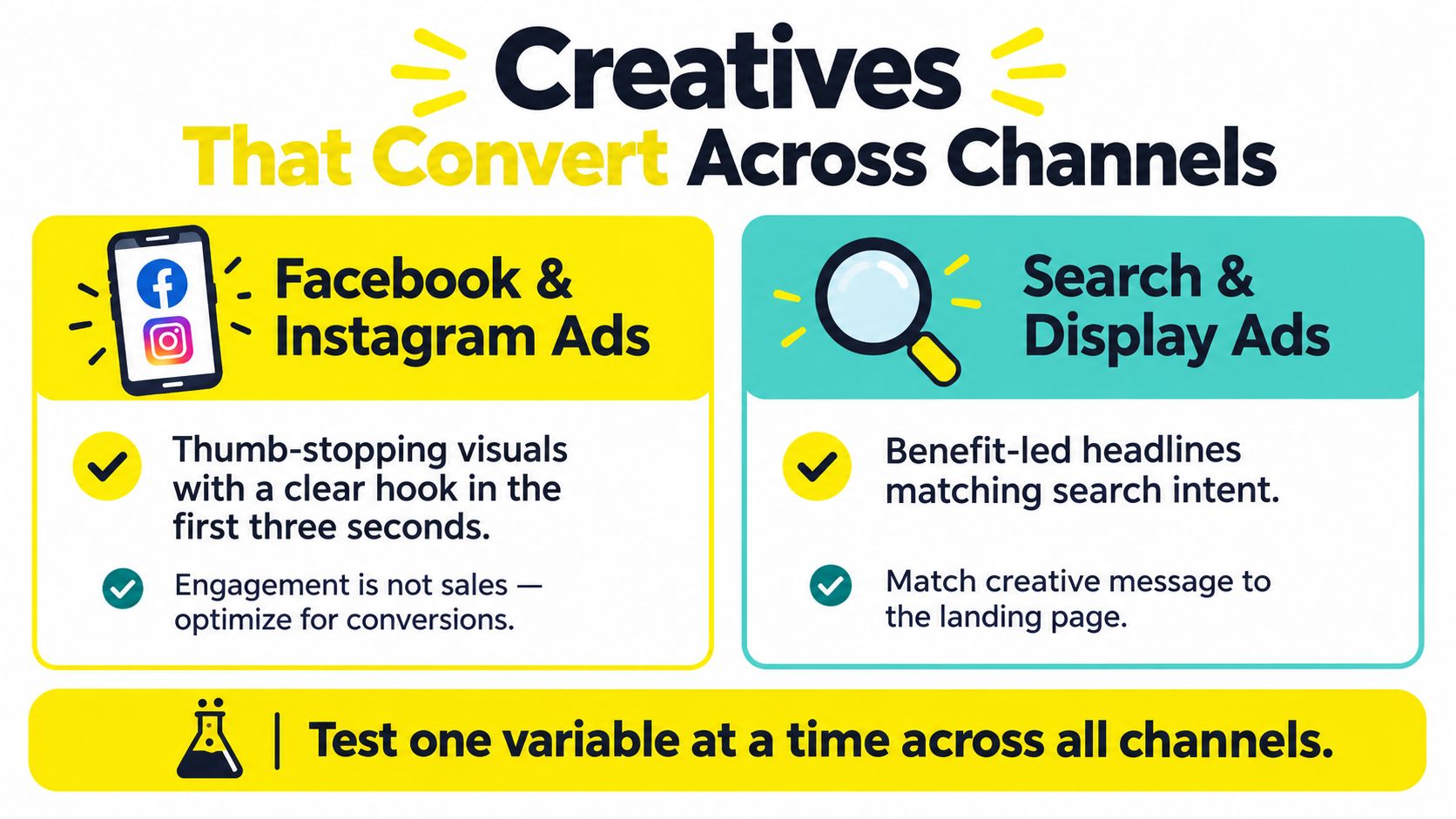
Facebook and Instagram reward immediate visual clarity. Put the problem, outcome, or distinctive demonstration in the opening moment, then support it with captions and a direct call to action. A polished brand film can work, but it shouldn't be the only asset. Most users encounter these ads while moving quickly through a feed, so the first visual must carry meaning without relying on sound.
TikTok favors a native, human rhythm. Demonstrations, reactions, founder-led explanations, customer language, and creator-style framing can make the ad feel like content rather than an interruption. YouTube gives you more room to build a narrative, but the opening still needs a clear reason to continue watching. Search ads operate differently. They must align tightly with intent through benefit-led headlines, relevant descriptions, and a landing page that repeats the core promise.
A 2026 multi-brand study across more than 1,900 video and image assets on Meta and Google DV360 found that predictive creative scoring forecast e-commerce conversion with 81% accuracy. Ads aligned with the model's recommendations delivered an average 4x improvement in conversion rates, while shifting spend toward higher-scoring assets could generate more than 2x as many conversions from the same budget, as reported by Marketing Dive's coverage of predictive creative scoring.
Compare what each channel needs
Platform | Winning Creative Trait | Common Mistake |
|---|---|---|
Clear problem framing and credible proof | Optimizing for reactions instead of purchases | |
Strong visual identity with concise overlay text | Hiding the offer beneath decorative design | |
TikTok | Native pacing, human delivery, and visible demonstration | Producing an ad that feels disconnected from the feed |
Google Search | Benefit-led copy matched to intent | Sending every query to the same generic page |
YouTube | A compelling opening followed by a structured explanation | Delaying the value proposition until too late |
AI can accelerate production, but it doesn't remove the need for judgment. Research summarized by StackAdapt found that AI-generated ads had higher click-through rates overall, yet ads that merely looked AI-generated performed worse. The implication is practical: use AI for ideation, versioning, resizing, and analysis, while preserving human specificity, believable emotion, and the visual details that make a brand feel real.
Test concepts before testing minor wording changes. Score each asset against the audience, hook, proof, offer clarity, product demonstration, brand fit, and conversion intent. After launch, reallocate toward assets that produce qualified actions, not just the highest engagement.
Optimizing Landing Pages and Funnel Friction
An ad can do its job perfectly and still send a buyer to the wrong experience. The landing page inherits the ad's promise, audience expectation, and urgency. If the page changes the offer, buries the proof, or loads slowly on mobile, the media account absorbs the cost.
Google Ads identifies page speed and mobile-friendliness as part of landing page evaluation. In retail, Google documents that a 1-second delay on mobile can reduce mobile conversions by up to 20%, as explained in its landing page experience guidance.
Find the first meaningful drop-off
Map the funnel by business model rather than forcing every campaign into a purchase template.
For e-commerce, inspect the transition from ad to product page, product page to cart, and cart to checkout. Look for mismatched prices, unclear shipping information, weak product photography, missing reviews, and distracting navigation. For a local service business, review the form, confirmation page, scheduling step, and speed of follow-up. A form that produces many submissions but little revenue may need better qualification rather than more traffic.
For a webinar or consultation funnel, check whether the registration promise matches the event content and whether the follow-up sequence handles the objections raised in the ad. Landing page copy should answer the buyer's immediate questions in the same order the ad created them.
Prioritize technical and message fixes
Fix technical friction first when users can't access or complete the page. Then address message friction, including vague headlines, weak proof, unclear pricing, or a call to action that asks for an unnecessary commitment. Video can support explanation and trust when the product or service benefits from demonstration. A practical resource on driving sales with landing page video offers additional ideas for using video within conversion paths.
Use benchmarks as context, not as a verdict. WordStream's 2026 Google and Microsoft Ads benchmark analyzed more than 13,000 search campaigns across 23 industries and reported an average conversion rate of 8.18%, while its 2025 benchmark across more than 16,000 campaigns reported 7.52%, as documented in WordStream's benchmark analysis. Triple Whale's 2025 analysis of more than 18,000 ecommerce brands found conversion-rate declines across 13 of 14 industries, with Pets & Animals the only improving category, reaching 4.43% after a 3.36% increase. Those figures come from Triple Whale's benchmark discussion, but the more useful lesson is to compare your campaign with the relevant category and funnel stage.
Source and Year | Sample Size | Key Finding |
|---|---|---|
WordStream, 2026 | More than 13,000 search campaigns across 23 industries | Average conversion rate reported at 8.18% |
WordStream, 2025 | More than 16,000 campaigns | Average conversion rate reported at 7.52% |
Triple Whale, 2025 | More than 18,000 ecommerce brands | Conversion rates declined in 13 of 14 industries |
Testing Bidding Strategies and Budget Allocation
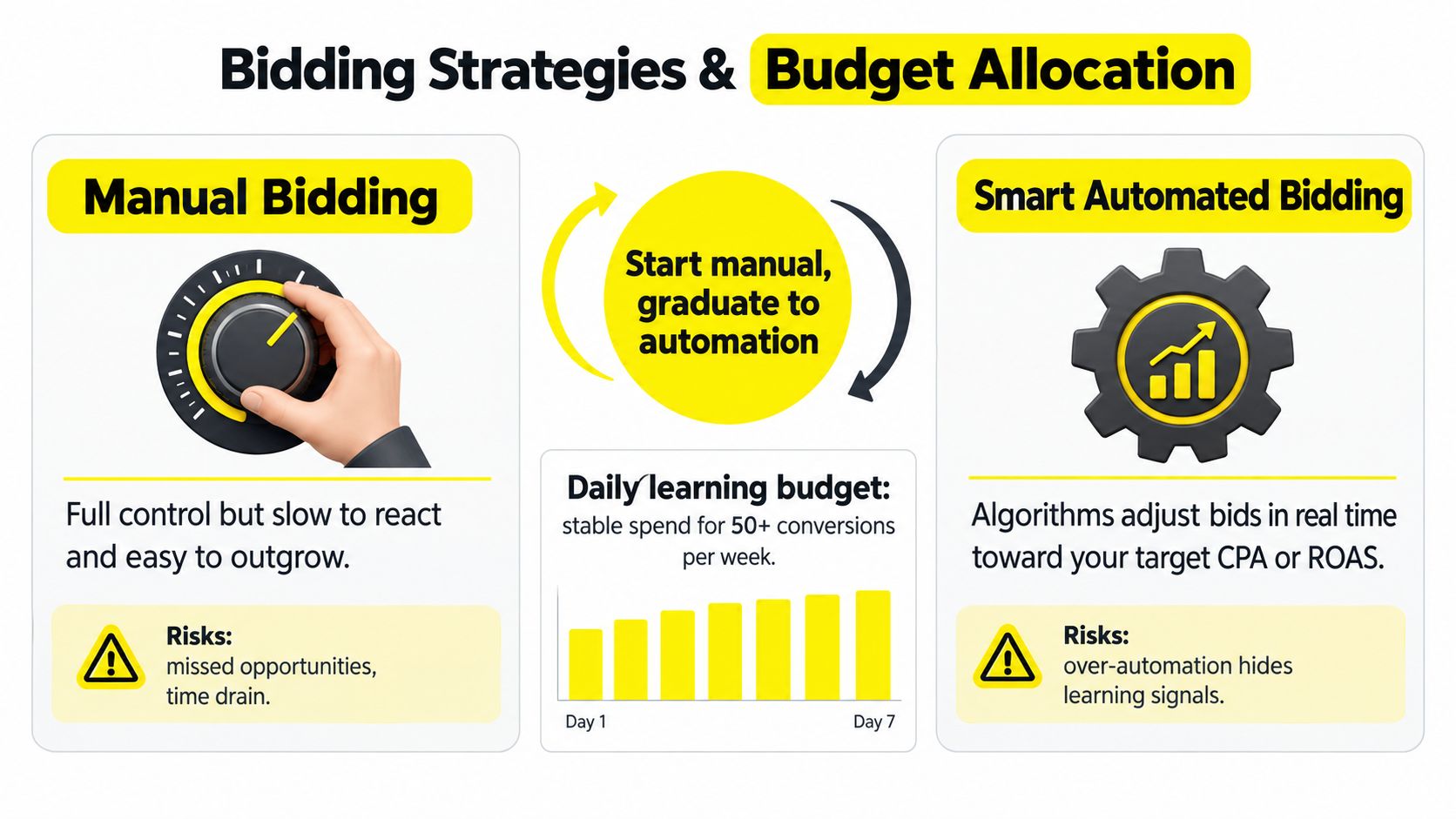
A campaign can have excellent creative and still waste money if the bidding strategy optimizes for the wrong outcome. Manual bidding gives you control, but it demands close attention and may miss opportunities as conditions change. Automated bidding can react faster, but it will pursue the signals you provide, including weak or incomplete conversion events.
Start with a stable conversion definition. A qualified consultation, completed purchase, or revenue event is more useful than an inexpensive form submission that never becomes a customer. If the account has limited reliable data, keep the structure simple and avoid dividing spend across too many campaigns.
Move from control to automation deliberately
Manual controls can help during early exploration, especially when you're validating search terms, placements, creative angles, or lead quality. Once conversion tracking is reliable and the campaign has enough consistent signal, test automated approaches such as maximizing conversion value or target ROAS for revenue campaigns. For lead generation, a target CPA can make sense only when the conversion event reflects a lead your sales team wants.
Consider a campaign with three creative concepts. One receives early clicks, another produces fewer but better-qualified visits, and the third generates cheap leads that rarely progress. A weak operator shifts budget toward the cheapest lead. A disciplined operator checks downstream quality, preserves enough spend for learning, and moves budget toward the concept that supports the business objective.
Automation should reduce repetitive decisions, not remove accountability for the decision criteria.
Change one major variable at a time. If you alter the bid strategy, audience, budget, and landing page together, you won't know which change caused the result. Keep a testing log with the hypothesis, change, start date, primary metric, guardrail metric, and decision rule.
Campaign Stage | Recommended Bidding Approach | What to Monitor |
|---|---|---|
Early validation | Controlled manual or simple automated bidding | Search intent, conversion quality, delivery stability |
Reliable conversion signal | Automated conversion or value bidding | Cost efficiency, conversion volume, revenue quality |
Scaling | Target-based automation with controlled budget changes | Marginal return, learning disruption, lead quality |
Creative reallocation | Preserve winning concepts and reduce weak variants | Conversion-linked performance, not engagement alone |
Budget reallocation should follow evidence, not a single strong day. Protect the learning environment, then shift spend when the relationship between creative, audience, and business outcome remains consistent.
Scaling Profitably Without Breaking Attribution
Scaling is a measurement problem before it's a budget problem. If the platform reports conversions that would have happened without the ad, increasing spend can create the appearance of growth while reducing true profit.
Use incrementality as a decision framework. Ask whether exposed customers behaved differently from comparable customers who weren't exposed. For prospecting, consider holdout designs or geo-based tests where practical. For retargeting, be especially cautious, because the audience already demonstrated interest and the platform may claim credit for demand that existed before the ad.

A platform dashboard is useful for operating campaigns, but it shouldn't be the only source of truth. Compare platform-reported results with sales records, customer relationship management data, qualified pipeline, repeat purchases, refunds, and contribution margin. Teams can also use a website traffic checking tool to add context around broader demand and traffic patterns, provided they don't confuse traffic movement with incremental revenue.
Scale with guardrails
Increase budgets in controlled steps and watch whether conversion quality stays stable. If cost rises immediately after expansion, check delivery changes, audience breadth, placement mix, and creative distribution before assuming the campaign needs a new bid target.
Warning signs include:
Revenue quality falls: The account reports more conversions, but average order value, close rate, or retention weakens.
Retargeting dominates reporting: Most attributed results come from people who already knew the brand.
New prospecting stalls: The campaign can capture existing demand but struggles to create fresh demand.
Creative concentration increases: One asset receives most delivery, leaving the account exposed to fatigue.
Business records disagree: The platform shows growth while the CRM, payment system, or booked calendar does not.
The incrementality evidence discussed earlier reinforces the need for this discipline. Don't scale a campaign solely because its attributed ROAS looks attractive. Scale when platform efficiency, customer quality, and incremental business lift point in the same direction.
Playbook Summaries for Different Business Types
The right optimization priority depends on how a business creates value. An e-commerce brand needs a fast connection between creative, product demand, checkout completion, and repeat purchase. A local service business needs qualified conversations and reliable follow-up. A coach or consultant needs enough trust and context for a prospect to commit to a meaningful conversation.
E-commerce brands
Start with the offer and product page. Test bundles, guarantees, demonstrations, customer objections, and creator-style content against a clearly defined buyer problem. Keep prospecting creative focused on discovery and use retargeting creative to resolve specific objections, such as fit, shipping, usability, or product comparison.
Review the complete path from ad to checkout. If traffic is strong but cart completion is weak, don't immediately change targeting. Inspect product information, mobile usability, trust elements, and the consistency between the ad and page.
Local service businesses
Optimize for qualified appointments, not raw lead volume. Use ad copy that identifies the service area, problem, and appropriate customer. Add qualification questions where they protect the sales team from poor-fit inquiries, then connect forms and calls to the CRM so you can compare booked appointments with closed business.
Creative should make the service tangible. Show the process, the provider, the environment, and the outcome without relying on vague claims. Follow-up speed and scheduling availability belong in the performance review because the ad is only one part of the acquisition system.
Coaches, consultants, and course creators
Build authority before demanding a sales call. Use educational creative to frame the problem, explain the mechanism, and demonstrate who the offer is for. A webinar, audit, or focused consultation can provide a more natural next step than a generic “book now” message.
Track progression through registration, attendance or consumption, consultation quality, and sale. The cheapest lead isn't necessarily the strongest prospect. Your optimization target should reflect the revenue event that sustains the business.
Use this immediate checklist:
Audit the four pillars: Identify the weakest offer, audience, creative, or landing experience.
Choose one audience signal: Tie the next creative concept to a clear behavior or intent stage.
Fix the first funnel leak: Improve the earliest point where qualified prospects drop out.
Validate the bid goal: Make sure the platform optimizes toward a real business outcome.
Test incrementality: Compare attributed results with customer and revenue evidence before scaling.
Wojo Media offers paid advertising and sales systems across Facebook, Instagram, TikTok, Google, and YouTube, with support for offer refinement, landing pages, creative production, retargeting, and backend KPI tracking. If you want an incrementality-aware plan for improving ad performance and scaling with tighter measurement, visit Wojo Media to explore its paid advertising approach.
Comments