
Product Launch Advertising: A Practical Playbook

A launch is close. The product is ready, the landing page is nearly done, and someone is asking which platform should get the budget. That's usually the wrong first question. Before choosing channels, decide what the campaign must prove, how you'll tell whether advertising created demand, and what you'll change if the evidence is weak.
Product launch advertising works best as a sequence of decisions, not a single burst of spend. The practical job is to prepare demand, give prospects a clear reason to act, measure the response against a credible baseline, and protect the economics as you learn. Here's how to run that sequence with a small team and a manageable set of checkpoints.
How to Think About a Product Launch Before You Spend
Start with the buyer, not the media plan. Describe the person most likely to buy now, the problem that makes the new product relevant, and what alternatives they use today. “People interested in wellness” is too broad to guide a launch. A sharper audience might be busy parents looking for a simple way to prepare weekday meals. The more clearly you define the buyer, the easier it is to choose an offer, write creative, and assess whether incoming leads or orders look qualified.
Next, take stock of the proof you can show. That might be a product demonstration, beta-user feedback, a clear comparison with the current workaround, or a transparent explanation of what the product does and doesn't do. Don't imply that a new offer has a track record it hasn't earned. If proof is limited, make the launch message concrete and lower the uncertainty with a clear guarantee, return policy, trial, or consultation process where appropriate.
Set a day-30 business outcome
Choose one primary outcome before anyone builds the campaign. It could be incremental first-time purchases, qualified booked calls, or contribution margin from new customers. Then define diagnostic measures separately: click-through rate, cost per click, landing-page conversion rate, and lead quality can help explain performance, but they aren't substitutes for the business result.
That distinction matters because an ad platform can report conversions without proving that advertising caused them. Google describes an incrementality experiment as comparing shoppers exposed to an ad with eligible shoppers who weren't exposed, helping distinguish advertising-driven demand from organic behavior (Google Ads' guide to incrementality experiments). For a launch, decide early whether you can create a holdout group or geographic control and what outcome you'll compare.
Pre-flight check: Name the target buyer, list the proof available, choose one primary outcome, confirm the landing page can fulfill the promise, and assign someone to review results and make decisions.
If the offer, proof, or buying experience still feels unclear, more traffic won't fix it. For a useful perspective on sequencing the sales and marketplace work around a launch, review how Online Brand Growth launches products.
Building Pre-Launch Demand That Ads Can Multiply
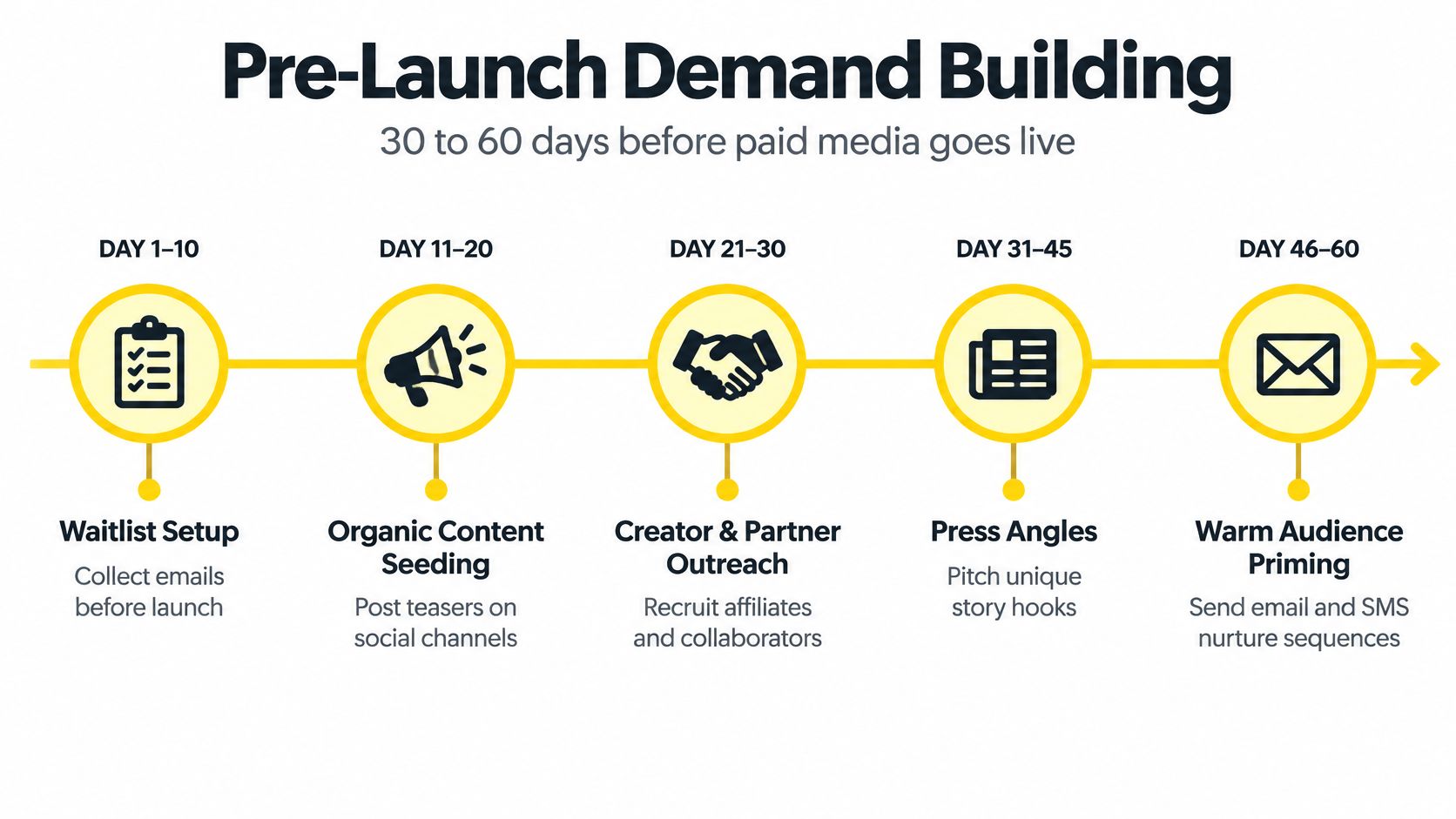
The weeks before paid media goes live are for creating reasons to pay attention, not just announcing a date. Set up a waitlist or early-access page that says who the product is for, what problem it addresses, and what subscribers will hear next. Use organic posts to demonstrate the product in context. Ask creators and partners to understand the offer before launch, and give press contacts a specific story angle instead of a generic announcement.
Keep publicity and advertising in different roles. Publicity, previews, and editorial coverage can build attention and credibility before release. Paid advertising can then extend the reach of that attention and help convert prospects when the product is available. A study of 3,336 video games tracked across 52 weeks found that pre-launch publicity was more effective than pre-launch advertising, while advertising became more effective after launch (the empirical study of video-game publicity and advertising). That's a useful sequencing lesson, not a guarantee that every category will behave identically.
A manageable pre-launch cadence
Organize the work around what a small team can maintain alongside product finalization:
Early preparation: Build the waitlist page, draft the product explanation, and create an FAQ from real customer questions.
As launch approaches: Seed demonstrations and useful tips through organic content. Contact creators, affiliates, and partners with a clear brief and an easy way to review the offer.
Before paid campaigns begin: Pitch a distinctive press angle and send warm subscribers a helpful preview, early-access invitation, or launch-date reminder.
At each checkpoint: Review replies, questions, and objections. Use them to improve the page, messaging, or support materials rather than treating comments as applause.
Offer design belongs here, too. Decide how price, bundle, guarantee, shipping, trial, or consultation terms will appear before ads start. Paid traffic amplifies the offer you've built. It won't make unclear terms or a weak value proposition easier to understand.
A Nielsen BuzzMetrics and BASES study of U.S. consumer-packaged-goods launches in 2005–2006 found a relationship between paid launch advertising and online discussion: products in the top 10% for blog interest spent nearly $20 million on pre-launch paid media, compared with about $5 million among the bottom 50% (Nielsen's historical analysis of launch advertising and online buzz). That finding doesn't prove spending alone caused conversation. It does underline why launch support and earned attention should be planned together.
Crafting the Offer, Hook, and Creative Angles to Test
A launch ad needs a reason to stop, a reason to believe, and a next step. Begin with one defensible product truth: a feature, process, convenience, service experience, or outcome you can substantiate. Write several hooks from that truth, each addressing a different buyer concern. Don't invent separate value propositions just to make more ads.
For an ecommerce product, one angle might show the product solving a familiar task, while another explains how its design differs from a common alternative. A local service can lead with the customer's immediate concern, then show the process and how to book. A coach or consultant might name a costly bottleneck, explain the method, and invite a prospect to a fit call. In each case, the ad should match what the landing page delivers.

Build useful variations, not busywork
Create a small set of distinct angles before multiplying formats. A creator-style video, a direct-response demonstration, and a clear product explainer can each communicate the same offer in a different way. Keep the message recognizable across versions so the test tells you which framing resonates, rather than testing unrelated promises at once.
A launch-specific script can follow a simple path:
Problem-aware opening: Name a situation the intended buyer recognizes.
Product and proof: Show how the offer addresses it, using evidence you can support.
Clear action: Tell the viewer what to do next, such as shop, request a quote, or book a call.
Keep the call to action proportionate to the buying decision. An unfamiliar, high-consideration offer may need an explanation or consultation before a purchase prompt feels credible. A straightforward ecommerce product can often send the prospect directly to a focused product page.
Useful angles to develop include:
Ecommerce: Product in use, material or design detail, comparison with an everyday workaround, or an honest unboxing.
Local services: The customer problem, what happens during the service, who it suits, and how the booking process works.
Coaches and consultants: A common misconception, a practical teaching point, the method behind the offer, or a fit-check invitation.
Choose formats that suit the placement, then adapt framing, captions, and opening moments. Don't rebuild every asset from scratch for every platform, and don't assume one polished brand film will answer every buyer objection. For broader planning around product pages and online sales, browse the online selling guide.
Setting Up Tracking, Attribution, and the Landing Page That Converts
Before ads start, test the path from click to outcome. Use GA4 or an equivalent analytics setup to record meaningful events, and confirm that Meta and TikTok tracking, including Conversions API where appropriate, is configured and tested. Name campaigns consistently with UTMs so your analytics reports can distinguish source, medium, campaign, and creative. Check that forms, checkout, lead routing, and confirmation pages work on the devices your audience uses.
Keep UTMs readable
Parameter | Purpose | Example value |
|---|---|---|
Identifies the platform or referrer | ||
Identifies the traffic type | ||
Identifies the launch campaign | ||
Distinguishes creative or message | ||
Records a keyword or audience label where relevant |
Use a consistent naming convention and document it. If every person on the team labels the same campaign differently, the data becomes harder to interpret.
The landing page should continue the ad's promise without making prospects hunt for details. Put the product and offer in the opening view, explain the main benefit in plain language, and show relevant proof. Answer the questions that could stop a purchase or booking, including delivery, pricing, eligibility, guarantees, and what happens next. Make the primary action easy to find, especially on mobile, and test the full journey from ad click through confirmation.
A tracking event tells you what the platform observed. It doesn't, by itself, tell you what would have happened without the ad.
That difference matters when platform attribution and business results disagree. View-through attribution can add context to conversion reporting, but teams should know what it does and doesn't establish. For a concise explanation, see how MyMentions tracks attribution. Set up a holdout or geographic control where feasible, keep the offer and conditions comparable, and compare eligible groups rather than treating attributed conversions as causal proof.
Launch Day Execution and the First 72 Hours
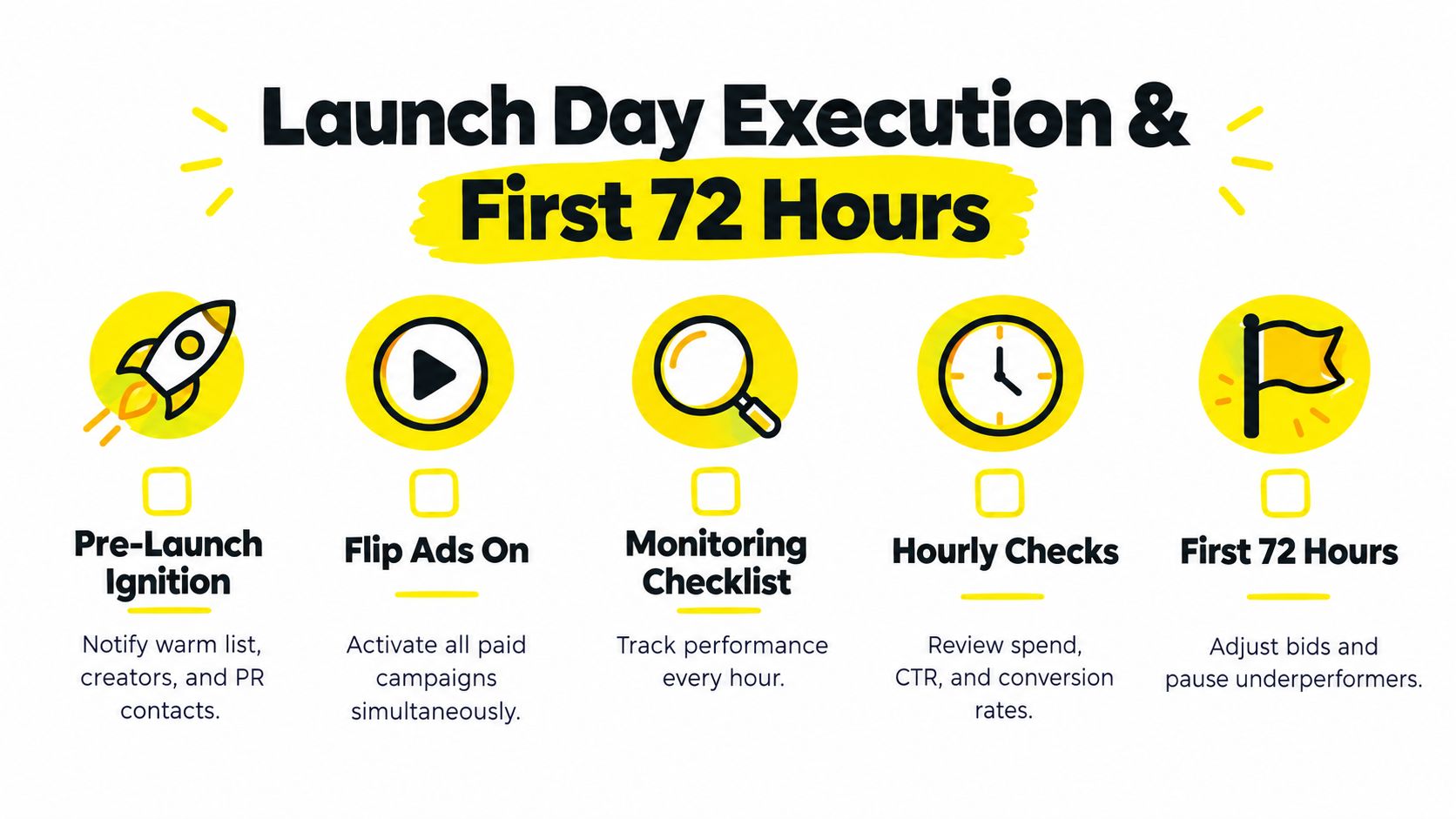
Launch day is an operating process. Confirm stock or service capacity, test the landing page and forms, verify tracking, and make sure someone owns customer questions before the first campaign goes live. Then coordinate the warm-list announcement, creator posts, press activity, and paid campaigns so prospects encounter a coherent offer rather than a series of disconnected messages.
A launch-day run of show
Use the team's local working hours, but give each checkpoint an owner:
Before the day starts: Confirm inventory, pricing, links, tracking, lead routing, customer support coverage, and the approved creative.
Morning: Notify the warm audience and partners. Publish launch content, then activate paid campaigns once the destination pages and purchase or booking flow pass a final test.
During the first working block: Check that campaigns are delivering, clicks reach the intended page, events fire, and leads or orders appear in the correct systems.
Later in the day: Review spend pacing, audience reach, frequency, site behavior, and customer questions. Fix operational faults before changing bids or rewriting creative.
At close: Record what changed, what was observed, and who owns the next review. Don't make a lasting budget decision from one noisy hour.
For lead generation, verify that a test submission reaches the right person and that the team responds promptly. For ecommerce, check stock status, shipping details, checkout errors, and customer-service coverage. Those operational checks often matter more than a quick bid adjustment.
Make the first 72 hours diagnostic
Early results are a chance to find broken links, mismatched messaging, tracking gaps, or poor-quality traffic. Pause an ad if the destination is wrong, the offer is misleading, or the campaign is spending without reaching the intended audience. Don't pause a relevant creative solely because a short window hasn't produced enough conversions to judge it.
Keep budgets controlled while you diagnose. If an ad attracts attention but the page doesn't convert, inspect the offer and page before blaming the platform. If leads arrive but aren't qualified, revisit targeting and the message that set expectations. When combining channels, look at unique reach and frequency across the campaign where available, since repeated delivery to the same people can obscure how much new audience the launch is reaching. Nielsen recommends evaluating reach alongside resonance and warns against over-serving exposures that no longer improve impact (Nielsen's guide to reach efficiency in digital campaigns).
Scaling Rules and Post-Launch Optimization With the Right KPIs
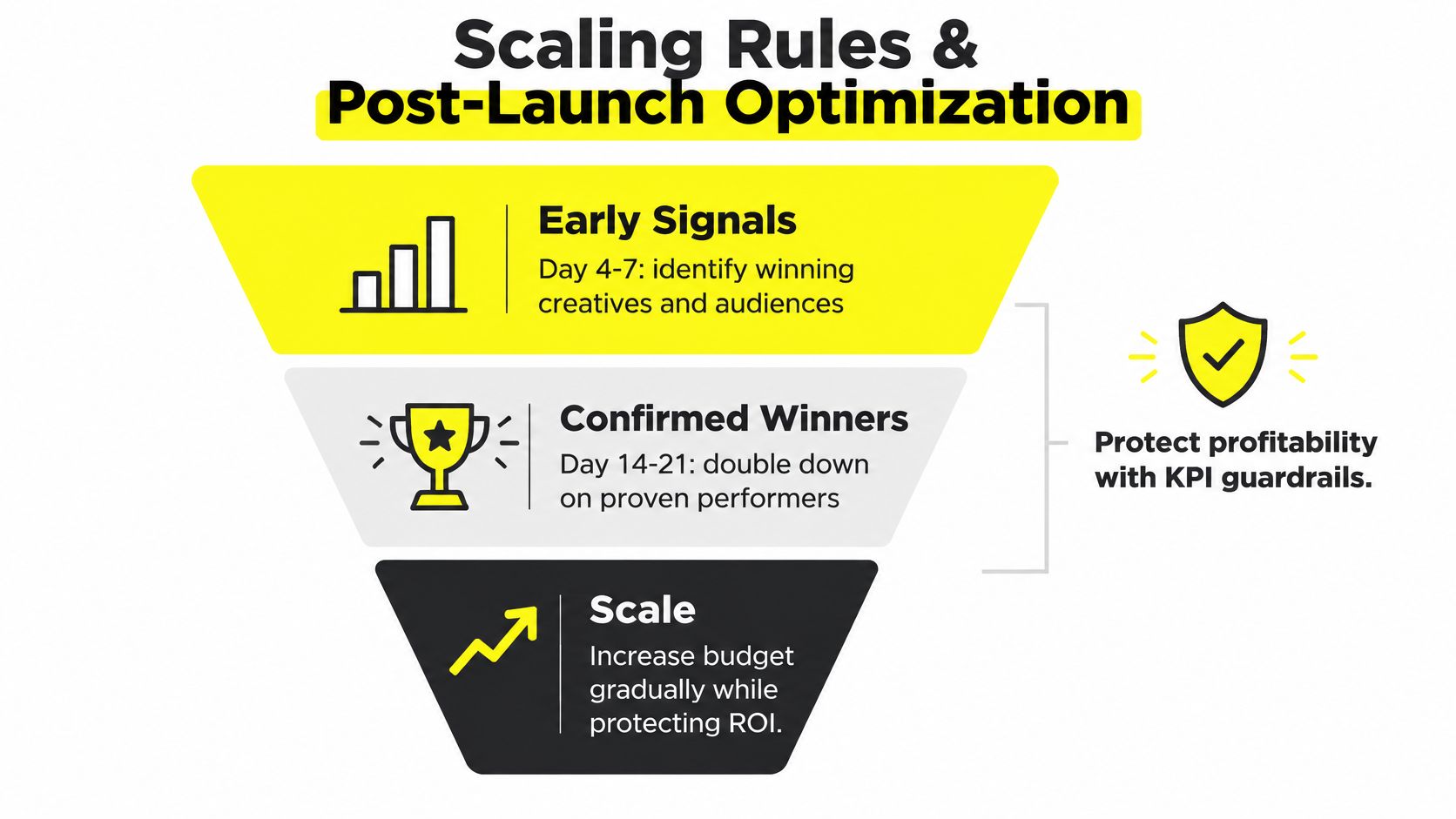
A launch isn't ready to scale just because one platform reports an attractive return. First decide whether the result is commercially sound: are new customers buying, does their contribution margin support the acquisition cost, and can the business fulfill more demand without damaging the experience? Treat early results as a signal to investigate, not permission to increase spend automatically.
Read the launch in layers
Start with the primary business outcome you defined before launch. Then review the supporting measures that can explain it:
Incremental new customers: Separate first-time buyers or qualified prospects from repeat customers and existing demand.
Contribution margin: Account for the costs that change with each sale, not just gross revenue.
Blended acquisition cost and payback: Assess the full campaign against the business's ability to recover the cost of acquiring a customer.
Unique reach and frequency: Check whether delivery is finding new prospects or concentrating on a narrow group.
Diagnostic metrics: Use CTR, CPM, and landing-page conversion rate to locate friction, not as the final definition of success.
When a controlled test is possible, compare outcomes between an exposed group and a comparable holdout. The prescribed incrementality calculation is \frac{Test-Control}{Control} for lift; incremental conversions are test conversions minus expected control conversions, and incremental CPA is spend divided by incremental conversions. Keep the test conditions comparable, including product, price, geography, seasonality, and promotion. If the control is too small or the test conditions changed, say so plainly rather than presenting a noisy comparison as certainty.
Scale only what the evidence supports
When performance is stable and the economics work, increase budget carefully enough to observe whether results hold. Expand toward relevant new prospects before increasing repeated delivery to the same audience. Refresh creative when the audience has seen it repeatedly or its response weakens, and preserve the versions that generated qualified demand so you can learn what changed.
Platform-reported ROAS and last-click revenue are useful views, but neither proves incrementality. A high reported return may include people who already intended to buy; a campaign aimed at new prospects can look weaker under last-click reporting while contributing to future demand. If those measures conflict, pause automatic scaling, check customer type and margin, and use a holdout or other credible comparison before assigning cause.
Common Launch Mistakes and a Reusable Pre-Launch Checklist
The budget leaks often come from decisions that feel efficient in the moment. A team launches with one creative, optimizes toward cheap clicks, sees a platform conversion report, and increases spend before checking whether those buyers are new or profitable. The fix is not another dashboard full of metrics. It's a clear decision rule for what the team will investigate and what would justify a change.
One creative carries the whole launch. Build distinct messages around the same defensible product truth, then compare how each attracts and qualifies prospects.
Frequency rises before reach does. Review unique reach and frequency, and redistribute spend if the campaign keeps repeating impressions to a narrow audience.
Cheap conversions become the goal. Check lead quality, first-time purchases, and contribution margin before calling a low-cost result successful.
Attributed conversions are treated as proof. Compare exposed and holdout groups where feasible, and separate existing demand from new-customer acquisition.
The page doesn't match the ad. Align the promise, price, proof, and next step across the creative and destination.
The team changes too much at once. Record each change and its reason so you can tell whether the adjustment helped.
If performance disappoints in the first week, check the sequence rather than making a blanket budget cut. Confirm that tracking works, the right audience is seeing the campaign, the promise matches the page, and the sales or fulfillment process can handle the response. Change the broken part first. If the evidence remains inconclusive, hold spend steady while collecting cleaner data.
Save this pre-launch checklist
Offer: Price, bundle, guarantee, eligibility, and terms are clear.
Proof: Product demonstrations, customer feedback, and claims are accurate.
Audience: The intended buyer and exclusions are documented.
Creative: Multiple distinct hooks explain one real product truth.
Landing page: The offer, proof, FAQs, and next step match the ads.
Tracking: Analytics, pixels, conversion events, and UTMs are tested.
Operations: Stock, booking capacity, lead routing, and support coverage are ready.
Budget: A responsible owner knows what can be spent and who can authorize changes.
Measurement: One primary business outcome, diagnostic metrics, and a holdout plan where feasible are defined.
Review ownership: Someone is assigned to record findings and decide what to change.
Wojo Media builds paid advertising campaigns across social and search, with offer refinement, landing-page work, creative development, and backend KPI tracking. If you want help applying a measurement-first launch plan to your offer, visit Wojo Media to discuss a campaign strategy.
Comments