.png)
Local Lead Generation Services That Actually Book Jobs

84% of consumers search for local businesses online daily, and 97% read reviews before deciding, so local lead generation services need to capture intent and convert it into booked work, not just clicks. The cheapest channel mix isn't always the most profitable one, because a lead costs little if nobody answers, qualifies, books, and tracks the resulting revenue.
At 9:14 a.m., a contractor's phone rings twice. Nobody picks up. In the Google Ads dashboard, yesterday's campaign shows 47 clicks and zero booked inspections. The agency report calls the traffic “strong.” The owner sees an empty schedule.
Those two descriptions can both be true. Local lead generation has become a multi-channel, performance-driven system measured in booked calls and jobs, not clicks. At the same time, the lowest-cost channel mix can produce the least profitable customers if response time, qualification, and attribution are weak.
The North America lead generation market is projected to exceed $15 billion by 2028, at roughly 12% CAGR, while blended cost per lead across channels is about $213.60. Local small businesses may see costs as low as $58 with the right channel mix, according to local lead generation market data. The practical question isn't which platform delivers the cheapest inquiry. It's which source produced a booked job that produced revenue.
The Local Lead Generation Shift You Should Not Ignore
The contractor in that office doesn't have a traffic problem. The business has a conversion and measurement problem. Forty-seven clicks can represent real demand, but they don't prove that anyone reached the company, spoke with a qualified employee, received a workable appointment, or became a paying customer.
That distinction changes how local lead generation services should be bought. A provider isn't managing a collection of isolated campaigns. The provider is building a system that catches demand, makes contact, filters fit, schedules work, and sends the outcome back into reporting.
Google's Local Services Ads reporting reflects this shift. Google describes reports that measure charged leads and separate them by call, message, and booking, rather than treating every interaction as equivalent. That product design supports an outcome-based buying model, where the meaningful event is a service opportunity rather than a page visit. You can review the framework in Google's Local Services Ads reporting guidance.
Practical rule: Treat impressions, clicks, and raw form fills as inputs. Treat qualified conversations, booked appointments, completed jobs, and collected revenue as outcomes.
The rest of the decision framework comes down to seven operating moves:
Define what a local lead generation service owns.
Match paid search, paid social, and LSAs to different demand conditions.
Find the leaks between impression and revenue.
Choose agency, in-house, or hybrid execution deliberately.
Require reporting that exposes qualified calls and booked jobs.
Build response speed, reviews, CRM workflows, and nurture around paid media.
Vet providers through a 30-day operating rhythm.
That framework prevents a polished dashboard from hiding an empty calendar.
What Local Lead Generation Services Really Do
A local lead generation service connects local demand to booked work. It identifies people seeking a service, captures their inquiry, qualifies the opportunity, and records what happened after the contact. The useful output is not a click. It is a call, appointment, or estimate request that can be tied to revenue.
The work spans four connected areas.
Demand capture
Google Search campaigns and Local Services Ads reach people already looking for help. Someone searching for emergency plumbing usually has stronger immediate intent than someone watching a plumbing video while browsing social media.
Meta and TikTok create or stimulate demand through audience targeting, creative, offers, and local relevance. Local SEO, Google Business Profile optimization, reviews, referrals, and city-specific pages add demand from owned and earned channels. Each source can work, but each should be judged by the jobs it helps produce.
Conversion infrastructure
A landing page should make the next action obvious. The action may be a call, estimate request, appointment, or service-area confirmation. A generic homepage often adds friction by making visitors search for the relevant service, location, proof, and contact option.
The intake form needs the same discipline. It can capture service type, urgency, location, and preferred contact method without turning the first interaction into an interrogation.
Qualification and handoff
The provider should connect forms, calls, booking events, and CRM records. For calls, that often includes dynamic number insertion, source storage, landing-page data, answered or missed status, and a disposition such as qualified, spam, out of area, or wrong service. Call-tracking best practices describe this source and outcome mapping as a practical foundation for channel decisions.
Optimization against business outcomes
The buyer is paying for more than media buying. The scope should include creative iteration, landing-page testing, call and form tracking, CRM integration, response workflows, and weekly optimization against qualified-lead and booked-job performance.
A serious provider can show how platform data connects to revenue. Impressions, clicks, and traffic help diagnose performance, but they are inputs. The operating question is which source produced a qualified conversation, which conversation became a booked job, and whether that job generated profitable work. That connection is what makes local lead generation accountable.
How Paid Search, Paid Social, and Local Services Ads Produce Leads Differently
The three channels can all generate inquiries, but they enter the customer journey at different points.
Paid search captures existing demand. Someone types a service-plus-location query, sees an ad, and chooses whether to call or submit a form. The trade-off is competitive auction pressure and potentially higher click costs. The advantage is intent. Search often gives the clearest path from query to booked service because the prospect is already evaluating providers.
Local Services Ads use a pay-per-lead model and place eligibility, screening, badges, reviews, and service category requirements inside the buying decision. Google explains that LSA reports focus on charged leads and break them down by calls, messages, and bookings. That makes LSAs attractive for eligible home-service categories, but the business must manage profile quality, responsiveness, disputes, and lead validity.
Paid social creates demand. Meta and TikTok can reach local audiences through creative, demographic signals, interests, retargeting, and lookalike audiences. Click costs can be lower than high-intent search, but cheap traffic doesn't remove the need for a strong offer, fast page load, convincing proof, and disciplined follow-up. Social usually needs more education before the prospect is ready to book.
Channel | Cost model | Intent level | Typical CPL range | Best for |
|---|---|---|---|---|
Paid Search | Pay per click | High, existing demand | Varies by service, market, and auction | Capturing urgent or actively researched service needs |
Paid Social | Usually pay per impression or click | Low to medium, demand creation | Varies by audience, creative, and offer | Creating awareness, generating consideration, and retargeting |
Local Services Ads | Pay per lead | High, category and location dependent | Varies by eligibility, market, and lead mix | Eligible local services that can answer and qualify calls quickly |
The benchmarks matter less than the booked-job economics. Independent benchmark material cited by local small-business lead research reports that home-service LSA accounts often generate 20 to 40 leads per month at budgets of $800 to $2,000, while higher-spend accounts can reach 40 to 80 or more leads monthly. The same material reports an average of 178 unique leads in 2025, up from 132 in 2024, a 35% year-over-year increase. These figures are directional, not a promise for an individual business.
The operating rule is simple: search funds demand, social creates it, and LSAs can reduce platform and eligibility friction when the category qualifies. Let booked-job data decide how much each channel deserves.
The Local Lead Funnel From Impression to Booked Job
A local lead passes through seven stages:
Impression, when a prospect sees the business.
Click, when the prospect engages with the ad or listing.
Form or call capture, when contact information or a conversation enters the system.
Response, when the business answers or follows up.
Qualification, when the team confirms service, location, urgency, and fit.
Booking, when an appointment or job is confirmed.
Revenue, when the work produces payment.
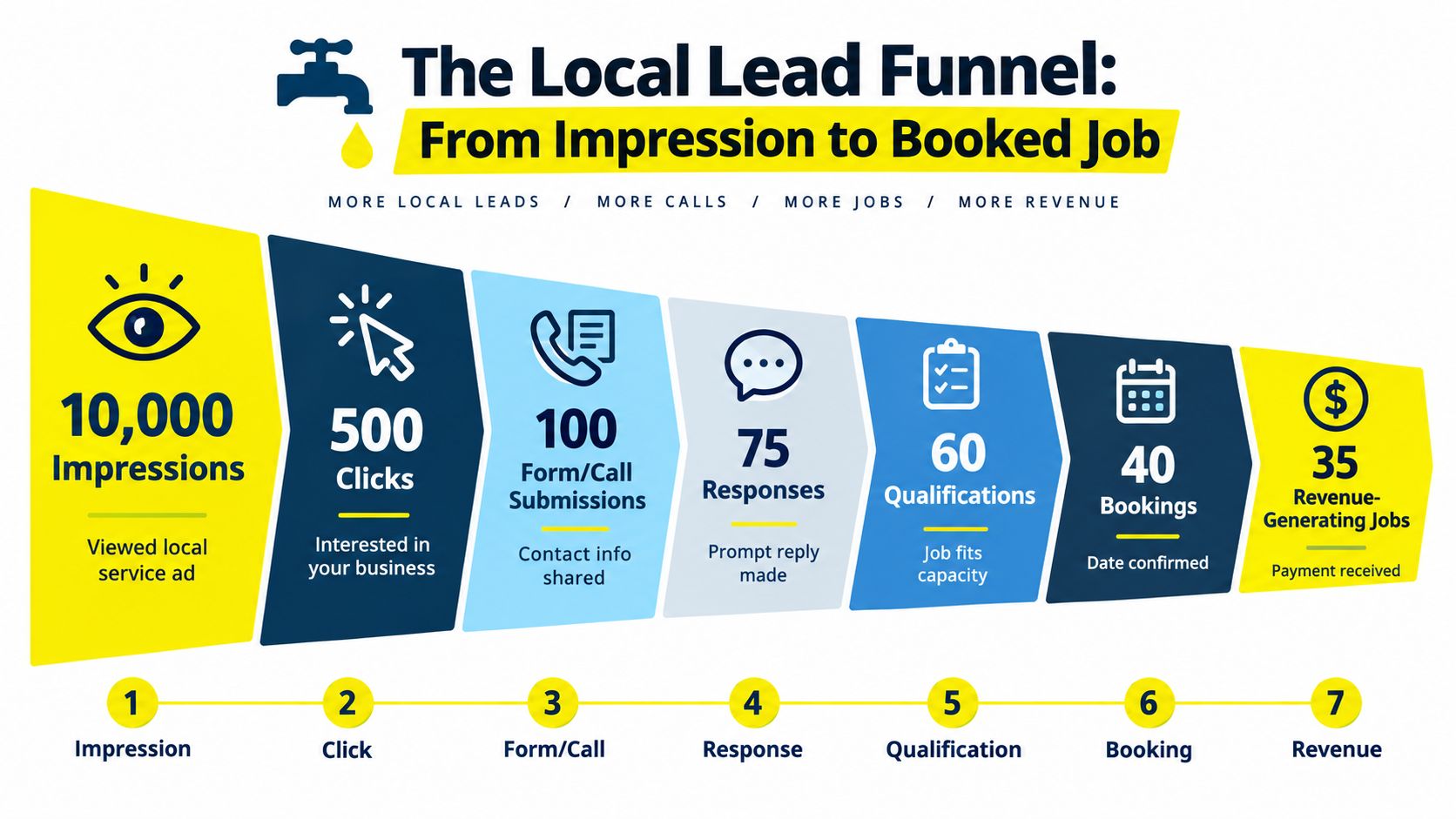
Take a plumber handling an urgent leak. The ad can be relevant, the landing page can load, and the prospect can submit a form. If the office calls back slowly, the homeowner may contact another plumber. If the intake form doesn't identify emergency work, the team may route the request into a general queue. If the CRM doesn't support two-way SMS, the prospect may never receive a confirmation.
That is why a click isn't a lead, a lead isn't a booking, and a booking isn't revenue. Each transition needs an owner and a recorded status.
Common leaks include:
Slow callbacks: Missed calls and delayed replies allow high-intent prospects to keep searching.
After-hours gaps: A campaign can generate demand outside office hours even when nobody monitors the phone.
Generic forms: The team can't prioritize urgent jobs or reject out-of-area requests efficiently.
Broken handoffs: A CRM that doesn't sync with booking tools leaves staff working from incomplete records.
Unclear dispositions: Without labels for spam, wrong service, or booked work, optimization becomes guesswork.
Use this language with any provider. Ask for the count and rate at every stage, then ask where the system loses prospects. A provider that reports only clicks can't tell you whether the problem sits in targeting, the page, the phone process, qualification, scheduling, or service delivery.
Agency vs In-House Tradeoffs for Local Lead Generation
The right operating model depends on how much volume, complexity, and internal feedback your business can support. An agency brings a ready-made acquisition team, but it can't compensate for an office that misses calls or refuses to classify outcomes. An internal team knows the operation well, but may lack cross-channel testing experience.
Dimension | Agency | In-House | Hybrid |
|---|---|---|---|
Cost structure | Retainer plus media and specialist tools | Salaries, training, software, and media | Focused agency fee plus an internal owner |
Speed to launch | Usually faster because systems already exist | Slower while hiring and building processes | Fast acquisition launch with internal operations setup |
Expertise depth | Access to search, social, creative, tracking, and landing-page specialists | Deep product and service knowledge | Specialists acquire demand while staff own customer context |
Attribution discipline | Can provide cross-channel dashboards and benchmarks | Strong first-party access if systems are maintained | Shared ownership, with clear CRM and revenue definitions |
When an agency earns its fee
Agencies make sense when the business needs multi-channel scale quickly, lacks platform specialists, or has fragmented attribution. They can compare campaign structures across accounts, identify tracking gaps, and run creative and landing-page tests without building every role internally.
The risk is distance from operations. If the agency optimizes to form volume while the office optimizes to booked work, both teams can claim success while revenue suffers. Contract terms should define data ownership, call access, CRM visibility, and the exact event used for optimization.
When internal execution wins
In-house teams tend to perform well when lead volume is high, the sales motion is unusual, and dispatchers or salespeople can give immediate feedback to marketers. A roofing company with complex inspection rules may benefit from marketers who sit beside the scheduling team and hear why leads fail.
The cost isn't just payroll. The business must also maintain tracking, creative production, landing pages, platform knowledge, reporting, and testing discipline.
A hybrid model often works best for local service brands. The agency handles paid acquisition, creative, landing pages, and measurement. An internal owner controls intake, call answering, qualification, scheduling, and revenue reconciliation. This preserves specialist execution without outsourcing the customer experience.
KPIs and Reporting Standards to Require From Any Provider
A provider can make lead volume look healthy while hiding poor lead quality. Require a report that connects media to calls, calls to bookings, and bookings to revenue.
The minimum dashboard should include:
KPI | Why it matters | Target benchmark |
|---|---|---|
Qualified-call rate | Separates relevant opportunities from raw call volume | Establish a baseline by service and location |
Average call duration by outcome | Helps distinguish serious conversations from misroutes and short inquiries | Compare booked, qualified, missed, and non-booked calls |
Speed to lead | Shows how quickly the team responds to forms and missed calls | Set an internal service-level target and report actual response time |
Cost per qualified lead | Connects media spend to usable opportunities | Compare by channel, campaign, and service |
Cost per booked job | Shows acquisition efficiency closer to revenue | Set from job economics, not platform averages |
Show rate | Reveals whether booked appointments become attended opportunities | Segment by source and appointment type |
Closed revenue by channel | Proves which sources create financial value | Reconcile CRM and payment data weekly |
Call tracking guidance identifies call duration, answer rate, calls by source, and qualified-call rate as practical optimization signals. The local lead-generation call-quality guidance also recommends mapping calls to booked appointments or closed jobs, because raw inquiry volume can conceal spam, wrong-service requests, and operational losses.
Why duration needs context
A call lasting more than 90 seconds can be a stronger booked-job proxy than a form submission, but duration isn't a universal qualification rule. A short call may be a perfect booking, while a long call may end with an out-of-area request. Use duration as a filter, then verify the disposition and booking status.
Report unique callers and repeat-caller rate as well. Duplicate calls can inflate lead counts and make a campaign look stronger than it is. A weekly report should show source, landing page, campaign, call status, duration, qualification, booking, and revenue wherever the data exists.
A contract can state:
Reporting requirement: Provider will report weekly by channel, campaign, and service area, including qualified calls, call duration by disposition, response time, cost per qualified lead, cost per booked job, show rate, and closed revenue. Optimization recommendations must reference booked-job and revenue data, not lead volume alone.
That clause turns reporting from a presentation into an operating control.
Why Paid Ads Alone Are Not the Whole Answer
Paid media creates an opportunity. The business creates the customer through response, qualification, trust, and follow-up.
A local prospect may click an ad, call, and reach voicemail. The same prospect may submit a form and receive a generic automated email. A second prospect may see strong reviews, get a text confirmation, and speak with a helpful coordinator within minutes. The campaigns could be identical. The outcomes won't be.
The local lead generation systems analysis identifies CRM integration, call tracking, fast response, and backend KPI monitoring as core requirements, while noting that many public playbooks stop at Google Business Profile optimization, reviews, and geo-targeted ads. That gap leaves businesses unable to prove which channel created profitable customers.
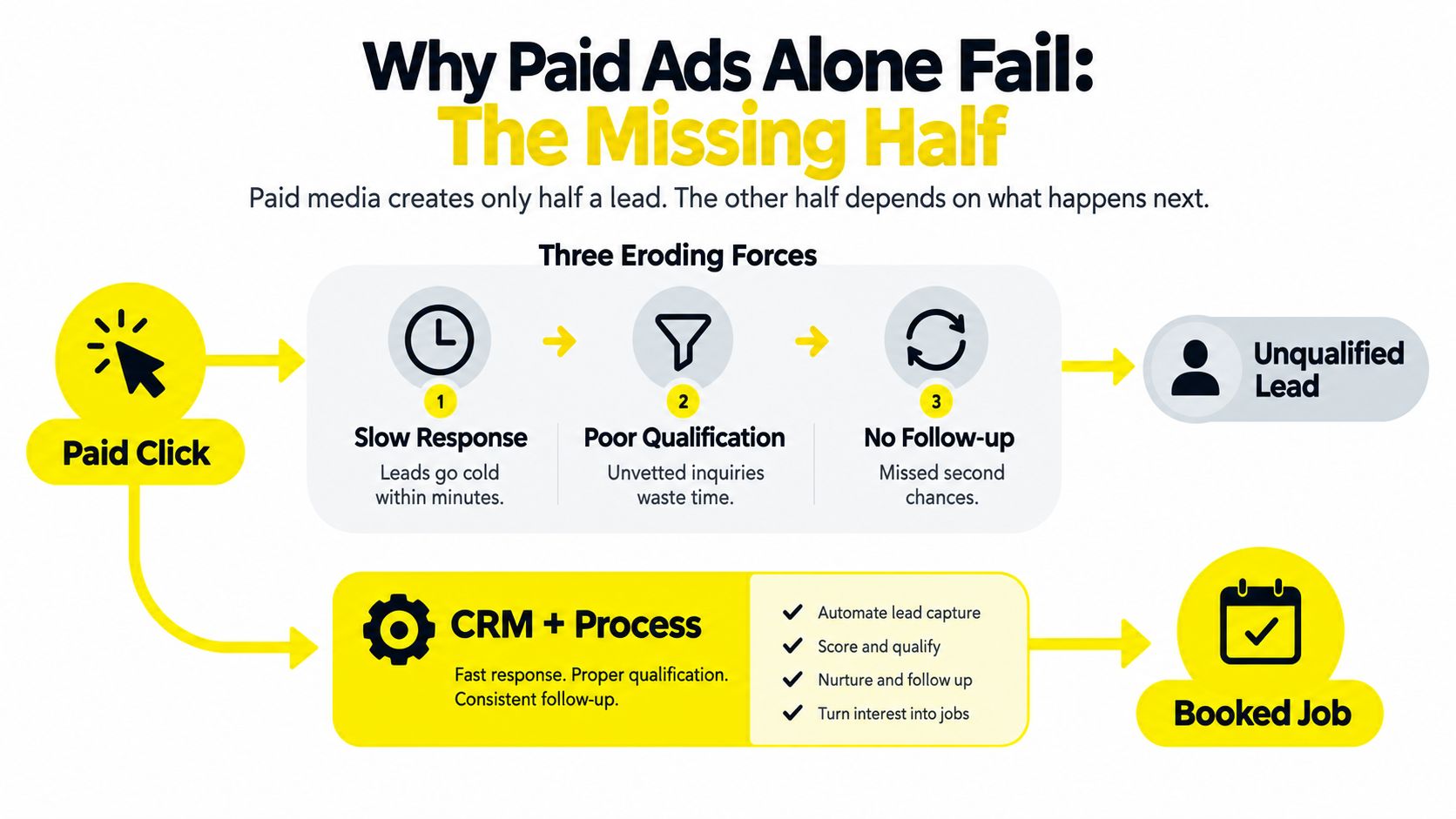
A blended stack typically includes:
Paid acquisition: Search and LSAs capture urgent intent, while Meta or TikTok support demand creation and retargeting.
Conversion assets: Service-specific pages, clear offers, local proof, click-to-call options, and short qualification forms.
Response workflows: Immediate confirmation, call routing, two-way SMS, missed-call text-back, and assigned ownership.
Reputation signals: Google Business Profile maintenance and a consistent process for requesting genuine reviews.
Nurture: Email and SMS follow-up for prospects who don't book during the first conversation.
Revenue feedback: CRM dispositions that pass booked and closed outcomes back to marketing.
Recent guidance argues that response within five minutes can decide who wins the job, and identifies paid search, local SEO, Google Business Profile optimization, referrals, and direct follow-up as complementary parts of a local pipeline in local lead generation trend analysis. That doesn't mean every business needs every channel immediately. It means increasing ad spend without fixing response and follow-up can amplify waste.
The practical test is operational. Run a response-time experiment, compare answered and missed calls, and measure booked jobs by source. If the same media produces more revenue after the handoff improves, the next budget decision isn't necessarily “buy more clicks.” It may be “make the business reachable.”
Evaluating Providers and Your Next 30 Days
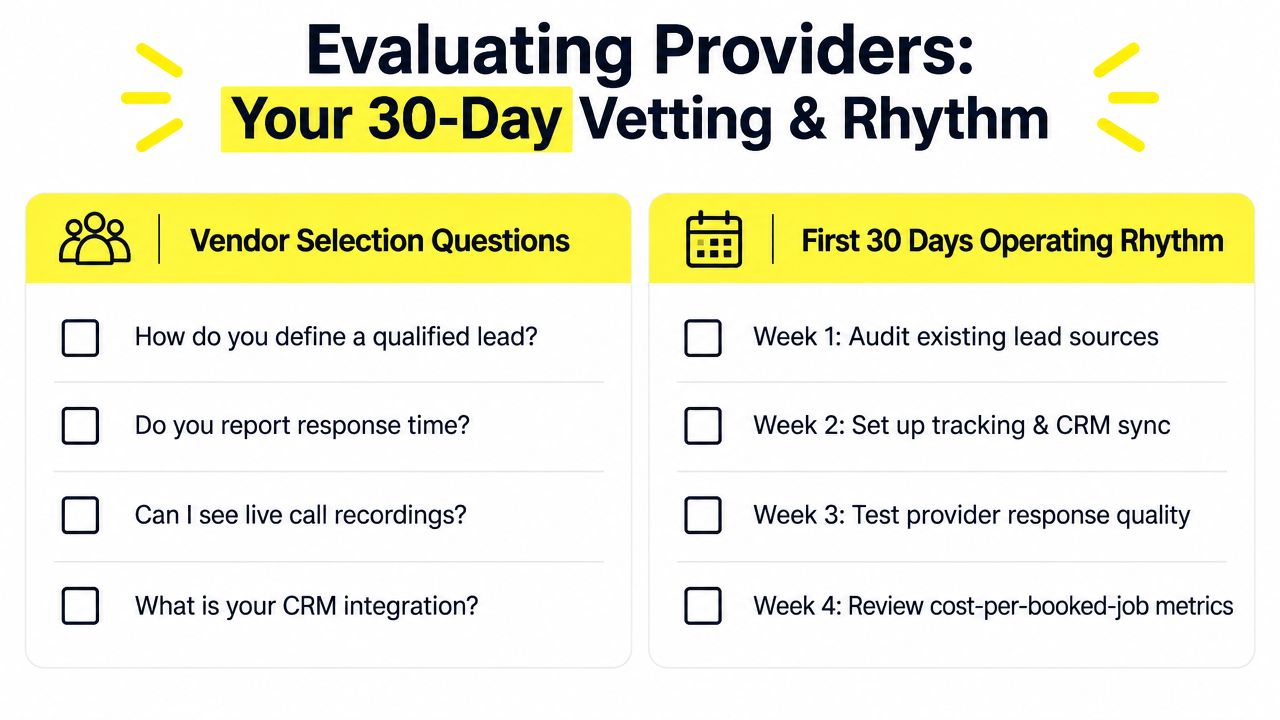
A provider should answer five questions before receiving more budget:
Qualified lead definition: Does “qualified” mean a form submission, a relevant conversation, or a job that fits your service area and capacity?
Booked-job reporting: Can the provider connect leads to bookings and closed revenue, or only report platform activity?
Attribution resolution: How are calls, forms, repeat contacts, offline bookings, and CRM records matched?
CPL response: What changes when cost per lead rises, lead quality drops, or the campaign attracts the wrong service?
Budget decisions: Are recommendations based on qualified opportunities and revenue rather than click volume?
Reject dashboards that hide campaign-level data, retainers that provide no cost-per-lead visibility, and providers that will not share call recordings. Optimization should reach the booking desk and the revenue report, not stop inside an ad platform.
Use the first 30 days to produce evidence:
Week 1: Audit historical sources, missed calls, form quality, booking records, and revenue fields.
Week 2: Set up call tracking, dynamic number insertion, CRM synchronization, source capture, and outcome dispositions.
Week 3: Test response quality for calls, forms, missed-call text-back, and after-hours inquiries.
Week 4: Compare cost per qualified lead, cost per booked job, show rate, and closed revenue by channel.
The local lead attribution guide supports recording source, landing page, call status, and disposition. Use those fields to measure attribution coverage and how often marketing records match revenue. A provider should be able to explain missing records and disputed outcomes with evidence.
Wojo Media is one option for businesses seeking paid acquisition connected to landing pages, CRM capture, lead scoring, follow-up workflows, and backend KPI reporting. The vendor matters less than whether it accepts booked revenue as the performance standard.
If clicks cannot be connected to qualified calls, booked jobs, and revenue, visit Wojo Media with your campaign, call, and booking data. The review should identify where profitable opportunities are being lost.
Comments