
TikTok Ads for Shopify: A Merchant Playbook That Works

“Install the pixel, launch a Spark ad, and watch ROAS” is bad advice if you've already lost money on TikTok. It treats connecting your store as proof that your measurement works, then treats attributed purchases as proof that your ads generated profitable demand.
TikTok ads for Shopify need a stricter operating system. Verify the purchase signals, separate customer acquisition from demand capture, and reconcile reported revenue against money your business keeps. Only then should you decide which creative deserves more budget and whether shoppers belong on your website or inside TikTok Shop.
Why Most Shopify Brands Fail at TikTok Ads
The technical connection isn't the hard part. TikTok and Shopify announced their integration on October 27, 2020, with one-click pixel installation and shoppable in-feed video, designed to serve more than 1 million merchants, according to the official TikTok Shopify app information.
That made launching accessible. It didn't make every launch commercially sound.
My diagnosis starts with a simpler question than targeting: What evidence would make you stop spending? If your answer depends entirely on the number in Ads Manager, you haven't defined a business test.
The leaks to investigate first
Before commissioning more videos, audit these failure modes:
Browser-only measurement. You're making decisions with an incomplete view of the purchase journey.
Inconsistent attribution settings. You're comparing campaigns that receive credit under different rules.
Revenue mistaken for profit. You're celebrating sales without accounting for product costs, fulfillment, discounts, and refunds.
These are operating failures, not proof that your product can't sell through TikTok. The reverse is equally important: fixing them won't rescue a weak offer.
A founder who's already wasted money doesn't need encouragement to keep spending. You need boundaries around the next test: a defined commercial hypothesis, an affordable loss limit, and a clear reason to continue or stop.
Practical rule: Treat early spend as a controlled investigation, not permission to tolerate unexplained losses.
Reset what success looks like
I'd evaluate TikTok as a discovery channel with a purchase obligation. Your ads should introduce a product convincingly, but attention alone doesn't justify an acquisition budget.
Don't expect an audience setting to compensate for unclear demonstrations, unexpected shipping costs, or a landing page that contradicts the video. Equally, don't reject a useful acquisition channel because the last-click report misses part of its contribution.
Your working standard should be demanding: creative that produces commercially useful behavior, measurement you can defend, and incremental profit that survives reconciliation. Keep producing new creative hypotheses, but don't confuse output volume with learning. Each test should answer something specific about the buyer, product, or offer.
Setting Up TikTok for Business and the Shopify Pixel
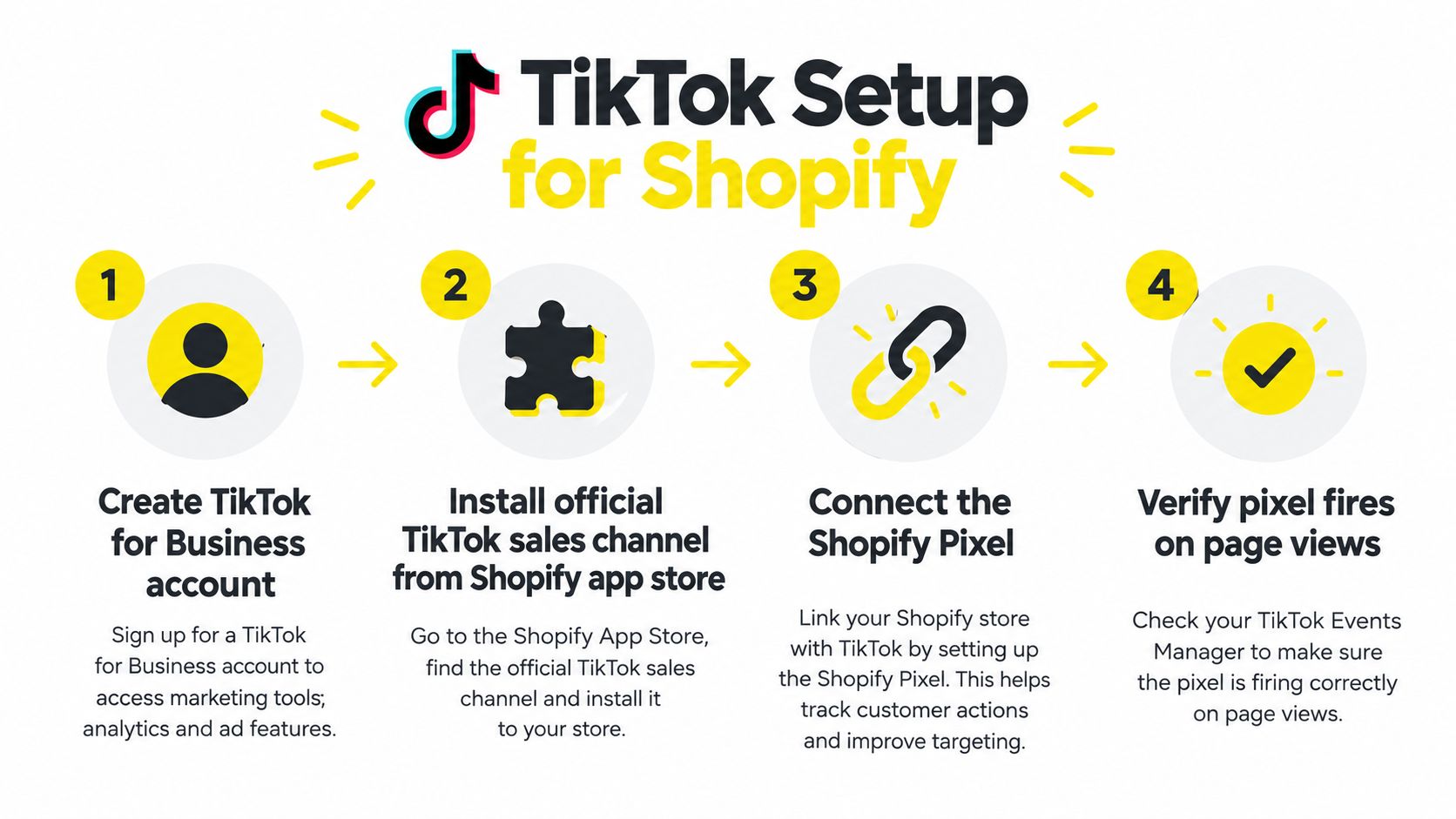
Use the official integration rather than assembling overlapping tracking installations. Your objective isn't a green connection badge. It's a reliable event trail from product interest to a completed Shopify order.
Use this setup flow as the starting point, then run the purchase-level checks below.
Connect the account and measurement layers
Create or connect your TikTok for Business account through the TikTok sales channel in Shopify. Confirm that the advertising account, store, and product catalog belong to the intended business before connecting measurement.
Then evaluate Enhanced or Maximum data sharing, rather than accepting browser-only tracking by default. TikTok's Shopify data-sharing documentation describes Enhanced as adding Events API and Advanced Matching, while Maximum can also incorporate Shopify APIs.
Choose the appropriate level alongside your consent and privacy requirements. More customer data isn't automatically the right implementation, and server-side transmission doesn't remove those obligations.
The Pixel and Events API have complementary jobs. The browser captures on-site behavior; the server connection supplies another route for conversion events. TikTok describes Events API as less dependent on cookies, browser connectivity, and third-party code.
In its Shopify Pixel and Events API guidance, TikTok reports 19% more events captured and a 15% improvement in cost per action among advertisers using both. Those are platform-reported averages, not a promised Shopify-store result.
Run a purchase-level QA sequence
Don't stop after confirming a page view. Run this sequence in TikTok Event Manager and Shopify:
Trace the funnel. Verify ViewContent, AddToCart, InitiateCheckout, and Purchase as you move through the store.
Place a test order. Inspect the browser and server event streams for the same transaction.
Check deduplication. Confirm matching event IDs identify the browser and server Purchase signals as the same purchase, not separate conversions.
Inspect commercial fields. Compare the event's value and currency with the Shopify order.
Document the result. Save the order reference, event evidence, and any discrepancy before approving campaign launch.
A test order validates event delivery. It doesn't validate advertising attribution, because a direct test purchase may have no eligible ad interaction.
Avoid sending Purchase alone. You need the intermediate funnel events to diagnose where shoppers disengage. If checkout starts disappear while purchases still arrive, investigate the implementation rather than assuming buyer behavior changed.
Don't change bid strategy to compensate for broken signals. Repair the event pipeline first, then judge campaign performance.
Campaign Structure That Scales Without Cannibalization
A complicated account isn't necessarily a disciplined account. I'd rather see a manageable prospecting campaign and clearly separated retargeting than a collection of audience fragments that can't support meaningful decisions.
The key distinction is finding new buyers versus converting people who already know you. Give those jobs separate reporting and budgets. Otherwise, warm-audience purchases can make acquisition look healthier than it is.
Recommended TikTok Campaign Structure for Shopify
There's no defensible universal budget percentage. Allocate money according to audience capacity and verified acquisition economics, not a template presented as a benchmark.
Funnel Stage | Campaign Objective | Audience | Suggested Budget Share |
|---|---|---|---|
Prospecting | Website purchase acquisition | Cold broad audiences, with warm exclusions where feasible | Majority of testing budget |
Prospecting experiments | Website purchase acquisition | Interest or purchaser-based lookalike hypotheses | Limited allocation carved from prospecting |
Retargeting | Website purchase conversion | Site visitors and product-aware nonbuyers | Smaller, capacity-limited share |
High-intent recovery | Website purchase conversion | Cart and checkout abandoners | Constrained by eligible audience size |
Existing customers | Repeat purchase | Past purchasers | Separate retention allocation |
Don't launch every row automatically. Combine closely related warm audiences if separating them would create thin, overlapping groups. Keep existing-customer revenue outside your new-customer acquisition assessment.
Use a naming convention such as:
For an ad, append the creator, opening concept, and version. Someone reviewing Shopify orders should be able to connect a campaign name to a test without asking the buyer to translate it.
Control spend before delegating allocation
My recommendation is ad-group budget control during diagnosis and campaign-level allocation once the test cells have earned comparable confidence. With ad-group budgeting, you can reserve spend for a hypothesis. With campaign-level budgeting, you delegate more of that allocation.
Neither setting establishes that your test is fair. Keep the offer, landing page, geography, attribution settings, and other major variables stable when comparing results.
For bidding, begin with a delivery-oriented approach while establishing an actual purchase-cost baseline. Introduce cost controls only when you have a margin-backed acquisition target. Don't set an aspirational cap and interpret restricted delivery as proof that TikTok can't find buyers.
Separate reporting makes cannibalization easier to investigate. It doesn't prove that retargeting generated additional sales.
Use the TikTok attribution framework to standardize campaign comparisons. For material allocation decisions, require backend evidence and a lift test rather than moving budget toward whichever audience reports the prettiest ROAS.
UGC and Spark Ads Creative Playbook
A person holding your product isn't a creative strategy. UGC needs a sales argument, not just a creator, captions, and background music.
Brief creators around a buyer's unresolved question. The filming setup matters less than whether the footage answers it.
TikTok's commerce discovery materials report that 70% of users discover new brands and products, 75% are likely to buy something while using the platform, and 83% say TikTok influences purchase decisions. These describe platform-level behavior, not your store's expected conversion rate.
Give creators a usable brief
Send a product page, a specific customer objection, approved claims, and the action you want the viewer to take. Request footage that your editor can reshape, rather than only a finished video.
Opening concept. Start with the problem, use case, or visible result. Social Media Scheduler's resource on scroll-stopping hooks can help generate opening hypotheses, but relevance should decide what you film.
Product demonstration. Show the actual use process, including anything a buyer could misunderstand from a still image.
Proof and limitations. Use genuine customer experience or observable product behavior. Don't script fabricated testimonials or unsupported transformations.
Clear close. Match the advertised product, offer, and next step to the Shopify product detail page.
Test problem-solution, unboxing, genuine social proof, and before-and-after demonstrations where the comparison is truthful and appropriate. Treat them as hypotheses, not formats with guaranteed profitability.
For instance, an unboxing can answer what arrives in the package. A demonstration can answer whether the product fits a particular use case. Those are different buying objections, so don't judge both solely by engagement.
Use the video below as a discussion aid when briefing your creative team, not as evidence of expected results.
Amplify evidence, not popularity
Use Spark Ads when an existing creator post contains a persuasive product argument and you've secured the necessary authorization. Use standard in-feed creative when you need more control over edits, variants, or the message.
Organic popularity is a reason to investigate a post, not an automatic buying signal. Review whether paid traffic progresses through product views, carts, checkout, and profitable orders.
Set a recurring production cadence your team can sustain. Let tests mature according to spend and downstream evidence, not an arbitrary calendar deadline. Graduate an ad when it improves customer economics; revise it when attention increases but qualified purchase behavior weakens.
Tracking LTV and Real ROAS Beyond the Dashboard
Attributed revenue is a reporting output. Incremental profit is the business objective. If your finance discussion ends at platform ROAS, you're leaving the most important question unanswered: what did the advertising add?
TikTok's attribution documentation, referenced earlier, includes assisted purchases following exposure within 28 days. That can help explain influence, but exposure before purchase doesn't establish that the ad caused the purchase.
Build a commercial reconciliation
Use a funnel report to locate the problem, then an order-level report to price it.
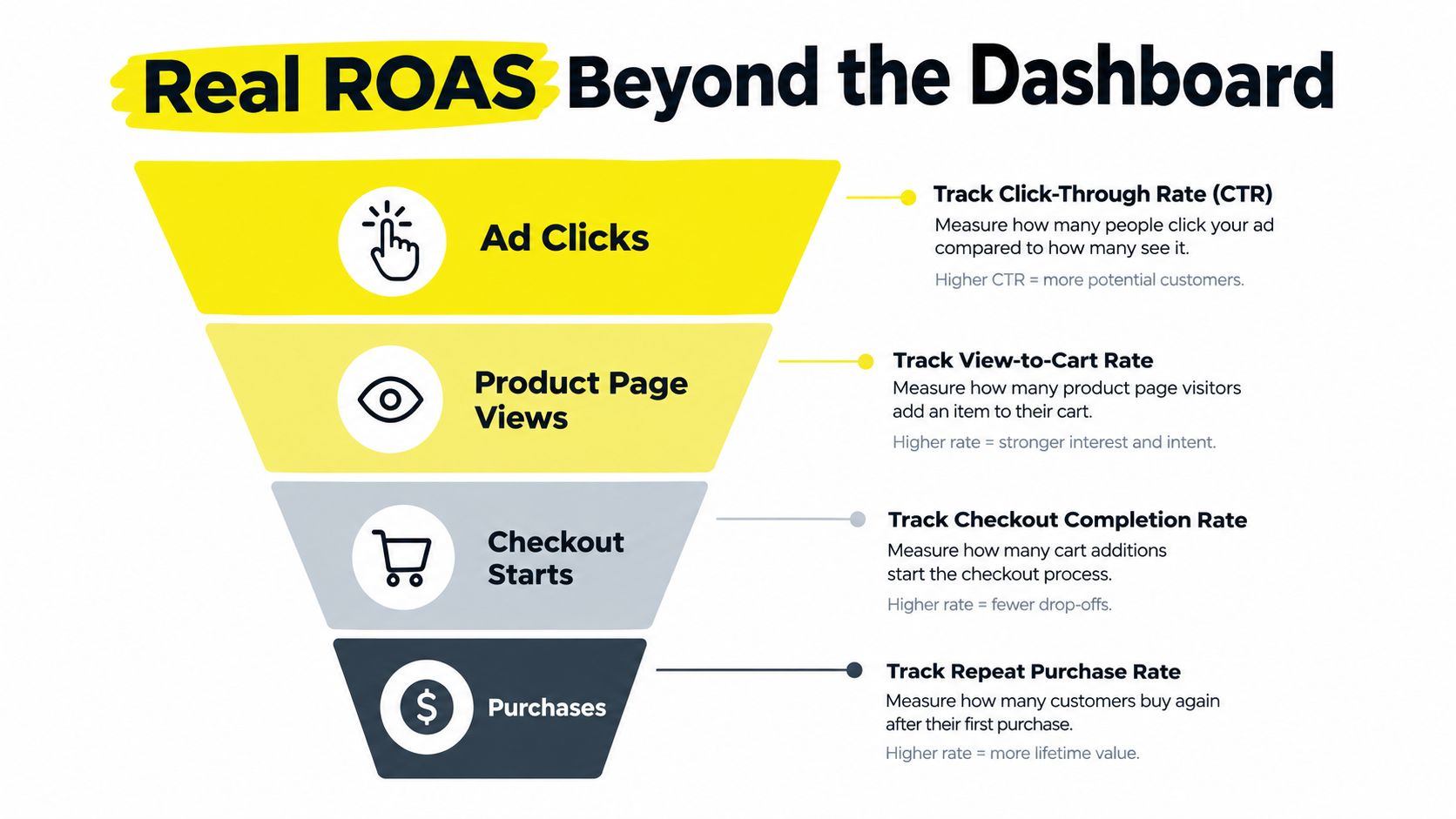
Maintain distinct views rather than forcing every system to report identical revenue:
Measurement view | What it answers |
|---|---|
TikTok-attributed revenue | Which purchases TikTok credits under its attribution rules |
Shopify source and UTM reporting | How orders are classified in your store |
Order contribution | What remains after variable order costs |
Blended CAC | Total acquisition spending relative to new customers acquired |
Customer-cohort contribution | Whether acquired customers generate profitable repeat business |
Incremental lift | What changed because advertising ran |
For the underlying reporting discipline, Wistec's guide to website analytics for business growth provides useful context. Keep your actual reconciliation anchored to Shopify orders and documented metric definitions.
Calculate pre-ad contribution from net sales after refunds, less product costs, fulfillment, shipping subsidies, payment fees, and applicable commissions. Then subtract acquisition spending to evaluate post-ad contribution. Use consistent accounting treatment across reports.
Keep UTMs consistent, preserve order identifiers, and investigate discount codes that obscure source classification. Treat unexplained revenue differences as reconciliation work, not evidence that whichever dashboard looks better must be right.
Separate customer value from optimistic forecasts
Review repeat purchase behavior by acquisition cohort over a fixed observation period. Don't use mature customers' lifetime value to justify aggressive spending on a new cohort whose retention you haven't observed.
A practical acquisition ceiling starts with realized contribution and a payback period your cash position can support. Future repeat orders can expand that ceiling only when cohort evidence supports them.
Finance test: If the campaign requires unproven repeat purchases to look profitable, you're financing a forecast.
Before a material increase, use a feasible holdout or geographic test. Define the comparison groups, outcome, and evaluation period before launch; avoid changing promotions or other major acquisition activity unevenly during the test.
Better event matching strengthens measurement. It doesn't establish causality. Require incremental contribution to justify scale, especially when retargeting claims substantial revenue that may have happened anyway.
TikTok Shop Ads vs Shopify Checkout
Choose the checkout destination around the buying job, not whichever dashboard reports stronger returns. TikTok Shop and Shopify website campaigns don't use interchangeable attribution rules.
TikTok's Shop Ads attribution documentation states that orders are attributed using Shop ID, with a 7-day click window and 1-day view window, giving clicks priority over views. Attribution can also include affiliate creator videos.
That makes a direct ROAS comparison with website campaigns unreliable unless you account for the different rules.
Choose the destination by operational needs
Use this comparison as a starting point, then verify the economics and customer-data access available to your business.
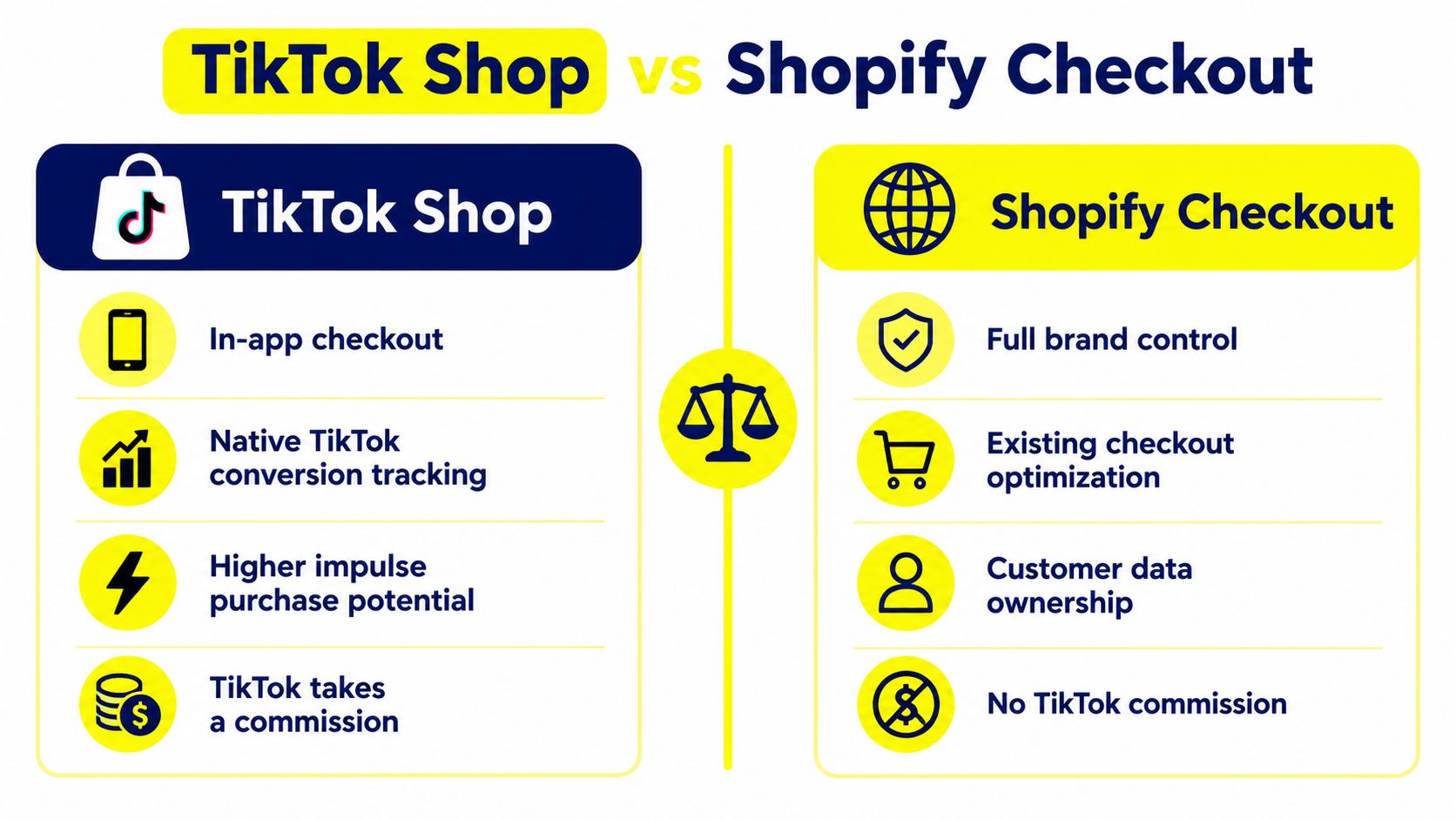
My default recommendation is Shopify checkout when the customer relationship needs more depth. Favor it when subscriptions, detailed product education, CRM workflows, or post-purchase personalization are central to the purchase.
Test TikTok Shop when immediate purchase convenience and creator-led distribution are the main hypotheses. A straightforward product with an easily demonstrated use case is a more sensible starting point than an offer requiring extensive configuration or consultation.
Choose Shopify first if you need to explain the purchase carefully and manage a richer branded customer journey.
Test TikTok Shop first if you want to investigate whether an on-platform purchase path improves profitable order completion.
Run a bounded comparison if both paths fit, keeping the product, offer, and creative proposition as comparable as practical.
Don't describe either destination as automatically cheaper. Include the actual fees and operational costs your business incurs.
Compare retained contribution
Build a unified channel P&L with separate order identifiers for each environment. Reconcile sales, refunds, product costs, shipping, fulfillment, creator commissions, platform charges, and acquisition spend before comparing profitability.
Then assess customer quality: repeat purchases, refund behavior, service burden, and the customer information you can legitimately use afterward. Don't assume either environment gives you the same usable customer profile.
The winning checkout is the one that produces more defensible contribution within your operating constraints. A smoother purchase path is useful only if the economics survive the completed order.
A 30-60-90 Day Scaling Plan for Shopify Brands on TikTok
Use the 30-60-90 day plan as a proposed operating schedule, not a promise that an account will become scalable on a deadline.
Establish the foundation
During the opening phase, complete purchase QA, adopt the naming convention, and test a manageable creative backlog. Define your acquisition ceiling and stop conditions before approving additional spend.
Keep tests narrow enough to explain. Don't launch so many audience and creative combinations that nobody can identify what changed.
Expand only after commercial validation
In the middle phase, develop creator partnerships and introduce retargeting where audience capacity supports it. Increase budgets only when reconciled contribution and blended acquisition costs justify the decision.
Coordinate retention with acquisition. Yassine Malti's email and paid ad tactics for stores offer useful context for planning the follow-up experience alongside paid traffic.
Scale with explicit brakes
In the final phase, expand validated creative, evaluate the appropriate checkout test, and use observed customer value to refine acquisition limits.
Pause expansion when you see:
Weaker purchase progression, including falling cart rates or rising checkout abandonment.
Deteriorating order quality, especially increasing refunds or service problems.
Unexplained reporting gaps between attributed revenue and backend results.
Unacceptable payback, even when platform ROAS appears healthy.
Fix the failing component before buying more traffic. Scaling should follow evidence, not pressure to recover previous losses.
Wojo Media offers TikTok ecommerce advertising, creative production, landing-page work, and backend KPI tracking. If you want help connecting those pieces around your Shopify store's economics, visit Wojo Media to discuss your offer, measurement gaps, and the conditions your next campaign must meet before you increase spend.
Comments