
Real Estate Wholesaling Leads: How to Find and Close Them

Investors purchased approximately 18% of all U.S. homes sold in 2025, according to Redfin-based figures summarized in industry data. That demand does not make every inquiry valuable. A real estate wholesaling lead only earns money when a seller signs an assignable contract and a verified buyer closes it. Judge every channel by that endpoint, not by how cheaply it fills your CRM.
Lead Sources Compared by Cost and Quality
A cheap inquiry from a homeowner who wants full retail price is worth less than a pricier conversation with an owner who has equity, a deadline, and authority to sign. That's the trade-off behind every source below. I would rank real estate wholesaling leads by signed contracts and completed assignments first, then work backward to cost per lead.
What Each Source Does Best
Direct mail reaches absentee owners and inherited properties that rarely respond to ads. It is slow, and bad address data wastes postage before you've learned anything about motivation. Before a batch goes out, clean the file and standardize every record. A practical walkthrough on how to reformat mailing addresses helps you catch formatting errors that cause returned mail and mismatched duplicates.
Cold calling works best on lists you've already screened for a distress event, equity, and occupancy. Calling an unscreened list burns dialer time on owners with no reason to sell below market. Foreclosure-event lists sit at the other end of that problem, because the owner has a dated legal filing you can verify before first contact.
Practical rule: If a channel can't be tied to appointments, contracts, and fallout in your CRM, you don't have a lead source yet. You have an expense with good stories attached.
Paid search captures people actively looking for a way to sell, and that intent is expensive. In 2024, the average cost per click for a real estate investor Google ad was $25.20, according to Carrot's 2025 investor marketing report. At that click price, a weak landing page or slow callback destroys the math fast. Search fits high-intent sellers and buyer recruitment better than broad awareness.
Paid social on Facebook, Instagram, and TikTok does the opposite job. It builds awareness with owners who aren't searching yet, so your creative has to name a situation, such as an inherited house, a vacant rental, or a relocation deadline. The 2025 National Association of REALTORS technology survey found that 39% of respondents identified social media as the technology producing the highest number of quality leads, ahead of CRM systems and local MLS systems, as summarized in Connecticut's real estate wholesaling guidance page. That does not prove social leads close wholesale deals in your market. It only justifies testing social with downstream tracking instead of dismissing it.
Source | Best for | Quality signal |
|---|---|---|
Direct mail | Absentee owners and inherited properties | Response rate per mail piece and mail batch |
Cold calling to screened lists | Owners with a distress event on record | Connected-call rate and appointment rate |
Paid search (Google) | Active sellers and buyers searching with intent | Contract rate per click source |
Paid social (Facebook, Instagram, TikTok) | Building seller awareness and intent | Named by 39% of NAR 2025 survey respondents as top quality-lead technology |
Foreclosure-event lists | Owners with a defined legal deadline | Equity and lien screen pass rate |
Where the table has no sourced cost figure, treat that cost as unknown until your own cohort proves it. Don't borrow another operator's cost per lead from a different county, list age, or property type. The path that follows is source, qualify, measure, comply, then act.
How to Build a Distress List from Public Records
ATTOM data reported more than 322,000 lis pendens notices in the United States during 2024, according to reporting on ATTOM foreclosure figures. A lis pendens is a formal notice that a foreclosure lawsuit or proceeding has been filed. It is not proof the owner will lose the property, since owners may cure the default, refinance, sell conventionally, or reach another resolution. Treat that national count as a top-of-funnel pool, not a forecast of wholesale deals.
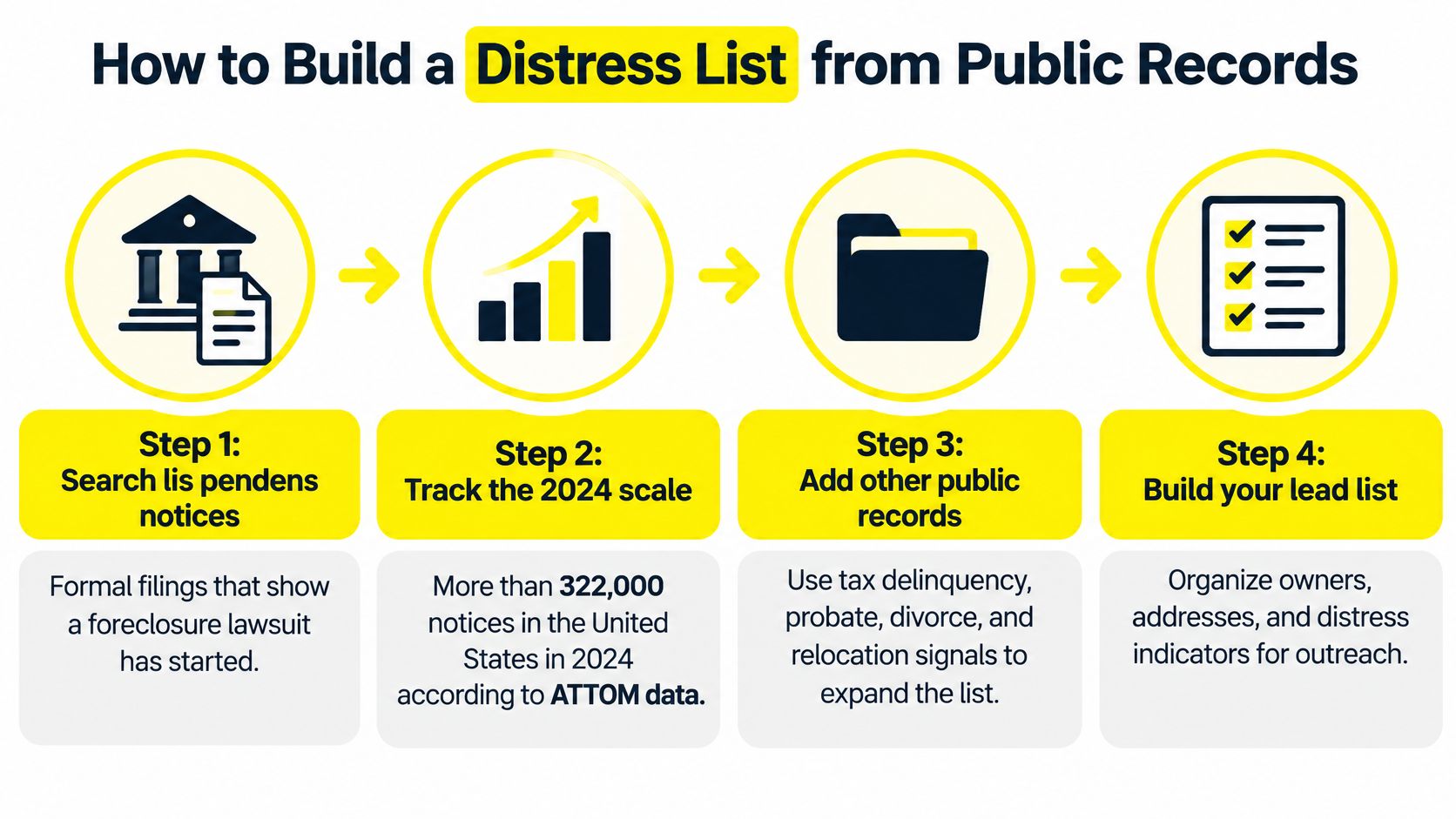
A usable list starts at county level, because filing formats, timelines, and available fields differ by courthouse. If you're new to screening these properties, understanding distressed properties gives you the basic vocabulary before you start scoring owners. Build the file in this order.
The Seven-Step Build
Pull lis pendens filings for your target county and record the filing date, lender, owner name, and property address. The common slip is pulling a statewide file you can't work, so start where you can visit or verify properties.
Estimate equity from assessed value and known loan balances. Drop properties whose liens leave too little room for a discounted offer, repairs, and your fee. Guessing at equity from a listing-portal estimate alone puts dead deals on your call list.
Flag occupancy. Separate vacant homes from tenant-occupied and owner-occupied properties, because access, timeline, and the owner's problem differ in each case. Mixing them into one script produces clumsy first calls.
Run skip tracing to attach current phone numbers and mailing addresses. Keep the property address and the owner's mailing address in separate fields, since absentee owners often live elsewhere.
Scrub every number against the Do Not Call registry and your own opt-out list before anyone dials. Skipping this step turns a data problem into a compliance problem.
Dedupe across sources so one owner doesn't get contacted three times from three lists. Skipping the dedupe inflates your list count and makes response rates look better than they are.
Tag every record with source, filing date, and county. Without those tags, you can't tell later which batch produced contracts and which only produced conversations.
Event-triggered data beats a generic motivated seller list because the event is dated, public, and tied to one property.
Screen by equity, occupancy, liens, and estimated repair needs before outreach, not after an appointment. A finished list is a county-level file where each owner has a dated event, an equity estimate, and a verified number. Anything missing one of those three fields goes back for cleanup instead of going to a caller.
Qualify Leads Before You Spend Time on Them
The most expensive mistake in wholesaling is spending appointment time on a lead with no timeline. The drive, the walkthrough, and the follow-up all cost hours you can't recover. Qualification exists to stop that waste before it starts.

On the first call, capture the reason for selling, whether that's a foreclosure deadline, probate, divorce, relocation, or a job move. Then capture the timeline, estimated equity, property condition, known liens or back taxes, and occupancy. Finish by confirming whether every owner on title is reachable, including heirs or co-owners who may live in another state.
Three Questions That Start Every Call
What is making you think about selling? This names the situation in the seller's own words and tells you which problem your offer has to solve.
When would you need to be out? A real date separates a motivated owner from someone testing the market.
Who else is on the title? A missing heir or unreachable co-owner can stall a signed contract at title.
In 2024, 42.83% of leads used by real estate investors were classified as dead, according to REsimpli's investor data. Verify phone numbers and mailing addresses before scoring, so you don't count a contact problem as seller disinterest. A bad number and an unmotivated owner need completely different fixes.
The short video below walks through how a first qualification call sounds when the questions stay focused on timeline and decision authority.
Score each lead from 1 to 5 across motivation, timeline, equity, and decision-maker access. Only leads above your chosen threshold move to an appointment. The rest go to nurture with a dated next step, not into a vague follow-up pile.
Call the same day a lead arrives, while the seller still remembers filling out the form or opening the letter.
Log the exact words the seller used about their reason for selling, so follow-up references their problem instead of your pitch.
Re-score after every contact, because timelines tighten and co-owners appear as conversations progress.
Measure the Funnel to Know What Each Deal Costs
Start with one equation and update it by channel. Expected gross assignment revenue equals leads times contact rate times qualified rate times signed-contract rate times closing rate times average fee. That model, laid out in a real-estate marketing KPI guide, forces you to look past cost per lead.
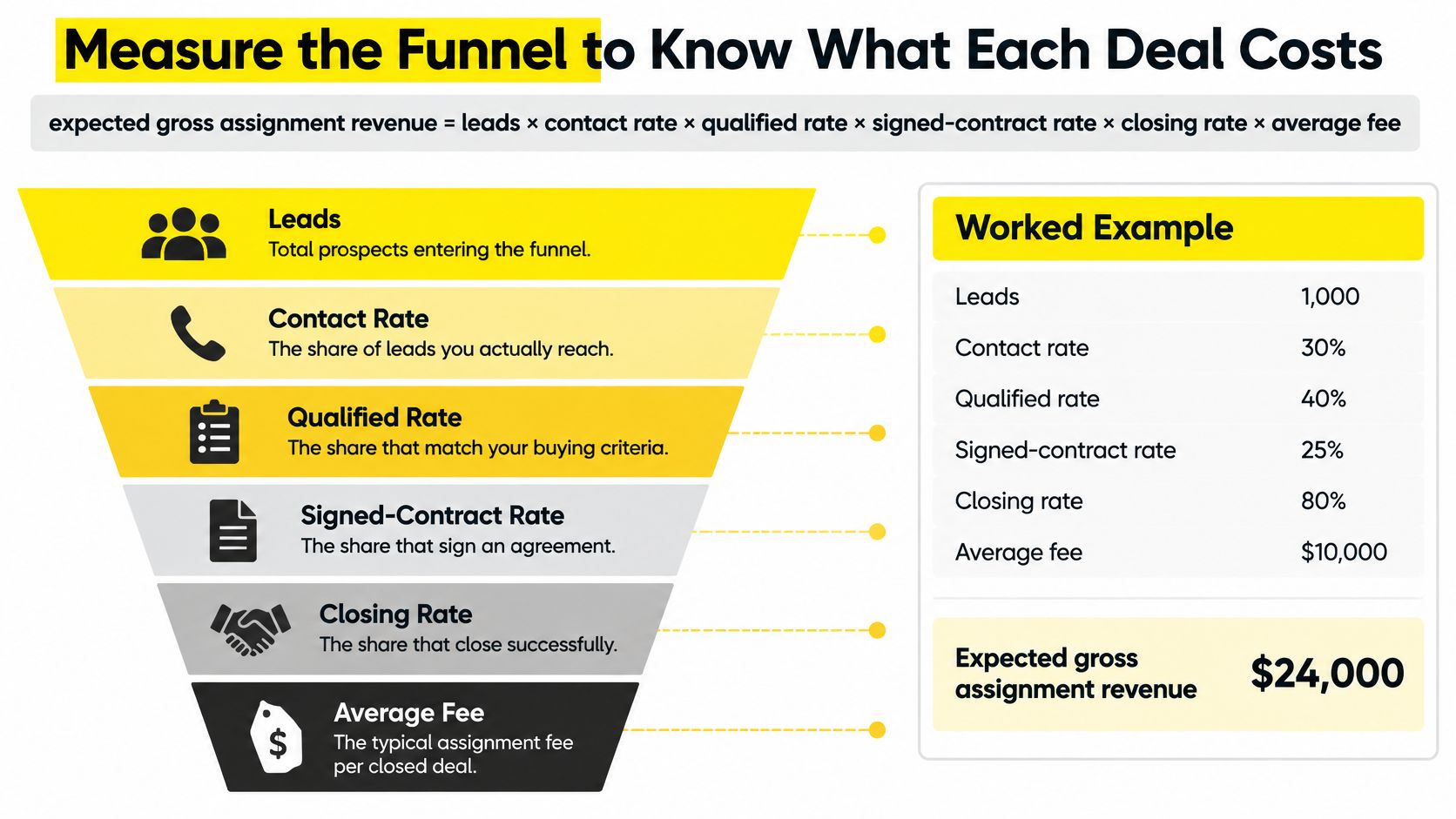
Say 1,000 leads produce a 55% contact rate, a 20% qualification rate, an 8% signed-contract rate, and a 70% completed-assignment rate. That cohort yields 6.16 expected completed deals. Change only the closing rate to 50% and the same 1,000 leads yield 4.4 deals. A small drop at the last stage removes almost two deals, which is why title problems, unrealistic seller expectations, weak buyer lists, and cancellations make cheap leads expensive.
Metrics to Track by Source
Metric | What it tells you |
|---|---|
Inquiry rate | Share of ad or list touches that come back as an inquiry |
Contact rate | Whether your lists and phone numbers actually reach owners |
Qualification rate | Whether leads meet your scoring threshold |
Appointment or offer rate | Whether qualified owners engage on terms |
Signed-contract rate | Whether the seller will commit to terms |
Buyer-verification rate | Whether buyers prove funds for the assignment |
Assignment completion rate | Whether title clears and the assignment closes |
Gross assignment fee | Revenue per completed deal |
Acquisition cost | Total spend per lead, including ads and skip tracing |
Fallout rate | Share of signed contracts lost before closing |
Broad marketing conversion ranges don't transfer cleanly to motivated-seller funnels, so don't forecast from them. Build your own medians from at least 100 to 200 leads per channel and report them by cohort instead of blending every source into one average. Calculate contribution margin after ad spend, skip tracing, list costs, earnest money, inspection, legal, and failed-deal expenses. Then reconcile CRM stages against title-company and closing records, so contracted and revenue numbers aren't inflated by deals that never closed.
Build the Cash Buyer List Before You Buy Leads
A signed contract with no verified buyer is a liability with a deadline. Buyer demand is broad, spanning local landlords, rehabbers, and high-volume firms, and those groups don't buy the same properties at the same prices. Build the list before you spend on seller acquisition, so every contract has somewhere to go on day one.
Where Verified Buyers Come From
Pull recent cash purchases from county deed records. Sort buyers by zip code and price band, since a landlord buying small rentals won't fund a heavy rehab across town. Recent closings prove activity better than any networking claim.
Add past buyers and investor contacts from local meetups. Record each buyer's price range, repair tolerance, target areas, and preferred property type in the CRM. A name with no criteria sheet isn't a buyer, it's a phone number.
Verify proof of funds before any contract goes to a buyer. Unverified buyers are a main cause of failed assignments, and the failure usually surfaces days before closing when you have no time to replace them.
Match each contract only to buyers legally able to transact in that state. A fast yes from the wrong buyer still ends in fallout at title.
A buyer list is only as good as its last verified closing. Names you haven't rechecked are marketing, not liquidity.
The common slip is counting every name as an active buyer. That inflates your pool and makes your buyer-verification rate look healthier than it is. I would rather work from a short list where every buyer has a verified funding source, a criteria sheet, and a dated last-deal record. Judge your lead system on both sides, the seller conversations it creates and the speed with which qualified buyers evaluate and fund contracts.
State Rules That Change Your Lead Campaign
Disclosure can affect whether a lead becomes a signed contract or a cancellation. If an ad, form, or follow-up suggests you own the property or guarantee a cash purchase, the seller may misunderstand what you are offering. The Virginia Land Title Association examiner roundup of state wholesaling laws illustrates why state rules belong in campaign design, not just closing paperwork.
State | Requirement that affects leads | Effective |
|---|---|---|
Oregon | Register qualifying residential wholesalers, disclose status in property ads, and provide disclosures to buyers, sellers and brokers | January 1, 2025 |
Tennessee | State intent to assign or sell the contractual interest and explain the nature of that interest | 2025 |
Maryland | Homeowner cancellation rights when required disclosures are missing | October 1, 2025 |
Oklahoma | Required disclosure plus a two-business-day cancellation period | Current effective date not established here |
Four Changes to Make Before You Advertise
Segment audiences by state and match each ad set to the rules that apply there. A single national campaign with generic claims can miss required disclosures.
Adjust ad copy and landing pages to state your wholesaling role where required. Put the disclosure where sellers will see it, rather than burying it in a footnote.
Document disclosures in the CRM with a date and dedicated field. A clear record helps establish what the seller saw and when.
Check buyer eligibility before handoff and block the lead from moving forward until the buyer is legally able to transact in that state.
Cancellation periods affect the path from lead to closing. Maryland provides cancellation rights when required disclosures are missing, and Oklahoma has a two-business-day cancellation period. Build those windows into follow-up, earnest money, and buyer commitments. Scheduling closing before a cancellation period ends can leave a signed deal vulnerable to fallout.
Use the table as a starting point, not a substitute for legal advice. Confirm current requirements in every state where you advertise, and ask local counsel to review your creative, forms, and contracts. Rules can change, so retain the version of each campaign and its disclosures. A lead source is only valuable if its contracts can survive the rules governing the seller, the property, and the transaction.
Start Your Lead Process This Week
A lead process is ready when each inquiry has an owner, a next action, and a recorded outcome. Before launching ads, confirm that your sources are tagged, your qualification score and opening questions are written, and your CRM has the disclosure fields required for each market. Set a review point for 100 to 200 leads per channel so you can compare which sources produce contracts and assignments, not just inexpensive inquiries.
The Follow-Up Sequence After First Contact
Call each lead the same day it arrives while the seller still remembers the form or letter. Use the three opening questions and log the seller's exact words in the record.
Send a text where state rules and consent records allow it. Keep the message short and include a link to book a call.
Mail a letter within two days to the property and the owner's mailing address. This gives an owner who missed the call a written record.
Retarget the owner on social platforms with state-compliant creative. Stop when the lead signs or drops out.
Re-score after every contact. If a lead remains below threshold after three attempts, move it to a 90-day nurture list and record the next touch date.
A booked call or a low-cost lead does not prove a deal will close. Track progression from inquiry to signed contract and assignment, and check that any buyer receiving the opportunity is eligible to transact in that state. Schedule closing and fund transfers only after any applicable cancellation window ends, and record its end date in the CRM.
A free demo call with Jason or a growth manager is one option for reviewing your setup. Jason discusses your business, what is working, what could be improved, and best practices for scaling.
Measure contracts, not clicks.
If inquiries outnumber assignable contracts, Wojo Media can help refine the offer, landing pages, and omnipresent ad campaigns, then track results against backend performance rather than click costs. Book a free demo call through Wojo Media's calendar to discuss a custom paid ad strategy for your market.
Comments